
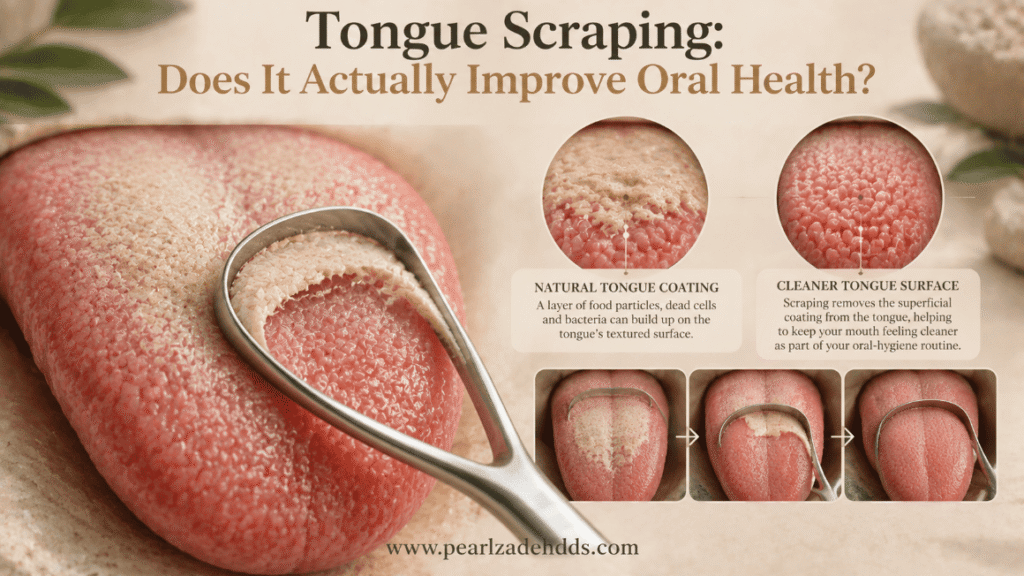
You look in the mirror, notice a filmy coating across your tongue, and wonder if that has anything to do with your breath. Tongue scrapers have become a standard item in a lot of bathroom cabinets, often picked up after a recommendation from a friend or a wellness video rather than a dentist.
That coating is real, and it is made of ordinary things: bacteria, food debris, shed cells, and mucus that accumulate in the grooves of the tongue’s surface. Removing it may help with certain things. It does not automatically follow that scraping your tongue prevents dental disease or replaces anything else in your routine.
What Is Tongue Scraping?
A tongue scraper is a small tool, usually a thin curved strip of plastic or metal, designed to be drawn across the surface of the tongue from back to front. The curved edge contacts the tongue’s surface directly and pulls debris forward, where it is wiped or rinsed away.
This is different from brushing your tongue with a toothbrush, which uses bristles to agitate the surface rather than a solid edge to lift material off it. People commonly use a scraper first thing in the morning, when tongue coating tends to be most noticeable, though there is no medical requirement tying it to a specific time of day.
Traditional and commercial instructions generally suggest one or two gentle passes from the back of the tongue toward the tip, rinsing the scraper between passes. This is a common practice, not an established clinical protocol with a single required technique or duration.
What Does Tongue Scraping Actually Remove?
Tongue coating is a biofilm made up of several things at once: bacteria, food debris, cells that have naturally shed from the tongue’s surface, mucus, and small amounts of blood and salivary components. The tongue’s surface is covered in tiny projections called papillae, and the grooves between them trap this material, particularly toward the back third of the tongue.
A visible coating is not automatically a sign of poor oral hygiene or an underlying problem. Some degree of coating is considered a normal, physiological feature of a healthy mouth. How much coating someone has, and how visible it looks, varies naturally based on diet, hydration, saliva flow, and other individual factors, not just how recently they last cleaned their tongue.
Does Tongue Scraping Help Bad Breath?
A 2010 systematic review in the International Journal of Dental Hygiene examined seven experiments across five studies. The studies compared tongue cleaning with a scraper or brush against toothbrushing alone. All seven found a positive effect on measures of oral malodor. The review concluded that mechanical tongue cleaning may reduce breath odor and tongue coating. However, evidence remained insufficient for its effect on chronic halitosis.
A separate 2013 systematic review and meta-analysis in Nursing Research combined five randomized trials involving 251 participants. It found that adding tongue cleaning to toothbrushing reduced volatile sulfur compounds and tongue coating more than toothbrushing alone. However, the review found insufficient evidence to recommend a specific frequency, duration, or cleaning method.
An earlier Cochrane review from 2006 included only two trials with 40 participants. Neither trial measured the review’s primary outcome, which was self-reported or examiner-assessed breath odor. However, both trials found that tongue cleaning reduced measured VSC levels more than toothbrushing alone. One trial also found that the effect lasted longer with tongue cleaning than with a toothbrush.
Taken together, research has consistently found short-term reductions in odor-causing compounds after tongue cleaning. However, a temporary change in a lab measurement does not mean tongue scraping permanently treats chronic halitosis. Persistent bad breath can have several causes and may need a dental evaluation rather than ongoing tongue scraping alone.
Does Tongue Scraping Reduce Bacteria?
The tongue hosts an enormous and genuinely diverse bacterial population, more so per surface area than most other places in the mouth, largely because its grooved structure protects bacteria from the flushing action of saliva.
Physically removing tongue coating removes some of the bacteria living within it, which is part of the mechanism behind the breath-odor findings above. That is different from creating a broadly healthier oral microbiome. Bacteria repopulate the tongue’s surface quickly after cleaning, and reducing the numbers of specific measured species in a study is not the same as permanently altering the balance of organisms living in your mouth. It would be inaccurate to describe tongue scraping as killing harmful bacteria; the available evidence points to a temporary, partial mechanical reduction, not an antimicrobial effect.
Can Tongue Scraping Prevent Cavities?
There is not enough evidence to present tongue scraping as a proven way to prevent cavities. It also targets a different surface from where cavities develop.
Cavities form on tooth enamel when plaque builds up on the teeth. Tongue scraping does not remove plaque from tooth surfaces. Cavity prevention depends on several factors, including fluoride exposure, thorough brushing, and cleaning between teeth. How often and how long your teeth contact sugar also matters. Saliva flow and your individual cavity risk can play a role too. Tongue scraping has no established direct role in these factors.
Can Tongue Scraping Prevent Gum Disease?
No clinical evidence supports tongue scraping as a way to prevent or treat gum disease. Gingivitis and periodontal disease are driven primarily by plaque and bacterial buildup at and below the gumline, an area a tongue scraper does not reach or address. Our overview of early signs of gum disease covers what actually indicates a problem developing, and none of it involves tongue coating. Tongue scraping does not replace brushing or cleaning between your teeth, which remain the established tools for managing gum health.
Is Tongue Scraping Better Than Brushing Your Tongue?
Neither method has proven universally superior. Both a dedicated scraper and a toothbrush can physically remove tongue coating. Reviews have found benefits from both methods compared with no tongue cleaning.
Some research and clinical observations suggest that a scraper may lift more coating in one pass than bristles. This may be more noticeable on a heavily coated tongue. However, research has not established a meaningful difference in outcomes such as breath odor.
In practice, choose the method that feels comfortable and works well for you. Some people find that a scraper reaches farther back without triggering their gag reflex. Others find that a toothbrush works just as well.
How Often Should You Scrape Your Tongue?
There is no clinically established, universally required frequency. The 2013 meta-analysis cited above explicitly found insufficient evidence to recommend a specific frequency, duration, or delivery method for tongue cleaning, despite finding a benefit from doing it at all. Many people who use a scraper do so once daily, typically in the morning, simply because that is when coating is most noticeable and it fits naturally into an existing routine.
Scraping more often, or pressing harder, does not appear to provide a greater benefit and is more likely to cause irritation than to meaningfully improve results. This is not a habit where more effort produces a proportionally better outcome.
Can Tongue Scraping Damage Your Tongue?
Used gently, tongue scraping is a low-risk habit for most people. The tongue’s surface is sensitive tissue, though, and excessive pressure or repeatedly scraping the same spot can cause irritation, soreness, or minor bleeding.
Use a light touch and draw the scraper from back to front once or twice. You do not need to press hard. Gentle tongue scraping should not damage healthy tongue tissue. If you notice persistent soreness, bleeding, or discomfort, reduce the pressure or frequency. Mention ongoing symptoms to your dentist.
Can Tongue Scraping Remove a White or Coated Tongue?
Some surface coating can be mechanically lifted off with a scraper, and many people see a visible difference immediately after use. That is not true of every white or discolored appearance, though. Certain changes to the tongue’s surface are not loose debris sitting on top of otherwise normal tissue, and scraping will not remove them because there is nothing removable there.
A coating that does not visibly improve with gentle scraping, that returns unusually quickly, that is accompanied by pain or a burning sensation, or that looks patchy or textured rather than a uniform film is worth having a dentist look at rather than assuming a firmer scraping technique will fix it.
What If Your Tongue Still Looks Coated After Scraping?
Persistent coating has several possible explanations, and appearance alone does not point to a specific one. Some people simply have a naturally more textured or deeply grooved tongue surface that recoats more visibly than others. Dry mouth reduces the saliva flow that would otherwise help clear debris naturally. Diet, tobacco use, certain medications, and your overall oral hygiene routine can all influence how quickly and how visibly coating reaccumulates. Some oral conditions also affect tongue appearance independently of hygiene.
None of this can be diagnosed from a description of how your tongue looks. If a coating persists despite reasonable home care, that is a reasonable thing to bring up at your next dental visit rather than something to solve by scraping harder or more often.
Is Tongue Scraping Necessary for Everyone?
No. Tongue scraping is a reasonable, optional addition to an oral hygiene routine for someone who notices a coated tongue or is concerned about breath odor. It is not an essential requirement that every adult needs to add to their routine to maintain good oral health.
Some people notice a clear difference in how their tongue looks or how fresh their breath feels. Others try it and notice little change, particularly if their tongue coating was already minimal to begin with. Both are normal outcomes, and neither means you are doing something wrong.
Where Does Tongue Scraping Fit Into Your Oral-Hygiene Routine?
It belongs as an addition, not a foundation. The habits with the strongest, most established evidence remain brushing your teeth twice daily with fluoride toothpaste, cleaning between your teeth daily, managing how often you expose your teeth to sugar, and keeping up with regular dental visits. Xylitol gum and nano-hydroxyapatite toothpaste occupy a similar place in a routine: reasonable things to consider once the fundamentals are covered, not substitutes for them. Tongue scraping sits alongside those, worth trying if it appeals to you, without needing to treat it as essential.
Talk to Dr. Pearl Zadeh About Your Oral-Hygiene Routine
Tongue scraping can be a reasonable habit for someone who notices tongue coating or wants to address breath odor, without being essential for everyone or a replacement for brushing, cleaning between teeth, and regular dental visits. What actually matters most for your mouth depends on your own habits, risk factors, and history.
Call (818) 716-6722 or click the button below to schedule your consultation online.
Frequently Asked Questions
For removing visible tongue coating and reducing measured breath odor in the short term, evidence supports some benefit. For broader oral health outcomes like cavities or gum disease, evidence does not support it as an effective method.
Research shows it can reduce measured odor compounds in the short term. Evidence for treating chronic, ongoing halitosis specifically remains limited, and persistent bad breath is worth having evaluated.
It mechanically removes some of the bacteria living in tongue coating, which is temporary. It does not eliminate harmful bacteria or create a lasting change to your oral microbiome.
No. Cavities form from plaque on tooth surfaces, not on the tongue, and no evidence shows tongue scraping affects that process.
No. Plaque and bacteria at the gumline drive gum disease, and tongue scraping does not reach that area. Brushing and cleaning between your teeth remain the established ways to control plaque.
This article is for informational purposes only and is not a substitute for professional dental advice. Please schedule a consultation with Pearl Zadeh DDS to discuss your specific situation.