
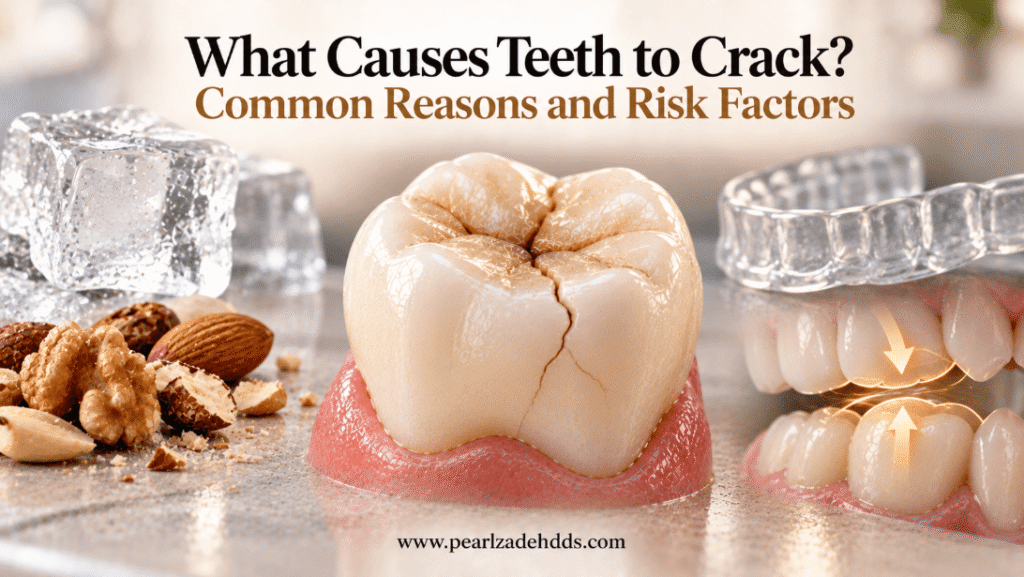
A tooth may crack from a single hard bite or develop a crack after years of repeated stress. This can happen when the forces placed on a tooth exceed what its structure can withstand. In many cases, more than one factor contributes to the damage.
Common causes include biting hard foods, grinding or clenching, mouth injuries, large fillings, long-term wear, and changes that occur with age. Sometimes, there is no obvious event or single cause.
Having one or more of these risk factors does not mean a tooth will crack. Many people with similar habits or dental history never experience a crack. It helps to distinguish between an event that triggers a crack and conditions that may leave a tooth more vulnerable.
If a crack is suspected but does not appear on a standard X-ray, learn more about how a cracked tooth is diagnosed when an X-ray looks normal. If you already have a cracked tooth, read what to do if you have a cracked tooth to learn how to protect it while arranging a dental evaluation.
What Causes Teeth to Crack?
A trigger is an event or force that may start a crack. Risk factors are conditions that may leave a tooth more vulnerable. The two often overlap, and one crack can involve both.
Biting Hard Foods or Objects
Hard items can place a sudden, concentrated load on a tooth. The AAE says a tooth can crack from injury or general wear and tear. It advises against chewing ice, unpopped popcorn kernels, or pens.
MouthHealthy, the ADA’s consumer site, adds that chewing ice, popcorn kernels, and hard candy can crack a tooth. StatPearls, a clinical reference, lists nail biting among habits that can complicate cracked teeth.
A hard bite does not always crack a tooth. The tooth’s size, structure, and condition all influence how it responds.
Teeth Grinding and Clenching
The National Institute of Dental and Craniofacial Research (NIDCR) defines bruxism as grinding, clenching, or gnashing the teeth. It can occur awake or asleep. Repeated forces from these habits may place stress on teeth. Cleveland Clinic says stress and other issues may lead a person to grind and, over time, crack a tooth.
Stress may contribute to clenching or grinding in some people. Mayo Clinic says extra anxiety or stress can lead to teeth grinding and clenching. The grinding, in turn, may add to the load on teeth.
Not everyone who grinds develops cracks. NIDCR says many cases of bruxism are mild. Mayo Clinic says bruxism does not cause serious complications for most people.
Some people grind without knowing it. Mayo Clinic says some may not learn they have sleep bruxism until tooth or jaw problems appear. NIDCR also lists genetics, alcohol or caffeine use, smoking, and certain medications as possible contributors to bruxism.
Accidents and Direct Trauma
A blow to the mouth can crack a tooth. Cleveland Clinic lists falls, sports injuries, and vehicle accidents among the possible causes. MouthHealthy advises wearing a mouthguard during sports and recreational activities.
Common Risk Factors That Make Teeth More Vulnerable
Cracked tooth risk factors do not cause a crack on their own. They may lower the amount of force a tooth can tolerate. A tooth with several risk factors may respond differently from one with none.
Large Fillings and Weakened Tooth Structure
StatPearls says teeth weakened by restorations face a higher fracture risk under biting forces. Cleveland Clinic says large fillings or root canal treatment can weaken a tooth. That raises the chance of a crack, it adds, especially without a crown.
The AAE adds that a fractured cusp often breaks around a filling. Extensive decay or previous dental work may leave less healthy tooth structure to share the load.
StatPearls cites research that a restoration larger than one-quarter of the distance between cusps carries a higher fracture risk. Size alone does not decide the outcome, because placement and the tooth’s condition also matter. A large filling does not mean a crack will follow.
Repeated Chewing Forces and Wear
Chewing places force on teeth every day. StatPearls calls occlusal forces the leading cause of cracked tooth syndrome. Teeth absorb these forces during chewing and nighttime grinding. That does not mean ordinary chewing will crack a healthy tooth. Forces matter most when other risk factors are present.
StatPearls reports that mandibular molars are the teeth most commonly affected, followed by maxillary premolars and molars. It also says tooth anatomy, such as deep grooves and steep cusps, can influence fracture risk.
Age-Related Changes
Cleveland Clinic says teeth wear down as you get older, which raises the chance of a crack. It reports that people age 50 and older are more likely to have cracks. StatPearls says the mechanical properties of teeth can change with age, potentially reducing their elasticity.
Age ranges vary by source. StatPearls says the condition predominantly affects adults aged 30 to 50. Age acts as a risk factor rather than a trigger. It is one factor among several, and it does not make a crack inevitable.
Sudden Temperature Changes
Hot and cold more often appear as a symptom than as a cause. Cleveland Clinic and StatPearls both describe sensitivity to temperature as a sign of a cracked tooth. Neither source lists ordinary hot or cold foods as a cause. A tooth that reacts to hot or cold may be responding to an existing crack. Another problem, such as decay, may also be the reason.
Whether extreme temperature changes add stress to tooth structure remains uncertain. They should not be treated as a known cause of cracks.
Can a Tooth Crack Without an Obvious Injury?
Yes. A crack does not require one dramatic event. The AAE says a tooth can crack from general wear and tear, not only from injury.
Why teeth crack without an injury may come down to factors that build up over time. A large filling, regular grinding, and years of chewing may combine to stress a tooth. Any one of them alone may not crack it.
StatPearls says cracked tooth syndrome can be further complicated in teeth with extensive restorations and parafunctional habits. A person may not remember an injury or identify one specific event. Not every crack traces back to a single, definite cause.
A dentist may ask about habits, past dental work, and any recent injury. Those details can help explain why the tooth cracked, though some cases have no clear answer.
Signs That May Warrant a Dental Evaluation
Possible signs of a crack include:
- Pain when biting down or when releasing the bite.
- Sensitivity to hot or cold.
- Discomfort that comes and goes.
The AAE describes erratic pain when chewing, possibly with the release of biting pressure. Some cracks cause few noticeable symptoms, though. Cleveland Clinic says cracked teeth do not always cause symptoms. The AAE adds that pain that comes and goes can make the tooth difficult for a dentist to locate. It also says a vertical root fracture often has minimal symptoms.
These signs can also have other causes. MouthHealthy lists decay, fractured teeth, worn fillings, and gum disease among causes of tooth sensitivity. Symptoms alone cannot confirm a crack or show how serious it is.
When Should You See a Dentist?
Arrange a dental evaluation if you suspect a cracked tooth, even if it does not hurt. Cleveland Clinic says to talk to a dentist if you have symptoms or notice a crack.
Seek prompt care for significant pain or a recent dental injury. Cleveland Clinic says to call your dentist right away if an injury loosened a tooth. It also lists bleeding that will not stop, severe pain that medication does not relieve, and a broken jaw. These call for the emergency room.
A crack’s seriousness depends on the tooth, the extent and location of the damage, and other individual factors. Dr. Pearl Zadeh can examine the tooth, explain the findings, and discuss the options that fit.
Call (818) 716-6722 or click the button below to schedule your consultation online.
Frequently Asked Questions
No single cause applies to every person. StatPearls names occlusal forces, the forces of chewing and nighttime grinding, as the leading cause of cracked tooth syndrome. Hard bites, injury, and weakened tooth structure can also contribute.
They can. Grinding may add repeated stress to teeth. NIDCR says severe bruxism can lead to damaged teeth and lists cracked teeth among the signs. Many cases are mild, though, and grinding does not always lead to a crack.
Yes. Gradual wear, chewing forces, and weakened tooth structure can contribute without any single event. Some people cannot recall when or how a crack began.
It can. The AAE lists erratic pain when chewing among the symptoms. Other dental problems can cause the same pattern, so the symptom alone does not confirm a crack.
Yes, if a crack is suspected. Cracked teeth do not always cause symptoms. StatPearls says early detection plays a crucial role in the prognosis of a cracked tooth.
The information above is for informational purposes only and is not a substitute for professional dental advice. Please schedule a consultation with Pearl Zadeh DDS to discuss your specific situation.