
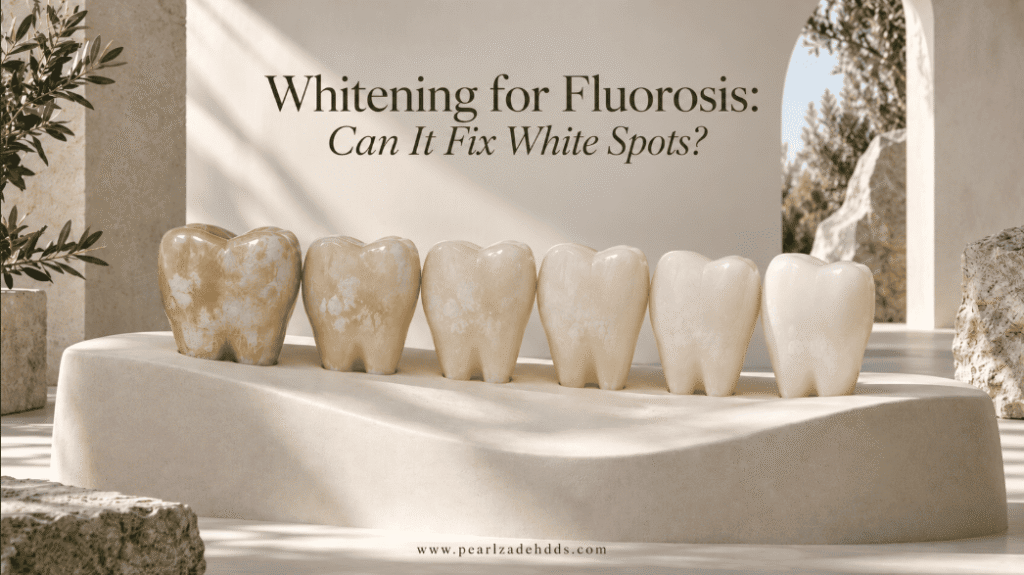
White spots and chalky streaks can be one of the most frustrating changes to see in your smile. You may assume whitening will even out your tooth color, only to find that the spots remain or look different after treatment. If those marks are caused by dental fluorosis, whitening does not work the way you might expect.
Whitening changes the color of natural tooth structure through bleaching. It does not erase the enamel changes associated with fluorosis. As a result, whitening may change the overall shade of your teeth without completely removing the white spots. In some cases, it can even change the contrast between the spots and the surrounding enamel.
That is why identifying the cause of the white spots matters before choosing a whitening treatment. The right approach depends on what caused the discoloration, how pronounced it is, and what you want your smile to look like.
Can Teeth Whitening Fix Fluorosis White Spots?
Whitening may make fluorosis spots less noticeable, even though it does not change the enamel changes that caused them. The key is the color of the surrounding tooth structure. When healthy enamel becomes lighter, it may blend more closely with the fluorosed areas and create a more even overall appearance.
A clinical review of dental fluorosis published through the National Center for Biotechnology Information explains this effect. Lightening unaffected tooth structure can help camouflage fluorosed enamel. The review also describes vital bleaching as a highly effective treatment option in mild cases of dental fluorosis.
So the result depends on more than whether the spots remain. Their visibility after whitening can depend on the original contrast between the spots and surrounding enamel, the severity of the fluorosis, and how your teeth respond to bleaching.
What Is Dental Fluorosis?
Dental fluorosis develops when a child takes in too much fluoride while their permanent teeth are still forming under the gums. The fluoride interferes with how enamel mineralizes, leaving areas that are less densely mineralized than the enamel around them. According to the Centers for Disease Control and Prevention, the enamel of permanent teeth is fully formed by about age 8, and older children, teens, and adults cannot develop dental fluorosis.
That timing point answers a question many adults ask. Brushing with fluoride toothpaste as an adult does not cause fluorosis, because the enamel is already formed. The critical window closed years ago. In children, recognized sources of excess intake include swallowed toothpaste, fluoride supplements, and drinking water with high fluoride levels.
Severity varies with how much fluoride was taken in and for how long during that window. The CDC notes that in the United States, dental fluorosis is mostly mild and cosmetic, meaning it does not affect how the tooth functions and is not painful, and that moderate and severe forms are rare.
What Do Fluorosis White Spots Look Like?
Presentation ranges widely. Milder fluorosis often shows as faint white lines following the contours of the tooth, small chalky flecks, or scattered opaque patches that look slightly cloudier than the surrounding enamel. Many people go years without noticing them.
More extensive fluorosis can involve larger mottled areas covering much of the tooth surface. In more severe presentations, brown discoloration can appear, and the enamel surface itself may be pitted or rough rather than smooth.
None of these patterns is unique to fluorosis. A white spot on a tooth is a finding, not a diagnosis.
Are All White Spots on Teeth Caused by Fluorosis?
No, and this matters before anyone reaches for a whitening product. Several different things produce white or opaque areas on enamel.
Demineralization creates chalky white areas where acid has begun drawing minerals out of the enamel, often along the gumline or around where orthodontic brackets sat. These are early enamel changes associated with the decay process, and they need clinical attention rather than cosmetic treatment.
Developmental enamel defects unrelated to fluoride can also produce opaque patches, arising from illness, injury to a baby tooth, or disruptions during enamel formation. The CDC notes that tooth color can be affected by early childhood illness, medications taken, infections in baby teeth, facial trauma, and genetics.
Location, pattern, symmetry, and your own history all help distinguish these. Fluorosis typically affects teeth that were developing at the same time, so it tends to appear symmetrically. Decay-related white spots more often cluster where plaque accumulates. A dentist examines these features rather than judging from appearance alone, which is why our article on why whitening sometimes doesn’t work puts identifying the cause ahead of choosing a product.
Why Doesn’t Whitening Simply Remove Fluorosis Spots?
Whitening and fluorosis operate on different things. Bleaching agents break down pigment molecules that have built up within or on the tooth, which lightens its color. Fluorosis is not pigment. It is a difference in how densely the enamel mineralized in certain areas, which changes how light passes through and reflects off those spots. That optical difference is what makes them look white or cloudy.
Bleaching cannot re-mineralize enamel or smooth out that structural difference. It acts on color, not on the enamel’s internal makeup. This is why whitening can shift the overall shade of a fluorosed tooth without making the marked areas disappear.
Can Whitening Make Fluorosis White Spots More Noticeable?
It can go either way, and the outcome depends on the starting contrast. When surrounding enamel is noticeably darker than the white areas, lightening it reduces the difference, and the spots blend in better. That is the camouflage effect described earlier, and it is the reason bleaching helps in many mild cases.
The opposite can also happen. Hypomineralized enamel is more porous than healthy enamel and can take up whitening agents differently, so the spots may become more prominent rather than less. In some patterns, a noticeable difference simply persists after treatment.
Neither result is guaranteed. What determines it is the specific pattern, the degree of contrast, and how your particular teeth respond, which is why an evaluation beforehand is worth more here than with ordinary staining.
Does Whitening Work Differently for Mild and Severe Fluorosis?
Mild fluorosis
Faint lines or small opaque flecks may be subtle to begin with. Lightening the whole tooth can make them less conspicuous, and many patients are satisfied with the overall result even though the marks technically remain. This is the presentation where published clinical guidance most supports bleaching as an option.
More noticeable fluorosis
When mottling covers larger areas, or when brown discoloration and surface irregularity are present, whitening alone is less likely to deliver the change a patient is hoping for. The same clinical review notes that in cases with severe discoloration, veneers or crowns may become necessary to reach a cosmetically acceptable result. That is a statement about severe cases specifically, not a rule for anyone with visible fluorosis.
Severity is a useful way to think about likely outcomes, not a protocol. Two people with similar-looking fluorosis can want very different things from treatment.
What If Whitening Doesn’t Fix the White Spots?
Whitening is one option among several, and the review cited above frames fluorosis treatment as patient-led, since concerns are cosmetic in most cases. In mild cases where the patient is unconcerned, it also notes that no treatment may be necessary at all. Beyond bleaching, minimally invasive approaches exist, including enamel microabrasion and resin infiltration, which address the affected enamel itself rather than the tooth’s overall color. Restorative options including veneers are considered in selected cases. Our overview of cosmetic treatment options for stained teeth covers the broader picture.
None of these is a default next step. Which one fits depends on the cause of the spots, how deep they extend, how much tooth structure is involved, and what the patient actually wants changed. Availability of any specific technique is worth confirming directly with the practice.
Can Veneers Cover Fluorosis?
Veneers can change a tooth’s visible appearance, since they cover the front surface with a new material in a chosen shade. They are sometimes considered when mottling or brown discoloration is significant and less invasive approaches have not achieved the desired result. They also involve considerably more treatment than whitening, including permanent alteration of the tooth. Our breakdown of the steps in a cosmetic veneer case walks through the planning, and our veneer service page covers the treatment. Shade planning matters here, because the underlying tooth can influence the final appearance.
Veneers are not necessary for severe fluorosis as a rule. They are one possible answer when the cosmetic concern justifies that level of treatment.
Does Fluorosis Mean Your Teeth Are Unhealthy?
Mild fluorosis is generally regarded as a cosmetic difference rather than a sign of unhealthy teeth. The CDC describes fluorosis in the United States as mostly mild and cosmetic, not affecting tooth function and not painful.
More severe fluorosis is a different matter, since it can involve structural enamel changes including pitting and surface irregularity. That is also why no one should assume a white or mottled area is harmless fluorosis without an examination. The spots could be fluorosis, or they could be early decay-related changes that need treating rather than covering.
Should You Whiten Fluorosis-Stained Teeth?
Rather than a yes or no, it comes down to what your dentist finds. The relevant factors include whether the spots are actually fluorosis, how severe and widely distributed they are, your current overall tooth shade and how much contrast exists, the condition of your enamel, any sensitivity you experience, existing dental work in your smile line, and what result you are hoping for.
That last factor deserves weight. A patient who wants a more even overall appearance may be well served by bleaching. A patient who wants specific marks gone entirely is asking for something bleaching does not do. Our guide to whitening with sensitive teeth and our discussion of whitening and enamel cover two of the practical considerations.
Is Professional Whitening Better for Fluorosis?
Not automatically, and framing it that way misses the actual advantage. The value of a professional evaluation is identifying what the white spots are before any product is applied, then setting realistic expectations about how they will look afterward. Whitening a tooth with an untreated decay-related white spot addresses the wrong problem entirely. If bleaching is appropriate, professional teeth whitening can then be planned around your teeth and goals, and our overview of how long professional whitening takes covers the practical side.
What Should You Do Before Whitening White Spots?
1. Confirm what is actually causing the white spots rather than assuming fluorosis.
2. Have your teeth and gums examined, including enamel condition.
3. Discuss whether whitening is likely to change your overall appearance the way you want.
4. Ask specifically how whitening may affect the contrast between the spots and the enamel around them.
5. Talk through the alternatives if bleaching alone is unlikely to reach your goal.
Speak With Dr. Pearl Zadeh About White Spots and Fluorosis
Whitening can change the overall color of your natural teeth, but it does not erase fluorosis-related white spots. What it does affect is how much those spots stand out against the enamel around them, and that varies considerably from person to person. Identifying the cause and pattern of your spots first is what makes it possible to choose an approach that matches what you actually want your smile to look like.
Call (818) 716-6722 or click the button below to schedule your consultation online.
Frequently Asked Questions
Whitening does not remove fluorosis. It lightens the surrounding enamel, which can make the spots blend in better, particularly in mild cases.
No. Bleaching changes tooth color and does not remove the enamel changes that cause white spots, whatever their cause.
It can go either way. Reduced contrast often makes spots less noticeable, though in some patterns a difference persists or becomes more apparent.
Excess fluoride intake while permanent teeth are forming, generally before about age 8, can leave areas of less densely mineralized enamel.
No. Enamel of permanent teeth is fully formed by roughly age 8, so fluorosis cannot develop after that point.
This article is for informational purposes only and is not a substitute for professional dental advice. Please schedule a consultation with Pearl Zadeh DDS to discuss your specific situation.