
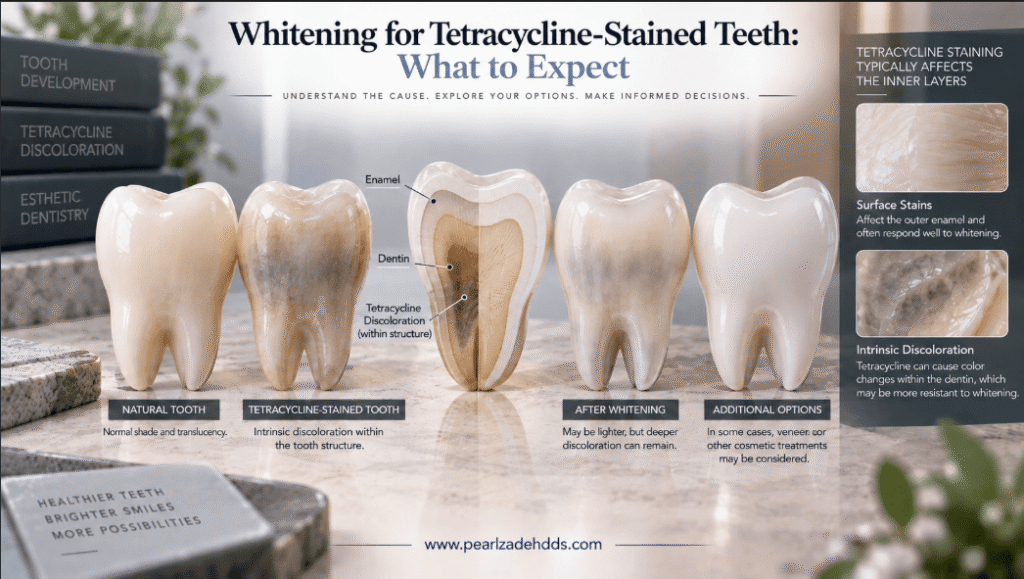
If your teeth have a gray, brown, or banded discoloration that whitening toothpaste never touched, tetracycline staining may be the reason. The question most people arrive with is whether professional whitening can actually change it.
The honest answer is that it often can, though results depend heavily on how severe the staining is and where it sits on the tooth. Tetracycline discoloration is not like coffee or wine staining. It developed inside the tooth rather than on it, and that changes what whitening has to work through.
What Causes Tetracycline-Stained Teeth?
Tetracyclines are a family of antibiotics used to treat bacterial infections. They have a chemical property that matters here: they bind to calcium. When someone is exposed to tetracycline while their teeth are still forming, the antibiotic can be incorporated into the developing tooth structure along with the minerals being laid down.
That is why the discoloration is described as intrinsic. It is built into the tooth rather than deposited on the surface. Timing is what determines whether it happens at all. Exposure during the years when permanent teeth are mineralizing, including before birth through early childhood, is when incorporation can occur. Exposure as an adult, after the teeth have fully formed, does not cause discoloration by this route, since there is no developing tooth structure left for the antibiotic to be built into. One derivative, minocycline, has separately been associated with tooth discoloration in adults through a different mechanism, so adult-onset color changes are worth discussing with a dentist rather than ruled out.
The appearance varies between patients because the amount of antibiotic, how long it was taken, and exactly which stage of tooth development it coincided with all differ. None of this reflects anything the patient or their parents did wrong. Tetracycline was widely prescribed before this effect was well understood, and it was often the appropriate medication at the time.
What Do Tetracycline-Stained Teeth Look Like?
Presentations differ, but some patterns are common. Some patients have gray or gray-brown discoloration, which tends to be the more noticeable presentation. Others show yellow-brown tones that can look closer to ordinary staining at a glance. Horizontal bands or stripes across the teeth are a recognizable pattern, reflecting the period of development during which exposure occurred. Severity ranges from a mild, fairly uniform shade change to deep banding that is obvious at conversational distance. Discoloration is often uneven between teeth, since different teeth mineralize on different schedules.
Appearance alone does not confirm the cause. Gray, brown, and banded discoloration can also result from other developmental conditions, trauma, or enamel changes unrelated to medication. An examination and a history are what actually establish what you are looking at.
Can Tetracycline-Stained Teeth Be Whitened?
Often, yes, though the results are less predictable than with surface staining. A 2021 clinical paper in the British Dental Journal describes tetracycline as one of the most difficult stains to bleach, while also concluding that vital tooth bleaching should be considered the initial treatment for tetracycline-stained teeth, and that it can have a dramatic effect as a conservative sole therapy in some cases. Both of those statements are true at once, which is the core of what patients need to understand here.
The variability comes from the staining itself. Discoloration that extends deep into the tooth, or that concentrates near the gumline, tends to respond less predictably than a milder, more evenly distributed shade change. Two people with tetracycline staining can undergo similar treatment and see quite different degrees of improvement.
Why Are Tetracycline Stains Harder to Whiten?
The difference comes down to where the color actually lives.
Extrinsic discoloration sits on or near the outer surface of the tooth. Pigments from coffee, tea, wine, or tobacco accumulate on the enamel and in the thin protein layer covering it. Whitening agents reach that pigment readily, which is why surface staining tends to respond well.
Intrinsic discoloration is different in kind, not just in degree. With tetracycline, the antibiotic was incorporated into the tooth structure during formation, primarily into the dentin beneath the enamel. Enamel is translucent, so the color of the dentin underneath shows through it. A whitening agent has to penetrate the enamel and act on discoloration located inside the tooth. That is a longer and less certain path than lifting pigment off a surface. Our breakdown of why whitening sometimes doesn’t work covers the other causes of limited results, but tetracycline is a distinct case because the discoloration is structural in origin.
Does Professional Teeth Whitening Work Better for Tetracycline Stains?
Professional treatment offers something more useful than simply a stronger product: an assessment of what you are actually dealing with. Professional teeth whitening begins with a dentist evaluating the pattern and severity of the discoloration, checking the condition of your enamel and gums, noting any existing restorations, and discussing what degree of change is realistic for your specific teeth.
That last part matters more with tetracycline staining than with almost any other whitening case. Setting expectations accurately at the start is part of the treatment, not a disclaimer attached to it. A patient who knows in advance that banding may lighten rather than disappear is in a very different position than one who expected it to vanish, even if both end up with identical teeth at the end. Satisfaction with these cases tracks closely with what the patient was told to expect going in.
How Long Does Whitening Take for Tetracycline-Stained Teeth?
Longer than for ordinary staining, and there is no single timeline. Research on this has used extended treatment rather than short courses. A longitudinal study following patients for 90 months after treatment reported that tetracycline-stained teeth can be whitened successfully using extended treatment time, and that the shade change remained stable for at least 90 months afterward. That study involved six months of active nightly treatment with a 10% carbamide peroxide gel in custom trays, and the long-term follow-up reached 15 of the 21 original participants.
That is a specific research protocol rather than a recommendation for your teeth, and it illustrates the scale involved. Tetracycline cases are generally planned in months, not in a single appointment. Our overview of how long professional whitening takes covers the more typical timelines for comparison.
What If Whitening Does Not Remove All the Discoloration?
Partial improvement is a common and legitimate outcome here, not a failed treatment. Bleaching can lighten intrinsic discoloration substantially while still leaving some banding visible, particularly near the gumline where the staining often concentrates. That reflects the limits of what bleaching can do with deeply located color, not an error in how it was carried out.
From there, a dentist may consider continuing or adjusting whitening if it is still producing change, reassessing whether something other than tetracycline is contributing, or discussing restorative options. Our overview of cosmetic treatment options for stained teeth covers what else may apply. None of these is automatically the right next step. The appropriate choice depends on how much change you actually got, how much more you want, and what your teeth can support.
Can Veneers Cover Tetracycline Staining?
Veneers can change the visible color of a tooth, since they cover the front surface with a new material in a selected shade. They are sometimes considered when intrinsic discoloration remains noticeable after bleaching. Shade selection and planning matter considerably with dark underlying teeth, because a very dark tooth can show through a thin restoration. Our breakdown of the steps in a cosmetic veneer case walks through that planning process, and our veneer service page covers the treatment itself.
Worth knowing: bleaching first can make restorative treatment more conservative. The same British Dental Journal paper notes that bleaching performed before restorative work in complex tetracycline cases can require less reduction of tooth structure and produce better results. Veneers are not necessary for everyone with tetracycline staining, and they involve permanently altering the teeth, which is a genuine consideration rather than a formality.
What About Existing Crowns, Fillings, or Veneers?
Conventional whitening works on natural tooth structure. The American Dental Association states that only natural teeth can be whitened, not tooth-colored restorations. If you already have crowns, veneers, or tooth-colored fillings, they will generally hold their existing shade while the natural teeth around them lighten, which can create a mismatch. Our discussion of whitening before veneers or crowns covers how that sequencing is usually handled.
Does Tetracycline Staining Mean Your Teeth Are Unhealthy?
No. Color and health are separate questions. A tooth can carry intrinsic discoloration from childhood antibiotic exposure and still be structurally sound, cavity-free, and functioning normally. The antibiotic affected how the tooth looks, not whether it works. The staining is a cosmetic characteristic, not a disease process.
A dentist will still want to examine your teeth before cosmetic whitening, for the same reasons that apply to any patient: checking for decay, assessing gum health, and noting enamel condition. That examination is about making sure whitening is appropriate, not about treating the discoloration as a health problem.
Is Whitening Safe for Tetracycline-Stained Teeth?
No whitening approach is entirely risk-free, and the longer treatment courses used for tetracycline cases make a few factors worth weighing. Your existing enamel condition, any history of sensitivity, gum health, and existing restorations all belong in the conversation. The ADA identifies temporary tooth sensitivity and gum irritation as the most commonly reported side effects of whitening. The British Dental Journal paper is direct that sensitivity can, in some patients, rule out bleaching as an option.
More aggressive treatment is not automatically the answer when progress is slow. Our discussion of whitening and enamel and our guide for sensitive teeth both cover what that means in practice.
What Should You Do Before Whitening Tetracycline-Stained Teeth?
1. Have the likely cause of the discoloration identified rather than assumed.
2. Get your teeth and gums examined, including enamel condition and any sensitivity.
3. Discuss what degree of change is realistic for your specific pattern of staining.
4. Account for any existing crowns, veneers, or visible fillings.
5. Decide whether whitening alone is likely to get you close enough to your goal.
6. Ask what the options are if intrinsic discoloration remains after treatment.
Get a Clearer Plan for Tetracycline-Stained Teeth
Tetracycline staining can be challenging to whiten, especially when discoloration runs deeper within the tooth. The right approach depends on the type, pattern, and severity of the staining, as well as the condition of your teeth and any existing dental work.
Dr. Pearl Zadeh can evaluate your discoloration, explain what whitening may realistically accomplish, and discuss other cosmetic options if whitening alone may not achieve the result you want.
Call (818) 716-6722 or click the button below to schedule your consultation online.
Frequently Asked Questions
Often, yes. Research supports bleaching as an initial treatment for tetracycline staining, though results vary with severity and typically require extended treatment.
It can lighten them, sometimes substantially, but complete removal is not a realistic expectation for every patient, particularly with severe or banded staining.
It can be. Its main advantage is evaluation and planning, since tetracycline cases need an accurate assessment of severity before treatment starts.
Longer than ordinary staining. Published research has used extended treatment measured in months rather than a single appointment.
Severe cases often improve but are less predictable. Deep or gumline banding may lighten without disappearing entirely.
Yes, veneers can change a tooth’s visible color. They are not necessary for everyone, and bleaching first may allow more conservative restorative work.
This article is for informational purposes only and is not a substitute for professional dental advice. Please schedule a consultation with Pearl Zadeh DDS to discuss your specific situation.