
A drugstore aisle can hold a dozen whitening products at a dozen price points, and a dental practice offers something different again. Pens, strips, and professional treatment all promise whiter teeth, which makes them look interchangeable. They aren’t.
These methods differ in how the whitening agent actually reaches your teeth, how evenly and consistently it stays there, and how much of the process a dentist is involved in. Those differences matter, but so does something people rarely consider first: why your teeth are discolored in the first place.
Whitening Pens, Strips, or Professional Treatment?
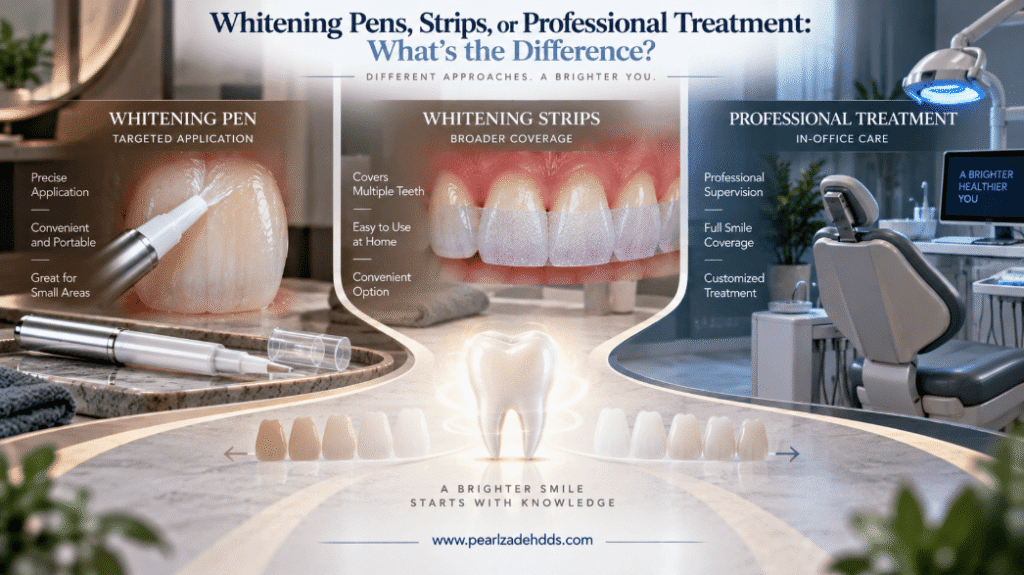
A whitening pen paints a gel directly onto the tooth surface with a brush tip. A whitening strip is a flexible film coated with gel that you press across several teeth at once and leave in place. Professional whitening starts with a dental evaluation and uses stronger formulations applied under supervision, or dentist-directed trays used at home.
Results vary between these options, and they vary considerably between two people using the same option. The method affects how much whitening agent contacts your enamel and for how long. Your specific discoloration affects whether that contact accomplishes anything. No single method suits every type of stain.
How Whitening Pens Work
A pen dispenses a peroxide-based gel through a brush or applicator tip. You paint it directly onto the teeth you want to treat, and the gel is formulated to cling to enamel on its own. A peer-reviewed review of over-the-counter whitening products describes these paint-on products as gels that adhere to enamel without any physical barrier such as a tray or strip holding them in place.
That design is the source of both the appeal and the limitation. Application is genuinely targeted: you can treat a single darker tooth rather than your whole smile, or touch up one area before an event. But nothing covers the gel once it’s applied, so saliva, lips, and tongue can dilute or wipe it away before the full contact time has passed. How evenly you paint it, and how long it actually stays put, varies from application to application and from person to person. Following the product’s instructions matters more here than with a product that holds itself in position.
How Whitening Strips Work
A strip is a thin, flexible film pre-coated with peroxide gel. You press it against the front surfaces of several teeth at once, and the film holds the gel in contact with the enamel for the wear time on the label. Because the strip covers the teeth, it also acts as a partial barrier against saliva.
That gives strips fairly consistent coverage across the teeth they reach, though the fit is not perfect for everyone. Strips are cut to a standard shape, so they may not conform well to crowded, rotated, or unusually shaped teeth, and they typically do not reach back teeth. Gel that squeezes past the edges can contact the gums, which is one reason temporary gum irritation is a recognized side effect. Wear times differ by product, so the instructions on your specific box are the ones that apply.
How Professional Teeth Whitening Differs
The biggest difference is not the gel. It’s what happens before the gel goes on. Professional teeth whitening begins with an examination: the condition of your enamel, the health of your gums, any existing restorations in your smile line, your sensitivity history, and what type of discoloration you actually have. The American Dental Association notes that professional whitening uses higher-concentration peroxide than over-the-counter products, applied with the soft tissues protected.
Supervision also changes how problems get handled. If sensitivity appears mid-treatment, the approach can be adjusted. If your discoloration turns out to be something bleaching won’t address, that gets identified before you spend weeks on a product that was never going to work. None of this makes professional treatment automatically the right choice for every patient. It makes it a different kind of choice, with evaluation built into the front of it.
Whitening Pens vs Strips: What’s the Practical Difference?
The practical difference comes down to coverage and contact. Strips hold gel against several teeth at once under a film; pens place gel precisely but leave it exposed. Research has compared these directly. A randomized clinical trial assigned 52 adults to peroxide whitening strips, a peroxide paint-on gel, or a water rinse control, and found the strips produced the greatest end-of-treatment reduction in yellowness. Worth noting: the two products were used on different schedules, strips twice daily for 7 days and the gel twice daily for 14 days, so this compares the products as labeled rather than the delivery methods head to head under identical conditions.
The broader evidence picture differs between the two as well. The same review of over-the-counter products points in two directions here. It notes a clinical study in which a 6% hydrogen peroxide paint-on system showed significant efficacy whether a dentist or the patient applied it. It also cites a systematic review and meta-analysis that found the effectiveness of paint-on systems inconclusive, largely because few studies were available to assess. Inconclusive evidence is not the same as evidence that pens don’t work. It means the research base behind strips is currently larger.
Practically, a pen is easier to carry and use on one tooth, and easier to apply without a mirror and full attention. A strip covers more teeth at once with less technique involved, but treats whatever it covers rather than what you choose. Neither is universally better. They suit different goals.
At-Home Whitening vs Professional Treatment
The gap between at-home and professional whitening is narrower than marketing on either side suggests. A systematic review and meta-analysis compared over-the-counter whitening strips with the dentist-directed tray approach using 10% carbamide peroxide and found similar tooth whitening and similar rates of tooth and gum sensitivity between them, while cautioning that the available studies have limitations and do not establish that strips can simply replace the tray technique.
What genuinely changes when a dentist is involved is the evaluation, the planning, and the ability to adjust. Our comparison of professional and at-home whitening goes further into those differences, and our overview of how long professional whitening takes covers the practical side of an appointment.
Which Option Works for Different Types of Stains?
This is where the method matters less than the cause. Surface staining, the kind that builds up from coffee, tea, red wine, or tobacco, sits on the outside of the enamel and tends to respond to peroxide-based whitening across all three approaches.
Intrinsic discoloration develops within the tooth structure itself, from causes including aging, certain medications taken during tooth development, or past trauma. It responds differently, sometimes slowly and sometimes not much at all, and stronger products are not reliably the answer.
Natural tooth color is not a stain. Dentin is naturally yellow, and thinner or more translucent enamel lets more of it show through. Whitening has limits when your baseline shade is doing most of the work.
Enamel changes such as white spots are demineralized enamel rather than surface discoloration, and they need evaluation rather than a whitening product. Our breakdown of why whitening sometimes doesn’t work walks through each of these possibilities in more detail.
What About Tooth Sensitivity?
Temporary tooth sensitivity and gum irritation are the most commonly reported side effects of whitening, according to the ADA. These effects can occur with different whitening methods, and no approach guarantees a sensitivity-free experience. Sensitivity during whitening does not necessarily mean you damaged your enamel. It usually remains temporary and resolves after treatment.
If you already experience sensitivity, consider it before choosing a whitening method. Your dentist can adjust the concentration, contact time, and frequency based on your needs. Our discussion of whitening for sensitive teeth covers how that planning works.
Can Whitening Pens or Strips Whiten Veneers, Crowns, or Fillings?
No, and this applies to professional whitening too. The ADA is direct that only natural teeth can be whitened, not tooth-colored restorations. Porcelain and composite do not respond to peroxide the way natural enamel does. If you have visible crowns, veneers, or fillings, whitening your natural teeth can leave those restorations looking darker by comparison. That doesn’t mean they need replacing. It means the shade relationship deserves thought before you start. Our guide to whitening when you already have veneers and our discussion of whitening before veneers or crowns cover both situations.
When Should You Talk to a Dentist Before Whitening?
A few situations are worth raising first: significant or lingering sensitivity, gum irritation that persists after you stop a product, discoloration you can’t explain, chalky white spots, color that’s uneven from tooth to tooth, existing restorations in your smile line, whitening that has already produced little change, or any concern about the condition of your enamel. None of these means whitening is off the table. They mean it’s worth knowing what you’re treating before you treat it.
How to Choose a Whitening Approach
A whitening pen may suit someone who wants targeted, portable application, perhaps for one tooth that reads darker than its neighbors, and who is comfortable with results that depend partly on technique.
Whitening strips may suit someone who wants to treat several visible teeth at once with less technique involved, and who has fairly even, well-aligned front teeth for the strip to sit against.
Professional treatment may suit someone who wants their teeth and gums evaluated first, who has restorations or sensitivity to work around, or whose previous whitening attempts didn’t accomplish much.
These are starting points rather than rules. The same person might reasonably choose differently depending on what their teeth actually need.
How Long Do Whitening Results Last?
Results are not permanent with any of these methods. Staining returns gradually as your teeth encounter the same foods, drinks, and habits that discolored them before. How quickly depends on your diet, whether you use tobacco, your oral hygiene routine, the type of staining you had, and the method you used. Our discussion of how long whitening results last covers what actually affects that timeline and how maintenance works.
Find the Whitening Approach That Fits Your Smile
Not every whitening method works the same way, and the right choice depends on more than how white you want your teeth to look. Your discoloration, sensitivity, oral health, and existing dental work can all affect which option makes sense.
Dr. Pearl Zadeh can evaluate your teeth, explain what each option can realistically achieve, and help you choose a whitening approach based on your smile and goals.
Call (818) 716-6722 or click the button below to schedule your consultation online.
Frequently Asked Questions
Research comparing them directly has favored strips, though fewer studies exist on pens overall. That reflects a smaller evidence base rather than proof that pens don’t work.
Professional whitening uses higher concentrations and includes an evaluation first. Research comparing strips with dentist-directed tray whitening has found similar results between those two approaches.
Used according to instructions, peroxide whitening products are not shown to cause lasting enamel damage. Overuse or ignoring directions is where problems are more likely.
Coffee causes surface staining, which generally responds to peroxide-based whitening across all three methods. How much change you see still depends on your teeth.
The discoloration may be intrinsic rather than surface-level, may reflect your natural tooth color, or may involve restorations or enamel changes that whitening does not address.
It’s particularly worth it if you have sensitivity, restorations, unexplained discoloration, or whitening attempts that produced little change.
This article is for informational purposes only and is not a substitute for professional dental advice. Please schedule a consultation with Pearl Zadeh DDS to discuss your specific situation.