
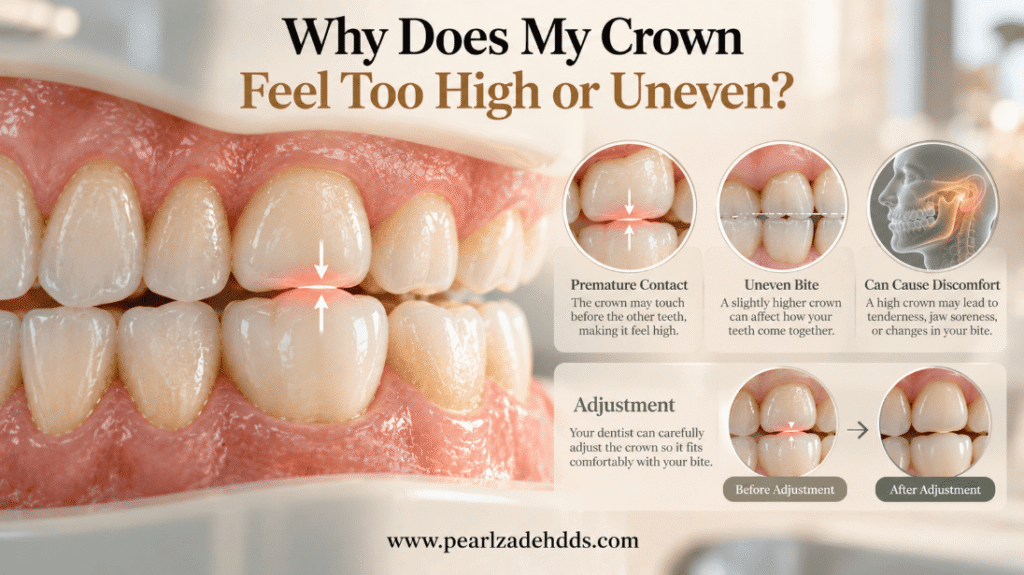
Your crown is in, but something feels off. The tooth seems higher than the surrounding teeth. One tooth hits first, your bite feels uneven, or biting feels uncomfortable.
A new crown can feel unfamiliar at first. Even so, a bite that feels noticeably high or uneven, especially if it persists, should be evaluated. Your dentist can examine the crown, the tooth, and your bite to determine what may be causing the problem.
Dentists use the term occlusion to describe how your upper and lower teeth meet when you bite. In plain terms, it is how your bite fits together. A change in how your teeth contact each other can make a new crown feel too high or uneven.
What Does a Crown That Feels Too High Usually Feel Like?
Patients can describe the sensation in different ways. The crown may feel taller than the teeth beside it. One tooth may touch first when you close your teeth. Your jaw may shift when you bite to avoid that tooth.
Chewing on that side may feel awkward. The tooth may also feel tender when you put pressure on it. Some patients notice that their bite simply feels different from before the crown was placed.
These sensations do not identify the cause by themselves. Several different problems can produce similar symptoms. A Dental Economics article discusses patients returning after restorative treatment because their bite, sensitivity, or comfort does not feel right.
A dental examination can help determine whether the sensation relates to the crown, the bite, the tooth, or surrounding tissues.
What Can Make a Crown Feel High or Uneven?
Several reasons are possible. The crown may contact the opposing tooth before the other teeth do. Dentists may describe this as a high spot or premature contact.
The crown’s shape can also differ from the natural tooth it replaced. Your tongue and bite may notice that difference immediately.
The tissues around the tooth may also feel tender after treatment. Changes in how the teeth contact each other can place different forces on the tooth and surrounding tissues. The source of discomfort may also be the tooth beneath the crown rather than the crown itself.
A crown that feels high does not automatically mean the dentist made an error. A dentist can check the bite and determine whether the restoration has an area of excessive contact. If appropriate, the crown may need a minor adjustment.
Should a New Crown Feel Different?
A little, often yes. Your tongue notices a new surface and shape right away. The bite can also feel unfamiliar after a restoration is placed. A crown does not need to feel identical to your natural tooth on the first day.
Unfamiliar does not necessarily mean something is wrong. A crown that feels different but allows you to bite comfortably is different from one that consistently makes a tooth contact first. Pain when biting or a bite that feels clearly uneven deserves attention.
The pattern also matters. Mild sensations that are improving are different from discomfort that is becoming stronger or remaining unchanged. If the bite continues to feel noticeably high or uneven, your dentist can examine the restoration and determine whether it needs attention.
Will a High Crown Adjust Itself?
Do not assume that it will. Some patients become less aware of a new crown as they get used to its shape. That does not mean a true high spot has corrected itself.
You cannot determine the cause from the sensation alone. If one tooth consistently contacts first or your bite feels significantly uneven, your dentist can check the contacts and determine whether the crown needs adjustment.
There is no universal waiting period that applies to every patient. Your dentist’s instructions should come first. If your bite feels clearly wrong or becomes uncomfortable, contact your dental office rather than assuming the sensation will resolve.
A University of the Pacific dental school handout makes a related point. It notes that additional adjustments may be necessary when a patient’s bite feels uneven.
Can a High Crown Cause Pain When Biting?
It can, but a high crown is not the only possible cause. Pain when biting after a crown can have several sources:
- Bite pressure: A high spot can place extra pressure on the tooth when you close or chew.
- Post-treatment sensitivity: Preparing the tooth can temporarily irritate the tooth and surrounding tissues.
- Pulpal irritation: The pulp, which contains the tooth’s nerves and blood vessels, can become inflamed after dental treatment.
- Another tooth problem: A crack, decay, or another condition can cause pain when you bite.
- Gum or surrounding tissue irritation: The tissues around a newly placed crown may be tender.
- A restoration problem: A loose, damaged, or poorly fitting restoration can cause discomfort.
Research supports several of these possibilities. A 2019 literature review of 43 articles notes that prepared vital teeth can develop pulpal inflammation. This response may be temporary or persist, depending on the circumstances.
The American Association of Endodontists also lists several possible causes of tooth pain, including decay, loose fillings, and cracked teeth. These causes can produce symptoms that overlap with bite-related discomfort.
Cracked teeth deserve particular attention because biting pain can occur with a crack. A 2002 review in the Journal of the Canadian Dental Association describes pain on biting that stops when pressure is released as a common feature of cracked tooth syndrome. The authors also note that pain after an inlay is cemented can sometimes be incorrectly attributed to a high spot. A proper diagnosis should consider pulpal, periodontal, and periapical causes rather than assuming the bite is responsible.
What Happens If Your Dentist Finds the Crown Is Too High?
Your dentist will start by asking about your symptoms. Before the visit, note which tooth seems to touch first, what triggers the discomfort, and when the problem began. These details can help guide the examination.
The dentist may then:
- Check how your upper and lower teeth meet and where the crown contacts.
- Use bite-marking material, such as articulating paper or ribbon, to identify contact areas.
- Examine the crown, the tooth underneath it, the opposing tooth, and surrounding tissues.
- Make a small adjustment if the findings support one.
- Recheck the bite after the adjustment.
In Dental Economics, dentist Scott Cairns discusses using marking ribbon to evaluate contacts while helping the patient close in a natural position.
Not every complaint results in an adjustment. If the bite appears balanced, your dentist can investigate other possible causes. The findings may point toward the tooth, the restoration, or surrounding tissues instead.
A follow-up visit may also be appropriate if the symptoms continue or the dentist wants to see how the tooth responds.
Does Adjusting a Crown Damage It?
A minor bite adjustment can be a normal part of restorative care when the examination shows that one is appropriate. The effect of an adjustment depends on the crown’s material, design, and the amount of material removed.
Porcelain, zirconia, and other restorative materials have different properties. Removing material can affect the restoration’s shape, thickness, or surface depending on how much is adjusted and how the surface is finished afterward.
That is why crown adjustment should be performed by a dentist rather than attempted at home. Your dentist can determine whether an adjustment is necessary and how much change is appropriate.
Our article on zirconia vs porcelain crowns explains how common crown materials differ.
What If Your Crown Is Temporary?
A temporary crown uses different materials and cement from a permanent crown. Its shape and bite may also feel different. Temporary crowns can loosen more easily than permanent restorations.
A University of the Pacific dental school handout advises avoiding sticky, hard, and crunchy foods on the side with a temporary crown. Follow any specific eating instructions your dentist provides.
Contact your dental office if a temporary crown feels noticeably high, loose, or uncomfortable. Do not file it down or try to recement it yourself.
Our article on caring for a new dental crown covers temporary crown precautions in more detail.
Can a High Crown Cause Problems If You Ignore It?
The answer depends on what is causing the sensation. Not every crown that feels high leads to a problem. A new restoration can feel unfamiliar, and some temporary discomfort may improve as the surrounding tissues recover.
The concern is that you cannot determine the cause from the sensation alone. A persistent bite change or sore tooth may reflect the crown’s contact, irritation of the tooth, or another dental problem that needs attention.
Bite forces can also matter. A Canadian review notes that repeated chewing forces can contribute to cracks in teeth weakened by large restorations. This does not mean a high crown will crack a tooth. It shows why the condition of the tooth and the forces placed on it can matter when evaluating biting pain.
Grinding and clenching can add further force. MouthHealthy notes that a dentist may recommend a night guard for some people who grind their teeth. Tell your dentist if you regularly clench or grind so they can consider it as part of your treatment plan.
When Should You Contact Your Dentist About a Crown That Feels High?
Contact your dentist if you notice any of the following:
- Pain when you bite, especially if it is severe, worsening, or persistent.
- A bite that feels noticeably high or uneven.
- One tooth that consistently hits before the others.
- Difficulty chewing on the side with the crown.
- A crown that feels loose or moves.
- A crown that chips or cracks.
- Swollen, painful, or irritated gums near the crown.
These signs do not identify the cause. Your dentist can examine the crown, tooth, bite, and surrounding tissues to determine what may be happening.
Persistent tooth pain deserves evaluation. The American Association of Endodontists explains that tooth pain can have several causes and may require a dental examination to identify the source.
Sensitivity can also have different causes. MouthHealthy lists problems such as decay, fractured teeth, worn fillings, and gum disease among possible causes. If you are unsure what changed after your crown was placed, contacting your dentist can help clarify the problem.
Intermittent pain should not automatically be dismissed. The AAE notes that pain from a cracked tooth can come and go, which can make the source difficult to identify.
Can You Adjust a Crown Yourself?
No. Do not file, grind, sand, or glue a crown yourself. You cannot reliably assess all the contacts between the crown and opposing teeth, and you may remove material from the wrong area. Filing can also damage the crown or affect the opposing tooth.
Home adjustments can hide the real problem as well. If the crown feels wrong, contact your dental office and have it evaluated. Only a dental professional should adjust a crown.
How Can You Prevent Problems With a New Crown?
You cannot control every outcome, but these steps can help:
- Ask your dentist to check your bite before you leave.
- Pay attention to how it feels once the numbness fades.
- Call early if the bite feels off, and mention which tooth seems to touch first.
- Avoid biting ice, hard objects, or packaging.
- Tell your dentist if you grind or clench.
- Keep up with regular exams and cleanings.
Our guide to new crown aftercare covers eating, brushing, and flossing in detail.
A Crown Should Feel Comfortable to Chew On
A crown should restore comfortable function, although it may feel unfamiliar at first. Any bite that feels clearly high or uneven deserves evaluation. Persistent pain does too.
A dentist can tell whether the sensation comes from your bite, the restoration, the tooth, or the surrounding tissues. Dr. Pearl Zadeh provides individualized restorative evaluation and crown care. You can learn more about crowns at Pearl Zadeh DDS.
Call (818) 716-6722 or click the button below to schedule your consultation online.
Frequently Asked Questions
A new crown can feel unfamiliar. Still, a bite that feels clearly high or uneven should be checked. Only an exam can tell the difference.
It varies, and no universal timeline applies. Follow your dentist’s instructions. Call if the feeling worsens or does not fade.
Not necessarily. Some patients adapt, but a true high spot may remain. Do not assume it will settle.
It can. Other causes are possible too, including sensitivity, a cracked tooth, or gum irritation. A dentist can sort out the cause.
Often, yes, when an adjustment is appropriate. It depends on the material, the design, and the exam findings.
The information above is for informational purposes only and is not a substitute for professional dental advice. Please schedule a consultation with Pearl Zadeh DDS to discuss your specific situation.