
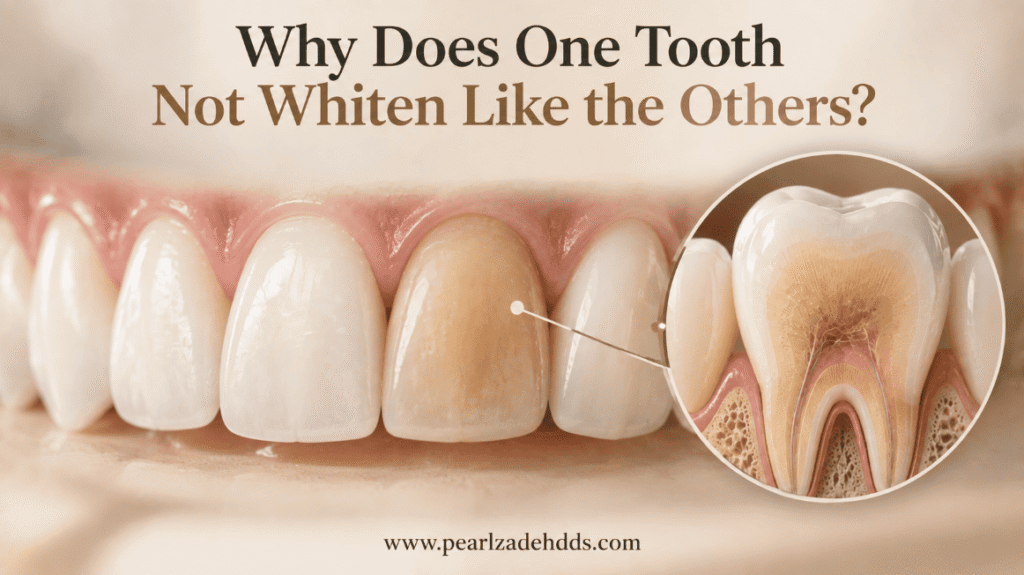
You whiten your teeth, follow the instructions carefully, and the results look great, except for one tooth. It sits a shade or two darker than the rest, and no amount of extra treatment seems to close the gap. If this sounds familiar, you are not imagining it, and you are not doing anything wrong.
Teeth do not always respond to whitening the same way, even sitting right next to each other in your mouth. A tooth that lags behind usually has a specific reason, and understanding that reason can help you decide what to do next.
What Can Make One Tooth Whiten Differently?
In most cases, one tooth resists whitening because something about it is genuinely different from the teeth around it. That difference might be the type of stain it has, its natural color, a filling or crown, an old injury, or discoloration that sits deeper within the tooth.
Whitening products work on the color of natural tooth structure. They cannot change the shade of a dental restoration, and they may not fully address deeper discoloration. So when one tooth looks different afterward, the explanation usually comes down to the type and location of the discoloration, not a flaw in how you whitened.
The Tooth May Have a Different Type of Stain
Tooth discoloration generally falls into two categories, and it matters for how well whitening works. According to the American Dental Association, extrinsic stains sit on the outer surface and typically come from coffee, tea, red wine, and tobacco. Intrinsic stains develop within the dentin layer beneath the enamel and are considered far harder to treat with external whitening, since the ADA notes that removing intrinsic stains within the dentin is considered near impossible with an external procedure.
If most of your teeth have surface staining but one tooth has a stain that originated deeper, the whitening gel may lighten the surface stains on your other teeth while barely touching that one tooth. This is also why fluorosis and tetracycline staining behave differently under whitening. Brown fluorosis and tetracycline stains tend to respond somewhat better to bleaching, while white fluorosis spots may become less noticeable only as the surrounding tooth lightens around them.
One Tooth May Naturally Be Darker
Sometimes there is no stain involved at all. Teeth vary in color naturally, even in a healthy mouth. Canine teeth, for example, often appear darker than the incisors next to them, because canines tend to have a thicker layer of dentin relative to enamel, and dentin has more influence over a tooth’s overall shade than the thinner enamel covering it.
Larger teeth, including molars and canines, often carry more of this darker undertone, and areas near the gumline can look slightly darker too, since enamel tends to be thinner there. None of this reflects a problem. It is simply how teeth are built, and whitening can only lighten a tooth within the range its own structure allows. If one of your teeth has always looked a little different, even before you considered whitening, that natural variation is a likely explanation.
Previous Dental Work May Not Whiten Like Natural Teeth
A crown, veneer, bonding, or filling on one tooth will not change color the way a whitening gel changes natural enamel. The ADA is direct about this: only natural teeth can be whitened, and tooth-colored restorations do not respond to bleaching agents. If you have a filling or crown on the tooth that looks darker, that restoration is very likely why it did not lighten with everything else.
This works in both directions. A restored tooth can look darker than its whitened neighbors because the material stayed the same shade while the surrounding enamel lightened, or a restoration matched before whitening can end up looking lighter once your natural teeth catch up. Either way, the mismatch is a material issue, not a sign that anything went wrong with the whitening itself.
A Previous Injury Could Affect Tooth Color
A tooth that took a hit at some point, even years ago, can end up a different color than the teeth around it. Trauma can affect the blood supply and soft tissue inside a tooth, and depending on what happens afterward, the tooth may darken, take on a gray or brown tint, or shift color gradually over time.
Color change after an injury does not automatically mean the tooth is dying or infected, and it does not always mean the change is permanent. In some documented cases involving traumatic injuries, discoloration that appeared shortly after the injury faded on its own within weeks to months as the tooth recovered. In other cases, the change persists and reflects a more lasting shift inside the tooth.
Because there is a real range of possible causes and outcomes, a tooth with a history of trauma that looks different from its neighbors is worth having evaluated by a dentist rather than assumed to be either harmless or serious. A clinical exam, sometimes with an X-ray, is the only reliable way to understand what is happening inside that tooth.
Some Discoloration Is Deeper Within the Tooth
Even without an obvious cause like a filling or an old injury, some discoloration simply sits too far inside the tooth for a topical whitening gel to reach. Whitening agents work by penetrating the enamel and lightening the dentin just beneath it. When the pigment sits deeper than that, or the dentin itself has darkened significantly, results can be limited no matter how consistently you use the product. If a tooth simply will not whiten no matter what you try, this kind of deeper discoloration is often part of the explanation, and it is one reason dentists sometimes recommend an evaluation before continuing to whiten on your own.
What If One Tooth Is Gray, Brown, or Much Darker?
A single tooth that looks distinctly gray or brown, rather than just a shade off from its neighbors, deserves a closer look. This kind of shift can point to several things: internal staining from an old injury, changes related to a previous root canal, a restoration, or changes inside the tooth that have not caused any pain or other symptoms.
Gray and brown discoloration is not automatically a sign of infection or a dying tooth, and it is not something to diagnose from color alone. A dentist can check the tooth’s health with a clinical exam and, when needed, an X-ray, then explain what is happening and what options exist.
Can You Whiten Just One Tooth?
In some situations, yes. If a single tooth is genuinely lagging behind because it simply needs more exposure to a whitening agent, a dentist may be able to target that tooth specifically, often using a custom tray or a more concentrated approach applied just to that area under professional supervision.
This tends to work best when the tooth has extrinsic or moderate staining that has not fully responded yet, rather than a tooth affected by a restoration, deep intrinsic staining, or past trauma. Your dentist can evaluate the tooth and let you know whether targeted whitening is likely to help or whether the underlying cause needs a different treatment altogether.
What If Whitening Makes the Difference More Noticeable?
This happens more often than people expect, and it can feel discouraging. If your natural teeth lighten several shades while one tooth, whether due to a restoration, an old injury, or deep intrinsic staining, stays roughly the same, the contrast becomes more obvious rather than less. Before whitening, the difference may have been subtle enough to go unnoticed. Afterward, it can stand out.
This is not a sign that anything went wrong with your treatment. It simply reflects the fact that your other teeth changed color and that particular tooth did not, or did not change by the same amount.
Should You Keep Whitening Until the Darker Tooth Matches?
It depends on why that tooth is not responding. Ordinary extrinsic staining that simply needs more time may narrow the gap with continued whitening under your dentist’s guidance. A restoration, deep intrinsic staining, or a color change related to past trauma usually will not, and continuing to whiten may just mean more exposure to a bleaching agent without the payoff you want. There is also a limit to how much whitening a tooth’s enamel can safely tolerate, so whitening indefinitely in pursuit of a perfect match is not typically recommended. Your dentist can tell you honestly whether more whitening is worth pursuing.
When Should You See a Dentist About One Darker Tooth?
A dental evaluation is a reasonable next step any time one tooth looks noticeably different, especially if it has a history of trauma, the color is gray, brown, or distinctly different rather than just a shade off, it has ever had sensitivity or pain, whitening has been used consistently for several weeks without change, or you simply are not sure why. None of these are cause for alarm on their own. They are signs the color difference has a specific cause worth identifying.
How Can a Dentist Determine Why One Tooth Looks Different?
A dentist typically starts with a visual exam, comparing the tooth with its neighbors and sometimes using a shade guide to document the difference, along with questions about your dental history: whether the tooth was ever injured, whether it has a filling or crown, and any childhood exposure to certain medications or high fluoride levels.
An X-ray is often part of this evaluation, since it can reveal things not visible from the outside, such as changes related to an old injury or a previous root canal. Sensibility testing, which checks how the tooth responds to temperature, is sometimes used as well, though results are interpreted cautiously since a traumatized tooth does not always respond predictably.
Can the Tooth Be Made to Match the Others?
Often, yes, though the right approach depends entirely on the cause. If the tooth simply needs more whitening, your dentist may recommend a targeted approach. A mismatched restoration may need replacement with a shade that matches your newly whitened teeth. Deeper intrinsic staining or discoloration from a past injury may require bonding or a veneer on that specific tooth instead.
A dentist will generally walk through these possibilities once the cause is clear, explaining what each option involves and what a realistic outcome looks like, rather than assuming one solution fits every situation.
Talk to Dr. Pearl Zadeh About Your Smile
A tooth that will not whiten like the rest usually has a clear, identifiable reason behind it, even when that reason is not obvious from looking in the mirror. Whether it turns out to be a natural shade difference, an old restoration, or something that deserves a closer look, a dental evaluation is the most reliable way to understand what is happening and what your options are.
Dr. Pearl Zadeh and her Woodland Hills team can evaluate the tooth, help explain why it is behaving differently from the rest of your smile, and walk you through the options that make sense for your situation.
Call (818) 716-6722 or click the button below to schedule an appointment and discuss your oral health needs.
Frequently Asked Questions
The tooth that is not responding usually has something different about it, such as a restoration, a deeper intrinsic stain, a naturally darker shade, or a history of injury. Whitening only affects natural enamel and dentin, so anything outside that scope will not change color the same way.
Yes, in many cases. Teeth naturally vary in shade, and canines in particular often appear darker than the teeth beside them due to differences in enamel and dentin thickness. This is a normal variation rather than a sign of a problem.
No. Whitening products only work on natural tooth structure. Crowns, veneers, and fillings keep their original shade after whitening. If the restoration no longer matches, your dentist may recommend replacing it.
It is possible. Trauma can affect the tissue inside a tooth and cause gray or brown discoloration. Some trauma-related discoloration fades over time. Other cases cause lasting changes. A dental evaluation can determine what is causing the color change.
It depends on the cause. If the tooth needs more time, continued whitening may help. Your dentist can guide the process. If a restoration or deep staining causes the difference, more whitening may not help. Your dentist can suggest a more effective option.
This article is for informational purposes only and is not a substitute for professional dental advice. Please schedule a consultation with Pearl Zadeh DDS to discuss your specific situation.