
You wake up with a headache and a jaw that feels tired or sore. By afternoon, your temples feel tight again. Your partner has also mentioned hearing you grind your teeth at night. At first, none of these things seem connected.
But when headaches keep showing up alongside jaw pain, clenching, or grinding, the connection is worth looking into. TMJ problems can involve the jaw joints and the muscles around them, and those muscles extend into areas that can hurt when they become tense or overworked.
What Is TMJ?
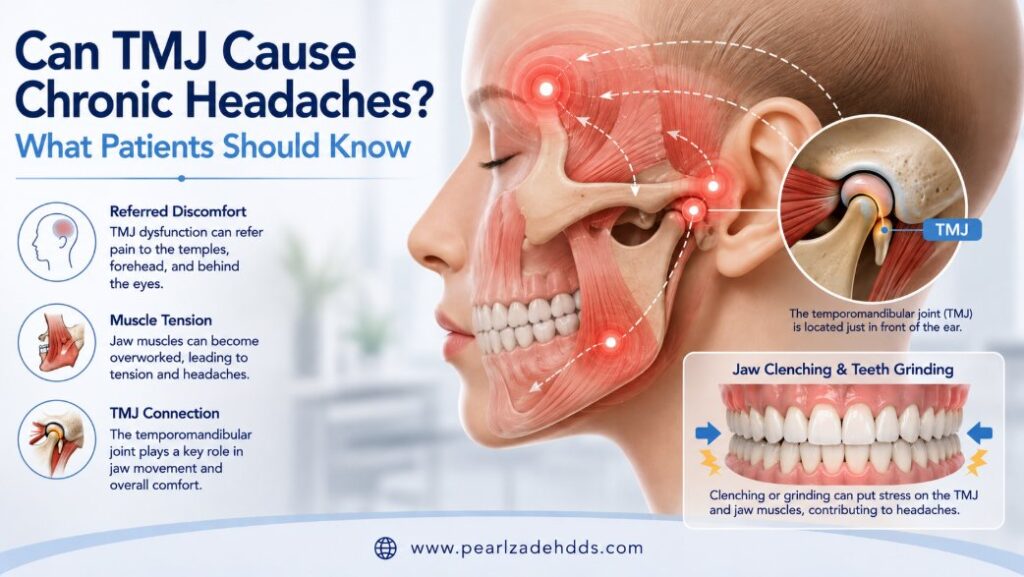
You have a temporomandibular joint on each side of your face, connecting your lower jaw to your skull. These joints, along with the muscles around them, let you chew, speak, yawn, and swallow. TMJ disorders can involve the joint itself, the surrounding muscles, or both together.
Can TMJ Problems Cause Headaches?
TMJ disorders and jaw muscle tension may be associated with pain around your temples, face, jaw, the area near your ears, and your head and neck generally. Pain originating in overworked jaw muscles can genuinely be experienced as head pain, since these muscles sit close to areas patients associate with headaches. A systematic review published in the Journal of the American Dental Association found a real association between painful TMD and both tension-type headaches and migraines, though the certainty of that evidence was rated low to very low across the studies reviewed. Headaches have plenty of possible causes beyond your jaw, so having one doesn’t prove TMJ is responsible. TMJ problems may contribute to headaches in some patients. That’s a different statement than TMJ causing chronic headaches outright.
What Does a TMJ-Related Headache Feel Like?
There’s no single pattern that confirms a TMJ connection on its own. Some patients notice temple pressure or aching, jaw soreness, tenderness in the facial muscles, pain near the ears, jaw fatigue, headaches that show up after a long stretch of chewing, or symptoms that feel worse right after waking. Every one of these can have other causes too, which is exactly why none of them confirms anything by itself.
Why Can Jaw Tension Lead to Head Pain?
Your jaw muscles connect to and interact with muscles and tissue in nearby areas, including your temples. Repeated clenching, grinding, or holding tension in your jaw over long stretches can leave those muscles genuinely overworked. Discomfort starting in an overworked jaw muscle can spread into nearby areas rather than staying neatly contained. This doesn’t play out as a direct, guaranteed cause-and-effect chain in every patient. It’s a plausible mechanism, not a rule that applies identically to everyone.
Can Teeth Grinding Be Connected to Headaches?
Bruxism, the term for grinding or clenching your teeth, may be part of this picture for some patients. Nighttime grinding places repeated stress on both your jaw muscles and your teeth. Alongside grinding, you might notice morning jaw soreness, tooth sensitivity, worn or flattened teeth, chips, facial soreness, and headaches. Our discussion of how teeth grinding damages teeth over the years goes further into what that wear can actually look like over time.
Why Are Headaches Sometimes Worse in the Morning?
Unconscious nighttime clenching or grinding is one possible explanation for jaw-related discomfort you notice after sleeping. It isn’t the only one, though. Morning headaches can also come from sleep quality issues, other health conditions, and factors that have nothing to do with your jaw at all. Waking up with a headache doesn’t automatically point to bruxism. It’s simply one possibility worth mentioning if it’s a pattern you keep noticing.
Can Stress Make TMJ Symptoms Worse?
Stress may contribute to clenching or increased jaw muscle tension for some people, though it isn’t accurate to call stress the underlying cause of TMJ disorders generally. Some patients notice a real pattern where jaw tension, clenching, and headaches all become more noticeable during particularly stressful stretches. That’s worth paying attention to as a pattern, not as proof that stress alone explains everything going on.
What Other TMJ Symptoms Should You Look For?
Headaches become more worth discussing with a dentist when they show up alongside other jaw symptoms:
- Clicking or popping
- Jaw pain
- Pain while chewing
- Facial tenderness
- Limited mouth opening
- Jaw stiffness
- Jaw locking
- Discomfort near the ears
- A noticeable change in how your teeth come together
Our guide to when jaw symptoms warrant a dental evaluation goes further into that distinction.
Is Jaw Clicking Related to Headaches?
Clicking or popping by itself doesn’t necessarily mean you have a serious TMJ problem, and it isn’t accurate to say jaw clicking causes headaches. The same JADA-published systematic review specifically looked at painless TMJ issues, the kind without any accompanying pain, and found no positive association with either tension-type headache or migraine. Clicking that comes with pain, locking, or limited movement is a different situation and deserves more attention. The combination of symptoms matters more than the sound alone. Our discussion of TMJ and jaw clicking goes further into what jaw sounds can and can’t tell you on their own.
Could a Night Guard Help?
A night guard may be worth considering when teeth grinding or clenching is genuinely part of what’s going on. It isn’t a universal treatment for headaches or TMJ disorders in general. What actually helps depends on the underlying cause and your specific symptoms. Our overview of occlusal splints goes further into how these appliances work and who they’re actually appropriate for. No dentist can honestly promise that a night guard will stop your headaches.
What Can a Dentist Check?
An evaluation typically covers your jaw movement, any jaw tenderness, your bite, your teeth, tooth wear, signs of grinding, existing dental restorations, and what you report experiencing. Your dentist may ask when your headaches tend to occur, whether they’re worse in the morning, and whether jaw symptoms show up around the same time. A dental evaluation is genuinely useful, but it doesn’t rule out non-dental causes for your headaches. That’s an important limitation to keep in mind.
Does TMJ Always Need Treatment?
No. Mild or occasional jaw symptoms may not need active treatment at all. Whether treatment makes sense depends on severity, how long symptoms have lasted, how much pain is involved, how your jaw is functioning, how much it’s affecting your daily life, and what’s actually causing it. Our discussion of non-surgical TMJ treatment options covers conservative approaches in more depth. Surgery isn’t a commonly needed step for most patients dealing with jaw symptoms.
What Can You Do at Home?
A few simple, low-risk habits can reduce unnecessary strain on your jaw. Avoid chewing gum for long stretches. Skip very hard or chewy foods if chewing already causes discomfort. Pay attention to whether you’re clenching during the day, not just at night. Try keeping your jaw relaxed when you aren’t actively eating or speaking. Avoid repeatedly opening your mouth very wide just to test how it feels. Follow whatever specific instructions your dentist has actually given you. None of this is a substitute for an evaluation if your symptoms are persistent, and aggressive jaw exercises aren’t something to start on your own without a treatment plan behind them.
When Should You See a Dentist?
A handful of situations are worth bringing to a dentist rather than waiting them out:
- Recurring headaches occurring alongside jaw symptoms
- Persistent jaw pain
- Pain while chewing
- Frequent morning jaw soreness
- Painful clicking or popping
- Jaw locking
- Difficulty opening your mouth
- Frequent clenching or grinding
- Significant tooth wear
- A sudden change in your bite
When Should a Headache Be Evaluated Medically?
Chronic or recurring headaches can have plenty of causes that have nothing to do with your jaw. This section isn’t about diagnosing anything. It’s about making sure a dental explanation isn’t assumed when it shouldn’t be. Seek medical evaluation for headaches that are:
- Sudden and extremely severe
- Accompanied by neurological symptoms
- Accompanied by confusion or fainting
- Accompanied by weakness or trouble speaking
- Accompanied by significant vision changes
- Accompanied by fever or a stiff neck
- Following a significant head injury
Any of these deserve prompt medical attention rather than being treated as a dental issue.
How Do You Know If Your Jaw Might Be Part of the Problem?
Pay attention to whether your headaches repeatedly show up alongside jaw soreness, temple tenderness, teeth grinding, clenching, clicking, jaw stiffness, pain when chewing, or morning jaw fatigue. A pattern that keeps repeating is worth discussing with a professional. This isn’t meant as a diagnostic checklist you can score yourself against. It’s simply a way to notice whether your jaw and your headaches seem to be showing up together often enough to be worth a real conversation.
Could Your Jaw Be Part of the Headache?
TMJ problems and jaw muscle tension may contribute to head or facial pain in some patients. Teeth grinding and clenching can add extra strain on top of that. Headaches still have plenty of possible causes beyond your jaw, so TMJ shouldn’t automatically be assumed to be responsible just because both are present. When headaches keep showing up alongside jaw symptoms, a professional evaluation can help figure out what’s actually contributing, rather than guessing on your own.
Speak With Dr. Pearl Zadeh About TMJ Symptoms
Recurring headaches can have many causes, but jaw symptoms may be part of the picture for some patients. Dr. Pearl Zadeh, a member of the American Dental Association and California Dental Association, can evaluate your jaw, teeth, bite, and reported symptoms to help determine whether TMJ problems or grinding may be contributing. If your headaches are persistent or concerning, appropriate medical evaluation is worth pursuing alongside a dental visit, not instead of it.
Call (818) 716-6722 or click the button below to schedule a consultation online.
Frequently Asked Questions
Can TMJ really cause headaches?
Research shows an association between painful TMJ disorders and certain headache types, though it isn’t proof that TMJ causes every headache. It may contribute for some patients.
What does a TMJ headache feel like?
There’s no single confirming pattern. Temple pressure, jaw soreness, and facial tenderness alongside a headache are worth noting, though these symptoms can have other causes too.
Does jaw clicking cause headaches?
Clicking alone hasn’t shown a clear association with headaches in research. Clicking combined with pain, locking, or limited movement is a different, more relevant situation.
Will a night guard stop my headaches?
Not necessarily. A night guard may help if grinding is part of the picture, but it isn’t a universal fix for headaches or TMJ disorders.
When should I worry my headache isn’t dental?
Sudden severe headaches, neurological symptoms, confusion, vision changes, fever with a stiff neck, or headaches following a head injury need prompt medical evaluation, not a dental appointment.
This article is for informational purposes only and is not a substitute for professional dental or medical advice. Please schedule a consultation with Pearl Zadeh DDS to discuss your specific situation, and seek prompt medical care for any concerning or severe headache symptoms.