
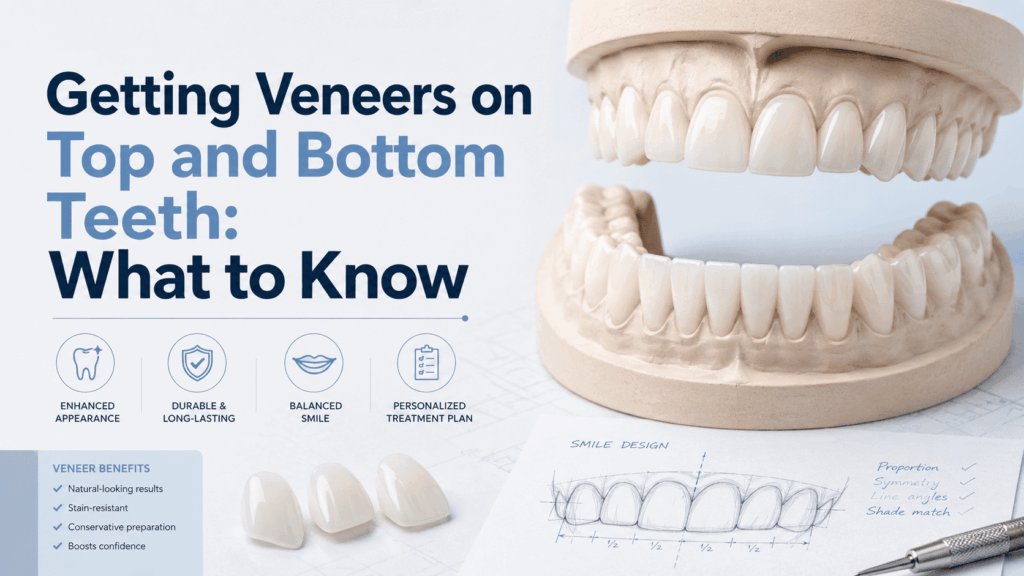
You’ve decided you want a smile makeover, and now you’re stuck on a question that never came up in the before-and-after photos you’ve been saving: do your bottom teeth need veneers too, or will treating the top row be enough?
It’s a fair question, and the answer depends on more than personal preference. It comes down to how your specific smile behaves when you talk, laugh, and smile naturally, not just how it looks in a still photo.
What It Means to Get Veneers on Both Arches
Getting veneers on top and bottom teeth means treating visible teeth in both the upper and lower arch as part of one coordinated plan, rather than focusing on the upper teeth alone. This isn’t automatically part of every smile makeover, and it isn’t a sign that a patient’s case is more severe than someone getting upper veneers only. It’s simply a different scope, chosen based on what a specific smile actually needs to look balanced.
Why Many Smile Makeovers Focus Mainly on Upper Teeth
For a lot of people, the upper front teeth do most of the visual work during a natural smile. Many patients show only their upper teeth, or upper teeth with a small amount of lower tooth visible, when they smile normally. Because of this, treating the upper arch alone is often enough to noticeably change how a smile looks and feels, without extending treatment further than necessary.
This pattern isn’t universal, though. Some people show more of their lower teeth than average, whether due to how their lips rest, how their teeth are positioned, or simply how they smile. For these patients, stopping at the upper arch can leave a visible mismatch between a bright, refreshed top row and a lower row that still shows its original wear or color.
Why Some Patients Consider Veneers on Both Top and Bottom
A handful of situations tend to bring the lower teeth into the conversation. Some patients want a more comprehensive transformation and don’t want any visible tooth left untouched. Others notice a real color difference between their upper and lower teeth, sometimes because lower teeth stain more stubbornly due to more constant exposure to saliva and less benefit from whitening treatments. Patients who show a fair amount of lower tooth structure when smiling or speaking sometimes prefer treating both arches so the whole visible smile reads as consistent, rather than only the top half looking refreshed.
Significant cosmetic concerns, such as noticeable wear, chips, or unevenness affecting several lower teeth, can also be a reason to include them in the plan. The unifying theme across these situations is a desire for one consistent, balanced appearance across everything that shows when the patient talks and smiles, not simply treating more teeth for its own sake.
When Treating Lower Teeth May Improve Overall Balance
Balance is really the key word here. A dentist isn’t just checking whether lower teeth are visible at all. They’re evaluating whether leaving them untreated would create a visible inconsistency once the upper teeth are refreshed. If your lower teeth are in reasonably good shape, similar in shade to the newly planned upper veneers, and not particularly visible during normal conversation, many patients are satisfied stopping at the upper arch. If the difference would be noticeable, treating some or all of the lower teeth may create a more cohesive result.
When a Dentist May Recommend Treating Fewer Teeth
Just as some patients end up needing both arches treated, others are steered toward a smaller plan than they originally expected. If your lower teeth are healthy, well-matched in color, and rarely visible, adding veneers there may not meaningfully change your smile’s appearance and would extend treatment without a clear benefit. Our breakdown of how many veneers a smile makeover typically involves goes further into how dentists narrow down a plan to the teeth that genuinely need it, rather than defaulting to every visible tooth.
How Dentists Decide Which Teeth Should Receive Veneers
Deciding whether a plan should include lower teeth, and which specific teeth in either arch, comes down to a detailed evaluation rather than a general rule. A few factors carry real weight in that decision.
Smile Width and How Much Tooth Shows
Some smiles reveal more teeth toward the back, while others show mostly the front four to six teeth per arch. A wider smile with more visible teeth on both the top and bottom naturally brings more of the lower arch into the conversation than a narrower smile would.
Lip Movement and Speech
A dentist typically watches how your lips move at rest, during a natural smile, and while you’re speaking, since these moments can reveal different amounts of upper and lower tooth structure. Some patients show very little lower tooth at rest but reveal quite a bit more while talking, which matters for planning.
Tooth Proportions, Shape, and Size
Lower front teeth are naturally smaller and sit closer together than upper front teeth. This affects the available space and how your dentist shapes the veneers. Proper design helps prevent a bulky or unnatural appearance next to neighbouring teeth.
Existing Restorations
Old fillings, crowns, or bonding on lower teeth can affect whether your dentist includes them in a veneer plan. This matters especially when existing restorations have changed colour or no longer match the planned shade.
Tooth Color
If your lower teeth are much darker than the planned shade for your upper veneers, the difference may become more noticeable after treatment. This is one reason dentists may recommend including some lower teeth in the treatment plan.
Bite Relationship Between Upper and Lower Teeth
How your upper and lower teeth meet when you close your mouth affects veneer design and material choice for either arch. Patients with a deep bite may have limited space between their upper and lower teeth. In these cases, dentists may recommend thinner veneers or a different approach to reduce excess pressure.
If your bite involves noticeable misalignment rather than a cosmetic concern, our guide on veneers and crooked teeth explains when veneers may help and when orthodontic treatment may come first.
Signs of Wear or Grinding
Both upper and lower teeth are affected by grinding and clenching, and existing wear patterns give a dentist useful information about how forcefully your bite comes together. Our discussion of veneers for patients who grind their teeth covers how bruxism factors into candidacy and planning across both arches, not just the upper teeth.
Overall Oral Health
Active decay, gum disease, or other untreated dental issues typically need to be addressed before cosmetic treatment on either arch. A healthy foundation across your whole mouth matters more to a lasting result than which specific teeth receive veneers.
Upper Veneers vs Lower Veneers: Key Differences
Upper and lower veneers aren’t simply mirror images of the same treatment. The table below summarizes some general differences worth understanding, though your specific case is what ultimately shapes the plan.
| Consideration | Upper Veneers | Lower Veneers |
| Visibility | Typically the most visible teeth during a smile | Often less visible when smiling, more visible when speaking or laughing |
| Common reasons for treatment | Discoloration, chips, gaps, and overall smile appearance | Wear, stubborn discoloration, or visible unevenness during speech |
| Planning considerations | Smile width, lip position, and proportion relative to the face | Available space, tooth size, and how they’ll look next to upper teeth |
| Bite considerations | Involved in how the bite closes and distributes force | Often carry concentrated bite force, requiring careful evaluation |
Lower veneers in particular tend to require additional planning, since they sit on smaller teeth, interact directly with the opposing arch during every bite, and are seen differently depending on whether you’re smiling, talking, or at rest.
Does Every Visible Tooth Need a Veneer?
No. A visible tooth does not automatically need treatment. If a tooth already has a suitable shape, size, and colour compared with nearby teeth, your dentist may not recommend a veneer. Treatment plans usually focus on teeth that create a cosmetic concern or noticeable difference, rather than every visible tooth by default.
Materials for Upper and Lower Veneers
Both arches can generally receive porcelain or composite veneers. Material choice often depends on durability expectations, cosmetic goals, and the condition of the teeth being treated. It does not usually depend only on which arch needs veneers.
Our porcelain veneers guide and composite veneers overview explain what each material involves. Our comparison of porcelain and composite veneers also covers the differences in more detail. Some dentists may use different materials within one treatment plan. For example, they may recommend porcelain for upper teeth and another option for lower teeth based on bite forces and cosmetic goals.
Alternatives and Combined Treatments
Veneers aren’t always the only piece of a smile makeover, upper or lower. Teeth whitening can sometimes address general discoloration without veneers at all, particularly on teeth that are otherwise well-shaped. Dental bonding may handle a minor chip or gap on a lower tooth without the more involved process a veneer requires. Orthodontic treatment may be worth discussing first if the concern is more about tooth position than color or shape. Combining these approaches, rather than defaulting to veneers on every visible tooth, is part of what a thorough smile makeover planning process looks like. Some patients achieve their goals with fewer veneers than they originally expected once these combined options are on the table.
Are Upper and Lower Veneers Treated at the Same Time?
This depends on your dentist’s process and the complexity of your case. Some practices treat both arches within the same overall timeline, staging preparation and placement so the process moves efficiently. Others prefer to complete one arch first, evaluate how it looks and feels, and then move to the second arch with that information in hand. Neither approach is inherently better, and your dentist can walk you through which sequence makes sense for your specific plan.
Planning Your Smile Makeover in Woodland Hills
Dr. Pearl Zadeh evaluates smile width, lip movement, bite relationship, and tooth condition across both arches before recommending whether a plan should include upper teeth alone or both top and bottom. Her approach to cosmetic treatment planning focuses on what your specific smile needs rather than defaulting to a broader plan than necessary. Patients considering veneers in Woodland Hills can expect that same individualized evaluation, and our overview of cosmetic dentistry in Woodland Hills covers the fuller range of options if your plan ends up combining veneers with other treatments.
Once your plan is set, our guide to preparing for a veneers appointment walks through what to expect, whether your treatment involves one arch or both.
Schedule a Consultation With Dr. Pearl Zadeh
Whether your smile makeover should include your upper teeth or both arches depends on your smile, not a general assumption. A personalised evaluation helps determine what a balanced, natural-looking result requires for you.
Dr. Pearl Zadeh and her Woodland Hills team can evaluate your smile width, bite, and tooth condition. They can help you decide whether upper veneers, lower veneers, or a combination approach fits your goals.
Call (818) 716-6722 or click the button below to schedule your consultation online.
Schedule a ConsultationFrequently Asked Questions
1. Can you get veneers on both top and bottom teeth?Yes, in many cases. Whether this makes sense for you depends on how visible your lower teeth are, their current color and condition, and your overall smile goals.
2. Do most people need veneers on their lower teeth?Not necessarily. Many patients achieve their goals with upper veneers alone, since the upper teeth tend to be more visible during a natural smile. Some patients do benefit from including lower teeth, depending on their specific smile pattern.
3. How many veneers are needed for a full smile makeover?This varies by patient and depends on smile width, tooth proportions, color, and personal goals rather than a fixed number that applies to everyone.
4. Are upper veneers enough for a natural-looking smile?Often, yes, particularly for patients whose lower teeth are healthy, reasonably well-matched in color, and not especially visible when smiling or speaking. Your dentist can evaluate whether this applies to your specific smile.
5. Do bottom veneers affect your bite?They can, since lower teeth interact directly with the upper teeth during every bite. Your dentist evaluates your bite relationship carefully before recommending lower veneers to help avoid uneven pressure or premature wear.