
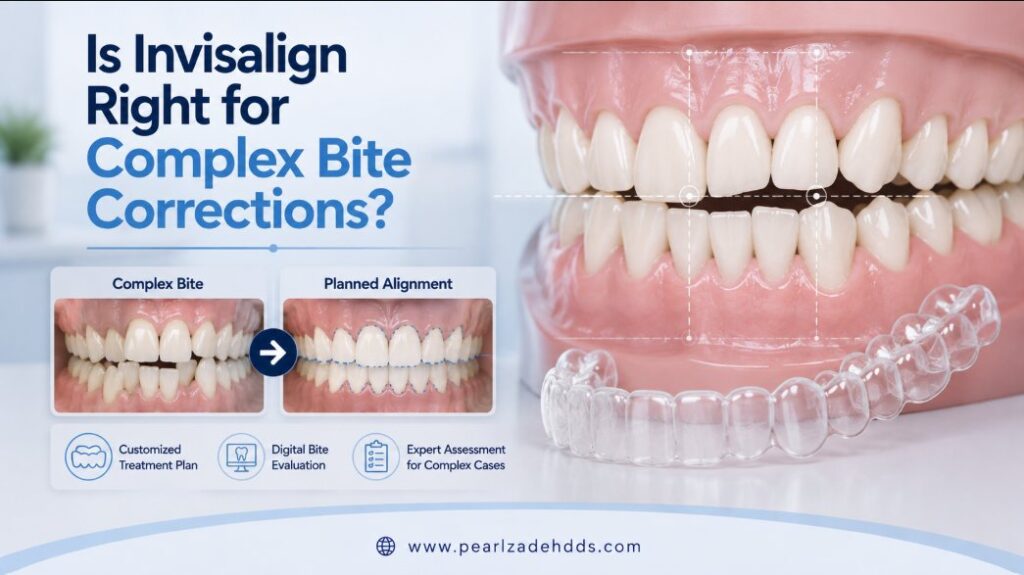
You hear the word overbite, or crossbite, or maybe something with more syllables, and you assume that’s it. Your case sounds complicated, so clear aligners are probably off the table. Braces it is.
Not necessarily. Does having a complicated bite automatically rule out Invisalign? The honest answer isn’t a simple yes or no. Some genuinely complex bite corrections respond well to Invisalign, sometimes with a few extra tools involved. Others need a different approach entirely. Which category you fall into depends on specifics that a consultation, not a diagnosis name, actually reveals.
What Makes a Bite Correction “Complex”?
“Complex” isn’t one specific diagnosis. A case can become more challenging for a whole range of reasons:
- The overall severity of the bite problem
- Large tooth movements
- Significant crowding or spacing
- Tooth rotations
- A deep bite
- An open bite
- An underbite
- A crossbite
- Multiple bite problems occurring together
- Jaw or skeletal discrepancies
- Missing teeth
- Existing dental restorations
- Gum or bone concerns
- The overall amount of correction required
A smile that looks complicated in the mirror doesn’t automatically mean Invisalign can’t work. It just means more factors need weighing before anyone can say for sure.
Which Bite Problems Can Invisalign Treat?
Invisalign may help address a range of common bite concerns, though how well it works depends heavily on severity and whether the problem is primarily dental or involves the jaw itself.
An overbite, where the upper front teeth overlap the lower ones more than expected, can often be improved with aligners in appropriate cases. An underbite is more situational. Some dental underbites, where the issue is mainly tooth position, may respond to aligners, while more significant skeletal underbites often need a different approach. A crossbite, where certain upper teeth sit inside the lower teeth instead of outside them, can sometimes be corrected with aligners when the cause is primarily dental rather than skeletal.
An open bite, where certain teeth don’t touch when biting down, is another area Invisalign can sometimes address. Our deeper look at Invisalign and open bite correction covers that specific question in more detail. A deep bite, where the upper teeth cover too much of the lower teeth, often involves coordinating movement across several teeth rather than simply straightening one or two. None of these conditions guarantee Invisalign is appropriate at every severity level. They’re simply areas where aligners are a genuine possibility worth evaluating.
Dental Bite Problems vs. Skeletal Problems
This distinction matters more than almost anything else in this article. A dental bite problem is mainly about tooth position, teeth sitting where they shouldn’t within jaws that are otherwise proportioned normally. A skeletal bite problem involves the actual size, position, or relationship of the upper and lower jaws themselves.
Clear aligners move teeth. They don’t reposition adult jaw bones the way some patients imagine, since the jaw itself has already finished growing in most adult patients. A bite problem rooted mainly in tooth position is generally a better fit for aligners than one rooted in how the jaws themselves relate to each other. A more significant skeletal discrepancy may call for orthodontic treatment that goes beyond clear aligners, or in some cases, evaluation by a specialist. None of this can be determined from how a smile looks in a photo. It takes an actual clinical exam and appropriate records to know what’s really driving the bite problem.
How Does Invisalign Correct a Complex Bite?
Bite correction usually involves coordinated movement across several teeth, not just making individual teeth look straighter. Depending on the case, that can include controlled tooth movement, coordinating how the upper and lower arches relate to each other, vertical movement, certain rotations, managing available space, and letting the bite settle into its final relationship over the later stages of treatment. A 2025 systematic review on Invisalign predictability found that certain movements, including expansion, rotation, and space closure, show more variability than others. Not every movement involved in a complex bite correction is equally predictable, and that’s worth knowing going in rather than assuming every part of the plan will play out identically.
Additional Tools That May Support a Complex Bite Plan
Several tools can become part of a more involved bite correction, and needing any of them isn’t a sign your case is unusually difficult. Attachments, small tooth-colored shapes bonded to selected teeth, give the aligner extra grip for movements that need more control. Elastics connect the upper and lower arches to provide a type of force aligners alone don’t generate, which matters for certain bite relationships. IPR, a small, planned amount of enamel removed between selected teeth, sometimes creates space or adjusts tooth proportions when a plan calls for it. None of these tools are automatically part of every complex case, and none of them mean anything went wrong when they are.
What If the First Invisalign Plan Doesn’t Finish the Bite?
Reaching the end of your original aligner series with some movement still remaining is common enough in bite correction specifically, since real teeth don’t always land exactly where a digital plan predicted. Refinements, a new set of aligners built from updated scans of your current tooth positions, pick up where the original series left off. Needing a refinement round doesn’t mean the original treatment failed. It means the plan is being fine-tuned based on where your teeth actually are, not just where the software originally guessed they’d be.
How Does a Dentist Decide If Invisalign Is Right for You?
An evaluation typically covers:
- A clinical examination
- An assessment of your bite
- Your current tooth positions
- Gum health
- Any existing restorations
- X-rays when appropriate
- Digital scans
- How your jaws relate to each other
- Exactly what movements your case requires
- Your treatment goals
- Your own expectations for the result
The digital treatment simulation you see during planning is a helpful part of that process, not a guarantee that every predicted movement plays out exactly as shown. The final call on whether Invisalign fits your case should come from your dentist after actually evaluating your teeth and bite, not from comparing your diagnosis name to what you’ve read online.
What Can Make Invisalign Less Predictable?
A handful of factors can affect how smoothly treatment progresses. Complex tooth movements, significant rotations, severe bite discrepancies, and underlying skeletal problems all add difficulty on the clinical side. The same 2025 systematic review found that treatment success is multifactorial, shaped by patient compliance, how the treatment was planned, and the complexity of the case itself, together rather than any single factor alone. On the patient side, inconsistent aligner wear, missed appointments, teeth not tracking as expected, and existing dental or periodontal concerns can all play a role. Compliance genuinely matters here, since aligners only work while they’re actually being worn as prescribed, but not every tracking issue traces back to something a patient did wrong.
What Happens If Your Teeth Don’t Track as Planned?
Tracking just means how closely your teeth are moving to where a given aligner expects them to be. If a tooth isn’t tracking closely enough, your dentist reassesses rather than just letting the plan run on autopilot. Depending on what they find, that might mean continuing the current plan a bit longer, making adjustments, adding attachments, recommending elastics, ordering a refinement, or in some cases changing the treatment approach altogether. This is a decision for your dentist to make after evaluating the situation, not something to guess your way through by switching trays on your own.
When Might Braces Be a Better Option?
Traditional braces may be considered when extensive tooth movement is required, the bite discrepancy is significant, more precise control over the movement is needed, the case involves substantial skeletal issues, or clear aligners seem unlikely to deliver the required correction predictably. Research discussed in a peer-reviewed study on clear aligner predictability points to fixed appliances outperforming clear aligners for cases requiring severe rotation, extrusion, and bodily tooth movement, and completing severe extraction cases in less time. This isn’t a case for braces being the universally better choice. It’s a reminder that certain movements are still more reliably handled with fixed appliances, depending on what a specific bite actually needs.
Does Needing Invisalign Extras Mean Your Case Is Too Complicated?
No. Attachments, elastics, IPR, and refinements can all be a completely normal part of Invisalign treatment, complex bite or otherwise. None of these tools automatically signal that treatment failed or that your case is unusually severe. What actually matters is why your dentist is recommending a specific tool and what movement it’s meant to accomplish, not whether your plan happens to include more moving pieces than someone else’s.
What About Patient Compliance?
Complex bite correction asks more of you than a simple case might, since more movements happening at once leaves less room for inconsistency. That means wearing your aligners for the prescribed amount of time, switching trays according to your actual schedule, using elastics exactly as instructed, keeping your appointments, reporting a broken attachment or other problem promptly, and resisting the urge to take your aligners out more than necessary. Our discussion of what happens if you stop wearing Invisalign early covers the general mechanics if a longer interruption ever happens. One missed day here or there isn’t going to derail a complex plan on its own. A repeated pattern of inconsistency is a different story.
How Long Does Complex Invisalign Treatment Take?
There’s no single number that applies across the board. Treatment length depends on the type of bite problem involved, how much movement is actually required, whether elastics are part of the plan, whether attachments are needed, whether refinements become necessary along the way, how consistently the aligners get worn, and how your specific teeth respond to the forces involved. Your dentist can give you a realistic estimate once they’ve evaluated your case and built an actual treatment plan around it, not before.
Is Invisalign Worth Considering If Your Bite Is Complicated?
A complicated bite doesn’t automatically rule Invisalign out. A consultation is what actually determines whether your problem is primarily dental, whether the movements your case requires are suitable for aligners, whether additional tools would be part of the plan, or whether another approach would get you there more predictably. The goal is finding the appropriate treatment for your specific bite, not choosing Invisalign simply because clear trays sound more appealing than brackets and wires.
Frequently Asked Questions
Can Invisalign fix a severe overbite or underbite?
Sometimes, depending on whether the problem is primarily dental or involves the jaw itself. A clinical evaluation determines which category your case falls into.
Is Invisalign only for mild cases?
No. Invisalign has expanded to treat many moderate and complex cases, though certain severe movements are still more reliably handled with traditional braces.
Does needing attachments or elastics mean my case is too complicated for Invisalign?
No. These tools are a normal part of many treatment plans, including plenty of straightforward ones, and don’t indicate treatment has gone wrong.
How do I know if my bite is dental or skeletal?
This requires a clinical examination and appropriate records. It isn’t something that can be determined from appearance alone.
When would a dentist recommend braces instead of Invisalign for a complex bite?
When the case requires extensive movement, significant precision, or involves substantial skeletal issues that clear aligners are unlikely to correct as predictably.
This article is for informational purposes only and is not a substitute for professional dental advice. Please schedule a consultation with Pearl Zadeh DDS to discuss your specific situation.
Speak With Dr. Pearl Zadeh About Invisalign
Having a complicated bite doesn’t automatically rule out Invisalign. As an Invisalign Premier Provider, Dr. Pearl Zadeh can evaluate your teeth and bite, discuss what type of correction your case actually needs, explain whether aligners may be appropriate, and walk through any additional tools that might be part of your plan. Learn more about Invisalign in Woodland Hills.
Call (818) 716-6722 or click the button below to schedule a consultation online.