
Your partner mentions, again, that you were grinding your teeth loudly last night. You wake up with a sore jaw sometimes, and a dentist recently pointed out some wear on your back teeth. Otherwise, you feel fine. No obvious reason for any of it.
Then you wonder: could nighttime breathing problems have something to do with nighttime grinding? Researchers have actually looked into this. They’ve found an association between sleep-disordered breathing and sleep bruxism, but the relationship isn’t as simple as saying one condition causes the other.
What Is Sleep Bruxism?
Sleep bruxism refers to repeated jaw-muscle activity during sleep. That can look like clenching, grinding, or repeated tooth-to-tooth contact. Plenty of people do this without any awareness at all, since it happens while they’re unconscious. Often, a partner notices the sound long before the person doing it ever suspects anything.
What Is Sleep Apnea?
Sleep apnea is a sleep-related breathing disorder involving repeated interruptions or reductions in breathing during sleep. The National Heart, Lung, and Blood Institute describes obstructive sleep apnea, the most common type, as involving repeated narrowing or blockage of the upper airway during sleep. That’s the short version. Sleep apnea itself is a much bigger topic than what fits here.
Is There Really a Connection?
This is the central question, and it deserves a careful answer rather than a simple yes or no. A 2025 systematic review examining bruxism and obstructive sleep apnea found that sleep bruxism shows up more often in people with obstructive sleep apnea than in the general population. Researchers have proposed possible links through brief arousals during sleep and changes in nervous system activity. That same review was direct about the limits of this evidence: inconsistent diagnostic criteria and only moderate methodological quality across studies limited how strong those conclusions could be, and the review specifically noted that a clear causal relationship remains unclear.
Worth knowing too: not every study agrees on how strong this connection actually is.
A separate meta-analysis of the same general question found the odds of bruxism in sleep apnea patients weren’t statistically different from a control group. Researchers in this space are still working through some real disagreement, which is a normal part of how evidence like this develops over time.
Why Might the Two Conditions Be Related?
A few proposed mechanisms come up in the research. Brief arousals from sleep, meaning short moments where the brain partially wakes without full awareness, seem to be involved in both conditions. Changes in breathing patterns and shifts in jaw-muscle activity around those arousal moments are part of the picture too, along with general activation of the nervous system during sleep. None of this adds up to one proven chain of events. Researchers are still working out exactly how these pieces fit together, and it would be misleading to present any single explanation as settled science.
Does Sleep Apnea Cause Teeth Grinding?
Not necessarily. The evidence supports an association between the two conditions, which is a different thing than saying one directly causes the other. Plenty of people with sleep apnea never develop bruxism. On the flip side, most people who grind their teeth at night don’t have sleep apnea at all. This distinction matters more than almost anything else in this article.
Can Teeth Grinding Be a Sign of Sleep Apnea?
Grinding by itself isn’t enough information to point toward sleep apnea. If it shows up alongside other specific symptoms, though, it may be worth looking at the bigger picture with a healthcare professional. Those symptoms include loud or frequent snoring, breathing pauses a partner has actually witnessed, gasping or choking sounds during sleep, excessive daytime sleepiness, morning headaches, a dry mouth on waking, or trouble staying asleep through the night. None of these symptoms, alone or combined, automatically confirms sleep apnea. They’re simply worth mentioning together rather than treating each one as unrelated.
What Does a Dentist Notice?
During an exam, a dentist might notice flattened tooth surfaces, worn enamel, small chips, tooth sensitivity, tenderness in the jaw muscles, other signs of clenching, or specific patterns of wear. These findings can suggest bruxism is happening. They cannot diagnose sleep apnea, which is a breathing disorder rather than a dental one. If a dentist notices signs that line up with what a patient describes about their sleep, it’s reasonable for that dentist to suggest discussing those symptoms with a physician or sleep specialist.
How Bruxism, and Possibly Sleep Apnea, Can Affect Your Teeth
Sleep apnea itself is a breathing disorder, not something that directly damages teeth. Any tooth damage in patients with both conditions likely relates to the associated bruxism, dry mouth, or other contributing factors, not sleep apnea acting on the teeth directly. It’s an important distinction, since it’s easy to oversimplify the pathway. Bruxism on its own can lead to flattened tooth surfaces, small chips, cracks, sensitivity, and extra wear around any existing dental work. Our discussion of how teeth grinding damages teeth over the years covers that side of things in more depth.
What About Jaw Pain and TMJ Symptoms?
Sleep bruxism places repeated demand on the jaw muscles, and some patients notice morning jaw soreness, general muscle fatigue, facial discomfort, headaches, or jaw stiffness as a result. Bruxism isn’t responsible for every TMJ symptom out there, so it’s worth being careful not to assume that connection automatically. Our discussion of TMJ and jaw clicking goes further into how jaw symptoms get evaluated more broadly.
Should You Get a Sleep Study If You Grind Your Teeth?
Grinding alone doesn’t automatically mean you need a sleep study. A sleep evaluation makes more sense when grinding shows up alongside symptoms that suggest sleep-disordered breathing, the kind covered above. A dentist can talk through what you’re experiencing and, when it seems appropriate, suggest speaking with a physician or sleep specialist. What a dentist shouldn’t do is diagnose sleep apnea based on dental symptoms alone, since that’s simply outside what a dental exam can determine.
Can Treating Sleep Apnea Stop Teeth Grinding?
This is still being studied, and it wouldn’t be honest to promise a specific result. Some patients notice changes in their grinding after sleep apnea treatment. Others don’t see much difference at all. Outcomes vary enough between patients that no one can reasonably guarantee treating one condition will resolve the other.
What About a Night Guard?
An occlusal splint, often called a night guard, may help protect teeth in appropriate patients dealing with bruxism. Our overview of occlusal splints goes further into how these appliances work and who they actually fit. What a night guard does not do is treat the underlying airway obstruction involved in sleep apnea. If sleep apnea is suspected based on your symptoms, that calls for appropriate medical evaluation, not reliance on a dental appliance alone to handle it.
When to Talk to a Dentist, and When to Talk to a Doctor
A few dental signs are worth mentioning at your next visit:
- Increasing tooth wear
- Repeated chips
- Tooth sensitivity
- Morning jaw soreness
- Frequent headaches
- General jaw discomfort
- A partner who regularly hears you grinding
Separately, a few symptoms are worth discussing with a physician or sleep specialist rather than a dentist alone:
- Loud or frequent snoring
- Breathing pauses someone has actually witnessed
- Choking or gasping during sleep
- Significant daytime sleepiness
Mentioning grinding at your next dental visit is a reasonable starting point either way, along with asking a partner directly whether they’ve noticed breathing pauses along with the grinding, paying attention to morning jaw soreness or headaches, and noticing any changes in tooth sensitivity or wear over time.
Sleep Apnea and Bruxism Are Related, But Not the Same Thing
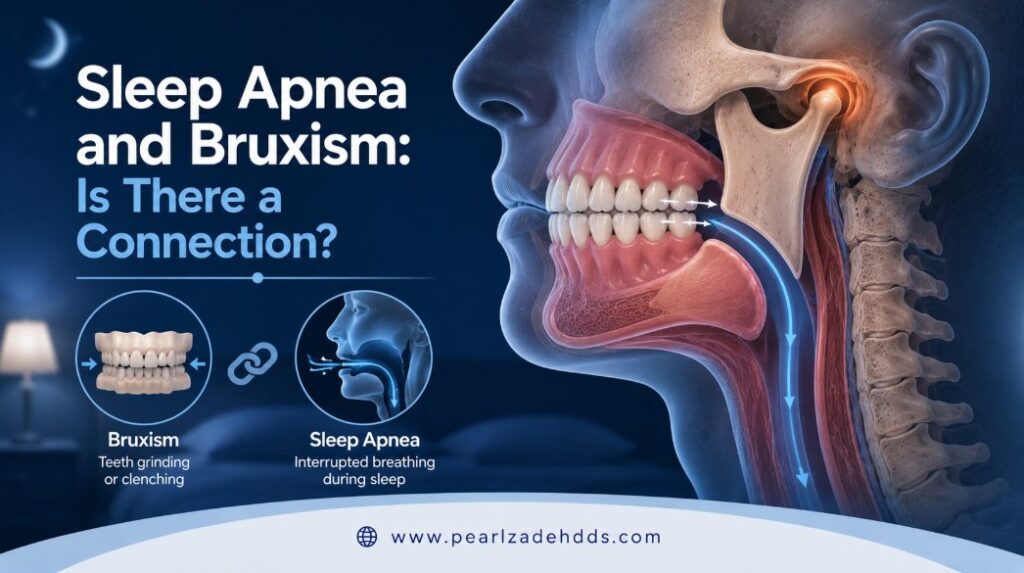
Sleep apnea involves disrupted breathing during sleep. Bruxism involves jaw-muscle activity during sleep. The two can occur together, and research suggests a genuine association between them. Grinding your teeth does not automatically mean you have sleep apnea, and sleep apnea can’t be diagnosed from tooth grinding alone. Keeping that distinction clear is really the main point of everything above.
Speak With Dr. Pearl Zadeh About Teeth Grinding
Nighttime grinding can have several different contributing factors, and it doesn’t automatically mean you have sleep apnea. Dr. Pearl Zadeh, a member of the American Dental Association and California Dental Association, can evaluate signs of tooth wear, clenching, grinding, jaw symptoms, and your overall oral health. If your symptoms suggest a possible sleep-related breathing issue, that’s a conversation worth having with an appropriate healthcare or sleep professional alongside your dental care.
Schedule a consultation to talk through what you’re noticing and get a clearer picture of your dental health.
Call (818) 716-6722 or click the button below to schedule a consultation online.
Frequently Asked Questions
Does grinding my teeth mean I have sleep apnea?
No. Research shows an association between sleep bruxism and sleep apnea, but most people who grind their teeth don’t have sleep apnea, and most people with sleep apnea don’t necessarily grind their teeth.
Can sleep apnea cause teeth grinding?
The evidence supports an association rather than a proven cause-and-effect relationship. Researchers are still working out the exact mechanisms connecting the two.
Should I get a sleep study just because I grind my teeth?
Not automatically. A sleep evaluation makes more sense if grinding occurs alongside symptoms like loud snoring, witnessed breathing pauses, or excessive daytime sleepiness.
Will treating sleep apnea stop my teeth grinding?
It might for some patients, but not for everyone. Research on this is ongoing, and outcomes vary between individuals.
Does a night guard treat sleep apnea?
No. A night guard may protect teeth from grinding, but it doesn’t treat the airway obstruction involved in sleep apnea. Suspected sleep apnea needs its own medical evaluation.
This article is for informational purposes only and is not a substitute for professional dental or medical advice. Please schedule a consultation with Pearl Zadeh DDS to discuss your specific situation.