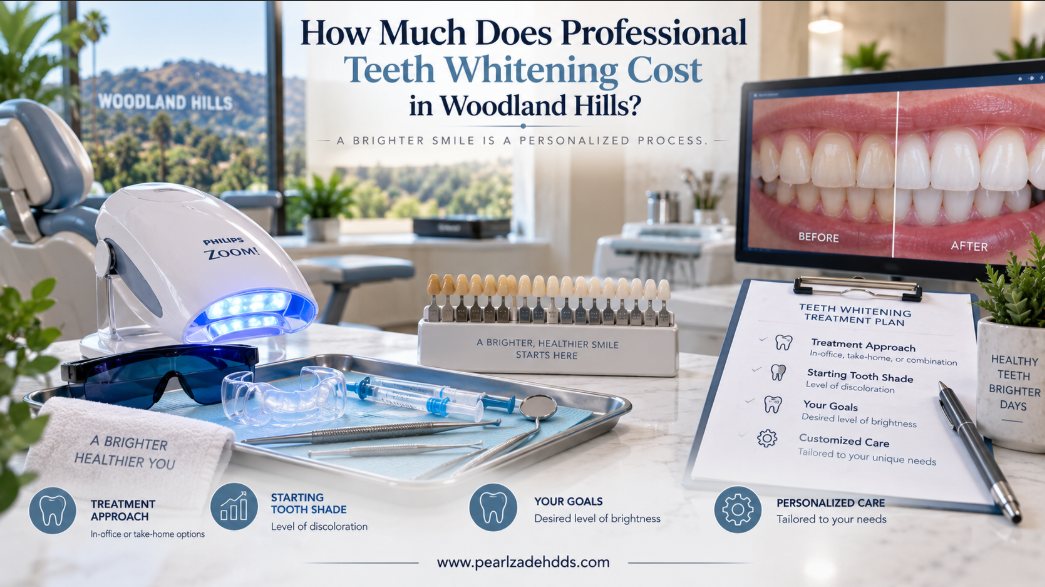
Cost is one of the first things people want to know before scheduling professional teeth whitening. It’s a fair question. The honest answer is that no single price applies to every patient in Woodland Hills.
Several factors affect the final cost. These include your treatment approach and the number of sessions you need. Your starting tooth shade and the type of discoloration also matter. The condition of your teeth and gums can affect the price too. Existing dental work and your specific whitening goals also factor into the final cost.
Our professional teeth whitening services are planned around each patient individually rather than priced the same way for everyone who walks in.
How Much Does Professional Teeth Whitening Cost in Woodland Hills?
Our current whitening fee is best confirmed directly with the practice. Publishing an unverified number here would not give you a reliable answer. General whitening costs vary widely between sources. Prices also depend on location, treatment method, and the provider. Giving one figure could create a false sense of precision rather than provide useful information.
A national average or price from another city does not tell you what your treatment will cost. It cannot account for your specific teeth, goals, or treatment needs. It’s more useful to understand what drives the cost. That way, you know what questions to ask and what to expect after your dentist evaluates your teeth and provides a personalized quote.
What Affects the Cost of Professional Teeth Whitening?
The Type of Whitening Treatment
Professional whitening isn’t a single procedure. Dentists use different approaches based on your needs and goals. These include in-office whitening completed in one visit and dentist-supervised take-home trays used over several weeks. In-office whitening typically uses a higher-concentration whitening agent. The dental team applies it directly to your teeth, often producing a visible change after one appointment.
Take-home trays use a lower-concentration whitening agent. You apply them yourself over several nights under your dentist’s guidance. This approach spreads the whitening process over time instead of concentrating it into one visit.
The materials and whitening agent concentration can affect the cost. The treatment setting also matters. You may receive treatment in the office or at home under professional guidance.
The right method isn’t necessarily the most expensive or cheapest option. It’s the one that fits your goals, schedule, and dental needs.
How Much Whitening You Need
Patients start from very different places. Some have mild surface staining that responds readily to whitening. Others have deeper discoloration that takes more time or a different approach to address. The American Dental Association notes that whitening can be effective on surface stains, but treats staining within the dentin layer very differently: removing that kind of deep, intrinsic staining through an external whitening procedure alone is considered close to impossible. Not every type of discoloration responds the same way, and no provider can honestly promise the same result for every patient walking through the door.
Your Existing Oral Health
A dentist typically needs to evaluate your teeth and gums before recommending whitening. Untreated decay, active gum problems, significant sensitivity, or cracked or damaged teeth can all affect whether whitening makes sense right now, or whether something else needs attention first. Whitening a tooth with an unresolved cavity underneath it, for example, doesn’t address the actual problem and can make it harder to monitor.
Whitening isn’t something that should automatically happen before addressing an active dental problem. Our discussion of early signs of gum disease covers what’s worth watching for if you’re unsure where your gum health currently stands.
What Is Included in Professional Teeth Whitening?
Depending on the treatment approach, professional whitening may include a dental evaluation to check whether whitening is appropriate right now, treatment planning specific to your teeth and goals, professional-grade whitening materials that aren’t available over the counter, customization based on your particular sensitivity and discoloration pattern, professional application or supervision throughout the process, instructions for maintaining your results afterward, and follow-up recommendations when appropriate.
A quoted price built around a genuine evaluation and a plan tailored to your teeth is a different thing than a flat fee for a generic product, even if the numbers happen to look similar on paper. Not every element applies to every treatment plan, and what’s specifically included in your case is something to confirm directly with your provider rather than assume from a general list like this one.
Why Does Professional Whitening Cost More Than Whitening Strips?
Professional treatments generally use stronger whitening formulations than what’s available over the counter, applied under a dentist’s supervision rather than on your own. The ADA confirms that professional whitening uses higher-concentration peroxide agents than over-the-counter products, which generally means visible change happens faster than it would with a lower-concentration product used at home. A dentist can also customize the approach and monitor for side effects along the way. Convenience matters too.
A single supervised session accomplishes something that might take weeks of consistent at-home use to approach. This doesn’t mean professional whitening is always dramatically more effective for every patient and every type of staining. It means you’re generally paying for strength, customization, and oversight rather than the whitening product alone. Our comparison of professional and at-home whitening goes further into these differences.
Does the Type of Staining Affect Whitening Cost?
Yes, in a meaningful way. Surface stains from coffee, tea, red wine, or tobacco tend to respond well to standard whitening approaches, since they sit on the outer surface of the tooth rather than deep within it. Deeper, intrinsic discoloration, the kind that develops within the tooth structure itself, behaves differently and generally needs more time or a stronger approach to address.
Age-related darkening happens gradually as enamel thins and the naturally darker dentin underneath becomes more visible. Certain medication-related staining, particularly from medications taken during childhood tooth development, can be especially resistant to standard whitening.
Discoloration tied to past dental trauma or affecting a single tooth is its own category entirely, sometimes involving changes inside the tooth that external whitening simply can’t reach. In some cases, whitening alone may not fully resolve the concern, and a different cosmetic approach may be worth discussing instead. Our overview of cosmetic treatment options for stained teeth goes further into what else might apply depending on the type of discoloration involved.
Can Crowns, Veneers, or Fillings Affect Whitening Cost?
This is worth understanding before you start. Whitening changes the color of natural tooth structure. The ADA is direct on this point: only natural teeth can be whitened, not tooth-colored restorations like crowns, veneers, or fillings. If you have visible restorations, your dentist needs to consider whether your natural teeth will end up a noticeably different shade than the restored ones once whitening is complete.
A front tooth with a crown sitting next to teeth that just got several shades lighter is exactly the kind of mismatch worth planning around ahead of time, not discovering afterward. This doesn’t mean restorations always need to be replaced after whitening, and it doesn’t mean whitening treatment changes the color of an existing restoration. It simply means shade matching is part of the conversation when restorations are involved, and it can affect what your dentist actually recommends.
Does Tooth Sensitivity Make Professional Whitening More Expensive?
Not automatically, though it’s a real factor in how treatment gets planned. The ADA identifies temporary tooth sensitivity and gum irritation as the most common side effects of whitening treatment. Existing sensitivity can influence which approach your dentist recommends, how the treatment is paced, or what concentration of whitening agent makes sense for you.
A patient who already deals with sensitive teeth might do better with a lower-concentration approach spread over a longer period, rather than a single high-concentration session, even if that changes which specific treatment gets recommended. Sensitive teeth don’t automatically mean a more expensive treatment plan. They mean an individualized one. No provider can promise a completely sensitivity-free experience, but a thoughtful plan can help manage it, and any sensitivity that does occur is generally temporary.
How Many Whitening Treatments Will You Need?
This varies considerably based on your starting tooth shade, the type of discoloration involved, your desired result, the treatment method used, how your teeth actually respond, and how well you maintain results afterward. Some patients see the change they want after one session. Others need a follow-up treatment or ongoing touch-ups to maintain results over time, since whitening isn’t necessarily permanent and everyday habits like coffee, tea, or tobacco can gradually reintroduce staining.
That maintenance factor is worth asking about directly, since it can affect the total cost of keeping your results over the following months and years, not just the initial treatment. No dentist can honestly promise a specific number of shades of improvement or a universal number of sessions before actually evaluating your teeth.
Is Professional Teeth Whitening Worth the Cost?
That depends on your goals, the type of staining you’re dealing with, your expectations, and whether you value professional supervision over a do-it-yourself approach. Whitening strips and whitening toothpaste are less expensive and more convenient for mild, gradual change, but they generally work more slowly and offer less customization than professional treatment. They also can’t account for existing restorations, sensitivity, or discoloration that needs a different approach entirely, since there’s no evaluation built into a box you pick up at the drugstore.
Dentist-supervised at-home whitening sits somewhere in between, combining professional oversight with the convenience of treating your teeth at home. None of these options is universally better. What matters is which one actually fits what you’re trying to achieve, your budget, and your specific teeth.
How Can You Find Out What Teeth Whitening Will Cost?
The most accurate estimate comes from discussing your specific goals and dental condition directly with your provider. A few questions worth asking during that conversation: Which whitening method is being recommended for me? What’s actually included in the treatment? How many treatments might I realistically need? Are there any additional costs I should know about? Will my existing crowns, veneers, or fillings affect the plan? What should I expect after treatment? And what can I do to maintain the results once I have them?
Speak With Dr. Pearl Zadeh About Teeth Whitening
There’s no single price that fits every patient considering professional teeth whitening. Dr. Pearl Zadeh, an accredited member of the American Academy of Cosmetic Dentistry, can evaluate your teeth, discuss your goals, and help determine the right approach and current cost for your specific situation.
Call (818) 716-6722 or click the button below to schedule your consultation online.
Frequently Asked Questions
How much does professional teeth whitening cost in Woodland Hills?
Cost varies based on treatment method, the number of sessions needed, and your individual dental condition. The most accurate figure comes from a consultation with the practice.
Why does professional teeth whitening have different prices?
Treatment method, materials, the amount of discoloration involved, and whether existing dental work needs to be considered all influence the final cost.
Is professional teeth whitening more expensive than whitening strips?
Generally yes, since professional treatment uses stronger formulations under dental supervision, though the two options serve different needs and budgets.
Does insurance cover professional teeth whitening?
Cosmetic teeth whitening is generally not covered as a routine dental benefit, though coverage details can vary, so it’s worth checking directly with your insurance provider.
Do crowns and veneers affect the cost of teeth whitening?
They can factor into treatment planning, since restorations don’t whiten the same way natural teeth do, which may affect what approach makes sense for your smile.
This article is for informational purposes only and is not a substitute for professional dental advice. Please schedule a consultation with Pearl Zadeh DDS to discuss your specific situation and current pricing.