
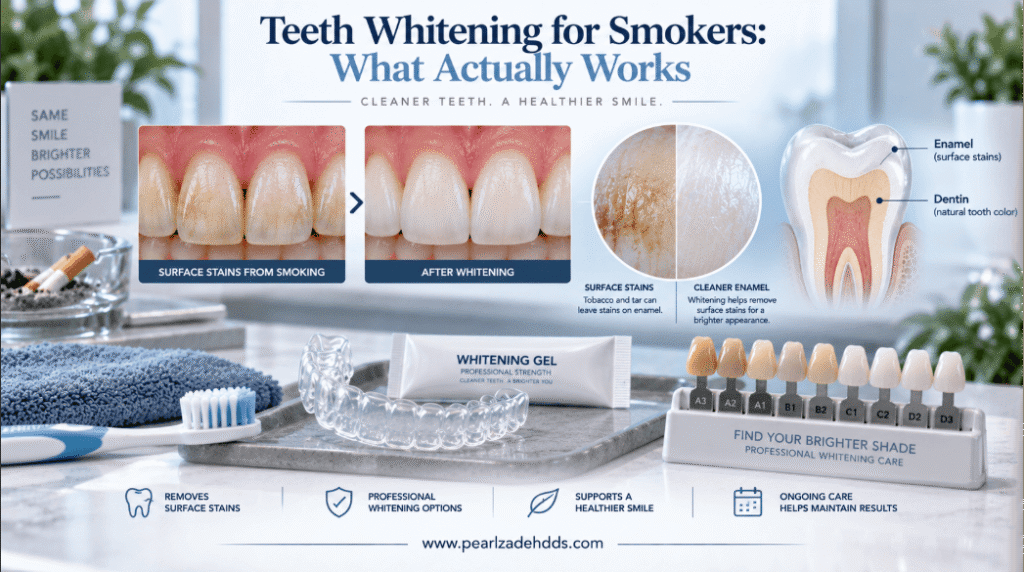
You catch a glimpse of your teeth in a photo and notice the yellow or brown tint that’s crept in over the years. You want a cleaner-looking smile, and whitening seems like the obvious place to start. Maybe you’ve already tried a drugstore kit or a box of strips, and the results felt underwhelming compared to what the packaging promised.
Tobacco-related discoloration often comes from staining sitting on the tooth surface, but the color you’re seeing can have other contributing factors too. Before picking a product off a shelf, it helps to understand what whitening can actually change for your specific teeth.
How Does Smoking Stain Your Teeth?
Tobacco smoke contains substances that settle onto tooth surfaces with repeated exposure. Nicotine itself is colorless, but it turns yellow to brown when it reacts with oxygen, and tar deposits a dark, sticky residue that clings readily to enamel. A 2023 systematic review and meta-analysis on tobacco and nicotine staining discusses research showing that cigarette smoke exposure can cause surface pits and other irregularities in enamel, which may make the tooth surface more susceptible to picking up staining compounds over time.
This helps explain why stains tend to become more noticeable the longer smoking continues, and why they can build up in places that are harder to reach with regular brushing, like along the gumline and between teeth. Someone who smokes occasionally for a few years will generally see less staining than someone who has smoked daily for decades, since the exposure simply adds up over time rather than happening all at once. Smoking isn’t the only thing that causes yellow or brown teeth, though. Coffee, tea, certain foods, and simple aging all contribute to similar-looking discoloration in people who’ve never smoked at all.
Can Teeth Whitening Remove Smoking Stains?
Often, yes, at least partially. Whitening tends to help most with surface staining, the kind sitting on top of your enamel rather than developed within the tooth structure itself. How much actual improvement you see depends on the type and depth of your discoloration, not just how long you’ve smoked. Two people with a similar smoking history can end up with genuinely different whitening results, since one might have mostly surface staining while the other has discoloration that’s partly settled deeper into the tooth. Our discussion of common reasons whitening doesn’t work goes further into why some stains respond differently than others.
What Whitening Options Can Help With Smoking Stains?
A few different approaches exist, and none of them is automatically the right choice for every patient. What actually fits depends on your specific staining, your budget, and how much oversight you’d prefer during treatment.
Professional Teeth Whitening
A dentist can evaluate your specific discoloration and let you know whether it’s the kind of staining likely to respond well to whitening, before you commit time and money to treatment. Professional teeth whitening gives you that evaluation up front, along with a treatment plan tailored to what your teeth actually need. This isn’t a promise of a specific outcome. It’s an evaluation-first approach rather than trial and error with whatever product is on the shelf.
Whitening Strips and At-Home Products
Over-the-counter strips and kits use lower-concentration whitening agents than what a dentist can use, generally applied over a longer stretch of time rather than in a single session. Results genuinely vary depending on your specific staining and how consistently you use the product. These can be a reasonable starting point for milder, more surface-level discoloration, though they aren’t guaranteed to work the same way for everyone.
Whitening Toothpaste
Whitening toothpaste primarily works through its cleaning action, helping remove surface stains as you brush rather than chemically bleaching the tooth. It isn’t designed to produce the same effect as professional bleaching treatments, and it generally works best as a maintenance habit rather than a standalone solution for more established staining.
Why Can Smoking Stains Be Difficult to Whiten?
A few things can make tobacco-related discoloration more resistant to whitening than expected. The staining may simply be heavy or long-standing, having built up over years rather than months, which generally takes more time and consistency to lighten than staining that developed more recently. Some of the discoloration may not sit entirely on the surface, meaning whitening reaches part of the problem but not all of it, particularly once tar and nicotine have had years to work into small surface irregularities in the enamel.
Your natural tooth color plays a role too, since teeth vary in shade regardless of staining, and whitening can only lighten what’s actually stained rather than change your underlying tooth color entirely. Enamel changes that happen with age can alter how light reflects off your teeth in ways whitening doesn’t directly address, since thinner enamel lets more of the naturally yellower dentin underneath show through.
Existing restorations don’t respond to whitening the way natural teeth do, so a crown or filling placed years ago will stay exactly where it started regardless of how well your natural teeth respond. And sometimes the whitening approach being used simply doesn’t match what’s actually causing the discoloration, the same way a product built for coffee stains won’t necessarily work as well on years of accumulated tar. Reaching for a stronger product isn’t automatically the fix when one of these factors is actually at play.
What If Whitening Barely Changes Your Teeth?
If you’ve already tried whitening with little visible improvement, that doesn’t necessarily mean the product was defective or that you did something wrong. Limited results are often a sign that the color you’re seeing isn’t the type whitening addresses well. Someone who’s used whitening strips faithfully for weeks with barely noticeable change may actually be dealing with discoloration that goes deeper than what surface-focused products can reach. Identifying the actual source of your discoloration matters more than trying yet another product.
A dentist can assess whether your color comes from surface staining, deeper intrinsic discoloration, your natural tooth shade, or existing dental restorations. Our overview of cosmetic treatment options for stained teeth goes further into what else might apply depending on what’s actually going on. No single alternative is automatically the better choice. What fits depends on the cause and your own goals.
Does Smoking Make Teeth Whitening Results Fade Faster?
Continued exposure to tobacco smoke can contribute to new staining building up after whitening, since the same substances that caused the original discoloration are still reaching your teeth. There’s no guaranteed duration for how long whitening results actually last. How quickly maintenance becomes necessary depends on your individual habits, oral hygiene routine, diet, and the specific whitening treatment you used. Our discussion of how long teeth whitening lasts goes further into what actually affects that timeline.
Can You Whiten Crowns, Veneers, or Fillings That Have Smoking Stains?
Natural tooth structure and restorative materials respond to whitening differently. Whitening doesn’t simply change the shade of every material in your mouth the way it changes natural enamel. Crowns, veneers, and fillings generally stay at whatever shade they were originally made in, regardless of what whitening does to your natural teeth. Picture a front tooth crown placed years ago, discolored on its surface from years of smoking.
Cleaning can remove some of that surface buildup, but the crown itself won’t lighten the way a natural tooth would under a whitening agent. If your surrounding natural teeth become noticeably lighter, an existing restoration can end up looking mismatched by comparison. Our discussion of whitening before veneers or crowns covers that timing question in more depth. This doesn’t mean a restoration always needs replacing after whitening. It simply explains a mismatch that whitening itself won’t resolve on its own.
What About Sensitive Teeth?
Whitening can cause temporary sensitivity for some people, regardless of smoking history. Nicotine and tar don’t make teeth inherently more or less sensitive to whitening on their own. If you already deal with sensitivity, a more individualized approach to concentration, timing, or product choice often makes sense. Our discussion of teeth whitening for sensitive teeth and our look at whether whitening can damage enamel both go further into what’s actually happening when sensitivity shows up. Experiencing sensitivity doesn’t automatically mean your enamel has been damaged.
Can You Keep Teeth White If You Continue Smoking?
Realistically, continued smoking can contribute to new staining building up over time, which can make it harder to maintain a lighter appearance for as long as you might like. This doesn’t mean whitening is pointless if you continue to smoke. It means maintenance and touch-ups become a more regular part of the picture, and consistent oral hygiene along with periodic professional cleanings genuinely help slow new staining down.
Rinsing with water after smoking, keeping up with regular brushing, and not letting stretches go by without a dental cleaning all make a real difference in how quickly new discoloration reappears. If quitting smoking is something you’re considering for your own reasons, it can also reduce how quickly new discoloration develops, though that’s ultimately a personal decision separate from whether whitening is worth pursuing now.
When Should You See a Dentist About Tooth Discoloration?
Discoloration that’s persistent, unusual, uneven between teeth, or simply doesn’t match what you’d expect from typical staining deserves an actual evaluation. Color changes can sometimes come from causes entirely unrelated to smoking, including changes in gum health.
Our discussion of early signs of gum disease covers what else is worth watching for. None of this can be determined from color alone. A dental examination can identify what’s actually causing your specific discoloration and whether whitening is an appropriate next step before any treatment begins.
Speak With Dr. Pearl Zadeh About Tobacco-Related Staining
Tobacco-related discoloration doesn’t respond the same way in every patient, and whitening isn’t a one-size-fits-all solution. Dr. Pearl Zadeh can evaluate the actual source of your discoloration, whether it’s surface staining, natural tooth color, existing restorations, or something else entirely, and discuss whether professional whitening fits your goals.
Call (818) 716-6722 or click the button below to schedule your consultation online.
Frequently Asked Questions
Can teeth whitening remove smoking stains?
Often, at least partially, particularly for surface staining. How much improvement you see depends on the type and depth of your specific discoloration.
What is the best teeth whitening for smokers?
There isn’t one universally best option. The right approach depends on the type of discoloration, any sensitivity, your overall oral health, and your specific goals.
Can smokers get professional teeth whitening?
Yes, smoking itself doesn’t rule out professional whitening. A dental evaluation can determine whether your specific discoloration is likely to respond well.
Do whitening strips remove cigarette stains?
They can help with milder, surface-level staining, though results vary and strips generally use lower concentrations than professional treatment.
Why are my teeth still yellow after whitening?
Your natural tooth color, enamel changes, or discoloration that extends beneath the surface can all limit how much visible change whitening produces.
Will smoking make my teeth turn yellow again after whitening?
Continued exposure to tobacco can contribute to new staining over time, so ongoing maintenance is often part of keeping results looking their best.
This article is for informational purposes only and is not a substitute for professional dental advice. Please schedule a consultation with Pearl Zadeh DDS to discuss your specific situation.