
When a tooth is removed or lost, the gap does not stay neutral for long. The teeth around it begin adapting almost immediately. Chewing shifts, pressure redistributes, and the bite starts adjusting in ways most patients do not notice at first.
Dentists use dental bridges to stop this chain reaction. They restore the missing tooth and help bring balance back to the bite. Most patients go through two phases of treatment: a temporary bridge first, followed by a permanent one.
Both serve different purposes, even though they sit in the same space.
What a dental bridge is doing in the background
A bridge replaces a missing tooth by anchoring an artificial tooth between two supporting teeth. Those supporting teeth carry the load every time you chew.
Without that support, nearby teeth slowly drift into the empty space. The opposing tooth may also start moving out of position. Over time, that creates uneven contact between teeth, which then affects chewing efficiency and jaw comfort.
A bridge interrupts that process and restores a stable chewing pattern.
Temporary bridges are about protection, not permanence
A temporary bridge goes in right after the dentist prepares the supporting teeth. At this stage, the preparation reshapes those teeth, and they can become sensitive if left uncovered.
The temporary bridge acts as a protective cover.
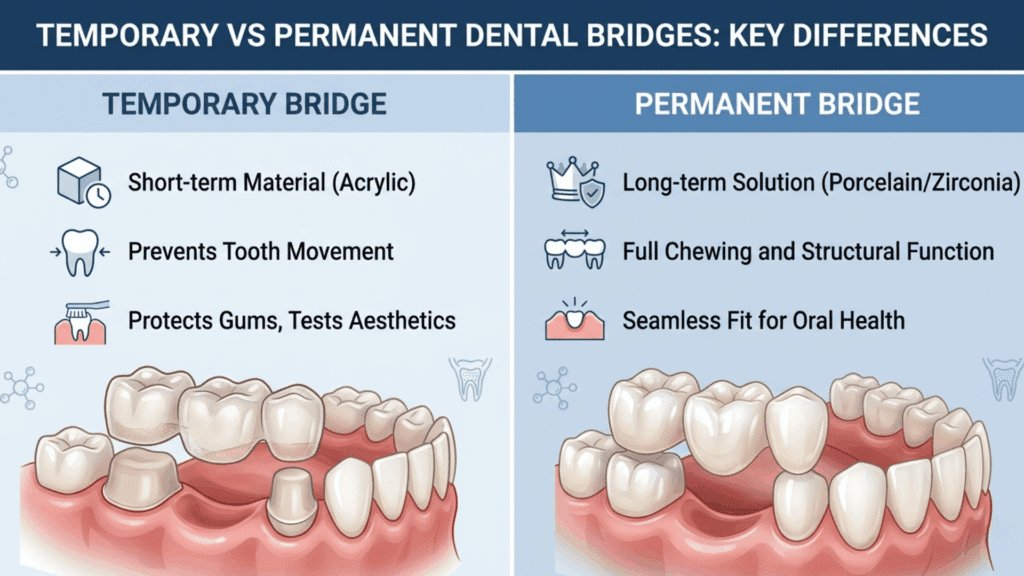
Dentists usually make it from resin or acrylic. These materials adjust easily, which helps during healing, but they do not handle long-term chewing pressure well.
Most patients wear it for a short period while the dentist fabricates the permanent bridge.
During this phase, the goal is simple: keep the teeth covered, reduce sensitivity, and prevent nearby teeth from shifting.
It works well for function, but it is not strong enough for heavy chewing. Sticky or hard foods can easily affect its fit or cause damage.
Permanent bridges are built for long-term function
Dentists custom-make a permanent bridge using detailed scans or impressions of the mouth. They adjust the design to match bite forces, tooth shape, and surrounding alignment.
The team selects materials based on where the bridge sits and how much pressure it needs to handle. Porcelain, ceramic, zirconia, or metal-supported options are commonly used.
Once placed, the dentist cements it securely onto the supporting teeth. At that point, it becomes part of the bite system.
Most patients notice the difference immediately. It feels more stable, more natural, and more predictable during chewing.
Temporary vs permanent dental bridges
When you compare both stages, the contrast becomes clear in function rather than appearance.
| Factor | Temporary Bridge | Permanent Bridge |
| Purpose | Protects prepared teeth during healing | Restores long-term chewing function |
| Material | Resin or acrylic | Porcelain, ceramic, zirconia, or metal-based |
| Strength | Light chewing only | Handles daily bite forces |
| Duration | Weeks to a few months | Several years |
| Fit | Basic fit that may change | Precision fit based on final bite |
| Stability | Can loosen more easily | Fixed and stable |
The temporary bridge supports healing. The permanent bridge completes the restoration once the mouth is ready.
Why the temporary stage matters more than patients expect
Many patients assume the temporary bridge is just a placeholder, but it plays a bigger role than it seems.
It keeps the prepared teeth from becoming sensitive or irritated. It also holds space so nearby teeth do not drift into the gap while waiting for the final bridge.
Even the gums benefit from it. Without that structure, gum tissue can shift slightly, which later affects how accurately the permanent bridge fits.
When temporary bridges are ignored or stressed too much, the final result often needs more adjustment later.
What changes when the permanent bridge is placed
Once the permanent bridge is fitted, the experience shifts quickly.
Chewing feels more even. Pressure distributes more naturally. The restoration does not draw attention the way the temporary one sometimes does.
There is usually a short adjustment period while the bite settles. Small refinements may be needed, especially if one side feels slightly higher than the other at first.
After that phase, the bridge should blend into normal function without conscious effort.
How long each one realistically lasts
Temporary bridges are not designed for longevity. They usually stay in place for a few weeks, sometimes a little longer depending on healing and lab timing.
Permanent bridges, on the other hand, are designed for long-term use. Most last between 5 and 15 years, sometimes longer when patients maintain good oral hygiene and protect against grinding.
Their lifespan depends heavily on bite force, gum health, and how well the supporting teeth remain stable over time.
What usually goes wrong with temporary bridges
Because they are made from softer materials, temporary bridges are more sensitive to everyday habits.
They can loosen if chewing pressure is too strong or if sticky foods are used. They may also chip or wear down more quickly than expected.
For that reason, dentists usually advise patients to chew carefully and avoid putting heavy force on that area during the temporary phase.
Taking care of both stages
Both types of bridges rely on the same foundation, good hygiene and consistent care.
Brushing around the gum line and cleaning underneath the bridge helps prevent plaque buildup. Regular checkups also allow early detection of small fit changes before they become larger issues.
Patients who grind their teeth often benefit from a nightguard once a permanent bridge is placed, since grinding puts constant pressure on the restoration.
Book a dental bridge consultation
If you are planning a dental bridge or already have one that feels slightly different while chewing, it is worth getting it checked before small changes turn into structural problems.
At Dr. Pearl’s practice, bridge treatment goes beyond simply replacing a missing tooth. She evaluates how the bridge fits into your overall bite, not just how it looks on its own. Each case focuses on pressure distribution, supporting tooth strength, and long-term stability so the result feels natural when you chew, not just when you smile.
Call (818) 716-6722 or click the button below to schedule a consultation and review the best option for your situation.
Schedule a ConsultationFrequently Asked Questions
1. How can I tell if my temporary dental bridge is failing?A temporary bridge often shows early signs of problems through small changes. It may feel slightly loose, shift when you chew, or trap food more than before. Some patients also notice sensitivity in the prepared teeth underneath. Even minor movement is worth checking because the temporary bridge protects the area while the permanent one is being made.
2. Why does a permanent dental bridge feel different from a temporary one?A permanent bridge feels more stable because dentists custom-make it from detailed scans or impressions of your bite. It is designed to handle full chewing pressure and fit precisely against your supporting teeth. A temporary bridge, on the other hand, only serves a short-term function and does not have the same level of precision or strength.
3. Can I eat normally with a temporary dental bridge?You can eat with a temporary bridge, but it requires caution. Hard, sticky, or very chewy foods can loosen or damage it. Most dentists recommend softer foods during this phase to protect both the temporary bridge and the prepared teeth underneath.
4. How long does it take to get a permanent dental bridge?In most cases, it takes a few weeks to receive a permanent bridge. The exact timeline depends on the complexity of the case and the dental laboratory process. During this time, the temporary bridge protects the area and maintains function while healing and fabrication take place.
5. What makes Dr. Pearl’s approach to dental bridges different?Dr. Pearl evaluates dental bridges based on how they affect the entire bite, not just how they restore the missing tooth. She focuses on long-term stability, supporting tooth health, and how evenly pressure spreads during chewing. This approach helps create bridges that feel natural and function comfortably in daily use.