
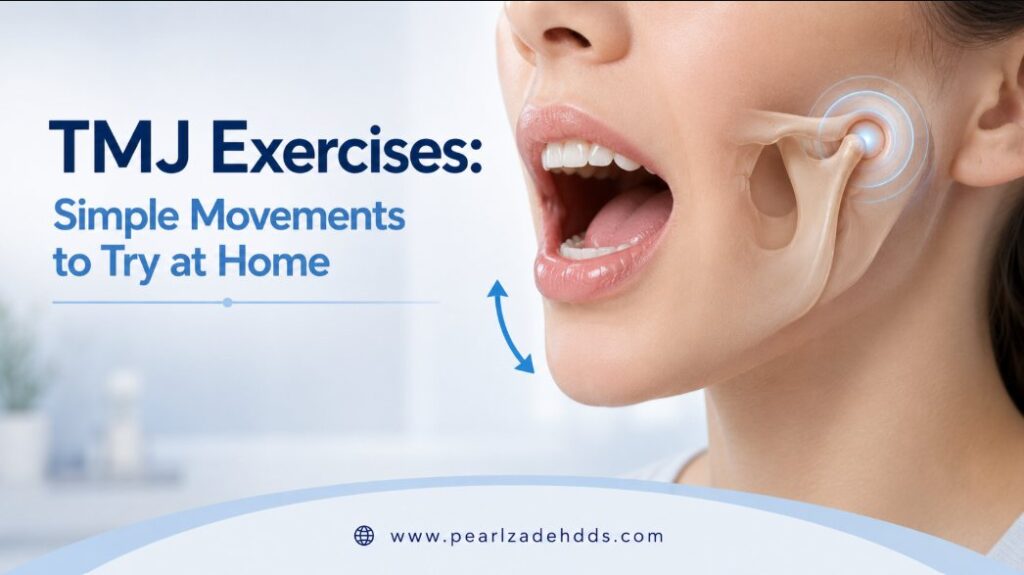
Your jaw feels tight by the end of the day. Maybe it’s from clenching through a stressful meeting, chewing through a long lunch, or just hours spent hunched over a desk. You search for TMJ exercises and land on a page full of aggressive-looking stretches that seem more likely to strain your jaw than help it.
Gentle, controlled jaw movements may genuinely help some people. More movement isn’t automatically better, and the right exercise depends on what’s actually causing your symptoms. The goal here is gentle motion, not forcing your jaw through pain to see what happens.
What Does “TMJ” Actually Mean?
You have a temporomandibular joint on each side of your face, just in front of your ears, connecting your lower jaw to your skull. Muscles, ligaments, and other structures around that joint let your jaw open, close, and move side to side. Patients commonly say “TMJ” to mean all sorts of things: jaw pain, clicking, general stiffness, or a diagnosed TMJ disorder. This article uses the term loosely too, the way most people actually use it in conversation.
Can TMJ Exercises Help?
For some people, yes, though not everyone. Gentle exercises may help improve controlled jaw movement, ease muscle tension, or restore more comfortable movement in certain situations. A pilot randomized controlled trial on jaw-opening exercises notes that this kind of exercise therapy is considered standard, conservative care for temporomandibular disorders, and several studies have found it helps decrease muscle and joint pain while improving mobility. That same trial specifically excluded patients with certain types of disc displacement from participating, which is a useful reminder that exercises aren’t a fit for every jaw problem. The National Institute of Dental and Craniofacial Research notes that most common jaw joint and muscle problems are temporary and don’t get worse, and that conservative, reversible approaches are generally recommended first. Some jaw problems genuinely call for an examination rather than more exercises at home.
Six Gentle Exercises to Try at Home
Each of these should feel controlled and comfortable. None of them should be pushed through pain.
1. Relaxed Jaw Position
Let your jaw hang loose rather than actively holding it in place. Keep your teeth slightly apart rather than touching. Let your tongue rest comfortably rather than pressing hard against anything. This position avoids unnecessary tooth contact and gives your jaw muscles a genuine break, which can help if you tend to clench without realizing it throughout the day.
2. Controlled Jaw Opening
Slowly open your mouth in a smooth, controlled way. The goal is controlled motion, not opening as wide as physically possible. The movement should stay comfortable the entire time. If your jaw becomes painful, catches, or locks partway through, stop rather than pushing further to see what happens.
3. Controlled Jaw Closing
Slowly bring your jaw back to a relaxed, resting position. Keep the motion smooth and unhurried rather than snapping your mouth shut. There’s no reason to deliberately guide your jaw into a spot that clicks or feels painful just to test it.
4. Tongue-on-the-Roof-of-the-Mouth Movement
Rest the tip of your tongue gently on the roof of your mouth, then perform a controlled opening and closing movement while keeping it there. This is a simple way to encourage smoother movement without focusing solely on the jaw itself. It isn’t a technique that permanently repositions your jaw or changes your bite, and it shouldn’t be treated as one.
5. Gentle Side-to-Side Movement
With your mouth slightly open, gently shift your lower jaw to one side, then the other. The goal is comfortable movement, not forcing your jaw farther than it naturally wants to go. A small, easy range is the point here, not a dramatic stretch.
6. Gentle Forward Jaw Movement
Gently move your lower jaw slightly forward, then return it to a relaxed position. Keep this movement small and unforced. If it brings on pain, catching, or makes your symptoms feel worse, stop and skip this one rather than repeating it.
Should TMJ Exercises Hurt?
No, they shouldn’t be forced through pain. Gentle movement, mild stretching, or a general awareness of your muscles working is reasonable. Sharp pain, joint pain that increases as you continue, or your jaw locking or catching are different signals entirely. Discomfort that gets worse during or after an exercise is a reason to stop, not a reason to push harder.
How Often Should You Do TMJ Exercises?
There’s no single schedule that fits everyone, since the right frequency depends on the specific movement and why it was recommended in the first place. If a dentist, physical therapist, or another healthcare professional has given you a specific routine, follow that rather than improvising your own. Doing more repetitions on a painful jaw isn’t automatically better, and repeating an exercise that consistently hurts isn’t the same as making progress.
What Should You Avoid While Your Jaw Is Irritated?
A handful of everyday habits can add unnecessary strain while your jaw is already bothered:
- Chewing gum for long stretches
- Eating very hard or chewy foods when your jaw is painful
- Biting your nails
- Chewing on pens or other objects
- Opening your mouth unnecessarily wide
- Repeatedly testing a jaw click just to see if it’s still there
- Clenching your teeth without a real reason to
Cutting back on these habits can be just as useful as adding exercises, sometimes more so.
What If Your Jaw Clicks During an Exercise?
Clicking or popping during a movement doesn’t automatically mean your joint is being damaged. It’s a different story if that clicking comes with pain, locking, catching, limited movement, or a sudden change in how your bite feels. In those cases, stop the exercise and talk to your dentist rather than continuing through it. Our discussion of TMJ and jaw clicking goes further into what jaw sounds can and can’t tell you on their own.
When TMJ Exercises May Not Be Enough
Home exercises aren’t a substitute for an actual evaluation when symptoms persist or get worse. A few situations are worth bringing to a dentist rather than continuing to self-manage:
- Ongoing jaw pain
- Increasing stiffness
- Difficulty opening your mouth
- Jaw locking
- Difficulty chewing
- Facial swelling
- A sudden change in your bite
- Symptoms that started after an injury
- Pain that keeps returning
- Severe or worsening symptoms
Not every item on this list is urgent. Ongoing stiffness is a reasonable thing to mention at a routine visit, while sudden swelling or symptoms following an injury deserve more prompt attention.
Can Teeth Grinding Cause Jaw Tightness?
For some patients, yes. Clenching and grinding place extra demand on the same jaw muscles these exercises are meant to relax. Our discussion of how teeth grinding damages teeth over the years covers that connection in more depth. This doesn’t mean every case of jaw tightness or TMJ symptom traces back to grinding. It’s simply one contributing factor worth considering alongside everything else.
Can a Night Guard Help With TMJ Symptoms?
For some patients, an occlusal splint may be part of managing jaw symptoms, but it isn’t a universal treatment for every jaw problem. Our overview of occlusal splints goes further into how these appliances work and who they’re actually appropriate for. Whether one makes sense for you depends on your teeth, your bite, your specific symptoms, and what a dentist finds during an evaluation, not something to assume from an online description alone.
How a Dentist Evaluates Jaw Symptoms
An evaluation typically covers how your jaw moves, your range of motion, tooth wear, your bite, the muscles around your jaw, any joint sounds, pain or tenderness, when your symptoms tend to show up, and whether clenching or grinding seems to be part of the picture. The goal is figuring out what’s actually contributing to your symptoms before deciding whether exercises, an appliance, ongoing monitoring, or another approach makes the most sense.
Simple Habits That Can Help Your Jaw
Keeping your teeth apart when you’re not actually eating gives your jaw muscles a break they often don’t get. Avoiding unnecessary clenching, even outside of stressful moments, helps too. Taking breaks during long stretches of chewing, choosing softer foods temporarily if chewing feels uncomfortable, and paying attention to your posture during long hours at a desk can all reduce unnecessary strain. Resisting the urge to repeatedly test a painful movement, just to check if it still hurts, is worth adding to that list as well.
Speak With Dr. Pearl Zadeh About Your Jaw Symptoms
Gentle exercises may help some patients manage mild jaw tightness or stiffness, but persistent or worsening symptoms deserve an individualized look rather than more exercises alone. Dr. Pearl Zadeh, a member of the American Dental Association and California Dental Association, can examine your teeth, bite, jaw movement, and symptoms to help figure out what may be contributing to the problem and whether home exercises make sense for your situation.
Schedule a consultation to talk through what you’re experiencing and get a clearer picture of what might actually help.
Call (818) 716-6722 or click the button below to schedule a consultation online.
Frequently Asked Questions
Can TMJ exercises fix my jaw problem?
Not necessarily. Gentle exercises may help with muscle tension or controlled movement for some people, but they don’t address every possible cause of jaw symptoms.
Are jaw exercises safe to try at home?
Gentle, controlled movements are generally reasonable to try, but they should never be forced through pain. Stop if you notice sharp pain, locking, or worsening symptoms.
How many times a day should I do TMJ exercises?
There’s no universal schedule. Frequency depends on the specific exercise and why it was recommended. Follow a professional’s specific routine if one has been provided.
Is it normal for my jaw to click during exercises?
Clicking alone doesn’t automatically mean something is wrong. If it comes with pain, locking, or limited movement, stop and have it evaluated.
When should I stop doing exercises and see a dentist instead?
If your symptoms are persisting, getting worse, or include locking, swelling, or a sudden bite change, an evaluation makes more sense than continuing to self-manage.
This article is for informational purposes only and is not a substitute for professional dental advice. Please schedule a consultation with Pearl Zadeh DDS to discuss your specific situation.