
Your dentist says you need a crown. A friend finished hers in one visit. Yours will take two or more appointments. Why the difference?
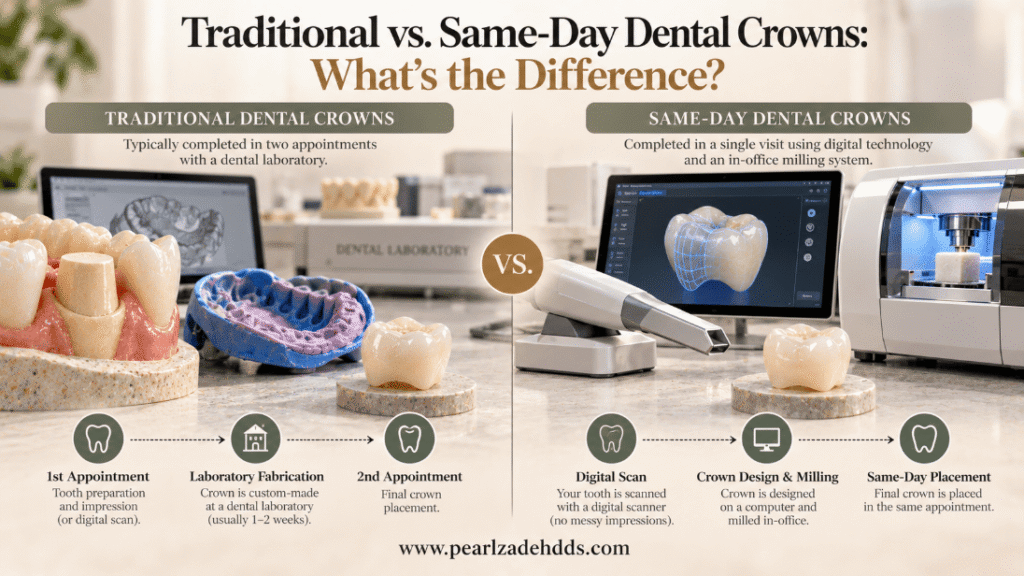
Dental crowns can be produced through different workflows. In a traditional workflow, the dentist prepares the tooth and records its shape with impressions or a digital scan. A temporary crown may be placed while the final restoration is fabricated for a later appointment.
Same-day systems use digital design and chairside milling or other in-office fabrication methods. They can allow the final restoration to be designed and placed during the same visit. The number of appointments reflects the workflow. It does not, by itself, tell you which approach will provide better treatment.
Both approaches can result in a finished crown that restores and protects the tooth. The main difference is how the restoration is designed, fabricated, and delivered. The right choice depends on the tooth, restoration, materials, clinical requirements, and available workflow.
What Is a Traditional Dental Crown?
A traditional crown follows a sequence of steps. Exact workflows vary between dentists, laboratories, materials, and individual cases.
Examination and treatment planning come first. The dentist then prepares the tooth, reshaping it to make room for the crown. An impression or digital scan records the prepared tooth and surrounding structures. When appropriate, a temporary crown is placed to protect the prepared tooth while the final restoration is made.
A dental laboratory commonly fabricates the final crown in a traditional workflow. The ADA explains that indirect restorations can be fabricated outside the mouth and then placed by the dentist. Digital impressions can also be part of this process.
At a later appointment, the dentist tries in the crown and evaluates its fit, appearance, and bite. After any necessary adjustments, the dentist cements or bonds the restoration.
A traditional crown does not always require exactly two appointments. The number of visits and time between them can vary depending on the case, laboratory, material, and dentist’s workflow.
A temporary crown may be used during this period. It helps protect the prepared tooth until the final restoration is ready. Because temporary cement commonly holds it in place, your dentist may give you specific instructions for eating and cleaning around it.
What Is a Same-Day Dental Crown?
Same-day crowns commonly use chairside CAD/CAM dentistry. CAD/CAM stands for computer-aided design and computer-aided manufacturing.
A digital scanner records the prepared tooth. Software then helps the dentist design the crown. In a chairside workflow, an in-office milling or fabrication system produces the restoration, which the dentist then finishes, evaluates, and places. The ADA notes that some indirect restorative work can be completed in the dental office.
This workflow can allow some crowns to be designed and placed during a single appointment. The exact process depends on the technology, material, and individual case.
CEREC is one example of chairside CAD/CAM technology. The name refers to a specific system rather than every same-day crown workflow. A 15-year study of chairside lithium disilicate crowns, for example, evaluated crowns produced with a CEREC system. Other chairside systems also exist.
Not every crown case is suitable for a same-day workflow. The tooth, restoration requirements, material, esthetic demands, and available technology can all affect the appropriate approach.
Digital scanning is also used in many traditional crown workflows. The main difference is therefore not simply whether a scanner is used. It is how the restoration is designed and fabricated and whether the final crown can be completed during the same visit.
A same-day appointment may also take several hours because design, fabrication, finishing, and placement occur during that visit.
Traditional vs. Same-Day Crowns: What Is the Difference?
The table compares typical features of each workflow.
| Factor | Traditional crown | Same-day crown |
| Number of visits | Often multiple appointments | Often one appointment |
| Temporary crown | Commonly used when needed | May not be needed |
| Fabrication | Often laboratory-based | Often completed in-office |
| Digital technology | May use digital scans | Typically relies heavily on digital design and fabrication |
| Waiting period | Final restoration is fabricated before placement | Design and fabrication occur during the visit |
| Material options | Depends on dentist and laboratory | Depends on the available chairside system |
| Adjustments | Evaluated before final placement | Evaluated during the same treatment visit |
| Suitability | Depends on the tooth and treatment plan | Depends on the case and available system |
This table gives a general comparison. The exact process varies by dentist, crown material, technology, and individual treatment needs.
Why Do Traditional Crowns Take More Than One Appointment?
Laboratory fabrication adds time to the treatment process. In a traditional workflow, the dentist sends the impression or digital scan and treatment instructions to a dental laboratory. The laboratory then fabricates the final restoration according to the prescribed material, shade, and design requirements.
A temporary crown may protect the prepared tooth while the final restoration is being made. At the later appointment, the dentist evaluates the crown’s fit, bite, shade, and appearance. Any necessary adjustments can be made before final cementation or bonding.
The additional time is not necessarily a disadvantage. Laboratory fabrication can give the dental team time to produce and characterize the restoration outside the patient’s appointment. The specific benefits depend on the material, restoration, laboratory, and clinical requirements.
Why Can Some Crowns Be Made in One Visit?
CAD/CAM technology can combine several stages of crown treatment within one appointment. A digital scanner records the prepared tooth, and software supports the crown design. The dentist can review the digital design and make adjustments before the restoration is fabricated in the office.
A chairside unit may mill the restoration from a ceramic block or use another in-office fabrication method. The dentist then completes any required finishing or characterization before evaluating and placing the crown.
Digital scanning itself has supporting research. A 2023 meta-analysis of 10 in vivo studies compared digital and conventional impressions for single-unit ceramic crowns. The pooled results found no significant difference in fit and reported clinically acceptable marginal fit for the digital workflows studied.
That research supports the use of digital impressions in appropriate crown workflows. It does not mean that every same-day crown will have the same outcome.
“Same-day” refers to the treatment workflow and timing. It does not mean diagnosis and planning happen instantly. The dentist still needs to examine the tooth, determine whether a crown is appropriate, and plan the restoration.
The appointment can also take several hours. Depending on the material and system, the restoration may require milling, crystallization, sintering, glazing, polishing, or other finishing steps before it is ready for placement.
Are Same-Day Crowns as Strong as Traditional Crowns?
No blanket answer applies. Crown strength and performance depend on the material, design, and thickness. Tooth location, bite forces, and the way the crown is cemented or bonded also matter.
A same-day crown is not a single material category. The manufacturing workflow and the crown material are separate questions. Widely used CAD/CAM materials include zirconia, glass ceramics, and resin-ceramic composites, according to the ADA. Which materials are available depends on the chairside system and treatment plan. Our article on zirconia vs porcelain crowns explains how common ceramic materials compare.
Design also affects how a crown performs under chewing forces. Thickness, shape, material properties, and the amount of tooth structure supporting the restoration all play a role. These factors depend on the individual tooth and the selected restorative system, not simply on whether the crown is made in one visit.
Do Same-Day Crowns Look Natural?
Appearance depends on the ceramic system, shade selection, and translucency. Surface texture, crown design, finishing, characterization, and the dentist’s technique can also affect the result.
Front teeth deserve particular attention because subtle differences in color and surface texture can be easier to see. For a visible tooth, matching the surrounding smile may be an important esthetic goal. Shade selection and the way the crown reflects and transmits light can both affect how natural it appears.
Research gives a mixed picture. A 2023 systematic review of 13 studies reported more esthetic complications with the CAD/CAM crowns studied than with conventional crowns. The review found no significant differences in the biological or technical complications it evaluated. However, it did not clearly separate chairside CAD/CAM crowns from laboratory-fabricated CAD/CAM crowns. The studies in its meta-analysis also used veneered ceramic frameworks, with an average follow-up of 3.6 years.
A 2020 review of six studies examining CAD/CAM lithium disilicate crowns reported no esthetic complications in the included studies.
Neither review supports a blanket claim about same-day crown esthetics. Same-day crowns do not automatically look less natural than laboratory-made crowns, and laboratory fabrication does not automatically produce a more esthetic result. The material, design, shade, finishing, and clinical circumstances all matter.
Do Same-Day Crowns Last as Long as Traditional Crowns?
Appointment count cannot determine crown longevity. Crown material, tooth condition, and design all matter. So do fit, bite forces, bruxism, oral hygiene, and gum health. Diet, habits, cementation or bonding, and regular dental examinations can also affect long-term performance.
The condition of the tooth deserves particular attention. A crown depends on the natural tooth and surrounding tissues that support it. A weakened or compromised tooth can create different considerations from a tooth with more healthy structure remaining.
Studies address specific materials and workflows rather than “same-day crowns” as one group. One 15-year study followed 34 chairside lithium disilicate crowns made with a CEREC system. The estimated survival rate was 80.1%, with a wide 95% confidence interval of 56.8% to 94.4%. The study had no comparison group, so it cannot show that chairside crowns last longer or shorter than traditional crowns.
A 2020 review of CAD/CAM lithium disilicate crowns reported favorable medium-term survival among the studies it evaluated. Another 12-year randomized trial of CAD/CAM partial ceramic crowns found differences in survival associated with the luting protocol used.
These studies provide useful information about particular materials and techniques. They do not establish a universal lifespan for same-day crowns. Our article on how long porcelain crowns last covers the factors that can affect crown longevity in more detail.
What Are the Benefits of Same-Day Crowns?
Same-day workflows may offer several practical benefits. Fewer appointments can make treatment more convenient. The time between tooth preparation and final placement may also be shorter.
In appropriate cases, a temporary crown may not be necessary. When a temporary is not needed, there is no temporary restoration that can loosen between visits. Patients with demanding work, travel, or scheduling commitments may also value completing treatment in one appointment.
The in-office digital workflow can combine scanning, design, fabrication, and placement within the same treatment process. This can reduce the number of separate visits needed for an appropriate case.
These benefits do not apply to every patient. A single-visit workflow is not automatically more comfortable or more effective. Your dentist can explain whether it is appropriate for your tooth.
What Are the Limitations of Same-Day Crowns?
Not every tooth or case suits a same-day workflow. Available materials and fabrication options depend on the chairside system used by the dental office.
The complexity of the restoration can also influence the workflow. Esthetic requirements, available space, crown design, material properties, and the condition of the tooth may all affect the decision. Some restorations may benefit from laboratory fabrication because of the materials, techniques, or customization involved.
Equipment, software, materials, and clinical training also vary between offices. Dentists who use chairside crown systems still need to determine which cases are suitable for that workflow.
These limitations do not mean that same-day crowns are inherently less durable or less accurate. Research on digital impressions, for example, has found clinically acceptable fit for digital workflows. Suitability remains a case-by-case decision.
Which Is Better: Traditional or Same-Day Crowns?
Neither approach is automatically better for every patient. The appropriate workflow depends on the tooth, restoration, materials, clinical requirements, and patient preferences.
The amount of remaining tooth structure matters, as do the tooth’s location and the forces placed on it during chewing. Esthetic requirements, crown material, and the complexity of the case can also influence the choice.
Available technology and the dentist’s laboratory workflow play a role as well. Your scheduling needs may matter when both approaches are clinically appropriate.
Two patients with similar dental problems can reach different decisions. One may value completing treatment in a single visit. Another may benefit from a material, design, or fabrication process that requires laboratory work.
The goal is an appropriate restoration that meets the needs of the tooth and patient. The fewest appointments are not necessarily the most important consideration.
What Should You Ask Before Choosing a Crown Workflow?
A few practical questions can help you understand why your dentist recommends a particular crown workflow:
- Which crown material do you recommend?
- Why is that material appropriate for my tooth?
- Will my crown be made in the office or by a laboratory?
- Do I need a temporary crown?
- How many appointments should I expect?
- How will you evaluate the crown’s fit and bite?
- What happens if the crown needs an adjustment?
- What should I expect after placement?
Our article on caring for a new crown covers what to expect during the first days and weeks after placement.
Clear answers can help you compare treatment plans based on more than appointment count. Material, tooth condition, restoration design, fit, and follow-up all matter. Writing your questions down before the appointment can also help you remember what you want to discuss.
How Does Dr. Pearl Zadeh Approach Crown Treatment?
Dr. Pearl Zadeh provides individualized restorative care based on the needs of each tooth and patient. Crown treatment can involve evaluating the tooth, surrounding tissues, bite, and restorative requirements before selecting the appropriate treatment.
You can learn more about crowns at Pearl Zadeh DDS.
A consultation can also give you an opportunity to ask about crown materials, the number of appointments, temporary restorations, and follow-up care. The appropriate plan depends on your tooth and your individual treatment needs.
Call (818) 716-6722 or click the button below to schedule your consultation online.
Frequently Asked Questions
Quality depends on the material, design, fit, and case, not the number of visits. Neither workflow is automatically better.
Longevity cannot be judged by appointment count. Material, tooth condition, bite, hygiene, and cementation all matter.
Often not, because the final crown is placed in the same visit. Some cases may still need a temporary.
It varies by dentist, laboratory, material, and case. Many involve at least two visits, but no fixed number applies.
No. Suitability depends on the tooth, the case, the material needed, and the available system.
The information above is for informational purposes only and is not a substitute for professional dental advice. Please schedule a consultation with Pearl Zadeh DDS to discuss your specific situation.