
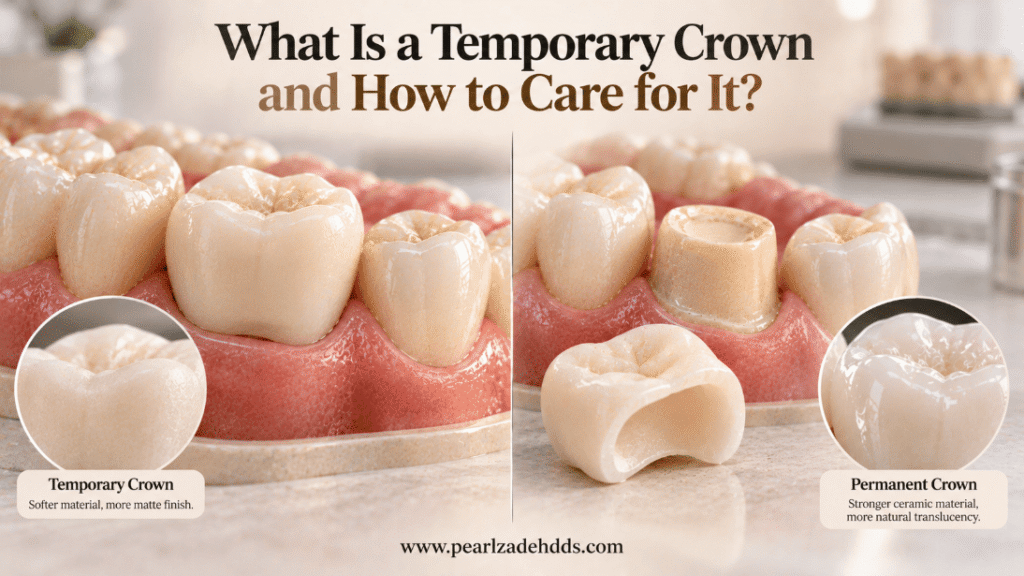
Your tooth has been prepared for a crown, and the numbness is fading. A temporary restoration now covers the tooth while your final crown is made. You may wonder how careful you need to be.
A temporary crown serves a different purpose from a permanent one. It protects the tooth for a limited time, and it often needs extra care. Your dentist’s own instructions come first.
Temporary crowns come in different materials and designs, so your care may differ from another patient’s. Ask your dentist what applies to your tooth.
What Is a Temporary Dental Crown?
Dentists use a temporary crown to cover and protect a prepared tooth until the permanent restoration is ready. A 2023 British Dental Journal article says provisionals should protect the pulp and secure positional stability, function, and esthetics. Common purposes include:
- Protecting the prepared tooth.
- Reducing sensitivity and discomfort.
- Helping maintain the tooth’s shape and position.
- Supporting chewing and appearance during the waiting period.
Materials vary. A dentist-reviewed Healthline article quotes a dentist describing relatively weak plastics such as ethyl methacrylates and bisacrylics. One review in the Journal of the Irish Dental Association says the literature tends to favor acrylic resin. It adds that no ideal material exists. That review dates from 2004.
The material and design depend on the clinical situation and your dentist’s workflow. Not every temporary crown offers the same protection or strength. A temporary may also look different from your final crown, since its shape and shade can differ.
Why Do You Need a Temporary Crown?
A permanent crown may need laboratory fabrication or additional preparation before placement. One dentist-reviewed WebMD article says a lab may need two to three weeks to make a permanent crown. Your timeline may differ.
The temporary crown protects the prepared tooth during that interval. It also lets your dentist assess the tooth and proceed with the planned restoration at a later appointment.
Healthline says a temporary crown protects the tooth and gums, helps you chew, and keeps spacing between teeth. Those jobs matter while the tooth waits.
The number of appointments and the time between them vary. They depend on your treatment plan, the material, and your individual case.
How Long Does a Temporary Crown Last?
A temporary crown is built for short-term use, not long-term service. How long it stays in place depends on several factors:
- The material and the fit of the crown.
- The cement used to hold it.
- The tooth’s location and the chewing forces on it.
- Your individual habits.
Heavier chewing forces on back teeth may affect how securely a temporary stays in place. Habits such as grinding can matter too.
No universal number of days or weeks applies. The Healthline article quotes a dentist describing a weakened temporary cement purposely designed not to last long. Follow your dentist’s instructions and the appointment schedule they planned.
Contact the office if the crown becomes loose or damaged before your permanent appointment. Permanent crowns follow a different timeline. Our article on how long porcelain crowns last covers that contrast.
What Can You Eat With a Temporary Crown?
You do not need a restrictive diet. A few sensible habits go a long way. If chewing feels awkward at first, soft foods such as eggs, yogurt, or cooked vegetables are an easy choice. Keep these habits in mind:
- Choose foods that are comfortable to chew.
- Cut firmer foods into smaller pieces.
- Chew on the opposite side when possible.
- Be cautious with sticky, chewy, hard, or crunchy foods.
Those foods may dislodge or damage a temporary restoration. Examples include chewing gum, caramel, hard sweets, ice, and very crunchy foods. One student-written handout from the University of the Pacific dental school offers an example. It advises avoiding sticky, hard, and crunchy foods on that side to keep the temporary in place.
Cleveland Clinic warns that ice cubes, extremely hard nuts, popcorn kernels, and sticky taffy can damage or dislodge crowns. The right precautions depend on the tooth, the restoration, and your dentist’s instructions.
How Should You Brush and Floss Around a Temporary Crown?
Keep cleaning your teeth, but do it carefully. MouthHealthy advises brushing twice a day with a soft-bristled brush. Brush gently around the crown and along the gumline. Aggressive scrubbing can irritate the gums and may loosen the temporary.
Clean between your teeth daily. Do not stop flossing. Technique matters, though, because pulling floss upward against a temporary crown may dislodge it in some situations. Sources describe slightly different methods. The Pacific handout says to pull the floss out from the side instead of lifting it up. Healthline says to slide floss gently in and out rather than pulling it down.
Ask your dentist which technique suits your crown and how to remove floss around it. MouthHealthy also says never to snap floss into the gums.
Is Sensitivity Normal With a Temporary Crown?
Some sensitivity to temperature, pressure, or chewing can occur after tooth preparation. The Pacific handout says sensitivity to cold or pressure may occur when the anesthetic wears off. Symptoms vary, and they should not automatically be dismissed as normal. Do not assume pain is normal simply because the crown is temporary.
The American Association of Endodontists says recent dental work may inflame the tooth’s pulp and cause a temporary symptom. It advises a dentist or endodontist to check the tooth if pain persists or worsens. A 2019 literature review notes that this inflammatory response can be transient or persist.
Mild sensitivity that is improving differs from pain that is severe, persistent, worsening, or spontaneous. Sensitivity may relate to the prepared tooth, the surrounding tissues, your bite, or another dental problem. Tell your dentist which triggers you notice: cold, heat, pressure, or chewing. Those details help narrow the cause. Contact your dentist if your symptoms concern you.
What Should You Avoid While Wearing a Temporary Crown?
These precautions protect the restoration and the tooth beneath it:
- Avoid chewing ice or very hard objects.
- Avoid sticky foods that may pull on the crown.
- Do not use the crowned tooth to open packaging.
- Avoid biting directly into very firm foods with the temporary.
- Do not file, grind, glue, or adjust the crown yourself.
MouthHealthy warns that chewing ice and using teeth as tools can crack teeth. Temporary crowns can be less durable and less securely retained than permanent ones. The Irish review notes that low strength and crack propagation are common causes of failure in acrylic restorations.
What Should You Do If Your Temporary Crown Feels Loose or Falls Off?
Stay calm. A loose temporary is a common problem, and a clear response helps:
- Contact the dental office for instructions.
- Save the crown, and any pieces, in a clean container if it comes off.
- Avoid chewing on the affected tooth.
- Keep the area clean without aggressive brushing.
- Do not use household glue or force the crown back into place.
If the crown comes off after hours, check your dentist’s voicemail or website for instructions.
Your dentist may be able to recement or replace the temporary, depending on its condition and the tooth. Healthline notes that your dentist is likely to replace it with another temporary crown. Our article on what to do if a dental crown falls off gives more detailed instructions.
Significant pain, swelling, or signs of infection warrant prompt assessment. Mayo Clinic advises going to the emergency room for trouble breathing or swallowing. Seek emergency medical attention for those symptoms.
When Should You Contact Your Dentist About a Temporary Crown?
Contact your dentist if the temporary crown does any of the following:
- Comes loose or falls off.
- Cracks or breaks.
- Feels noticeably high or uneven when you bite.
- Causes significant or worsening pain.
- Is associated with swelling or persistent gum irritation.
WebMD notes that a temporary crown may be taller than the other teeth and inflame a nearby tooth. Symptoms alone cannot identify the cause. Your dentist can evaluate the crown, the prepared tooth, your bite, and the surrounding tissues. Call even if the problem seems small, and the office can tell you whether you need a visit.
Why Is It Important to Attend Your Permanent Crown Appointment?
A temporary crown is not meant to replace the final crown indefinitely. Your final crown is made for your tooth, and the temporary is only a stand-in. The dentist needs to assess the tooth and place the planned permanent restoration when appropriate.
Delaying the appointment can leave the prepared tooth dependent on a temporary restoration for longer than intended. Not every delay causes damage. The risk depends on the tooth, the restoration, and the clinical circumstances. At placement, your dentist can also check the permanent crown’s fit and bite.
Some treatment plans use provisional restorations for longer periods for specific reasons. Follow the schedule your dentist gave you. If you need to reschedule, contact the office. Bring questions to the visit, and mention any sensitivity or bite changes you noticed while wearing the temporary.
A Temporary Crown Needs Careful Handling Until the Permanent Crown Arrives
A temporary crown protects a prepared tooth while the permanent restoration is made. It needs careful handling during that period. Follow your dentist’s instructions, call if the crown loosens or symptoms worsen, and attend your planned appointment. Dr. Pearl Zadeh can evaluate your tooth and explain next steps. For broader aftercare, see our article on caring for a new dental crown. You can also learn more about dental crown treatment at Pearl Zadeh DDS.
Call (818) 716-6722 or click the button below to schedule your consultation online.
Frequently Asked Questions
No universal timeline applies. A temporary crown is meant for short-term use. Follow your dentist’s schedule and call if it loosens or breaks
Yes. Brush gently and clean between your teeth daily. Ask your dentist how to remove floss without lifting the crown.
Be cautious with sticky, chewy, hard, and crunchy foods, such as caramel, gum, hard sweets, and ice. Chew on the other side when you can.
Call your dental office. Save the crown in a clean container and avoid chewing on that tooth. Do not use household glue or force it back.
Some sensitivity can occur. Severe, persistent, worsening, or spontaneous pain deserves a call to your dentist.
The information above is for informational purposes only and is not a substitute for professional dental advice. Please schedule a consultation with Pearl Zadeh DDS to discuss your specific situation.