
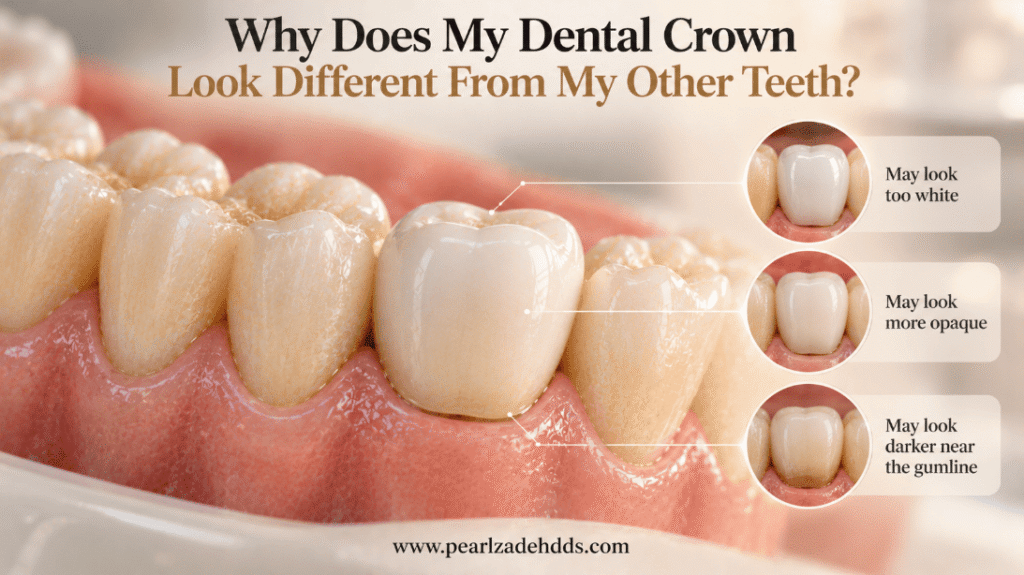
Your crown looks too white. Or it looks too dark, too opaque, or just slightly off next to the teeth beside it. Patients often notice this in daylight or in a photo.
A crown restores a tooth’s function and appearance. Matching a natural tooth is still challenging. The reason for the difference decides which solutions may be possible.
Some crowns never matched. Others looked fine at first and changed later. A shade mismatch, surface staining, changes in natural teeth, and material limits are different problems. Each one calls for a different response.
Why Does My Dental Crown Look Different From My Other Teeth?
Several factors can combine to make a crown stand out:
- Shade mismatch. The crown may be lighter or darker than the neighboring teeth.
- Translucency differences. Natural enamel lets light pass through and scatter. Some crown materials reproduce that differently.
- Surface texture and finish. Gloss, contour, and texture change how a crown reflects light.
- Changes in natural teeth. Neighboring teeth can darken or stain while the crown keeps much of its original shade.
- Lighting. A crown can look different in daylight, indoor light, and flash photos.
- Material and design. Different ceramic systems have different optical properties.
Materials do differ. The ADA’s page on indirect restorative materials says lithium disilicate is more translucent than any zirconia. It also says framework zirconia is veneered with porcelain or glass-ceramic for a tooth-like look because of its opacity. Our article on how zirconia and porcelain crowns compare covers the details.
A crown’s appearance depends on more than its basic shade. Shape, translucency, surface characteristics, and the surrounding teeth all affect the result. Natural teeth also often vary in color from the gumline to the biting edge. Reproducing that variation is difficult.
Why Does My New Crown Look Too White or Too Dark?
A crown that looks too white may have a shade that does not match its neighbors. It may also look too opaque, or reflect light differently from the teeth beside it. An opaque crown can look flat next to translucent neighbors. Shape and surface gloss can also make a crown look brighter than its neighbors when the shade is close.
A crown that looks too dark may reflect a shade mismatch or a different translucency. Surrounding teeth that have changed color can also make it look darker. A dark appearance does not automatically mean the crown is damaged or decaying.
Lighting can exaggerate differences. A Dental Products Report article for dentists on shade matching lists poor lighting as a common problem. It advises confirming a shade in daylight and under a second light source. Photographs and bathroom lighting may also exaggerate differences.
If the crown looked acceptable at first, ask what has changed: the crown, the neighboring teeth, or the lighting. That question narrows the possibilities. Do not try to diagnose the cause from appearance alone. If the difference persists in different lighting, have it assessed.
Can a Dental Crown Change Color Over Time?
Natural teeth change. MouthHealthy, the ADA’s consumer site, lists coffee, tea, red wine, tobacco, trauma, and some medications as causes of discoloration. It also notes that enamel thins over time, so more yellowish dentin shows through.
Crown materials behave differently from enamel. Ceramic crowns are often relatively resistant to discoloration, but materials differ. In a 2021 laboratory study of CAD/CAM materials, coffee caused color changes the authors called clinically acceptable. The three materials tested did not change equally. Polished surfaces were rougher than glazed ones. The authors tested only coffee and one polishing kit.
Finish matters too. A 2025 systematic review of lithium disilicate found that polished specimens changed color more than glazed ones. All the included studies were laboratory studies, and the results varied widely. None of this proves how your own crown will behave.
Natural tooth optics shift with age as well. A 2015 review in the Journal of Biomedical Optics reports that enamel translucency increases with age. Dentin changed little. The author notes that few clinical measurements exist.
A crown can also look different because the neighboring teeth darkened. Its surface may have worn or been damaged. A crown that looks different over time has not necessarily changed color itself. Wear or damage to its surface may also scatter light differently, so the crown can look duller than before.
No crown is guaranteed to stay stain-free. Daily cleaning helps limit surface deposits, as our article on caring for a new dental crown explains. For a longer view, see how long porcelain crowns last.
Can You Whiten a Dental Crown?
Not in the usual way. Conventional whitening does not lighten the underlying shade of an existing crown as it lightens natural teeth. MouthHealthy states that whitening will not work on caps, veneers, crowns, or fillings. The ADA says only natural teeth can be whitened, not tooth-colored restorations.
Whitening your natural teeth can make a mismatch more noticeable. The ADA notes that bleaching could result in differences between natural teeth and restorations, which will not change color. Our page on professional teeth whitening covers whitening for natural teeth. That is a separate decision from fixing a crown. Your dentist can tell you whether it suits your situation.
Professional cleaning may help when the difference comes from removable surface deposits. The result depends on the material and the crown’s condition. Cleaning cannot correct every intrinsic shade mismatch. A cleaning also lets your dentist judge what is surface and what is shade.
Stronger products, longer sessions, and abrasive toothpaste will not change a crown’s underlying color. Do not try home polishing or color correction.
How Can a Dentist Correct a Crown Color Mismatch?
Your dentist starts by working out which problem you have. A surface stain, a shade mismatch, and a change in the neighboring teeth need different responses. Matching the response to the cause avoids unnecessary treatment.
Treatment depends on the cause, the material, the tooth’s location, and the crown’s condition. Possible approaches include:
- Professional cleaning or polishing. This may help with certain surface stains or deposits when it suits the restoration.
- Minor surface refinishing. This may be considered for specific surface or finish concerns, depending on the material and the adjustment needed.
- Whitening the natural teeth. This may fit when the natural teeth are darker than desired and the crown’s shade is otherwise acceptable. The crown will not whiten with them.
- Replacing the crown. This may be considered when a shade or translucency mismatch is significant and less invasive methods cannot correct it.
Not every crown can be recolored, polished, or modified to match naturally. Replacement is not automatically necessary for every difference in appearance.
Does Replacing a Crown Mean the New One Will Match Better?
Replacement may allow your dentist and the dental laboratory to choose a different shade, translucency, contour, and surface finish. A better match is possible, but it is not guaranteed.
The result depends on the assessment, shade selection, material, and design. Communication with the laboratory matters when one is involved. So do the clinical circumstances.
Your dentist should also consider the surrounding teeth and the appearance you want. If you plan to whiten, discuss the timing and the final shade before the replacement crown is made. No crown can be promised as indistinguishable from natural teeth.
Tell your dentist what bothers you about the current crown. Say whether it looks too white, too dark, or too flat. Specific feedback helps with shade selection.
Should You Whiten Your Teeth Before Getting a New Crown?
Planning matters here. Whitening changes natural tooth color, but a new crown is made to a selected shade. The ADA notes that restorative materials generally do not change color. It also warns that patient expectations may not be met without addressing cosmetic issues with existing restorations. They may also be unrealistic.
Your dentist may recommend coordinating whitening and shade selection. That way the final restoration is planned around the tooth color you want.
If a crown is being replaced and you plan to whiten, tell your dentist early. That allows one coordinated plan instead of two separate decisions.
No universal waiting period applies after whitening. Timing depends on the whitening method, your circumstances, and your dentist’s recommendations.
When Should You Have a Crown’s Appearance Checked?
A cosmetic difference alone is not always an emergency. Still, a dentist should evaluate a crown that develops a new or unexplained change in appearance. Pay particular attention to these signs:
- A chip, crack, or rough area.
- A crown that feels loose.
- Pain or sensitivity.
- Swelling or bleeding around the crown.
- A visible dark area near the crown margin.
Cleveland Clinic lists cracks, chips, and a loose crown among reasons to call your dentist. A dark line or color change does not by itself prove decay. Only an exam can assess the crown, the tooth, and the surrounding tissues. Note when you first noticed a change. Photos taken in the same light over time can help show whether anything has changed.
The Right Fix Depends on Why the Crown Looks Different
A crown may look different because of its shade, translucency, surface, staining, or changes in the neighboring teeth. The right correction depends on the cause, the material, and the crown’s condition. Surface stains and intrinsic shade mismatches are different problems, and only an exam can separate them. If a crown’s appearance concerns you, Dr. Pearl Zadeh can evaluate it and explain your options. You can learn more about dental crown treatment at Pearl Zadeh DDS.
Call (818) 716-6722 or click the button below to schedule your consultation online.
Frequently Asked Questions
Not like natural teeth. Whitening does not lighten the underlying shade of an existing crown. Cleaning may remove surface deposits.
The shade may be lighter than your neighbors, or the crown may look more opaque. Natural teeth can also darken over time while the crown keeps its shade.
Sometimes a surface stain can be addressed. An intrinsic shade mismatch usually cannot be recolored. Your dentist can tell which applies.
It can look that way. Your natural teeth lighten, but the crown does not change. The mismatch may become more noticeable.
Not always. Surface staining or changes in neighboring teeth may have other solutions. An exam shows which options fit.
The information above is for informational purposes only and is not a substitute for professional dental advice. Please schedule a consultation with Pearl Zadeh DDS to discuss your specific situation.