
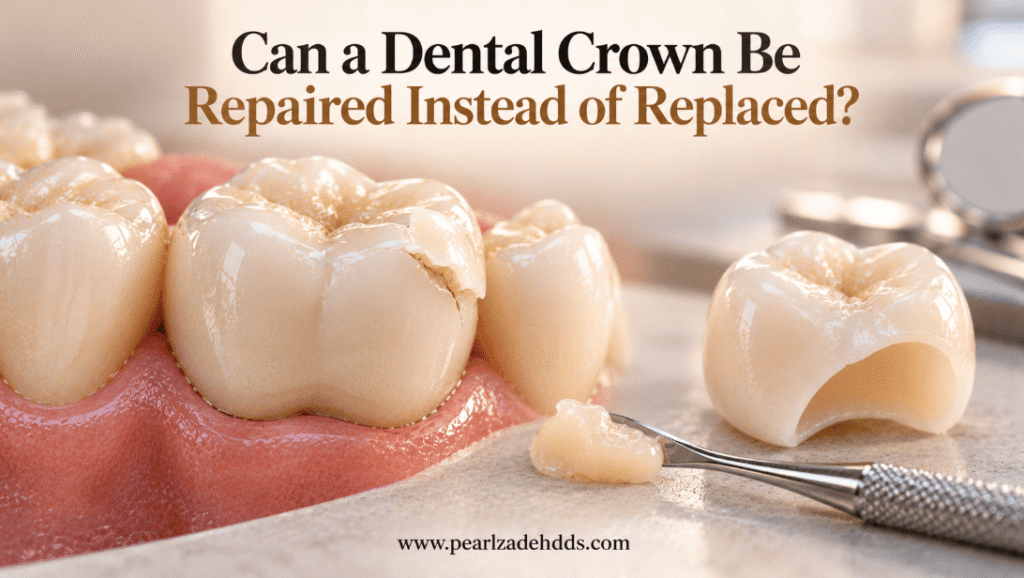
You notice a small chip in your dental crown, or it feels different when you bite down. You may wonder whether your dentist can repair it or if you need a replacement.
A crown can sometimes be repaired, depending on the type of damage and its location. A small chip may be manageable, while a loose crown, a poor fit, or damage to the tooth underneath may call for replacement or further treatment. Not every damaged crown needs to be replaced, but some problems cannot be fixed with a simple repair.
Your dentist can examine the crown and the tooth beneath it to determine what needs attention.
Can a Dental Crown Be Repaired?
Sometimes. Repair may be possible when damage is limited and the crown stays stable, functional, and suitable for continued use. A 2016 Operative Dentistry article on intraoral repair says repair is mainly indicated for localized shortcomings of restorations. It says replacement is indicated when problems are multiple or severe and repair is not feasible.
Your dentist considers several factors:
- The type and location of the damage.
- Whether the crown is still securely attached.
- The crown material.
- The condition of the underlying tooth.
- Whether the crown’s margins and fit remain acceptable.
A dentist must evaluate these factors before recommending repair. Sometimes a small chip is the only problem. It may also accompany a fit or tooth problem that needs attention. Fit deserves special attention. A gap at the margin may allow bacteria to reach the tooth. Polishing or patching the visible surface does not close that gap. Your dentist checks the margins before deciding whether repair makes sense.
What Types of Dental Crown Damage Can Sometimes Be Repaired?
Small chips or rough edges. Minor damage may sometimes be smoothed, polished, or repaired with a restorative material. The options depend on the crown material and the location of the chip. Mention any rough spot that irritates your tongue or cheek.
WebMD says a small chip on a porcelain or porcelain-fused-to-metal crown can be repaired with composite resin. The crown stays in your mouth during the repair. WebMD calls this usually a temporary fix and says extensive chipping may mean replacement. A dentist-focused Dental Update article calls repair of metal-ceramic and all-ceramic restorations a reliable, low-cost, low-risk technique. It says the technique may be of value for loss or fracture of porcelain from a crown or bridge. Sources differ, so outcomes vary.
Surface wear or minor cosmetic defects. Polishing or another limited correction may improve a surface in some cases. Not every discoloration or defect can be corrected this way. The Operative Dentistry article adds that some minor margin defects, such as minor discoloration, may need only monitoring. Your dentist can explain whether a defect is cosmetic or affects function.
A loose crown. Sometimes a loose crown may be recemented if the crown and tooth remain suitable. Colgate’s oral health site says a dentist first makes certain the crown is intact and still fits properly. It also notes that a badly broken or decayed tooth may not be strong enough to hold the crown.
The crown may be reusable, or a new one may be needed. A dentist-reviewed Healthline article says the dentist decides whether to reinstall the crown or make a new one. Recementation does not suit every loose crown.
Damage to the underlying tooth. Repairing the crown alone may not address decay, a fracture, or other problems in the tooth beneath it. WebMD notes that when cement washes out, bacteria can leak in and cause decay in the remaining tooth. In that case, the tooth needs attention too.
Major cracks, extensive fractures, and significant structural damage are not routine repairs. Your dentist can tell you whether your crown is a candidate.
When Does a Dental Crown Need to Be Replaced?
Repair may not be reliable or appropriate in these situations:
- A large chip or fracture that affects the crown’s strength.
- Extensive cracking or structural damage.
- A crown that no longer fits properly.
- Damage or decay affecting the tooth underneath.
- Repeated loosening or failure.
- Problems with the bite or surrounding gum tissue that cannot be addressed adequately while keeping the crown.
A large fracture can leave too little crown to withstand chewing. Repair may not restore that strength. In that case, replacement may be the more dependable option.
Repeated loosening deserves a closer look. One retrospective study of 1,037 tooth-supported single crowns found loss of retention and recurrent caries the most common complications. That study reflects one dental school clinic, so it cannot predict your crown.
Bite forces matter as well. Mayo Clinic says severe grinding may damage fillings, crowns, and other dental repairs. If bite forces keep damaging a crown, your dentist may need to address the cause, not only the damage.
Replacement is not automatic whenever a crown has a problem. Depending on the findings, your dentist may recommend repair, recementation, replacement, or treatment of the underlying tooth.
Our article on signs your dental crown needs to be replaced covers the warning signs in detail. Age alone does not decide the question either. Our article on how long porcelain crowns last with proper care explains what affects crown lifespan.
Does Crown Material Affect the Repair Options?
Yes, but not in a simple way. Repair techniques and their predictability vary by material, the type of damage, and where the crown sits. Some surface defects may be polished or repaired. A repair may not restore the original strength or appearance in every case. Location matters too. Back teeth take heavier chewing forces than front teeth. The same chip may call for different decisions in different places. Ask your dentist how your crown’s material affects the plan.
The Operative Dentistry article says the composition of the repaired surface is the most important factor in success. Its repair protocols cover metal-ceramic and zirconia fixed restorations, not crowns alone. On metal, air abrasion followed by a metal primer increases adhesion significantly. For zirconia, air abrasion followed by a silane containing MDP monomer was the most effective conditioning method. The article still says achieving a sustainable chemical bond to zirconia remains problematic.
The ADA’s page on indirect restorative materials describes complications by material. All-ceramic crowns commonly show fracture and chipping. Zirconia-based restorations commonly show chipping and fracture. A 2021 ADA survey cited on the same page found debonding the most common zirconia problem. Porcelain-fused-to-metal crowns commonly show veneer chipping. For gold restorations, secondary caries and retention failure are among the most common reasons for failure.
Those lists describe what tends to go wrong. They do not rank repairability. No material is universally easier to repair, and none is immune to damage. Our article on how zirconia and porcelain crowns compare explains material differences in more depth.
What Happens During a Dental Crown Repair Appointment?
The process depends on the problem. Expect questions about when you noticed it and what you feel when you chew. Your dentist may also ask about habits such as grinding or chewing hard objects. They can affect the plan. A typical evaluation includes these steps:
- Your dentist examines the crown, its margins, and the underlying tooth.
- The damage is assessed, and the crown’s stability and bite are checked.
- Imaging, such as X-rays, may be used when indicated.
- You and your dentist discuss whether repair, recementation, replacement, or other treatment is suitable.
- If repair is appropriate, your dentist explains the procedure and its limitations.
Imaging helps because X-rays can reveal damage or disease not visible during an exam, according to MouthHealthy. A crown can look fine while the tooth beneath it has a problem.
Not every repair is finished in one appointment. Timing depends on the problem and the treatment needed. The Operative Dentistry article also notes that repair is not always risk-free, because the preparation sometimes needs extending. After any crown work, daily cleaning still matters. Our article on caring for a new dental crown covers habits that protect a crown.
Can You Repair a Dental Crown at Home?
No. Do not use household glue, superglue, or other non-dental adhesives on a crown. Also do not force a damaged or loose crown back into place. It may not seat correctly, and the tooth underneath may need treatment. Do not file or trim a rough edge yourself either.
If a crown comes off, keep it in a safe, clean container. Avoid chewing on the affected tooth and contact your dentist for instructions. Healthline says the most important step is to retrieve the crown and take it to a dentist. Our article on what happens if your dental crown falls off covers that situation in detail.
Temporary dental products exist, and some websites suggest them. They do not replace a professional evaluation, and they do not suit every situation. Ask your dentist before using one.
Is Repair Cheaper Than Replacing a Dental Crown?
Cost depends on the type of repair and the crown material. It also depends on the tooth underneath and whether additional treatment is needed. A simple polish differs from a repair that needs added material. Recementation differs from replacement.
Repair is not always cheaper over time. A repair that does not hold may lead to other treatment later. Your dentist can give a more useful estimate after assessing the crown and the tooth. Ask what each option involves and what it may not solve. Also ask whether the estimate covers the tooth underneath.
A damaged crown does not always need replacing, but not every crown can be repaired. Dr. Pearl Zadeh can examine your crown and the tooth beneath it and explain which options apply. You can learn more about dental crown treatment at Pearl Zadeh DDS.
Call (818) 716-6722 or click the button below to schedule your consultation online.
Frequently Asked Questions
Sometimes. A small chip may be smoothed, polished, or repaired, depending on the material and location. Large chips that weaken the crown may need replacement. Your dentist decides after an exam.
Sometimes. A dentist checks that the crown is intact, fits properly, and sits on a sound tooth. If decay or damage is present, recementation may not be suitable. Do not use household glue.
Extensive cracking is not a routine repair. A small, localized defect may be a candidate. Cracks that affect the crown’s strength or involve the tooth may need replacement. Only an exam can tell which applies.
Neither is better for every crown. Repair may suit limited damage on a stable, well-fitting crown. Replacement may suit extensive damage, poor fit, or tooth problems. Your dentist weighs these findings.
Avoid chewing on the affected tooth until your dentist gives guidance. This matters most if the crown is loose, fractured, or painful. Healthline advises soft foods and avoiding the affected side. Call your dentist for instructions.
The information above is for informational purposes only and is not a substitute for professional dental advice. Please schedule a consultation with Pearl Zadeh DDS to discuss your specific situation.