
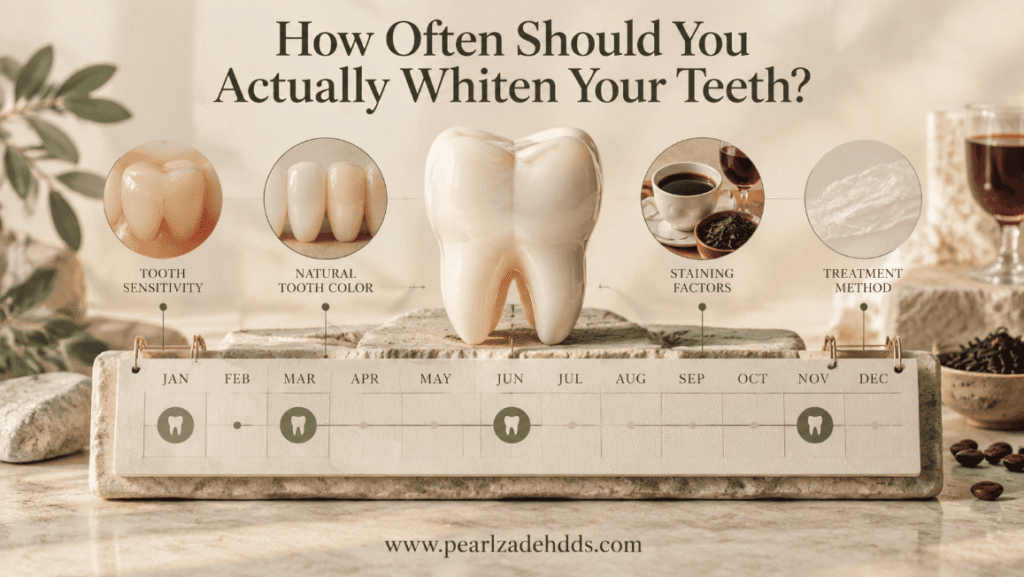
When you search for an answer to how often you should whiten your teeth, you will find a different number every time. Every two weeks. Every six months. Once a year. But none of those numbers comes from your mouth, so none can tell you what is right for your teeth.
There is no single interval that works for everyone. How often you can whiten depends on your teeth, your sensitivity history, the method you use, and the type of staining you have. Your previous response to whitening matters too.
Instead of chasing a fixed schedule, look at what your teeth need and why you want to whiten again.
Why There Is No Universal Whitening Schedule
Two people can use the same whitening product and need very different intervals before their next round. One drinks coffee daily and grinds slightly at night, wearing at their enamel. Another barely touches staining foods and has naturally resilient teeth. Age, enamel thickness, diet, and past dental work all shape how quickly color returns. They also shape how much whitening those teeth can comfortably handle. A schedule built for one mouth is not automatically safe for another.
What Actually Happens to Your Teeth Each Time You Whiten
Whitening works by allowing peroxide to pass through the enamel and reach the layer underneath. According to the American Dental Association, whitening peroxide can make enamel temporarily more permeable while it works. That process can also let the peroxide reach the nerve. This is part of why some people notice temporary sensitivity afterward. Between sessions, enamel has a chance to settle. That recovery window is part of why spacing sessions out matters. It is not just about the number of times a year you whiten.
How Often Can You Safely Whiten at Home?
At-home kits, whether trays, strips, or pens, are designed for a defined course rather than ongoing use. Most products are built around a set number of days or weeks, followed by a break. Using a product more often than directed does not typically speed up results. Neither does layering multiple products at once. Both mainly increase the chance of sensitivity, without a matching improvement in shade. The American Dental Association also notes that overuse of whiteners can damage enamel or gums. This is why following the printed directions matters. Stop earlier if your teeth or gums feel uncomfortable, rather than pushing through for a whiter result.
How Often Can You Get Professional Whitening?
Professional whitening is typically spaced out further than at-home touch-ups, and for good reason. According to the American Dental Association, people seeking whiter teeth are generally better served visiting their dentist. Once or twice a year is often enough, and that beats repeating whitening on their own more frequently. That is a general guideline, not a fixed rule for every patient. Your dentist can evaluate your enamel and gum health first. They can also factor in how your teeth responded to your last treatment before recommending your next one.
What Are the Risks of Whitening Too Often?
Whitening more often than your teeth can tolerate is not simply a matter of wasted product. The ADA has reported that overuse of whitening products has been shown to damage enamel and gums. It can also increase tooth sensitivity. In some cases it can lead to a more translucent look at the edges of teeth. The underlying layer becomes more visible. Occasional whitening, followed by a real recovery period, allows the enamel surface to remineralize between sessions. Repeated bleaching without those breaks does not give it that chance. That is why whitening more frequently is not automatically better or safer.
What Signs Suggest You Are Whitening Too Frequently?
A few patterns are worth watching for. Sensitivity that gets worse with each round, rather than settling between them. Gums that feel irritated after treatment. Teeth that look more translucent or gray at the edges, instead of simply whiter. Feeling like you need to whiten again almost immediately, just to hold the same shade. Any of these is a reasonable signal to stop. Let your teeth recover, and check in with your dentist before whitening again.
Do Teeth Reach a Point Where They Stop Getting Whiter?
Yes. Whitening lightens the natural color of your enamel and dentin. It cannot take a tooth past its own underlying shade. Once you reach the lightest shade your teeth are capable of, additional whitening will not lighten them further. It can still raise your risk of sensitivity and irritation, with no real benefit in return. A plateau despite continued whitening is generally a sign to stop, rather than a reason to intensify the routine.
How Long Do Whitening Results Typically Last Before a Touch-Up?
How long results hold up before color starts to return varies by person and habits. This is covered in more depth in our guide to how long teeth whitening results last. In general terms, diet, smoking, oral hygiene, and the whitening method all affect how quickly staining reappears. That timeline, not a fixed calendar date, is what should guide when a touch-up makes sense.
What Factors Affect How Often You Should Whiten?
Several things influence the right interval for you specifically. How porous or sensitive your enamel is. Whether you have dental work, like fillings, crowns, or veneers, that will not change color like natural enamel does. Your diet, including how often you have coffee, tea, or red wine. Whether you smoke or use tobacco. How your teeth and gums responded to your last treatment. Someone with a daily coffee habit and little rinsing afterward will typically need touch-ups sooner. That is true even if they started from a similar shade as someone with a lower-staining diet. A dentist weighing all of this together will generally land on a more useful answer. That beats any generic interval found online.
Should You Whiten on a Set Schedule or Only When You Notice Fading?
Both approaches exist. Some people prefer a loose schedule built around their dentist’s recommendation. That might mean a professional touch-up once or twice a year. Others prefer to whiten only when they notice visible fading. This can mean longer or shorter gaps, depending on how their teeth actually behave. What matters more than which approach you choose is this. You should not whiten reactively, out of habit or impatience. Give your teeth a real chance to recover between rounds.
Is the Interval Different for Trays, Strips, and In-Office Treatment?
Yes. Strips and at-home trays are generally used in short, defined courses with breaks built in. Touch-ups with these tend to happen more often than professional visits, though still not continuously. In-office treatment uses a stronger concentration under supervision. That is part of why it is typically spaced out further. It is often once or twice a year for most patients. If you are comparing the two, our guide to whitening pens, strips, or professional treatment breaks down the differences. Mixing methods, such as layering strips on top of a recent professional treatment, is more likely to cause irritation. It rarely improves results.
What If You Have Sensitive Teeth?
If your teeth are already sensitive, that changes how often whitening makes sense. It is not just about how it feels while you do it. It is worth reading our guide on what helps sensitive teeth after whitening. Also see our guide on whitening options for sensitive teeth. Do not assume your usual interval still applies. A history of sensitivity is generally a good reason to space treatments further apart, or use a lower concentration. It can also be a reason to check in with your dentist before restarting. That beats following the same schedule someone with no sensitivity history might use.
Can Whitening Too Often Damage Your Enamel?
This is one of the more common concerns. The honest answer is that it depends on frequency and technique, rather than whitening being inherently harmful. Our detailed look at whether teeth whitening damages enamel goes further into the evidence. The short version is that spacing treatments appropriately matters most for enamel health. No single session matters as much on its own.
What About Touch-Up Whitening Between Full Treatments?
A quick touch-up is not the same as a full whitening course, but it is not automatically risk-free either. Are you reaching for a touch-up product every few weeks just to maintain a shade? Mention that pattern to your dentist. It may mean the interval between full treatments should be adjusted, rather than patched over with frequent small doses.
How Often Should You Whiten With Crowns, Veneers, or Fillings?
Whitening lightens natural tooth enamel, but it does not change the color of crowns, veneers, bonding, or fillings. Whitening too often will not help match dental work to a shade it cannot reach. It can instead leave natural teeth looking noticeably whiter than the restored ones. If you have visible dental work, read our guide on whitening with fillings or crowns first. It covers how often, or whether, to keep whitening around them.
Why Might One Tooth Need Different Attention Than the Rest?
Not every tooth responds to whitening at the same pace. Repeating a whole course just because one tooth still looks slightly different is not always the answer. Our article on why one tooth may not whiten like the others explains some of the more common reasons. These range from natural variation to old dental work to deeper, internal staining that surface whitening cannot fully reach.
What If Whitening Stops Working As Well As It Used To?
If you feel like you are whitening more often just to get the same result, that is worth investigating. Do not simply increase frequency. Our guide on why teeth won’t whiten covers some of the underlying reasons results can stall. Several of these have nothing to do with how often you are whitening. They have more to do with the type of staining involved.
How Can a Dentist Help You Build the Right Whitening Schedule?
A dentist can look at your enamel condition, existing dental work, sensitivity history, and staining pattern. They can use all of that to recommend an interval built around your actual teeth. That beats a generic number. This is part of why professional evaluation tends to produce steadier, more predictable results over time. Repeated at-home whitening driven by guesswork often falls short. If you are weighing your options, our overview of what professional whitening involves is a useful starting point.
Talk to Dr. Pearl Zadeh About Your Whitening Schedule
There is no single number that tells you how often to whiten your teeth. Your enamel, your habits, and your dental history are not the same as anyone else’s. Guessing at a schedule is risky. So is whitening more often just because results seem to be fading. Both are more likely to cause sensitivity and irritation than a consistently bright smile.
Dr. Pearl Zadeh and her Woodland Hills team can evaluate your teeth and build a whitening plan. That might mean an occasional professional treatment, a well-timed at-home routine, or a combination of the two. It depends on what your teeth actually need.
Call (818) 716-6722 or click the button below to schedule your consultation online.
Frequently Asked Questions
It depends on your enamel, sensitivity history, and the method you use, so there is no single number that applies to everyone. Professional whitening is often spaced out to roughly once or twice a year for many patients, while at-home products are meant to be used in short, defined courses with breaks in between.
For most people, whitening every single month is more frequent than dentists generally recommend, particularly with stronger products. How often is appropriate depends on your individual teeth, so it is worth checking with a dentist rather than assuming a monthly routine is fine by default.
Many patients are advised to consider professional whitening roughly once or twice a year, though the right interval depends on your enamel, staining habits, and how your teeth responded to previous treatment. Your dentist can tailor this to you specifically.
Yes. Whitening more often than your teeth can handle has been linked to enamel and gum irritation and increased sensitivity, without necessarily producing a whiter result once your teeth reach their natural limit
Possible effects include increased tooth sensitivity, gum irritation, and a more translucent look at the edges of teeth as the underlying layer becomes more visible. It does not continue making teeth whiter once they reach their natural shade limit.
This varies by person and method. It depends on how your teeth and gums responded to the last treatment, your sensitivity history, and how quickly staining tends to return for you. A dentist can help you settle on a realistic interval.
Frequently Asked Questions
It depends on your enamel, sensitivity history, and the method you use, so there is no single number that applies to everyone. Professional whitening is often spaced out to roughly once or twice a year for many patients, while at-home products are meant to be used in short, defined courses with breaks in between.
For most people, whitening every single month is more frequent than dentists generally recommend, particularly with stronger products. How often is appropriate depends on your individual teeth, so it is worth checking with a dentist rather than assuming a monthly routine is fine by default.
Many patients are advised to consider professional whitening roughly once or twice a year, though the right interval depends on your enamel, staining habits, and how your teeth responded to previous treatment. Your dentist can tailor this to you specifically.
Yes. Whitening more often than your teeth can handle has been linked to enamel and gum irritation and increased sensitivity, without necessarily producing a whiter result once your teeth reach their natural limit.
Possible effects include increased tooth sensitivity, gum irritation, and a more translucent look at the edges of teeth as the underlying layer becomes more visible. It does not continue making teeth whiter once they reach their natural shade limit.
This article is for informational purposes only and is not a substitute for professional dental advice. Please schedule a consultation with Pearl Zadeh DDS to discuss your specific situation.