
You whitened your teeth last year, and maybe again this spring. Now the shade has faded, and the box of strips is still in the drawer. Can you keep going? Hydrogen peroxide is the active ingredient in many whitening products. A single treatment raises few questions. Repeated use over months or years raises different ones.
The answer depends on your exposure, the product you use, and the condition of your teeth. It is not simply a matter of whether hydrogen peroxide is safe or unsafe. Understanding those factors can help you decide whether whitening again makes sense.
What Does Hydrogen Peroxide Do During Teeth Whitening?
Hydrogen peroxide releases reactive oxygen molecules. The ADA describes the process as generally believed to occur when they meet colored compounds in enamel and dentin. Those compounds are called chromophores. In plain terms, peroxide breaks down the molecules that make teeth look darker.
This differs from removing surface stains. Polishing and whitening toothpastes lift stains from the outside of the tooth. Peroxide works within the tooth structure. Whitening changes how a tooth looks. It does not rebuild or replace tooth structure.
What Does “Long-Term Use” Actually Mean?
Long-term use can describe very different habits. A single professional treatment is one. At-home whitening in a short course is another. Occasional maintenance treatments differ again. Repeated whitening cycles add exposure over time. Frequent or prolonged use beyond product instructions is a separate category.
No universal definition or time period exists for long-term. Each pattern carries a different level of exposure. When you ask whether long-term use is safe, name the pattern you mean. Your dentist can help you place your own habits on that spectrum.
Is Hydrogen Peroxide Whitening Safe When Used as Directed?
Peroxide-based products can be used safely when the product is appropriate and used correctly. The ADA describes sensitivity as typically mild and transient in tray-based treatments. It lists gum inflammation among the most common adverse effects too. A Cochrane review of home bleaching covered 71 trials and 3,780 adults. It reached a similar conclusion about side effects.
The same review also set limits on what it could say. Its evidence covered periods of two weeks to six months. It rated the overall certainty as low to very low. Most trials do not follow people for years.
Directions, concentration, and exposure time matter for that reason. Products differ in formulation and delivery. One product’s results may not apply to another. Not every hydrogen peroxide whitening product is equally safe.
What Can Happen With Repeated Whitening?
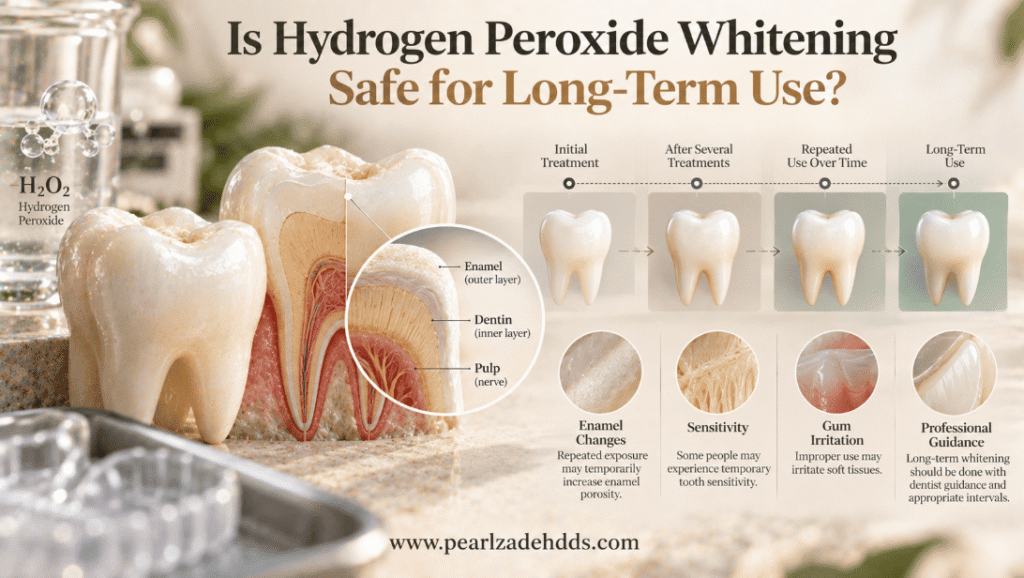
Repeated or excessive whitening is associated with several possible effects. Tooth sensitivity is the most common. Gum irritation can occur too. The ADA notes that gum irritation is typically due to poor-fitting trays or improper gel application.
Laboratory studies have reported temporary changes to the tooth surface. Overused or ill-fitting products can irritate soft tissue. Results may also level off once the teeth reach their limit for that method.
Most of these effects are temporary. They are not evidence of permanent structural damage. Repeated whitening does not automatically damage enamel.
Can Hydrogen Peroxide Damage Enamel Over Time?
The evidence is mixed, and it depends on exposure. As the ADA puts it, research suggests bleaching protocols may alter the surface roughness of enamel. That wording is cautious for a reason. Much of the research comes from laboratory studies. Researchers apply peroxide to enamel samples and measure hardness or surface texture. Samples in a lab do not fully reflect conditions in the mouth.
A 2019 PLOS ONE laboratory study shows why exposure matters. Researchers applied 10% carbamide peroxide for four hours daily over 14, 21, or 28 days. Under an electron microscope, enamel surface changes appeared in every bleached group. They became more pronounced as exposure lengthened. The authors cautioned against use beyond manufacturer instructions.
Microscopic changes in a lab are not the same as clinically significant damage. Temporary or microscopic changes, changes tied to excessive exposure, and real-world harm are separate questions. Properly used whitening and overuse also differ. Lab findings alone cannot show how any one patient’s teeth would respond.
Our article on whether teeth whitening damages enamel covers this question in more detail.
Why Does Whitening Cause Sensitivity?
The ADA explains that peroxide passes through enamel to the dentin and can irritate the nerve of the tooth. In most cases the sensitivity is temporary. It varies between individuals, and some people notice none.
Sensitivity does not prove enamel damage. It is a known response to peroxide reaching deeper layers of the tooth. The Cochrane review found sensitivity and irritation were more common with higher concentrations of active agents.
Our article on what helps sensitive teeth after whitening offers general guidance. If your teeth are already sensitive, see our page on teeth whitening for sensitive teeth.
Can You Whiten Your Teeth Too Often?
Wanting a brighter shade is not enough reason to keep whitening. Several factors should guide frequency. Your previous response matters. So do your sensitivity and the type of staining. The condition of your teeth, the product instructions, and any existing dental work count too.
Ask whether more whitening is likely to produce a meaningful improvement. If the last round changed little, another round may add exposure without adding benefit. No universal limit on treatments exists, and no schedule fits everyone. Our article on how often to whiten your teeth discusses frequency in more depth.
Does More Hydrogen Peroxide Mean Better Whitening?
Not necessarily. The Cochrane review found that sensitivity and irritation were more prevalent with higher concentrations. An umbrella review of in-office bleaching in the Saudi Dental Journal reached a similar view. It found low-to-medium concentrations whitened comparably to higher ones, with less sensitivity. Higher concentrations may increase adverse effects without added meaningful benefit. Its certainty for that finding was moderate.
Those findings concern in-office protocols, so they do not transfer directly to home products. They do show that stronger is not automatically better. Longer exposure and higher concentration raise exposure. Sensitivity and soft-tissue irritation sit on the other side of the balance.
This article does not recommend increasing concentration, treatment time, or frequency.
What If Your Teeth Stop Getting Whiter?
Whitening has limits. Your teeth may have reached the lightest shade peroxide can produce for them. The discoloration may not respond well to peroxide. As the ADA says yellow teeth will probably bleach well. Brown teeth may not respond as well. Gray-toned teeth may not bleach at all.
Color that comes from inside the tooth, called intrinsic discoloration, behaves differently from surface stains. A crown or filling that stays the same color can look darker as your natural teeth lighten. One tooth may respond differently from its neighbors. Some discoloration reflects something other than a surface stain, so more peroxide cannot fix it.
Our article on why teeth may not whiten covers common reasons. Another explains why one tooth does not whiten like the others.
Does Long-Term Whitening Affect Crowns, Veneers, or Fillings?
Natural teeth and restorations respond differently. The ADA says only natural teeth can be whitened, not tooth-colored restorations. Repeated whitening can make a restoration look different by changing the shade of the surrounding tooth. A crown that matched before may start to stand out.
Peroxide does not automatically damage crowns, veneers, or fillings. The ADA also notes research suggesting bleaching may reduce bond strength between enamel and some restorative materials. Tell your dentist if you plan bonding or other work. Learn more in our articles on whitening with fillings or crowns and whitening with veneers.
What About At-Home Whitening Products?
Peroxide strips, trays, gels, and other at-home approaches vary. This article does not rank brands. Instructions matter because they define your exposure. Follow the directions for your specific product and ask your dentist about your situation.
Several habits can create problems. Using a product more often than directed is one. Leaving it on longer is another. Combining multiple whitening products adds exposure. Continuing despite significant sensitivity is a concern. So is using products on teeth with unexplained pain or discoloration. The ADA warns that overuse of whiteners can damage enamel or gums. At-home whitening is not inherently unsafe, but how you use it matters.
Is Professional Whitening Safer for Long-Term Whitening?
Professional whitening is not automatically safer. What professional care adds is evaluation. A dentist can examine your teeth first and identify problems that may affect whitening. The dentist can then choose an approach for your circumstances. According to the ADA, a clinical exam before bleaching can help diagnose factors contributing to discoloration.
Supervision does not eliminate every possible side effect. Sensitivity and gum irritation can still occur. You can read about professional teeth whitening at Pearl Zadeh DDS.
When Should You Stop Whitening and See a Dentist?
Some signs deserve an evaluation before you continue. Significant or persistent sensitivity is one. Gum irritation that does not settle is another. Pain in one particular tooth also calls for an exam.
Other signs include a tooth that suddenly looks darker, uneven discoloration, or unexplained changes in tooth color. Whitening that produces little improvement despite repeated use belongs on the list. So do existing restorations that become noticeably mismatched. A dentist can look for the cause. Symptoms alone cannot identify it.
How Can You Whiten More Thoughtfully Over Time?
Use this framework instead of a fixed schedule.
1. Follow the product instructions.
2. Avoid increasing frequency just because you want faster results.
3. Pay attention to sensitivity and gum irritation.
4. Consider the type of discoloration before repeating treatment.
5. Account for crowns, veneers, and fillings.
6. Give your teeth time to respond before assuming more whitening is needed.
7. Seek a dental evaluation when the response is unusual or symptoms persist.
This is a framework, not a schedule. Your dentist can help you adapt it to your teeth.
Long-Term Whitening Starts With Your Teeth, Not a Schedule
Long-term whitening should reflect your teeth, your whitening method, your exposure, your sensitivity, and your response. A fixed schedule cannot account for all of those factors. Dr. Pearl Zadeh evaluates your teeth and helps determine whether additional whitening is appropriate. That evaluation can also identify problems that more peroxide will not fix.
Call (818) 716-6722 or click the button below to schedule your consultation online.
Frequently Asked Questions
It can be safe when the product is appropriate and used as directed. Evidence on very long-term use is limited. Concentration, frequency, and your teeth all affect the outcome.
Research suggests peroxide may alter enamel surface roughness, especially with excessive exposure. Lab changes do not necessarily mean clinically significant damage. Your dentist can assess your teeth.
Yes, whitening can be repeated more often than your teeth need. Frequency should reflect your response, sensitivity, and the product directions. A dentist can help you decide.
Not by itself. Sensitivity is a known, usually temporary response to peroxide reaching deeper layers of the tooth. Contact your dentist if it is severe or persistent.
Not automatically. Professional care adds an exam and a plan based on your teeth. Both approaches can cause sensitivity or gum irritation.
This article is for informational purposes only and is not a substitute for professional dental advice. Please schedule a consultation with Pearl Zadeh DDS to discuss your specific situation.