
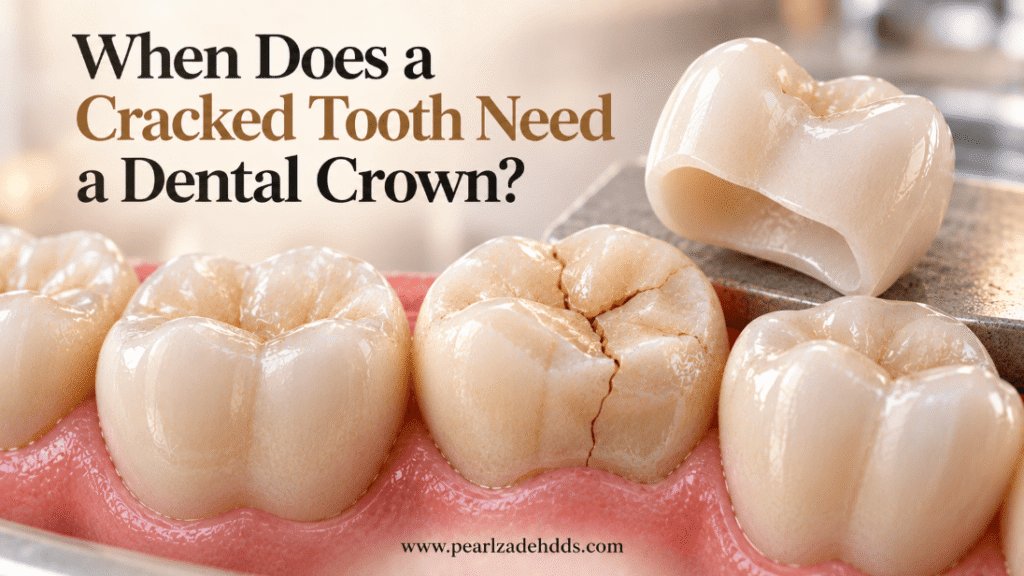
A dentist finds a crack in a back tooth and recommends a crown. You may have expected a simple filling, so the recommendation might come as a surprise.
A crown is not necessary for every cracked tooth. The best option depends on the crack’s location and depth, along with how much healthy tooth structure remains. Some cracks can be managed with monitoring or a smaller restoration. Others may need more extensive treatment, and a crown may not be enough.
A dentist can examine the tooth and explain whether a filling, onlay, or crown is appropriate. If the crack extends too far into the tooth or root, a different treatment may be necessary.
When Does a Cracked Tooth Need a Crown?
A cracked tooth may need a crown when it is weakened and can still be restored predictably. Your dentist makes that call after an exam. It is not a rule for every crack.
A crown covers the visible part of the tooth above the gum. That coverage can support a weakened tooth and shield it from chewing forces. Cleveland Clinic lists protecting and supporting a cracked tooth among the reasons dentists place crowns.
Several different problems all get called cracks, and the type points toward different treatment. The AAE describes these types:
- Craze lines: tiny cracks in the outer enamel that cause no concern beyond appearance.
- Fractured cusp: a break in a chewing point of the tooth, which rarely damages the pulp.
- Cracked tooth: a crack that runs vertically toward the root, in a tooth not yet separated into pieces.
- Split tooth: a crack with distinct segments that can be separated.
- Vertical root fracture: a crack that begins in the root and extends toward the chewing surface.
For a fractured cusp, the AAE says a dentist can place a filling or crown to protect the tooth. So cusp damage points toward a crown in some cases, not all.
Crowns become more likely when a crack involves a cusp or runs into the chewing surface. Even then, full coverage is not automatic. Cleveland Clinic says you may not need treatment for a cracked tooth that causes no infection or pain. That applies only if the crack does not extend very deep or far into the tooth. It also advises talking to a dentist whenever you notice a crack.
Monitoring can be a reasonable plan for some teeth. In a National Dental PBRN study, 2,858 patients each had a visible crack in a back tooth. About 80% of teeth recommended for monitoring at the start stayed on monitoring for three years. The authors concluded that dentists can effectively evaluate patient, tooth, and crack features to choose between treatment and monitoring.
What Determines Whether a Crown Can Save the Tooth?
No single symptom or X-ray finding decides treatment. Dentists weigh several findings together. The AAE says treatment and outcome depend on the type, location, and extent of the crack. These factors matter most:
- The crack’s location and depth.
- Whether the crack extends below the gumline or into the root.
- How much healthy tooth structure remains.
- Whether the tooth is split or has separated segments.
- Symptoms and findings from the clinical examination.
- Whether the tooth can be predictably restored.
Location and depth come first. A crack confined to the visible part of the tooth differs from one that runs toward the root. The AAE describes a cracked tooth whose crack extends below the gum line as no longer treatable.
Remaining tooth structure matters because a crown needs sound tooth to hold onto. Earlier decay, a large filling, or the crack itself can reduce what remains. Your dentist may also check whether the pulp appears healthy.
Symptoms and exam findings guide the decision, but each has limits. Pain on biting, temperature sensitivity, and a visible line can occur with several conditions. Our article on how a cracked tooth is diagnosed when an X-ray looks normal covers that evaluation.
The final question is practical. Can the tooth be restored in a way that is likely to function? Dentists answer that by combining every factor above, not by relying on one.
When Is a Filling or Onlay Enough?
A filling, an onlay, and a crown differ mainly in how much of the tooth they cover. Cleveland Clinic describes inlays and onlays as custom restorations. They suit a cavity too big for a filling but too small for a crown. An onlay covers at least one cusp. A crown fits over the entire tooth.
That range explains why treatment varies. A smaller defect may need a more conservative restoration. In contrast, a weakened tooth may need more coverage. An article on onlays and crowns, medically reviewed by a dentist, calls an onlay the more conservative option. It says the extent of damage and the condition of your teeth determine which one you receive.
Research points toward coverage for some cracked teeth, though not all. In the same PBRN study, treatment failures were associated with intracoronal restorations rather than full or partial coverage. Intracoronal restorations sit within the tooth, like fillings. Among 478 teeth that received one recommended restoration, about 14% were determined to have failed. Dentists enrolled a convenience sample, so the results may not predict your outcome.
No one option is best for every crack. Your dentist weighs the crack, the remaining tooth, your bite, and the pulp before recommending a restoration.
If a crown or onlay is planned, material is a separate decision. Our article on how zirconia and porcelain crowns compare outlines the choices.
When Might a Crown Not Be Enough?
A crown cannot reliably repair every crack. The AAE notes that, unlike a broken bone, the fracture in a cracked tooth will not heal. A crown protects the tooth. It does not heal the crack. These situations may call for a different plan:
- A crack that extends into the root.
- A split tooth with separated segments.
- Too little healthy tooth structure to support a crown.
The AAE says a split tooth cannot be saved intact. Endodontic treatment may sometimes save a portion of it. For a vertical root fracture, it says treatment may involve extraction.
Too little remaining structure creates a similar problem. A crown needs enough sound tooth to hold onto and seal against. When that is missing, your dentist may discuss other options.
Root canal treatment and crown placement solve different problems. A root canal removes inflamed or infected pulp from inside the tooth. The crown covers and protects the outside. If a crack reaches the pulp and the pulp is irreversibly damaged, a tooth may need both. Your dentist decides that after testing and will explain who would provide each part of the care.
The two treatments often work together. A 2024 systematic review in the Journal of Dentistry looked at cracked teeth with root canal treatment. It reported a higher extraction risk when the tooth had no full crown.
Extraction may be recommended when a tooth cannot be restored predictably. Cleveland Clinic says a dentist may recommend removing the tooth when a crack severely damages the root and nerves. That decision should follow an exam and a discussion of your options.
What Happens When a Dentist Treats a Cracked Tooth With a Crown?
The exact process and timing depend on your tooth and your treatment plan. A typical sequence includes these steps:
- Assessment of the crack, the remaining tooth structure, and your symptoms, with imaging when appropriate.
- Treatment of any problem inside the tooth first, if the pulp is involved.
- Preparation of the tooth, which involves removing some enamel and sometimes building up the tooth with filling material.
- An impression or digital scan to guide the making of the crown.
- A temporary restoration to protect the tooth while the permanent crown is made, when needed.
- Placement of the permanent crown after a check of its fit, bonded with dental cement.
Cleveland Clinic says crown placement usually requires two appointments. A dental lab usually takes two to three weeks or longer to make the crown. Your schedule may differ, especially if the tooth needs other treatment first. Ask your dentist to explain the plan and what to expect between visits.
Can a Crown Prevent a Cracked Tooth From Getting Worse?
Appropriate coverage may help protect certain cracked teeth from chewing forces. It does not make a tooth immune to further damage.
The 2024 review included 27 studies. In cracked teeth with vital pulp, direct restorations without cuspal coverage were associated with higher risks than full crowns. Those risks included pulp complications and extraction. The authors also concluded that monitoring without restorative treatment might be an option for a cracked tooth without symptoms. They strongly recommended full crowns for cracked teeth with symptoms and for those with root canal treatment. Those pooled findings guide your dentist’s judgment. They cannot predict what will happen to your tooth.
No crown guarantees a result. The AAE says a crown provides maximum protection but does not guarantee success in all cases. Cleveland Clinic adds that, even with treatment, cracks sometimes continue to get bigger or split. That can result in tooth loss.
Long-term results also depend on the tooth and the crown. Our article on how long porcelain crowns last with proper care discusses crown longevity in general.
When Should You Have a Cracked Tooth Evaluated?
Schedule an evaluation if you have pain when you bite, sensitivity to temperature, or a visible crack. These signs have several possible causes, and only an exam can tell them apart. Early evaluation may give your dentist more options to discuss.
Severe pain, swelling, or other worsening symptoms warrant prompt professional advice. Our article on what to do if you have a cracked tooth covers immediate steps.
A crown may be the right treatment for some cracked teeth. It is not the answer for all of them. Dr. Pearl Zadeh can examine your tooth, explain what the findings mean, and discuss the options that fit it. You can learn more about dental crown treatment at Pearl Zadeh DDS.
Call (818) 716-6722 or click the button below to schedule your consultation online.
Frequently Asked Questions
No. Craze lines and some small cracks may need no crown, and some teeth are monitored. Treatment depends on the type, location, and extent of the crack and the tooth structure that remains.
A crown can protect and support a cracked tooth that can be restored. It does not heal the crack, and it cannot fix every crack. A split tooth or a crack into the root may need a different plan.
Not always. A filling may be enough for a smaller defect, and an onlay may suit damage in between. For a weakened tooth, a crown gives more coverage. Your dentist compares the options for your tooth.
Yes. If a crack reaches the pulp, root canal treatment may be needed. A root canal treats the inside of the tooth, and a crown protects the outside. Some teeth need both.
It can happen. The AAE says a crown on a cracked tooth does not guarantee success in all cases. Some cracks keep progressing despite treatment. Regular exams help your dentist watch the tooth over time.
The information above is for informational purposes only and is not a substitute for professional dental advice. Please schedule a consultation with Pearl Zadeh DDS to discuss your specific situation.