Pearl Zadeh DDS

Category: TMJ and Teeth Grinding

  • TMJ and Jaw Clicking: When to Take the Sound Seriously

    TMJ and Jaw Clicking: When to Take the Sound Seriously

    You open your mouth wide in the mirror one morning and hear it. A small click, right near the joint in front of your ear. It happens again while you’re chewing lunch, and once more during a big yawn. You start wondering if something is grinding or wearing down every time that sound shows up.

    A clicking or popping jaw doesn’t automatically mean you have a serious problem with your temporomandibular joint, the joint connecting your lower jaw to your skull. Plenty of people have joint sounds with no pain and no trouble opening or closing normally. The picture changes when clicking shows up alongside pain, locking, limited movement, swelling, or a bite that suddenly feels different.

    What Is the TMJ?

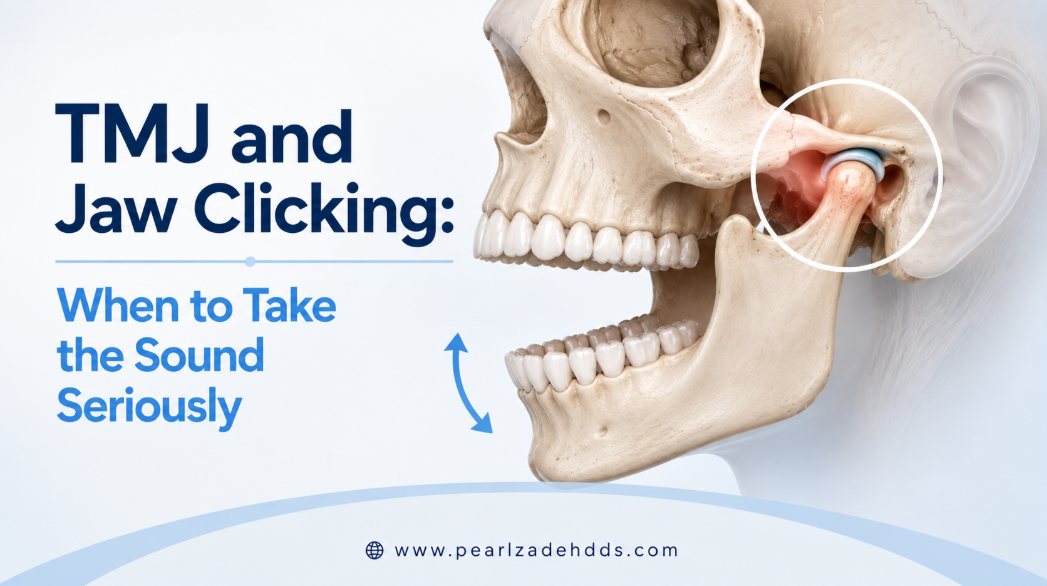
    You have one of these joints on each side of your face, right where your lower jaw meets your skull, just in front of your ears. They let your jaw open, close, slide forward, and move side to side. That’s really all you need to know to follow the rest of this. The click you’re hearing is coming from right there.

    Why Does Your Jaw Click?

    Inside each joint sits a small disc, a piece of cartilage that helps your jaw glide smoothly as it opens and closes. When that disc shifts slightly out of its usual position and then slips back as your mouth opens, it can produce a click. The Merck Manual describes this pattern, called disc displacement with reduction, as typically involving clicking, some jaw deviation during opening, and pain with jaw use like chewing, at least in patients who come in specifically because something feels wrong. That’s a different population from everyday people walking around with a click and nothing else bothering them, which is worth keeping in mind. That’s one possible explanation for a click, not the only one. Muscle tension, joint structure, and other factors can all play a role too, which is exactly why the sound by itself doesn’t tell your dentist much. A click doesn’t automatically mean a disc has slipped out of place. Figuring out what’s actually happening takes looking at your symptoms, your jaw movement, and your history together, not just listening to one sound.

    Is Jaw Clicking Normal?

    For a lot of people, yes, at least in the sense that it doesn’t require treatment. A peer-reviewed review of disc displacement notes that this same clicking pattern shows up in roughly a third of people with no symptoms at all, meaning plenty of joints click without anything being functionally wrong. That said, it wouldn’t be accurate to say clicking is always harmless in every situation.

    An occasional click with zero pain is a different situation from clicking that happens constantly, clicking paired with soreness, clicking alongside limited opening, or a jaw that catches or locks after the click. A new sound that showed up right after an injury is its own category too. The sound itself matters less than everything happening around it.

    Why Does My Jaw Click but Not Hurt?

    Some people simply have joint sounds without any pain or functional trouble to go along with them. That’s a real, fairly common experience, not a red flag on its own. It’s not something to ignore forever, either. If your jaw opens and closes the way it always has and nothing else feels off, it may not need immediate attention. If the click is new, getting louder or more frequent, or shows up alongside anything else changing, having it looked at is a reasonable move.

    When Does Jaw Clicking Become a Concern?

    A handful of accompanying symptoms shift clicking from background noise to something worth checking. Jaw pain, facial pain, or discomfort near the ear can occur alongside jaw problems, though ear symptoms have plenty of other possible causes too. Pain while chewing, difficulty opening your mouth fully, your jaw catching or locking, a bite that suddenly feels different, or swelling around the joint all may warrant a closer look. Frequent headaches paired with jaw discomfort are worth mentioning as well, though not every headache traces back to your jaw. Symptoms that are increasing in frequency or intensity, or anything that started after an injury, are also reasonable reasons to get evaluated rather than wait it out.

    What Does It Mean If Your Jaw Locks?

    A click is a sound. Locking is something else entirely, a real difficulty moving your jaw the way you normally would. A jaw that gets stuck open, gets stuck closed, or repeatedly catches partway through opening deserves professional attention rather than being brushed off. If your jaw suddenly locks and you genuinely can’t move it, don’t try forcing it back into place yourself. Get evaluated promptly instead.

    Clicking, Popping, and Grinding: What’s the Difference?

    Clicking tends to describe a single, sharper sound during opening or closing. Popping often refers to something louder or more pronounced. Grinding usually describes a rougher sound or sensation, sometimes tied to tooth wear or muscle activity rather than the joint itself. These descriptions are useful for explaining what you’re noticing, but they aren’t diagnostic tests. You can’t determine what’s actually happening in your joint just from how the sound is described. That still takes an actual evaluation.

    Can Your Bite Affect Jaw Symptoms?

    This deserves a careful answer. How your upper and lower teeth meet can be relevant when a dentist evaluates jaw function, but that’s different from saying a specific bite automatically causes TMJ problems. The National Institute of Dental and Craniofacial Research notes that current research doesn’t support the older idea that a bad bite directly causes these disorders. A dentist evaluating jaw clicking typically looks at your bite alongside jaw movement, muscle tenderness, joint tenderness, range of motion, tooth wear, any history of clenching or grinding, and past injury, since bite is one piece among several rather than a single simple explanation. Our discussion of signs your bite may be causing dental problems goes further into that evaluation if you want more detail.

    Can Clenching Make Jaw Clicking Worse?

    Clenching and grinding place extra load on your jaw muscles and joints, which can make existing symptoms more noticeable. Stress plays a role for some people too, either by increasing clenching itself or just making you more aware of jaw tension you’d otherwise ignore. None of this means stress is the sole cause behind every case of jaw clicking. Cutting back on unnecessary clenching can genuinely help some patients, but persistent symptoms still deserve an evaluation rather than assuming stress management alone will resolve them. Dental anxiety is one specific source of that tension for some patients, worth mentioning if visiting the dentist itself adds to your stress load.

    Can Jaw Clicking Go Away on Its Own?

    Some jaw sounds stay stable for years without ever turning into a painful problem. Others change over time, sometimes for the better, sometimes not. There’s no single timeline that applies to everyone here. Someone with painless clicking isn’t necessarily on the same path as someone whose clicking comes with locking or pain that’s getting worse. It wouldn’t be honest to promise every click eventually disappears, because that’s simply not true for everyone.

    Should You Stop Chewing or Avoid Opening Your Mouth?

    Hearing a click for the first time makes some patients suddenly cautious about yawning, chewing normally, or opening wide at all. Normal jaw movement is generally just part of everyday function and doesn’t need to be avoided out of caution alone. That said, if a specific movement consistently brings on pain, or your jaw keeps catching or locking during it, that’s worth having evaluated rather than repeatedly testing the same motion to see if it happens again. Skip any aggressive jaw stretching or exercise routines you find online without a professional actually guiding you through them first.

    What Can a Dentist Check?

    An evaluation typically covers where the sound is coming from, whether the joint itself is tender, how far your jaw opens, whether it shifts to one side during opening, how your teeth meet, whether the muscles around your jaw are tender, any signs of clenching or grinding, and whether anything changed recently or followed an injury. Imaging like an X-ray or MRI sometimes comes up depending on what the exam finds, but it isn’t something every patient needs. Most of what a dentist learns comes from the exam itself, not from a scan.

    Does Jaw Clicking Always Need Treatment?

    No. Whether treatment makes sense depends on your symptoms, how your jaw is functioning, what the exam finds, and what’s actually driving the sound. A painless click with completely normal jaw movement often gets managed differently than painful clicking paired with locking or restricted opening. Our discussion of non-surgical TMJ treatment options covers this in more depth, but the short version is that conservative approaches are generally considered first, not invasive treatment as some kind of default starting point.

    What Should You Avoid Doing?

    A few habits are worth skipping while you sort out what your clicking actually means:

    • Constantly testing your jaw just to hear if it still clicks
    • Forcing your mouth open when it feels stuck
    • Trying to “pop” your jaw back into place yourself
    • Chewing very hard foods if chewing is already painful
    • Ignoring persistent pain or locking
    • Assuming you need a specific treatment based on the sound alone

    None of this is meant to sound alarming. It’s mostly about not accidentally making things harder to sort out.

    When Should You See a Dentist?

    An evaluation is reasonable when clicking shows up alongside:

    • Pain
    • Persistent tenderness
    • Difficulty opening or closing your mouth
    • Jaw locking or catching
    • Swelling
    • A sudden change in your bite
    • Symptoms that are increasing over time
    • Symptoms that started after an injury
    • Difficulty chewing normally

    A painless, occasional click is a different situation from a painful or steadily worsening one. Our broader overview of TMJ disorder and our guide on when jaw symptoms warrant a dental evaluation both go further into that distinction if you want the fuller picture.

    Speak With Dr. Pearl Zadeh About Jaw Clicking

    A jaw click on its own doesn’t automatically mean something serious is going on. Persistent or painful symptoms deserve a real look rather than guesswork. Dr. Pearl Zadeh, a member of the American Dental Association and California Dental Association, can evaluate your jaw movement, bite, muscles, and joint symptoms as part of a general dental exam and help determine whether further attention makes sense.

    Schedule a consultation to talk through what you’re noticing and get a clearer picture of what’s actually going on.

    Call (818) 716-6722 or click the button below to schedule a consultation online.

    Frequently Asked Questions

    Is it normal for my jaw to click when I chew?

    It can be, especially if there’s no pain and your jaw opens and closes normally. Clicking without other symptoms is common and doesn’t automatically mean a problem.

    Why does my jaw click but not hurt?

    Some people have joint sounds without any accompanying pain or dysfunction. If nothing else feels off, it may not need immediate treatment, though a new or worsening sound is worth mentioning to your dentist.

    When should I worry about jaw clicking?

    When it comes with pain, locking, difficulty opening your mouth, swelling, a bite change, or symptoms that keep getting worse. Those combinations are worth having evaluated.

    Can jaw clicking lead to locking?

    For some patients, yes, though not for everyone. A jaw that starts catching or getting stuck alongside clicking deserves professional attention.

    Does jaw clicking always require treatment?

    No. Treatment depends on your symptoms, jaw function, and what an evaluation finds. Painless clicking with normal movement is often managed differently than painful or restricted clicking.

    This article is for informational purposes only and is not a substitute for professional dental advice. Please schedule a consultation with Pearl Zadeh DDS to discuss your specific situation.

  • Can TMJ Disorder Be Treated Without Surgery?

    A TMJ disorder diagnosis does not automatically mean surgery. In fact, many patients start with conservative treatment aimed at reducing pain, easing jaw tension, and protecting normal jaw function.

    The right approach depends on what is causing your symptoms and how severe the problem is. Some patients improve with simple changes and targeted care, while others need more involved treatment. Surgery can play a role in certain cases, but it usually isn’t where treatment begins.

    What Does TMJ Disorder Treatment Without Surgery Actually Involve?

    Non-surgical treatment covers a range of approaches aimed at reducing strain on the jaw, managing muscle tension, addressing clenching or grinding, improving day-to-day comfort, protecting your teeth, and supporting normal jaw function. None of these involve cutting into the joint or making permanent changes to your bite or jaw structure. What actually gets recommended depends heavily on the type of TMJ problem you have. A patient dealing mostly with muscle tension needs a different approach than one with a joint that’s actually locking, which is why there’s no single treatment that fits everyone.

    Jaw Rest and Temporary Diet Changes

    Softer foods and avoiding excessive chewing can reduce strain on a painful jaw in the short term, giving irritated muscles or joint tissue a chance to calm down. This tends to be one of the first things a dentist suggests, since it’s simple and low-risk. A few habits are worth cutting back on while symptoms are active:

    • Chewing gum
    • Biting into hard foods
    • Very wide yawning
    • Biting objects like pens or fingernails
    • Using your teeth as tools, like opening packaging

    These measures can help manage symptoms in the moment, but they don’t necessarily address whatever’s actually causing them. Think of this as calming things down rather than solving the underlying issue.

    Warm or Cold Compresses

    Applying heat or cold to the jaw is a simple comfort measure some patients find genuinely helpful. Cold can help with acute pain or swelling, while warmth may ease muscle tension and stiffness. Neither works identically for everyone, and there’s no single approach proven best across the board. Many dentists suggest trying both and sticking with whichever brings more relief for your specific symptoms.

    Managing Clenching and Grinding

    Clenching and grinding, sometimes called bruxism, place repeated strain on the jaw joint and muscles. Some people do this at night without any awareness of it, while others clench during the day, often during focused or stressful moments. Reducing unnecessary jaw tension, becoming more aware of daytime clenching, and addressing nighttime grinding can all help lower that strain. This doesn’t mean grinding explains every case of TMJ disorder. For some patients it’s a major factor, and for others it plays little to no role at all.

    Oral Appliances and Night Guards

    A dentist may recommend an oral appliance for certain patients, though the purpose varies by situation. Some appliances aim to reduce the impact of nighttime grinding, while others are designed to help the jaw rest in a more relaxed position. Not every patient with TMJ symptoms needs a night guard, and wearing one isn’t a permanent fix for TMJ disorder on its own. What matters is that any appliance is properly evaluated and fitted for your specific bite and symptoms, since an ill-fitting or generic appliance can do little to help, and in some cases adds its own discomfort.

    Physical Therapy and Jaw Exercises

    For selected patients, physical therapy can help with jaw mobility, muscle tension, movement patterns, and general pain management. The National Institute of Dental and Craniofacial Research notes that gentle jaw stretching and strengthening exercises, often combined with heat or cold, are commonly part of initial conservative care. That said, exercises need to match your specific condition. A patient with a painful, locked joint shouldn’t force movement through it, and generic exercises found online aren’t a substitute for guidance based on an actual evaluation of your jaw.

    Stress Management and Relaxation

    Stress can contribute to jaw clenching and general muscle tension, though it doesn’t explain every case of TMJ disorder. For patients where stress plays a role, becoming more aware of daytime clenching, practicing deliberate jaw relaxation, managing stress more broadly, and improving sleep habits can all help reduce the tension adding to their symptoms. Cleveland Clinic lists deep breathing and meditation among the practical ways patients reduce stress-related jaw tension. For some patients, dental visits themselves are part of that stress picture, which our page on dental anxiety addresses separately.

    Medication

    Depending on the situation, a dentist or physician may recommend medication aimed at pain or inflammation as part of a broader treatment plan. This isn’t something to approach with a fixed protocol, since appropriate options and dosing depend on your individual health history and should come from a professional evaluation rather than general guidance. Medication can help manage symptoms, but it generally doesn’t address whatever is actually causing them, which is why it’s typically used alongside other approaches rather than as a standalone fix.

    What About the Bite?

    A dentist may examine how your teeth meet as part of a broader TMJ evaluation, since bite relationships can be one of several relevant factors. That said, not every bite irregularity causes TMJ disorder, and grinding down healthy teeth or permanently altering someone’s bite isn’t automatically the right move just because a minor irregularity shows up during an exam. Why bite matters more than straight teeth goes further into how functional bite assessment fits into overall evaluation. Treatment decisions involving the bite should follow a proper evaluation, not a reflexive adjustment made without a clear reason.

    Can Invisalign or Orthodontic Treatment Help TMJ?

    Sometimes, but not automatically. Orthodontic treatment, including Invisalign, is designed to address tooth position and certain bite concerns. It isn’t a designed treatment for a painful jaw joint or tense jaw muscles, and straightening teeth doesn’t reliably resolve TMJ symptoms on its own. There’s a real difference between treating tooth alignment, treating a bite concern, and treating a painful jaw joint or muscle problem, and these three don’t automatically overlap just because they all involve the mouth. If orthodontic treatment is genuinely relevant to your situation, it comes up as part of an evaluation, not as an assumed fix for jaw pain.

    When Non-Surgical Treatment May Be Enough

    Many patients manage their symptoms successfully with conservative care: reduced jaw strain, addressing clenching, an appropriately fitted oral appliance, physical therapy, lifestyle adjustments, or some combination recommended after an evaluation. This doesn’t mean results are permanent or guaranteed. Some patients need ongoing management rather than a one-time fix, particularly if contributing factors like stress or clenching are part of an ongoing pattern rather than a single episode.

    When Surgery May Be Considered

    Surgery isn’t the automatic next step if conservative treatment doesn’t work overnight, but it does have a role for certain patients. The National Institute of Dental and Craniofacial Research notes that experts generally recommend avoiding treatments that permanently change the jaw joints, teeth, or bite unless conservative approaches haven’t adequately addressed the problem. Surgery may be considered in situations involving significant structural joint damage, certain severe injuries, advanced joint disease, or symptoms that haven’t responded to appropriate conservative care over time. This is a decision that requires a proper evaluation by a specialist, not something to assume based on the severity of pain alone. Many patients with even persistent symptoms never end up needing it.

    How Do You Know Which Treatment You Need?

    Treatment selection starts with an evaluation, not a guess based on symptoms alone. A dentist typically considers:

    • Your symptoms and how they’ve changed over time
    • How long they’ve lasted and how severe they are
    • Your jaw movement and any joint sounds
    • Muscle and joint tenderness
    • Signs of clenching or grinding
    • How your teeth meet
    • Your medical and dental history
    • Any treatment you’ve already tried

    Imaging is sometimes part of this, but not every patient needs it. If you’re still deciding whether your symptoms are worth bringing up at all, our guide on when to see a dentist for TMJ symptoms covers that decision in more depth. The goal of any evaluation is identifying what’s actually contributing to your symptoms before choosing a treatment path, rather than starting with a treatment and hoping it fits.

    How Long Does Non-Surgical TMJ Treatment Take?

    There’s no single timeline that applies to everyone. Some symptoms improve over days or weeks once jaw strain is reduced, particularly for mild or recently developed cases. Other situations require longer-term management, especially when clenching, stress, or a more involved joint issue is part of the picture. How long treatment takes depends on the underlying cause, how severe your symptoms are, which treatment approach fits your case, your own habits, and how consistently you follow the recommended care. No one can honestly promise a specific recovery window before actually evaluating your jaw.

    Does TMJ Disorder Go Away Without Treatment?

    For some patients, yes. Mild or temporary symptoms sometimes settle on their own, particularly if they’re tied to a short-term stressful period or a one-off strain. That said, persistent pain, locking, restricted movement, or symptoms that keep getting worse shouldn’t simply be ignored in hopes they’ll resolve. Recognizing which symptoms deserve a dental evaluation is worth reviewing if you’re trying to decide whether to wait it out or book an appointment.

    Common Mistakes Patients Make

    A few habits tend to make TMJ symptoms harder to manage than they need to be:

    • Ignoring persistent pain and hoping it resolves on its own
    • Chewing gum frequently while symptoms are active
    • Eating very hard foods during a painful stretch
    • Clenching more during stressful situations without noticing it
    • Trying aggressive jaw exercises without professional guidance
    • Assuming a night guard is automatically the right fit for their situation
    • Assuming Invisalign will automatically resolve TMJ symptoms
    • Assuming surgery is the only real solution

    None of these are meant as judgment. They’re common patterns worth being aware of, since avoiding them tends to make whatever treatment you do pursue more effective.

    Concerned About TMJ Symptoms? Talk With Dr. Pearl Zadeh

    TMJ disorder treatment without surgery is genuinely the right starting point for most patients, and surgery is not automatically the first step. That said, don’t assume every case can be managed without professional evaluation. What’s actually going on with your jaw is worth a real assessment rather than guesswork.

    Dr. Pearl Zadeh, a member of the American Dental Association and California Dental Association, and her Woodland Hills team can evaluate your jaw symptoms, examine your bite and jaw function, and discuss appropriate next steps for your specific situation.

    Call (818) 716-6722 or click the button below to schedule a consultation online.

    Frequently Asked Questions

    1. Can TMJ disorder go away without surgery?

    Yes, for most patients. Conservative, non-surgical treatment is the recommended starting point for the majority of TMJ cases, and many patients manage their symptoms this way without ever needing surgery.

    2. What is the best non-surgical treatment for TMJ?

    There isn’t one universal answer. The right approach depends on your specific cause and symptoms, which is why an evaluation, rather than a generic recommendation, determines what fits your situation best.

    3. Can a night guard help TMJ pain?

    For some patients, yes, particularly when clenching or grinding is a contributing factor. A night guard isn’t a universal fix, and it needs to be properly fitted and recommended based on your specific situation.

    4. How long does non-surgical TMJ treatment take?

    This varies widely. Some symptoms ease within days or weeks, while others require longer-term management depending on the cause, severity, and consistency of care.

    5. When does TMJ disorder require surgery?

    Surgery is generally considered when there’s significant structural joint damage or when appropriate conservative treatment hasn’t adequately addressed the problem, and it requires evaluation by a specialist rather than being an automatic next step.

    This article is for informational purposes only and is not a substitute for professional dental advice. Please schedule a consultation with Pearl Zadeh DDS to discuss your specific situation.

  • When Should You See a Dentist for TMJ Symptoms?

    A clicking jaw does not always mean something is wrong. But when that clicking comes with pain, stiffness, locking, or trouble chewing, it deserves more attention. The same applies when jaw symptoms keep returning or gradually get worse.

    Knowing the difference can help you decide whether to simply mention a symptom at your next checkup or schedule a separate evaluation. Persistent pain, limited jaw movement, locking, and noticeable changes in how your jaw functions are signs worth discussing with your dentist.

    Not Every Jaw Click Is a Sign of a Disorder

    Clicking or popping on its own, without pain, is common and usually doesn’t need treatment. The National Institute of Dental and Craniofacial Research notes that this kind of clicking is considered normal for many people. What changes the picture is when clicking shows up alongside other symptoms. Clicking can be worth a closer look when it occurs together with pain, swelling, limited movement, jaw locking, difficulty chewing, or a noticeable change in how your jaw moves. On its own, a click is just a sound. Paired with one of these, it may be part of a bigger pattern worth mentioning to a dentist.

    TMJ Symptoms That Should Prompt a Dental Evaluation

    A handful of specific symptoms tend to be worth scheduling an evaluation for, rather than waiting to see if they pass on their own.

    Persistent or Recurring Jaw Pain

    Pain that shows up once after a stressful day and fades by the next morning is different from pain that keeps returning week after week. Ongoing or recurring jaw pain deserves evaluation rather than being brushed off, since it’s a signal that something is straining the joint or muscles repeatedly rather than just once.

    Pain While Chewing

    Pain during normal chewing can affect what you’re comfortable eating, sometimes without you fully realizing you’ve started avoiding certain foods. This kind of functional pain, meaning pain during an activity your jaw does dozens of times a day, is worth assessing rather than working around indefinitely.

    Jaw Locking

    This is one of the more important signs on this list. Occasional stiffness that loosens up after a moment is different from a jaw that genuinely gets stuck, whether that means it won’t open past a certain point or won’t fully close again. A jaw that locks, even briefly, is a stronger signal than most other symptoms on this list and generally warrants an evaluation.

    Limited Mouth Opening

    Some restriction is only concerning if it’s new, worsening, or significant enough to affect eating or speaking comfortably. If you notice you can’t open your mouth as wide as you used to, or opening feels tight and restricted rather than smooth, that’s worth mentioning at your next visit, sooner if it’s affecting daily activities.

    Pain Around the Ears

    The temporomandibular joints sit just in front of your ears, which is why jaw-related problems can sometimes cause discomfort that feels like it’s coming from the ear itself. That said, ear pain has plenty of other possible causes, from infections to sinus issues, so it shouldn’t be automatically assumed to be jaw-related. If ear pain shows up alongside jaw symptoms like clicking, stiffness, or pain while chewing, that combination is more suggestive of a jaw connection worth discussing with your dentist.

    Frequent Headaches or Facial Pain

    Jaw muscle tension and clenching can contribute to headaches or facial discomfort for some patients, particularly tension that builds around the temples or jawline. This doesn’t mean every headache is jaw-related. Plenty of headaches have nothing to do with the jaw at all. But if headaches are showing up alongside jaw soreness, clenching, or other TMJ symptoms, it’s a pattern worth mentioning rather than treating as an unrelated coincidence.

    Changes in How Your Teeth Meet

    If your bite suddenly feels different, teeth meeting in a way that feels off compared to before, that’s a noticeable change worth bringing up at your next appointment. Our discussion of signs your bite may be causing dental problems covers this kind of change in more detail, including other bite-related signs worth watching for.

    Symptoms That Keep Getting Worse

    Even a symptom that started out mild deserves attention if it’s clearly trending in the wrong direction. Worsening pain, increasing frequency of clicking or locking, or a gradual reduction in how far you can open your mouth are all signs that whatever’s happening isn’t resolving on its own.

    When a Jaw Click May Not Be Concerning

    It’s worth balancing the list above with some reassurance. A painless click, on its own, does not automatically mean you have a TMJ disorder. Dentists weigh the full picture rather than reacting to a single symptom in isolation: whether there’s pain, how your jaw functions day to day, your range of motion, whether locking occurs, how often symptoms show up, and whether anything has changed recently. A click that’s been present for years without any other symptoms is a very different situation than a click that appeared last month alongside new jaw pain.

    When TMJ Symptoms May Need Prompt Attention

    Most jaw symptoms aren’t emergencies, and this section isn’t meant to turn routine discomfort into something alarming. That said, a few situations are worth prompt attention rather than waiting for your next regular visit:

    • A jaw that locks and won’t return to normal movement
    • Significant difficulty eating because of pain or restriction
    • Pain that’s severe or rapidly getting worse
    • Noticeable swelling
    • Symptoms that started after trauma to the jaw or face
    • A major change in how your jaw moves
    • Being unable to open or close your mouth normally

    If you’ve experienced significant trauma, severe swelling, or a jaw that won’t move at all, that combination may point toward a more serious injury and is worth an urgent evaluation rather than waiting.

    What Happens During a TMJ Evaluation?

    Knowing what to expect can make the decision to book an appointment feel less uncertain. Your dentist typically asks about your symptoms and reviews your dental and medical history, then checks how your jaw moves, including how far you can open your mouth. They’ll examine the jaw joints and chewing muscles directly, listen for joint sounds, and look for signs of clenching or grinding, along with evaluating how your teeth meet. Imaging is sometimes recommended, but only when your specific symptoms suggest a more complex joint problem, not as a routine step for everyone. The goal of this evaluation is straightforward: figuring out whether your symptoms involve the joint, the muscles, your bite, or something else entirely. If you want a fuller picture of what TMJ disorder actually involves and how it develops, our broader overview of TMJ disorder covers that in more depth.

    Why Waiting Can Sometimes Make Things More Difficult

    This isn’t a claim that untreated TMJ symptoms always get worse, because that’s not accurate for every patient. But persistent symptoms left unaddressed can start affecting eating, sleep, daily comfort, and general jaw movement in ways that are harder to ignore the longer they continue. Cleveland Clinic notes that early care can make a real difference in how patients feel day to day. Getting an evaluation earlier gives your dentist a chance to identify what’s contributing to your symptoms before they interfere more significantly with your daily life, rather than after.

    Can Stress or Clenching Trigger TMJ Symptoms?

    Stress and jaw clenching can contribute to TMJ symptoms for some patients. However, stress alone does not cause every case.

    Many people clench their jaws more during stressful periods without realizing it. This can place ongoing tension on the muscles around the joint.

    If dental visits add to that stress, our page on dental anxiety explains how anxiety and physical tension can affect each other.

    Bite and TMJ Symptoms

    It’s worth repeating here: a bite that isn’t perfectly aligned does not automatically mean someone has, or will develop, TMJ symptoms. NIDCR research doesn’t support the idea that a bad bite directly causes TMD. Dentists may still assess how your teeth meet as one part of a broader evaluation, not because bite alone is assumed to be the cause. This kind of functional bite assessment is separate from cosmetic alignment alone, and it’s one piece of the larger picture your dentist looks at during an evaluation.

    Not every jaw click or occasional ache means you need treatment. But persistent pain, locking, limited movement, or symptoms that keep getting worse deserve a real evaluation rather than guesswork.

    Dr. Pearl Zadeh, a member of the American Dental Association and California Dental Association, and her Woodland Hills team can evaluate your symptoms as part of a general dental exam, listen to what you’ve been experiencing, and explain what may be contributing to them.

    Call (818) 716-6722 or click the button below to schedule a consultation online.

    Frequently Asked Questions

    1. Is jaw clicking always a sign of TMJ disorder?

    No. Occasional clicking without pain or restricted movement does not always indicate TMJ disorder. Persistent clicking with pain, locking, or limited movement deserves an evaluation.

    2. When should I see a dentist for TMJ symptoms?

    See your dentist if jaw pain persists, your jaw locks, movement becomes difficult, or symptoms keep getting worse. An evaluation can help identify the likely cause.

    3. Can headaches be caused by TMJ problems?

    They can. Jaw clenching and muscle tension may contribute to headaches or facial pain. However, headaches have many possible causes, so a dental evaluation cannot confirm TMJ as the cause by itself.

    4. Can teeth grinding cause TMJ symptoms?

    Yes. Frequent grinding or clenching can place repeated stress on the jaw muscles and joints. Your dentist can look for signs of these habits during an examination.

    5. What happens during a TMJ evaluation?

    Your dentist may review your symptoms, check jaw movement, examine the jaw joints and chewing muscles, and evaluate how your teeth meet. Imaging may be recommended when needed.

    This article is for informational purposes only and is not a substitute for professional dental advice. Please schedule a consultation with Pearl Zadeh DDS to discuss your specific situation.

  • What Is TMJ Disorder? Symptoms, Causes, and Treatment

    TMJ disorder is a common term for problems affecting the jaw joints, chewing muscles, or both. Some symptoms stay mild and come and go. Others can interfere with eating, speaking, sleeping, or opening your mouth normally.

    The tricky part is that not every jaw click means you have a disorder. What matters is the combination of symptoms, how often they occur, and whether they affect how your jaw functions. Knowing what to watch for can help you decide when a dental evaluation makes sense.

    What Is TMJ Disorder?

    TMJ disorder is the everyday term patients use to describe problems with the jaw joint or the muscles around it. Technically, TMJ refers to the temporomandibular joint itself, the joint connecting your lower jaw to your skull, while TMD, short for temporomandibular disorders, refers to the actual conditions that cause pain or dysfunction in that area. The National Institute of Dental and Craniofacial Research describes TMDs as a group of conditions, more than thirty in total, that affect the jaw joint and the muscles controlling jaw movement. In everyday conversation, most people just say TMJ or TMJ disorder to mean the same general thing. TMD is fairly common: NIDCR estimates that roughly 5 to 10 percent of the U.S. population has some form of it, and it occurs about twice as often in women as in men.

    TMD is generally grouped into three broad categories. Myofascial pain, the most common type, involves discomfort in the muscles that control jaw movement rather than the joint itself. Internal derangement involves issues within the joint, such as a displaced disc or a jaw that dislocates. Degenerative joint disease refers to arthritis affecting the joint. Many patients have symptoms that overlap more than one category, which is part of why an individual evaluation matters more than trying to self-categorize based on symptoms alone.

    Where the TMJ Joints Are and How They Work

    You have two temporomandibular joints, one on each side of your face, sitting just in front of your ears. These joints work together with several jaw muscles to let your mouth open and close, move forward and back, and shift from side to side. That coordination is what makes chewing, talking, and yawning feel effortless most of the time. When something in that system, whether it’s the joint itself, the muscles, or how they work together, isn’t functioning smoothly, it can lead to the symptoms people associate with TMJ disorder.

    Common TMJ Disorder Symptoms

    Symptoms vary quite a bit from person to person, and having one or two of these occasionally doesn’t necessarily mean you have a significant problem. Common symptoms include:

    • Jaw pain or tenderness
    • Discomfort near the ears
    • Clicking or popping sounds when opening or closing your mouth
    • Jaw stiffness or difficulty opening your mouth fully
    • Jaw locking, either open or closed
    • Pain while chewing, or general facial pain
    • Headaches
    • Sore jaw muscles
    • Tooth soreness related to clenching
    • A sense that your teeth meet differently than they used to

    Any of these on their own, especially if mild and occasional, isn’t necessarily a sign of a significant problem. It’s the combination and persistence of symptoms that tends to matter more, which the next few sections cover in more detail.

    Is Jaw Clicking or Popping Always a Problem?

    No. This is one of the most common misunderstandings patients have. According to the National Institute of Dental and Craniofacial Research, clicking or popping sounds in the jaw joint, without pain, are common and considered normal, and they generally don’t require treatment on their own. Plenty of people have a clicky jaw for years without any pain or functional problem. What matters more is whether the clicking comes with pain, limited movement, or locking, since that combination is a better indicator that something deserves a closer look.

    When Do Jaw Symptoms Become More Concerning?

    A symptom that shows up once after a big yawn or a large bite of food usually isn’t cause for concern. Symptoms become more worth paying attention to when they persist over time, keep returning, get progressively worse, or start limiting how far you can open your mouth. Jaw locking, whether temporary or lasting, is also a signal worth taking seriously, along with pain that interferes with eating, sleeping, or your daily routine.

    What Causes TMJ Disorder?

    There’s rarely a single cause. TMD tends to develop from a combination of contributing factors rather than one clear trigger, and that combination looks different from patient to patient. Teeth grinding and jaw clenching are common contributors, since they place repeated strain on the jaw muscles and joint. Stress and general muscle tension can play a role as well. A jaw injury, whether from an accident, a sports impact, or even a dental procedure that required holding your mouth open for a long time, can contribute too. Arthritis and joint inflammation are relevant for some patients, particularly when the joint itself is involved rather than just the surrounding muscles. Certain bite-related factors and repetitive chewing habits, like frequent gum chewing, are sometimes part of the picture as well. Many patients have more than one of these factors overlapping, which is part of why TMD can be tricky to pin down to a single cause.

    Can Stress and Anxiety Contribute to Jaw Clenching?

    Often, yes, though stress doesn’t directly cause every case of TMJ disorder on its own. Many people clench their jaw more during stressful periods without realizing it, whether that’s during a demanding week at work or while feeling anxious about something unrelated to their teeth. Over time, that added muscle tension can contribute to jaw soreness and other TMD symptoms. This connection between stress, tension, and dental health also comes up for patients dealing with dental anxiety, since anxious tension can show up in the jaw just as easily as it shows up anywhere else in the body.

    How Bite Problems May Relate to TMJ Symptoms

    The way your upper and lower teeth meet affects how comfortably you chew and how force gets distributed across your jaw. That said, it’s important to be careful here: a bite that isn’t perfectly aligned does not automatically mean someone has, or will develop, TMJ disorder. The National Institute of Dental and Craniofacial Research notes that current research doesn’t support the idea that a bad bite or orthodontic treatment directly causes TMDs. The relationship between bite, jaw muscles, and TMD is more complex than a simple cause-and-effect. That said, some symptoms can point toward a bite-related concern worth evaluating on its own merits, which our discussion of signs your bite may be causing dental problems covers in more detail.

    How a Dentist Evaluates TMJ Problems

    An evaluation typically starts with a conversation: your dentist asks about your symptoms, when they started, what makes them better or worse, and your general medical and dental history. From there, your dentist checks how your jaw moves, including your range of motion when opening and closing, and listens for joint sounds like clicking or grinding. They’ll check for tenderness in the jaw muscles and the joint itself, look for signs of clenching or grinding, such as wear patterns on your teeth, and evaluate how your teeth meet when you bite down.

    The American Academy of Orofacial Pain, the professional organization dedicated to the diagnosis and treatment of jaw and facial pain conditions, describes this kind of thorough evaluation as central to identifying what’s actually contributing to a patient’s symptoms. This is also part of why a functional bite assessment matters, a topic covered in more depth in our explanation of why bite matters more than straight teeth. Your dentist also checks whether your jaw moves symmetrically on both sides. Imaging, such as an X-ray or more advanced scans, is sometimes recommended, but only when symptoms suggest a more complex joint problem. Not every patient needs imaging, and your dentist will explain why if it’s recommended for your specific situation.

    TMJ Disorder Treatment Options

    Treatment depends on the cause, your symptoms, and their severity. No single approach works for every patient. Cleveland Clinic notes that TMD is generally treatable and rarely causes lasting problems. Many cases respond well to conservative care before more involved treatment becomes necessary.

    Conservative care may include choosing softer foods for a while. Avoiding excessive or prolonged chewing can also reduce strain on the jaw. Cutting back on habits like nail biting or chewing ice may help as well.

    Warm or cold compresses can ease discomfort for some patients. Jaw relaxation techniques and general stress-management strategies may also help. If clenching or grinding contributes to the problem, addressing it directly may become part of the treatment plan. In some cases, your dentist may recommend a professionally fitted oral appliance.

    Not every patient needs a night guard, medication, orthodontic treatment, injections, or surgery. More involved treatment is something that follows a proper evaluation and a clear understanding of what’s actually driving your specific symptoms, not a default starting point.

    Can TMJ Disorder Go Away on Its Own?

    Mild or temporary jaw symptoms can improve on their own. This often happens after a short period of stress or a one-time strain from a large meal or wide yawn.

    Persistent pain, jaw locking, restricted movement, or worsening symptoms are different. These symptoms deserve a professional evaluation rather than waiting for them to resolve on their own. Ignoring symptoms that continue or interfere with daily life can allow the underlying problem to persist.

    When Should You See a Dentist?

    It’s reasonable to schedule an evaluation if your symptoms persist or keep coming back. The same applies if they interfere with eating or limit how far you can open your mouth.

    You should also seek an evaluation if your jaw locks or your symptoms continue to worsen. Symptoms that affect your sleep or daily activities also deserve attention.

    Significant jaw trauma, severe swelling, or an inability to open or close your mouth can signal a serious injury. A dislocation or fracture may require urgent medical care rather than a routine dental appointment.

    After an acute injury, urgent care or an emergency room may be the safer first choice when you’re unsure.

    Concerned About Jaw Pain or TMJ Symptoms? Talk With Dr. Pearl Zadeh

    Persistent jaw pain, painful clicking, limited movement, locking, or a change in how your bite feels are all worth a professional evaluation rather than guesswork. Most TMJ disorder cases are manageable, especially when addressed before symptoms become more disruptive.

    Dr. Pearl Zadeh, a member of the American Dental Association and California Dental Association, and her Woodland Hills team can evaluate your symptoms as part of a general dental exam, discuss what may be contributing to them, and explain appropriate next steps for your specific situation.

    Call (818) 716-6722 or click the button below to schedule a consultation online.

    Frequently Asked Questions

    1. What is TMJ disorder?

    TMJ disorder is the common term for problems affecting the temporomandibular joint or the muscles around it, causing symptoms like jaw pain, clicking, or stiffness.

    2. What does TMJ stand for?

    TMJ stands for temporomandibular joint, the joint connecting your lower jaw to your skull. TMD, or temporomandibular disorders, refers to the conditions affecting that joint and surrounding muscles.

    3. What are the symptoms of TMJ disorder?

    Common symptoms include jaw pain, tenderness near the ears, clicking or popping, stiffness, difficulty opening the mouth, jaw locking, facial pain, headaches, and soreness from clenching.

    4. Is jaw clicking normal?

    Clicking or popping without pain is common and generally considered normal. It’s the combination of clicking with pain, limited movement, or locking that’s more worth evaluating.

    5. Can stress cause TMJ problems?

    Stress can contribute to jaw clenching and muscle tension, which may play a role in TMD symptoms, though stress alone doesn’t directly cause every case.