Pearl Zadeh DDS

Category: TMJ and Teeth Grinding

  • TMJ Pain vs. Sinus Pain: How to Tell the Difference

    TMJ Pain vs. Sinus Pain: How to Tell the Difference

    You feel pressure around your cheeks and upper jaw, but you can’t quite tell where it’s coming from. Maybe your teeth feel sore when you bite down. Maybe your nose is congested. Or maybe your jaw has been tense lately.

    Sinus problems and TMJ pain can feel surprisingly similar, especially around the cheeks, face, and upper jaw. The difference often comes down to the symptoms that appear alongside the pain, not simply where you feel it.

    Why TMJ Pain and Sinus Pain Can Feel Similar

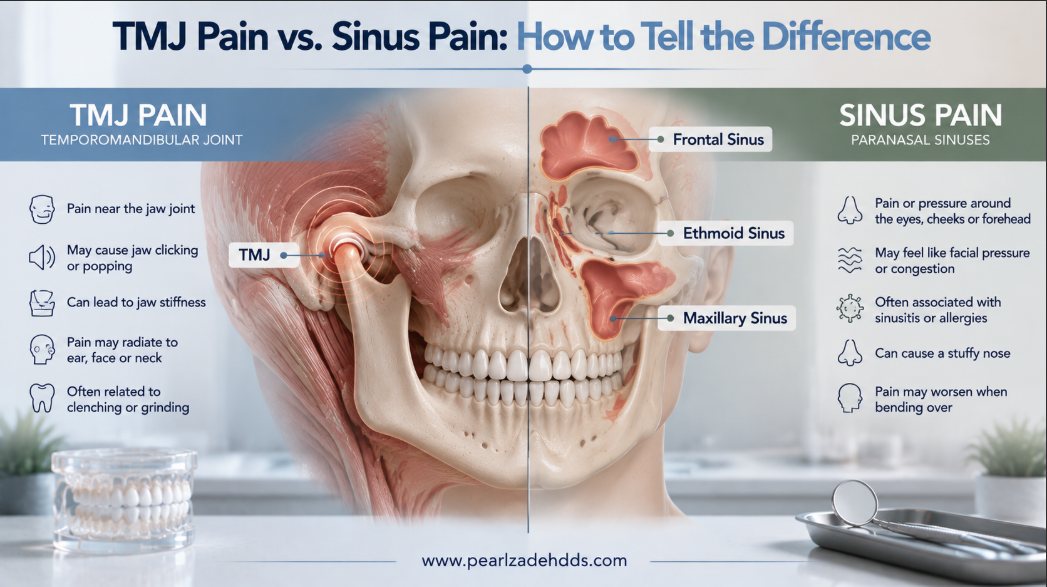
    Both can involve discomfort around your cheeks, temples, upper jaw, general facial area, and the region near your ears. Nearby nerves and structures sit close enough together that pinpointing the actual source based on location alone is genuinely difficult, even for the person experiencing it.

    What Does TMJ Pain Usually Feel Like?

    Common patterns include jaw soreness, pain while chewing, pain when opening your mouth, jaw stiffness, tender jaw muscles, clicking or popping, difficulty opening your mouth fully, facial discomfort near the jaw joint itself, and symptoms that seem to worsen with clenching or grinding. None of these confirm anything definitively on their own. TMJ disorders can involve the jaw joints, the surrounding chewing muscles, or both together.

    What Does Sinus Pain Usually Feel Like?

    Common sinus-related symptoms include facial pressure, nasal congestion, a runny nose, a reduced sense of smell, pressure around the cheeks or forehead, symptoms that get worse with congestion, and in some cases discomfort in the upper teeth. A peer-reviewed review of maxillary sinus conditions lists facial pain or pressure, nasal congestion, nasal discharge, a persistent bad or foul smell, and postnasal drip among the more common symptoms associated with sinus-related conditions. Sinus conditions can genuinely create pressure that feels like it involves your upper teeth, which is exactly where this gets confusing.

    TMJ Pain vs. Sinus Pain: Common Differences

    Pain With Chewing

    Jaw-related pain tends to become more noticeable when you’re chewing or actively moving your jaw.

    Nasal Symptoms

    Congestion, nasal discharge, or a reduced sense of smell point more toward something sinus-related.

    Jaw Movement

    Stiffness, clicking, popping, or difficulty opening your mouth fully tend to accompany TMJ-related problems specifically.

    Facial Pressure

    Sinus-related discomfort often feels more like genuine pressure, particularly around the cheeks or forehead.

    Tooth Pain

    Both dental problems and sinus issues can create upper tooth discomfort. Tooth pain doesn’t automatically point to a dental cause.

    Morning Jaw Soreness

    Waking up with a sore jaw can happen with nighttime clenching or grinding, though morning soreness alone doesn’t prove bruxism is actually happening.

    Can Sinus Problems Cause Upper Tooth Pain?

    Yes, sometimes. Inflammation or pressure in the maxillary sinus area, located just above your upper back teeth, can sometimes be felt as discomfort in those same teeth. Mayo Clinic notes that if a dentist rules out a dental cause for a toothache, a medical evaluation for a possible sinus condition is a reasonable next step. Tooth pain can just as easily come from an actual dental cause, though. If tooth pain persists or shows up alongside other dental symptoms, a dental evaluation is worth pursuing.

    Can TMJ Problems Feel Like Sinus Pressure?

    Jaw or jaw-muscle discomfort can sometimes be felt in nearby areas of your face, which can create a sensation that resembles pressure. It wouldn’t be accurate to say TMJ problems commonly cause true sinus pressure, though. There’s a real difference between a general feeling of facial pressure and actual sinus inflammation or congestion, even when the two can feel surprisingly similar in the moment.

    Can Teeth Grinding Make the Difference Harder to Recognize?

    It genuinely can. Clenching and grinding cause jaw muscle soreness and facial discomfort, and some patients interpret that discomfort as a sinus problem or an unrelated headache instead. Our discussion of stress and teeth grinding goes further into that connection. Over time, grinding can also affect your teeth directly, which our discussion of how teeth grinding damages teeth over the years covers in more depth.

    What About Tooth Pain?

    Tooth pain deserves particular attention here, since it can come from several genuinely different places: tooth decay, a crack, a dental infection, gum problems, or discomfort referred from a sinus issue. A dentist can evaluate your actual teeth to determine whether a dental source is involved. This isn’t something to work out on your own from home.

    When Should You See a Dentist?

    A dental evaluation makes sense when:

    • Jaw pain keeps returning
    • Chewing causes discomfort
    • Your jaw feels stiff
    • Your mouth doesn’t open normally
    • Tooth pain persists
    • A tooth becomes sensitive without an obvious reason
    • Jaw symptoms show up alongside clenching or grinding
    • Facial pain continues even after sinus symptoms have improved
    • You’re genuinely unsure whether the discomfort is dental or jaw-related

    Not every facial pain problem requires a dentist, but these particular patterns are reasonable prompts.

    When Should You See a Doctor?

    Medical evaluation tends to make more sense when your symptoms lean heavily toward a sinus or respiratory issue: significant nasal congestion, persistent nasal discharge, fever, facial pressure alongside respiratory symptoms, symptoms that persist or get worse, or sinus problems that keep recurring. Severe or genuinely concerning symptoms may call for prompt medical care rather than waiting to see how things develop.

    What If You’re Not Sure Which One It Is?

    You don’t need to work out the diagnosis yourself. A dentist can evaluate your teeth, gums, jaw muscles, bite, and jaw movement directly. If what they find points toward a non-dental cause, you may simply be advised to pursue medical evaluation next. The goal is identifying what’s actually likely going on, not forcing every symptom into a dental explanation just because you started with a dentist. When jaw-related findings do turn out to be part of the picture, conservative management is often where things start, though that’s a separate conversation from the differential question itself.

    What Happens During a Dental Evaluation?

    Expect questions about:

    • When the pain started
    • Where it occurs
    • Whether chewing makes it worse
    • Whether your jaw clicks or feels stiff
    • Whether there’s tooth sensitivity
    • Whether you clench or grind
    • Whether you’ve had any recent dental procedures
    • Whether sinus symptoms are also present

    Your dentist may then examine your:

    • Teeth
    • Gums
    • Bite
    • Jaw movement
    • Jaw muscles
    • The TMJ area itself

    Imaging sometimes gets recommended when appropriate, though not every patient needs X-rays or advanced imaging as a matter of routine.

    What If Your Sinus Symptoms Improve but the Jaw Pain Remains?

    That’s worth another look. If your congestion and sinus pressure clear up but jaw or tooth discomfort sticks around, a dental evaluation may genuinely help. This doesn’t automatically prove a TMJ or dental cause on its own. It just means the remaining symptom deserves its own separate look rather than being assumed to fade along with the sinus issue.

    What If the Pain Gets Worse When You Chew?

    Jaw movement and chewing place real stress on your jaw muscles and joints, which can make jaw-related pain more noticeable. Tooth problems can become more noticeable with biting too, for entirely different reasons. Chewing pain alone can’t tell you which one you’re actually dealing with. If it persists, that’s a reasonable prompt for an evaluation rather than something to keep monitoring indefinitely on your own.

    What If the Pain Is Mostly in the Upper Teeth?

    Upper tooth discomfort specifically can have several possible sources: sinus pressure, tooth decay, a crack, an infection, or another dental problem entirely, and several of these can feel remarkably similar. A dental examination helps determine whether your teeth themselves actually look and test healthy, which narrows the possibilities considerably.

    Can You Have Both a Sinus Problem and TMJ Symptoms?

    Yes. Having one condition doesn’t prevent you from also experiencing the other. It’s entirely possible to have sinus congestion and jaw muscle tension happening at the same time, as two separate things rather than one causing the other. Without more specific evidence in your particular case, it isn’t accurate to assume one condition is responsible for the other.

    What Can You Do While You Figure Out the Cause?

    A few conservative steps can help in the meantime. Avoid excessive gum chewing. Skip opening your mouth unnecessarily wide. Pay attention to whether you’re clenching during the day. Choose softer foods temporarily if chewing hurts. Follow whatever medical advice applies to your sinus symptoms specifically. Keep a rough note of when the pain shows up. Aggressive jaw exercises or treatments aren’t something to start without an actual evaluation, and any medication decisions are worth discussing with whichever professional is treating the relevant symptom.

    When Facial Pain Needs Prompt Attention

    A few situations call for prompt medical or dental care rather than waiting things out:

    • Significant facial swelling
    • Difficulty breathing or swallowing
    • High fever with severe facial or dental pain
    • Rapidly worsening swelling
    • Severe pain following facial trauma
    • Other symptoms that feel genuinely urgent or unusual

    Most facial discomfort doesn’t fall into this category, but these particular situations are worth knowing.

    Look at the Whole Pattern, Not Just Where It Hurts

    TMJ pain and sinus pain can genuinely overlap, particularly around the cheeks and upper jaw. Jaw movement, chewing discomfort, stiffness, clicking, and muscle soreness tend to point toward TMJ-related problems. Congestion, nasal symptoms, facial pressure, and respiratory symptoms tend to point more toward a sinus issue. Symptoms can still overlap in individual cases, though, and persistent pain shouldn’t be self-diagnosed either way. When the source isn’t clear, a professional evaluation can help narrow down what’s actually causing the discomfort.

    Speak With Dr. Pearl Zadeh About Your Facial or Jaw Pain

    Facial, jaw, and upper tooth discomfort can have several possible causes. If you’re unsure whether your symptoms involve your teeth, your jaw, or something else entirely, a dental evaluation can help assess the dental and jaw-related possibilities. Dr. Pearl Zadeh, a member of the American Dental Association and California Dental Association, can evaluate your teeth, bite, jaw movement, and related symptoms, and can recommend appropriate next steps when further medical evaluation may be needed.

    Call (818) 716-6722 or click the button below to schedule a consultation online.

    Frequently Asked Questions

    How can I tell if my jaw pain is TMJ or a sinus problem?

    Jaw stiffness, clicking, and pain that worsens with chewing tend to point toward TMJ, while nasal congestion, discharge, and facial pressure tend to point toward sinus issues. Symptoms can overlap, so persistent discomfort is worth having evaluated.

    Can a sinus infection cause tooth pain?

    Yes, particularly in the upper back teeth near the maxillary sinuses. If a dentist rules out a dental cause, a sinus-related origin is worth discussing with a doctor.

    Can TMJ cause sinus-like pressure?

    TMJ or jaw muscle discomfort can feel like pressure in nearby facial areas, but it doesn’t typically cause true sinus inflammation or congestion.

    Should I see a dentist or a doctor for facial pain?

    It depends on your symptoms. Jaw stiffness, chewing pain, or tooth-specific discomfort are reasons to see a dentist, while significant congestion, discharge, or fever point more toward a medical evaluation.

    Can I have both TMJ symptoms and a sinus problem at the same time?

    Yes. Having one doesn’t rule out the other, and they can occur together without one necessarily causing the other.

    This article is for informational purposes only and is not a substitute for professional dental or medical advice. Please schedule a consultation with Pearl Zadeh DDS to discuss your specific situation, and seek prompt medical care for any urgent or severe symptoms.
  • Chronic Jaw Pain: When Should You See a Dentist?

    Chronic Jaw Pain: When Should You See a Dentist?

    Jaw pain is easy to ignore when it comes and goes. You might notice it while chewing, wake up with a tight jaw, or feel soreness around your temples after a stressful day. Then it settles down, so you move on.

    But when the pain keeps returning, becomes more noticeable, or starts affecting how you eat or sleep, waiting it out becomes harder to justify.

    So when should you actually see a dentist for jaw pain? The answer depends on how long it has lasted, what triggers it, and what other symptoms you are experiencing.

    What Counts as Chronic Jaw Pain?

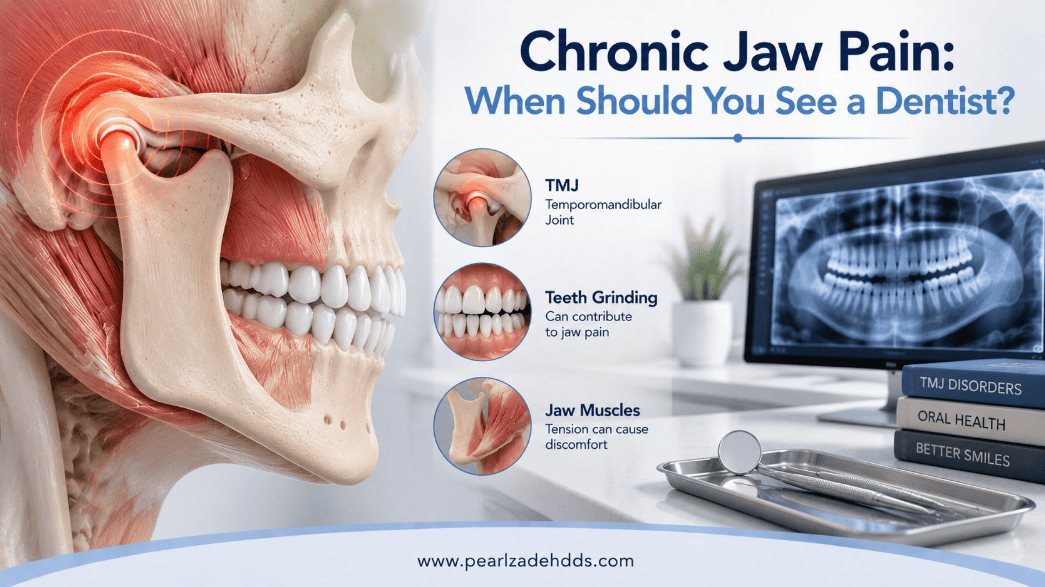
    “Chronic” generally means pain that persists or keeps returning over an extended stretch of time. The National Institutes of Health describes chronic pain broadly as pain lasting longer than three months, or longer than the time your body would normally need to heal. That’s a general medical benchmark, not a strict rule specific to your jaw. The pattern of your pain matters just as much as how long it’s lasted. Temporary soreness after a long day of chewing is different from discomfort that keeps returning every few weeks, which is different again from pain that’s simply been there, on some level, for a while now. Worth paying attention to whether your pain shows up in the morning, during chewing, when you open your mouth wide, after stressful stretches, alongside headaches, with clicking or popping, or together with tooth pain. Those details tell your dentist more than the raw duration alone.

    Where Does Jaw Pain Come From?

    Jaw pain can come from more places than people expect. The jaw joints themselves, the muscles around them, the teeth, the gums, strain related to your bite, clenching or grinding habits, previous dental work, or an old injury can all be involved. This isn’t a list to diagnose yourself from. It’s exactly why figuring out the actual source is one of the more useful things a dental evaluation can do.

    Could Teeth Grinding Be Causing Your Jaw Pain?

    It’s a genuine possibility for some patients. Nighttime grinding and daytime clenching place repeated stress on your jaw muscles and teeth, which can show up as morning jaw soreness, general muscle fatigue, tooth wear, or tooth sensitivity. Our discussion of how teeth grinding damages teeth over the years goes further into that connection. Not everyone with jaw pain grinds their teeth, though, so this is one possible piece of the picture rather than an automatic explanation.

    Could TMJ Disorder Cause Jaw Pain?

    Problems involving the temporomandibular joints or the muscles around them can genuinely cause jaw pain. That can include pain near the joint itself, pain while chewing, clicking or popping, jaw stiffness, limited opening, headaches, or facial muscle soreness. Our broader overview of TMJ disorder covers this territory in more depth. Clicking alone doesn’t automatically mean you’re dealing with a serious TMJ disorder. It’s one detail among several a dentist actually weighs.

    Can Jaw Pain Come From a Tooth?

    Not all pain you feel around your jaw actually originates in the joint. Tooth decay, a cracked tooth, a dental infection, gum problems, or an issue with an existing restoration can all cause pain that feels broader than one specific tooth. Dental pain has a way of radiating outward, which is part of why patients often can’t pinpoint the true source on their own. None of these possibilities can be confirmed from symptoms alone.

    Can Your Bite Contribute to Jaw Pain?

    How your upper and lower teeth meet can be relevant for some patients, though it isn’t accurate to say an imperfect bite automatically causes chronic jaw pain. A dentist evaluating this might look at bite contact, tooth wear, existing restorations, signs of clenching, and jaw movement together. Our discussion of signs your bite may be causing dental problems goes further into that evaluation. Bite assessment is one part of a broader picture, not the whole story on its own.

    When Should You See a Dentist for Jaw Pain?

    A dental evaluation makes sense when jaw pain:

    • Keeps returning
    • Doesn’t improve
    • Makes chewing uncomfortable
    • Affects your sleep
    • Comes with tooth sensitivity
    • Occurs alongside noticeable tooth wear
    • Comes with painful clicking or popping
    • Makes opening your mouth difficult
    • Occurs with headaches or facial muscle soreness
    • Follows dental treatment and doesn’t feel normal afterward

    Persistent or recurring symptoms deserve attention even when the pain itself isn’t severe. Our guide to when jaw symptoms warrant a dental evaluation goes further into that specific question.

    When Is Jaw Pain an Urgent Problem?

    A few situations call for prompt attention rather than a routine appointment:

    • Significant facial swelling
    • Fever along with dental or jaw pain
    • Difficulty breathing or swallowing
    • Signs of a severe infection
    • Major trauma to the jaw
    • Jaw locking that prevents normal movement
    • Sudden severe pain accompanied by other concerning symptoms

    If you’re experiencing difficulty breathing or swallowing, that calls for urgent medical care, not a wait-and-see approach. Most jaw pain doesn’t fall into this category, but these specific situations are worth knowing.

    What Happens During a Jaw Pain Evaluation?

    Expect questions about:

    • When the pain started
    • Where it hurts
    • What makes it better or worse
    • Whether it happens during chewing
    • Whether you grind or clench
    • Whether you get headaches
    • Your previous dental treatment
    • Any past jaw injuries

    Your dentist may then examine your:

    • Teeth
    • Gums
    • Bite
    • Jaw movement
    • Jaw muscles
    • The TMJ area itself

    Imaging sometimes gets recommended depending on what the exam finds, though not every patient needs X-rays or advanced imaging as a matter of routine.

    Does Every Jaw Pain Patient Need a Night Guard?

    No. A night guard can genuinely help patients who grind or clench, particularly when protecting the teeth is part of the goal. It isn’t automatically the answer for every case of jaw pain, though. What’s actually causing the pain needs to be understood before an appliance gets recommended, not the other way around.

    What About TMJ Treatment Without Surgery?

    Some TMJ-related symptoms can be managed with conservative approaches, depending on the underlying cause and how severe things are. Our discussion of non-surgical TMJ treatment options covers this in more depth. Not every TMJ condition can be resolved without surgery, but for plenty of patients, conservative care is where things reasonably start.

    Can Stress Make Jaw Pain Worse?

    For some people, yes. Stress may contribute to jaw clenching and general muscle tension, and patients sometimes notice more discomfort during particularly stressful stretches. This doesn’t mean stress explains every case of chronic jaw pain. It’s one contributing factor among several possible ones.

    What Can You Do While Waiting for an Appointment?

    A few low-risk, temporary steps can help in the meantime. Choose softer foods if chewing is uncomfortable. Skip chewing gum for now. Avoid opening your mouth unnecessarily wide. Pay attention to whether you’re clenching during the day. Follow any instructions your dentist has already given you. Keep a rough note of when your symptoms show up. None of this is a diagnosis or a cure, and it isn’t a reason to try aggressive jaw exercises or make permanent changes to how you eat. These are just reasonable comfort measures until you’re actually seen.

    What If the Pain Comes and Goes?

    Intermittent symptoms still deserve attention, even if you feel completely fine for days at a time between episodes. Pay attention to whether certain patterns line up with your flare-ups, stressful periods, mornings specifically, certain foods, chewing, recent dental treatment, clenching, or headaches. Mentioning those patterns during your visit gives your dentist genuinely useful information, more than just describing the pain itself.

    What If Your Jaw Pain Started After Dental Work?

    Some temporary soreness after certain dental procedures is normal. Persistent, worsening, or unusual symptoms are a different matter and worth a conversation with your dentist. Mention when the pain actually began, what procedure you had done, whether your bite feels different than before, whether chewing feels uncomfortable, and whether things seem to be improving or getting worse. This doesn’t mean the treatment caused a lasting problem. It just means it’s worth having someone take a look.

    How Can You Tell If Jaw Pain Is Coming From Your Teeth or Jaw?

    Honestly, you often can’t tell on your own. Tooth pain, jaw muscle discomfort, TMJ symptoms, and pain that radiates from somewhere else nearby can all feel remarkably similar. A dental examination is really what helps narrow down where the problem is actually coming from. There isn’t a reliable way to self-diagnose this based on symptoms alone.

    Can Chronic Jaw Pain Go Away on Its Own?

    Sometimes, yes. Some temporary jaw discomfort settles without any treatment at all. Pain that persists, keeps coming back, gets worse, or starts affecting your eating and daily activities is a different situation and genuinely deserves evaluation. Waiting indefinitely on the assumption it will eventually resolve isn’t a great strategy once a pattern like that shows up.

    What Happens If You Ignore Chronic Jaw Pain?

    Ignoring persistent symptoms mainly delays figuring out what’s actually causing them. If the underlying issue involves tooth damage, ongoing grinding, an infection, or a jaw function problem, putting off an evaluation just gives that issue more time to continue. This doesn’t mean every case of untreated jaw pain is destined to become severe. It just means there’s little upside to waiting once symptoms are clearly sticking around.

    Persistent Jaw Pain Is Worth Checking

    Jaw pain can come from the jaw joints, the surrounding muscles, your teeth, your gums, clenching or grinding, previous dental work, or other causes entirely. Occasional mild soreness may well settle on its own. Recurring or persistent pain deserves real attention. A dentist can evaluate your teeth, bite, jaw movement, muscles, and other relevant areas to help figure out what’s actually contributing to what you’re feeling. The goal was never simply to treat the pain. It’s to understand why it’s happening in the first place.

    Speak With Dr. Pearl Zadeh About Your Jaw Pain

    Persistent jaw pain can have several possible causes, and patients don’t always know where the discomfort is actually coming from. Dr. Pearl Zadeh, a member of the American Dental Association and California Dental Association, can evaluate your teeth, bite, jaw, and related symptoms to help identify what may be contributing to what you’re experiencing.

    Call (818) 716-6722 or click the button below to schedule a consultation online.

    Frequently Asked Questions

    How long does jaw pain need to last before I should see a dentist?

    There’s no strict cutoff, but pain that keeps returning, doesn’t improve, or interferes with chewing or sleep is worth having evaluated rather than waiting further.

    Does jaw pain always mean I have TMJ disorder?

    No. Jaw pain can come from the joint, the surrounding muscles, a tooth, the gums, or your bite. A dental evaluation helps identify the actual source.

    Can a tooth problem cause pain that feels like it’s in my jaw?

    Yes. Dental pain from decay, a crack, or an infection can radiate outward and feel broader than one specific tooth.

    When is jaw pain an emergency?

    Significant facial swelling, fever with jaw pain, difficulty breathing or swallowing, major trauma, or jaw locking all call for prompt attention rather than a routine appointment.

    Will jaw pain go away on its own?

    Sometimes mild, temporary soreness does. Pain that persists, keeps returning, or affects eating and daily activities is worth having evaluated.

    This article is for informational purposes only and is not a substitute for professional dental or medical advice. Please schedule a consultation with Pearl Zadeh DDS to discuss your specific situation, and seek prompt medical care for any urgent or severe symptoms.
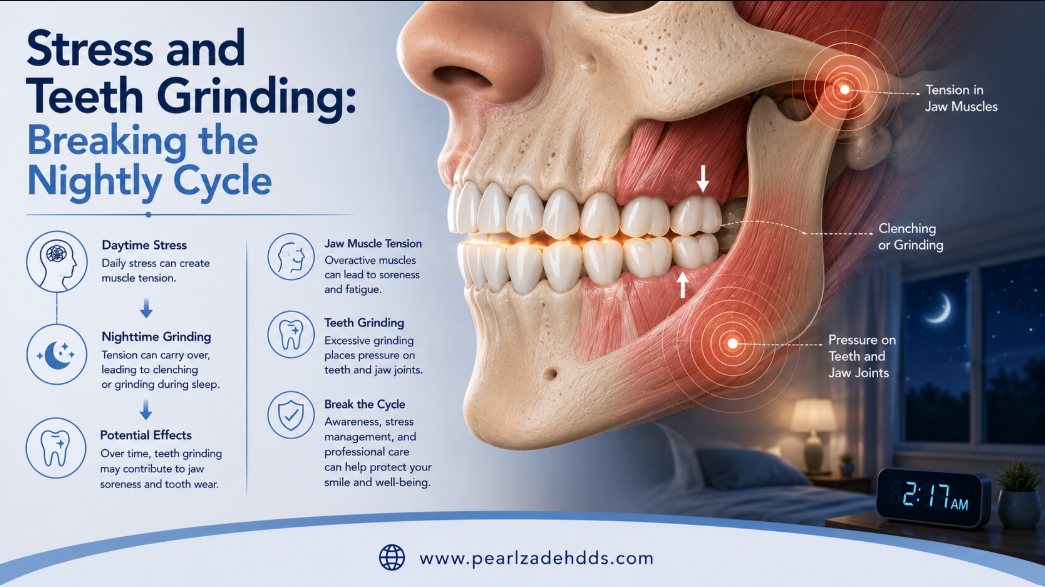
  • Stress and Teeth Grinding: Breaking the Nightly Cycle

    Stress and Teeth Grinding: Breaking the Nightly Cycle

    You wake up with a sore, tight jaw after a stressful day. Your teeth feel more sensitive than usual, and your partner says they heard you grinding during the night. Now you’re wondering whether all that tension followed you into sleep.

    It might have. Stress can contribute to teeth clenching and grinding in some people, especially during periods of ongoing tension. But stress isn’t the only possible reason you grind your teeth, and figuring out what’s behind it matters if your teeth or jaw are starting to suffer.

    What Is Teeth Grinding?

    Dentists call this bruxism, and it covers two related things. Grinding is when your teeth actually slide or rub against each other. Clenching is when your jaw muscles tighten forcefully, sometimes without much visible tooth movement. Both can happen while you’re asleep or while you’re awake. Plenty of people have no idea they grind or clench at night, simply because it happens while they’re unconscious. The signs usually show up elsewhere, a sore jaw, sensitive teeth, a comment from a partner, long before anyone notices the actual grinding.

    Can Stress Cause Teeth Grinding?

    Stress can be one factor that contributes to teeth grinding or clenching in some people. Periods of increased stress sometimes coincide with more noticeable jaw tension or grinding, though stress isn’t the only possible contributor here. A systematic review published in the Journal of Oral & Facial Pain and Headache looked specifically at psychosocial factors, including stress, anxiety, and depression, in relation to bruxism, and found evidence connecting these factors to grinding across a substantial body of research. That’s meaningfully different from saying stress causes teeth grinding outright. Sleep-related factors, certain medications, other habits, and various health conditions may also play a role. This isn’t meant to be an exhaustive rundown of every possible cause. It’s simply a reminder that stress is part of a bigger picture, not the whole picture.

    Why Does Stress Show Up in Your Jaw?

    Some people respond to stress by tightening their jaw muscles without ever noticing they’re doing it, the same way others might hunch their shoulders or clench their fists. In people who already grind or clench, that muscle activity can continue right through sleep. This may contribute to morning jaw soreness, facial muscle fatigue, temple discomfort, tooth sensitivity, headaches, or a general sense of jaw tightness. Every one of these symptoms can also come from something else entirely, so none of them confirms grinding on its own.

    How Do You Know If You Grind Your Teeth at Night?

    You may never actually notice the grinding itself, since it happens while you’re asleep. A few signs tend to point in that direction:

    • Waking with a sore or tired jaw
    • Tooth sensitivity
    • Flattened or worn tooth surfaces
    • Chipped teeth
    • Jaw stiffness
    • Temple discomfort
    • Indentations on your tongue or the inside of your cheek
    • A partner mentioning grinding sounds
    • Noticeably more jaw tension during stressful stretches

    None of these prove bruxism definitively on their own. A dentist can actually look for signs of tooth wear and other evidence that points toward grinding.

    What Happens to Your Teeth When You Grind?

    Repeated grinding can lead to tooth wear over time, flattened chewing surfaces, small cracks, chipping, increased sensitivity, and in some cases damage to existing dental work. This isn’t meant to sound alarming. Most grinding doesn’t cause dramatic damage overnight. It’s a gradual process, and how much wear actually shows up depends heavily on how often and how forcefully you grind.

    Can Teeth Grinding Affect Your Jaw?

    Repeated clenching and grinding places extra workload on your jaw muscles, which can show up as jaw soreness, muscle fatigue, clicking or popping, pain while chewing, or difficulty opening your mouth comfortably. Grinding doesn’t automatically mean you have a TMJ disorder, though the two can genuinely overlap for some patients. If jaw symptoms are part of what you’re noticing alongside grinding, that broader connection is worth understanding.

    Why Does Grinding Sometimes Get Worse During Stressful Periods?

    People sometimes clench more during periods of tension, worry, or intense concentration, even without realizing it in the moment. Daytime habits like this can sometimes carry over into nighttime grinding too. A demanding stretch at work, a major life change, anxiety before something important, long hours of focused concentration, or a run of poor sleep can all coincide with more noticeable grinding. This doesn’t mean reducing stress alone will fix the underlying habit. It’s more that stress can act as one thing tipping the scale.

    Can Stress Reduction Help With Teeth Grinding?

    For some people, yes, reducing stress may help ease clenching or general muscle tension, though it’s not a guaranteed fix. A few practical habits worth trying: keeping a consistent bedtime routine, actually getting enough sleep, taking short breaks during stressful stretches at work, paying attention to when you’re clenching during the day, practicing some form of relaxation before bed, and addressing ongoing sources of stress where that’s realistically possible. None of this replaces a conversation with your dentist if grinding is already affecting your teeth or jaw.

    What Is the Best Position for Your Jaw During the Day?

    When you’re not eating or speaking, your teeth generally don’t need to stay pressed together. A relaxed jaw means your lips are gently closed, your teeth are slightly apart, and your jaw muscles aren’t actively working. Simply noticing when you catch yourself clenching during the day, at your desk, in traffic, scrolling your phone, can make you more aware of a habit that often runs on autopilot.

    Can a Night Guard Help With Stress-Related Grinding?

    A night guard may help protect your teeth from the physical effects of grinding and can be appropriate for some patients. What it generally doesn’t do is eliminate the underlying tendency to clench or grind in the first place. The right appliance should be selected based on your specific teeth, your bite, your grinding pattern, and your overall dental health, not chosen off a shelf without any of that in mind.

    Are Store-Bought Night Guards Good Enough?

    Sometimes, depending on the situation. Fit genuinely matters here, since a poorly fitting appliance can be uncomfortable or simply not suited to your bite. Our comparison of custom and store-bought night guards goes further into the practical differences between the two if you’re weighing your options.

    Can Teeth Grinding Cause Headaches?

    Grinding and jaw muscle tension may contribute to headaches for some people, and morning headaches sometimes show up alongside nighttime clenching. Headaches have plenty of possible causes beyond your jaw, though, so it wouldn’t be accurate to say grinding explains every morning headache you have. Our deeper look at TMJ and chronic headaches covers that connection in more detail.

    What About Jaw Clicking?

    Grinding and jaw tension can occur alongside clicking or popping, but clicking on its own doesn’t automatically mean you have a serious TMJ disorder. Our discussion of TMJ and jaw clicking goes further into what that sound can and can’t tell you. If you’re dealing with painful clicking, locking, or real difficulty moving your jaw, that’s worth discussing with a dentist rather than watching and waiting.

    When Should You Talk to Your Dentist?

    A few situations are worth bringing up rather than assuming they’ll resolve on their own:

    • Persistent morning jaw soreness
    • Tooth sensitivity without an obvious cause
    • Noticeable tooth wear
    • Chipped or cracked teeth
    • Frequent headaches alongside jaw symptoms
    • Pain when chewing
    • Painful clicking or popping
    • Jaw locking
    • Difficulty opening your mouth
    • A partner regularly noticing nighttime grinding

    A dentist can look for signs of bruxism and assess your teeth, jaw, bite, and any existing dental work together. Our guide to when jaw symptoms warrant a dental evaluation goes further into that distinction.

    What Can a Dentist Check?

    An evaluation typically covers:

    • Tooth wear
    • Cracks or chips
    • Tooth sensitivity
    • Jaw movement
    • Jaw muscle tenderness
    • Your bite
    • Any existing restorations
    • Other signs of clenching or grinding

    Your dentist looks at these findings alongside what you’re actually experiencing and your history, not any single finding in isolation. One worn tooth doesn’t prove nighttime grinding by itself. The overall pattern is what actually tells the story.

    Can You Break the Nightly Grinding Cycle?

    Managing bruxism often involves more than one single step. Depending on your situation, that might mean addressing:

    1. Possible contributing factors

    2. Daytime clenching habits

    3. Sleep and stress patterns

    4. Tooth protection

    5. Any jaw symptoms

    6. Underlying dental issues

    The right combination varies from person to person. Stress management alone isn’t a guaranteed cure, but it can genuinely be one useful piece of a larger approach.

    Stress May Be Part of the Picture

    Stress can contribute to clenching and grinding for some people, but it isn’t the only possible factor at play. Repeated grinding can affect your teeth and place real strain on your jaw muscles over time. Paying attention to stress, daytime clenching, sleep habits, and any dental symptoms can help you start noticing your own patterns. If grinding is frequent or already causing problems with your teeth or jaw, a dental evaluation can help figure out what’s actually happening and whether protection or treatment makes sense for you.

    Speak With Dr. Pearl Zadeh About Teeth Grinding

    Stress may contribute to teeth grinding, but persistent grinding can have several contributing factors working together. Dr. Pearl Zadeh, a member of the American Dental Association and California Dental Association, can evaluate your teeth, bite, jaw, and signs of grinding, then discuss appropriate ways to protect your teeth and manage related symptoms.

    Call (818) 716-6722 or click the button below to schedule a consultation online.

    Frequently Asked Questions

    Can stress really cause teeth grinding?

    Stress can be one factor that contributes to grinding or clenching in some people, though it isn’t the only possible cause. Sleep patterns, habits, and other health factors can play a role too.

    How do I know if I’m grinding my teeth at night?

    Common signs include waking with a sore jaw, tooth sensitivity, visible tooth wear, or a partner mentioning grinding sounds. A dentist can look for physical evidence during an exam.

    Will reducing stress stop my teeth grinding?

    It may help some people reduce clenching or jaw tension, but it isn’t a guaranteed fix. Grinding often has more than one contributing factor.

    Can a night guard stop the underlying urge to grind?

    Not necessarily. A night guard can help protect your teeth from the physical effects of grinding, but it doesn’t usually eliminate the underlying tendency to clench or grind.

    When should I see a dentist about teeth grinding?

    Persistent jaw soreness, noticeable tooth wear, chipped teeth, painful clicking, or a partner regularly noticing grinding are all reasonable reasons to schedule an evaluation.

    This article is for informational purposes only and is not a substitute for professional dental advice. Please schedule a consultation with Pearl Zadeh DDS to discuss your specific situation.

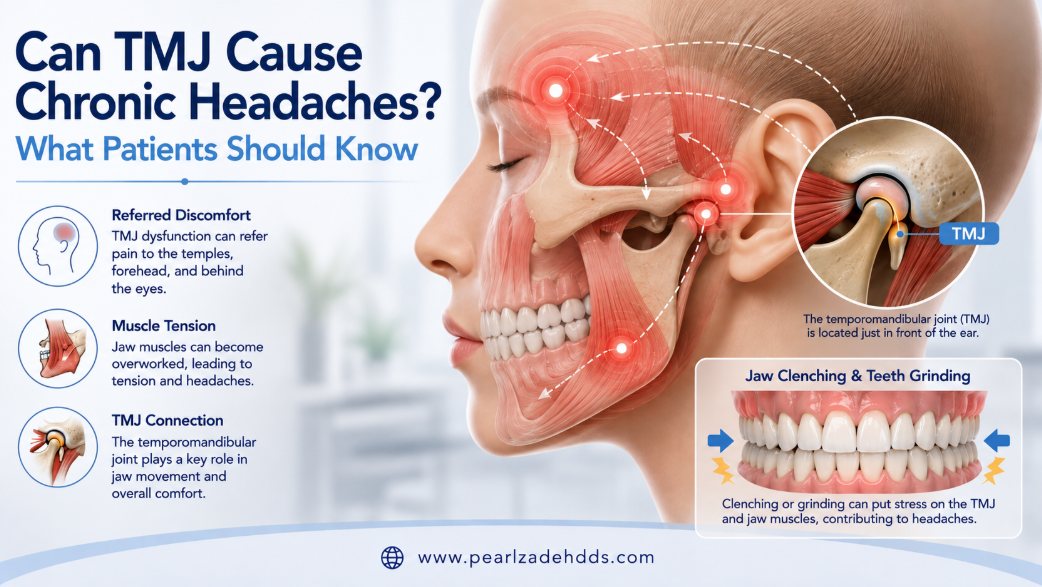
  • Can TMJ Cause Chronic Headaches? What Patients Should Know

    Can TMJ Cause Chronic Headaches? What Patients Should Know

    You wake up with a headache and a jaw that feels tired or sore. By afternoon, your temples feel tight again. Your partner has also mentioned hearing you grind your teeth at night. At first, none of these things seem connected.

    But when headaches keep showing up alongside jaw pain, clenching, or grinding, the connection is worth looking into. TMJ problems can involve the jaw joints and the muscles around them, and those muscles extend into areas that can hurt when they become tense or overworked.

    What Is TMJ?

    You have a temporomandibular joint on each side of your face, connecting your lower jaw to your skull. These joints, along with the muscles around them, let you chew, speak, yawn, and swallow. TMJ disorders can involve the joint itself, the surrounding muscles, or both together.

    Can TMJ Problems Cause Headaches?

    TMJ disorders and jaw muscle tension may be associated with pain around your temples, face, jaw, the area near your ears, and your head and neck generally. Pain originating in overworked jaw muscles can genuinely be experienced as head pain, since these muscles sit close to areas patients associate with headaches. A systematic review published in the Journal of the American Dental Association found a real association between painful TMD and both tension-type headaches and migraines, though the certainty of that evidence was rated low to very low across the studies reviewed. Headaches have plenty of possible causes beyond your jaw, so having one doesn’t prove TMJ is responsible. TMJ problems may contribute to headaches in some patients. That’s a different statement than TMJ causing chronic headaches outright.

    What Does a TMJ-Related Headache Feel Like?

    There’s no single pattern that confirms a TMJ connection on its own. Some patients notice temple pressure or aching, jaw soreness, tenderness in the facial muscles, pain near the ears, jaw fatigue, headaches that show up after a long stretch of chewing, or symptoms that feel worse right after waking. Every one of these can have other causes too, which is exactly why none of them confirms anything by itself.

    Why Can Jaw Tension Lead to Head Pain?

    Your jaw muscles connect to and interact with muscles and tissue in nearby areas, including your temples. Repeated clenching, grinding, or holding tension in your jaw over long stretches can leave those muscles genuinely overworked. Discomfort starting in an overworked jaw muscle can spread into nearby areas rather than staying neatly contained. This doesn’t play out as a direct, guaranteed cause-and-effect chain in every patient. It’s a plausible mechanism, not a rule that applies identically to everyone.

    Can Teeth Grinding Be Connected to Headaches?

    Bruxism, the term for grinding or clenching your teeth, may be part of this picture for some patients. Nighttime grinding places repeated stress on both your jaw muscles and your teeth. Alongside grinding, you might notice morning jaw soreness, tooth sensitivity, worn or flattened teeth, chips, facial soreness, and headaches. Our discussion of how teeth grinding damages teeth over the years goes further into what that wear can actually look like over time.

    Why Are Headaches Sometimes Worse in the Morning?

    Unconscious nighttime clenching or grinding is one possible explanation for jaw-related discomfort you notice after sleeping. It isn’t the only one, though. Morning headaches can also come from sleep quality issues, other health conditions, and factors that have nothing to do with your jaw at all. Waking up with a headache doesn’t automatically point to bruxism. It’s simply one possibility worth mentioning if it’s a pattern you keep noticing.

    Can Stress Make TMJ Symptoms Worse?

    Stress may contribute to clenching or increased jaw muscle tension for some people, though it isn’t accurate to call stress the underlying cause of TMJ disorders generally. Some patients notice a real pattern where jaw tension, clenching, and headaches all become more noticeable during particularly stressful stretches. That’s worth paying attention to as a pattern, not as proof that stress alone explains everything going on.

    What Other TMJ Symptoms Should You Look For?

    Headaches become more worth discussing with a dentist when they show up alongside other jaw symptoms:

    • Clicking or popping
    • Jaw pain
    • Pain while chewing
    • Facial tenderness
    • Limited mouth opening
    • Jaw stiffness
    • Jaw locking
    • Discomfort near the ears
    • A noticeable change in how your teeth come together

    Our guide to when jaw symptoms warrant a dental evaluation goes further into that distinction.

    Is Jaw Clicking Related to Headaches?

    Clicking or popping by itself doesn’t necessarily mean you have a serious TMJ problem, and it isn’t accurate to say jaw clicking causes headaches. The same JADA-published systematic review specifically looked at painless TMJ issues, the kind without any accompanying pain, and found no positive association with either tension-type headache or migraine. Clicking that comes with pain, locking, or limited movement is a different situation and deserves more attention. The combination of symptoms matters more than the sound alone. Our discussion of TMJ and jaw clicking goes further into what jaw sounds can and can’t tell you on their own.

    Could a Night Guard Help?

    A night guard may be worth considering when teeth grinding or clenching is genuinely part of what’s going on. It isn’t a universal treatment for headaches or TMJ disorders in general. What actually helps depends on the underlying cause and your specific symptoms. Our overview of occlusal splints goes further into how these appliances work and who they’re actually appropriate for. No dentist can honestly promise that a night guard will stop your headaches.

    What Can a Dentist Check?

    An evaluation typically covers your jaw movement, any jaw tenderness, your bite, your teeth, tooth wear, signs of grinding, existing dental restorations, and what you report experiencing. Your dentist may ask when your headaches tend to occur, whether they’re worse in the morning, and whether jaw symptoms show up around the same time. A dental evaluation is genuinely useful, but it doesn’t rule out non-dental causes for your headaches. That’s an important limitation to keep in mind.

    Does TMJ Always Need Treatment?

    No. Mild or occasional jaw symptoms may not need active treatment at all. Whether treatment makes sense depends on severity, how long symptoms have lasted, how much pain is involved, how your jaw is functioning, how much it’s affecting your daily life, and what’s actually causing it. Our discussion of non-surgical TMJ treatment options covers conservative approaches in more depth. Surgery isn’t a commonly needed step for most patients dealing with jaw symptoms.

    What Can You Do at Home?

    A few simple, low-risk habits can reduce unnecessary strain on your jaw. Avoid chewing gum for long stretches. Skip very hard or chewy foods if chewing already causes discomfort. Pay attention to whether you’re clenching during the day, not just at night. Try keeping your jaw relaxed when you aren’t actively eating or speaking. Avoid repeatedly opening your mouth very wide just to test how it feels. Follow whatever specific instructions your dentist has actually given you. None of this is a substitute for an evaluation if your symptoms are persistent, and aggressive jaw exercises aren’t something to start on your own without a treatment plan behind them.

    When Should You See a Dentist?

    A handful of situations are worth bringing to a dentist rather than waiting them out:

    • Recurring headaches occurring alongside jaw symptoms
    • Persistent jaw pain
    • Pain while chewing
    • Frequent morning jaw soreness
    • Painful clicking or popping
    • Jaw locking
    • Difficulty opening your mouth
    • Frequent clenching or grinding
    • Significant tooth wear
    • A sudden change in your bite

    When Should a Headache Be Evaluated Medically?

    Chronic or recurring headaches can have plenty of causes that have nothing to do with your jaw. This section isn’t about diagnosing anything. It’s about making sure a dental explanation isn’t assumed when it shouldn’t be. Seek medical evaluation for headaches that are:

    • Sudden and extremely severe
    • Accompanied by neurological symptoms
    • Accompanied by confusion or fainting
    • Accompanied by weakness or trouble speaking
    • Accompanied by significant vision changes
    • Accompanied by fever or a stiff neck
    • Following a significant head injury

    Any of these deserve prompt medical attention rather than being treated as a dental issue.

    How Do You Know If Your Jaw Might Be Part of the Problem?

    Pay attention to whether your headaches repeatedly show up alongside jaw soreness, temple tenderness, teeth grinding, clenching, clicking, jaw stiffness, pain when chewing, or morning jaw fatigue. A pattern that keeps repeating is worth discussing with a professional. This isn’t meant as a diagnostic checklist you can score yourself against. It’s simply a way to notice whether your jaw and your headaches seem to be showing up together often enough to be worth a real conversation.

    Could Your Jaw Be Part of the Headache?

    TMJ problems and jaw muscle tension may contribute to head or facial pain in some patients. Teeth grinding and clenching can add extra strain on top of that. Headaches still have plenty of possible causes beyond your jaw, so TMJ shouldn’t automatically be assumed to be responsible just because both are present. When headaches keep showing up alongside jaw symptoms, a professional evaluation can help figure out what’s actually contributing, rather than guessing on your own.

    Speak With Dr. Pearl Zadeh About TMJ Symptoms

    Recurring headaches can have many causes, but jaw symptoms may be part of the picture for some patients. Dr. Pearl Zadeh, a member of the American Dental Association and California Dental Association, can evaluate your jaw, teeth, bite, and reported symptoms to help determine whether TMJ problems or grinding may be contributing. If your headaches are persistent or concerning, appropriate medical evaluation is worth pursuing alongside a dental visit, not instead of it.

    Call (818) 716-6722 or click the button below to schedule a consultation online.

    Frequently Asked Questions

    Can TMJ really cause headaches?

    Research shows an association between painful TMJ disorders and certain headache types, though it isn’t proof that TMJ causes every headache. It may contribute for some patients.

    What does a TMJ headache feel like?

    There’s no single confirming pattern. Temple pressure, jaw soreness, and facial tenderness alongside a headache are worth noting, though these symptoms can have other causes too.

    Does jaw clicking cause headaches?

    Clicking alone hasn’t shown a clear association with headaches in research. Clicking combined with pain, locking, or limited movement is a different, more relevant situation.

    Will a night guard stop my headaches?

    Not necessarily. A night guard may help if grinding is part of the picture, but it isn’t a universal fix for headaches or TMJ disorders.

    When should I worry my headache isn’t dental?

    Sudden severe headaches, neurological symptoms, confusion, vision changes, fever with a stiff neck, or headaches following a head injury need prompt medical evaluation, not a dental appointment.

    This article is for informational purposes only and is not a substitute for professional dental or medical advice. Please schedule a consultation with Pearl Zadeh DDS to discuss your specific situation, and seek prompt medical care for any concerning or severe headache symptoms.

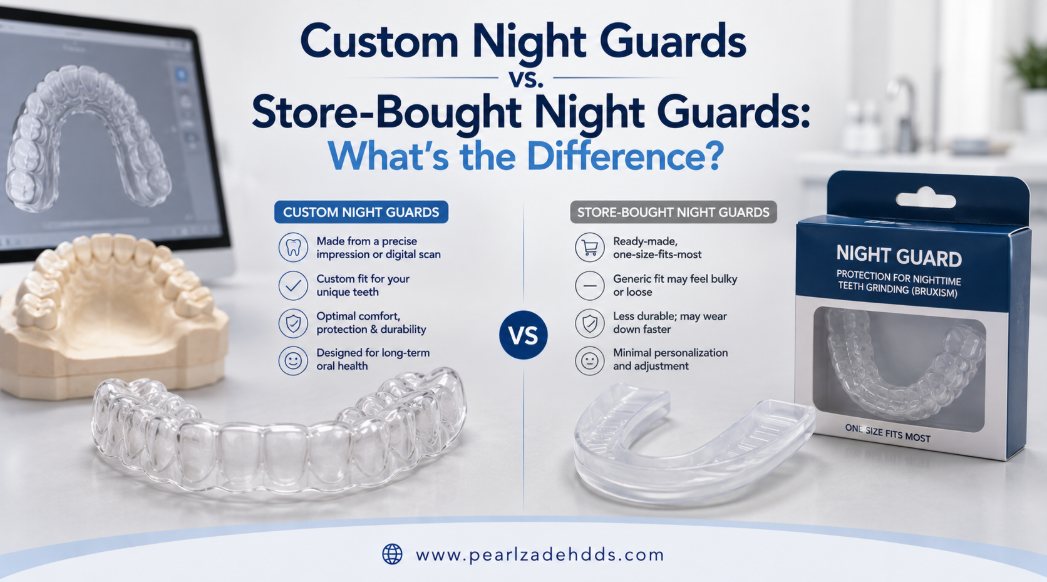
  • Custom Night Guards vs. Store-Bought Night Guards: What’s the Difference?

    Custom Night Guards vs. Store-Bought Night Guards: What’s the Difference?

    You wake up with your jaw feeling tired again. Your partner says you were grinding your teeth again last night. So you start looking for a night guard and quickly find plenty of options online and at the pharmacy, some for surprisingly little money. Then you check the price of a custom night guard from a dentist and wonder why the difference is so large.

    Both are designed to sit between your teeth while you sleep. But they aren’t made the same way, and the difference goes beyond price. Fit, bite, comfort, material, and how your dentist monitors the appliance can all matter when you’re wearing it night after night.

    What Is a Custom Night Guard?

    A custom night guard is made specifically for your teeth, not selected from a shelf. Your dentist evaluates your bite before recommending one, then has it fabricated to fit your mouth precisely. If something feels off once you’re wearing it, your dentist can actually adjust it, which isn’t something you can do with a generic product. The design itself can take your specific dental situation into account, whether that’s existing dental work, how you grind, or your bite relationship. Not every custom appliance looks or works identically. What you actually get depends on what your teeth and grinding pattern call for.

    What Is a Store-Bought Night Guard?

    Two main types show up at pharmacies and online. Stock guards come ready-made in predetermined shapes and sizes, no molding required. Boil-and-bite guards use a material you soften in hot water and then bite into shape yourself at home. Both are considerably more accessible than a custom appliance, and both usually cost less. What neither one offers is a dentist’s detailed assessment of your individual bite before you start wearing it. That’s not a criticism so much as a description of how they’re made.

    Custom vs. Store-Bought: What’s Actually Different?

    A handful of practical things tend to separate these two categories:

    • How well the appliance actually fits
    • How it interacts with your bite
    • Comfort
    • Thickness
    • How well it stays in place
    • Whether it can be adjusted
    • How long it holds up
    • The material used
    • How easy it is to sleep with
    • Whether a professional is keeping an eye on how it’s working for you

    It wouldn’t be accurate to say custom guards always last longer across the board. Durability really depends on the material, the design, your own habits, and how heavily you grind. The next few sections go through the specifics that actually matter.

    Does Fit Really Matter, and Are Store-Bought Guards Bad for Your Teeth?

    A night guard sits in your mouth for hours while you sleep, so fit matters more than it might for something you only wear briefly. An appliance that feels loose, bulky, uncomfortable, or poorly positioned can be genuinely hard to tolerate night after night. A randomized controlled trial comparing over-the-counter and custom bite splints found that patients using the self-fitted, over-the-counter version had more difficulty getting the fit to a clinically acceptable standard than those using a custom appliance. That doesn’t mean every store-bought guard is bad for your teeth. Plenty of patients use one without major problems. What it does mean is that a store-bought appliance doesn’t come with the individualized assessment and adjustment a professionally made one does. Fitting over your teeth isn’t the same thing as fitting your bite correctly. Persistent discomfort, poor retention, or your bite feeling different are reasons to have the appliance actually looked at, not proof that it’s damaging you.

    Can a Night Guard Change Your Bite?

    A night guard sits directly between your upper and lower teeth, so it naturally affects how they contact each other while you’re wearing it. A properly selected appliance should be appropriate for your specific dental situation to begin with. If you notice your bite feeling different after you take the appliance out, new jaw discomfort, persistent tooth soreness, or trouble getting your teeth to come together the way they normally do, stop guessing and talk to your dentist. This doesn’t mean store-bought guards routinely cause permanent bite changes. It means any of these specific signs are worth a real evaluation rather than assuming they’ll sort themselves out.

    What About Comfort?

    A custom appliance is built around your specific teeth rather than a generic shape close enough to fit most people. That distinction tends to matter most for patients who struggle with bulkiness, looseness, gagging, pressure concentrated on certain teeth, trouble actually falling asleep with something in their mouth, or an appliance that just won’t stay put. None of this means a custom guard feels perfectly comfortable the moment you put it in. Most patients still need some adjustment period getting used to wearing one, custom or not.

    What About People With Heavy Teeth Grinding?

    How severe your grinding actually is changes what you need. Someone who occasionally clenches during a stressful week has different needs than someone grinding heavily enough to visibly damage their teeth. Signs pointing toward more significant grinding include flattened or worn tooth surfaces, chipped teeth, morning jaw soreness, headaches, tooth sensitivity, jaw fatigue, and cracked dental work. Our discussion of how teeth grinding damages teeth over the years goes further into what that wear can actually look like. Nighttime grinding can sometimes relate to sleep-disordered breathing too, though grinding on its own doesn’t mean you have a sleep-related breathing issue. That’s a separate question worth its own conversation if it applies to you.

    What If You Have Crowns, Veneers, or Other Dental Work?

    Existing dental work makes appliance selection a more individual decision. Crowns, veneers, bridges, fillings, and other restorations all factor into how an appliance should actually be designed. Your dentist may need to weigh your restorations, your bite, and your overall dental condition together when figuring out what makes sense. This doesn’t mean everyone with a crown or veneer automatically needs a custom guard. It means it’s one more factor worth considering rather than assuming a generic option will work fine regardless.

    What If You Have Jaw Clicking or TMJ Symptoms?

    A night guard isn’t automatically the answer to every jaw problem. If you’re already dealing with jaw clicking, jaw pain, limited opening, locking, jaw fatigue, or a bite that feels different than usual, those symptoms are worth discussing with a dentist before you pick out any appliance. Our discussion of TMJ and jaw clicking goes further into what those symptoms can and can’t tell you on their own. A night guard isn’t a cure for TMJ disorders, and assuming one will fix an underlying jaw problem isn’t a safe assumption to make on your own.

    Custom Night Guards and Occlusal Splints

    You’ll hear terms like night guard, occlusal splint, bite guard, and bruxism appliance used somewhat interchangeably in everyday conversation, and that’s not entirely wrong. Our overview of occlusal splints goes further into how appliances can actually differ in design and purpose even when the terminology overlaps. Not every night guard on the market, or even every custom one, is clinically identical to another.

    What About Boil-and-Bite Guards Specifically?

    Patients reach for these for understandable reasons: lower upfront cost, easy access without scheduling anything, no dental appointment required, and they can genuinely work as a temporary option in the right situation. The limitations are worth knowing too. The fit depends heavily on how well you actually mold the material yourself. They aren’t individually fabricated from a dental impression or digital scan. They can’t be professionally adjusted the way a custom appliance can. And some patients find them too bulky or simply hard to tolerate through a full night’s sleep. None of this adds up to a blanket recommendation either way. It depends on what you actually need it for.

    Cost and Lifespan: What Actually Varies

    There’s no single price that applies to every custom night guard, since cost depends on the type of appliance, the material used, the laboratory involved, the specific dental office, whether adjustments end up being needed, and whether an exam is required beforehand. The point isn’t simply that custom guards cost more. It’s understanding what that cost is actually paying for.

    Lifespan varies just as much, shaped by how severely you grind, how often you clench, the appliance material, your cleaning habits, how consistently you wear it, and whether it gets damaged along the way. A few signs suggest it’s time for an evaluation or replacement: cracks, significant wear, holes or thin spots, a fit that’s changed, persistent discomfort, or an appliance that no longer stays in place. There’s no single fixed replacement schedule that applies to every patient here either.

    Can You Sleep With a Store-Bought Guard Every Night?

    Plenty of people do exactly this without incident. The more useful question isn’t really whether nightly use is allowed. It’s whether the appliance actually fits well, stays comfortable, and remains appropriate for your specific dental situation over time. If you’re planning to wear a store-bought guard every night to manage significant grinding, that ongoing use is a reasonable moment to have a dentist take a look, mainly because significant grinding tends to benefit from an individualized assessment either way. None of this means you need to stop using an over-the-counter guard immediately. It just means regular, long-term use is worth checking in about rather than assuming indefinitely.

    When Should You See a Dentist Before Buying a Night Guard?

    A few situations are worth a professional evaluation before you pick anything out:

    • Significant or frequent teeth grinding
    • Chipped or worn teeth
    • A cracked tooth
    • Existing crowns, veneers, or extensive dental work
    • Jaw pain
    • Persistent jaw clicking along with other symptoms
    • Morning headaches or jaw soreness
    • A bite that feels different
    • Previous problems with a night guard
    • An appliance that causes discomfort or won’t stay in place

    None of this is meant to sound alarming. It’s about getting an actual look at your situation rather than guessing your way through it.

    Custom vs. Store-Bought: Which One Is Right for You?

    A store-bought guard may genuinely appeal to someone who:

    • Wants a lower-cost option
    • Needs something right away
    • Has mild or occasional symptoms
    • Has no known bite or jaw concerns

    A custom appliance tends to make more sense when:

    • Grinding is frequent or significant
    • Tooth wear is already noticeable
    • Existing restorations need to be factored in
    • Generic guards haven’t worked out well
    • Comfort and fit are major sticking points
    • A dentist has identified a specific bite or jaw-related concern

    These are general considerations to think through, not a diagnosis of what you specifically need.

    Questions to Ask Before Choosing a Night Guard

    If you’re unsure which type to choose, these questions can help you have a more useful conversation with your dentist:

    • How severe is my teeth grinding?
    • Is my grinding already causing tooth damage?
    • Does my bite need to be evaluated before I choose a guard?
    • Would a store-bought guard be appropriate for me?
    • Would a custom night guard be a better fit for my teeth?
    • Do my crowns, veneers, or other restorations affect which guard I should use?
    • How should I clean and store the appliance?
    • How often should I have the night guard checked or replaced?
    • What should I do if my bite feels different after wearing it?

    So, Which Night Guard Is Right for You?

    Store-bought night guards can be convenient and affordable, but they aren’t designed around your individual teeth and bite the way a custom appliance is. A custom guard offers a professionally planned fit that can actually be evaluated and adjusted as part of your ongoing dental care. Which one makes sense for you depends on how severe your grinding is, your dental health, any existing restorations, comfort, and what you specifically need, not simply which option costs less upfront.

    Speak With Dr. Pearl Zadeh About a Night Guard

    Choosing a night guard isn’t only about price. Fit, how severely you grind, existing dental work, your bite, jaw symptoms, and comfort can all matter. Dr. Pearl Zadeh, a member of the American Dental Association and California Dental Association, can evaluate your teeth and bite and discuss whether a custom appliance or another option makes sense for your situation.

    Call (818) 716-6722 or click the button below to schedule a consultation online.

    Frequently Asked Questions

    Do I really need a custom night guard, or is a store-bought one fine?

    It depends on your situation. Mild, occasional grinding with no bite or jaw concerns may be fine with a store-bought option, while significant grinding, existing dental work, or jaw symptoms are reasons to have a dentist evaluate what actually fits your needs.

    Are custom night guards worth the extra cost?

    For patients with significant grinding, existing restorations, or comfort issues with generic guards, the individualized fit and ability to adjust the appliance often justify the cost. It isn’t a universal requirement for every patient.

    Can a boil-and-bite guard damage my teeth?

    Not automatically. Many patients use them without major problems, though the fit depends on how well the material is molded, and it doesn’t come with a dentist’s individualized bite assessment.

    How do I know if my store-bought night guard isn’t working well?

    Persistent discomfort, poor retention, a bite that feels different, or the appliance not staying in place are all reasons to have it evaluated rather than continuing to use it as is.

    Should I see a dentist before buying any night guard?

    It’s worth it if you have significant grinding, tooth damage, existing crowns or veneers, jaw pain, or previous problems with a night guard. For mild, occasional symptoms, it’s a reasonable option to discuss but not always essential first.

    This article is for informational purposes only and is not a substitute for professional dental advice. Please schedule a consultation with Pearl Zadeh DDS to discuss your specific situation.

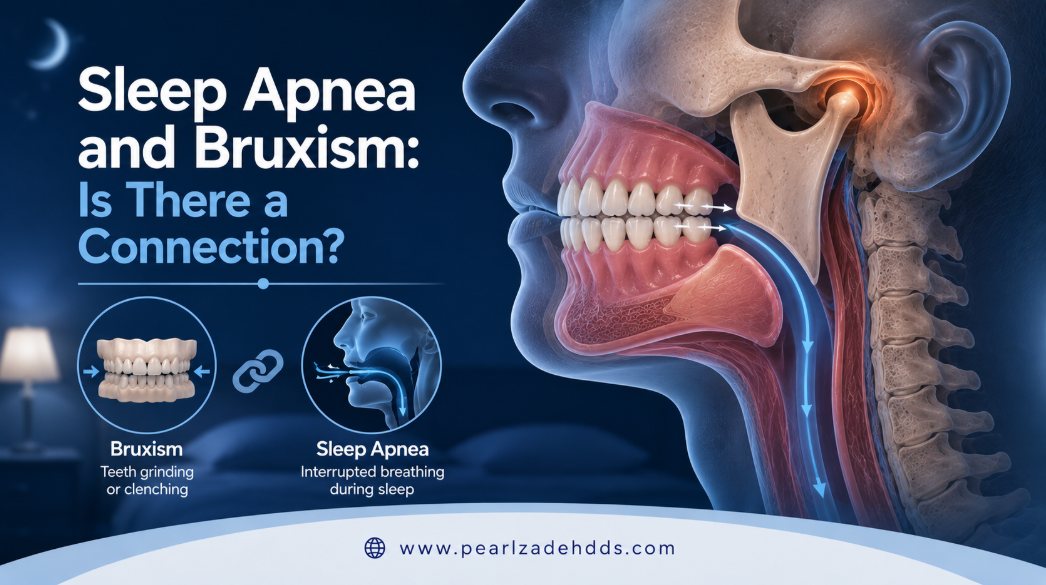
  • Sleep Apnea and Bruxism: Is There a Connection?

    Sleep Apnea and Bruxism: Is There a Connection?

    Your partner mentions, again, that you were grinding your teeth loudly last night. You wake up with a sore jaw sometimes, and a dentist recently pointed out some wear on your back teeth. Otherwise, you feel fine. No obvious reason for any of it.

    Then you wonder: could nighttime breathing problems have something to do with nighttime grinding? Researchers have actually looked into this. They’ve found an association between sleep-disordered breathing and sleep bruxism, but the relationship isn’t as simple as saying one condition causes the other.

    What Is Sleep Bruxism?

    Sleep bruxism refers to repeated jaw-muscle activity during sleep. That can look like clenching, grinding, or repeated tooth-to-tooth contact. Plenty of people do this without any awareness at all, since it happens while they’re unconscious. Often, a partner notices the sound long before the person doing it ever suspects anything.

    What Is Sleep Apnea?

    Sleep apnea is a sleep-related breathing disorder involving repeated interruptions or reductions in breathing during sleep. The National Heart, Lung, and Blood Institute describes obstructive sleep apnea, the most common type, as involving repeated narrowing or blockage of the upper airway during sleep. That’s the short version. Sleep apnea itself is a much bigger topic than what fits here.

    Is There Really a Connection?

    This is the central question, and it deserves a careful answer rather than a simple yes or no. A 2025 systematic review examining bruxism and obstructive sleep apnea found that sleep bruxism shows up more often in people with obstructive sleep apnea than in the general population. Researchers have proposed possible links through brief arousals during sleep and changes in nervous system activity. That same review was direct about the limits of this evidence: inconsistent diagnostic criteria and only moderate methodological quality across studies limited how strong those conclusions could be, and the review specifically noted that a clear causal relationship remains unclear.

    Worth knowing too: not every study agrees on how strong this connection actually is.

    A separate meta-analysis of the same general question found the odds of bruxism in sleep apnea patients weren’t statistically different from a control group. Researchers in this space are still working through some real disagreement, which is a normal part of how evidence like this develops over time.

    Why Might the Two Conditions Be Related?

    A few proposed mechanisms come up in the research. Brief arousals from sleep, meaning short moments where the brain partially wakes without full awareness, seem to be involved in both conditions. Changes in breathing patterns and shifts in jaw-muscle activity around those arousal moments are part of the picture too, along with general activation of the nervous system during sleep. None of this adds up to one proven chain of events. Researchers are still working out exactly how these pieces fit together, and it would be misleading to present any single explanation as settled science.

    Does Sleep Apnea Cause Teeth Grinding?

    Not necessarily. The evidence supports an association between the two conditions, which is a different thing than saying one directly causes the other. Plenty of people with sleep apnea never develop bruxism. On the flip side, most people who grind their teeth at night don’t have sleep apnea at all. This distinction matters more than almost anything else in this article.

    Can Teeth Grinding Be a Sign of Sleep Apnea?

    Grinding by itself isn’t enough information to point toward sleep apnea. If it shows up alongside other specific symptoms, though, it may be worth looking at the bigger picture with a healthcare professional. Those symptoms include loud or frequent snoring, breathing pauses a partner has actually witnessed, gasping or choking sounds during sleep, excessive daytime sleepiness, morning headaches, a dry mouth on waking, or trouble staying asleep through the night. None of these symptoms, alone or combined, automatically confirms sleep apnea. They’re simply worth mentioning together rather than treating each one as unrelated.

    What Does a Dentist Notice?

    During an exam, a dentist might notice flattened tooth surfaces, worn enamel, small chips, tooth sensitivity, tenderness in the jaw muscles, other signs of clenching, or specific patterns of wear. These findings can suggest bruxism is happening. They cannot diagnose sleep apnea, which is a breathing disorder rather than a dental one. If a dentist notices signs that line up with what a patient describes about their sleep, it’s reasonable for that dentist to suggest discussing those symptoms with a physician or sleep specialist.

    How Bruxism, and Possibly Sleep Apnea, Can Affect Your Teeth

    Sleep apnea itself is a breathing disorder, not something that directly damages teeth. Any tooth damage in patients with both conditions likely relates to the associated bruxism, dry mouth, or other contributing factors, not sleep apnea acting on the teeth directly. It’s an important distinction, since it’s easy to oversimplify the pathway. Bruxism on its own can lead to flattened tooth surfaces, small chips, cracks, sensitivity, and extra wear around any existing dental work. Our discussion of how teeth grinding damages teeth over the years covers that side of things in more depth.

    What About Jaw Pain and TMJ Symptoms?

    Sleep bruxism places repeated demand on the jaw muscles, and some patients notice morning jaw soreness, general muscle fatigue, facial discomfort, headaches, or jaw stiffness as a result. Bruxism isn’t responsible for every TMJ symptom out there, so it’s worth being careful not to assume that connection automatically. Our discussion of TMJ and jaw clicking goes further into how jaw symptoms get evaluated more broadly.

    Should You Get a Sleep Study If You Grind Your Teeth?

    Grinding alone doesn’t automatically mean you need a sleep study. A sleep evaluation makes more sense when grinding shows up alongside symptoms that suggest sleep-disordered breathing, the kind covered above. A dentist can talk through what you’re experiencing and, when it seems appropriate, suggest speaking with a physician or sleep specialist. What a dentist shouldn’t do is diagnose sleep apnea based on dental symptoms alone, since that’s simply outside what a dental exam can determine.

    Can Treating Sleep Apnea Stop Teeth Grinding?

    This is still being studied, and it wouldn’t be honest to promise a specific result. Some patients notice changes in their grinding after sleep apnea treatment. Others don’t see much difference at all. Outcomes vary enough between patients that no one can reasonably guarantee treating one condition will resolve the other.

    What About a Night Guard?

    An occlusal splint, often called a night guard, may help protect teeth in appropriate patients dealing with bruxism. Our overview of occlusal splints goes further into how these appliances work and who they actually fit. What a night guard does not do is treat the underlying airway obstruction involved in sleep apnea. If sleep apnea is suspected based on your symptoms, that calls for appropriate medical evaluation, not reliance on a dental appliance alone to handle it.

    When to Talk to a Dentist, and When to Talk to a Doctor

    A few dental signs are worth mentioning at your next visit:

    • Increasing tooth wear
    • Repeated chips
    • Tooth sensitivity
    • Morning jaw soreness
    • Frequent headaches
    • General jaw discomfort
    • A partner who regularly hears you grinding

    Separately, a few symptoms are worth discussing with a physician or sleep specialist rather than a dentist alone:

    • Loud or frequent snoring
    • Breathing pauses someone has actually witnessed
    • Choking or gasping during sleep
    • Significant daytime sleepiness

    Mentioning grinding at your next dental visit is a reasonable starting point either way, along with asking a partner directly whether they’ve noticed breathing pauses along with the grinding, paying attention to morning jaw soreness or headaches, and noticing any changes in tooth sensitivity or wear over time.

    Sleep Apnea and Bruxism Are Related, But Not the Same Thing

    Sleep apnea involves disrupted breathing during sleep. Bruxism involves jaw-muscle activity during sleep. The two can occur together, and research suggests a genuine association between them. Grinding your teeth does not automatically mean you have sleep apnea, and sleep apnea can’t be diagnosed from tooth grinding alone. Keeping that distinction clear is really the main point of everything above.

    Speak With Dr. Pearl Zadeh About Teeth Grinding

    Nighttime grinding can have several different contributing factors, and it doesn’t automatically mean you have sleep apnea. Dr. Pearl Zadeh, a member of the American Dental Association and California Dental Association, can evaluate signs of tooth wear, clenching, grinding, jaw symptoms, and your overall oral health. If your symptoms suggest a possible sleep-related breathing issue, that’s a conversation worth having with an appropriate healthcare or sleep professional alongside your dental care.

    Schedule a consultation to talk through what you’re noticing and get a clearer picture of your dental health.

    Call (818) 716-6722 or click the button below to schedule a consultation online.

    Frequently Asked Questions

    Does grinding my teeth mean I have sleep apnea?

    No. Research shows an association between sleep bruxism and sleep apnea, but most people who grind their teeth don’t have sleep apnea, and most people with sleep apnea don’t necessarily grind their teeth.

    Can sleep apnea cause teeth grinding?

    The evidence supports an association rather than a proven cause-and-effect relationship. Researchers are still working out the exact mechanisms connecting the two.

    Should I get a sleep study just because I grind my teeth?

    Not automatically. A sleep evaluation makes more sense if grinding occurs alongside symptoms like loud snoring, witnessed breathing pauses, or excessive daytime sleepiness.

    Will treating sleep apnea stop my teeth grinding?

    It might for some patients, but not for everyone. Research on this is ongoing, and outcomes vary between individuals.

    Does a night guard treat sleep apnea?

    No. A night guard may protect teeth from grinding, but it doesn’t treat the airway obstruction involved in sleep apnea. Suspected sleep apnea needs its own medical evaluation.

    This article is for informational purposes only and is not a substitute for professional dental or medical advice. Please schedule a consultation with Pearl Zadeh DDS to discuss your specific situation.

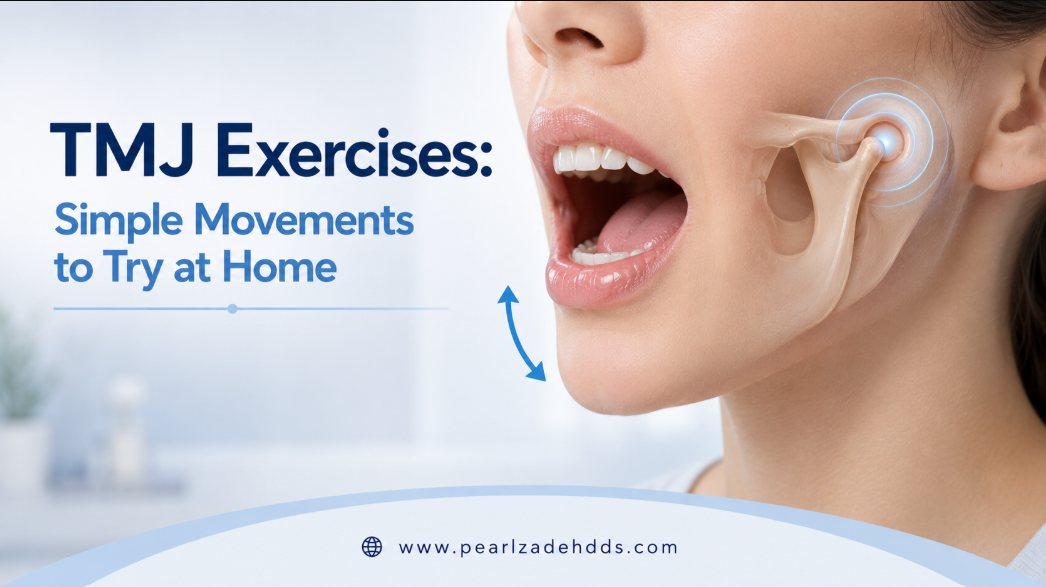
  • TMJ Exercises: Simple Movements to Try at Home

    TMJ Exercises: Simple Movements to Try at Home

    Your jaw feels tight by the end of the day. Maybe it’s from clenching through a stressful meeting, chewing through a long lunch, or just hours spent hunched over a desk. You search for TMJ exercises and land on a page full of aggressive-looking stretches that seem more likely to strain your jaw than help it.

    Gentle, controlled jaw movements may genuinely help some people. More movement isn’t automatically better, and the right exercise depends on what’s actually causing your symptoms. The goal here is gentle motion, not forcing your jaw through pain to see what happens.

    What Does “TMJ” Actually Mean?

    You have a temporomandibular joint on each side of your face, just in front of your ears, connecting your lower jaw to your skull. Muscles, ligaments, and other structures around that joint let your jaw open, close, and move side to side. Patients commonly say “TMJ” to mean all sorts of things: jaw pain, clicking, general stiffness, or a diagnosed TMJ disorder. This article uses the term loosely too, the way most people actually use it in conversation.

    Can TMJ Exercises Help?

    For some people, yes, though not everyone. Gentle exercises may help improve controlled jaw movement, ease muscle tension, or restore more comfortable movement in certain situations. A pilot randomized controlled trial on jaw-opening exercises notes that this kind of exercise therapy is considered standard, conservative care for temporomandibular disorders, and several studies have found it helps decrease muscle and joint pain while improving mobility. That same trial specifically excluded patients with certain types of disc displacement from participating, which is a useful reminder that exercises aren’t a fit for every jaw problem. The National Institute of Dental and Craniofacial Research notes that most common jaw joint and muscle problems are temporary and don’t get worse, and that conservative, reversible approaches are generally recommended first. Some jaw problems genuinely call for an examination rather than more exercises at home.

    Six Gentle Exercises to Try at Home

    Each of these should feel controlled and comfortable. None of them should be pushed through pain.

    1. Relaxed Jaw Position

    Let your jaw hang loose rather than actively holding it in place. Keep your teeth slightly apart rather than touching. Let your tongue rest comfortably rather than pressing hard against anything. This position avoids unnecessary tooth contact and gives your jaw muscles a genuine break, which can help if you tend to clench without realizing it throughout the day.

    2. Controlled Jaw Opening

    Slowly open your mouth in a smooth, controlled way. The goal is controlled motion, not opening as wide as physically possible. The movement should stay comfortable the entire time. If your jaw becomes painful, catches, or locks partway through, stop rather than pushing further to see what happens.

    3. Controlled Jaw Closing

    Slowly bring your jaw back to a relaxed, resting position. Keep the motion smooth and unhurried rather than snapping your mouth shut. There’s no reason to deliberately guide your jaw into a spot that clicks or feels painful just to test it.

    4. Tongue-on-the-Roof-of-the-Mouth Movement

    Rest the tip of your tongue gently on the roof of your mouth, then perform a controlled opening and closing movement while keeping it there. This is a simple way to encourage smoother movement without focusing solely on the jaw itself. It isn’t a technique that permanently repositions your jaw or changes your bite, and it shouldn’t be treated as one.

    5. Gentle Side-to-Side Movement

    With your mouth slightly open, gently shift your lower jaw to one side, then the other. The goal is comfortable movement, not forcing your jaw farther than it naturally wants to go. A small, easy range is the point here, not a dramatic stretch.

    6. Gentle Forward Jaw Movement

    Gently move your lower jaw slightly forward, then return it to a relaxed position. Keep this movement small and unforced. If it brings on pain, catching, or makes your symptoms feel worse, stop and skip this one rather than repeating it.

    Should TMJ Exercises Hurt?

    No, they shouldn’t be forced through pain. Gentle movement, mild stretching, or a general awareness of your muscles working is reasonable. Sharp pain, joint pain that increases as you continue, or your jaw locking or catching are different signals entirely. Discomfort that gets worse during or after an exercise is a reason to stop, not a reason to push harder.

    How Often Should You Do TMJ Exercises?

    There’s no single schedule that fits everyone, since the right frequency depends on the specific movement and why it was recommended in the first place. If a dentist, physical therapist, or another healthcare professional has given you a specific routine, follow that rather than improvising your own. Doing more repetitions on a painful jaw isn’t automatically better, and repeating an exercise that consistently hurts isn’t the same as making progress.

    What Should You Avoid While Your Jaw Is Irritated?

    A handful of everyday habits can add unnecessary strain while your jaw is already bothered:

    • Chewing gum for long stretches
    • Eating very hard or chewy foods when your jaw is painful
    • Biting your nails
    • Chewing on pens or other objects
    • Opening your mouth unnecessarily wide
    • Repeatedly testing a jaw click just to see if it’s still there
    • Clenching your teeth without a real reason to

    Cutting back on these habits can be just as useful as adding exercises, sometimes more so.

    What If Your Jaw Clicks During an Exercise?

    Clicking or popping during a movement doesn’t automatically mean your joint is being damaged. It’s a different story if that clicking comes with pain, locking, catching, limited movement, or a sudden change in how your bite feels. In those cases, stop the exercise and talk to your dentist rather than continuing through it. Our discussion of TMJ and jaw clicking goes further into what jaw sounds can and can’t tell you on their own.

    When TMJ Exercises May Not Be Enough

    Home exercises aren’t a substitute for an actual evaluation when symptoms persist or get worse. A few situations are worth bringing to a dentist rather than continuing to self-manage:

    • Ongoing jaw pain
    • Increasing stiffness
    • Difficulty opening your mouth
    • Jaw locking
    • Difficulty chewing
    • Facial swelling
    • A sudden change in your bite
    • Symptoms that started after an injury
    • Pain that keeps returning
    • Severe or worsening symptoms

    Not every item on this list is urgent. Ongoing stiffness is a reasonable thing to mention at a routine visit, while sudden swelling or symptoms following an injury deserve more prompt attention.

    Can Teeth Grinding Cause Jaw Tightness?

    For some patients, yes. Clenching and grinding place extra demand on the same jaw muscles these exercises are meant to relax. Our discussion of how teeth grinding damages teeth over the years covers that connection in more depth. This doesn’t mean every case of jaw tightness or TMJ symptom traces back to grinding. It’s simply one contributing factor worth considering alongside everything else.

    Can a Night Guard Help With TMJ Symptoms?

    For some patients, an occlusal splint may be part of managing jaw symptoms, but it isn’t a universal treatment for every jaw problem. Our overview of occlusal splints goes further into how these appliances work and who they’re actually appropriate for. Whether one makes sense for you depends on your teeth, your bite, your specific symptoms, and what a dentist finds during an evaluation, not something to assume from an online description alone.

    How a Dentist Evaluates Jaw Symptoms

    An evaluation typically covers how your jaw moves, your range of motion, tooth wear, your bite, the muscles around your jaw, any joint sounds, pain or tenderness, when your symptoms tend to show up, and whether clenching or grinding seems to be part of the picture. The goal is figuring out what’s actually contributing to your symptoms before deciding whether exercises, an appliance, ongoing monitoring, or another approach makes the most sense.

    Simple Habits That Can Help Your Jaw

    Keeping your teeth apart when you’re not actually eating gives your jaw muscles a break they often don’t get. Avoiding unnecessary clenching, even outside of stressful moments, helps too. Taking breaks during long stretches of chewing, choosing softer foods temporarily if chewing feels uncomfortable, and paying attention to your posture during long hours at a desk can all reduce unnecessary strain. Resisting the urge to repeatedly test a painful movement, just to check if it still hurts, is worth adding to that list as well.

    Speak With Dr. Pearl Zadeh About Your Jaw Symptoms

    Gentle exercises may help some patients manage mild jaw tightness or stiffness, but persistent or worsening symptoms deserve an individualized look rather than more exercises alone. Dr. Pearl Zadeh, a member of the American Dental Association and California Dental Association, can examine your teeth, bite, jaw movement, and symptoms to help figure out what may be contributing to the problem and whether home exercises make sense for your situation.

    Schedule a consultation to talk through what you’re experiencing and get a clearer picture of what might actually help.

    Call (818) 716-6722 or click the button below to schedule a consultation online.

    Frequently Asked Questions

    Can TMJ exercises fix my jaw problem?

    Not necessarily. Gentle exercises may help with muscle tension or controlled movement for some people, but they don’t address every possible cause of jaw symptoms.

    Are jaw exercises safe to try at home?

    Gentle, controlled movements are generally reasonable to try, but they should never be forced through pain. Stop if you notice sharp pain, locking, or worsening symptoms.

    How many times a day should I do TMJ exercises?

    There’s no universal schedule. Frequency depends on the specific exercise and why it was recommended. Follow a professional’s specific routine if one has been provided.

    Is it normal for my jaw to click during exercises?

    Clicking alone doesn’t automatically mean something is wrong. If it comes with pain, locking, or limited movement, stop and have it evaluated.

    When should I stop doing exercises and see a dentist instead?

    If your symptoms are persisting, getting worse, or include locking, swelling, or a sudden bite change, an evaluation makes more sense than continuing to self-manage.

    This article is for informational purposes only and is not a substitute for professional dental advice. Please schedule a consultation with Pearl Zadeh DDS to discuss your specific situation.

  • Teeth Grinding in Kids: What’s Normal and When to See a Dentist

    Teeth Grinding in Kids: What’s Normal and When to See a Dentist

    You check on your child at night and hear it before you see anything, a scraping, grinding sound coming from somewhere near their pillow. It stops as soon as you get close. The next morning, your child has no idea what you’re talking about.

    Teeth grinding can happen in children, and hearing it doesn’t automatically mean something is seriously wrong. At the same time, grinding that keeps happening, visible wear on the teeth, pain, or other symptoms are worth bringing up with a dentist rather than assuming it will simply pass.

    What Is Teeth Grinding in Children?

    Dentists call this bruxism. It covers two related behaviors. Grinding happens when teeth actually move or rub against each other. Clenching happens when the jaw muscles tighten forcefully, sometimes without much visible tooth movement at all. Some children grind mainly while asleep. Others clench or grind during the day, often without anyone noticing. Parents tend to pick up on nighttime grinding because of the sound. Daytime clenching is much easier to miss, since there’s usually nothing to hear.

    Is Teeth Grinding Common in Kids?

    It can show up at different points during childhood, sometimes tied to specific stages of dental development. Rather than relying on a specific percentage, it’s more useful to know this: the presence of grinding alone doesn’t tell you whether your child has a serious dental problem. A dentist looks at your child’s actual teeth, symptoms, stage of development, and overall health, not just the sound you heard through a bedroom door.

    Why Do Kids Grind Their Teeth?

    There isn’t always one clear answer. Normal changes as baby teeth loosen and permanent teeth come in can play a role. How a child’s upper and lower teeth meet can factor in too. Sleep-related patterns, general stress or emotional changes, certain habits, and other individual factors can all contribute. Stress isn’t the automatic explanation for every child who grinds, and grinding on its own doesn’t mean your child is anxious. In plenty of cases, the exact reason simply isn’t obvious, even to a dentist looking closely.

    Can Baby Teeth Grinding Be Normal?

    Children go through significant changes as their teeth and jaws develop, and some grinding during these stages doesn’t necessarily point to a problem. That said, it’s still worth mentioning frequent grinding at regular dental visits, particularly if you notice tooth wear, chips, pain, sensitivity, or jaw discomfort alongside it. Grinding in baby teeth isn’t automatically harmless just because the teeth are temporary.

    Can Grinding Damage a Child’s Teeth?

    It depends on how often it happens, how much force is behind it, and how long it continues. Possible signs of more significant wear include flattened tooth edges, worn chewing surfaces, small chips, changes in tooth shape, and in some cases sensitivity. Teeth naturally experience some wear over time, so noticing a small change doesn’t automatically confirm a serious grinding problem. A dentist can tell you whether what they’re seeing looks typical for your child’s stage of dental development or whether it’s worth watching more closely.

    What About Permanent Teeth?

    It’s worth mentioning grinding as permanent teeth start coming in, since those teeth are meant to last a lifetime, and repeated excessive wear deserves attention. This isn’t meant to cause alarm. The American Academy of Pediatric Dentistry notes that preliminary evidence suggests juvenile bruxism is often a self-limiting condition, meaning many children don’t carry it into adulthood. Early evaluation simply gives your dentist a chance to monitor tooth wear over time and catch anything that looks like it’s actually causing damage.

    How Can You Tell If Your Child Grinds at Night?

    A few clues tend to show up: hearing the grinding sound directly, your child waking with jaw soreness, complaints about tooth discomfort, morning headaches in some cases, visible wear on the teeth, or a dentist noticing wear patterns during a routine exam. None of these confirm bruxism definitively on their own. Plenty of these symptoms have other possible explanations too, which is exactly why an evaluation matters more than trying to piece it together at home.

    Does Grinding Cause Jaw Pain or Headaches in Kids?

    For some children, yes, clenching or grinding can lead to jaw muscle fatigue or general discomfort. The American Academy of Pediatric Dentistry lists dental wear, headaches, jaw dysfunction, and muscle soreness among the complications reported with childhood bruxism. Headaches in children have plenty of other possible causes though, so it isn’t accurate to assume grinding is behind every headache your child has. If your child regularly experiences jaw pain, headaches, or facial discomfort, it’s worth discussing with your dentist or your child’s pediatrician.

    When Should Parents Be Concerned?

    A handful of signs are worth a conversation rather than waiting to see if they pass:

    • Visible tooth wear that seems to be increasing
    • Repeated tooth chips
    • Tooth sensitivity
    • Jaw pain or soreness
    • Frequent complaints of facial discomfort
    • Grinding you hear regularly over a long period
    • Difficulty chewing
    • Changes in how the teeth come together
    • Sleep concerns
    • A child waking with pain

    You don’t need to wait for severe symptoms before mentioning any of this to your dentist.

    Does Every Child Who Grinds Need a Night Guard?

    No. Children are still growing, and their teeth and jaws continue changing over time, which makes this a different conversation than it is for adults. A dentist should evaluate whether an appliance actually makes sense rather than a parent picking one up on their own. Adult night guards and generic store-bought options aren’t a universal solution for kids, and shouldn’t be treated as one. Our overview of occlusal splints covers appliance basics in more general terms, though children’s dental development means the same reasoning doesn’t automatically transfer over. What actually makes sense for a child depends on their age, whether baby or permanent teeth are involved, how much wear is present, their symptoms, their dental development, and the overall reason behind the grinding.

    What Can Parents Do at Home?

    Mention the grinding at your child’s regular dental visits, even if it seems minor. Pay attention to new symptoms rather than assuming everything is fine by default. Avoid jumping to conclusions about what’s causing it. If it’s helpful, jot down a simple note of when you notice symptoms, which can help your dentist spot a pattern. Beyond that, follow whatever your dentist actually recommends. Skip unproven home remedies for stopping grinding, and don’t try to get your child to consciously stop grinding at night. That’s simply not something a child can control while asleep.

    What Will a Dentist Look For?

    An exam typically covers wear patterns on the teeth, chips or cracks, how your child’s teeth are developing, how the upper and lower teeth meet, any signs of sensitivity, jaw comfort, and how things have changed since a previous visit. Your dentist is looking at the whole picture. One grinding sound you mentioned, or one slightly worn tooth, doesn’t automatically mean treatment is necessary.

    How Is Childhood Teeth Grinding Managed?

    It depends entirely on what your dentist actually finds. In many cases, the plan is simply to keep an eye on things during regular visits. Other situations call for closer evaluation if there’s significant wear, pain, or another contributing factor worth addressing. There’s no single approach that fits every child, and no guarantee that any particular approach will permanently stop the grinding itself.

    Does Childhood Teeth Grinding Go Away?

    For many children, yes, grinding fades out on its own as their teeth and jaws continue developing. For others, it continues longer or comes with symptoms that are worth monitoring over time. There’s no single timeline that applies to every child. The more useful question isn’t really whether you still hear grinding occasionally. It’s whether that grinding seems to be causing actual damage or symptoms worth addressing.

    Speak With Dr. Pearl Zadeh About Your Child’s Teeth

    Occasional grinding doesn’t automatically mean something is wrong with your child’s teeth. Changes in tooth wear, pain, sensitivity, or symptoms that continue over time are worth a closer look. Dr. Pearl Zadeh, a member of the American Dental Association and California Dental Association, can evaluate your child’s teeth and talk through whether the grinding you’re noticing appears to be causing any dental concerns.

    Schedule a consultation to talk through what you’re noticing and get a clearer picture of your child’s dental health.

    Call (818) 716-6722 or click the button below to schedule a consultation online.

    Frequently Asked Questions

    Is it normal for kids to grind their teeth?

    It can happen at various stages of childhood and doesn’t automatically mean something is wrong. Persistent grinding, visible wear, or symptoms like pain are still worth mentioning to a dentist.

    Can teeth grinding damage my child’s baby teeth?

    It’s possible, depending on how often and how forcefully your child grinds. A dentist can tell you whether the wear they’re seeing looks typical or worth watching more closely.

    Does my child need a night guard if they grind their teeth?

    Not necessarily. Whether an appliance makes sense depends on your child’s age, dental development, symptoms, and the amount of wear present, which a dentist should evaluate directly.

    Will my child outgrow teeth grinding?

    Many children do stop as their teeth and jaws develop further, though there’s no guaranteed timeline. What matters more is whether the grinding is causing noticeable damage or symptoms.

    When should I take my child to the dentist about grinding?

    If you notice increasing tooth wear, chips, sensitivity, jaw pain, changes in how their teeth meet, or if grinding continues regularly over time, it’s worth bringing up rather than waiting.

    This article is for informational purposes only and is not a substitute for professional dental advice. Please schedule a consultation with Pearl Zadeh DDS to discuss your child’s specific situation.

  • Occlusal Splints: What Patients Should Know About Night Guards

    Occlusal Splints: What Patients Should Know About Night Guards

    Your dentist just mentioned you clench or grind your teeth and suggested an occlusal splint. That sounds reasonable enough. Then you start wondering what you’re actually supposed to wear. You’ve seen those boil-and-bite guards at the pharmacy for a fraction of the cost. Why not just grab one of those instead?

    An occlusal splint is a dental appliance built for a specific purpose, and which one makes sense depends entirely on what your dentist is actually trying to manage. Not every mouth guard does the same job, even when they look similar sitting in a case.

    What Is an Occlusal Splint?

    Occlusal refers to how your upper and lower teeth come together when you bite down. Splint refers to an appliance designed to sit between your teeth and influence, or protect, that contact. Put together, an occlusal splint is typically a removable appliance you wear over your teeth, built around your specific bite rather than a generic shape.

    Occlusal Splint or Night Guard: Same Thing, or Not?

    Patients and even dental offices sometimes use “night guard,” “bite guard,” and “occlusal splint” somewhat interchangeably, and that’s not entirely wrong. What actually varies is the appliance itself. Material, design, fit, thickness, how much of your mouth it covers, what it’s meant to accomplish, and how it interacts with your specific bite can all differ significantly between one “night guard” and another. Not every product sold as a night guard is equivalent to a professionally planned occlusal splint, though that doesn’t mean every store-bought option is automatically unsafe or useless.

    A randomized controlled trial comparing over-the-counter and custom bite splints found that patients using the self-fitted, over-the-counter version had a harder time getting the fit to a clinically acceptable standard compared to those using a custom appliance. That’s less about OTC products being inherently bad and more about fit mattering more than people expect, and a dentist being better positioned to get that fit right for your specific teeth.

    Why Would Your Dentist Recommend One?

    Common reasons include teeth grinding, clenching, forces on your teeth that seem excessive for normal use, visible wear, repeated chipping, certain jaw symptoms, and in some cases protecting existing dental work. When jaw symptoms are part of the picture, an occlusal splint may be one part of managing them, but it isn’t automatically the right treatment for every TMJ problem. Plenty of jaw issues have causes and solutions that have nothing to do with an appliance at all.

    How Does an Occlusal Splint Protect Your Teeth?

    The appliance creates a controlled surface between your upper and lower teeth, which reduces direct tooth-to-tooth contact and spreads force across the appliance rather than concentrating it on your enamel. What it doesn’t do is prevent every possible form of damage, and it doesn’t stop you from grinding in the first place. There’s a real difference between protecting your teeth from the direct impact of grinding and actually eliminating the underlying habit. A splint generally does the first one, not the second.

    Can an Occlusal Splint Stop You From Grinding?

    Not necessarily. Wearing one doesn’t automatically make the clenching or grinding stop. You can absolutely still grind while wearing your splint. Its job is usually to protect your teeth and manage the forces involved, not to eliminate the behavior itself. That’s a distinction worth understanding before you start wearing one, so you know what to actually expect.

    Who Actually Needs One?

    Not every patient who grinds their teeth needs an appliance. Your dentist weighs how much wear is already present, how often and how forcefully you grind, whether you’re experiencing sensitivity, cracks, or chips, any existing restorations you have, jaw symptoms, your bite, your overall dental health, and whether things seem to be getting worse over time. If you have crowns, veneers, bridges, or fillings, that’s one more factor your dentist considers when deciding whether a splint makes sense and what design would actually fit your mouth well. Our porcelain veneers guide touches on some of those durability considerations if cosmetic work is part of your situation. Mild signs sometimes just get monitored over time. Others genuinely benefit from an appliance.

    What Happens When Your Dentist Makes One?

    The process generally involves examining your teeth and bite, discussing your symptoms and grinding or clenching habits, taking digital scans or impressions, choosing an appliance design suited to your situation, having it fabricated, checking the fit once it arrives, and making adjustments if it doesn’t feel quite right. Not every appliance follows the exact same steps, since the specifics depend on what your dentist is trying to accomplish.

    What Should an Occlusal Splint Feel Like?

    A brand new appliance usually feels unfamiliar at first. Some patients describe it as slightly bulky, a bit tight, or just different against the tongue or cheeks. Biting down with it in can feel unusual too. Most of this settles as you get used to wearing it. Significant pain, soreness that doesn’t ease up, an inability to bite comfortably, or an appliance that feels unstable in your mouth are all reasons to call your dentist rather than waiting it out.

    Can an Occlusal Splint Change Your Bite?

    Since the appliance sits directly between your teeth, your bite can feel temporarily different while it’s in place, which is expected. A properly selected appliance, monitored by your dentist, is built around your specific needs. If wearing it causes a significant or persistent change to your bite that doesn’t resolve, that’s worth discussing rather than continuing to wear it and hoping it settles on its own. Not every appliance permanently changes anyone’s bite, but any lasting change deserves a conversation.

    How Long Do Occlusal Splints Last?

    There’s no single lifespan that applies to every patient. How often you wear it, how forcefully you grind, the material and design of the appliance, and how well you care for it all factor into how long it holds up. Patients who grind heavily tend to wear through their appliance faster than someone with milder clenching. Regular dental visits help your dentist catch when an appliance needs adjusting, repairing, or replacing before it stops doing its job effectively.

    Caring for Your Appliance

    Rinse it after you take it out, and clean it regularly the way your dentist recommends, often with a soft toothbrush rather than anything abrasive. Let it dry before putting it away, and keep it in its case rather than loose in a drawer or bag. Avoid exposing it to high heat, which can warp the material, and skip harsh cleaning products unless your dentist or the manufacturer specifically says they’re fine to use. Since care instructions can vary by material, it’s worth confirming the specifics for your particular appliance rather than assuming one routine covers every type.

    What Happens If You Stop Wearing It?

    Your teeth stop getting whatever protection or support the appliance was prescribed to provide. Missing one night here or there isn’t the same as routinely abandoning it altogether. Research on splint use notes that stopping altogether has been linked to a return of symptoms that had settled down, whether related to jaw discomfort or grinding itself. If the appliance is uncomfortable or you’re thinking about stopping altogether, that’s worth bringing up with your dentist rather than just quietly setting it aside.

    If Your Splint Suddenly Feels Different

    An appliance that no longer fits the way it used to, feels noticeably tighter or looser, has cracked, has a piece missing, has become uncomfortable, or seems to be affecting your bite differently than before are all reasons to reach out to your dentist. Don’t try bending, cutting, heating, or reshaping it yourself. That’s more likely to make things worse than fix the actual problem.

    Occlusal Splints and TMJ Symptoms

    Some occlusal splints get used as part of managing certain jaw symptoms, but TMJ disorders have multiple possible causes and different treatment approaches depending on what’s actually going on. An appliance isn’t a fix for every clicking jaw, every instance of jaw pain, or every TMJ diagnosis. Our discussion of TMJ and jaw clicking goes further into what jaw symptoms can and can’t tell you on their own, if that’s part of what brought you here.

    Occlusal Splints and Teeth Grinding

    Patients who already show visible signs of wear tend to have a different conversation about appliance protection than someone with occasional clenching and no signs of damage yet. Our discussion of how teeth grinding damages teeth over the years covers what that wear can actually look like, which helps explain why the same recommendation doesn’t apply to every patient who mentions grinding.

    When Should You Talk to Your Dentist?

    A handful of situations are worth bringing up rather than waiting on:

    • New or worsening tooth wear
    • Frequent teeth grinding
    • Repeated chips
    • A cracked tooth
    • Tooth sensitivity
    • Morning jaw soreness
    • Jaw pain
    • An appliance that no longer fits
    • A broken appliance
    • A noticeable change in your bite
    • Persistent discomfort while wearing your appliance

    You don’t need to wait until significant damage has already happened before mentioning grinding or clenching to your dentist.

    Speak With Dr. Pearl Zadeh About an Occlusal Splint

    Not every patient who clenches, grinds, or notices jaw symptoms needs the same type of appliance, or one at all. Dr. Pearl Zadeh, a member of the American Dental Association and California Dental Association, can evaluate your teeth, bite, existing dental work, and grinding or jaw concerns to help determine whether an occlusal splint makes sense for your situation.

    Schedule a consultation to talk through what you’re experiencing and get a clearer picture of what might actually help.

    Call (818) 716-6722 or click the button below to schedule a consultation online.

    Frequently Asked Questions

    Is an occlusal splint the same as a night guard?

    The terms are often used interchangeably, but appliances themselves can differ quite a bit in material, fit, and purpose. Not every product sold as a night guard matches a professionally planned occlusal splint.

    Will an occlusal splint stop me from grinding my teeth?

    Not necessarily. It’s designed to protect your teeth and manage the forces involved, not to eliminate the grinding habit itself.

    Do I need a custom night guard, or is a store-bought one fine?

    It depends on your specific situation. A properly fitted custom appliance tends to offer more reliable protection, but the right choice comes down to what your dentist is trying to manage.

    Can wearing an occlusal splint change my bite?

    Your bite can feel temporarily different while the appliance is in place. A significant or persistent change is worth discussing with your dentist rather than continuing to wear it as is.

    Does everyone who clenches or grinds need an occlusal splint?

    No. Whether one makes sense depends on the amount of wear, your symptoms, your dental history, and how things are progressing over time.

    This article is for informational purposes only and is not a substitute for professional dental advice. Please schedule a consultation with Pearl Zadeh DDS to discuss your specific situation.

  • How Teeth Grinding Damages Your Teeth Over the Years

    How Teeth Grinding Damages Your Teeth Over the Years

    You catch your smile in a photo and something looks slightly off compared to a few years ago. The edges of your front teeth look flatter than you remember. Cold water sends a quick zing through one tooth that never used to bother you. Maybe your partner mentioned hearing a grinding sound coming from your side of the bed last night.

    Teeth grinding rarely damages teeth all at once. The real issue is repeated pressure and friction, showing up again and again over months and years until the changes finally become visible. Because the wear happens so gradually, plenty of people never notice it happening in real time. They just notice the result one day, seemingly out of nowhere.

    It’s also more common than most people realize. One peer-reviewed study puts bruxism at around 31 percent of adults, meaning a noticeable chunk of the people around you deal with some version of this too, even if they’ve never mentioned it.

    What Is Teeth Grinding?

    Dentists call this bruxism, and it actually covers two related habits. Grinding is when your teeth slide or rub against each other. Clenching is when your jaw muscles tighten forcefully, sometimes without much actual tooth movement. Both can happen while you’re awake or while you’re asleep, and plenty of people have no idea they’re doing either one. You can’t always tell just by paying attention to your own mouth.

    Why Grinding Can Damage Teeth

    Every time your teeth grind or clench against each other, that repeated contact places real stress on your enamel and the tooth structure underneath. How much that stress actually adds up to varies a lot from person to person. It depends on how often it happens, how much force is behind it, how long the habit has been going on, the condition your teeth were already in, whether you have fillings, crowns, or veneers, and even the specific shape of your bite. The National Institute of Dental and Craniofacial Research notes that mild or occasional bruxism isn’t a health problem on its own, though it’s worth keeping an eye on, since frequent or severe grinding left unaddressed can eventually contribute to real dental problems. Two people who both grind their teeth can end up with very different amounts of actual wear.

    The Early Signs of Tooth Wear

    Early changes tend to be subtle. Biting edges that look a little flatter than before. A small chip you don’t remember getting. A tooth shape that’s shifted slightly. New sensitivity to cold or sweet. Rough or sharp spots where a tooth used to feel smooth. Flattened areas on your back teeth. Small cracks that don’t necessarily hurt yet. None of this is usually painful in the early stages, which is part of why it goes unnoticed. A dentist often spots these changes during a routine exam before a patient ever mentions anything.

    What Happens to Enamel Over Time?

    Enamel is the hard, outer layer covering each tooth, and once it’s genuinely lost, it doesn’t grow back. Repeated grinding can gradually thin that layer down over months and years. This doesn’t mean every clenching episode causes measurable damage. A single stressful night of grinding isn’t the same as months of consistent pressure. There’s a real difference between the slow, normal wear everyone’s teeth experience just from a lifetime of chewing, and the more excessive wear that comes from repeated forceful grinding well beyond what normal use accounts for.

    Can Grinding Make Your Teeth Sensitive?

    It can, eventually. Significant wear can thin enamel enough to expose dentin, the softer layer underneath that’s naturally more sensitive to temperature and pressure. That said, sensitivity has plenty of other possible causes too, including decay, gum recession, or a cracked tooth. Noticing sensitivity doesn’t automatically mean you grind your teeth. It just means something is worth having looked at.

    Can Teeth Become Shorter From Grinding?

    Over enough time, yes, repeated wear can gradually flatten or shorten the visible parts of your teeth. Front incisor edges can lose their natural slight curve. Canine tips, normally a bit pointed, can flatten out. Molars can lose the natural contours that once helped them grip food while chewing. There’s no way to predict exactly how much wear any individual will experience. In more severe cases, this kind of change can affect both how your smile looks and how comfortably you chew.

    What Happens When Tooth Wear Gets More Advanced?

    This isn’t an inevitable progression for everyone, but when wear does advance, it can bring increased sensitivity, chips, small fractures, real loss of tooth structure, changes in how your upper and lower teeth actually meet, discomfort while chewing, and a higher risk of damage to any existing dental work. Once a meaningful amount of tooth structure is gone, restoring it becomes a more involved process than addressing the same issue back when it was still an early, subtle sign.

    Can Grinding Damage Fillings, Crowns, or Veneers?

    Dental restorations sit under the same repeated stress your natural teeth do, and they aren’t immune to it. Grinding and clenching can chip a restoration, crack one, wear it down faster than expected, or in some cases loosen it. Our porcelain veneers guide touches on durability considerations if you’re weighing cosmetic work alongside a grinding habit. None of this means a filling, crown, or veneer is guaranteed to fail if you grind your teeth. It just means restorations face some of the same forces your natural teeth do.

    Can Grinding Cause Cracks in Teeth?

    Repeated heavy force can contribute to cracks or fractures in some teeth, though not every cracked tooth traces back to grinding. There’s a real difference between a minor surface crack and a more significant fracture that affects how a tooth functions. Pain when you bite down, pain specifically when you release the bite, new sensitivity that wasn’t there before, a tooth that suddenly feels different than its neighbors, or a visible chip or fracture are all reasonable reasons to get a tooth checked rather than waiting to see if it resolves on its own.

    How Can Grinding Affect Your Jaw?

    Bruxism doesn’t stop at the teeth. It involves the jaw muscles and often the temporomandibular joints too, the joints connecting your jaw to your skull. Some patients notice jaw soreness, general facial muscle tension, a tired or fatigued jaw first thing in the morning, headaches, or jaw clicking and other joint symptoms. Headaches and jaw pain have plenty of other possible causes beyond grinding, so neither one points to bruxism on its own. Our discussion of TMJ and jaw clicking goes further into what jaw sounds can and can’t tell you, if that’s part of what you’re noticing.

    How Do You Know If You Grind at Night?

    Plenty of people who grind their teeth in their sleep have no idea they’re doing it, since it happens while they’re unconscious. A few clues can point in that direction: waking up with a sore jaw, morning headaches, tooth sensitivity, teeth that look flatter or chipped, a partner mentioning grinding sounds, or a dentist noticing more wear at a checkup than expected since your last visit. None of these signs prove sleep bruxism on their own. A dentist looks at the overall pattern of wear alongside your symptoms and history to get a clearer picture.

    Can You Stop the Damage From Getting Worse?

    Catching it early gives your dentist more room to monitor how your teeth are wearing and address whatever’s contributing to it. Depending on your situation, that might mean simply monitoring changes over time, addressing clenching habits directly, reviewing medications or other factors that sometimes play a role, managing jaw symptoms if they’re present, or considering a professionally fitted night guard when it genuinely makes sense for your case. Not everyone who grinds their teeth automatically needs a night guard, and an over-the-counter option isn’t necessarily the right fit for every patient’s bite.

    What Does a Dentist Look For?

    An exam typically covers:

    • Flattened tooth surfaces
    • Matching wear patterns between opposing teeth
    • Chips or fractures
    • Enamel loss
    • Cracks
    • Sensitivity
    • Changes in how your bite comes together
    • Damaged restorations
    • Tenderness in the jaw muscles
    • Other signs that suggest clenching or grinding

    Your dentist is looking at the overall pattern across your mouth rather than diagnosing bruxism from one worn tooth in isolation.

    Does Teeth Grinding Always Need Treatment?

    Not necessarily. Some patients have mild wear that mostly just needs monitoring over time. Others have more active or significant grinding that calls for actual management. What makes sense depends on how much wear is present, what symptoms you’re having, whether things seem to be progressing, what dental work you already have, and your overall situation. There isn’t one solution that fits every patient here.

    When Should You See a Dentist?

    A handful of signs are worth bringing up rather than waiting to mention:

    • New or worsening tooth sensitivity
    • Noticeably flattened teeth
    • Repeated chips
    • A cracked tooth
    • Pain when biting down
    • Jaw soreness
    • Morning headaches tied to jaw tension
    • A partner regularly hearing grinding at night
    • Dental restorations that keep breaking or wearing
    • A noticeable change in how your teeth meet

    You don’t need to wait until something actually hurts before mentioning it. Signs that your bite may be part of the picture are worth a look too, since a changing bite relationship sometimes shows up alongside grinding.

    Speak With Dr. Pearl Zadeh About Teeth Grinding

    Grinding-related damage is easy to overlook because it usually develops so gradually. Dr. Pearl Zadeh, a member of the American Dental Association and California Dental Association, can examine your teeth for signs of wear, sensitivity, cracks, restoration damage, bite changes, and jaw symptoms to help determine whether grinding may be part of what’s going on.

    Schedule a consultation to talk through what you’re noticing and get a clearer picture of your teeth and bite.

    Call (818) 716-6722 or click the button below to schedule a consultation online.

    Frequently Asked Questions

    Does everyone who grinds their teeth end up with serious damage?

    No. Occasional clenching doesn’t automatically lead to significant wear. Repeated or forceful grinding over months and years is what tends to create noticeable problems.

    Can teeth grinding really wear down enamel?

    Yes, over time. Enamel doesn’t regenerate once it’s genuinely lost, which is why repeated grinding matters more than a single instance of clenching.

    How do I know if I grind my teeth at night?

    Common clues include waking with a sore jaw, morning headaches, new sensitivity, flattened or chipped teeth, or a partner mentioning grinding sounds. None of these confirm it alone, which is why an evaluation helps.

    Can grinding damage a crown or filling?

    It can place stress on restorations the same way it does natural teeth, sometimes leading to chips, cracks, or premature wear, though this doesn’t happen to every restoration.

    Do I need a night guard if I grind my teeth?

    Not necessarily. Whether a night guard makes sense depends on your specific situation, and a dentist can help determine if one is appropriate for you.

    This article is for informational purposes only and is not a substitute for professional dental advice. Please schedule a consultation with Pearl Zadeh DDS to discuss your specific situation.