
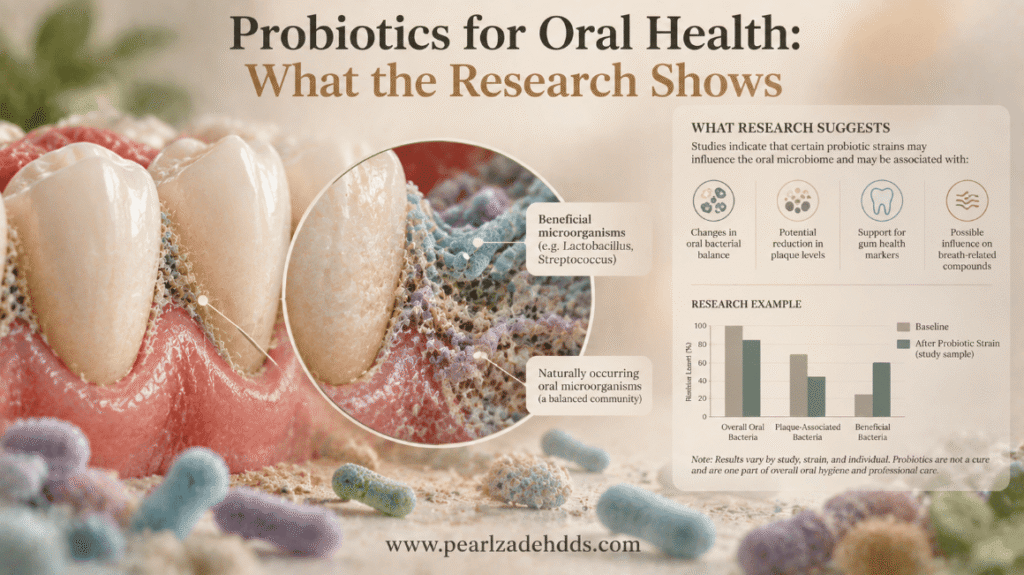
You may already think of probiotics as something you take for gut health. But what about your mouth?
Your mouth has its own microbial environment, and researchers are looking at whether certain probiotic strains can affect it. Some studies have found changes in oral bacteria, plaque, or gum inflammation. Those findings are interesting, but they do not automatically mean probiotics prevent cavities or gum disease.
The more useful question is what probiotics have actually been shown to do for oral health, and how strong that evidence really is.
What Are Probiotics?
Probiotics are live microorganisms. They are intended to provide a health benefit when consumed in the right amounts. Most people know them from yogurt, fermented foods, or gut-health supplements. Not every probiotic strain works the same way. A strain studied for digestive health is not automatically effective in the mouth. Effects depend heavily on the specific organism, not the general category of probiotic.
Why Are Researchers Studying Probiotics for Oral Health?
The mouth hosts hundreds of bacterial species living in a delicate balance. Some contribute to health. Others contribute to cavities, gum inflammation, or bad breath when they grow out of proportion. Researchers are studying whether certain probiotic strains can interact with that existing community. Possible mechanisms include competing with harmful bacteria for space or nutrients. Some strains may also produce substances that influence the local environment. This is a more complicated process than simply swapping bad bacteria for good ones. The oral microbiome does not work like a light switch.
Can Probiotics Improve the Balance of Oral Bacteria?
Many studies measure changes in oral bacteria after probiotic use. A reduction in certain harmful species is a common finding. That is different from proving a meaningful health benefit. A shift in bacterial counts is a laboratory or clinical marker. It is not the same as fewer cavities or healthier gums in practice. This distinction matters throughout the rest of this discussion. Measuring bacteria is easier than measuring disease outcomes. That gap is part of why so much research stops at the bacterial level.
Can Probiotics Help With Bad Breath?
Bad breath, or halitosis, is often linked to bacteria that produce sulfur compounds. A recent systematic review found that several probiotic strains reduced these compounds in short-term studies. One study noted the effect persisting for several months after treatment stopped. The same review cautioned that study designs varied widely. Sample sizes were small, and long-term follow-up was limited in most trials. A short-term reduction in measured compounds is not the same as curing chronic bad breath. Persistent halitosis can also come from gum disease, dry mouth, sinus issues, or other causes. Those causes need a dental evaluation rather than a supplement. For another approach some people use alongside brushing, see our article on tongue scraping and oral health.
Can Probiotics Help Prevent Cavities?
Researchers are interested here because certain bacteria, especially Streptococcus mutans, play a central role in cavity formation. A systematic review and meta-analysis found that probiotics increased the odds of reducing S. mutans and Lactobacillus counts. The same analysis did not find a significant reduction in actual cavity incidence. Its authors described the current evidence as insufficient to recommend probiotics for managing cavities. Probiotics should not be treated as a replacement for fluoride, regular brushing, or other established cavity-prevention steps. Other ingredient-level approaches, like xylitol gum, face a similar gap between promising mechanisms and proven cavity prevention.
Can Probiotics Help With Gingivitis?
Gingivitis involves inflammation of the gums, usually from plaque buildup. Some studies have looked at whether probiotics reduce gum bleeding or visible inflammation. Results have been more encouraging here than for cavities. A systematic review and meta-analysis found that probiotics significantly reduced bleeding on probing. Gingival inflammation scores improved as well in that review. Modest improvements in gingivitis markers are not the same as treating established gum disease. They also do not mean probiotics can replace professional cleanings or daily plaque removal.
What About Periodontal Disease?
Periodontitis is different from gingivitis. It involves deeper structural damage, including bone and attachment loss around the teeth. The same systematic review found reductions in pocket depth as well as improvements in bleeding and gingival inflammation. Pocket depth is one of the main measurements of periodontitis severity. This finding was more encouraging than the review’s results for cavities. A separate article from the American Dental Association compared probiotics to antimicrobial treatments and found mixed results. Probiotics performed better on pocket depth and attachment loss in that comparison. Antimicrobial treatments performed better on plaque and gingival index scores. The strongest results came from combining probiotics with conventional antimicrobial treatment, not using probiotics alone. Probiotics should not be viewed as a replacement for periodontal treatment. Notice changes in your gums? Our article on early signs of gum disease covers what to watch for.
Do Probiotic Foods Help Your Teeth?
Yogurt and other fermented foods naturally contain live bacterial cultures. That does not automatically mean they benefit your teeth the same way a studied probiotic strain does. Most oral-health research uses specific strains in controlled doses, not whole foods. A food’s overall composition matters too. Some yogurts and fermented products contain added sugar. That sugar can work against any potential benefit from the live cultures. A probiotic food is not automatically good for your teeth simply because it contains probiotics. The rest of its ingredients matter just as much.
Are Oral Probiotic Supplements Different From Regular Probiotics?
Delivery method and strain both matter for oral effects. A capsule designed to survive stomach acid and reach the intestines is not built to linger in the mouth. Lozenges, chewable tablets, and some oral rinses are designed to stay in contact with oral tissues longer. Some research suggests this extended contact time may matter for strains studied specifically for oral use. That does not mean oral-specific products are automatically more effective than general probiotic foods or supplements. It only means they are designed around a different mechanism. As with other alternative ingredients, such as nano-hydroxyapatite toothpaste, product design and the underlying evidence deserve a closer look. Do not assume effectiveness.
Do Gut Probiotics Also Benefit Your Mouth?
This is a common assumption worth addressing directly. A probiotic supplement marketed for digestive health is not automatically effective for oral health. Benefits are strain-specific and often site-specific. A strain studied for reducing digestive symptoms was tested in the gut, not the mouth. Evidence for one part of the body does not automatically transfer to another. If oral benefits are the goal, look for strains studied specifically for oral outcomes. General gut-health products are a different question.
How Strong Is the Evidence for Oral Probiotics?
The honest answer is that the evidence is mixed and still developing. Several factors make it difficult to draw one universal conclusion. Studies use different probiotic strains, which do not all behave the same way. Doses and delivery methods vary considerably between products. Many studies run for only a few weeks or months. That limits what can be said about long-term effects. Participant groups are often small. Different studies measure different outcomes, from bacterial counts to gum bleeding to cavity incidence, which makes comparisons difficult. Baseline oral health varies between study populations too. Several reviews have found that benefits fade once probiotic use stops, rather than producing a lasting change. None of this means the research should be dismissed. It means the evidence is not yet strong enough to support broad, confident claims. That is similar to where the evidence currently stands for other emerging approaches like oil pulling.
Are Probiotics Safe for Everyone?
Most healthy adults tolerate common probiotic strains without issue. Safety is not automatically guaranteed simply because a product is labeled natural. Products vary in strain, dose, and quality control, and not all are studied equally. People with significant underlying medical conditions or weakened immune systems face different considerations. Authoritative medical guidance generally recommends discussing any new supplement, including probiotics, with a physician first in these situations. This article cannot assess your individual medical situation. General safety information is not a substitute for that conversation.
Can Probiotics Replace Brushing, Flossing, or Dental Cleanings?
No. Nothing in the current research supports using probiotics as a substitute for established oral hygiene. Brushing removes plaque mechanically, which no supplement can replicate. Cleaning between teeth reaches areas a toothbrush cannot. Fluoride, where appropriate, has decades of evidence behind it for cavity prevention. Limiting frequent sugar exposure reduces fuel for harmful bacteria. Regular dental exams catch problems before they become bigger ones. Professional cleanings remove buildup that a toothbrush alone cannot address. Even small daily habits, like whether you should rinse after brushing, are part of this larger picture. A probiotic cannot compensate for gaps in plaque control or untreated dental disease.
Should You Add Probiotics to Your Oral-Care Routine?
There is no universal yes or no answer here. The evidence supports some promising changes in bacteria, breath compounds, and gum inflammation markers. It does not yet support confident claims about preventing cavities or reversing periodontal disease. Someone might reasonably choose a specific, studied probiotic strain as one additional habit alongside their existing routine. That is different from expecting it to meaningfully change their cavity risk or gum disease on its own. Brushing, interdental cleaning, and regular dental visits still have considerably stronger evidence behind them. Oral probiotics have not caught up to that standard yet.
What Should You Take Away About Probiotics for Oral Health?
Probiotics may influence certain oral bacteria and show potential benefits for some aspects of oral health. However, the research is still developing, and changes in bacterial levels do not necessarily mean probiotics prevent cavities, gum disease, or other dental problems.
For now, probiotics are better viewed as a possible addition to a healthy oral-care routine rather than a replacement for brushing, cleaning between your teeth, a balanced diet, or regular dental care.
If you have concerns about your teeth, gums, sensitivity, persistent bad breath, or another oral-health problem, a dental evaluation can help identify what may be causing it and what care may be appropriate.
Call (818) 716-6722 or click the button below to schedule your consultation online.
Frequently Asked Questions
Current evidence is not strong enough to say probiotics prevent cavities. Studies often show reductions in cavity-causing bacteria, but far fewer show an actual reduction in new cavities.
Some studies show probiotics reduce the compounds linked to bad breath in the short term. Evidence for long-term treatment of chronic halitosis remains limited.
Effects vary by strain, dose, and the outcome being measured. Some changes in bacteria or symptoms have been shown, but proven long-term dental benefits are not yet well established.
Not automatically. A food’s overall content matters, including added sugar, and most oral-health research involves specific strains rather than whole foods.
There is no established timeframe, since effects depend on strain, dose, and what outcome is being measured. Reliable evidence for specific timelines is currently limited.
This article is for informational purposes only and is not a substitute for professional dental advice. Please schedule a consultation with Pearl Zadeh DDS to discuss your specific situation.