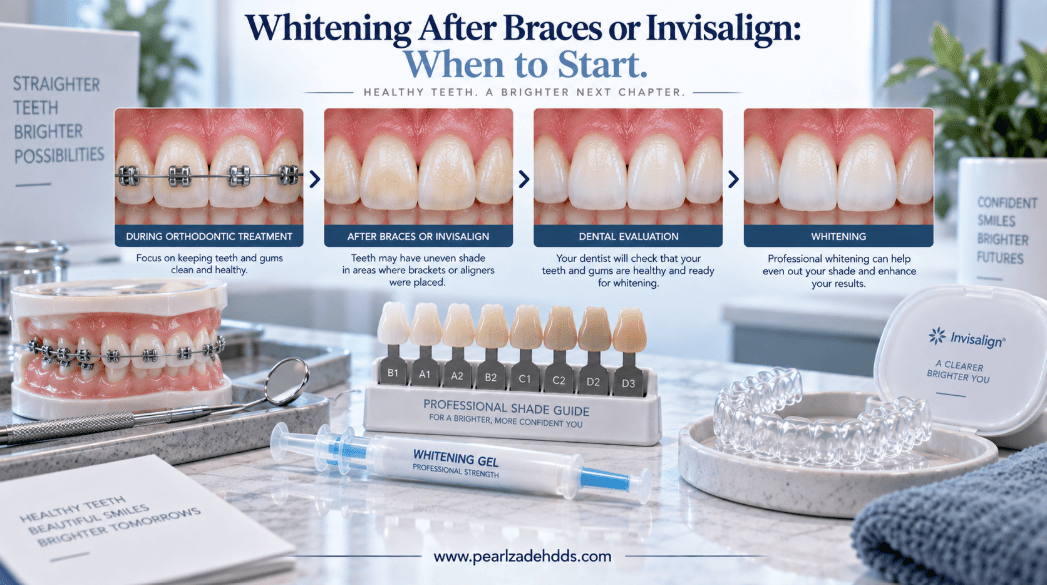
Your braces come off, or your last aligner comes out, and you finally see your straightened teeth. Then you notice the color. Maybe the shade looks duller than you expected, or there are pale marks where the brackets used to sit.
Whitening can be a reasonable next step after orthodontic treatment. The right time to start depends on the condition of your teeth and gums, not on a fixed number of weeks. What follows is what actually affects that timing.
Can You Whiten Your Teeth After Braces or Invisalign?
Often, yes. Many patients are reasonable candidates for whitening once orthodontic treatment is complete. Before starting, though, your teeth deserve an actual look: sensitivity, gum health, enamel condition, and the specific type of discoloration you’re seeing all affect whether whitening makes sense and what it can realistically do. Not every color change after braces is a stain, and that distinction matters more than any waiting period.
When Can You Whiten After Braces?
Removing brackets changes several things at once. Teeth are often temporarily sensitive after debonding. Gums that sat under wires and brackets for months can be irritated or inflamed, especially if brushing and flossing were difficult during treatment. Plaque and staining may have accumulated in spots that were hard to reach, particularly along the gumline and in the corners where brackets met enamel. And the enamel that was covered by each bracket may look different from the enamel around it, sometimes in a way that becomes more obvious a few days after debonding rather than immediately.
That last point is the one worth slowing down for. Some post-braces color differences are surface staining. Others are areas of enamel demineralization, often called white spot lesions, which form when plaque sits against enamel and produces acid. A review of post-orthodontic white spot lesions in Seminars in Orthodontics reports that roughly a third of orthodontic patients finish treatment with at least one white lesion, though reported estimates vary widely between studies, depending on how lesions are assessed. The more useful finding for timing is what happens next: these lesions often shrink on their own in the weeks after appliance removal, with about half of the original lesion remineralizing within about six months without any specific treatment. That natural recovery is one practical reason not to rush into whitening the week your brackets come off.
Whitening is also not the right tool for every kind of discoloration here. It lightens natural tooth structure. It does not rebuild demineralized enamel, and it does not treat decay. Getting an accurate read on what you’re actually looking at comes first.
When Can You Whiten After Invisalign?
Invisalign presents a different situation. There are no brackets bonded across the front of your teeth, so you generally won’t see the bracket-shaped color differences that fixed braces can leave behind. Gum irritation from hardware is usually less of a factor too. What does matter is attachments, the small tooth-colored bumps bonded to certain teeth to help aligners grip and move them.
While attachments are in place, they cover part of the tooth surface. Whitening during that period can leave the covered areas a different shade than the rest of the tooth once the attachments are removed. That’s the main reason many patients prefer to wait until treatment is finished and attachments are off. It isn’t a blanket rule, though, and it doesn’t mean whitening during aligner treatment is never appropriate. Some patients have no attachments on their most visible teeth, and some whitening approaches work alongside aligner wear. Your provider can tell you what applies to your case.
Keeping aligners clean during treatment also affects how your teeth look at the end. Our guide to cleaning Invisalign aligners covers the habits that keep staining from building up in the first place. It’s also worth confirming that treatment is genuinely complete, since refinement aligners sometimes follow the main set, occasionally with new attachments.
Why Your Teeth May Look Uneven After Braces
Several different things can produce uneven color, and they call for different responses.
Surface staining sits on the outside of the enamel, usually from food, drinks, or plaque that accumulated around hardware. This is the type most likely to respond to cleaning and whitening.
Natural tooth-color variation is simply how your teeth are. Canines are often slightly more yellow than incisors, and that difference can become more noticeable once teeth are straightened and visible from a new angle. Teeth that were previously overlapped or rotated may also be showing surfaces you have not really seen before.
White spot lesions are demineralized enamel, not stains. They look chalky or opaque rather than yellow or brown, and they typically appear along the gumline or in a rectangle-shaped outline where a bracket sat. These are an early stage of enamel breakdown, and they need a dentist’s assessment rather than a whitening kit.
Other enamel changes, including deeper discoloration from trauma or developmental causes, behave differently again and may not respond to whitening at all.
If whitening has already produced less change than you hoped, our breakdown of the common reasons whitening doesn’t work walks through these possibilities in more detail.
Should You Whiten Before or After Your Retainer?
There’s no universal sequence here, and your orthodontic provider’s instructions should come first. A few practical points do come up often. Retention usually begins immediately after treatment, which means your retainer is part of the picture from day one. Some whitening approaches use custom trays, and how those interact with your retainer schedule is worth asking about directly. If your retainer is a bonded wire behind your front teeth, that changes the cleaning picture rather than the whitening picture, since it sits out of sight. The practical step is simply telling both your dentist and your orthodontic provider what you’re planning, so the two schedules fit together.
What If Your Teeth Are Sensitive After Orthodontic Treatment?
Sensitivity after orthodontic treatment is common and usually temporary. Teeth that have been moving are often tender, and recently debonded enamel can react to temperature for a while. Whitening itself can also cause temporary sensitivity: the American Dental Association identifies tooth sensitivity and gum irritation as the most common side effects of whitening. Existing sensitivity doesn’t mean whitening is off the table. It does mean the approach, concentration, and timing deserve more thought than a generic plan. Our discussion of whitening for sensitive teeth goes further into how that gets managed.
Can Whitening Remove Stains Left After Braces?
It depends entirely on what the marks actually are. Surface staining often responds well. White spot lesions are a more interesting case, and the evidence is genuinely mixed rather than one-sided. A study in The Angle Orthodontist looked at ten patients with inactive white spot lesions after fixed braces and found that bleaching lightened both the lesions and the surrounding sound enamel, with the sound enamel lightening more, which improved how well the two areas matched. That is a small study, and it looked specifically at lesions that were no longer active. It does not mean whitening is the standard answer for white spots, and it does not mean whitening repairs the enamel underneath. The demineralization is still there.
Other approaches exist specifically for white spot lesions, including remineralizing treatments and micro-invasive options that mask the lesion. Which one fits, if any, depends on how deep the lesion is and whether it’s still active. That’s a clinical judgment, not a product choice.
What About Fillings, Crowns, or Veneers?
Whitening changes the color of natural tooth structure. The ADA is direct that only natural teeth can be whitened, not tooth-colored restorations. If you have visible fillings, a crown, or veneers, whitening your natural teeth can leave those restorations looking darker by comparison. This doesn’t mean they need replacing. It means the shade relationship is worth planning around before you start. Our discussion of whitening before veneers or crowns covers the sequencing question, and our guide to whitening when you already have veneers covers what to do when restorations are already in place.
Professional Whitening After Orthodontic Treatment
The value of an evaluation before whitening after orthodontics is mostly diagnostic. A dentist can look at your current tooth color, check the condition of your enamel, ask about sensitivity, assess whether your gums have settled after months of hardware, note any existing restorations, and identify what type of discoloration you’re actually dealing with. That last point is where post-braces cases differ most from ordinary whitening cases. Professional teeth whitening starts from that assessment rather than from a guess, which matters more when white spots or enamel changes may be part of the picture.
If you’re weighing what’s involved, our overview of how long professional whitening takes and how long results tend to last cover the practical side.
How to Prepare for Whitening After Braces or Invisalign
A few things genuinely help, and most of them are about making sure whitening is working on a clean, settled starting point. Get your oral hygiene routine back to full strength, which is easier once hardware is gone and brushing and flossing are straightforward again. Give irritated gums time to settle, and mention any bleeding or tenderness rather than working around it. Have any concerning discoloration evaluated before assuming it’s a stain. Tell your dentist about sensitivity you’re experiencing, including how long it’s been going on. Complete any needed dental treatment first, since whitening over an untreated cavity doesn’t address the cavity. And once you have a plan, follow the instructions you’re given rather than extending treatment time on your own.
When Should You Ask a Dentist Before Whitening?
Some situations are worth raising before you start anything: significant or persistent sensitivity, gum irritation that hasn’t settled well after your hardware came off, chalky white marks on your teeth, discoloration you can’t explain, any pain, enamel that looks rough or pitted rather than simply discolored, and existing fillings or crowns in your smile line. None of these automatically rules out whitening. They’re reasons to have someone look before you spend time and money on a product that may not address what’s actually going on.
Plan Your Whitening After Orthodontic Treatment
Finishing braces or Invisalign does not mean you need to whiten your teeth right away. Your teeth may need time to settle, and discoloration or sensitivity can affect what makes sense next.
Dr. Pearl Zadeh can examine your teeth and gums, identify the type of discoloration you’re seeing, and help you decide whether whitening is appropriate for your smile.
Call (818) 716-6722 or click the button below to schedule your consultation online.
Frequently Asked Questions
It’s generally worth waiting until sensitivity settles and your teeth have been evaluated, particularly since some post-braces marks are enamel changes rather than stains.
There’s no universal waiting period. The right timing depends on your sensitivity, gum health, and the type of discoloration present.
Often, yes. You can usually whiten your teeth once treatment ends and your dentist removes the attachments. However, confirm the timing with your provider based on your specific situation.
Attachments cover part of the tooth, so whitening while they’re in place can leave those areas a different shade once they come off.
White spots occur when enamel loses minerals. They are not surface stains. Whitening does not repair them, though research suggests it may sometimes make them less noticeable. A dentist should evaluate them before you start whitening.
This article is for informational purposes only and is not a substitute for professional dental advice. Please schedule a consultation with Pearl Zadeh DDS to discuss your specific situation.