
Your wedding is on the calendar. So are the engagement photos, rehearsal dinner, and other moments that will end up in pictures. You want your smile to look its brightest for all of them. Whitening can be part of that preparation, but leaving it until the final days can leave little room to adjust.
Sensitivity, uneven results, existing dental work, and stubborn stains can all affect what happens next. Planning ahead gives you time to see how your teeth respond and address anything unexpected before the event. The same approach can help if you are preparing for a graduation, anniversary, photoshoot, or vacation.
What Determines the Right Whitening Timeline?
There is no single ideal number of days. Timing depends on the whitening method, your treatment plan, your sensitivity, your staining, and the condition of your teeth. A fixed rule such as one week before the event ignores those differences.
A better approach is to plan early enough to stay flexible. That way, you can assess the result and respond if something unexpected happens. A dentist can help you choose a timeline that fits your teeth and your event.
Why Does Whitening Timing Matter Before an Important Event?
Event whitening differs from routine whitening. A routine session has no deadline. An event does, and a deadline raises the value of time.
Some patients notice temporary tooth sensitivity. Teeth do not always respond evenly, so one tooth may look different from its neighbors. Existing restorations may not change color at all. Some stains may not respond as expected. In some cases, a dentist may recommend further evaluation or treatment before whitening continues.
Having time to assess the result before photographs or the event makes each of those situations easier to manage. Complications are not inevitable. Planning simply gives you room to adjust if one arises.
How Long Does Teeth Whitening Take?
Treatment time depends on the whitening method. It helps to separate four different things. Appointment time is how long you spend in the dental office. Active whitening time is how long the whitening agent works on your teeth. For at-home treatment, duration is the number of days or weeks you use trays or strips. Assessment time is the period afterward when you judge the result.
These four rarely match. A short appointment does not mean the shade is final. The ADA’s MouthHealthy site says out-of-office whitening can take anywhere from a few days to a few weeks. One treatment may not produce the shade you want. Your dentist can estimate a timeline after examining your teeth. For more on appointment length, see our article on how long professional teeth whitening takes.
Will Your Teeth Look Different Immediately After Whitening?
Teeth may look lighter right after treatment. That first change does not necessarily show the final result. Individual teeth and treatments vary. A retrospective study of in-office bleaching found most groups changed more by one week than right after treatment. The Journal of Clinical Medicine published it, and the authors noted limits, including the retrospective design.
This finding does not mean everyone needs a set waiting period. It does suggest that the first look in the mirror may not tell the whole story. Judging the result with a little time can give a clearer picture.
What If Your Teeth Feel Sensitive After Whitening?
Temporary sensitivity can occur after whitening. The ADA explains that sensitivity can occur when whitening ingredients reach the dentin, the inner layer of the tooth. It is usually temporary. Not everyone develops it, and it varies from person to person.
Before an event, sensitivity matters for another reason. Photos and toasts are hard to enjoy with sharp zings. Time before the event lets you pause, ask your dentist for guidance, and let your teeth settle. Ask your dentist what is appropriate for you rather than choosing a product or schedule on your own.
Contact your dentist if sensitivity is severe, lasts longer than expected, or feels unusual. Sharp pain in one tooth, gum irritation, or swelling also deserves a call. An ADA News summary advises clinicians to caution patients about sensitivity and gum irritation from over-the-counter products. Our article on what helps sensitive teeth after whitening offers general guidance. If your teeth are already sensitive, see our page on teeth whitening for sensitive teeth.
Should You Whiten the Day Before Your Wedding?
Whitening the day before is not automatically unsafe. It does not automatically lead to a poor result either. The problem is flexibility. Sensitivity may appear, and you have no time to wait it out. One tooth may look uneven, and you cannot adjust. A stain may not respond, and you find out too late.
Planning ahead gives you more room to respond. Repeating whitening right before the event to fix a disappointing result is not a good plan. The ADA warns that overuse of whiteners can damage enamel or gums. Talk with your dentist first.
What If You Have Crowns, Veneers, or Fillings?
Natural teeth and dental restorations may not respond to whitening the same way. The ADA notes that only natural teeth can be whitened, not tooth-colored restorations. That does not mean restorations block whitening for your other teeth. It does mean shade differences can appear.
A whitened natural tooth may sit beside a crown that stays the same color. This matters most when restorations are on visible front teeth. Photographs can make that mismatch easier to notice. A restoration does not automatically need replacement. Your dentist can examine visible restorations first. That gives you time to decide what, if anything, to do. Learn more in our articles on whitening with fillings or crowns and whitening with veneers.
Should You Whiten Before Your Final Makeup or Photography Trial?
Whitening can fit alongside your other appearance preparations. Your schedule may include a dress fitting, a hair and makeup trial, or an engagement session. No arbitrary timetable suits everyone.
Photographs can make differences in tooth shade more noticeable. That is one reason to leave time to evaluate your result before the event. If trial photos show uneven shading or a standout restoration, you still have time to talk with your dentist.
What Should You Eat and Drink After Whitening?
Some foods and drinks carry strong pigments. Coffee, tea, red wine, berries, dark sauces, and cola are common examples. The ADA lists coffee, tea, and red wine as major staining culprits. Temporary dietary choices may be reasonable after whitening, especially if your teeth feel sensitive. Very hot or cold items can bother sensitive teeth.
You do not need a strict, permanent white diet. One cup of coffee is unlikely to undo your results. For specifics, see our article on what to eat and avoid the week after teeth whitening. To learn how long results last, read how long teeth whitening lasts.
What If Your Teeth Do Not Whiten as Much as Expected?
Whitening does not affect every type of discoloration equally. The ADA says yellow teeth will probably bleach well. Brown teeth may not respond as well. Teeth with gray tones may not bleach at all.
Several factors can limit the result. Intrinsic discoloration comes from inside the tooth. Natural tooth color varies. Certain stains respond less. Enamel characteristics can matter. Existing restorations will not change. Individual teeth may also differ from one another.
Discovering this a few days before the event leaves little room to respond. Finding it earlier gives you time to discuss options with your dentist. Our article on why teeth may not whiten covers common reasons. Another covers why one tooth does not whiten like the others.
How Should You Plan Teeth Whitening Around Your Event Date?
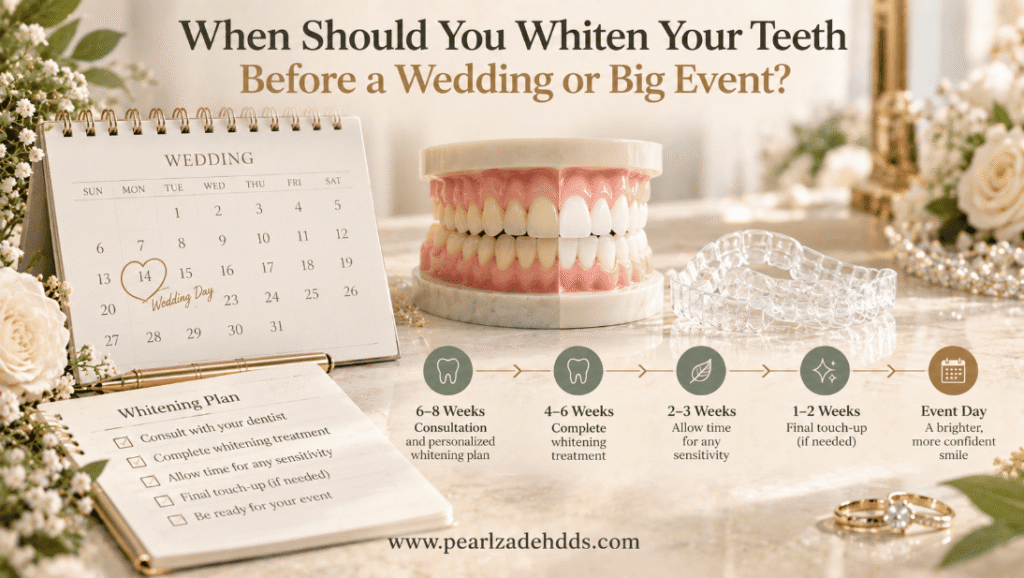
Use a framework instead of a fixed number of days.
1. Identify your event date. Decide how much flexibility you want before it.
2. Consider the whitening method. Professional treatment, dentist-provided trays, and over-the-counter products follow different schedules.
3. Allow time to assess the result. Judge the shade after the first change settles, not at the first mirror check.
4. Think about sensitivity. Mention any history of sensitive teeth before you start.
5. Account for dental work. Note any crowns, veneers, fillings, or bonding on visible teeth.
6. Raise unusual discoloration early. A dark tooth or unexplained stain deserves a conversation before treatment.
7. Avoid a last-minute decision when you have no flexibility. If the event is close, ask your dentist what is realistic.
This is a framework, not a calendar. Your dentist can turn it into dates that fit your teeth.
When Should You Talk to a Dentist Before Whitening?
An evaluation can be especially useful in several situations. Persistent tooth sensitivity is one. A single tooth that looks much darker is another. So is discoloration with no clear cause. Visible restorations and recent dental treatment also matter. Pain or other symptoms call for an exam. So does previous whitening that gave little improvement.
Color alone cannot diagnose a problem. A dentist examines the tooth and reviews your history. The ADA notes that a clinical exam before bleaching can help identify what contributes to discoloration. Radiographs and other tests may be added as appropriate.
Plan Ahead for a Whitening Approach That Fits Your Teeth
The best whitening plan starts well before the event. Early planning leaves room to manage sensitivity, assess the shade, and respond to anything unexpected. Dr. Pearl Zadeh evaluates your teeth and existing dental work, then helps you build a whitening plan around them. No one can guarantee a specific shade by a specific date. Dr. Pearl can help you decide what is realistic and when to start. You can read more about professional teeth whitening on our website.
Call (818) 716-6722 or click the button below to schedule your consultation online.
Frequently Asked Questions
There is no single best number of days. Timing depends on the whitening method, your teeth, your sensitivity, and any restorations. Starting early leaves room to assess the result and adjust. A dentist can help you choose a timeline.
It is not automatically unsafe, but it leaves little flexibility. If sensitivity or uneven results appear, there is no time to respond. Planning ahead is usually the more comfortable option.
It can, but not everyone experiences it. Temporary sensitivity is a recognized side effect. Contact your dentist if it is severe, persistent, or unusual.
Natural teeth can still be whitened. Crowns, veneers, and tooth-colored fillings do not change color. That can create a shade difference, especially on visible teeth. A dentist can review your options before treatment.
Some discoloration does not respond equally to whitening. Natural tooth color, intrinsic stains, and restorations can all play a role. Talk with your dentist rather than repeating treatment on your own.
This article is for informational purposes only and is not a substitute for professional dental advice. Please schedule a consultation with Pearl Zadeh DDS to discuss your specific situation.