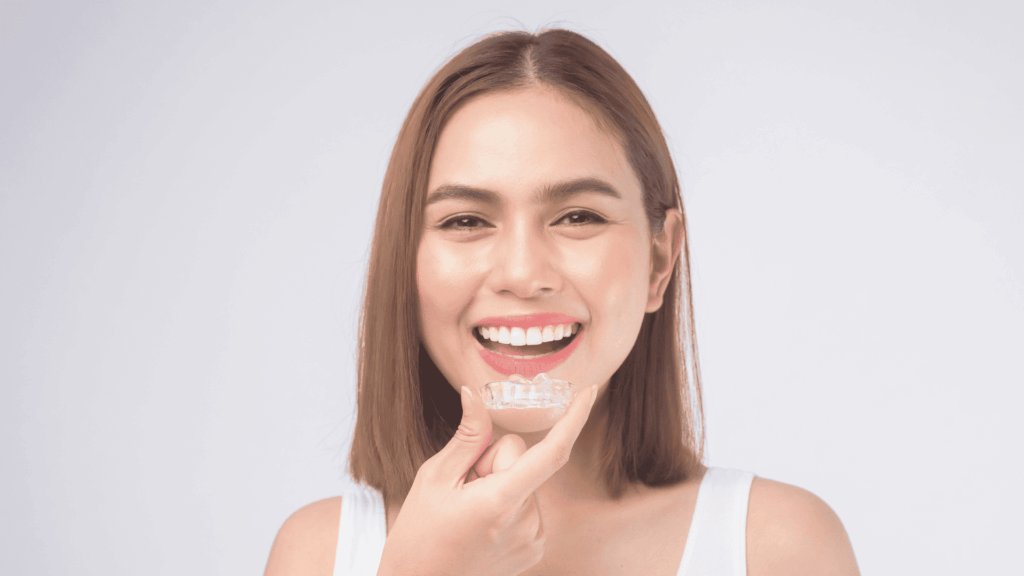
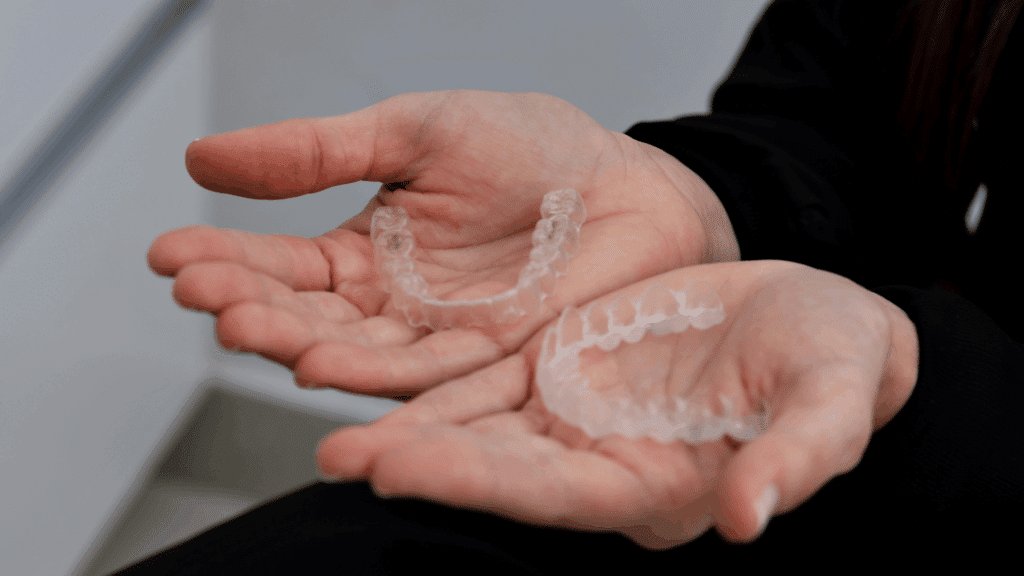
Many people want straighter teeth without the look of metal braces. Invisalign offers a clear, structured way to improve alignment while keeping daily life simple. This guide breaks down the Invisalign process step-by-step, from your first digital scan to your final smile.
Step 1. Digital Scan and Smile Evaluation
The Invisalign process starts with a digital scan of your teeth. A precise 3D scanner captures the shape, position, and spacing of each tooth. This replaces traditional impressions, which many patients find uncomfortable.
After the scan, the dentist reviews your bite, gum health, and overall tooth alignment. Existing dental work such as crowns or fillings also receives careful attention. At this stage, realistic goals are discussed so expectations stay clear from the beginning.
Next, the dentist designs a custom Invisalign plan. Each tooth movement is mapped in a specific order rather than moving everything at once. This planning protects bone support and keeps gums healthy.
The plan focuses on balance and function, not just straight teeth. Bite alignment, facial harmony, and long term stability all play an important role during this step.
Step 3. Custom Aligner Creation
Once the plan is approved, a series of clear aligners is created. Each set of aligners moves the teeth slightly closer to the final position. The aligners fit closely over the teeth and remain nearly invisible when worn.
Every aligner builds on the progress of the previous one. This gradual movement reduces discomfort and keeps treatment controlled.
Step 4. Wearing the Aligners Daily
Aligners are worn for about 20 to 22 hours per day. Most patients switch to a new set every one to two weeks, depending on the plan.
Because aligners are removable, eating and oral hygiene stay easy. Teeth can be brushed and flossed normally, which helps reduce the risk of cavities or gum problems during treatment.
Step 5. In Person Progress Checks
Regular office visits allow the dentist to check how teeth are moving. These visits help confirm that aligners fit properly and that progress stays on track.
If changes are needed, adjustments can happen early. This step helps avoid delays and improves the quality of the final result.
Step 6. Finishing and Retainers
After the final aligner, treatment does not simply stop. Retainers keep teeth in their new position and prevent shifting. Most patients wear retainers full time at first, then transition to nighttime wear.
Consistent retainer use protects the time and effort invested in Invisalign treatment.
Invisalign succeeds because it combines careful planning with regular monitoring. Each step builds on the previous one, creating steady and predictable movement.
Instead of guessing or relying on remote systems, the process stays guided from start to finish. The result is a smile that looks natural, feels comfortable, and lasts.
Start Invisalign Treatment With Professional Guidance
Invisalign works best when a dentist plans and monitors every step in person. If you are considering clear aligners and want careful planning instead of guesswork, a consultation at our clinic offers clarity.
Each visit focuses on comfort, safety, and natural results. From the first scan to final retainers, treatment stays guided and straightforward. Questions are answered clearly, and options are explained without pressure.
Schedule a visit to learn whether Invisalign fits your smile goals.
1. How long does Invisalign treatment usually take?
Most Invisalign treatments last between 12 and 18 months. The exact timeline depends on tooth alignment, bite position, and how consistently aligners are worn each day.
2. How many hours per day should aligners be worn?
Aligners should be worn 20 to 22 hours per day. Removing them only for meals and cleaning helps teeth move according to the treatment plan.
3. Does Invisalign hurt?
Some pressure is normal when starting a new aligner. This sensation usually fades within a day or two and signals that teeth are moving as planned.
4. Can Invisalign fix bite problems or just crooked teeth?
Invisalign can correct many bite issues, including overbite, underbite, and crossbite, when planned carefully. Severe cases may still require other orthodontic options.
5. Do I need to wear retainers after Invisalign treatment?
Yes. Retainers keep teeth from shifting back. Wearing them as instructed helps maintain long term results.
Invisalign vs Traditional Braces: What’s Right for Your Smile?
Pearl Zadeh DDSInvisalign
Choosing how to straighten your teeth is an important decision. Many patients compare Invisalign and traditional braces to find the best fit for their goals, lifestyle, and dental needs. Both options align teeth. Yet they differ in visibility, comfort, care routine, and case suitability. This guide breaks down the main differences so you can understand what each choice offers.
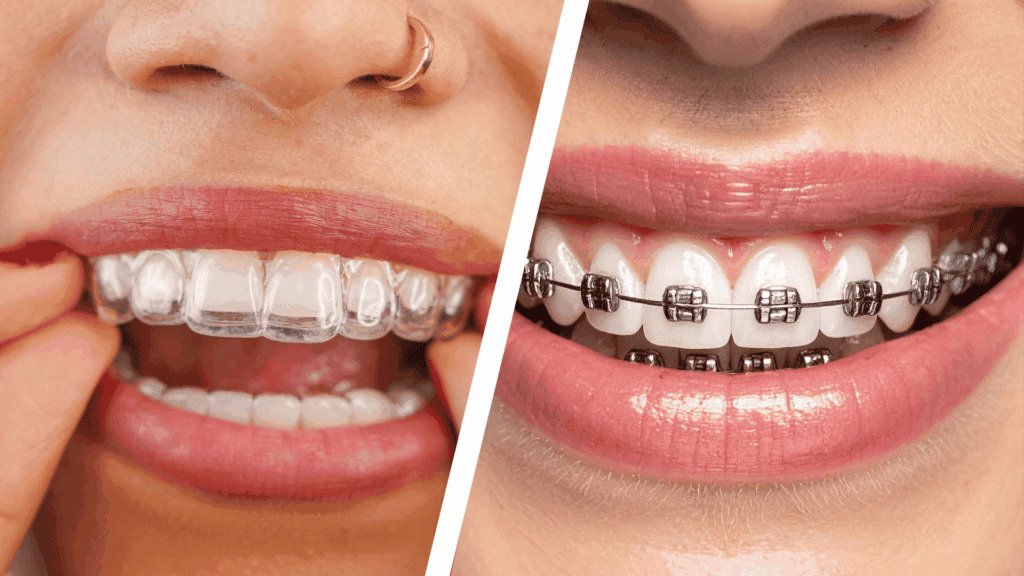
Traditional braces use metal brackets and wires that attach to your teeth. The orthodontist adds pressure over time to move teeth into a new position. These braces work 24 hours a day and do not rely on removal or placement by the wearer.
What Are Invisalign Aligners?
Invisalign uses a series of clear plastic trays that fit over your teeth. Each tray shifts your teeth slightly. You replace the trays every one to two weeks until treatment finishes. The aligners are removable. This lets you take them out for eating and cleaning.
Key Differences Between Invisalign and Traditional Braces
The table below shows how Invisalign and braces differ across the features that matter most to patients.
Proper care helps treatment stay on track, protects your teeth, and ensures a healthy smile.
Invisalign Care
Rinse trays before and after wearing.
Brush teeth and aligners at least twice a day.
Avoid sugary drinks while wearing aligners.
Store trays in their case when not in use to avoid loss or damage.
Wear aligners 20-22 hours per day for consistent progress.
Braces Care
Brush carefully around brackets and wires after each meal.
Use floss threaders or special brushes to clean between teeth.
Avoid hard, sticky, or chewy foods that can break brackets.
Attend regular orthodontist visits for adjustments.
Following these steps ensures treatment progresses smoothly, teeth remain healthy, and your final smile looks natural.
Schedule Your Consultation
At Pearl Zadeh DDS, we help you choose the best option for your smile based on your lifestyle, aesthetic preferences, and dental needs. Invisalign provides a discreet, flexible solution for adults and teens who want clear, removable aligners. Traditional braces remain the most effective choice for patients who require strong, constant pressure to correct more complex tooth movements.
During a consultation, Dr. Zadeh evaluates your bite, spacing, and facial structure. She then creates a treatment plan tailored to your goals and oral health, ensuring predictable, natural results.
Dr. Pearl Zadeh evaluates your bite, tooth alignment, and oral health during a consultation. Invisalign works well for mild to moderate cases, while more complex shifts may require traditional braces. She will recommend the option that meets your goals safely and effectively.
2. How long does Invisalign treatment usually take?
Treatment typically lasts 12-18 months, depending on your teeth and alignment needs. You will wear each tray for one to two weeks and attend regular check-ins to ensure your smile progresses as planned.
3. Can I eat normally with Invisalign?
Yes. Invisalign aligners are removable, so you can eat and drink without restrictions. Simply remove your trays before meals and brush your teeth before putting them back in. This makes maintaining oral hygiene much easier compared with traditional braces.
4. Will Invisalign feel uncomfortable?
Some pressure or slight soreness may occur when switching to a new tray, which is normal and signals that your teeth are moving. The smooth plastic trays rarely irritate gums or cheeks, making Invisalign more comfortable than metal braces for most patients.
5. Can I straighten my teeth without anyone noticing?
Yes. Invisalign aligners are clear and fit snugly over your teeth, making them nearly invisible. Most people will not notice you are wearing them, allowing you to maintain confidence while your teeth gradually move into place.
Can Invisalign Correct an Open Bite? What Patients Should Know
Pearl Zadeh DDSInvisalign
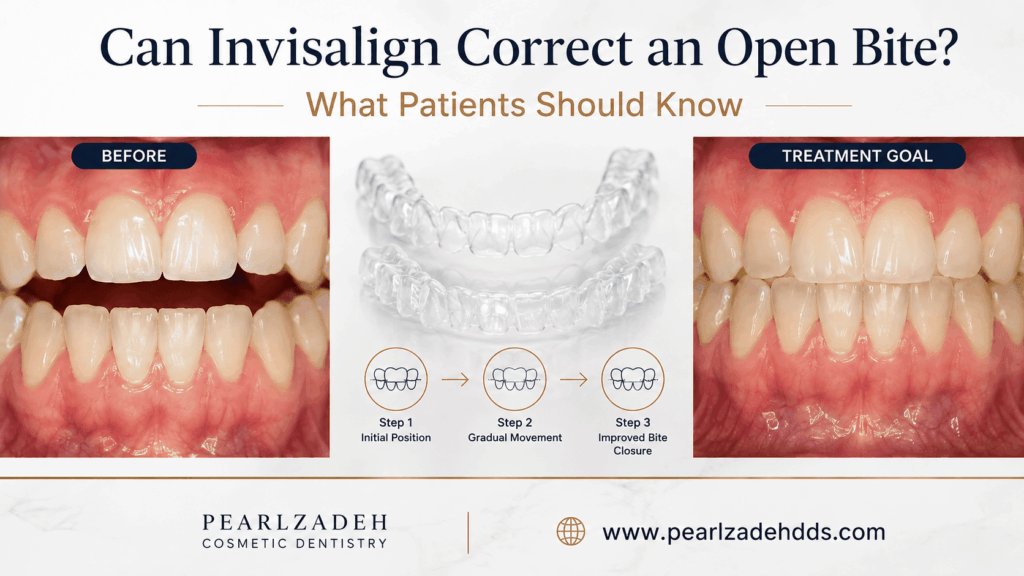
You close your teeth together, but your front teeth still leave a visible space. This is what many patients with an open bite experience, and it can affect more than just the appearance of their smile. An open bite may change how you bite into food, speak, or feel about your teeth.
Many people know Invisalign can straighten crowded teeth or close gaps, but they are less sure whether clear aligners can correct bite problems. The answer depends on several factors, including the type of open bite, its severity, and what is causing the teeth not to meet properly.
A proper evaluation can help determine whether Invisalign is a suitable option or whether another approach may better fit your smile goals.
What Is an Open Bite?
An open bite happens when some of your teeth don’t make contact when you bite down fully. Invisalign’s own patient resources describe two main types. An anterior open bite affects the front teeth, leaving a visible gap between your upper and lower teeth even when you close your back teeth together. A posterior open bite is less common and affects the back teeth instead, where the molars and premolars don’t meet even though the front teeth do. This is different from an overbite, underbite, or crowded teeth, which involve teeth overlapping, misaligning, or sitting too close together rather than failing to meet at all.
Beyond how it looks, an open bite can affect everyday function. Some patients notice difficulty biting into certain foods, changes in how certain sounds are pronounced, or a tendency for the tongue to rest between the front teeth. Left unaddressed for years, an open bite can also place uneven strain on the jaw joint for some patients. This isn’t true for everyone with an open bite, and severity plays a large role, but it’s part of why correction can matter beyond appearance alone.
What Causes an Open Bite?
Open bites usually come from one of a few sources. Childhood habits like prolonged thumb sucking or pacifier use can gradually push teeth out of position over years of repeated pressure. Tongue thrusting, where the tongue pushes against the front teeth during swallowing or speech, can have a similar effect. In other cases, the cause is skeletal rather than habitual, meaning the jaw itself grew in a way that creates the gap, sometimes described as a long-face or vertical growth pattern. Knowing which of these is behind your specific open bite matters, since it shapes what treatment approach actually makes sense.
Can Invisalign Correct an Open Bite?
In many mild to moderate cases, yes. Invisalign has shown reasonable success treating open bites caused primarily by tooth position rather than significant jaw structure issues. That said, not every open bite responds to Invisalign alone, and results vary considerably based on severity and cause. This isn’t a treatment that works identically for every patient with an open bite, which is exactly why an evaluation matters more than a general yes or no answer found online.
How Invisalign Works to Improve Bite Alignment
For many anterior open bite cases, Invisalign aligners are designed to act somewhat like bite blocks, applying gentle, sustained pressure that can help the back teeth settle slightly while allowing the front teeth to extrude, or move down, into contact. One study looking at anterior open bite predictability with clear aligners found that treatment achieved roughly two-thirds of what the software’s initial prediction had projected, a reminder that digital previews give a general direction rather than a guaranteed outcome. This is part of why regular monitoring throughout treatment matters, so your dentist can adjust the plan if your bite isn’t closing as expected. The general tooth-movement mechanics involved are similar to how Invisalign closes gaps between teeth, just applied to vertical movement rather than horizontal spacing.
What Determines Whether You’re a Good Candidate
Several factors shape whether Invisalign is a reasonable option for your specific open bite. Severity matters most: a small gap involving one or two teeth responds differently than an open bite spanning several teeth. How much tooth movement is actually needed factors in too, since more significant repositioning can push past what aligners alone reliably achieve. Whether the open bite is primarily dental, meaning it’s about tooth position, or skeletal, meaning it involves how the jaw itself developed, makes a substantial difference, since aligners work on tooth position and have real limits when it comes to jaw structure. Your overall oral health, including gum condition and any existing dental work, also factors into whether your teeth are ready for aligner treatment at all.
Mild cases, often limited to a few teeth with a primarily dental cause, tend to respond most predictably to Invisalign alone. Moderate cases may still be treatable but often need closer monitoring and sometimes additional tools, like small attachments that give aligners more precise grip on specific teeth. More complex cases, particularly those with a significant skeletal component, may need a combination of approaches or a different treatment path altogether. Open bite correction also tends to take longer than treatment focused mainly on crowding or spacing, since vertical tooth movement generally progresses more slowly than horizontal movement.
When Invisalign May Not Be the Ideal Option
Severe skeletal open bites, especially those linked to significant jaw growth patterns, may require more than Invisalign alone. In these cases, your dentist or orthodontist may recommend traditional braces for more controlled tooth movement. Some severe cases may also require a combination of orthodontic treatment and jaw surgery. This does not mean Invisalign is the wrong choice for everyone. It means a proper evaluation helps you choose the right treatment path. Starting with Invisalign when another approach fits better can delay progress and prevent you from reaching your desired outcome.
What to Expect During Evaluation and Treatment Planning
Your evaluation begins with photos, digital scans, and a close examination of your bite. Your dentist determines whether your open bite is dental or skeletal. They also assess how many teeth are involved and estimate a realistic treatment timeline. This is a good time to ask how treatment may affect your bite and smile line. Our discussion of Invisalign and facial changes explores that topic in more detail. A clear treatment plan makes it easier to track your progress throughout treatment.
Why Dentist Supervision Matters Throughout Treatment
Open bite correction requires ongoing monitoring throughout treatment. Regular check-ins help your dentist confirm your bite is closing as planned. If progress slows or changes unexpectedly, your dentist can adjust your aligner sequence or attachments. Catching these issues early helps keep treatment on track. Wearing your aligners as directed also plays a major role. Inconsistent wear is one of the most common reasons treatment takes longer or fails to fully correct an open bite.
How Retainers Help Maintain Results
Once your active treatment ends, wearing a retainer becomes part of your routine. Skipping it is one of the most common reasons an open bite can begin to return. Teeth naturally drift over time, including those moved with Invisalign. Wearing your retainer as directed helps keep your teeth in their new position and protects the results you achieved during treatment.
Getting an Open Bite Evaluation With Dr. Pearl Zadeh in Woodland Hills
Dr. Pearl Zadeh, an Invisalign Premier Provider, carefully evaluates your open bite before recommending Invisalign or another treatment. She determines whether your case is dental or skeletal. She also assesses how many teeth are involved and what outcome is realistic for your bite. Her goal is to give you an honest understanding of your options, so you know what to expect before committing to treatment.
Schedule a Consultation With Dr. Pearl Zadeh
Whether Invisalign can correct your open bite depends on your specific bite. No single answer applies to everyone. A professional evaluation is the only reliable way to determine what is realistic for your situation.
Dr. Pearl Zadeh and her Woodland Hills team can evaluate your open bite and explain your treatment options. They will help you decide whether Invisalign or another approach best fits your needs.
Call (818) 716-6722 or click the button below to schedule a consultation online.
In many mild to moderate cases, Invisalign can meaningfully improve or close an open bite, though results vary by severity and cause. Severe skeletal cases may need a different or combined approach.
2. How long does Invisalign take to correct an open bite?
Timelines vary widely based on severity and how many teeth are involved. Your dentist can give you a more specific estimate after evaluating your bite directly.
3. Can clear aligners correct a posterior open bite?
Posterior open bites are less common and can be more challenging to treat with aligners alone, depending on the cause. A dentist can evaluate whether your specific case is a good fit.
4. What happens if Invisalign doesn’t fully close my open bite?
Your dentist may recommend additional aligners, attachments, or, in some cases, a different treatment approach if progress isn’t matching the original plan. Regular monitoring is what catches this early.
5. Is an open bite always caused by childhood habits?
No. While habits like thumb sucking are common causes, some open bites are primarily skeletal, related to how the jaw developed, rather than habit-related.
This article is for informational purposes only and is not a substitute for professional dental advice. Please schedule a consultation with Dr. Pearl Zadeh to discuss your specific situation.
What Is IPR During Invisalign? What Patients Should Know
Pearl Zadeh DDSInvisalign
You expected clear trays gently nudging your teeth into place. Then your dentist mentions IPR, or says something about enamel reduction, and suddenly you’re picturing a drill near teeth you didn’t expect anyone to touch. It’s an understandable reaction. The name sounds more intimidating than the procedure itself.
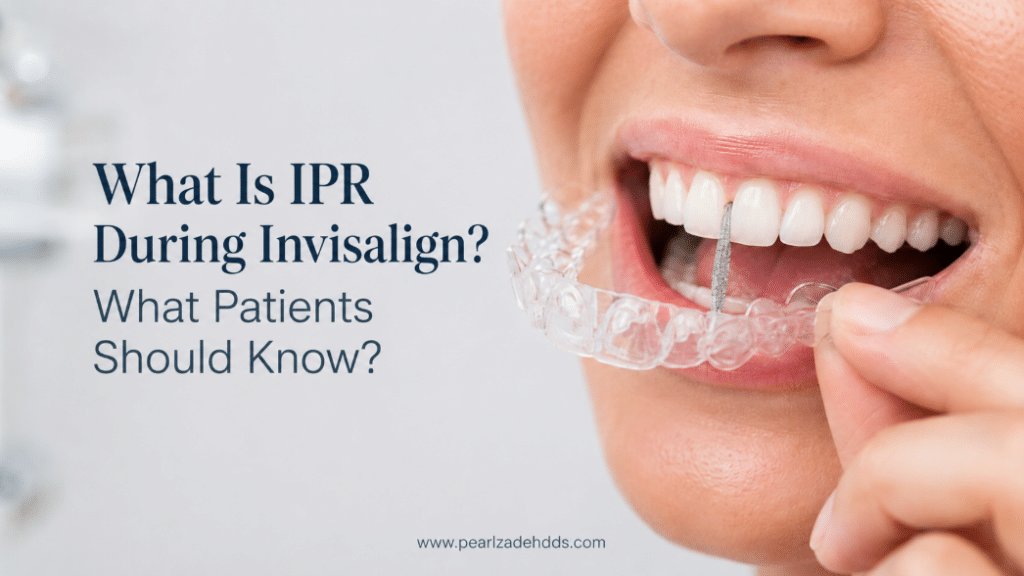
IPR stands for interproximal reduction. During Invisalign treatment, it means removing a very small, carefully measured amount of enamel from between selected teeth. The goal may be to create space for certain tooth movements or help the teeth fit together more effectively. Your dentist plans where and how much reduction is needed before the procedure. IPR isn’t performed on every tooth, and plenty of Invisalign patients never need it at all.
What IPR During Invisalign Actually Means
“Interproximal” means between neighboring teeth, at the contact point where one tooth meets the next. “Reduction” refers to removing a small amount of enamel from that area.
The procedure is planned around your specific treatment needs. Your dentist identifies which teeth need additional space and how much reduction is appropriate. A thin strip, disc, or another specialized instrument may then be used to carefully reduce the enamel between those teeth.
It isn’t random filing, and it doesn’t involve reshaping the entire tooth. Only the selected contact areas are treated, and the amount removed is kept small. Whether you need IPR depends on your teeth, bite, available space, and the movements your Invisalign plan needs to achieve.
Why Would I Need IPR During Invisalign?
Sometimes teeth need more room to move into the positions your treatment plan is aiming for than currently exists in your mouth. When that’s the case, your dentist has more than one way to create that space, depending on your specific situation. IPR is one option. It creates small amounts of space between selected teeth without removing an entire tooth.
It can help with crowding, support planned tooth movement, and improve how neighboring teeth contact each other. In some cases, it may also be part of managing tooth proportions as the overall smile is being planned. None of this means IPR is required for every crowded smile, and it isn’t automatically preferable to other approaches such as extraction. Your treatment plan, based on your specific teeth and bite, determines whether it makes sense for you.
Is This the Same Thing as “Shaving Your Teeth”?
You’ve probably seen that phrase somewhere, and it makes the procedure sound far more aggressive than it actually is. IPR removes a small, carefully planned amount of enamel from between selected teeth. It doesn’t reshape the entire tooth or make your teeth noticeably smaller. The goal is to create space at specific contact points, not change the visible shape of the tooth.
“Shaving” is casual shorthand, but it doesn’t really describe how targeted the procedure is. Your dentist controls where the enamel is reduced and how much is removed based on what your Invisalign treatment needs.
Does It Hurt?
There’s no cutting into your gums, no drilling into the center of the tooth, and nothing intended to come anywhere near the nerve. Most patients describe feeling pressure or a mild vibration during the procedure itself, along with a scraping or rubbing sensation as the instrument passes between the teeth. It’s not painless for absolutely everyone, and it’s fair to say some patients notice mild temporary sensitivity in the treated area afterward, particularly to cold. That typically settles within a day or two. If sensitivity is significant or sticks around longer than that, it’s worth a call to your dentist rather than waiting it out.
How Is IPR Actually Done?
Your dentist identifies which teeth and contact points actually need space, based on your treatment plan, and works out how much reduction each site calls for. The tooth surfaces involved are accessed carefully, and a specialized strip, disc, or similar instrument removes a small amount of enamel from between the selected teeth. Your dentist checks the resulting space and the condition of the tooth surfaces, then finishes and polishes the area so it’s smooth rather than rough. From there, your Invisalign treatment continues on schedule. This is a professional dental procedure performed with specific instruments and training. It isn’t something to attempt yourself under any circumstances.
How Much Enamel Actually Comes Off?
IPR involves a small amount of enamel. A recent peer-reviewed analysis of enamel thickness and IPR planning reports that enamel reduction at a single interproximal site is often planned within a range of about 0.20 to 0.50 millimeters. That range does not mean the same amount will be removed from every tooth or every patient.
The amount depends on which teeth are involved, how much space your treatment plan needs, the thickness and shape of your enamel at that contact point, and the movement your dentist is trying to achieve. Your dentist evaluates those factors before deciding whether IPR is appropriate and how much reduction is needed.
Does Enamel Grow Back After IPR?
No. Enamel doesn’t regenerate once it has been removed, whether through IPR or normal wear over time. That’s why the amount removed during IPR is planned carefully and kept within the limits appropriate for the tooth being treated.
Professional IPR is different from uncontrolled filing because your dentist determines exactly where the enamel needs to be reduced and how much space the treatment requires. The goal is to create the needed space while preserving as much healthy enamel as possible.
Can IPR Damage Your Teeth?
Before recommending IPR, your dentist considers your tooth anatomy, enamel thickness, how much space is actually needed, the health of your teeth and gums, the specific contact points involved, and how IPR fits into the rest of your treatment plan.
A systematic review of the dental and periodontal effects associated with IPR found that IPR appears clinically safe when performed with appropriate case selection, proper technique, and adequate finishing. The review did not find consistent evidence that properly performed IPR increases the risk of cavities, gum problems, or lasting sensitivity.
That doesn’t mean there is zero risk in every situation. Possible concerns include temporary sensitivity, a rough surface if the area isn’t finished and polished properly, excessive enamel removal, or gum irritation depending on the technique used. The purpose of professional IPR is controlled space creation, not removing enamel unnecessarily.
Will I Have Gaps After IPR, or Will My Teeth Look Smaller?
The small amount of space IPR creates is intentional and part of the treatment plan. As your aligners continue moving your teeth, that space is generally used to achieve the planned positions rather than remaining as a visible gap.
What your finished smile looks like depends on the entire treatment plan, not IPR alone. Your dentist considers the amount of space needed, tooth positions, and overall tooth proportions before deciding whether IPR is appropriate.
As for your teeth looking smaller, properly planned IPR shouldn’t noticeably change their visible size. The enamel is removed from the sides where neighboring teeth contact each other, rather than from the front surface you see when you smile.
If tooth proportions are part of your treatment goals, your dentist considers them when planning where IPR is needed and how much enamel should be removed.
Does Everyone Getting Invisalign Need IPR?
No. Plenty of Invisalign cases don’t require IPR at all. For others, it’s one part of a larger treatment plan.
Whether you need it depends on factors such as the amount of crowding, the shape and size of your teeth, the space already available, where your teeth need to move, your bite, and your overall treatment goals. IPR isn’t a standard step that every Invisalign patient automatically goes through.
Other Ways to Create Space: Extraction and Arch Expansion
IPR isn’t the only way to create space when teeth need more room. Extraction involves removing an entire tooth, so it’s a much different approach and may be considered when a case requires more space than IPR can provide. Some orthodontic cases call for extraction, while many can be treated without it.
Another option is arch expansion, which involves gradually widening the dental arch to create additional room. Whether that’s appropriate depends on the patient’s anatomy, tooth positions, and bite.
None of these approaches is automatically better than the others. Your dentist considers how much space the treatment needs and which approach is appropriate for your teeth and bite.
What Happens After IPR?
Your teeth may feel slightly different against your tongue for a little while. Some patients notice a subtly different texture where the enamel was reduced, and mild temporary sensitivity is possible.
The treated contact points may also feel slightly more open at first. Your aligners then continue moving the teeth according to the treatment plan.
Continue your usual brushing and flossing routine after the procedure. If you develop significant pain, swelling, or sensitivity that doesn’t start to settle after a couple of days, contact your dentist rather than waiting it out.
Does IPR Always Happen at the Start of Treatment?
Not necessarily. IPR may be performed before certain aligners are worn, during active treatment, or at another stage when your treatment plan calls for additional space.
Not every patient who needs IPR has it done on the first day. Your dentist may also reassess your teeth as treatment progresses. If the plan changes or additional space appears necessary, they’ll evaluate whether IPR is appropriate before making that decision.
This can sometimes come up alongside refinements, which are additional aligners used to fine-tune tooth movement after the initial series.
IPR and Attachments Are Two Different Tools
It’s easy to mix these up since both can come up during Invisalign planning, but they do very different jobs. Attachments are small tooth-colored shapes bonded to selected teeth. They give the aligner something to grip when certain movements need extra support.
IPR does the opposite. It removes a small amount of enamel between selected teeth to create space or improve how neighboring teeth fit together.
One adds material to the surface of a tooth. The other removes a small amount between two teeth. Your treatment plan may include one, both, or neither, depending on what your teeth need.
How IPR Fits Into Your Overall Treatment Plan
IPR is part of the treatment planning process, not something your dentist adds randomly during an appointment. Your dentist considers your tooth positions, crowding, tooth shape, bite, available space, and where your teeth need to end up.
This is also why two patients with similar-looking smiles can end up with different treatment plans. The amount of movement needed, the available space, and the way each person’s teeth fit together aren’t always visible just by looking at their smiles.
A more involved case may require IPR, but complexity alone doesn’t automatically mean you’ll need it. The decision comes down to the movements your specific treatment plan needs to achieve.
Does IPR Affect the Cost of Invisalign?
Whether IPR is included in your overall Invisalign fee or handled separately depends on your provider and treatment agreement. There isn’t one pricing rule that applies to every practice.
If IPR is part of your plan, ask whether the procedure is included in your quoted treatment fee or carries a separate charge. Getting that answer before treatment starts is better than assuming either way.
Speak With Dr. Pearl Zadeh About Your Invisalign Treatment
Hearing that your Invisalign plan includes IPR isn’t necessarily a reason to worry. It’s a planned technique your dentist may use when certain movements need additional space. Only the areas that need it are treated, and the amount of enamel removed is carefully determined as part of your treatment plan.
As an Invisalign Premier Provider, Dr. Pearl Zadeh can evaluate your teeth, bite, and treatment goals and explain whether IPR makes sense for you and why. Learn more about Invisalign in Woodland Hills.
Call (818) 716-6722 or click the button below to schedule a consultation online.
When properly planned and performed by a dental professional, IPR is a controlled way to create limited space between selected teeth, with research generally supporting its safety when done with appropriate technique and case selection.
2. Does IPR hurt?
Many patients tolerate it well. You may notice pressure, vibration, or a scraping sensation during the procedure, and some temporary sensitivity afterward.
3. Does enamel grow back after IPR?
No. Enamel doesn’t regenerate, which is exactly why the amount removed during IPR is planned so carefully and kept small.
4. Will IPR leave gaps between my teeth?
The procedure creates small spaces on purpose. Those spaces are part of the treatment plan and generally get used as your aligners continue moving your teeth.
5. Can IPR make my teeth sensitive?
Temporary sensitivity is possible, though significant or persistent sensitivity is worth discussing with your dentist.
This article is for informational purposes only and is not a substitute for professional dental advice. Please schedule a consultation with Dr. Pearl Zadeh to discuss your specific situation.
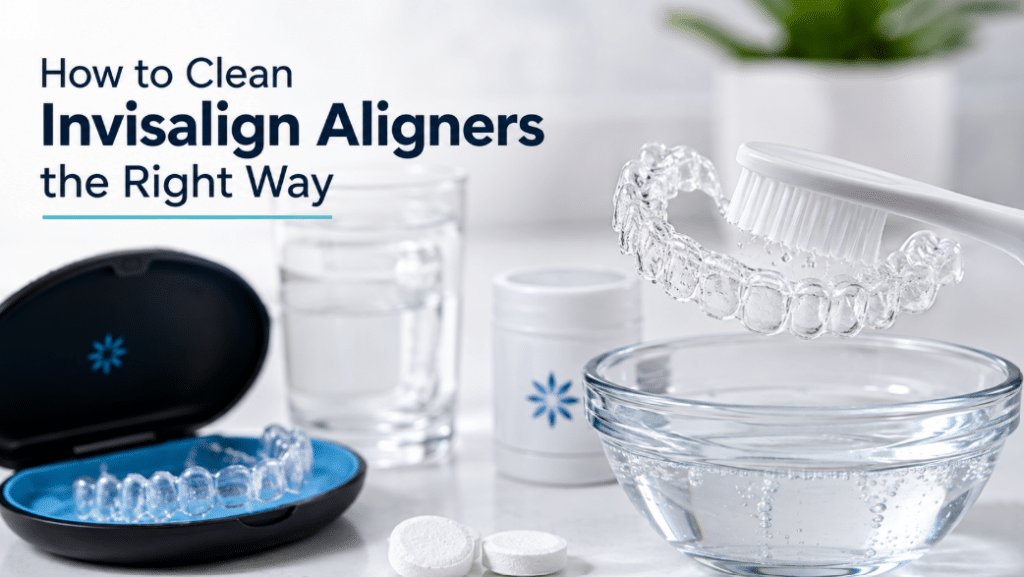
Your Invisalign aligners are designed to stay clear and discreet, but daily use can change that quickly. After wearing them for a while, many patients notice their trays look cloudy, feel less fresh, or develop an odor they did not expect.
This often leads to the same question: Am I cleaning my Invisalign aligners the right way?
Because aligners are removable, it is easy to assume they need less care than your teeth. In reality, they collect saliva, bacteria, and residue throughout the day, which means proper cleaning plays an important role in keeping them clear, comfortable, and fresh during treatment.
Why Cleaning Your Aligners Actually Matters
Your aligners sit against your teeth for roughly 20 to 22 hours a day, which means saliva, food particles, and plaque build up on them just as they would anywhere else in your mouth. Left uncleaned, that buildup can lead to bad breath, a cloudy or yellowed appearance, and a higher risk of decay along the gumline, since the aligner traps bacteria against your teeth rather than letting saliva rinse it away naturally. The American Association of Orthodontists notes that orthodontic appliances create hard-to-reach spaces where plaque and bacteria tend to collect, and that staying diligent with cleaning between visits helps prevent cavities from developing in those areas.
Clear, well-maintained aligners are also part of why many patients choose Invisalign over traditional braces in the first place. Cloudy or visibly dirty trays work against that discretion, which is one more reason cleaning matters beyond hygiene alone.
How Often Should You Clean Your Aligners?
A quick rinse every time you remove your aligners, whether for a meal, a drink, or just to brush your teeth, helps prevent buildup from settling in. Beyond that rinse, a more thorough cleaning once or twice a day is generally recommended, along with a deeper soak once daily to clear out bacteria and odor that brushing alone tends to miss. Recommendations can vary somewhat by provider, so it’s worth confirming the specific routine your dentist suggests for your aligners.
The Right Way to Clean Invisalign Aligners
A simple, consistent routine covers most of what your aligners need.
Rinse: As soon as you take your aligners out, rinse them with lukewarm water to wash away saliva and loose debris before it dries onto the surface.
Brush gently: Use a soft-bristled toothbrush and a clear, unscented antibacterial soap, with light pressure rather than scrubbing, since aligner plastic scratches more easily than tooth enamel.
Soak once a day: Soak the aligners in a cleaning solution made specifically for aligners, typically for about fifteen minutes.
Rinse again: Rinse thoroughly after soaking to remove any residue before the aligners go back in your mouth.
Brush and floss your own teeth first: Do this before reinserting the aligners, so food particles aren’t sealed against your teeth for the next several hours.
Store properly: Keep your aligners in their case any time they’re out of your mouth, rather than wrapped in a napkin or left loose in a bag, where they’re more likely to get lost, damaged, or contaminated.
Official Invisalign Cleaning Crystals dissolve in lukewarm water and are designed specifically for the daily soaking step, without scratching or discoloring the trays. Cleaning your case regularly matters too. A clean aligner placed back into a dirty case picks up bacteria right away, undoing the cleaning you just did.
Can You Brush Aligners With Toothpaste?
It’s best to avoid it. Most toothpaste contains mild abrasives that work well on enamel but are too rough for aligner plastic. Over repeated use, those abrasives create tiny scratches on the surface, which is exactly what makes aligners start looking cloudy or dull over time. A clear, unscented antibacterial soap does the job of cleaning without that abrasive effect, which is why it’s generally recommended over toothpaste specifically for the trays, even though toothpaste is exactly what you should keep using on your actual teeth.
What to Avoid When Cleaning Your Aligners
A handful of common products cause more harm than good here. Hot water can warp the plastic, changing the shape just enough to affect how the aligner fits, which can interfere with your treatment progressing as planned. Colored or scented soaps and dish detergents often contain dyes or fragrances that stain the plastic or leave an unpleasant taste. Mouthwash, particularly colored varieties, can discolor or degrade the material rather than clean it effectively.
Bleach and other harsh household chemicals are too aggressive for aligner plastic and aren’t designed for something you place in your mouth. When in doubt, a milder option is almost always the safer choice, and checking with your dentist before trying a new cleaning product is a reasonable habit to build.
How to Handle Cloudy, Stained, or Smelly Aligners
Cloudiness usually traces back to scratches from an abrasive cleaner, most often toothpaste, or from buildup that’s gone too long without a proper soak. Staining tends to come from colored drinks, coffee, tea, or wine consumed while wearing the aligners rather than removing them first. A persistent smell is almost always a sign of bacterial buildup that a quick rinse alone isn’t reaching.
In each case, returning to a consistent daily soak, along with gentle brushing rather than scrubbing, usually improves things noticeably within a few days. If an aligner stays cloudy, stained, or smells off despite consistent cleaning, it’s worth mentioning to your dentist rather than assuming it will resolve on its own.
How to Keep Aligners Clear Throughout Treatment
Staying ahead of buildup is easier than trying to reverse it later. Removing your aligners before eating or drinking anything other than plain water prevents most staining and food debris from ever reaching the trays. Rinsing immediately after removal, rather than setting them aside for later, keeps saliva and food particles from drying onto the surface.
A consistent daily soak, paired with gentle brushing, handles the rest. Aligners that get this routine from the start tend to stay noticeably clearer through the following weeks than ones that only get attention once they’ve already started looking dingy.
How Aligner Hygiene Connects With Brushing, Flossing, and Oral Health
Cleaning your aligners does not replace normal oral hygiene, and brushing your teeth does not replace cleaning your aligners. Both habits work together.
Brush and floss your teeth before putting your aligners back in. This helps remove food particles that could stay trapped against your teeth for hours. This matters even more with aligners because the trays hold close against the tooth surface.
Skipping either part of your routine, whether cleaning your teeth or your aligners, can lead to the same issues. These include bad breath, a higher risk of decay, and aligners that may need replacement sooner than expected.
Habits That Can Shorten Aligner Lifespan or Affect Their Appearance
Some everyday habits cause more wear and staining than many patients expect. Drinking coffee, tea, wine, or other dark or acidic beverages while wearing aligners is one of the most common issues. Chewing gum can also create problems because it may stick to the plastic and affect the aligner’s shape.
Hot water can warp the material and change the fit, even when used accidentally during cleaning. Skipping daily soaking and only rinsing your trays can also allow odors and cloudiness to build up faster. These habits will not ruin your aligners overnight, but they can affect their appearance and condition over the one to two weeks you wear each tray.
Getting Personalized Guidance From Dr. Pearl Zadeh in Woodland Hills
General cleaning guidelines cover most situations, but your dentist may recommend adjustments based on your specific aligners, your habits, or how your treatment is progressing. As an Invisalign Premier Provider, Dr. Pearl Zadeh walks patients through the care routine that fits their treatment plan during regular check-ins, rather than leaving them to guess. If you’re also weighing cosmetic treatment alongside Invisalign, our comparison of Invisalign and veneers explains how the two fit together.
Keeping your aligners clean is a small daily habit that can make a noticeable difference in comfort, appearance, and your overall Invisalign experience. A simple routine followed consistently is usually enough to keep most common issues under control.
Dr. Pearl Zadeh and her Woodland Hills team can guide you through proper aligner care based on your treatment plan. They can also answer any questions that come up during your Invisalign journey.
Call (818) 716-6722 or click the button below to schedule a consultation online.
1. How often should I clean my Invisalign aligners?
Rinse them every time you remove them, and plan on a full soak and gentle brushing at least once a day. Your dentist can confirm the specific routine that fits your treatment.
2. Can I use toothpaste to clean my aligners?
It’s best to avoid it. Toothpaste is mildly abrasive and can scratch aligner plastic over time, leading to a cloudy appearance. Use a clear, unscented antibacterial soap instead.
3. Why do my aligners smell bad?
A persistent smell usually points to bacterial buildup that rinsing alone doesn’t remove. A consistent daily soak in an aligner-safe cleaning solution typically resolves it within a few days.
4. Can hot water damage my aligners?
Yes. Hot water can warp the plastic enough to affect how the aligner fits, which can interfere with treatment. Always use lukewarm water for rinsing and soaking.
5. Is it normal for aligners to get a little cloudy?
Some patients notice mild cloudiness even with good care. However, significant or fast-developing cloudiness often points to abrasive cleaners or infrequent soaking. Both issues can usually be fixed with better cleaning habits.
This article is for informational purposes only and is not a substitute for professional dental advice. Please schedule a consultation with Dr. Pearl Zadeh to discuss your specific situation.
What Happens If You Stop Wearing Invisalign Early?
Pearl Zadeh DDSInvisalign
Maybe the aligners started rubbing against your cheek, so you took them out one night and meant to put them back in. Then three weeks went by. Maybe your teeth already look pretty straight, so those last few trays sitting in their box feel optional. Or maybe you lost one on a trip, planned to deal with it when you got home, and never quite got around to it.
None of that means your treatment is ruined. It also doesn’t mean nothing happened while you weren’t wearing your aligners. What happens if you stop wearing Invisalign early depends on how long the break lasted, where you were in treatment, and what your teeth are doing now.
There isn’t one answer for every situation. There is, however, a sensible way to figure out what your next step should be.
What Counts as Stopping Early?
This covers more situations than people expect. Some patients stop after three or four aligners. Others make it halfway through treatment and lose momentum. Some wear their trays inconsistently without ever making a conscious decision to quit.
A few days without an aligner after losing one is very different from putting the rest of your trays in a drawer. Both interrupt treatment, but the circumstances aren’t remotely the same.
A missed afternoon isn’t the same as three weeks without your aligners. There isn’t one exact cutoff where a short break suddenly becomes serious. The impact depends on your treatment stage and how your teeth have responded.
What matters is being honest about what happened. Your dentist needs that information to know what makes sense next.
What Actually Happens If You Stop Wearing Invisalign Early
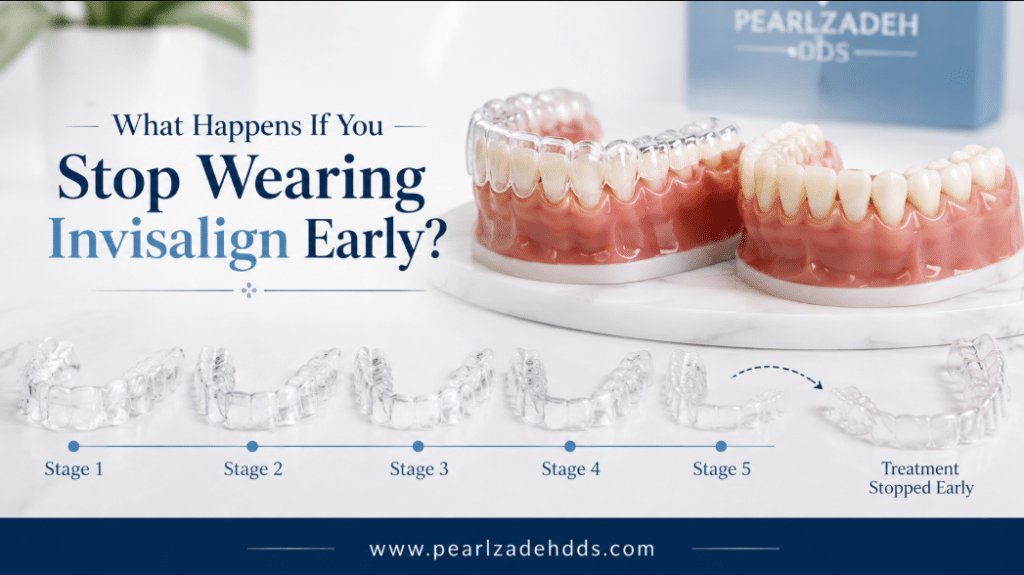
Each aligner in your series is designed to move your teeth toward a specific position before the next one takes over. Stop partway through, and some of those planned movements may remain incomplete.
Some teeth may end up close to their intended positions. Others may not move as far as planned, especially when treatment involves rotations or more complex movements. A bite correction that was still in progress may also remain unfinished.
The result may not match the treatment plan your dentist originally created. Depending on how long you stop and how much your teeth shift, getting treatment back on track may also require additional time or aligners.
None of this happens instantly, and it doesn’t happen the same way for every patient. Invisalign’s resources on retainers explain why teeth can shift after orthodontic movement. The tissues supporting your teeth need time to adapt to their new positions, which is one reason retention matters after active treatment.
Active treatment moves your teeth toward their planned positions. Retention helps maintain those positions afterward. If you stop active treatment early, you may be stopping before the planned movements are complete.
If Your Teeth Already Look Straight, Are You Actually Done?
This is one of the more common reasons people stop, and it’s understandable. A smile can look noticeably straighter before treatment is actually finished.
What’s harder to see in the mirror is whether your bite has fully settled. A specific tooth may still need to rotate into position. Small spaces may still need to close. Those last few aligners may also be making smaller adjustments that aren’t obvious from the front.
Sometimes a dentist looks at your progress and agrees you’re genuinely finished early. That’s a legitimate outcome. The difference is that it’s a decision made after an evaluation, not a guess made in a bathroom mirror.
If you feel like you’re finished, bring it up with your dentist. It’s better to confirm you’re done than quietly decide to stop on your own.
A Few Days Off Versus a Few Weeks Off
A short gap, such as missing a day or two, doesn’t necessarily mean your treatment is off track. What matters is what happened during that break and where you were in treatment.
Your dentist may consider which aligner you were wearing, how long you went without it, and whether the tray still fits comfortably. They may also want to know whether your teeth feel different or whether the aligner now feels tighter or looser.
Don’t assume you should jump ahead to the next aligner. Don’t assume you should simply keep wearing the same one either. A quick call to your dentist’s office can give you a specific answer based on your situation.
A gap lasting weeks or months is a different situation. Your last aligner may no longer fit properly if your teeth have shifted during the break. The original sequence may also no longer match your current tooth positions.
Your dentist may need new scans to assess where things stand. From there, you may be able to continue with existing aligners, need replacements, or receive additional aligners based on an updated plan.
A longer break doesn’t automatically mean starting treatment from scratch. The next step depends on what your teeth look like when your dentist evaluates them.
Should You Just Put Your Old Aligner Back In?
Not without checking first. An aligner that fit perfectly two months ago may feel tight or uncomfortable if your teeth have shifted since then. It may also no longer fit the way your dentist intended.
Don’t force a tray that no longer fits properly. It may not be the right way to bring your treatment back on track.
Whether you should continue with your current aligner, return to an earlier one, get a replacement, or have new scans depends on your current tooth positions.
That’s something your dentist should determine after evaluating your teeth. It’s better to check than to make the decision yourself at the bathroom sink.
If Discomfort Is Why You Stopped
Some pressure or mild soreness can occur when you start wearing a new aligner. That usually reflects the pressure needed to move your teeth.
Sharp pain, an edge cutting into your cheek or gum, or discomfort that doesn’t improve deserves a closer look. You don’t need to push through significant or persistent discomfort just to stay on schedule.
Your dentist can check whether the problem comes from normal tooth movement, an irritating aligner edge, poor fit, an attachment issue, or another dental concern. Once they know what’s causing the discomfort, they can tell you what to do next.
If a Lost Aligner Is What Started This
Losing a tray happens more often than people admit. It usually happens somewhere between a gym bag, a restaurant napkin, and a dog that got to it first.
The instinct to wing it isn’t a great one. Wearing the previous aligner longer or skipping ahead to the next tray may not be appropriate for your situation.
The right next step depends on where you were in the sequence and how your teeth have been tracking. Calling the dental office sooner rather than later can help prevent a lost aligner from turning into a longer treatment break.
Can You Restart After Stopping?
Often, yes. However, restarting isn’t always as simple as picking up the next tray.
Your treatment plan was built around where your teeth were expected to move at each stage. That plan assumes you’ll wear the aligners consistently.
After a longer interruption, your current tooth positions may no longer match the original sequence. Some patients can resume with their existing aligners once their dentist confirms the fit.
Others may need new scans and additional aligners based on their current tooth positions.
Either way, restarting should begin with an evaluation rather than an assumption.
Does This Add to Your Treatment Time?
It can, though not automatically and not always by much. Extra aligners, a round of refinements, new scans, or an adjusted treatment plan can all add time after an interruption.
A short gap that gets addressed quickly may have little effect on the overall timeline. A longer break can take more time to correct if your teeth have shifted significantly.
There’s no fixed amount of extra time that applies to everyone. The impact depends on how long you stopped, where you were in treatment, and how your teeth have changed.
What About Your Bite?
Invisalign treatment often addresses more than how your teeth look. Your bite, or how your upper and lower teeth meet, may also be part of the treatment plan.
If you stop before those planned movements are complete, your bite may not reach the position your dentist originally planned. Your smile can look straight while some bite adjustments still need work.
That doesn’t automatically mean you’ll develop a serious bite problem. It simply means the functional part of your treatment may remain incomplete.
Refinements Aren’t the Same Thing as Stopping Early
These two situations can sound similar, but they’re quite different.
Refinements happen after a patient completes their planned aligners and still needs additional adjustments to reach the intended result. That’s a normal part of treatment for many patients and doesn’t mean anything went wrong. Our page on Invisalign refinements explains the process in more detail.
Stopping early is different. It means the original treatment sequence wasn’t completed before the patient stopped wearing the aligners.
What About Just Switching to a Retainer?
A retainer holds teeth in their current position. It isn’t designed to complete unfinished tooth movement.
If you stop active Invisalign treatment early and switch to a retainer on your own, you may be trying to hold teeth before they reach the positions planned for them. That’s why it’s worth speaking with your dentist before making that change.
If you’re considering stopping Invisalign and switching to a retainer, talk with your dentist first.
Why Skipping the Next Appointment Actually Matters
Check-in appointments give your dentist a chance to see how treatment is progressing. They can compare your current tooth positions with the treatment plan, check the fit of your aligners, and evaluate your bite and attachments.
If you’ve fallen behind on your wear schedule, don’t skip the appointment because you’re embarrassed. Your dentist needs to know what happened to decide whether your current plan still fits your situation.
Being upfront can make it easier to address a problem before you spend even longer off track.
Why People Actually Stop
Discomfort. Forgetting until it becomes a habit. Travel that throws off the routine. A demanding stretch at work or school. Feeling self-conscious in a particular social situation.
Sometimes it’s losing a tray and putting off the call to the dental office. Other times, patients get tired of cleaning their aligners or simply feel their smile already looks finished.
None of these reasons are unusual. More importantly, none are reasons to hide what’s happened from your dental team. Your dentist needs the full picture to help you decide what to do next.
If You’ve Already Stopped, Here’s What to Actually Do
If you’ve already stopped wearing your aligners, don’t try to fix everything yourself. Start with these steps:
Don’t panic. A treatment break doesn’t automatically undo all your progress.
Don’t force an old aligner back in if it no longer fits comfortably.
Don’t guess which tray to wear next.
Note roughly how long you’ve gone without wearing your aligners.
Contact your dentist and explain what happened.
Bring your current and previous aligners if your dentist asks you to come in.
Follow the updated instructions your dentist gives you.
The more information your dentist has, the easier it is to decide what should happen next.
When to Actually Call Your Dentist
Some situations are worth contacting your dentist about sooner rather than later:
An aligner no longer fits properly
You’ve gone an extended period without wearing your aligners
You’ve lost a tray
You’re experiencing significant or persistent pain
Your bite suddenly feels different
You can see that your teeth have shifted
You’re unsure which aligner you should wear next
Other questions can usually wait until your next scheduled visit. For example, you may simply want to discuss your progress or ask whether you’re close to finishing treatment.
Not every interruption needs a same-day call. If you’re unsure what category your situation falls into, asking your dental office is a reasonable next step.
Speak With Dr. Pearl Zadeh About Your Invisalign Treatment
What happens after stopping Invisalign early depends on where your treatment stands and how your teeth have changed. Stopping early doesn’t mean everything you’ve accomplished is wasted, and it shouldn’t stop you from reaching out for help.
Dr. Pearl Zadeh, an Invisalign Premier Provider, can evaluate your current tooth positions and bite and explain what makes sense from there. Learn more about Invisalign in Woodland Hills, or reach out to discuss your treatment.
Call (818) 716-6722 or click the button below to schedule a consultation online.
1. What happens if I stop wearing Invisalign for a few days?
A short gap usually isn’t serious, but the right next step depends on which aligner you were on and how your teeth feel now. Contact your dentist rather than guessing.
2. Can I restart Invisalign after stopping?
Often, yes. Your dentist evaluates your current tooth positions first, since a longer break can mean your existing aligners no longer match where your teeth actually are.
3. Will my teeth move back if I stop Invisalign early?
They can, though how much varies by patient. Teeth aren’t fully stable in a new position until the surrounding gum and bone tissue has time to adjust.
4. Can I wear my old Invisalign aligners after stopping treatment?
Maybe, but check with your dentist first. An aligner that fit before a break may not fit correctly anymore, and forcing it on can cause unnecessary discomfort.
5. Do I need refinements if I stop Invisalign early?
Not necessarily. Refinements are extra aligners used after completing an original series to fine-tune results. Stopping early is a different situation and may call for a different solution, decided after an evaluation.
This article is for informational purposes only and is not a substitute for professional dental advice. Please schedule a consultation with Dr. Pearl Zadeh to discuss your specific situation.
6 Reasons Why Invisalign Is The Best Way To Boost Your Confidence
Pearl Zadeh DDSInvisalign
If you’re considering Invisalign to help improve your confidence, you’re not alone. In fact, Invisalign is one of the most popular orthodontic treatments available today. Here are just a few reasons why Invisalign is the best way to boost your confidence:
Invisalign is practically invisible.
Invisalign is comfortable.
Invisalign treatment is quick and easy.
If you’re looking for a way to boost your confidence and improve your smile, Invisalign is the perfect solution. Contact your orthodontist today to learn more about this life-changing treatment option!
Reasons Why Invisalign Is the Best Way to Boost Your Confidence
If you are considering Invisalign to help boost your confidence, there are many reasons why this treatment is the best way to achieve your goal. Invisalign is an excellent choice for those who want to improve their smile without anyone knowing they are undergoing treatment. The clear aligners are virtually invisible, so no one will be able to tell that you are wearing them. Additionally, Invisalign is a very effective treatment and can produce amazing results. You will be amazed at how much your confidence will increase once you see the final results of your treatment!
Appearance
Invisalign is the best way to boost your confidence because it is practically invisible. You can wear them while you are out and about, and no one will be able to tell that you are wearing them. This is a huge advantage over traditional braces, which can be very noticeable. With Invisalign, you can feel confident that your smile will look great, without anyone knowing that you are wearing aligners.
Comfort
If you’re not happy with your smile, Invisalign clear aligners can help. With Invisalign, you can achieve the smile you’ve always wanted without metal braces. Invisalign is also more comfortable than braces, and they won’t irritate your gums or cheeks like metal brackets can. And since they’re practically invisible, nobody will even know you’re wearing them!
Healthier Teeth and Gums
If you’re looking for a way to boost your confidence and improve your oral health, Invisalign is the perfect solution. Invisalign aligners are made of smooth, clear plastic that’s gentle on your teeth and gums. This means that you’re less likely to experience gum irritation or other problems associated with traditional metal braces.
It’s easy to keep your teeth and gums clean with Invisalign, as there are no brackets or wires to trap plaque and bacteria. Simply brush and floss as normal, and use the provided cleaning kit to keep your aligners clean.
Cheaper than Traditional Braces
If you’re considering braces, Invisalign is a great option that’s more affordable than traditional braces. Invisalign uses clear, removable aligners that are virtually invisible, so you can feel confident about your smile without worrying about metal wires and brackets.
In addition to being more affordable, Invisalign is also more comfortable than traditional braces. The aligners are made of smooth plastic, so they won’t irritate your gums or cheeks the way metal braces can. And because they’re removable, you can take them out for eating and brushing your teeth, making it easier to keep your mouth clean and healthy.
If you’re looking for a way to boost your confidence and improve your smile without breaking the bank, Invisalign is the way to go.
Easier To Maintain Oral Hygiene
When it comes to oral hygiene, Invisalign is much easier to keep clean than traditional braces. With metal braces, food and plaque can easily get trapped in the brackets and wires, making it difficult to brush and floss properly. This can lead to an increased risk of cavities and gum disease. However, because Invisalign aligners are removable, you can simply take them out before eating and brush and floss as usual. This makes it much easier to maintain good oral hygiene and helps reduce the risk of dental problems down the road.
Improved Self Esteem
Invisalign can help to improve your self-esteem in a number of ways. Firstly, it can give you straighter teeth, which can lead to a more confident smile. Secondly, the treatment is virtually invisible, meaning that you can wear it without anyone knowing and feel confident that your appearance is not being affected. Finally, Invisalign is removable, so you can take it out when you need to and know that your teeth are still being straightened effectively.
Conclusion
Invisalign is an excellent choice for those looking to improve their smile without traditional braces. With its discreet design, convenience, and comfort, Invisalign can boost your confidence in no time. Plus, it’s affordable and easy to maintain! With all these advantages of Invisalign treatment available, there’s really no reason not to give it a try if you’re looking for the perfect way to get that beautiful smile you’ve always wanted.
What Are Invisalign Refinements and Do You Need Them?
Pearl Zadeh DDSInvisalign
You reach the end of your Invisalign treatment plan expecting to see your final smile, but your dentist recommends additional aligners. For many patients, that moment creates the same concern: Why do I need more trays if treatment was supposed to be finished?
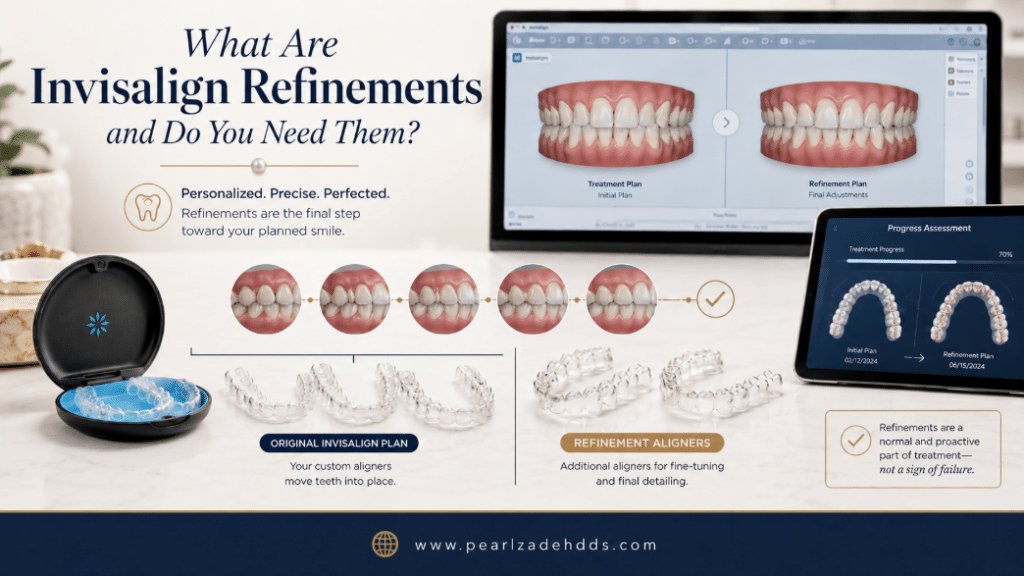
The answer is often simpler than it seems. Invisalign refinements are additional aligners used to fine-tune tooth movement and help achieve the planned result. They do not automatically mean something went wrong or that your original treatment failed.
Teeth do not always move exactly as predicted, and refinements allow your dentist to make adjustments based on how your smile responds during real treatment.
What Are Invisalign Refinements?
Refinements are an additional set, or sometimes a few sets, of aligners created after your original series to fine-tune movements that weren’t fully completed. Rather than starting your treatment over, refinements pick up exactly where your first series left off, targeting only the specific teeth or movements that still need adjustment.
Why Would You Need Invisalign Refinements?
Invisalign treatment plans are built from a digital prediction of how your teeth should move over the course of treatment. That prediction is detailed and generally reliable, but it’s still a prediction, and real teeth don’t always move in a perfectly straight line toward the planned result. Certain movements, particularly rotating a tooth or shifting it vertically, tend to be harder for aligners to execute with full precision compared to simpler tipping movements.
Some teeth respond a little slower than expected, or an attachment, the small tooth-colored bump that helps an aligner grip a tooth, loosens partway through treatment. Any of these can leave a small gap between where your teeth were supposed to land and where they actually landed, which is exactly what refinements are designed to close.
Do Refinements Mean Your First Treatment Failed?
No. It’s worth saying directly, since this is the assumption that causes the most unnecessary worry. Refinements address the natural gap between a digital prediction and biological reality, not a mistake in your original treatment plan. Many providers factor the likelihood of refinements into their planning from the start, treating them as an expected part of achieving a precise result rather than an exception that signals something went wrong.
How Common Are Invisalign Refinements?
Quite common. A retrospective study published in the American Journal of Orthodontics and Dentofacial Orthopedics, which reviewed records from 500 Invisalign patients, found an average of about two and a half Invisalign refinement scans per treatment. Needing one or more rounds of refinement is a routine part of the process for a large share of patients, particularly those with more complex starting alignment or movements that are naturally harder for aligners to complete precisely.
The same study found that about one in six patients ultimately switched from Invisalign to braces to complete treatment, which is worth knowing as one possible outcome in cases where aligners alone aren’t fully closing the remaining gap.
How Dentists Decide Whether Refinements Are Necessary
Near the end of your original aligner series, your dentist compares your current tooth positions against the plan’s intended final result. If everything landed where it was supposed to, no refinement is needed.
If certain teeth still need a bit more movement, whether that’s a small rotation, a remaining gap, or a bite relationship that isn’t quite settled, your dentist recommends refinement aligners to close that specific gap. This decision is based on a direct comparison between plan and reality, not a general guess.
When Do Refinements Usually Happen During Treatment?
Dentists most often order refinements near the end of your original aligner series. This usually happens after you complete the full set and your dentist can evaluate your progress.
In some cases, your dentist may recommend refinements earlier if your teeth are not tracking as planned. Starting adjustments sooner can help move treatment closer to your desired outcome instead of continuing with an ineffective sequence.
What Happens During the Refinement Process
The process begins with new digital scans or impressions of your current tooth position. Your dentist compares these results with your original treatment goals. They then create a shorter digital plan that focuses only on the remaining movements.
The new plan goes to the aligner manufacturer, and your dentist receives the refinement trays after production. Once they arrive, you wear the new aligners on the same schedule as your original set. Most patients wear them around 20 to 22 hours a day and switch trays as directed.
How Many Additional Aligners Might You Need, and How Long Does It Add to Treatment?
The number of refinement aligners varies by case. Some patients need only a few additional trays to adjust one or two teeth. Others with more complex movements may need a longer refinement series or, in some cases, multiple rounds. Refinements often add a few weeks to several months to treatment, depending on the number of aligners needed and how consistently you wear them. Although refinements extend the timeline, they are usually shorter than the original treatment phase because they focus only on remaining adjustments.
Do Invisalign Refinements Cost Extra?
The cost of refinements depends on your treatment plan and provider agreement. According to Invisalign’s provider resources, some treatment packages include additional aligners within a specific timeframe after the original treatment begins. Other refinements, especially those requested after treatment has ended, may require an additional fee. The best way to understand your coverage is to ask your dentist how your specific plan handles refinements.
What You Can Control: Wear Time and Regular Check-Ins
Aligner wear time is one of the few variables that’s genuinely in your hands. Wearing your aligners for the recommended 20 to 22 hours a day gives each tray its full intended effect, while removing them too often lets teeth drift back slightly between wears, which can widen the gap between plan and reality over time.
Attending your scheduled check-in appointments matters just as much, since these visits are when your dentist can catch a tooth that isn’t tracking as expected and make adjustments before the issue compounds. If your wear time has been consistent throughout treatment and you still need refinements, that’s simply the nature of how your specific teeth responded, not something to second-guess.
Caring for Your Aligners Through an Extended Treatment Timeline
Needing refinements means wearing aligners for longer than originally expected, which makes good aligner hygiene even more relevant. Our guide to cleaning Invisalign aligners the right way covers the daily routine that keeps trays clear and comfortable, which matters just as much for refinement aligners as it did for your original set.
Can Refinements Fix Remaining Gaps or Crooked Teeth?
Getting Personalized Guidance From Dr. Pearl Zadeh in Woodland Hills
As an Invisalign Premier Provider, Dr. Pearl Zadeh monitors treatment progress closely throughout each stage, so if refinements become part of your plan, you understand exactly why before moving forward. You can learn more about Invisalign treatment in Woodland Hills directly, and her background and treatment philosophy centers on explaining realistic expectations at every stage rather than leaving patients guessing why an extra step was added.
Schedule a Consultation With Dr. Pearl Zadeh
Needing refinements does not automatically mean something went wrong with your Invisalign treatment. In many cases, it’s simply the last step in getting your smile exactly where the original plan intended.
Dr. Pearl Zadeh and her Woodland Hills team can evaluate your Invisalign progress, explain whether refinements may be needed, and help you understand the next steps for your smile.
Call (818) 716-6722 or click the button below to schedule a consultation online.
Refinement aligners are additional trays created after your original series. They fine-tune tooth movements that need further adjustment using updated scans of your current tooth positions.
2. Are Invisalign refinements normal?
Yes. Needing one or more rounds of refinement is common and doesn’t indicate that your original treatment plan failed.
3. Does everyone need Invisalign refinements?
No. Some patients finish their original aligner series with no further adjustments needed, while others, particularly with more complex cases, may need one or more refinement rounds.
4. How long do Invisalign refinements take?
Your total treatment time depends on your specific case. Refinements often add a few weeks to several months, depending on the number of additional aligners you need.
5. Are refinement trays included with Invisalign?
Often, yes, depending on your specific treatment package and timing, though this varies by provider agreement. Ask your dentist directly about how your plan handles refinements.
This article is for informational purposes only and is not a substitute for professional dental advice. Please schedule a consultation with Pearl Zadeh DDS to discuss your specific situation.
Can Invisalign Close Gaps Between Teeth? What to Expect
Pearl Zadeh DDSInvisalign
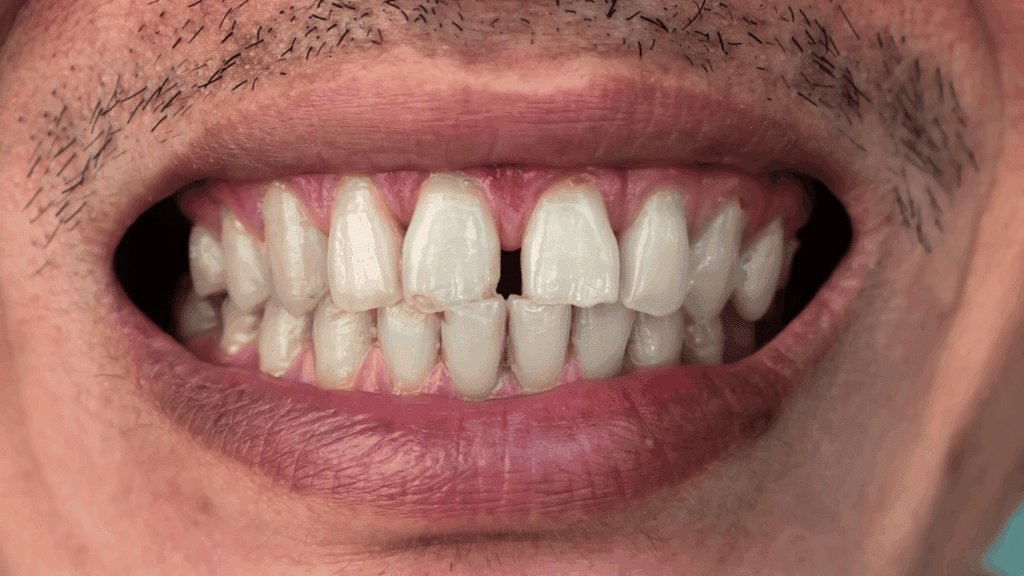
Gaps between teeth are common, and many people want to close them for both appearance and function. Invisalign is often considered for this purpose because it moves teeth gradually without metal brackets. But the real question is whether it actually works for spacing issues and what the process feels like in practice.
The short answer is yes. Invisalign can close many types of gaps. However, the outcome depends on the size of the spaces, the position of your teeth, and how consistently you wear the aligners.
Let’s look at how it works and what you should realistically expect.
How Invisalign actually closes gaps
Invisalign works by applying gentle, controlled pressure through a series of clear aligners. Each aligner makes small adjustments, and those changes build up over time.
When closing gaps, teeth do not move straight across in one step. Instead, the process is gradual and controlled:
Teeth slowly drift toward each other as space reduces.
The angle of certain teeth may shift so they sit more naturally in line.
In some cases, the overall arch is adjusted slightly to balance spacing across the smile.
Every movement is planned in advance using a digital scan of your teeth. This allows the dentist to map out where each tooth should move and how long each stage will take.
Why gaps form in the first place
Not all spacing issues have the same cause, and this affects treatment results.
Some gaps appear because teeth are naturally smaller than the jaw. Others develop after teeth shift over time due to bite pressure or missing teeth. In some cases, previous orthodontic treatment may have allowed spacing to return.
When the cause is simple crowding or minor size differences, Invisalign usually handles it well. When spacing is linked to missing teeth or bite imbalance, additional treatment may be needed alongside aligners.
Types of gaps Invisalign can improve
Invisalign is commonly used for:
Front tooth gaps that affect appearance
Small to moderate spacing across several teeth
Shifting that happens after braces or retainers are stopped
Uneven spacing caused by mild alignment issues
Larger gaps can also improve, but they often take longer and may require attachments or elastic bands to guide movement more precisely.
In cases where a tooth is missing, Invisalign alone will not replace it. Instead, the space may be prepared for a future implant or bridge.
What the treatment process feels like
Treatment begins with a scan or impression of your teeth. This creates a 3D model that shows how your teeth will move over time. Once the plan is approved, a series of aligners is made specifically for your mouth.
Each aligner is worn for about one to two weeks. You remove them only when eating, drinking anything other than water, and brushing your teeth. Most of the day, they stay in place to keep pressure consistent.
At first, each new set of aligners can feel tight. That pressure is a normal sign that teeth are responding. It usually settles after a couple of days.
Some people also notice a slight change in speech during the first week, but this typically improves quickly as the tongue adapts.
How long it takes to close gaps
The timeline depends mainly on how wide the gaps are and how consistently the aligners are worn.
Small gaps between front teeth may start to show change within a few weeks. More noticeable improvement often appears within two to three months. Full treatment can take anywhere from several months to over a year.
Wear time matters more than most people expect. Aligners need to stay in for 20 to 22 hours a day. When they are removed too often or for long periods, teeth slow down and gaps take longer to close.
What changes during treatment
As gaps begin to close, small changes become noticeable in daily life.
Teeth may feel slightly different when biting, especially after switching to a new aligner. Some aligners may feel tighter than others depending on which teeth are moving at that stage.
Cleaning also becomes more important. Food can still get trapped easily between shifting teeth, so brushing and flossing help keep gums healthy during the process.
Where Invisalign has limits
Invisalign can handle many spacing issues, but it does have boundaries.
Very large gaps caused by missing teeth usually need additional dental work. Severe bite problems may also require combined treatment to achieve stable results.
Success also depends on consistency. If aligners are not worn as directed, teeth can move unpredictably, which affects how well gaps close.
A proper assessment is important before starting so the treatment plan matches the actual condition of the teeth.
After gaps close
Once spacing is corrected, teeth still need support to stay in position. Without it, they can slowly shift back over time.
This stage is just as important as the active treatment phase because it helps keep the results stable long-term.
Find Out If Invisalign Can Close Your Teeth Gaps
Invisalign can close many types of gaps effectively, especially when spacing is mild to moderate and the treatment plan is followed closely. The process is steady rather than instant, and changes build gradually over time.
The key factor is not just the aligners themselves, but how consistently they are worn and how well the treatment is planned from the start.
At Pearl Zadeh DDS, we assess your teeth carefully, plan each movement with precision, and guide you through every stage of Invisalign treatment so your results stay predictable and stable. Call (818) 716-6722 or click the button below to schedule your consultation online.
1. Can Invisalign really close gaps between teeth?
Yes, Invisalign can close many types of gaps by gradually moving teeth closer together. It works best for small to moderate spacing, especially when the teeth and gums are otherwise healthy.
2. How long does it take to close gaps with Invisalign?
Smaller gaps may start improving within a few weeks, while more visible changes often show within two to three months. Full treatment usually takes several months, depending on the size of the gaps and how consistently aligners are worn.
3. Will Invisalign work if I have a large gap?
Invisalign can still help with larger gaps, but treatment may take longer and sometimes requires additional tools like attachments or elastics. In cases involving missing teeth, other dental treatments may be needed alongside aligners.
4. Is Invisalign uncomfortable when closing gaps?
Most people feel mild pressure when switching to a new set of aligners. This is normal and usually fades after a few days as the teeth adjust to their new position.
5. Do gaps come back after Invisalign treatment?
They can shift back if retainers are not used. That’s why retainers are essential after treatment to keep teeth in their new position and maintain the results over time.
Invisalign for Mild vs Severe Cases. What’s the Difference?
Pearl Zadeh DDSInvisalign
When people hear the word “Invisalign,” they often assume it works the same way for everyone. In reality, Invisalign treatment can look very different depending on how mild or severe the orthodontic issue is.
A patient with slight crowding may only need a few months of aligners. Meanwhile, someone with major bite problems or significant tooth movement may require attachments, refinements, rubber bands, or even a combination of treatments.
That’s why understanding the difference between mild and severe Invisalign cases matters before starting treatment.
In this article, we’ll break down how Invisalign works for different levels of dental misalignment, what changes during treatment, and when clear aligners may or may not be the best option.
What Is Considered a Mild Invisalign Case?
A mild Invisalign case usually involves small cosmetic or alignment issues that do not require major tooth movement.
These cases are generally simpler because the teeth only need limited adjustments.
Common Mild Cases Include:
Slight crowding
Small gaps between teeth
Minor relapse after braces
Mild crookedness
Small rotations
Slight overlap of front teeth
For example, someone who had braces years ago but stopped wearing their retainer may notice one or two front teeth shifting. Invisalign can often correct that type of problem relatively quickly.
Mild cases are usually easier to predict because the aligners do not need to move teeth over long distances or significantly change the bite.
What Is Considered a Severe Invisalign Case?
Severe Invisalign cases involve more complex orthodontic problems that affect both appearance and function.
These patients often need substantial tooth movement, bite correction, or jaw coordination.
Common Severe Cases Include:
Significant crowding
Large gaps
Deep overbite
Severe overbite
Underbite
Crossbite
Open bite
Teeth rotated at difficult angles
Teeth positioned high or low in the gums
Complex bite misalignment
In severe cases, the orthodontist must carefully plan how every tooth moves throughout treatment. Since aggressive tooth movement increases complexity, treatment often takes longer and may require additional tools.
However, Invisalign technology has improved dramatically over the years. Many cases that once required traditional braces can now be treated successfully with clear aligners.
The Biggest Differences Between Mild and Severe Invisalign Cases
Although both types of patients wear clear aligners, the treatment process can be very different.
Here are the major differences.
1. Treatment Time
Treatment duration is one of the clearest differences between mild and severe Invisalign cases.
Mild Cases
Mild Invisalign cases may take:
3 to 6 months
Sometimes up to 9 months
These treatments focus on smaller cosmetic adjustments, so fewer aligners are needed.
Severe Cases
Severe cases often take:
12 to 24 months
Sometimes longer for highly complex bites
More tooth movement means more aligners, more monitoring, and more refinements.
Additionally, severe cases may require multiple phases of treatment.
2. Complexity of Tooth Movement
Mild cases usually involve straightforward movements.
For example:
Slight tilting
Small rotations
Closing minor gaps
Severe cases require much more advanced biomechanics.
These movements may include:
Moving teeth vertically
Expanding dental arches
Correcting bite alignment
Rotating stubborn teeth
Shifting molars
Coordinating upper and lower arches
Some tooth movements are naturally harder for aligners to achieve. As a result, severe cases often need extra features to improve control.
3. Attachments and Accessories
Many patients do not realize Invisalign treatment often includes small accessories.
Mild Cases
Some mild cases may need few or no attachments.
Attachments are tiny tooth-colored bumps bonded to the teeth. They help aligners grip teeth more effectively.
Severe Cases
Severe cases commonly require:
Multiple attachments
Precision cuts
Elastics (rubber bands)
Refinement trays
Interproximal reduction (slight enamel reshaping)
These tools help guide difficult tooth movements more accurately.
For example, rubber bands may help correct bite problems that aligners alone cannot fully manage.
4. Predictability of Results
Mild cases tend to be more predictable because there are fewer complex movements involved.
If patients wear their aligners consistently, treatment usually progresses smoothly.
Severe cases carry a higher chance of adjustments during treatment.
Even with advanced digital planning, teeth do not always move exactly as expected. Some teeth respond slower than others. Because of that, patients with severe cases often need:
Mid-treatment refinements
Additional aligners
Treatment extensions
That does not mean Invisalign failed. Instead, it reflects the biological reality of complex tooth movement.
5. Cost Differences
In general, severe Invisalign cases cost more than mild cases.
That happens because:
Treatment lasts longer
More aligners are required
More appointments are needed
Case planning becomes more complex
Mild Cases
Mild cases may qualify for:
Invisalign Express
Invisalign Lite
These systems use fewer trays and shorter treatment timelines.
Severe Cases
Complex cases typically require comprehensive Invisalign treatment.
The exact cost depends on:
Case difficulty
Provider experience
Geographic location
Treatment length
Additional procedures
Can Invisalign Treat Severe Cases Effectively?
Yes. In many situations, Invisalign can successfully treat severe orthodontic problems.
Modern Invisalign systems use:
Advanced 3D imaging
SmartTrack material
Precision attachments
Digital treatment planning
These improvements have expanded the range of treatable cases significantly.
However, success depends heavily on the provider’s skill and the patient’s compliance.
An experienced Invisalign provider understands how to sequence tooth movement properly and recognize when aligners alone may not be enough.
When Braces May Still Be Better
Although Invisalign works well for many patients, traditional braces still have advantages in certain severe cases.
Braces may be recommended when patients have:
Severe jaw discrepancies
Impacted teeth
Major skeletal issues
Extreme rotations
Significant vertical movement needs
In some situations, orthodontists combine Invisalign with other treatments for better outcomes.
For example:
Invisalign plus elastics
Invisalign before jaw surgery
Limited braces combined with aligners
The goal is not simply choosing the “invisible” option. The goal is achieving a healthy, stable bite and long-term dental health.
Compliance Matters More in Severe Cases
One of the biggest challenges with Invisalign is patient compliance.
Unlike braces, Invisalign trays are removable.
Patients should typically wear aligners:
20 to 22 hours daily
Mild cases may still progress reasonably well even with occasional lapses.
Severe cases are far less forgiving.
If patients frequently remove aligners or fail to wear them consistently, treatment can:
Stall
Become less predictable
Require refinements
Take significantly longer
That is why orthodontists carefully evaluate whether a patient is a good candidate before recommending Invisalign for complex cases.
What Patients Often Misunderstand About “Severity”
Many people assume severe cases always look worse cosmetically.
That is not always true.
Sometimes a patient with relatively straight teeth may still have a serious bite problem that requires complex correction.
Meanwhile, another patient with visibly crooked teeth may actually have a simpler orthodontic case.
Severity depends on more than appearance alone.
Orthodontists evaluate:
Bite relationship
Tooth position
Jaw alignment
Bone support
Spacing
Crowding
Tooth rotation
Facial balance
That is why professional evaluation matters before choosing treatment.
How Orthodontists Determine Invisalign Complexity
During a consultation, providers usually perform:
Digital Scans
3D scans help map tooth positions precisely.
Bite Analysis
The orthodontist examines how upper and lower teeth fit together.
X-Rays
X-rays reveal roots, bone levels, and hidden dental concerns.
Treatment Simulation
Invisalign software creates a digital movement plan that predicts how teeth may shift over time.
This planning process helps determine whether the case is mild, moderate, or severe.
Are Severe Invisalign Cases More Uncomfortable?
Not necessarily, but they can involve more pressure during certain stages.
As aligners create larger movements, patients may notice:
Increased tightness
Soreness after tray changes
Temporary speech adjustments
More attachment-related irritation
Still, many patients find Invisalign more comfortable than traditional braces overall because there are no metal brackets or wires rubbing against the cheeks.
Long-Term Retention Is Important for Every Case
Whether the case is mild or severe, teeth can shift after treatment without proper retention.
Most patients need retainers after Invisalign.
Severe cases may carry a slightly higher relapse risk because the teeth underwent larger movements.
Orthodontists often recommend:
Nighttime retainers
Long-term retention plans
Regular monitoring
Retention protects the investment patients made in their smile.
Choosing the Right Invisalign Treatment
Invisalign treatment varies from person to person. Mild cases may require shorter treatment and simpler adjustments, while severe cases often involve longer timelines and more detailed planning.
The best way to understand your options is through a professional evaluation. A personalized treatment plan helps determine whether Invisalign is the right fit for your smile and long-term goals.
If you’re considering Invisalign and want to find out which treatment approach is right for your smile, call (818) 716-6722 or click the button below to schedule your consultation online.
Yes, Invisalign can treat many severe crowding cases. However, some patients may still need tooth extraction, enamel reduction, or additional orthodontic techniques depending on the amount of crowding.
2. Does severe Invisalign treatment hurt more?
Severe cases may involve stronger pressure during certain aligner stages, but discomfort is usually temporary and manageable.
3. Is Invisalign slower than braces for severe cases?
Sometimes. Certain tooth movements may progress faster with braces, especially highly complex movements. However, Invisalign technology has improved significantly for advanced cases.
4. Can mild Invisalign cases skip attachments?
Some mild cases may not need attachments, although many patients still benefit from them for improved precision.
5. How do I know if my Invisalign case is severe?
Only a dental professional can determine case complexity after evaluating your bite, tooth position, jaw alignment, and treatment goals.