Pearl Zadeh DDS

Category: Invisalign

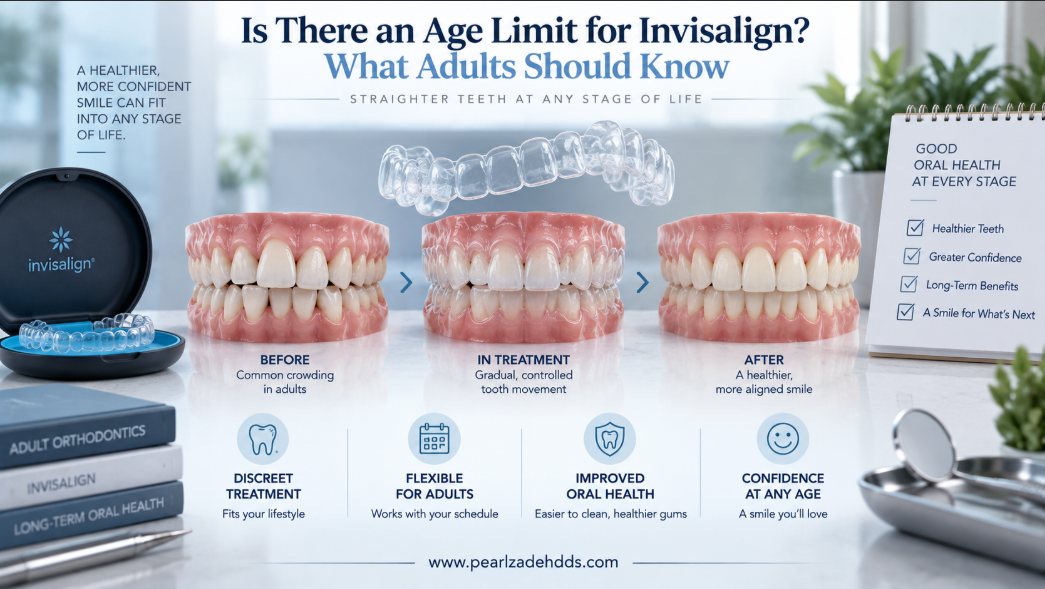
  • Is There an Age Limit for Invisalign? What Adults Should Know

    Is There an Age Limit for Invisalign? What Adults Should Know

    You’ve thought about straightening your teeth for years, and now you wonder if you waited too long. Maybe you’re in your 40s, 50s, or 60s and assume Invisalign suits younger patients with healthy, straightforward mouths. Maybe you had braces decades ago and your teeth have shifted since then. Or perhaps you never addressed crowding that has bothered you throughout adulthood.

    There isn’t a simple upper age cutoff for Invisalign. Adults can potentially receive treatment later in life, and age by itself doesn’t determine whether you’re a candidate. What actually matters is your oral health, tooth stability, gum health, bone support, bite concerns, and treatment goals. Those factors, not your birth year, are what a provider actually looks at.

    Is There an Age Limit for Invisalign?

    Invisalign is used for adults just as often as younger patients, and being older doesn’t automatically rule out treatment. The real question isn’t about a specific birthday. It’s about whether your teeth and the tissues supporting them can safely undergo the kind of movement Invisalign involves. There’s no universal maximum age written into how the treatment works or how providers evaluate candidates.

    Teeth remain capable of moving throughout adult life, since the bone surrounding each tooth continuously remodels in response to steady pressure, the same biological process that allows orthodontic movement to work at any age in the first place. What changes over decades isn’t that ability itself. It’s the surrounding conditions: whether gum disease has affected the bone supporting your teeth, whether decades of wear or previous dental work have altered how your teeth actually fit together, and whether any of that needs attention before orthodontic movement makes sense. Those are individual clinical questions, not automatic disqualifiers tied to a particular age.

    Can You Get Invisalign in Your 40s, 50s, or 60s?

    Often, yes, depending on your specific situation. Adults commonly seek treatment later in life for crowded teeth, spacing that’s opened up over the years, certain bite problems, teeth that have gradually shifted, or relapse after orthodontic treatment they had decades earlier. The reasons tend to shift somewhat by life stage. Patients in their 40s often notice teenage orthodontic work slowly relapsing after years without a retainer. Patients in their 50s and 60s more often bring in decades of gradual shifting, wear, or spacing that developed without any prior treatment at all, sometimes alongside restorations placed years earlier that now factor into planning. Not every bite problem can be corrected with Invisalign, though, and whether it’s the right fit depends entirely on your individual case rather than which decade of life you’re in.

    What Matters More Than Your Age?

    A handful of clinical factors matter more than how old you are.

    Healthy Gums

    Active gum disease may need attention before orthodontic treatment starts, since teeth need healthy supporting tissue to move safely and predictably. Our discussion of early signs of gum disease covers what to watch for if you’re unsure where your gum health currently stands.

    Stable Teeth and Supporting Bone

    Teeth need adequate bone support underneath them to handle the gradual pressure orthodontic movement applies. When that supporting bone has been reduced, whether from past gum disease, bone loss, or other factors, a tooth can become more mobile than it should be, which changes what’s safe to attempt. There’s no specific bone-density number that determines candidacy on its own. This is something your provider evaluates directly, often with imaging that shows the bone level around each tooth, rather than something that can be estimated from age alone.

    Cavities and Existing Dental Problems

    Untreated decay or other active dental problems generally need to be addressed before starting orthodontic treatment. Moving a tooth that has an unresolved cavity, a crack, or an infection underneath it can complicate both problems at once, and aligners can make certain areas harder to keep clean if decay is already present. Getting a clean bill of dental health first tends to make the orthodontic phase considerably more straightforward.

    Your Bite and Treatment Goals

    The type and complexity of your bite problem genuinely affects whether Invisalign is the appropriate tool for the job. Our comparison of Invisalign for mild versus more complex cases goes further into how treatment can differ depending on what you’re actually trying to correct.

    Does Invisalign Work Differently as You Get Older?

    Adult treatment tends to involve considerations that simply aren’t relevant for a teenager. Existing dental restorations, current gum health, previous orthodontic treatment, natural tooth wear, bite changes that have accumulated over years, and other dental work that may need attention all factor into planning for adult patients in a way they typically don’t for younger ones. A teenager’s treatment plan usually starts from healthy, unrestored teeth and gums. An adult’s plan more often starts from a mouth with some combination of fillings, a crown or two, and years of normal wear, all of which the provider needs to account for before deciding how teeth can safely move. This doesn’t mean Invisalign becomes less effective with age, and it doesn’t mean older adults automatically need longer treatment. It means the planning process accounts for a more complete dental history.

    Does Invisalign Take Longer for Older Adults?

    Treatment time genuinely varies from person to person, and age alone doesn’t determine how long it takes. What actually influences duration includes how complex the required tooth movement is, your starting bite, how consistently you wear your aligners, missed appointments or interruptions along the way, whether refinements become necessary, and whether any oral-health issues need attention during treatment. A peer-reviewed study examining orthodontic patients over 40 found that greater periodontal bone loss was associated with more irregular tooth positioning and higher orthodontic treatment need, which suggests that gum and bone health, not age by itself, can meaningfully affect how complex a case turns out to be. There’s no fixed timeline that applies to every adult patient.

    Can You Get Invisalign If You Already Have Crowns, Bridges, or Other Dental Work?

    Existing dental work does not automatically rule out treatment, but you should discuss it during your evaluation. Crowns, bridges, fillings, veneers, and previously treated teeth can respond differently to orthodontic pressure than natural teeth. A crown or filling generally moves with the tooth it covers, but the material and bonding method can affect treatment planning. Bridges require more consideration because they connect neighboring teeth. They cannot move independently like a single tooth, which can affect what treatment can achieve in that area.

    The American Association of Orthodontists notes that adults often present with restorations, missing teeth, or periodontal concerns that need to be stabilized before tooth movement begins, which is a genuine difference from most younger patients, whose teeth are typically unrestored. Your provider needs to assess the condition, position, and function of each restored tooth before building a treatment plan around it.

    What About Invisalign After Previous Braces?

    Plenty of adults had braces as teenagers and later noticed their teeth shifting, often after retainer use stopped years ago. Teeth don’t stay locked in place forever after braces come off. Natural forces from chewing, tongue and lip pressure, and simple aging keep exerting a gentle pull toward their original positions over decades, which is exactly why relapse happens even in patients who had genuinely successful orthodontic results the first time.

    This kind of relapse is a common reason adults return to orthodontic treatment later in life. What actually makes sense for you depends on where your teeth currently sit and what you’re hoping to accomplish this time around. Our comparison of Invisalign and other clear-aligner options goes further into the differences worth understanding before deciding.

    What Should Older Adults Expect During an Invisalign Evaluation?

    A thorough evaluation typically covers your dental and oral-health history, your current gum health, the condition of your teeth, any existing restorations, your bite and current alignment, and what you’re actually hoping to achieve. Your provider considers whether Invisalign can realistically address your specific concern, and whether any other dental treatment, such as treating a cavity, addressing gum inflammation, or repairing an aging restoration, should happen first.

    This often includes photographs, digital scans or impressions, and sometimes X-rays to see the bone and root structure beneath the gumline. The exact process varies somewhat between providers, so this is a general description rather than a fixed protocol every practice follows identically.

    What If You Need Invisalign Refinements?

    Refinements are additional aligners sometimes used partway through or near the end of treatment to fine-tune movements that need a bit more adjustment. Our explanation of how Invisalign refinements work covers this in more depth. Needing refinements isn’t something older adults automatically run into more than anyone else. It depends on the specific case, not the patient’s age.

    Is Invisalign a Good Option for Older Adults?

    For appropriate candidates, yes, Invisalign can be a good fit. Removable aligners are less noticeable than traditional braces. They also make it easier to maintain your normal oral hygiene routine. Your dentist can plan treatment around your specific dental needs rather than using a one-size-fits-all approach. That flexibility can benefit adults who already have dental work or gum health considerations that teenagers typically do not.

    That said, Invisalign isn’t automatically the right choice for every adult or bite problem. Some complex bite discrepancies, significant bone loss, or tooth movements may not respond well to aligners. In these cases, another orthodontic approach may work better. Some patients may also need coordinated care between a general dentist and an orthodontic specialist.

    An honest evaluation can help determine which option fits your needs. Your dentist should assess your teeth before recommending Invisalign.

    When Should You Talk to a Dentist Before Starting Invisalign?

    A few situations deserve attention before you pursue orthodontic treatment. These include bleeding or swollen gums, loose teeth, significant tooth sensitivity, untreated cavities, existing dental pain, concerns about previous dental work, or a noticeably changed bite.

    None of these automatically rule out Invisalign down the road, but they’re reasons to have your oral health evaluated first rather than starting orthodontic treatment on top of an unresolved issue. Bringing these concerns up early, rather than waiting until an Invisalign consultation, generally makes the whole process more straightforward for everyone involved.

    Speak With Dr. Pearl Zadeh About Invisalign

    If you’ve been wondering whether you’re too old for Invisalign, age alone does not answer that question. Your gum health, tooth stability, bite, dental history, and treatment goals all play a role in determining whether Invisalign is appropriate for you.

    As an Invisalign Premier Provider, Dr. Pearl Zadeh can evaluate your overall oral health and discuss whether Invisalign or another treatment approach fits your needs.

    Call (818) 716-6722 or click the button below to schedule your consultation online.

    Frequently Asked Questions

    Is there really an upper age limit for Invisalign?

    No specific age limit exists. Candidacy depends on the health of your teeth, gums, and supporting bone rather than your age alone.

    Can you get Invisalign after age 50?

    Many adults over 50 can be good candidates, provided a dentist evaluates their gum health, tooth stability, and bite first.

    Can you get Invisalign in your 60s?

    Many patients can benefit from it, but your dentist still needs to assess factors like gum health, bone support, and existing dental work individually.

    Does Invisalign work differently for older adults?

    Planning often accounts for more dental history, including existing restorations and gum health, but the treatment itself doesn’t fundamentally change based on age.

    Does Invisalign take longer as you get older?

    Not automatically. Treatment length depends on the complexity of the case and oral health factors more than age itself.

    This article is for informational purposes only and is not a substitute for professional dental advice. Please schedule a consultation with Pearl Zadeh DDS to discuss your specific situation.
  • How to Tell If Your Invisalign Treatment Is on Track

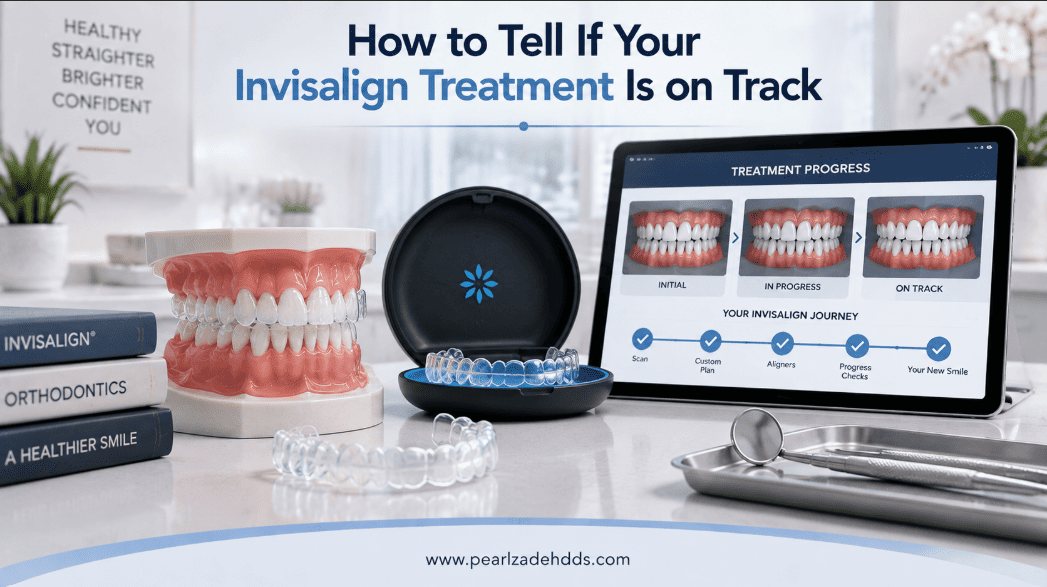
    How to Tell If Your Invisalign Treatment Is on Track

    You put in your new aligner and check the mirror out of habit. Nothing looks dramatically different. A few trays later, you’re still checking, and you’re still not entirely sure anything is actually happening under there.

    Is your Invisalign treatment really working? That’s the wrong question to obsess over, honestly. Invisalign movement can be subtle from one tray to the next, and not seeing an obvious change doesn’t mean treatment has stalled. The better question isn’t whether your teeth look dramatically different every week. It’s whether your teeth and aligners are progressing according to the plan.

    What Does “On Track” Mean With Invisalign?

    Being on track means your teeth are generally following the sequence of movements your plan actually called for. Invisalign works through a series of aligners, each one nudging your teeth a little closer to their planned position. How fast that seems to happen varies between patients, and even between individual teeth within the same mouth. Nobody should expect their treatment to move at the same pace as someone else’s.

    Should You Notice Changes With Every Aligner?

    Not necessarily. You might notice a slight shift in tooth position, a small gap starting to close, a rotated tooth looking a bit straighter, a change in how certain teeth contact each other, or different pressure in a specific spot. Plenty of changes are simply too subtle to catch day to day, though. Checking obsessively after every single tray isn’t going to give you reliable information either way.

    How Should a Properly Fitting Aligner Feel, and What If It Doesn’t?

    A properly fitting tray should sit securely over your teeth and generally feel snug, without obvious large gaps between the plastic and your teeth. It may feel tight right when you put it in, and some pressure is normal as your teeth start responding to the new shape. Discomfort or tightness on its own doesn’t automatically mean the aligner is working correctly, though. It’s just a common part of the adjustment.

    Pay attention if a tray won’t fully seat, if there’s a visible gap between the aligner and a tooth, if it feels unusually loose, if it suddenly feels very different from previous trays, or if it’s difficult to engage an attachment properly. Don’t force a tray into position if something feels off. Contact your dentist if the issue persists or seems genuinely unusual rather than just a normal first-day adjustment.

    What Are Some Signs Invisalign Is Progressing?

    A few things tend to suggest treatment is moving forward:

    • Teeth gradually shifting position
    • Crowding starting to ease
    • Spaces getting smaller
    • Rotations becoming less pronounced
    • Your bite relationship changing the way the plan intended
    • Each tray generally fitting as expected
    • Attachments staying properly engaged
    • Your dentist confirming progress at your checkups

    These are possible signs worth noticing, not a way to independently confirm everything is going perfectly on your own.

    Can You Compare Your Teeth With Photos?

    Photos can genuinely help you notice gradual changes that are hard to see day to day. If your dentist is comfortable with the approach, taking occasional photos from a similar angle and similar lighting can be a useful way to track things over a longer stretch. Daily comparisons tend to create more anxiety than insight, though. Professional scans and actual dental examinations give far better information about what’s really happening with your teeth than any photo comparison can.

    Why Can’t You Always See Invisalign Progress?

    Tooth movement happens gradually, and some of it is genuinely hard to notice. Certain movements are small, difficult to see from the front of your mouth, happening toward your back teeth, related to bite changes rather than visible alignment, or occurring across several small stages rather than one dramatic shift. A peer-reviewed study measuring the accuracy of Invisalign tooth movement found that actual achieved movement often falls meaningfully short of what the digital treatment plan initially predicted, with accuracy varying a good deal depending on the specific movement involved. That gap between prediction and reality is exactly why a mirror alone can’t tell you the full story. You may feel pressure or notice a different fit well before you see anything obvious.

    What Does Your Dentist Check During Invisalign Appointments?

    Your dentist may evaluate aligner fit, actual tooth movement, your attachments, any bite changes, your general oral health, whether your teeth are tracking with the planned movements, and whether anything needs adjusting. Professional monitoring is really the most reliable way to know whether treatment is progressing as expected. Not every appointment involves the exact same checks. What gets reviewed depends on where you are in your specific treatment.

    What Does “Tracking” Mean in Invisalign?

    Tracking refers to how closely your teeth are actually following the movements your aligners were designed around. When teeth don’t move quite as expected, the next aligner in the sequence may not fit the way it’s supposed to. This connects directly to the accuracy gap mentioned earlier: even well-planned treatment can involve some teeth tracking more closely than others. One small gap on one tooth doesn’t automatically mean something has gone wrong with your entire treatment. It’s one data point your dentist weighs alongside everything else.

    What If One Tooth Isn’t Moving as Planned?

    Individual teeth sometimes respond differently than the rest. The specific movement might just be more difficult for that tooth, it might need more time, the aligner might not be fully seating, an attachment might be missing, or the treatment plan itself might need adjusting. Your dentist may recommend additional steps or refinements when that’s the case. Needing a refinement doesn’t automatically mean treatment failed. It can simply be part of finishing planned movements that needed a bit more time.

    What If Your Aligner Has a Gap, or Your Teeth Look the Same After Several Trays?

    A small space between an aligner and a tooth can have more than one explanation, and it isn’t automatically a tracking problem. A gap that’s persistent or obvious, especially if the tray isn’t seating properly, is worth mentioning to your dentist rather than trying to diagnose it yourself. Similarly, if you feel like nothing has visibly changed for an extended stretch, bring that up at your next appointment. Your dentist can compare your current tooth position against the actual treatment plan and tell you whether things are progressing as expected, which is something you genuinely can’t determine on your own from a mirror.

    What If the Next Tray Doesn’t Fit?

    Don’t force it into place. Contact your dentist if a tray won’t seat properly or feels significantly different from what you’re used to. Depending on your specific situation, your dentist might recommend going back to your previous tray for a while, staying in your current one a little longer, or a different approach entirely. There’s no single instruction that applies to every patient here, which is exactly why this is a conversation to have rather than a decision to make alone.

    Can Missing Wear Time Put Treatment Off Track?

    Invisalign depends on consistent wear according to your dentist’s specific instructions. Missing a significant amount of wear time can affect how well your next aligners fit and can genuinely interfere with the planned movements. Our discussion of what happens if you stop wearing Invisalign early goes further into what a longer interruption can mean for treatment. There’s no universal wear-time number worth repeating here beyond whatever your dentist has actually prescribed for you.

    Attachments and Elastics: Two More Pieces of the Picture

    If you have attachments, they help your aligner apply the force certain movements actually need. If one falls off, tell your dentist, since it can affect how well the aligner engages that tooth. If elastics are part of your plan for bite correction, wearing them exactly as prescribed matters for those specific movements to happen on schedule.

    What If Your Bite Feels Different?

    Bite changes can happen during Invisalign simply because your teeth are moving, and a changing bite doesn’t automatically mean something is wrong. Mention it if you notice significant discomfort, a bite that suddenly feels very different, difficulty chewing, a tooth contacting much earlier than the rest, or bite concerns that just won’t let up. If bite correction is a central part of your plan, movements like these are worth understanding as they unfold, and our discussion of Invisalign and open bite correction covers one specific example of that kind of more complex movement. Your dentist can tell you whether what you’re noticing is actually expected at this stage of treatment.

    How Often Should Your Dentist Check Your Progress?

    There’s no single universal schedule here. How often you’re seen depends on your specific treatment plan, your dentist’s approach, and how your case is actually progressing. What matters is that regular checkups let your dentist compare your actual tooth movement against what the plan called for, something that simply isn’t possible from home.

    What Are Signs You Should Contact Your Dentist?

    A few situations are worth reaching out about rather than waiting for your next routine visit:

    • An aligner won’t seat properly
    • A noticeable gap persists between the tray and a tooth
    • An attachment has fallen off
    • A tray suddenly feels unusually loose
    • A tray feels unusually difficult to seat
    • A tooth doesn’t appear to be following the planned movement
    • You’re experiencing persistent or significant discomfort
    • Your bite changes in a way that concerns you
    • You’ve missed substantial wear time and the next tray no longer fits
    • You’re unsure whether you should move to the next aligner

    You don’t need to wait until your next scheduled appointment if something genuinely seems unusual.

    Does Needing Refinements Mean Treatment Is Off Track?

    No. Refinements are common in Invisalign treatment and don’t automatically mean anything went wrong. Some planned movements simply need a bit more time or a small adjustment to finish exactly as intended.

    How Can You Help Keep Your Invisalign Treatment on Track?

    A few habits genuinely help:

    • Wear your aligners according to your dentist’s instructions
    • Keep them clean
    • Store them properly when they’re out
    • Avoid removing them more than necessary
    • Follow whatever instructions you’ve been given for attachments and elastics
    • Attend your scheduled checkups
    • Report a damaged or lost aligner right away
    • Ask questions whenever something feels unusual

    Our guide to cleaning Invisalign aligners the right way covers that specific part of the routine in more detail.

    Can You Tell From the Mirror if Invisalign Is Working?

    Partly, but not entirely. You can genuinely notice real changes over time, and that’s worth paying attention to. A mirror simply can’t tell you the whole story, though. Tooth movement, bite changes, and how closely your teeth are tracking with the plan are things a professional exam and a direct comparison with your treatment plan can assess far better than your own reflection ever could.

    Progress Is More Than What You See in the Mirror

    Invisalign progress can be gradual and genuinely difficult to judge from home. A snug-fitting aligner, gradual tooth changes, and consistent wear are all encouraging signs, but none of them replace professional monitoring. If an aligner doesn’t fit properly, an attachment falls off, a tooth seems to have stopped moving, or something just feels unusual, that’s worth contacting your dentist about. The goal was never to watch every tooth move day by day. It’s to follow the plan and speak up when something seems different.

    Speak With Dr. Pearl Zadeh About Your Invisalign Progress

    Invisalign treatment involves gradual tooth movement, and you may not always be able to tell from the mirror whether every planned movement is actually happening. As an Invisalign Premier Provider, Dr. Pearl Zadeh can evaluate your aligner fit, tooth movement, attachments, bite changes, and overall progress during your visits. If an aligner doesn’t fit properly or something about your treatment seems unusual, reach out rather than waiting.

    Call (818) 716-6722 or click the button below to schedule a consultation online.

    Frequently Asked Questions

    How can I tell if my Invisalign is actually working?

    Gradual changes, a generally good aligner fit, and confirmation from your dentist at checkups are all encouraging signs, though a mirror alone can’t tell the full story.

    Is it normal not to see changes after every tray?

    Yes. Many movements are too subtle to notice day to day. This doesn’t necessarily mean treatment has stalled.

    What does it mean if my Invisalign aligner isn’t tracking?

    It means your teeth haven’t moved quite as closely to the planned position as expected for that stage, which can affect how the next aligner fits.

    Should I be worried if one tooth seems to be moving slower than the others?

    Not necessarily. Individual teeth can respond differently, and your dentist may recommend an adjustment or refinement if needed.

    Does needing Invisalign refinements mean something went wrong?

    No. Refinements are a common part of many Invisalign treatments and simply help finish planned movements that needed more time.

    This article is for informational purposes only and is not a substitute for professional dental advice. Please schedule a consultation with Pearl Zadeh DDS to discuss your specific situation.
  • Is Invisalign Right for Complex Bite Corrections?

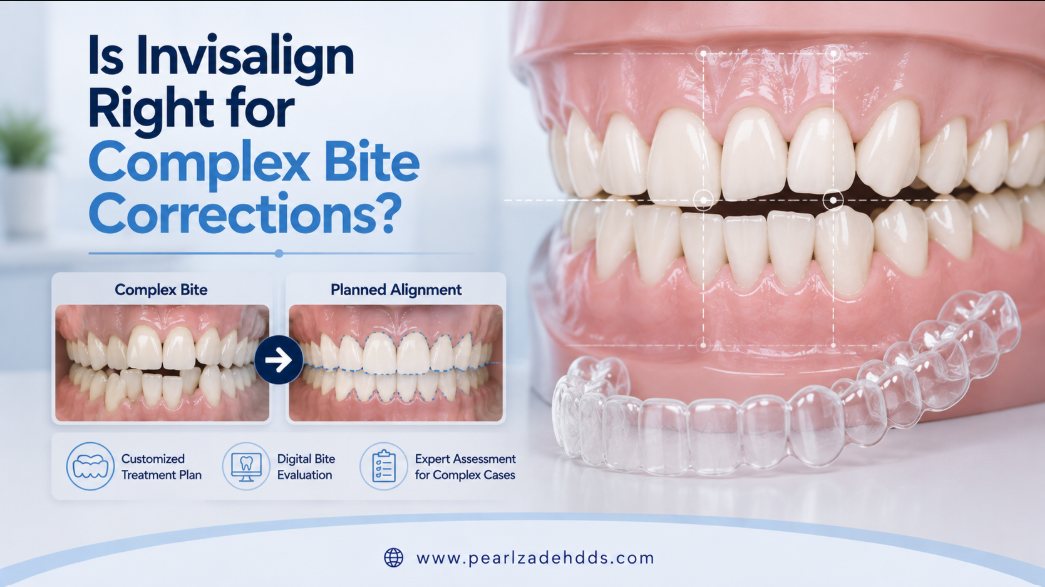
    Is Invisalign Right for Complex Bite Corrections?

    You hear the word overbite, or crossbite, or maybe something with more syllables, and you assume that’s it. Your case sounds complicated, so clear aligners are probably off the table. Braces it is.

    Not necessarily. Does having a complicated bite automatically rule out Invisalign? The honest answer isn’t a simple yes or no. Some genuinely complex bite corrections respond well to Invisalign, sometimes with a few extra tools involved. Others need a different approach entirely. Which category you fall into depends on specifics that a consultation, not a diagnosis name, actually reveals.

    What Makes a Bite Correction “Complex”?

    “Complex” isn’t one specific diagnosis. A case can become more challenging for a whole range of reasons:

    • The overall severity of the bite problem
    • Large tooth movements
    • Significant crowding or spacing
    • Tooth rotations
    • A deep bite
    • An open bite
    • An underbite
    • A crossbite
    • Multiple bite problems occurring together
    • Jaw or skeletal discrepancies
    • Missing teeth
    • Existing dental restorations
    • Gum or bone concerns
    • The overall amount of correction required

    A smile that looks complicated in the mirror doesn’t automatically mean Invisalign can’t work. It just means more factors need weighing before anyone can say for sure.

    Which Bite Problems Can Invisalign Treat?

    Invisalign may help address a range of common bite concerns, though how well it works depends heavily on severity and whether the problem is primarily dental or involves the jaw itself.

    An overbite, where the upper front teeth overlap the lower ones more than expected, can often be improved with aligners in appropriate cases. An underbite is more situational. Some dental underbites, where the issue is mainly tooth position, may respond to aligners, while more significant skeletal underbites often need a different approach. A crossbite, where certain upper teeth sit inside the lower teeth instead of outside them, can sometimes be corrected with aligners when the cause is primarily dental rather than skeletal.

    An open bite, where certain teeth don’t touch when biting down, is another area Invisalign can sometimes address. Our deeper look at Invisalign and open bite correction covers that specific question in more detail. A deep bite, where the upper teeth cover too much of the lower teeth, often involves coordinating movement across several teeth rather than simply straightening one or two. None of these conditions guarantee Invisalign is appropriate at every severity level. They’re simply areas where aligners are a genuine possibility worth evaluating.

    Dental Bite Problems vs. Skeletal Problems

    This distinction matters more than almost anything else in this article. A dental bite problem is mainly about tooth position, teeth sitting where they shouldn’t within jaws that are otherwise proportioned normally. A skeletal bite problem involves the actual size, position, or relationship of the upper and lower jaws themselves.

    Clear aligners move teeth. They don’t reposition adult jaw bones the way some patients imagine, since the jaw itself has already finished growing in most adult patients. A bite problem rooted mainly in tooth position is generally a better fit for aligners than one rooted in how the jaws themselves relate to each other. A more significant skeletal discrepancy may call for orthodontic treatment that goes beyond clear aligners, or in some cases, evaluation by a specialist. None of this can be determined from how a smile looks in a photo. It takes an actual clinical exam and appropriate records to know what’s really driving the bite problem.

    How Does Invisalign Correct a Complex Bite?

    Bite correction usually involves coordinated movement across several teeth, not just making individual teeth look straighter. Depending on the case, that can include controlled tooth movement, coordinating how the upper and lower arches relate to each other, vertical movement, certain rotations, managing available space, and letting the bite settle into its final relationship over the later stages of treatment. A 2025 systematic review on Invisalign predictability found that certain movements, including expansion, rotation, and space closure, show more variability than others. Not every movement involved in a complex bite correction is equally predictable, and that’s worth knowing going in rather than assuming every part of the plan will play out identically.

    Additional Tools That May Support a Complex Bite Plan

    Several tools can become part of a more involved bite correction, and needing any of them isn’t a sign your case is unusually difficult. Attachments, small tooth-colored shapes bonded to selected teeth, give the aligner extra grip for movements that need more control. Elastics connect the upper and lower arches to provide a type of force aligners alone don’t generate, which matters for certain bite relationships. IPR, a small, planned amount of enamel removed between selected teeth, sometimes creates space or adjusts tooth proportions when a plan calls for it. None of these tools are automatically part of every complex case, and none of them mean anything went wrong when they are.

    What If the First Invisalign Plan Doesn’t Finish the Bite?

    Reaching the end of your original aligner series with some movement still remaining is common enough in bite correction specifically, since real teeth don’t always land exactly where a digital plan predicted. Refinements, a new set of aligners built from updated scans of your current tooth positions, pick up where the original series left off. Needing a refinement round doesn’t mean the original treatment failed. It means the plan is being fine-tuned based on where your teeth actually are, not just where the software originally guessed they’d be.

    How Does a Dentist Decide If Invisalign Is Right for You?

    An evaluation typically covers:

    • A clinical examination
    • An assessment of your bite
    • Your current tooth positions
    • Gum health
    • Any existing restorations
    • X-rays when appropriate
    • Digital scans
    • How your jaws relate to each other
    • Exactly what movements your case requires
    • Your treatment goals
    • Your own expectations for the result

    The digital treatment simulation you see during planning is a helpful part of that process, not a guarantee that every predicted movement plays out exactly as shown. The final call on whether Invisalign fits your case should come from your dentist after actually evaluating your teeth and bite, not from comparing your diagnosis name to what you’ve read online.

    What Can Make Invisalign Less Predictable?

    A handful of factors can affect how smoothly treatment progresses. Complex tooth movements, significant rotations, severe bite discrepancies, and underlying skeletal problems all add difficulty on the clinical side. The same 2025 systematic review found that treatment success is multifactorial, shaped by patient compliance, how the treatment was planned, and the complexity of the case itself, together rather than any single factor alone. On the patient side, inconsistent aligner wear, missed appointments, teeth not tracking as expected, and existing dental or periodontal concerns can all play a role. Compliance genuinely matters here, since aligners only work while they’re actually being worn as prescribed, but not every tracking issue traces back to something a patient did wrong.

    What Happens If Your Teeth Don’t Track as Planned?

    Tracking just means how closely your teeth are moving to where a given aligner expects them to be. If a tooth isn’t tracking closely enough, your dentist reassesses rather than just letting the plan run on autopilot. Depending on what they find, that might mean continuing the current plan a bit longer, making adjustments, adding attachments, recommending elastics, ordering a refinement, or in some cases changing the treatment approach altogether. This is a decision for your dentist to make after evaluating the situation, not something to guess your way through by switching trays on your own.

    When Might Braces Be a Better Option?

    Traditional braces may be considered when extensive tooth movement is required, the bite discrepancy is significant, more precise control over the movement is needed, the case involves substantial skeletal issues, or clear aligners seem unlikely to deliver the required correction predictably. Research discussed in a peer-reviewed study on clear aligner predictability points to fixed appliances outperforming clear aligners for cases requiring severe rotation, extrusion, and bodily tooth movement, and completing severe extraction cases in less time. This isn’t a case for braces being the universally better choice. It’s a reminder that certain movements are still more reliably handled with fixed appliances, depending on what a specific bite actually needs.

    Does Needing Invisalign Extras Mean Your Case Is Too Complicated?

    No. Attachments, elastics, IPR, and refinements can all be a completely normal part of Invisalign treatment, complex bite or otherwise. None of these tools automatically signal that treatment failed or that your case is unusually severe. What actually matters is why your dentist is recommending a specific tool and what movement it’s meant to accomplish, not whether your plan happens to include more moving pieces than someone else’s.

    What About Patient Compliance?

    Complex bite correction asks more of you than a simple case might, since more movements happening at once leaves less room for inconsistency. That means wearing your aligners for the prescribed amount of time, switching trays according to your actual schedule, using elastics exactly as instructed, keeping your appointments, reporting a broken attachment or other problem promptly, and resisting the urge to take your aligners out more than necessary. Our discussion of what happens if you stop wearing Invisalign early covers the general mechanics if a longer interruption ever happens. One missed day here or there isn’t going to derail a complex plan on its own. A repeated pattern of inconsistency is a different story.

    How Long Does Complex Invisalign Treatment Take?

    There’s no single number that applies across the board. Treatment length depends on the type of bite problem involved, how much movement is actually required, whether elastics are part of the plan, whether attachments are needed, whether refinements become necessary along the way, how consistently the aligners get worn, and how your specific teeth respond to the forces involved. Your dentist can give you a realistic estimate once they’ve evaluated your case and built an actual treatment plan around it, not before.

    Is Invisalign Worth Considering If Your Bite Is Complicated?

    A complicated bite doesn’t automatically rule Invisalign out. A consultation is what actually determines whether your problem is primarily dental, whether the movements your case requires are suitable for aligners, whether additional tools would be part of the plan, or whether another approach would get you there more predictably. The goal is finding the appropriate treatment for your specific bite, not choosing Invisalign simply because clear trays sound more appealing than brackets and wires.

    Frequently Asked Questions

    Can Invisalign fix a severe overbite or underbite?

    Sometimes, depending on whether the problem is primarily dental or involves the jaw itself. A clinical evaluation determines which category your case falls into.

    Is Invisalign only for mild cases?

    No. Invisalign has expanded to treat many moderate and complex cases, though certain severe movements are still more reliably handled with traditional braces.

    Does needing attachments or elastics mean my case is too complicated for Invisalign?

    No. These tools are a normal part of many treatment plans, including plenty of straightforward ones, and don’t indicate treatment has gone wrong.

    How do I know if my bite is dental or skeletal?

    This requires a clinical examination and appropriate records. It isn’t something that can be determined from appearance alone.

    When would a dentist recommend braces instead of Invisalign for a complex bite?

    When the case requires extensive movement, significant precision, or involves substantial skeletal issues that clear aligners are unlikely to correct as predictably.

    This article is for informational purposes only and is not a substitute for professional dental advice. Please schedule a consultation with Pearl Zadeh DDS to discuss your specific situation.

    Speak With Dr. Pearl Zadeh About Invisalign

    Having a complicated bite doesn’t automatically rule out Invisalign. As an Invisalign Premier Provider, Dr. Pearl Zadeh can evaluate your teeth and bite, discuss what type of correction your case actually needs, explain whether aligners may be appropriate, and walk through any additional tools that might be part of your plan. Learn more about Invisalign in Woodland Hills.

    Call (818) 716-6722 or click the button below to schedule a consultation online.

  • Does Invisalign Affect Your Speech? Understanding the Lisp

    You put in a new aligner before heading out the door for work, and somewhere around your second cup of coffee, you notice certain words sound off. There’s a faint whistle on your s’s, or a word that used to come out clean now feels slightly slurred. You start wondering if the person across the table can hear it too, or if it’s mostly in your own head.

    Yes, Invisalign can temporarily affect speech for some patients, especially during the first few days with a new tray. It happens because the aligner adds a thin layer of plastic between your teeth, tongue, and the roof of your mouth. Your tongue is used to a certain amount of space and a familiar surface to push against when forming words. Give it a little time, and your speech usually settles back into place.

    Why Your Speech Can Sound Different

    Certain sounds rely on your tongue touching very specific spots behind your upper front teeth or along the roof of your mouth. An aligner sits directly over those surfaces, which changes the shape and texture your tongue is used to contacting. A peer-reviewed study on speech articulation with Invisalign found that the /z/ sound was the one most consistently affected when patients wore their trays.

    You may also notice that sounds such as “s,” “sh,” or “th” feel slightly different while you’re getting used to a new aligner. The exact effect varies from person to person. This isn’t the aligner physically blocking your speech. It’s your tongue working out where to land now that the terrain has changed slightly.

    Does Everyone Get an Invisalign Lisp?

    No. Some patients notice a real difference for the first few days. Others barely register a change at all. How noticeable it is can depend on things like how snugly the aligner fits, the thickness of the plastic at that stage of treatment, your own mouth anatomy, where your tongue naturally rests, and simply how quickly your tongue adapts to something new being there. Two people starting Invisalign the same week can have completely different experiences with this.

    How Long Does the Lisp Last?

    Speech changes tend to be most noticeable right after you put in a brand-new tray, whether that’s your very first one or a later tray in the sequence. A study on Invisalign patient acceptance found that most patients adapted to wearing their aligners within about a week. Many patients notice their speech settling within several days, though the exact timeline varies from person to person.

    There’s a difference between a temporary adjustment and a speech change that sticks around for weeks without improving. If your speech still feels noticeably different after you’ve had plenty of time to adjust, or the change is getting worse rather than better, it’s worth mentioning to your dentist.

    How to Get Used to Speaking With Invisalign

    Wearing your aligners for the amount of time your dentist prescribed gives your tongue consistent practice rather than starting over every time you take them out and put them back in. Keep talking normally instead of going quiet for a few days. Your tongue needs time to adjust to speaking with the trays in place. Reading a page out loud for a few minutes, or deliberately practicing whatever sound feels off, can also help you get comfortable with the change. Staying hydrated helps too, since a dry mouth can make any speech change feel more noticeable than it actually is.

    None of this needs to feel like an exercise program. It’s mostly just giving your tongue reps.

    Should You Take Your Invisalign Out Before Speaking?

    Generally, no. An important meeting, a presentation, or a first date isn’t a reason to pull your aligners out. Doing that repeatedly can work against your adjustment, since your tongue needs consistent time with the trays in place rather than getting used to them only between removals. Aligners come out for eating and for anything besides water, but speaking on its own isn’t a reason to take them out.

    Our rundown of common Invisalign mistakes touches on this same pattern, since removing trays more than necessary is a habit worth avoiding for reasons beyond speech.

    What About a Lisp After Switching to a New Tray?

    You may notice a brief change again when you move to a new aligner in your series. The new tray can sit or feel slightly different from the one you just finished wearing, so your tongue may need a little time to adjust again. That doesn’t mean every new tray will bring back a noticeable lisp. Plenty of patients stop noticing any speech difference after the first few trays. If your treatment eventually moves into refinements, you may notice a similar short adjustment with those aligners too.

    Can Attachments or Elastics Affect Speech?

    Small tooth-colored attachments change the texture of the tooth surface slightly, which can feel unusual against your tongue at first. The aligner itself is usually the bigger adjustment when you first start treatment. Elastics add another element to your mouth and can also feel unusual while you’re talking, particularly when they’re first prescribed for bite correction.

    If your plan includes attachments or elastics, they may add to the overall adjustment period. They don’t automatically mean you’ll develop a noticeable lisp.

    What About Speaking at Work or in Public?

    Teachers, salespeople, people who spend their day on the phone, singers, and public speakers may notice speech changes more than others. That’s partly because they’re paying closer attention to their pronunciation and speaking for longer periods.

    If you have something important coming up, whether that’s a presentation, a big phone call, or a performance, practice out loud with your aligners in beforehand. That’s better than taking them out just to avoid a temporary speech change. A few minutes of reading or rehearsing your material gives your tongue a chance to get used to speaking with the trays in place before the real thing.

    When Should You Talk to Your Dentist?

    A speech change that isn’t improving after you’ve had time to adjust, an aligner that feels unusually bulky or loose, real discomfort, or a tray that doesn’t seem to fit the way it should are all reasonable reasons to check in. Persistent speech difficulty on its own doesn’t automatically mean something’s wrong. It just means it’s worth having your dentist check the fit and rule out anything that might be getting in the way of a normal adjustment.

    Speak With Dr. Pearl Zadeh About Invisalign

    A temporary speech change is usually just your mouth adjusting to something new, not a sign that something has gone wrong. Persistent issues are still worth bringing up rather than ignoring. As an Invisalign Premier Provider, Dr. Pearl Zadeh can check your aligner fit, review your tooth movement and bite, and address anything affecting your comfort or speech. Learn more about Invisalign in Woodland Hills.

    Call (818) 716-6722 or click the button below to schedule a consultation online.

    Schedule a Consultation

    Frequently Asked Questions

    1. Does everyone get a lisp with Invisalign?

    No. Some patients notice a clear change in their speech for the first few days, while others barely notice anything at all.

    2. How long does the Invisalign lisp typically last?

    Most patients notice their speech settling within a few days to about a week, though the exact timeline varies. A change that continues for weeks without improving is worth mentioning to your dentist.

    3. Should I remove my aligners when I need to speak clearly?

    Generally no. Removing them for conversations actually slows your adjustment, since your tongue needs consistent time in the trays to adapt.

    4. Can a new aligner cause the lisp to come back?

    It can, briefly, since each new tray fits slightly differently than the one before it. Not every new aligner causes a noticeable change, and most patients adjust quickly.

    5. When should I contact my dentist about speech changes?

    If the change hasn’t improved after a couple of weeks, or if your aligner feels unusually loose, bulky, or uncomfortable, it’s worth having the fit checked.

    This article is for informational purposes only and is not a substitute for professional dental advice. Please schedule a consultation with Dr. Pearl Zadeh to discuss your specific situation.

  • Traveling With Invisalign: What Patients Should Know

    You’re standing at your gate with ten minutes before boarding, unwrapping a granola bar you grabbed at the last kiosk. Your aligners come out, and you realize you left your case in the bag you already checked. A napkin is the only option, and now you’re mentally reminding yourself not to throw it away with the trash. Somewhere behind you, someone’s asking how anyone is supposed to clean a tray in an airplane bathroom.

    None of that means travel and Invisalign don’t mix. It just means the routine you’ve built at home doesn’t automatically follow you through security. Once you know what actually changes on the road, most of it stops being a problem.

    What to Pack

    Your case matters more than almost anything else on this list, since a lost case can easily lead to a lost aligner. Pack your current tray, case, toothbrush, toothpaste, and floss or an interdental brush together in one spot rather than scattering them across different bags. If you’re between checkups and carrying a few upcoming aligners, keep those with the same group of items. Anything specific to your treatment, such as spare elastics if you use them or a small bottle of cleaning solution, travels better as a single kit than as loose items you’re hoping you remembered.

    The reason this matters more while traveling is simple. At home, a missing case usually turns up in a coat pocket or bathroom drawer within a day. On a trip, especially if your luggage gets separated from you or your plans change unexpectedly, that same missing case can leave you without a reliable place to store your aligners.

    Can You Wear Invisalign on a Plane?

    Yes. There’s no reason to stop wearing your aligners just because you’re in the air. Water is fine to drink with trays in. Anything else, and you’ll want to take them out the same way you would on the ground. The actual challenge isn’t anything about being airborne. It’s logistics: pulling trays out for the meal service, finding a moment to rinse your mouth before putting them back in, and not misplacing anything in a space that small. None of that is a reason to skip wearing them for the flight.

    Eating and Drinking on the Road

    Airport food courts, restaurant meals, long flights, gas station stops on a road trip, none of these are complicated on their own. The rule stays the same wherever you are: aligners come out for anything besides water, including coffee, tea, alcohol, sugary drinks, and snacking between meals. Travel tends to multiply how often that happens, though, since a trip usually means more meals out, more coffee, and more grazing throughout the day than your normal routine at home.

    Each removal on its own is fine. What actually matters is the total time your trays spend out of your mouth over the course of a day, since your prescribed wear schedule assumes they’re in for the vast majority of it. A vacation full of long lunches and afternoon coffee runs can quietly eat into that total more than you’d expect. Being a little more deliberate about getting your trays back in promptly, rather than leaving them in a napkin while you finish a conversation, keeps your wear time closer to the schedule your dentist prescribed.

    Cleaning Aligners Away From Home

    A hotel bathroom works fine for a normal cleaning routine. Airports and airplanes are more limited, but rinsing your aligners with water is a practical option until you have access to a toothbrush and proper supplies. Road trips fall somewhere in between, since gas station bathrooms exist but aren’t always where you want to linger. Our guide to cleaning Invisalign aligners the right way covers the daily routine in more detail, and most of it still applies on the road.

    What’s worth avoiding specifically while traveling is turning a quick rinse into your entire cleaning routine for days at a time. Once you reach your hotel or another place where you can clean properly, give your aligners the same attention you would at home. That helps keep them clear, clean, and more comfortable to wear throughout the trip.

    If You Forget Your Case

    Wrapping an aligner in a napkin is one of the easiest ways to lose one. Napkins get bundled with trash without a second thought, and a tray wrapped in tissue can look exactly like garbage to whoever’s clearing the table. If you’re genuinely without a case, use a clean, sealable container as a temporary option rather than paper of any kind. A small clean container or resealable bag can keep the aligner protected until you can get a proper case. The goal is simple: somewhere clean and secure where you won’t accidentally throw it away.

    If You Lose an Aligner While Traveling

    Losing a tray away from home feels more stressful than it needs to be. Don’t panic, and don’t assume you know the right move without checking. Skipping ahead to your next aligner isn’t automatically correct, and neither is going back to wear your previous one longer. Contact your dentist’s office and explain what happened and where you are in your treatment. If you still have other aligners with you, hold onto them rather than tossing them out just because one is missing. Our discussion of what happens if you stop wearing Invisalign early covers the general reasoning behind why guessing isn’t the best move if a longer gap without a tray ends up happening before you can sort it out.

    If an Aligner Breaks or an Attachment Falls Off

    A cracked tray, a sharp edge that’s suddenly rubbing your cheek, or an aligner that stops fitting the way it did yesterday isn’t something to fix yourself with nail clippers or a nail file in a hotel bathroom. If an attachment comes loose or an elastic breaks and you don’t have a spare, the same rule applies. Call your dentist’s office rather than improvising. They can tell you whether the problem needs attention while you’re away or whether it can reasonably wait until your next visit. That decision depends on what happened, where you are in treatment, and whether the problem is causing pain or preventing you from wearing your aligners properly.

    Time Zones and Wear Time

    This one sounds more complicated than it actually is. The goal is keeping your daily wear time where your dentist prescribed it, not tracking the exact clock time you put a tray in relative to home. If you fly from California to somewhere three hours ahead, you don’t need to do any math about when “your” day technically starts. Just settle into the local time zone, keep wearing your aligners as prescribed, and take them out for meals as usual. Crossing a time zone doesn’t change how the aligners work.

    Can You Travel During Treatment at All?

    Yes, and for most patients, travel doesn’t require pausing treatment. The real adjustment is keeping your routine intact while your daily schedule looks nothing like a normal week at home. If you know a significant trip is coming up, it’s worth mentioning during a regular visit, especially if you’ll be away during a stretch when you’d normally be picking up new aligners or attending a check-in.

    What About a Scheduled Appointment While You’re Away?

    Don’t just skip it and assume it’ll sort itself out. A short weekend trip probably won’t affect anything on your calendar. A longer vacation, business trip, or extended time out of the country might land right on top of a visit you’d otherwise need to attend. Let the office know ahead of time. Depending on where you are in treatment, there may be some room to adjust the timing around your travel rather than trying to fit your trip around a fixed appointment.

    Should You Bring Several Future Trays With You?

    This depends on where you are in your treatment and how long you’ll be gone, which is really a conversation to have with your dentist rather than a decision to make on your own. Bringing a couple of backup aligners can be useful insurance for a longer trip. Taking a large stack of future trays without checking first isn’t necessarily the right call, since moving ahead in your sequence without guidance can work against the plan rather than for it. Ask before you pack more than your dentist has actually suggested.

    Travel Mistakes Worth Avoiding

    A few habits come up again and again on trips specifically. Wrapping aligners in napkins. Forgetting the case entirely. Leaving trays out for hours because a meal turned into an afternoon. Sipping coffee or a cocktail with aligners still in. Skipping a proper cleaning for days because the setup wasn’t convenient. Losing a tray and guessing which one to wear instead of calling the office. Forgetting spare elastics if you use them. Quietly skipping a check-in appointment instead of reaching out about it. Our rundown of common Invisalign mistakes covers a lot of this same ground for patients generally, not just while traveling, and it’s worth a look before a longer trip.

    When to Actually Call

    A few situations are worth calling your dentist about rather than waiting until you’re back home:

    • Significant pain
    • An aligner that suddenly doesn’t fit properly
    • A cracked or broken aligner
    • A lost aligner
    • A missing or loose attachment
    • A bite that suddenly feels different
    • A problem that prevents you from wearing your aligners as prescribed

    Minor discomfort that fades within a day or two, or a small cosmetic question that isn’t affecting how your treatment is progressing, can usually wait for your next regular conversation with the office. If you’re genuinely unsure which category something falls into, that uncertainty alone is a good enough reason to call and ask.

    Speak With Dr. Pearl Zadeh About Your Invisalign Treatment

    Upcoming travel doesn’t have to derail your Invisalign treatment, and a problem that comes up while you’re away doesn’t mean starting over. As an Invisalign Premier Provider, Dr. Pearl Zadeh can help you plan around a trip, answer questions about your specific wear schedule, and help you handle anything that goes wrong while you’re away. Learn more about Invisalign in Woodland Hills.

    Call (818) 716-6722 or click the button below to schedule a consultation online.

    Frequently Asked Questions

    1. Can I travel while wearing Invisalign?

    Yes. Travel generally doesn’t require pausing treatment. The main adjustment is keeping your wear and cleaning routine consistent while your daily schedule changes.

    2. Can I wear Invisalign on a plane?

    Yes. You can wear your aligners during a flight and drink water with them in, removing them for meals the same way you would anywhere else.

    3. What should I do if I lose an aligner while traveling?

    Contact your dentist rather than guessing which tray to wear next. Hold onto any remaining aligners you have and follow the instructions you’re given based on where you are in treatment.

    4. How do I clean Invisalign while traveling?

    Rinse and brush your aligners when a full cleaning routine isn’t possible, and get back to your normal cleaning process as soon as you reasonably can. Avoid going several days with only a quick rinse.

    5. What happens if I forget my Invisalign for a day while on vacation?

    A single missed day usually isn’t a major setback, but it’s still worth getting back on schedule as soon as possible and mentioning it at your next appointment if it happens more than once.

    This article is for informational purposes only and is not a substitute for professional dental advice. Please schedule a consultation with Pearl Zadeh DDS to discuss your specific situation.

  • Why Your Invisalign Treatment May Need Elastics or Rubber Bands

    You signed up for clear trays. Just clear trays, quietly moving your teeth while you go about your life. Then your dentist mentions rubber bands, and for a second you’re picturing the metal-and-wire setup you specifically wanted to avoid. Why does something that’s supposed to be simple suddenly involve an extra piece of equipment?

    Invisalign elastics usually aren’t about making individual teeth straighter. They’re about how your upper and lower teeth meet when you bite down, something the aligners alone may not fully address. The aligners keep doing their job, moving teeth within each arch. The elastics add a separate force between the upper and lower arches, helping guide them into a better relationship with each other. Both tools work together, rather than one replacing the other.

    What Are Invisalign Elastics?

    Orthodontic elastics are small rubber bands that attach to specific points on your aligners or your teeth and stretch between the upper and lower arches. They provide a type of force that clear trays alone aren’t designed to create. Where they attach depends on what your dentist is trying to accomplish, since the connection points change based on the movement or bite correction being planned.

    If you hear someone call them rubber bands and someone else call them elastics, they’re talking about the same thing.

    This isn’t unique to Invisalign, either. Traditional braces have used elastics for the same basic purpose for decades. With clear aligners, the bands may attach to small hooks, buttons, or cutouts built into the aligners or placed on the teeth rather than hooking onto metal brackets.

    Why Would Invisalign Need Rubber Bands?

    The main reason usually comes down to bite correction. An overbite, an underbite, certain crossbite relationships, and other situations where your upper and lower teeth don’t meet quite right can all be reasons a dentist adds elastics to a treatment plan.

    The American Association of Orthodontists explains that orthodontic elastics add force that braces or aligners alone may not provide, with the direction and placement tailored to the patient’s bite.

    Clear aligners can move individual teeth into better positions within the upper or lower arch. Elastics add another type of force by connecting the upper and lower arches, which can help guide how they fit together. That doesn’t mean elastics correct every bite problem. Some situations require a different approach, and your dentist determines that during treatment planning.

    Not Every Patient Needs Them, and That Isn’t About Severity

    Some Invisalign patients only need their aligners. Others have elastics built into their plan from the beginning. The difference comes down to the tooth movements and bite correction the treatment needs to achieve, rather than a general scale of how “bad” someone’s teeth are.

    This is worth saying plainly because many patients assume needing elastics means their case must be unusually difficult. That’s not necessarily the case. Someone can have relatively straightforward tooth alignment and still need help correcting how their upper and lower teeth come together.

    Bite relationships and individual tooth alignment are related, but they aren’t the same thing. Needing elastics says more about the relationship between your upper and lower teeth than it does about how complicated your overall case is.

    What They Actually Do, and Where They Attach

    An elastic connects a point on your upper teeth or upper aligner to a point on your lower teeth or lower aligner. As it stretches, it creates a directional force that helps guide the relationship between your upper and lower arches.

    Align Technology, the company behind Invisalign, describes doctor-prescribed cutouts built into some Invisalign aligners for this purpose, giving the elastic a secure place to hook onto. Depending on your treatment plan, elastics may connect to those cutouts, small buttons bonded to certain teeth, or other features used to support the planned movement.

    There’s no single attachment pattern that works for everyone. Where the elastics connect depends on the bite relationship your dentist is trying to change.

    Wearing Them Consistently Actually Matters

    How many hours a day you’re told to wear elastics, and how long you’ll need them overall, depends on your treatment plan. The important part is consistency. The corrective force only works while the elastic is actually in place.

    Forgetting them once or twice isn’t likely to undo your treatment. Most patients have an occasional missed elastic. The bigger concern is a pattern of regularly skipping them, since that can reduce the amount of corrective force your bite receives and slow progress.

    If you’re repeatedly having trouble keeping up with your elastics, let your dentist know. They may need to adjust the treatment plan or extend the amount of time you need to wear them. It’s less about one missed day and more about what happens consistently over time.

    Getting Used to Them

    Most patients notice some pressure when they first start wearing elastics, along with mild soreness and a distinct feeling of their upper and lower teeth being pulled toward each other. Some people also notice irritation around the cheek or gum near an attachment point.

    Those sensations often become easier to manage as you get used to the elastics. If the discomfort is significant, keeps getting worse, or doesn’t start to settle, contact your dentist rather than trying to push through it. The same applies if an attachment point is causing sharp irritation or seems to be creating a problem beyond normal adjustment.

    Living With Elastics Day to Day

    You still take your aligners out to eat, just as you normally would. Whether your elastics should also come out during meals depends on how they’re being used and the instructions your dentist gives you. There isn’t one rule that applies to every Invisalign patient.

    It helps to keep spare elastics somewhere you’ll actually have them when you need them, such as at your desk, in your bag, or in your car.

    If an elastic breaks, replace it with a fresh one of the type and size your dentist provided, following the wear schedule you were given. Don’t substitute a random rubber band or a different elastic size because it’s what you happen to have available.

    If you’ve run out of spares or aren’t sure which elastic to use, contact the office rather than guessing. Different elastic sizes and strengths produce different forces, so using the wrong one isn’t a good substitute for the prescribed elastic.

    Elastics Aren’t the Same Thing as Attachments

    Easy to mix these up since they can both come up during Invisalign planning. Attachments are small tooth-colored shapes bonded directly to individual teeth, giving the aligner extra grip for certain movements.

    Elastics are removable rubber bands that connect different points, often between the upper and lower arches, to help guide how your bite comes together. One is bonded to the tooth and stays there. The other is removable and something you manage yourself each day.

    Your treatment plan might include one, both, or neither, depending on what your teeth and bite need.

    Will People Notice Them?

    The aligners themselves stay just as clear as they were before. The elastics are different, and it wouldn’t be honest to promise that nobody will notice them.

    How visible they are depends largely on where they’re attached and how they connect between your arches. Elastics positioned farther back tend to be less noticeable than ones closer to the front.

    Most patients get used to the appearance fairly quickly. It also helps to remember that elastics are a temporary part of treatment. They’re there for a specific purpose and usually aren’t something you’ll need forever.

    How Long Will You Need Them, and What Happens If You Stop Early?

    There’s no universal timeline. Some patients wear elastics for a relatively short part of their treatment. Others need them for longer, depending on how their bite responds and how much correction is still needed. Your dentist tracks that progress and decides when the additional force is no longer necessary.

    Stopping early, meaning deciding to stop before your dentist tells you it’s okay, can affect the bite correction the elastics were helping achieve. That’s different from missing one day here and there, which happens.

    The bigger concern is deciding on your own to stop for an extended period. If you’ve already done that, contact your dentist and explain how long you’ve been without the elastics. They can tell you whether to resume them, make an adjustment, or bring you in for a check rather than leaving you to guess.

    Can You Just Skip Elastics Altogether?

    It depends on what your treatment needs to accomplish. If elastics are part of your plan because your bite needs additional correction, leaving them out can change what your treatment is able to achieve.

    That doesn’t mean every patient has to wear elastics. It means that if your dentist prescribed them for your particular bite, skipping them isn’t likely to produce the same result as following the plan.

    If you’re hesitant about wearing elastics for any reason, talk to your dentist about it. You can ask what the elastics are correcting, how long you’ll need them, and what could happen if you don’t wear them as prescribed. That’s a much better conversation than deciding on your own to leave them out.

    How Elastics Fit Into the Bigger Invisalign Plan

    Elastics aren’t an extra feature added randomly. They’re prescribed because your specific bite correction calls for them, much like attachments are added when certain tooth movements need extra grip.

    Our step-by-step look at how Invisalign treatment works covers how digital scans, tooth positions, and bite assessment shape the overall treatment plan from the start.

    Sometimes a bite doesn’t fully settle within the original series of aligners. That’s where refinements, additional aligners used to fine-tune the remaining movement, may come into the picture. Your elastics plan may also be adjusted if your bite needs something different at that stage.

    Once active treatment is complete, retainers serve a different purpose. They help maintain the tooth positions you’ve worked to achieve rather than continuing the active bite correction elastics were used for.

    Speak With Dr. Pearl Zadeh About Your Invisalign Treatment

    Needing elastics doesn’t mean something has gone wrong, and it doesn’t automatically mean your case is unusually difficult. It means your bite may need some additional help beyond what the aligners can provide on their own.

    As an Invisalign Premier Provider, Dr. Pearl Zadeh can evaluate your teeth and bite directly and explain why elastics are, or aren’t, part of your treatment plan, how they fit into the rest of your treatment, and how long you may need to wear them. Learn more about Invisalign in Woodland Hills.

    Call (818) 716-6722 or click the button below to schedule a consultation online.

    Schedule a Consultation

    Frequently Asked Questions

    1. Why do I need rubber bands with Invisalign?

    Invisalign elastics are usually prescribed to help correct your bite. They connect the upper and lower arches and add a directional force that helps guide how they fit together. Your aligners continue moving individual teeth while the elastics help with the relationship between your upper and lower teeth.

    2. Does needing Invisalign elastics mean my case is severe?

    No. Needing elastics doesn’t automatically mean your Invisalign case is severe or unusually complicated. You may have relatively straightforward tooth alignment but still need additional help correcting your bite. Your dentist decides whether elastics are needed based on the movements and bite correction your treatment requires.

    3. How long do I need to wear Invisalign elastics?

    It depends on your treatment plan and how your bite responds. Some patients need elastics for only part of treatment, while others wear them longer. Follow the wear schedule your dentist gives you, since inconsistent use can slow the bite correction they’re intended to provide.

    4. Can I skip Invisalign elastics if I don’t like wearing them?

    If your dentist prescribed elastics for your treatment, skipping them can affect the bite correction your plan is designed to achieve. If you’re uncomfortable with them or concerned about how they look, talk to your dentist before stopping. They can explain what the elastics are correcting and whether there are any reasonable alternatives.

    5. What happens if I stop wearing my Invisalign elastics?

    Missing an elastic occasionally usually doesn’t undo your treatment. The bigger concern is repeatedly skipping them or stopping for an extended period. That can slow bite correction and may extend treatment. If you’ve stopped wearing them, contact your dentist and explain how long you’ve gone without them before deciding what to do next.

  • Invisalign Attachments: What They Are and Why You Need Them

    You signed up for clear aligners partly because they were supposed to be, well, clear. Then your dentist mentions attachments, and you catch a glimpse of small bumps on a few of your teeth that definitely weren’t there last week.

    If your first reaction was some version of “wait, what are those?” you’re not alone. Most patients have never heard the word until they’re already looking at the result in a mirror.

    So what are those little bumps actually doing? Invisalign attachments are small, tooth-colored shapes bonded to certain teeth. They give the aligner something firmer to grip and push against, which helps it carry out movements that clear plastic alone may not control as well.

    Not every patient needs them. Needing attachments also doesn’t mean your case is unusually difficult. It simply means your dentist has planned specific tools to help move your teeth as intended.

    What Invisalign Attachments Actually Are

    Picture a small, tooth-colored bump or ridge bonded to the surface of a tooth. That’s an attachment. The material is a tooth-colored dental composite, shaped according to the movement that tooth needs to make.

    A tooth that needs to rotate may need a different attachment shape than one that needs a different type of controlled movement.

    Not every tooth gets one. Some patients have several attachments placed only where the treatment plan calls for additional control. Others need very few, or none at all.

    The number and placement come from your treatment plan. There isn’t one standard attachment setup for every Invisalign patient.

    The simplest way to think about it is this: the aligner supplies the force. The attachment gives that force something to grip. Together, they help the aligner control certain tooth movements more precisely.

    Why Certain Movements Need Extra Grip

    A smooth plastic tray works well for many straightforward movements, such as closing a small gap or gently tipping a tooth in one direction.

    Rotating a rounded tooth is a different challenge. So is moving a tooth vertically or controlling it in a direction that a flat piece of plastic may not handle as easily. Without something to grip, the aligner may not have enough control over the tooth movement your treatment plan calls for.

    An attachment changes that. It gives the tray a surface to catch, helping it apply force more precisely to the tooth. That can make certain movements easier to control and track throughout treatment.

    Not every complex movement automatically requires an attachment. Your dentist decides which teeth need that extra support based on the movements your treatment plan requires.

    Does Everyone Get Attachments?

    No. Some treatment plans use several attachments. Others need only a few, and some cases may not require them at all.

    It comes down to which teeth are moving, what kind of movement each one requires, how complex the case is, and what the treatment plan is designed to accomplish.

    Two patients with visually similar smiles can end up with very different attachment plans. The movements needed beneath the surface aren’t always the same.

    What They Look Like, and Whether Anyone Will Notice

    They’re small and designed to blend with your natural tooth color. That’s the point. Invisalign describes its attachments as small shapes bonded to selected teeth to help the aligners control specific movements. Invisalign’s information on attachments

    How noticeable they are depends on the attachment itself, where it’s placed, its shape, and how closely its color matches your tooth.

    Invisalign is generally less noticeable than traditional brackets and wires, but attachments aren’t completely invisible. An attachment on a front tooth may be easier to see than one farther back, especially when someone is looking closely.

    When you wear your aligners, the attachments sit underneath the clear plastic. When you remove the aligners, the attachments remain bonded to your teeth because they’re part of the active treatment setup.

    Does Getting Them Placed Hurt?

    The placement process doesn’t involve drilling into the tooth or giving you a numbing injection. Your dentist prepares the tooth surface, applies the bonding material, positions the attachment, and hardens it with a curing light.

    You may feel some pressure during the process, but it shouldn’t feel like having a cavity filled.

    Afterward, you may notice the new texture against your cheek or tongue. A fresh aligner may also feel tighter or create some mild pressure around the attachments.

    That adjustment usually becomes less noticeable as you get used to them. Sharp irritation, significant pain, or discomfort that doesn’t settle should be brought to your dentist’s attention rather than something you simply push through.

    How They’re Actually Bonded to Your Teeth

    The process is fairly quick and doesn’t require drilling into healthy tooth structure. Your teeth are cleaned and dried first, then a bonding agent is applied to help the composite adhere to the enamel.

    Your dentist then uses a template tray, essentially a custom tray with small spaces where the attachments need to go. Composite resin is placed into those spaces, and the tray is positioned over your teeth. Gentle pressure helps the material settle into the right spots before your dentist cures it with a special light.

    Once the material has hardened, the template comes off and your dentist checks the attachments, removing any excess material around the edges.

    The attachment placement itself is usually a relatively short part of the overall Invisalign appointment.

    Will Attachments Damage Your Teeth?

    Attachments are bonded to the surface of the enamel rather than drilled into the tooth. When they’re placed and removed properly, they’re intended to stay on the tooth surface without damaging the underlying tooth structure.

    What matters during treatment is keeping the areas around them clean. The small bumps create additional surfaces where plaque can collect, so thorough brushing and cleaning between your teeth become especially important.

    If plaque stays around the attachments for long periods, it can contribute to the same problems associated with poor oral hygiene, including tooth decay and gum inflammation. The attachments themselves aren’t the problem. The issue is what can happen when plaque consistently builds up around them.

    How Long Will You Have Them?

    You’ll have attachments for as long as your treatment plan needs them, which varies from patient to patient and even from tooth to tooth.

    Some attachments stay in place for most or all of active treatment. Others may be removed partway through once the movement they were supporting is complete.

    There isn’t a standard number of weeks that applies to everyone. Their timing depends on the movements your treatment plan requires and how your teeth progress. Your dentist will monitor your treatment and decide when an attachment has finished serving its purpose.

    Can Invisalign Work Without Any Attachments at All?

    Sometimes, yes. Simpler cases involving mostly straightforward tooth movement may be treated with aligners alone.

    More involved movements, such as certain rotations, vertical adjustments, or repositioning, may require attachments to give the aligner better control over the tooth.

    They’re also not simply an optional add-on that you can skip because you’d prefer not to have them. If your dentist includes attachments in your treatment plan, they’re there for a specific reason. Removing them from the plan could affect how effectively the aligners can carry out the movements they were designed to make.

    What If an Attachment Falls Off?

    Contact your dentist’s office and let them know. Don’t try to glue it back on yourself, and don’t assume you necessarily need an emergency appointment either.

    What happens next depends on which tooth lost the attachment, what movement it was supporting, and where you are in your treatment.

    Your dentist can tell you whether it needs to be replaced right away or whether it can wait until your next scheduled visit. If an attachment is needed for a particular movement, continuing for too long without it may affect how well the aligner engages that tooth.

    That’s why it’s worth letting your dentist know sooner rather than simply waiting to see what happens.

    Can You Ask to Have an Attachment Removed Because You Don’t Like How It Looks?

    This one comes up more than you’d expect. An attachment isn’t just a cosmetic detail you can remove whenever you want. It’s part of how the aligner controls a specific tooth movement, so taking it off early could affect how that movement progresses.

    If one is bothering you, rubbing against your cheek, looking different than you expected, or simply making you uncomfortable, bring it up with your dentist. There may be a way to adjust the situation without interfering with your treatment plan.

    Removing an attachment simply because you don’t like how it looks may not be the right option if that tooth still needs the support.

    What Happens to Attachments When Treatment Ends?

    Your dentist removes the attachments once they’re no longer needed, usually by gently removing and polishing away the composite material from the tooth surface.

    The goal is to remove the attachment without removing healthy enamel underneath it. Your dentist can then check and polish the tooth as needed.

    The process feels different from having the attachment placed because there’s no bonding step involved. Once the material is gone, the tooth feels smooth again.

    Some patients notice the change against their tongue for a day or two after having several attachments removed. That feeling usually becomes less noticeable as you get used to the smooth tooth surface again.

    Attachments Aren’t the Same Thing as Braces

    It’s easy to confuse the two, but they work quite differently.

    Attachments are small, tooth-colored shapes bonded to selected teeth. They work together with removable clear aligners to help control specific tooth movements.

    Traditional braces use brackets bonded to the teeth and connected by an archwire. That wire stays in place throughout active treatment and gets adjusted during follow-up visits.

    Our comparison of Invisalign and traditional braces covers the broader differences between the two approaches if you’re deciding which treatment may be right for you.

    Why More Involved Cases Tend to Use More Attachments

    This isn’t a strict rule, but it’s a pattern worth understanding. Cases involving more rotation, vertical movement, or several teeth needing precise repositioning may require attachments more often than cases involving mostly simple spacing or minor tipping.

    Our comparison of Invisalign for mild versus more involved cases goes further into how case complexity can affect the overall treatment approach, including when attachments may be useful.

    Attachments Get Decided Before You Ever See One

    By the time your dentist mentions attachments, the decision has already been made during treatment planning. Digital scans and a stage-by-stage treatment plan help determine how your teeth need to move and where additional support may be needed.

    Our step-by-step look at how Invisalign treatment works covers that planning process in more detail.

    The plan was never simply about putting clear trays over your teeth and letting them move on their own. Different teeth need different types of movement, so the aligner design and attachment placement are planned together from the start.

    Attachments Can Change During Refinements

    If your treatment includes a round of refinements, additional aligners created to fine-tune movements that weren’t fully completed with the original series, your attachment plan may change too.

    New scans can show that certain attachments are no longer needed, while other teeth may benefit from additional support. Your dentist may add attachments in new locations, remove ones that have finished their job, or adjust the treatment plan around the remaining movements.

    None of this means the original plan failed. Teeth don’t always move exactly as predicted, and refinements give your dentist a chance to make further adjustments before treatment is complete.

    Living With Attachments Day to Day

    You still take your aligners out to eat and to drink anything besides water, just as you normally would. The attachments themselves stay bonded to your teeth whether your aligners are in or out.

    That means food and plaque can collect around them if you’re not keeping up with your usual brushing and flossing routine. Give those areas some extra attention rather than treating the attachments as something you need to work around.

    Our guide to cleaning Invisalign aligners the right way covers the daily care routine in more detail.

    Composite materials used for dental attachments are selected with factors such as stain resistance in mind. A 2024 study on composite materials used for orthodontic attachments Still, heavily pigmented foods and drinks such as coffee, tea, and red wine can contribute to staining over time, just as they can with other dental bonding materials.

    If an attachment feels rough or unusual, don’t pick or scrape at it yourself. You could loosen it instead of fixing the problem. Our rundown of common Invisalign mistakes covers other habits worth avoiding during treatment.

    Speak With Dr. Pearl Zadeh About Invisalign

    Attachments aren’t a sign that anything went wrong with your case. They’re one of the tools a dentist may use to help your aligners control specific tooth movements.

    As an Invisalign Premier Provider, Dr. Pearl Zadeh evaluates your teeth and bite before creating a treatment plan. She can explain why attachments are, or aren’t, part of your particular plan. Learn more about Invisalign in Woodland Hills.

    Call (818) 716-6722 or click the button below to schedule a consultation online.

    Schedule a Consultation

    Frequently Asked Questions

    Are Invisalign attachments permanent?

    No. They’re only meant to stay for the part of treatment when that specific movement needs the extra grip, then your dentist removes them.

    Are Invisalign attachments visible?

    They can be, especially up close. Visibility depends on size, placement, and how closely they’re shade-matched to your teeth.

    Do Invisalign attachments hurt?

    Placing them generally isn’t painful, since there’s no drilling or numbing involved. You may notice mild pressure afterward or some awareness of the new texture for a few days.

    Can I remove an Invisalign attachment myself?

    No. Attachments should only be removed by your dentist, since removal is part of a planned step in your treatment.

    What happens if my Invisalign attachment falls off?

    Contact your dentist’s office. They’ll determine whether it needs to be replaced right away or can wait until your next visit.

    This article is for informational purposes only and is not a substitute for professional dental advice. Please schedule a consultation with Dr. Pearl Zadeh to discuss your specific situation.

  • Invisalign for Teens vs. Adults: What’s Really Different?

    A fifteen-year-old thinking about Invisalign is usually thinking about school pictures in three weeks, or whether she’ll remember to put her aligners back in after volleyball practice. A forty-two-year-old may be wondering whether he can take them out between back-to-back meetings without anyone noticing. Same treatment. Completely different set of worries.

    Underneath both concerns sits the same basic idea. Clear aligners are custom-made from a digital scan and gradually move teeth according to a treatment plan. That part doesn’t change whether the patient is fourteen or fifty-four.

    What changes is everything around the treatment. Teens may still have developing teeth and busy school routines. Adults may have existing dental work, previous orthodontic treatment, or demanding work schedules. Wearing the aligners as directed matters for both, but the challenges of doing that can look very different at each age.

    Is Invisalign Really Different for Teenagers and Adults?

    Not in the basic mechanics. A fourteen-year-old and a forty-year-old follow the same general process. It starts with scans and a digital treatment plan, followed by a series of aligners and regular check-ins. Your dentist tells you when to move to the next set.

    The differences show up around the treatment itself. Dental development, oral health, previous dental work, lifestyle, and treatment goals can all affect the experience. So can how consistently the patient wears the aligners and how closely the dentist needs to monitor progress.

    None of these differences automatically makes treatment harder for one age group. Together, though, they explain why a teenager’s Invisalign experience can feel very different from an adult’s, even when the trays look almost identical.

    Invisalign for Teenagers

    Teenage mouths are still finishing a job that started in childhood. Some baby teeth may still be present, while permanent teeth, including second molars, may still be coming in. Jaw growth may also continue during these years.

    A dentist planning Invisalign for a teenager has to account for that development. The plan needs to consider more than the current position of the teeth that have already come in.

    This doesn’t mean every teen needs to wait for treatment. It also doesn’t mean a dentist can predict exactly how a teenager’s jaw will develop. It means the treatment plan needs to account for ongoing dental development. That’s another reason an in-person evaluation matters more than a simple age cutoff.

    Wearing the Aligners Consistently

    This is the part parents ask about most, and it’s a fair question. Aligners need to be worn for the amount of time your dentist recommends, typically around 20 to 22 hours a day. A teenager’s schedule can make that harder than it sounds.

    Sports practice. A lunch table where taking out an aligner feels awkward. A weekend trip where the case gets left on a nightstand three states away. A tray that comes out for pizza and doesn’t make it back in before bed.

    None of this means teenagers are careless. Their schedules change, and they’re still developing the habits needed to manage treatment independently. Consistent wear matters because missed wear can affect progress and extend treatment.

    Invisalign Teen

    Align Technology offers Invisalign Teen with features designed specifically for younger patients. According to Invisalign’s resources, some Invisalign Teen aligners include compliance indicators that fade over time with wear. These indicators can help the dentist assess aligner use during treatment.

    Invisalign also describes a teen-specific guarantee that may allow eligible patients to switch to another treatment approach if clear aligners aren’t the right fit. The specific terms and eligibility requirements apply, so families should review the current guarantee before relying on it.

    Some research has also compared oral hygiene outcomes between teens using clear aligners and those wearing fixed braces. One study reported better plaque-control measures among adolescents using removable clear aligners over a 12-month period. That may make daily brushing and flossing easier for some teens, since they can remove the aligners before cleaning their teeth.

    Keeping Up With Oral Hygiene

    A teenager brushing before school, grabbing lunch at 11:40, and heading straight to practice doesn’t have the same bathroom access as an adult working from home. That’s logistics, not a character flaw.

    Keeping a travel toothbrush in a backpack can make the routine easier. Rinsing the aligners with water before putting them back in can also help when brushing isn’t immediately possible. The goal is to build habits that fit into a teenager’s actual day, rather than expecting a perfect routine every time.

    Invisalign for Adults

    Adults rarely walk into a consultation with a blank slate. Many have a filling or two, a crown from years ago, or a veneer, bridge, or other restoration. Plenty have also seen their teeth shift since their last orthodontic treatment. None of that automatically rules out Invisalign. It simply gives the dentist more to consider when planning treatment.

    Adults have finished growing, but teeth can still move through supporting bone at any age. The American Association of Orthodontists notes that orthodontic treatment can work for adults as well as younger patients. However, factors such as bone health, gum health, previous treatment, and existing dental work can affect how treatment is planned.

    A bite that’s been slightly off for twenty years. A missing molar that was never replaced. Previous orthodontic work that partially relapsed. Each of these details can affect the plan.

    None automatically means longer or harder treatment. They simply mean the dentist needs to plan around the mouth that’s actually there, rather than treating age as the main factor.

    What Existing Dental Work Means for Treatment

    A crown, veneer, bridge, or filling doesn’t automatically prevent orthodontic movement. What it does is give your dentist another factor to consider when planning that movement.

    Attachments may need special consideration around existing restorations. Bonding can also differ depending on the material covering the tooth. Your dentist evaluates these details before deciding how each tooth should move.

    This happens tooth by tooth. A crown on one molar doesn’t automatically complicate the rest of your treatment. A veneer on a front tooth doesn’t necessarily mean that tooth gets skipped.

    It simply means your dentist looks at what’s already there before building the plan.

    Which Is Easier: Teens or Adults?

    Neither, as a rule. A motivated fifteen-year-old who treats her aligners like part of her morning routine may manage treatment very well. A thirty-eight-year-old who travels for work every other week can struggle if he keeps leaving his case in hotel rooms.

    Age alone doesn’t determine how smoothly treatment goes. Consistent wear, good oral hygiene, regular appointments, and the complexity of the case all matter.

    A patient’s daily habits can make a real difference, but so can the condition of their teeth and bite. That’s why the better question isn’t which age group has it easier. It’s whether the treatment plan fits the patient’s needs and routine.

    Does Invisalign Work Better for Teens or Adults?

    It doesn’t work better for one age group by default. Several factors influence the outcome, including the dental condition being treated and the movement required.

    Bite problems, oral health, treatment planning, consistent aligner wear, and follow-up visits also matter. Age alone doesn’t determine how well Invisalign works.

    A teenager with straightforward crowding and excellent compliance may see very good results. An adult with a similar case and similar compliance can have a similar experience.

    How Long Does Treatment Take?

    Age alone doesn’t set the timeline. Case complexity, the amount of movement needed, and consistent aligner wear all play a role.

    Some patients also need refinements, which are additional aligners used to fine-tune tooth movement. Our step-by-step look at how Invisalign treatment works covers the process in more detail.

    The same factors matter whether the patient is sixteen or fifty-six. Your dentist can give you a more useful timeline after evaluating your teeth and bite.

    Fitting Invisalign Into a Teenager’s Life

    School photo day, band practice, a first date, a tournament weekend. None of these have to stop because of orthodontic treatment.

    The trays come out for meals and go back in afterward. What takes some getting used to is speaking clearly with a new tray during the first day or two.

    Remembering the case matters, too. Wrapping an aligner in a cafeteria napkin is an easy way to lose it.

    Invisalign doesn’t make treatment effortless, and it isn’t automatically simpler than braces for every teen. It simply puts more responsibility on the patient. Instead of remembering which foods to avoid, they need to remember when to remove their trays and put them back in.

    Fitting Invisalign Into an Adult’s Life

    The adult version can look like removing an aligner before a client dinner. It also means remembering not to sip coffee while wearing it. Coffee and other drinks besides water can stain the trays, while hot liquids can distort the plastic.

    A morning coffee habit doesn’t have to disappear. The timing around it usually needs to change. Business travel also means packing a case and travel toothbrush, just like you’d pack a phone charger.

    Invisalign isn’t invisible in every situation. Someone sitting close during a long conversation may notice the trays. Most people, however, won’t pay much attention to them.

    What Invisalign Actually Costs

    Neither age group has a fixed price. A teenager with a straightforward case and an adult with a more involved one can have very different treatment costs.

    The price comes from the treatment plan itself. Factors include how many teeth need movement, the complexity of the case, and the expected treatment length. Our breakdown of what affects Invisalign cost in Woodland Hills covers these factors without pretending one number applies to everyone.

    What Happens After Invisalign? Retainers Matter

    Finishing your last aligner doesn’t mean your orthodontic treatment is completely over. Teeth can shift after treatment, which is why retainers help maintain the positions you’ve worked to achieve.

    That applies to teenagers and adults alike. Our explanation of retainers after Invisalign covers why retainers matter and how to care for them after active treatment ends.

    A Few Things That Trip Up Both Age Groups

    Forgetting to put a tray back in, losing one, skipping the cleaning routine, or drinking something besides water while wearing them can happen at any age. So can missing a check-in or falling behind the prescribed wear schedule.

    The consequences can vary, but the basic issue is the same. Invisalign works best when patients follow the treatment instructions consistently. Our rundown of common Invisalign mistakes covers these situations in more detail, including what to do when something goes wrong.

    So Who Should Actually Consider Invisalign?

    Not “teens” or “adults” as categories. A dentist evaluating Invisalign candidacy looks at the patient’s actual dental situation.

    That includes tooth alignment, bite, dental development, gum health, and the bone supporting the teeth. Existing restorations, oral hygiene, treatment goals, and the ability to follow the daily treatment routine also matter.

    Asking whether Invisalign is “for teens” or “for adults” misses the more useful question. What matters is whether Invisalign fits your teeth, your bite, your oral health, and your ability to follow the treatment plan.

    Speak With Dr. Pearl Zadeh About Invisalign

    Dr. Pearl Zadeh, an Invisalign Premier Provider, evaluates each patient’s teeth, bite, and dental history before recommending treatment. That applies whether the patient is sixteen or sixty.

    The real comparison between Invisalign for teens and adults happens during that evaluation, not on a webpage. Learn more about Invisalign in Woodland Hills, then bring your specific questions to a consultation. Your age is only one part of the picture.

    Call (818) 716-6722 or click the button below to schedule a consultation online.

    Schedule a Consultation

    Frequently Asked Questions

    1. Is Invisalign safe for teenagers?

    Yes, for appropriate candidates. A dentist evaluates whether a teen’s dental development and specific case fit Invisalign treatment, the same way they’d evaluate any orthodontic option.

    2. Is Invisalign harder for adults?

    Not inherently. Adults may have more existing dental work to plan around, but that affects treatment planning, not the day-to-day difficulty of wearing aligners.

    3. Does Invisalign work differently for teens and adults?

    The core process is the same. What differs is dental development, oral health considerations, existing dental work, and lifestyle factors that shape how treatment gets planned and monitored.

    4. Does age affect how long Invisalign treatment takes?

    Not directly. Treatment length depends more on case complexity, how much movement is needed, and consistent aligner wear than on the patient’s age.

    5. Which is better for teens, Invisalign or braces?

    Neither is universally better. The right choice depends on the specific case, the teen’s ability to follow a wear schedule, and what a dentist finds during an evaluation.

    This article is for informational purposes only and is not a substitute for professional dental advice. Please schedule a consultation with Dr. Pearl Zadeh to discuss your specific situation.

  • How Much Does Invisalign Cost in Woodland Hills?

    Before committing to Invisalign, most patients want to know one thing: How much will it cost? The answer depends on more than the aligners themselves. Your tooth movement, bite, treatment length, and the number of aligners you need all affect the final fee.

    That means two patients in Woodland Hills can receive very different Invisalign treatment plans and costs. The most useful way to look at Invisalign pricing is to understand what goes into the treatment plan and what you should ask before agreeing to treatment.

    Why Doesn’t Invisalign Have One Set Price?

    Invisalign treatment is customized to each patient’s teeth and bite. The amount of movement needed, treatment length, and number of aligners can all differ from one person to another. Two patients may both want straighter teeth but need very different treatment plans and costs.

    That is why a dentist cannot give you an accurate treatment fee without first evaluating your smile. A consultation allows the dentist to assess your teeth, bite, and treatment needs before outlining the expected cost.

    What Factors Influence Your Invisalign Cost in Woodland Hills?

    Several factors can affect the cost of Invisalign after your dentist evaluates your teeth and bite. None of these automatically means you’ll pay more. Together, they determine how involved your treatment needs to be.

    • The severity of your alignment concerns
    • How much your teeth need to move
    • Whether you have bite concerns, such as an overbite or underbite
    • How many teeth need treatment
    • The expected treatment length
    • The number of aligners you need
    • The complexity of your case
    • Whether attachments or other components are necessary
    • Whether you need refinements during treatment
    • Retainers needed after active treatment
    • Whether you need other dental work before Invisalign
    • Your provider’s treatment approach

    These factors work together rather than adding separate charges one by one. That’s why your dentist needs to evaluate your teeth before giving you an accurate treatment cost.

    Mild vs. More Complex Cases and How They Affect Planning

    A mild case may involve fewer teeth and less movement, which can make treatment simpler. More complex cases may require additional aligners, attachments, or a longer treatment period.

    Our comparison of Invisalign for mild versus severe cases explains how case complexity can affect treatment planning.

    However, case severity alone does not determine your Invisalign cost. Two patients with similar alignment concerns can still need different treatment plans. Your dentist must evaluate your teeth and bite to determine what your treatment requires.

    What May Be Included in an Invisalign Treatment Plan?

    Before agreeing to a treatment fee, ask exactly what it covers. Depending on the provider and treatment agreement, the fee may include:

    • Initial treatment planning
    • Digital scans
    • Your original aligners
    • Attachments
    • Progress appointments
    • Refinements
    • Retainers

    Not every practice includes these items in the same way. Some may charge separately for certain services or additional treatment.

    Ask your dentist, “What does my treatment fee include?” Confirming this before treatment starts can help you avoid unexpected costs later.

    Invisalign Refinements and Cost

    Refinements are additional aligners used to fine-tune tooth movement after your initial series. Needing them does not mean your treatment failed. Teeth do not always move exactly as predicted, so some patients need additional adjustments.

    Whether refinements are included in your treatment fee depends on your provider and treatment agreement. Ask about this before starting treatment so you know what happens if you need additional aligners.

    Retainers and Long-Term Costs

    Your Invisalign costs may not end with your final active aligner. Retainers help maintain your new tooth positions and reduce the chance of teeth shifting over time.

    Our explanation of retainers after Invisalign explains why retainers matter and how to care for them.

    Ask whether your treatment fee includes retainers or whether you will pay for them separately. Policies vary between practices.

    How Treatment Planning Affects Cost

    Every Invisalign treatment starts with an evaluation and a plan for moving your teeth. Digital scans help your dentist map out the movements needed throughout treatment.

    Our step-by-step look at how Invisalign treatment works explains how that process works.

    The complexity of those movements can affect the overall treatment plan and cost. More involved cases may require more aligners, attachments, or treatment time. Your dentist needs to evaluate your teeth before giving you an accurate fee.

    Invisalign vs. Braces: Does One Cost More?

    Neither Invisalign nor traditional braces is consistently cheaper or more expensive. The cost of either option depends on factors such as case complexity, treatment length, provider fees, and what the treatment plan includes.

    Our comparison of Invisalign and traditional braces explains the differences beyond cost. Price is only one factor when choosing between the two.

    Does Insurance Cover Invisalign?

    Sometimes. Coverage depends on your specific dental plan and whether it includes orthodontic benefits. Invisalign is not automatically excluded because some patients use it for cosmetic alignment. It can also address certain functional orthodontic concerns.

    The American Dental Association’s information on braces explains that orthodontic treatment can address both tooth appearance and function. However, individual insurance plans set their own coverage rules.

    Invisalign’s insurance information notes that coverage can depend on factors such as plan limits, waiting periods, and lifetime maximums.

    Dr. Pearl Zadeh’s practice does not accept dental insurance, but flexible payment options may be available. If you want to know whether your plan offers orthodontic reimbursement, contact your insurance provider directly.

    Payment and Financing Questions to Ask

    Before committing to Invisalign, ask the practice exactly how the treatment fee works. Useful questions include:

    • What is the total treatment fee?
    • What does the fee include?
    • Are refinements included?
    • Are retainers included?
    • Are scans and appointments included?
    • Are additional aligners billed separately?
    • What payment options are available?
    • Is a payment plan available?
    • When are payments due?

    Getting clear answers before treatment starts can help you avoid unexpected costs later.

    Hidden Costs Patients May Not Expect

    A few expenses can catch patients off guard if they don’t ask about them beforehand. Depending on your treatment plan, you may want to clarify:

    • Additional dental treatment needed before Invisalign starts
    • Replacement aligners if one is lost or damaged
    • Retainers after active treatment
    • Additional refinements if they are not included in your original fee
    • Additional appointments, depending on your treatment agreement

    These costs do not apply to every patient or practice. Think of this as a checklist of questions to ask before starting treatment, not a list of guaranteed charges.

    Common Mistakes That May Add to Treatment Costs

    Certain habits can affect your treatment timeline or lead to additional costs, depending on your agreement. Losing or damaging an aligner can interrupt your treatment progress. Not wearing your aligners as directed can also affect how well your teeth follow the planned movements.

    Our discussion of common Invisalign mistakes and how to avoid them covers these issues in more detail.

    Not every mistake leads to an additional fee. Still, ask your provider what happens if you lose or damage an aligner.

    Protecting Your Aligners During Treatment

    Simple daily care can help keep your aligners in good condition throughout treatment. Proper cleaning and handling may also help you avoid replacing an aligner unnecessarily.

    Our guide to cleaning Invisalign aligners the right way covers the basics of keeping your trays clean and well cared for.

    What Should You Ask Before Starting Invisalign?

    Bring these questions to your consultation:

    1. What is the total cost of my Invisalign treatment?
    2. What does that cost include?
    3. How many aligners are included?
    4. Are refinements included?
    5. Are retainers included?
    6. What happens if I lose an aligner?
    7. What happens if I need additional treatment?
    8. Are there separate appointment or scanning fees?
    9. What payment options are available?
    10. What happens if treatment takes longer than expected?

    Getting clear answers to these questions can give you a much better idea of your actual treatment costs than relying on a general price online.

    Find Out What Invisalign Would Cost for Your Smile

    An online estimate cannot account for your specific alignment, bite, treatment length, or number of aligners. Your actual cost depends on the treatment your smile requires.

    As an Invisalign Premier Provider, Dr. Pearl Zadeh can evaluate your smile and discuss the treatment plan and associated cost with you. Learn more about Invisalign treatment in Woodland Hills, or bring your questions to a consultation to discuss the cost specific to your smile.

    Call (818) 716-6722 or click the button below to schedule a consultation online.

    Schedule a Consultation

    Frequently Asked Questions

    1. How much does Invisalign cost in Woodland Hills?

    There’s no single price, since cost depends on your specific alignment, bite, and treatment plan. The only accurate way to know your cost is a direct evaluation with the practice.

    2. Why does Invisalign cost different amounts for different patients?

    Cost reflects the scope of your individual treatment plan: how much movement is needed, how many teeth are involved, how long treatment takes, and how many aligners your case requires.

    3. Does Invisalign insurance coverage vary?

    Yes, significantly. Coverage depends on your specific dental plan, and details like age limits or lifetime maximums can affect what applies. Dr. Pearl Zadeh’s practice does not accept dental insurance directly.

    4. Are Invisalign refinements included in the cost?

    This depends on the provider and treatment agreement. Ask directly whether refinements are included in your specific treatment fee or billed separately.

    5. Are Invisalign retainers included in the treatment price?

    This varies by practice and agreement. Confirm whether retainers are part of your original treatment fee or a separate cost before starting treatment.

    This article is for informational purposes only and is not a substitute for professional dental advice. Please schedule a consultation with Dr. Pearl Zadeh to discuss your specific situation.

  • How to Manage Invisalign Discomfort During Tray Changes

    How to Manage Invisalign Discomfort During Tray Changes

    You finish your current tray, snap in the next one before bed, and wake up the next morning to teeth that feel noticeably tight. Maybe biting down feels strange, or a few teeth ache in a way they didn’t yesterday. You’re left wondering whether that tray is actually too tight, or whether you’re supposed to just push through it.

    A new Invisalign tray is built to move your teeth toward their next planned position, and that movement usually comes with some pressure, tightness, and mild soreness. That part can be a normal piece of the adjustment. Sharp pain, pain that keeps building, or discomfort that feels genuinely wrong is a different situation, and it deserves a closer look rather than being pushed aside.

    Why New Trays Feel Different

    Each aligner in your sequence is shaped slightly differently from the one before it, since it’s built around wherever your teeth are supposed to be at that specific stage. That small shape difference is exactly why a new tray can put pressure somewhere your last one didn’t. The soreness itself traces back to the ligament holding each tooth in its socket. Research on orthodontic tooth movement describes how pressure on that ligament triggers a natural chain of signals that eventually reach the nerve endings there, which is what actually produces the sore feeling. A tray asking for a movement that feels more noticeable than earlier stages, maybe rotating a tooth rather than just nudging it forward, tends to bring more pressure with it. That doesn’t mean every single tray should hurt. Plenty of trays come and go without much notice at all.

    What Normal Pressure Actually Feels Like

    Tightness when the tray first goes in. A general ache across several teeth rather than one specific spot. Tenderness when you bite down on something firm. A sense that a tooth is being pushed or pulled in a particular direction. Any of these can show up, and how much you notice tends to shift from one tray to the next rather than staying constant. A tray that feels more intense than the last one doesn’t automatically mean it’s working better or moving your teeth faster. More pressure isn’t a scorecard.

    How Long Discomfort Usually Takes to Settle

    This varies enough from person to person that a fixed number of hours or days wouldn’t really be honest. What matters more is the pattern. Discomfort that’s most noticeable right after you switch trays and then gradually eases over the following days is a normal shape for this to take. Pain that keeps building instead of settling, or that hasn’t budged after a stretch that feels unusually long, is a different pattern worth paying attention to. A study surveying Invisalign patients found that most who experienced pain described it as mild rather than severe, which lines up with what most patients actually go through tray to tray. Some people become less aware of the sensation entirely as they move further into treatment.

    Making a New Tray More Comfortable

    Putting in each new tray on the schedule your dentist gave you, rather than pushing it back a few days to avoid the initial pressure, tends to keep things more predictable overall. Wearing it consistently matters too. Taking it out repeatedly because of mild pressure just means restarting that adjustment every time you put it back in. Softer foods for the first day or so can take some strain off tender teeth, and cool water can genuinely take the edge off compared to something hot. Staying hydrated in general helps more than people expect. Keeping your aligners clean and making sure each tray is fully seated against your teeth, not just resting loosely on top, also matters for both comfort and how well it actually works. If your dentist has recommended a seating aid, like a chewie, using it as directed is fine. Reaching for one on your own without that guidance isn’t necessary.

    If you’re considering an over-the-counter pain reliever, only take something you know you can safely use, and follow the product’s directions or whatever your dentist has specifically advised. Don’t heat, bend, cut, file, or otherwise modify an aligner yourself under any circumstances.

    Does Taking It Out Help?

    Removing a tray does relieve pressure in the moment, but that relief comes at a cost. Every hour it’s out is an hour it isn’t doing its job, and repeated removal because something feels tight can slow your progress more than the discomfort itself ever would. Taking it out briefly to eat or clean your teeth is completely normal and expected. Leaving it out for hours because it feels uncomfortable is a different pattern, one that tends to work against you rather than for you. None of this means pushing through pain that feels genuinely wrong. It just means mild pressure on its own isn’t a reason to stop wearing a tray.

    More Pain Doesn’t Mean Better Movement

    A tray can be doing exactly what it’s supposed to with barely any noticeable discomfort. Another can feel more intense and still be entirely on track. Neither pattern tells you much about how well your treatment is progressing on its own. The goal was never maximum pressure or the most dramatic soreness. It’s controlled movement, and controlled movement doesn’t always announce itself loudly.

    Why One Tray Hurts More Than Another

    A tray asking for a more involved movement at that specific stage can bring more noticeable pressure than one handling something simpler. How well your previous trays tracked matters too, since a tray following a movement that went smoothly tends to feel different from one correcting for something that didn’t quite land where planned. Individual sensitivity plays a role no chart can fully predict. Attachments, recent IPR, and elastics, if any of these are part of your plan, can add their own layer to how a given tray feels. How consistently you wore the last few trays factors in as well. None of this means a more uncomfortable tray automatically signals a problem. It usually just reflects what that particular stage is actually asking your teeth to do.

    When a Tray Feels Too Tight

    A snug fit on day one is common and usually nothing to worry about. A tray that genuinely won’t seat, no matter how you try, is a different situation entirely. Contact your dentist if the aligner won’t fully snap into place, if there’s a real gap between the tray and a tooth that isn’t closing, if one section keeps lifting away, if it feels dramatically different from what you expected, if you simply can’t wear it with any reasonable comfort, if the pain is significant or sharp, or if the tray itself looks damaged. Don’t force it into place if it clearly isn’t fitting. Don’t switch back to your previous tray or jump ahead to the next one on your own either. Your dentist is the one who should decide what actually happens next.

    Refinement Trays Feel the Same Way

    If you’ve moved into refinements, don’t be surprised if those trays bring back some of that same tightness. They’re built around your teeth’s current positions and still apply real pressure to finish whatever movements remain, so the same basic reasoning from your original series still applies.

    What Not to Do

    A handful of habits tend to make things harder than they need to be:

    • Stopping wear for long stretches because of mild pressure
    • Randomly switching back to an older tray on your own
    • Jumping ahead to the next tray without guidance
    • Cutting or filing an aligner yourself
    • Forcing a tray that clearly doesn’t fit
    • Treating pain as proof that treatment is working especially well
    • Ignoring pain that keeps getting worse

    None of these are about following rules for their own sake. They’re mostly about not improvising your way through something your dentist should actually be weighing in on.

    When to Call, and Whether You Should Stop Wearing It

    Mild pressure or general soreness isn’t a reason to stop wearing a tray on your own. A few situations are worth reaching out about:

    • Sharp or significant pain
    • Pain that keeps building instead of easing
    • Discomfort that simply isn’t improving
    • Swelling or bleeding
    • An aligner that won’t seat properly
    • A cracked or broken tray
    • A tray that suddenly fits completely differently
    • A tooth that’s become unusually painful
    • A bite that feels noticeably different
    • An attachment coming loose

    None of these automatically mean an emergency. They mean your dentist needs to actually look at what’s going on: the fit, how your teeth are tracking, your bite, your gums, and anything else that might explain what you’re feeling. If you’re genuinely unsure whether what you’re experiencing is normal, that uncertainty by itself is reason enough to ask rather than guess. Our discussion of what happens if you stop wearing Invisalign early covers the bigger picture if discomfort has already led you to pause for a while.

    How This Fits Into the Rest of Treatment

    Discomfort is really just one thread running through a much bigger process. Aligner fit, how your teeth are tracking, attachments, elastics, and how consistently you’re wearing your trays all shape how any given stretch of treatment actually feels day to day. Our rundown of common Invisalign mistakes covers a few habits worth avoiding beyond just discomfort, if you want the fuller picture.

    Speak With Dr. Pearl Zadeh About Your Invisalign Treatment

    Some pressure or mild soreness when you switch trays can be part of normal Invisalign treatment. Significant or persistent pain deserves a real look rather than being pushed through. As an Invisalign Premier Provider, Dr. Pearl Zadeh can evaluate your aligner fit, tooth movement, bite, attachments, and anything else that might be contributing to how a tray feels. Learn more about Invisalign in Woodland Hills.

    Call (818) 716-6722 or click the button below to schedule a consultation online.

    Frequently Asked Questions

    Is it normal for a new Invisalign tray to hurt?

    Some pressure, tightness, or mild soreness is common with a new tray. Sharp or worsening pain is different and worth mentioning to your dentist.

    How long does Invisalign discomfort usually last?

    It varies by person and by tray. Discomfort that’s strongest right after switching and gradually eases over the following days is a typical pattern.

    What can I do to make a new tray more comfortable?

    Wear it consistently rather than removing it often, stick to softer foods for a day or two, drink cool water, and make sure the tray is fully seated.

    Does more pain mean my teeth are moving faster?

    No. A tray can work exactly as planned with little discomfort, and significant pain isn’t evidence that treatment is progressing especially well.

    Should I take my aligner out if a new tray hurts?

    Mild pressure on its own usually isn’t a reason to stop wearing it. Significant, sharp, or worsening pain is worth contacting your dentist about rather than deciding on your own.

    This article is for informational purposes only and is not a substitute for professional dental advice. Please schedule a consultation with Pearl Zadeh DDS to discuss your specific situation.