Pearl Zadeh DDS

Tag: Bonding

  • Cracked Tooth Treatment: Bonding vs. Onlay vs. Crown

    Cracked Tooth Treatment: Bonding vs. Onlay vs. Crown

    You discover a crack in a back tooth and want to know how it can be repaired. Depending on the damage, a small repair may be enough, while a more extensive crack may need a larger restoration.

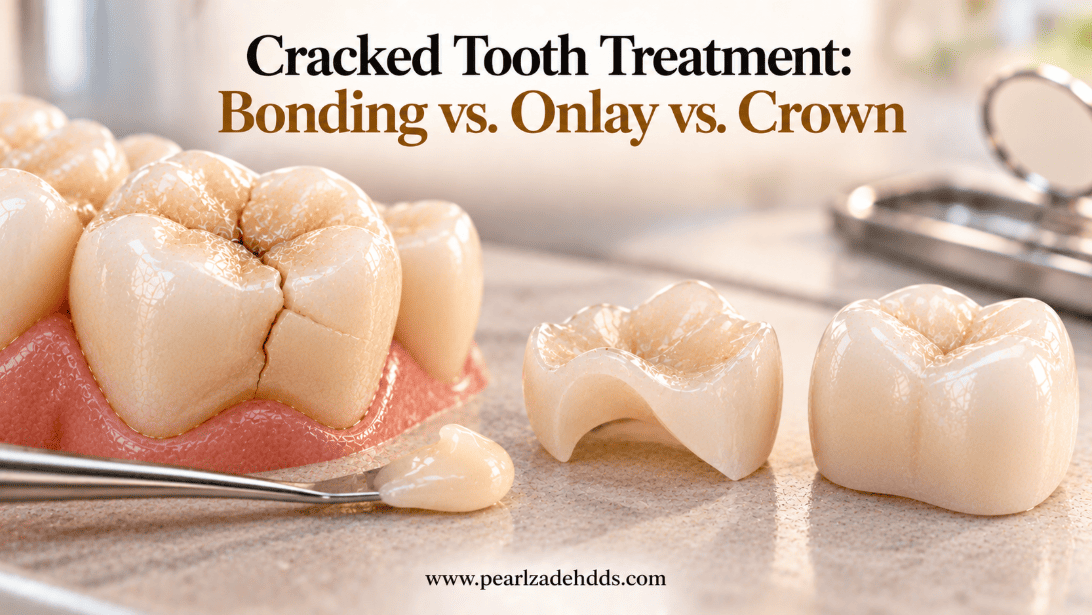
    Dentists use different treatments for cracked teeth, and each serves a different purpose. Bonding may work for limited damage. An onlay can cover one or more cusps while preserving more of the tooth than a full crown. A crown covers the tooth more extensively when it needs greater protection.

    The best option depends on more than the visible crack. Its location and depth, the amount of healthy tooth remaining, whether the pulp is affected, and whether the tooth can be restored all matter. Each treatment has benefits and limitations, which your dentist can explain after examining the tooth.

    If you need advice on what to do immediately, read our article on what to do if you have a cracked tooth.

    How Does a Dentist Choose the Right Treatment for a Cracked Tooth?

    Treatment planning looks at the whole tooth, not only the visible line. A dentist weighs several factors together:

    • The crack’s location, depth, and direction.
    • How much healthy tooth structure remains.
    • Whether the crack affects one or more cusps.
    • Whether the dental pulp is involved.
    • Existing fillings or previous restorations.
    • Bite forces, clenching, or grinding.
    • Whether the tooth can be predictably restored.

    StatPearls, a clinical reference, says the extent, position, and direction of a crack all affect prognosis. It also says teeth weakened by restorations face a higher fracture risk. Occlusal forces are the leading cause of cracked tooth syndrome, it notes. Extensive restorations and habits such as nighttime grinding can complicate matters.

    Symptoms and X-rays may not reveal every detail of a crack. A dentist may combine your history, a clinical examination, and appropriate tests to plan the options. Our article on how a cracked tooth is diagnosed when an X-ray looks normal explains that process.

    Some uncertainty can remain even after a thorough exam. StatPearls says a cracked tooth is sometimes unpredictable. It advises clinicians to explain this so patients can set realistic expectations. The AAE adds that early diagnosis can allow more conservative treatment when pulp inflammation is still reversible.

    When Can Bonding Help Repair a Cracked Tooth?

    Dental bonding uses a tooth-colored composite resin that the dentist shapes directly on the tooth. Cleveland Clinic says the dentist roughens the tooth surface and applies a liquid so the material bonds. The dentist then molds the resin and hardens it with a curing light.

    Bonding may be appropriate for selected minor defects or limited damage when enough sound tooth structure remains. A dentist may consider this conservative repair for a small area that does not carry heavy chewing force.

    For a crack without pulp symptoms, StatPearls describes removing undermined tissue, then placing a restoration such as flowable composite. It says a direct composite acts as an internal splint that limits flexing under biting load. That description covers selected cases and does not make composite a universal fix.

    The main benefit is that bonding can preserve more natural tooth structure. Cleveland Clinic says bonding typically does not require enamel removal. It lists concealing chips or minor cracks among bonding’s uses. Bonding is described there as an option for small cosmetic changes.

    The limits matter just as much. Bonding may not provide enough support when a crack crosses a load-bearing area or weakens the tooth. Cleveland Clinic says bonded material can chip over time.

    One study offers context. In a National Dental PBRN study, each of 2,858 patients had a visible crack in a back tooth. Treatment failures were associated with intracoronal restorations rather than full or partial coverage. Intracoronal restorations sit within the tooth rather than covering its cusps. The authors note that most of them were bonded composites. Because the patients were not randomly selected, the finding may not apply to every tooth.

    So bonding alone may not give enough protection for some cracked teeth. It cannot reliably stabilize every crack. A crack that extends deeply into the tooth calls for a different assessment.

    When Is an Onlay a Good Option for a Cracked Tooth?

    An onlay is a custom restoration that fits the prepared tooth. It differs from a filling because it can cover part of the chewing surface. Cleveland Clinic says an inlay fills the area between the cusps. An onlay, it adds, also covers at least one cusp. A crown, by contrast, fits over the entire tooth.

    In a cracked tooth, a weakened cusp may need more than a filling can offer. StatPearls says cuspal coverage with a crown or onlay may function extremely well as an external splint. Splinting limits flexing of the cracked tooth.

    An onlay can restore the tooth’s shape and chewing surface. It can also preserve more of the remaining tooth than some full-crown preparations. That does not hold in every case, so an onlay is not automatically the more conservative or better choice.

    The amount of remaining healthy structure matters most. An onlay needs enough sound tooth to hold and support it. If walls or cusps are thin, or the damage is widespread, an onlay may not provide enough coverage.

    A dentist judges this after examining the tooth. Sometimes the full picture appears only after the dentist removes an old filling or damaged tissue. Bite forces and the crack’s direction also factor into the decision.

    Cleveland Clinic describes onlays for a cavity too big for a filling but too small for a crown. That line addresses cavities, not cracks. For a cracked tooth, the crack’s extent and the tooth’s restorability guide the choice.

    When Does a Cracked Tooth Need a Crown?

    A crown covers the tooth more fully. Dentists may consider one when extensive damage or weakened structure calls for broader coverage. Cleveland Clinic says dentists use crowns to repair large cavities or restore broken teeth. MouthHealthy, the ADA’s consumer site, says a crown can protect a weak tooth from breaking. It can also restore a broken tooth.

    Several situations may point toward a crown. A crack may involve a cusp or a large part of the chewing surface. The tooth may have lost significant structure. An existing filling may take up much of the tooth.

    StatPearls says a full-coverage crown allows a more equal distribution of occlusal forces, which helps limit crack propagation. A crown differs from an onlay in extent. An onlay covers part of the tooth, while a crown covers all of it.

    A crown also has trade-offs. Cleveland Clinic says the dentist must remove some natural enamel to place one. StatPearls notes that crown preparation is invasive and raises the risk of devitalization. That means the pulp can lose its vitality. If your dentist recommends a crown, you can read about dental crown treatment at Pearl Zadeh DDS.

    Not every cracked tooth needs a crown. The AAE says craze lines, which are tiny cracks in the outer enamel, need no treatment beyond appearance concerns. In the PBRN study, about 80% of teeth recommended for monitoring stayed on monitoring for three years.

    A crown also cannot guarantee that a crack will stop progressing. The AAE says a crown offers maximum protection but does not guarantee success in every case. It adds that some cracks keep progressing even after treatment. The dentist must first assess the crack’s extent and whether the tooth is restorable.

    Bonding vs. Onlay vs. Crown: What Are the Differences?

    The table summarizes how the three options generally differ.

    FactorBondingOnlayCrown
    Main purposeRepairs selected minor defectsRestores damaged areas and may cover one or more cuspsProvides broader coverage for a weakened or extensively damaged tooth
    Tooth coverageLimited to the repaired areaCovers part of the tooth, including cusps when neededCovers most or all of the prepared tooth
    Tooth preparationOften minimalVaries with the damage and designUsually requires more extensive preparation
    When it may be consideredLimited damage with adequate remaining structureDamage requiring cusp coverage while preserving suitable tooth structureMore extensive damage requiring broader coverage
    Important limitationMay not provide enough support for a weakened toothNot suitable for every crack or tooth conditionCannot make every cracked tooth restorable

    These are general distinctions, not universal rules. A similar crack can call for a different restoration in a different tooth. The dentist must assess the individual tooth before recommending treatment.

    What If the Crack Reaches the Nerve or Root?

    Restorative treatment depends on how far the crack extends. When a crack reaches the pulp, the tooth may need root canal treatment before or alongside restoration.

    The AAE says a root canal removes inflamed or infected pulp from inside the tooth. It lists a crack among the possible triggers. Root canal treatment does not repair the crack itself. It treats the pulp, while a restoration addresses the tooth’s structural needs.

    This distinction explains why a restoration often follows. The AAE says the tooth is restored with a crown or filling for protection after a root canal. Cleveland Clinic says people who have root canal therapy also need a crown in most cases.

    An AAE Communiqué article cites research on cracked, root canal treated teeth. It reports a higher success rate for teeth with a full-coverage restoration than for those without. The same article says deeper initial periodontal probing depths around a crack were associated with less success. Even so, the right restoration depends on the tooth’s condition.

    A crack that extends into the root can make the outlook less favorable. The AAE says a cracked tooth whose crack extends below the gum line is no longer treatable. It adds that a split tooth cannot be saved intact, though part of it sometimes can. A vertical root fracture may require extraction.

    StatPearls says clefting of the pulp chamber floor usually means the tooth cannot be restored. When a tooth cannot be restored predictably, extraction may be the appropriate recommendation. Your dentist can explain which situation applies.

    How Can You Protect a Tooth After Cracked-Tooth Treatment?

    Follow your dentist’s instructions for your specific restoration. Keep up your daily oral hygiene, and attend the follow-up visits your dentist recommends. Those visits let the dentist check the tooth and the restoration.

    Grinding and clenching deserve attention. The AAE advises against both. It says to talk to your dentist about a retainer or other mouthguard if you grind during sleep. StatPearls recommends a bite check after a recent restoration. If your bite feels uneven, tell your dentist.

    The AAE also notes that some cracks keep progressing even after treatment. That is one reason follow-up matters. If you receive a crown, our article on how long porcelain crowns last with proper care covers upkeep.

    No restoration comes with a guarantee, and lifespans vary from tooth to tooth. Dr. Pearl Zadeh can examine your tooth and explain which options fit your situation.

    Call (818) 716-6722 or click the button below to schedule your consultation online.

    Frequently Asked Questions

    Can bonding fix a cracked tooth?

    Sometimes, for selected minor defects or limited damage with enough sound tooth structure. Bonding may not support a tooth weakened by a deeper crack. Your dentist can tell whether it suits your tooth.

    Is an onlay better than a crown for a cracked tooth?

    Not automatically. An onlay may preserve more tooth in some cases. A crown may suit a tooth that needs broader coverage. The better choice depends on the crack and the remaining structure.

    Does every cracked tooth need a crown?

    No. The AAE says craze lines need no treatment beyond appearance concerns. Other cracks may call for bonding, an onlay, a crown, or monitoring. A dentist decides after assessing the tooth.

    Can a cracked tooth need a root canal and a crown?

    Yes, in some cases. If a crack reaches the pulp and the tooth is restorable, root canal treatment addresses the pulp. A crown or other restoration then protects the tooth. Neither step repairs the crack itself.

    Can a cracked tooth be saved without extraction?

    Sometimes. It depends on the crack’s location and extent, pulp involvement, and whether the tooth can be restored. A split tooth or a crack below the gum line may not be savable. Your dentist can explain what applies.

    The information above is for informational purposes only and is not a substitute for professional dental advice. Please schedule a consultation with Pearl Zadeh DDS to discuss your specific situation.
  • How to Fix a Chipped Front Tooth: Bonding, Veneers, or Crowns?

    How to Fix a Chipped Front Tooth: Bonding, Veneers, or Crowns?

    You bite into something hard and notice a rough edge with your tongue. Part of your front tooth has chipped, and the damage is visible when you smile. You want to know how it can be repaired.

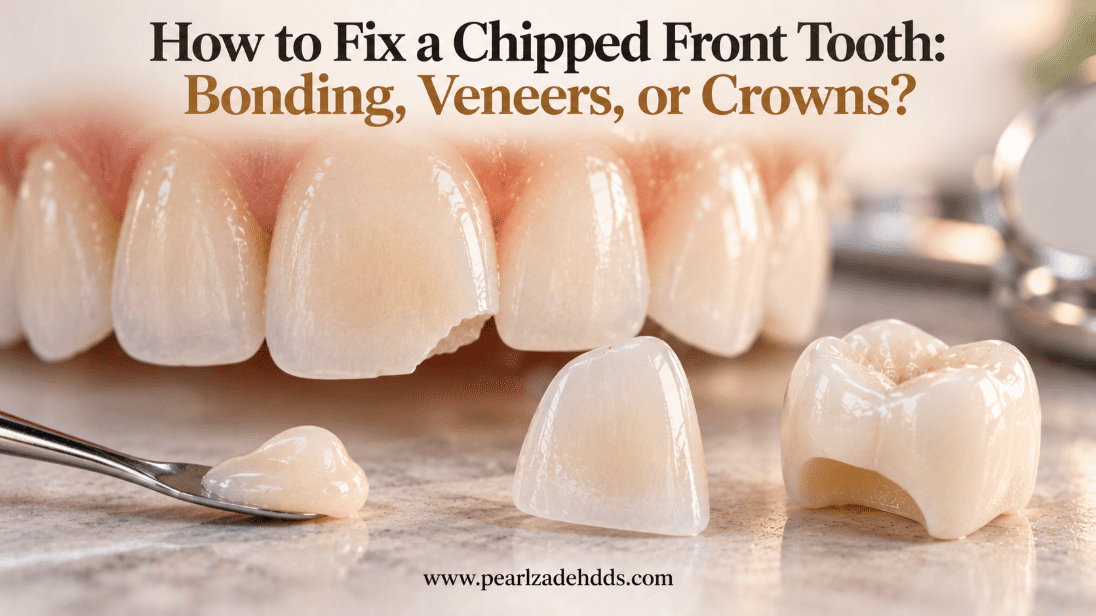
    The best way to fix a chipped front tooth depends on the size and location of the chip, the condition of the tooth, and the result you want. A small chip may need only smoothing or dental bonding. A larger chip may be better suited to a veneer or crown.

    Each option repairs the tooth differently. A dental exam can help determine which treatment is appropriate for your tooth.

    What Should You Do If You Chip a Front Tooth?

    Have the tooth evaluated, especially if the chip is large, painful, or sensitive. Cleveland Clinic advises scheduling an appointment as soon as possible after you notice a chip. It says an untreated chip can cause other problems if the damage goes beyond the enamel.

    Until your dentist assesses the tooth, avoid biting hard foods with it. Choose soft foods and keep the area clean. Cleveland Clinic suggests covering jagged edges with orthodontic wax. Bring any broken piece you can find to your appointment.

    A chip that follows an injury needs closer attention. Significant pain, bleeding that does not stop, or other signs of serious injury warrant prompt professional care. Cleveland Clinic says to call your dentist right away if an injury loosened a tooth. It lists bleeding that will not stop as a reason to go to an emergency room. Severe pain that medication does not relieve is another.

    How Do Dentists Choose the Right Repair?

    Dentists weigh several factors before recommending a repair. No single factor decides the plan. They include:

    • The size, depth, and location of the chip.
    • Whether the damage involves enamel only or extends into dentin.
    • Whether the tooth has a crack or other structural damage.
    • How much healthy tooth structure remains.
    • The tooth’s color, shape, and position.
    • Bite forces and habits such as grinding.
    • Your cosmetic goals and expectations.

    Cleveland Clinic explains that with a chip, some enamel breaks off, while a crack runs through the tooth. You need a dental provider to know for sure which you have. Slight chips usually cause no major issues. Severe chips that expose the tissue beneath the enamel need dental work to protect the tooth.

    Appearance alone cannot determine the best treatment. A small chip may hide a deeper problem. Likewise, a large chip may be simple to restore. Your dentist may need to examine the tooth and assess the surrounding structures, sometimes with X-rays.

    Habits matter, too. Grinding, nail biting, and chewing hard objects add stress to a repair. Mayo Clinic says severe grinding may damage fillings, crowns, and other dental repairs. Tell your dentist about any of these habits.

    Your goals count as well. Some patients want the least possible tooth removal. Others want a change in shape or color. Share your priorities so your dentist can match the options to them.

    Can Dental Bonding Fix a Chipped Front Tooth?

    Often, yes. Composite resin bonding can restore a tooth’s shape by adding material to the damaged area. Whether it suits your tooth depends on the chip and the tooth’s condition.

    Cleveland Clinic says bonding can improve the appearance of minor chips. The AAE says most chipped teeth can be repaired. Options include reattaching the broken piece of enamel or bonding a tooth-colored filling or crown in place. Bonding may suit smaller chips, especially when enough healthy tooth remains to support the material.

    Cleveland Clinic describes the process in several steps. The dentist selects a resin shade, roughens the tooth surface, and applies a liquid. Putty-like resin is then molded, smoothed, and hardened with a curing light. Final adjustments and polishing follow.

    Bonding is a conservative approach. Cleveland Clinic says it typically does not require enamel removal, unlike veneers or crowns. That may help preserve more natural tooth structure.

    Bonding also has limits. Cleveland Clinic notes that resin does not resist stains as well as porcelain and can chip over time. The ADA lists potential staining and discoloration as disadvantages of composite resin. Color matching varies, too. Your dentist selects a shade to blend with your natural teeth, but no one can promise an exact match.

    Bonding may not provide enough support in some cases. A large chip, little remaining structure, or heavy bite forces may call for another restoration. Bonding is also not permanent. It may need polishing, repair, or replacement over time.

    When Might a Veneer Be Better for a Chipped Front Tooth?

    A veneer covers the front surface of a tooth. Your dentist may consider one when a chip affects appearance and enough healthy structure remains to support it. A veneer is not automatically better than bonding.

    Veneers differ from bonding in scope. Bonding rebuilds the damaged area. Cleveland Clinic describes veneers as custom-made shells that fit over the front surfaces of teeth. They can conceal chips and stains. A veneer may help when shape, color, or surface concerns extend beyond the chip. The same page notes that veneers do not necessarily strengthen or repair a tooth.

    Your dentist must evaluate the enamel and the tooth’s overall condition first. Cleveland Clinic says veneers are an option only if you are free of extensive cavities and gum disease. MouthHealthy adds that porcelain placement involves removing a small amount of enamel, while composite veneers may require less. It says the treatment is not reversible because enamel is removed.

    A veneer is not suitable for every chipped tooth. MouthHealthy says veneers may not be a good choice if you clench, grind, or have a deep overbite. A large chip or limited enamel may also point to another option. Your dentist will explain why a veneer does or does not fit your tooth.

    When Does a Chipped Front Tooth Need a Crown?

    A crown covers the tooth more fully than a veneer does. Dentists may consider one when damage is extensive or the tooth needs more structural protection. Cleveland Clinic describes crowns as caps that protect a tooth that is weak or has experienced major damage. These situations may lead a dentist toward a crown:

    • Larger chips or fractures that leave the tooth weakened.
    • Significant loss of tooth structure.
    • Existing restorations or other factors that affect strength.

    A crown also differs from a veneer in coverage. Cleveland Clinic says a crown covers the entire tooth structure to add strength and protection. Its page on dental crowns says preparation involves removing some natural enamel and placement usually requires two appointments. Your schedule depends on the tooth and your treatment plan.

    Before choosing a crown, your dentist must decide whether the tooth can be predictably restored. That depends on the remaining structure, the condition of the inner tooth, and the bite. If a chip reaches the inner tissue, other treatment may be needed first. A crown is not the answer for every chipped front tooth.

    If a crown is planned, material is another decision. Our article on how zirconia and porcelain crowns compare explains the options. Front teeth also raise color questions. Our article on why a dental crown can look different from your other teeth covers what affects the match.

    Bonding vs. Veneers vs. Crowns: How Do They Compare?

    The table below summarizes general differences. Treat it as a guide, not a set of rules. The exact preparation and coverage depend on the clinical situation.

    FactorDental bondingVeneerCrown
    Typical purposeRepairing smaller chips and reshaping teethImproving the front surface’s appearance in selected casesRestoring and covering a more extensively damaged tooth
    Tooth coverageLimited to the repaired areaPrimarily the front surfaceCovers most or all of the visible tooth, depending on design
    Tooth preparationOften minimalMay require enamel removalUsually requires more extensive preparation
    MaintenanceMay need polishing or repairRequires ongoing oral care and monitoringRequires ongoing oral care and monitoring
    Best choiceDepends on the chip and tooth conditionDepends on the tooth’s structure and cosmetic needsDepends on the extent of damage and need for protection

    Appearance, durability, and treatment needs differ for each option and vary from tooth to tooth. Your dentist can explain how those trade-offs apply to your chip.

    How Long Does a Chipped Front Tooth Repair Last?

    Longevity varies. Material, bite forces, oral hygiene, and restoration size all play a role. Habits such as nail biting or chewing hard objects matter, too. No option lasts longest in every case, and no repair carries a guarantee.

    Cleveland Clinic says bonding typically lasts three to ten years before it needs a touch-up or replacement. It adds that lifespan depends on habits and the number of teeth treated. The ADA’s direct restorations page says patient behavior is reportedly the most significant factor in composite longevity.

    Veneers and crowns need the same daily care and regular exams. Their lifespan also varies with the tooth, the material, and your habits. Regular checkups let your dentist monitor any repair and polish or fix it when needed.

    Our article on how long porcelain crowns last with proper care explains what affects crown longevity in more detail.

    Can a Chipped Front Tooth Be Whitened Instead of Repaired?

    No. Whitening changes tooth color. It does not rebuild missing tooth structure. MouthHealthy says bleaches break stains into smaller pieces, which does nothing for a missing piece of tooth. A chip still needs a suitable restorative approach.

    Your dentist may discuss whitening when color is also a concern. MouthHealthy says whitening will not work on caps, veneers, crowns, or fillings. Bonding is made of tooth-colored resin, so ask your dentist how it will respond. Existing and new restorations do not whiten the way natural teeth do. You can read about teeth whitening at Pearl Zadeh DDS to learn more.

    A chipped front tooth can often be repaired, but the right option depends on your tooth. Dr. Pearl Zadeh can examine it, explain what the findings mean, and discuss the options that fit. You can learn more about dental crown treatment or explore cosmetic dentistry at Pearl Zadeh DDS.

    Call (818) 716-6722 or click the button below to schedule your consultation online.

    Frequently Asked Questions

    Can a small chip in a front tooth be repaired with bonding?

    Often, yes. Bonding may suit a small chip when enough healthy tooth remains to support the material. Your dentist confirms that after an exam and may find that smoothing the edge is enough.

    Is bonding or a veneer better for a chipped front tooth?

    Neither is better for every tooth. Bonding is more conservative and may suit a smaller chip. A veneer may help when changes in shape or color extend beyond the chip. Your dentist compares both for your tooth.

    When does a chipped front tooth need a crown?

    A crown may be considered for a large chip, major structure loss, or a tooth that needs protection. Not every chipped tooth needs one. Your dentist must decide whether the tooth can be predictably restored.

    Can a chipped front tooth be repaired in one appointment?

    Some repairs may be completed in one visit. Cleveland Clinic says bonding usually takes a single office visit. It describes a second visit for veneers and two appointments for crowns. Timing depends on the treatment and the condition of your tooth.

    Will a repaired front tooth look natural?

    A repair can blend well with neighboring teeth, but no one can promise a perfect result. The material, shade selection, and condition of your natural teeth all affect the outcome. Share your cosmetic goals before treatment.

    The information above is for informational purposes only and is not a substitute for professional dental advice. Please schedule a consultation with Pearl Zadeh DDS to discuss your specific situation.