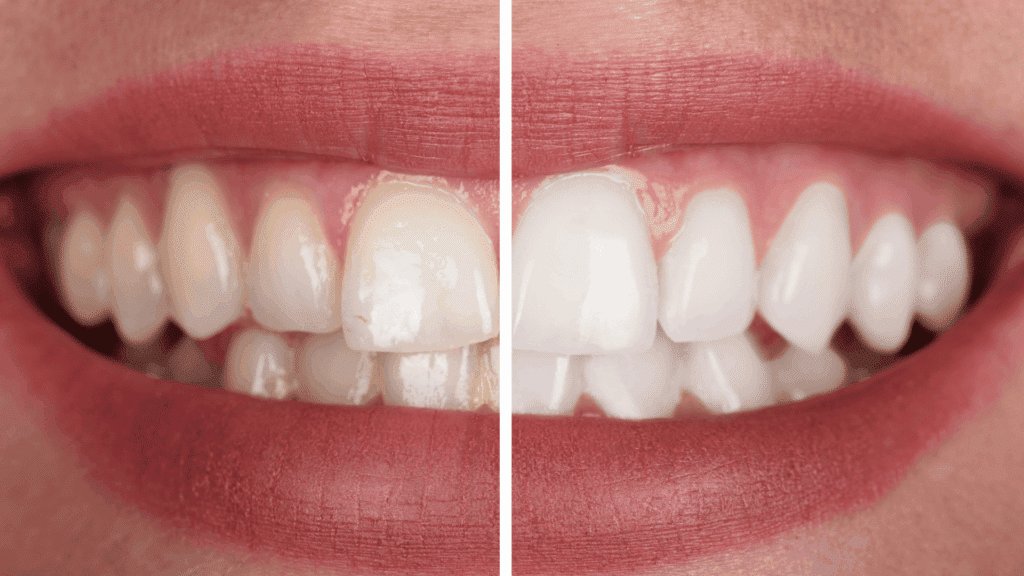
In the past decade there has been a dramatic interest in cosmetic dentistry. We all realize that having a healthy, bright, beautiful smile enhances our appearance and allows us to smile with confidence. Thanks to the advances in modern cosmetic dentistry, we are able to improve our teeth and smiles with quick, painless and surprisingly affordable treatments.
What can cosmetic dental treatments do?
Change the size, shape, and alignment of certain teeth.
Fill in unattractive spaces between teeth.
Improve or correct bites.
Lighten or brighten the color of teeth.
Repair decayed, broken, cracked, or chipped teeth.
Replace missing teeth.
Replace old, unattractive dental treatments.
Remember, your smile speaks before you even say a word!
Veneers are one of the most popular cosmetic dentistry treatments available, thanks to their ability to change the appearance of your smile quickly and effectively. If you have minor cracks and chips on your teeth, discoloration, or minor shape or spacing issues, dental veneers will cover those problems and give you an aesthetically pleasing smile. As with any kind of dental treatment, if you are considering veneers, you probably are wondering how long they will last. Here is what you need to know.
Veneers 101
Veneers are thin, wafer-like shells that are bonded to the front of your teeth. They are made of porcelain, and are custom-designed to match the shape and shade you desire. Your dentist will work with you to create your veneers so that they address the concerns you have with your teeth while blending seamlessly with your natural teeth. Your dentist may recommend veneers to correct misshapen or worn teeth, crooked or widely spaced teeth, and severe discoloration that does not respond to whitening treatments. Veneers can also be used to create a more uniform smile if your teeth are noticeably different in size.
It usually takes two visits to get veneers. During the first visit, your dentist will remove a small amount of tooth enamel to make room for the veneers. He or she will make impressions of your mouth so that your veneers can be custom-sized. Your dentist will also help you choose the color of your veneers during this visit. At your second appointment, your veneers will be bonded to your teeth after any necessary adjustments are made.
The Longevity of Dental Veneers
There are many factors that impact the longevity of veneers, including how you care for them and your overall oral health. Typically, veneers last for five to 10 years, though many people are able to get many more years out of them. Following your dentist’s care plan will dramatically increase the lifespan of your veneers.
To care for your veneers, maintain a high-quality oral hygiene routine, including brushing at least twice per day with a soft-bristled toothbrush and flossing at least once daily. Visit your dentist at least twice per year for a professional cleaning and check-up. If you grind your teeth, talk to your dentist about using a mouthguard to protect your veneers.
Could veneers give you the smile you’ve always wanted? Find out if you’re a good candidate for dental veneers by scheduling a consultation with Pearl Zadeh, DDS.
Preparing for Your Veneers Appointment: A Complete Guide
Pearl Zadeh DDSCosmetic Dentistry
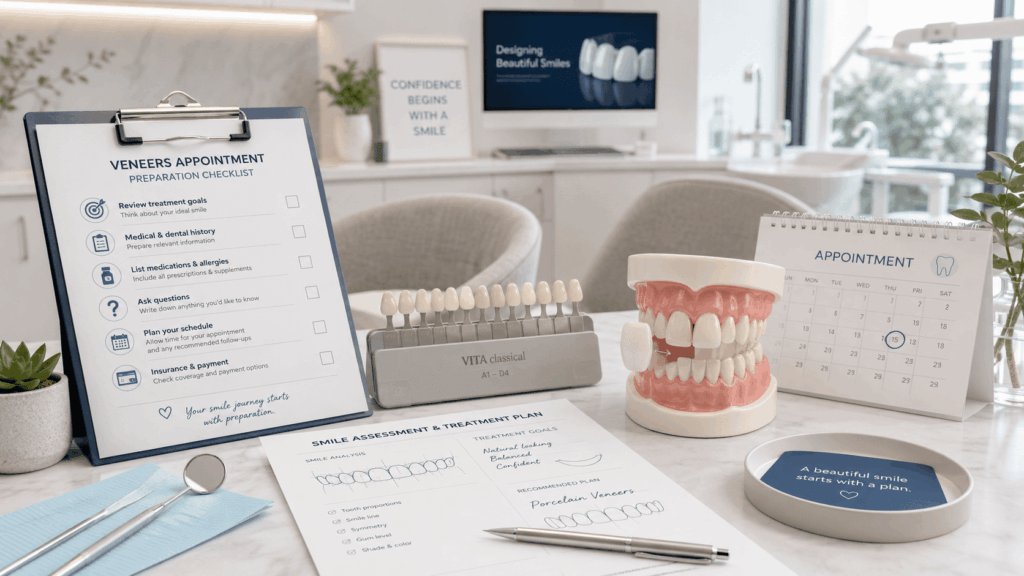
Getting veneers is a decision that usually comes with a lot of questions. You may want to know what happens during the first consultation, how your dentist evaluates your smile, or what steps come before the final placement. Knowing what to expect ahead of time can help you have a more productive conversation with your dentist and feel more prepared for the process.
From your first appointment to the final placement, each step gives your dentist a chance to understand your goals, assess your teeth, and create a treatment plan that fits your needs.
Why Preparing for Your Veneers Appointment Matters
Veneers involve more decisions than most patients expect going in: material, shade, shape, and how many teeth to treat. Walking into your first appointment with even a rough sense of your goals tends to make that conversation more productive, and it helps you follow along once your dentist starts explaining the options that fit your teeth.
Preparation doesn’t mean you need every decision made ahead of time. Your dentist will guide you through most of it. It simply means you’re not starting from zero once you sit in the chair. If you’re comparing veneers in Woodland Hills against other cosmetic options, understanding the general process before your first visit can make that decision easier.
What Happens During Your Veneers Consultation
Most veneer treatment starts with a consultation focused on conversation and evaluation, not any actual tooth preparation. This is where your dentist gathers the information needed to recommend an appropriate plan.
Talking Through Your Smile Goals
Your dentist will likely ask what you want to change about your smile, such as color, shape, spacing, or a combination of concerns. Bringing photos of smiles you like can help you explain your goals more clearly. Examples of what you would like to improve can also give your dentist a better understanding of your expectations.
Your consultation will also cover how many teeth you want to treat. Veneers can address a single tooth or multiple teeth, depending on your goals and dental needs. If you are considering a broader smile change, learning what a smile makeover includes can help you understand how veneers may fit into a larger treatment plan.
Evaluating Your Oral Health First
Before recommending veneers, your dentist typically examines your teeth and gums and may take x-rays or photos depending on your history. Active decay, gum disease, or a significant bite problem generally needs attention first, since a veneer placed over an unhealthy tooth may not hold up as expected. This evaluation is also where your dentist helps determine whether porcelain, composite, or a combination fits your case. Our porcelain veneers guide and our composite veneers overview both go into more detail on what each material generally involves.
Questions Worth Asking Before You Move Forward
A short list of questions can make your consultation more productive and help you leave with a clearer picture of what’s ahead:
How many teeth do you recommend treating, and why that number specifically?
Which material fits my goals, budget, and the condition of my teeth?
Roughly how much enamel will be removed, and is that amount typical for my case?
What should I expect my temporary veneers to look and feel like?
What happens if I’m not happy with the shade or shape once I see the temporaries?
Not every dentist answers these the same way, and that’s fine. The goal is simply having the information before treatment starts rather than discovering it along the way.
How to Prepare Physically and Mentally for the Visit
You do not need to make major physical preparations before a veneers consultation. However, a few simple steps can help you get more from your visit. If your dentist plans to discuss shade matching, arrive with your teeth in their usual condition. Avoid whitening strips or heavily pigmented foods right before your appointment, since your natural tooth color helps guide shade discussions.
It also helps to think about your goals before you arrive. You do not need to decide on an exact look beforehand. Veneer treatment involves a conversation between you and your dentist, and your dentist’s evaluation helps determine suitable options. Bringing a list of questions, even simple ones, can help you cover important details during your consultation.
What Happens When Your Teeth Are Prepared
If you move forward with treatment, a separate appointment (or a later part of the same visit, depending on your dentist’s process) is typically used to prepare your teeth.
Understanding Enamel Removal
For porcelain veneers, your dentist may remove a thin layer of enamel from the front surface of each treated tooth. The amount often measures less than half a millimeter, but it depends on your teeth and treatment plan. This step helps the veneer fit properly and create a natural appearance.
The American Dental Association notes that veneer treatment is generally not considered reversible once enamel removal occurs. Understanding this before treatment can help you make an informed decision. Composite veneers may require less enamel removal in some cases, depending on your specific needs. Your dentist can explain what applies to your teeth.
Dentists often use local anesthesia during enamel preparation. Most patients feel pressure rather than pain, although some may notice temporary sensitivity afterward.
Wearing Temporary Veneers
Your dentist customizes your permanent veneers, and the process often takes one to two weeks. During this time, you may wear temporary veneers to protect your prepared teeth. Temporary veneers can also provide a preview of the planned length and shape, although they may not look exactly like your final veneers.
If the shape or length does not feel right, tell your dentist during this stage. Discussing adjustments before your permanent veneers are completed can make it easier to address your concerns.
Choosing Your Shade and Shape
Shade selection typically happens during your consultation or your preparation appointment, depending on your dentist’s process. Rather than matching veneers exactly to your current tooth color, many patients choose a shade that’s noticeably brighter, though how bright depends on what looks natural against your skin tone and the rest of your smile.
If you’re still deciding between materials, comparing porcelain and composite veneers side by side can help clarify which fits your goals and budget before your consultation. Shape and length work similarly. Your dentist may use digital imaging or a mock-up to give you a general preview, though final results can vary once the lab has custom crafted each veneer.
Caring for Your Smile Around Your Appointments
In the days before your appointment, continue your normal oral hygiene routine rather than making drastic changes. If your consultation includes shade matching, limiting heavily pigmented foods and drinks like coffee, tea, or red wine for a day or two beforehand may help. Your natural tooth color plays a role when your dentist discusses shade options.
After your dentist places your permanent veneers, care usually looks similar to caring for natural teeth. Continue brushing, flossing, and attending routine checkups. Your dentist may also recommend avoiding habits like biting your nails or chewing very hard foods, as these habits can affect veneer condition over time. Veneer maintenance and replacement needs vary from person to person. Your dentist can explain what to expect based on your specific case.
Finding the Right Cosmetic Dentist in Woodland Hills
A dentist’s experience with veneers matters as much as the material itself. This becomes especially important when matching shades, shaping veneers, and making the preparation process comfortable. Dr. Pearl Zadeh takes a cosmetic-focused approach to veneer treatment for patients in Woodland Hills. Her team supports each step, from your first consultation to your final placement appointment.
If you are exploring cosmetic dentistry beyond veneers, our Woodland Hills cosmetic dentistry services cover a wider range of treatment options.
Schedule Your Veneers Consultation With Dr. Pearl Zadeh
Getting ready for a veneers appointment doesn’t need to feel like a guessing game. Knowing the general steps ahead of time, and coming in with a few questions, tends to make the whole process feel more collaborative from the start.
Dr. Pearl Zadeh and her Woodland Hills team can walk you through your options, answer your questions directly, and help you understand what a treatment plan built around your specific teeth and goals might look like.
Call (818) 716-6722 or click the button below to schedule your veneers consultation online.
1. How long does the veneers process take from consultation to final placement?
This typically spans a few weeks in total, though it depends on how many teeth are involved, your dentist’s process, and the dental lab’s timeline for fabricating your veneers.
2. Will I feel pain during tooth preparation?
Local anesthesia is generally used during this step, so most patients feel pressure rather than pain. Some mild sensitivity in the days afterward is possible and typically manageable.
3. Can I eat normally with temporary veneers?
Generally yes, though your dentist may suggest avoiding very hard or sticky foods that could dislodge a temporary. Ask your dental team for guidance specific to your temporaries.
4. What if I don’t like the shade once I see my temporary veneers?
Mention it to your dentist as soon as possible. Adjustments are typically easier to make before the permanent veneers are finished at the lab than after they’ve already been fabricated.
5. How many appointments does getting veneers usually take?
Most patients need at least two appointments: one for consultation and preparation, and one for final placement. Some dentists split these into three visits depending on the case.
If you are unhappy with your smile, you may be a good candidate for veneers. Veneers are thin pieces of porcelain that are bonded to the front surface of your teeth. They can improve the appearance of your teeth by changing their color, shape, and size.
What are Veneers?
If you are unhappy with your smile, you may be a candidate for veneers. Veneers are thin shells of porcelain that are bonded to the front of your teeth. This can help improve the appearance of your smile by hiding any flaws or imperfections.
Veneers can be used to correct a wide variety of cosmetic dental issues, such as:
gaps between teeth
misshapen or chipped teeth
discoloration or staining
permanently stained or yellowed teeth
Veneers are an ideal solution for people who want to improve the appearance of their smile without undergoing extensive dental work. The procedure is relatively simple and can be completed in just a few visits to the dentist.
If you are considering veneers in Woodland Hills, it is important to consult with a qualified cosmetic dentist to discuss if this treatment is right for you.
Benefits of Getting Veneers
There are many benefits that come along with getting veneers. For one, veneers can help restore your smile to perfection. If you have chipped, cracked, or stained teeth, veneers can cover up those imperfections and give you the perfect smile you’ve always wanted.
Another benefit of getting veneers is that they are a very durable option. They can last for many years with proper care and maintenance. Additionally, veneers are stain-resistant, so you won’t have to worry about your teeth yellowing over time.
If you’re looking for a way to boost your confidence and improve your smile, consider getting veneers. With their many benefits, they’re sure to give you the results you desire!
Types of Veneers
There are two types of veneers: direct and indirect.
Direct veneers are made from a mold of your teeth and applied directly to your teeth.
Indirect veneers are made from a mold of your teeth and then sent to a lab to be created. Once the veneers are ready, they will be applied to your teeth.
Both types of veneers are made from porcelain or ceramic.
Porcelain is the more expensive option, but it is also more durable and looks more natural.
Ceramic is less expensive but not as durable or natural looking.
The type of veneer you choose will depend on your budget and your needs. If you need a quick fix and don’t mind spending a little extra, direct veneers may be the best option for you. If you want something that looks more natural and will last longer, indirect veneers are the way to go.
How to Choose the Right Veneer for You?
When you are considering veneers, it is important to choose the right type for your needs. There are two main types of veneers: composite and porcelain.
Composite Veneers: Composite veneers are made from a mixture of plastic and ceramic materials. They are less expensive than porcelain veneers and can be applied directly to the teeth. However, they are not as durable as porcelain veneers and may not last as long.
Porcelain Veneers: Porcelain veneers are made from thin sheets of porcelain that are bonded to the front of the teeth. They are more expensive than composite veneers but they are also more durable and natural looking. Porcelain veneers can last for many years with proper care.
When choosing between composite and porcelain veneers, it is important to consider your budget as well as your aesthetic goals. If you want a more affordable option, composite veneers may be right for you. If you want a longer lasting solution with a more natural look, porcelain veneers may be a better choice.
Care and Maintenance of Your Dental Veneers
Assuming you have already had your veneers placed, congratulations! Veneers are a fantastic way to restore your smile to perfection. But like all dental work, they require proper care and maintenance to keep them looking their best. Here are a few tips on how to take care of your new veneers:
Brush and floss regularly
Just because you have veneers doesn’t mean you can neglect your oral hygiene! Be sure to brush at least twice a day and floss once a day to keep your teeth and gums healthy.
See your dentist regularly
It’s important to see your dentist for routine checkups and cleanings even if you have veneers. This will help ensure that your veneers stay in good shape and that your mouth stays healthy overall.
Avoid biting or chewing hard objects
Biting or chewing on hard objects (think: ice, hard candy, etc.) can damage or break your veneers. So be sure to avoid these things altogether.
Be careful with whitening products
If you want to whiten your teeth, talk to your dentist first. Some whitening products can damage or discolor veneers, so it’s best to get the okay from a professional before using any type of whitening product.
Conclusion
Veneers are a great way to instantly restore your smile and improve the look of your teeth. Veneers can help correct discoloration, chips, gaps and other imperfections in your smile quickly, easily and painlessly. With proper care, veneers can last for decades with little to no maintenance required. So if you’re looking for a quick fix that will dramatically improve the look of your smile, veneers may be the perfect solution!
FAQs
Q: What are dental veneers?
A: Veneers are wafer-thin, porcelain shells that are bonded to the front of your teeth. They are used to improve the appearance of your smile by changing the shape, size, and color of your teeth.
Q: How long do veneers last?
A: Veneers can last for many years with proper care. However, they may need to be replaced or repaired over time.
Q: How much do veneers cost?
A: The cost of veneers varies depending on the type of veneer, the number of teeth being treated, and the dentist performing the procedure.
Q: Are there any risks associated with veneers?
A: There are some risks associated with veneers, such as tooth sensitivity and damage to the underlying tooth structure. However, these risks are usually minor and can be avoided with proper care.
How Much Does Dental Bonding Cost in Woodland Hills?
Pearl Zadeh DDSCosmetic Dentistry
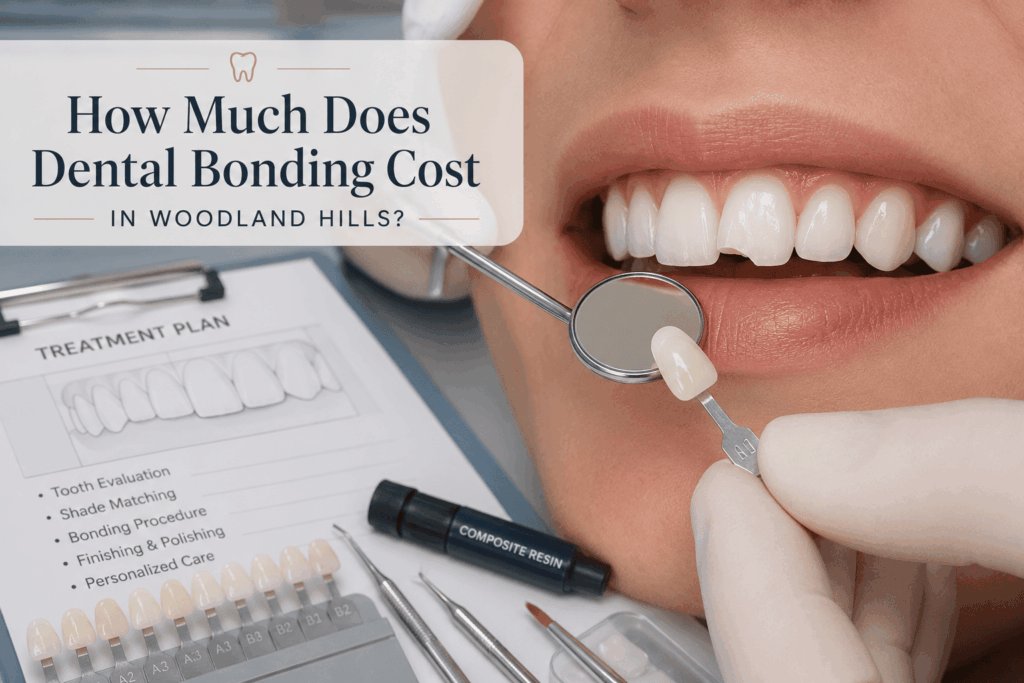
You want to repair a chipped tooth, close a small gap, or improve the appearance of one tooth that has bothered you for years. Naturally, one of your first questions is, “How much will it cost?”
The answer can feel frustrating. One website gives a low figure, another quotes something much higher, and neither explains why.
That’s because dental bonding does not have a single standard price. Every treatment is customised. The final cost depends on your teeth, your cosmetic goals, and the amount of work needed to create a natural-looking result. A personalised examination is the only reliable way to understand what your treatment is likely to involve.
Why There Isn’t a Fixed Price for Dental Bonding
Dental bonding is very different from a routine cleaning or examination. Dentists do not perform the same procedure on every patient.
Every bonded restoration is designed around the individual tooth. Your dentist considers its shape, size, colour, position, bite, and the cosmetic result you want to achieve before recommending treatment.
Two patients may both ask about repairing a chipped front tooth. One may need a simple edge repair that takes very little reshaping. The other may need the tooth rebuilt, colour matched, and blended with neighbouring teeth. Although both treatments involve bonding, they require very different amounts of planning and clinical work.
This is why responsible cosmetic dentists avoid giving exact prices before examining your smile.
Why You Cannot Compare Your Cost With Someone Else’s
Many patients ask friends what they paid or search online for average prices. While understandable, those comparisons rarely provide useful information.
Your friend’s treatment reflects their teeth, not yours.
Even two chips that appear similar can require different treatment. One may involve only enamel, while another extends deeper into the tooth. One patient may have excellent enamel for bonding, while another may have older restorations that change the treatment plan.
The same principle applies to cosmetic goals. One patient simply wants to repair damage. Another wants to improve tooth shape, symmetry, and colour at the same time.
Although both patients receive dental bonding, they are paying for different procedures.
What Actually Affects the Cost of Dental Bonding
Several factors influence the final treatment plan. Understanding them helps explain why dental bonding does not have a fixed fee.
Number of Teeth Being Treated
Treating one tooth is naturally simpler than treating several.
Each bonded tooth requires individual shade selection, careful shaping, finishing, and polishing. As more teeth become involved, the amount of planning and clinical time increases.
Not every bonding procedure requires the same amount of work.
Repairing a tiny corner chip often involves a small amount of composite resin and minimal reshaping. Rebuilding a larger section of a tooth requires additional layering, sculpting, and polishing to recreate its natural contours.
Larger corrections also demand greater precision because the repaired tooth must continue to look balanced with the surrounding teeth.
Repairing Existing Bonding or Starting Again
Older bonding does not always require complete replacement.
Sometimes your dentist can repair a small chip or refresh part of the restoration without removing the existing composite. In other situations, replacing the bonding creates a stronger and more predictable result.
Others require careful artistic shaping to recreate natural curves, edges, and proportions.
For example, rebuilding a front tooth that catches the light every time you smile often requires far more precision than repairing a small area that rarely shows.
That additional detail requires more time, which naturally influences treatment complexity.
One of the biggest factors patients rarely think about is colour matching.
Natural teeth contain subtle variations in shade, translucency, and brightness. Composite resin must blend with those variations rather than appear as a single flat colour.
Some smiles are straightforward to match. Others require more careful shade selection and detailed finishing to make the bonding disappear into the surrounding teeth.
This attention to detail often determines whether bonding looks obvious or completely natural.
Additional Cosmetic Treatment
Bonding sometimes forms part of a larger cosmetic plan.
Some patients combine bonding with whitening. Others receive bonding on one tooth while improving neighbouring teeth with veneers or other cosmetic treatments.
When several procedures happen together, your dentist plans them as one coordinated treatment rather than several unrelated appointments.
Your Overall Smile Goals
Your expectations influence treatment planning just as much as your teeth.
Some patients simply want to repair a small chip. Others hope to improve symmetry, reshape several teeth, or refresh their entire smile.
Those goals affect the amount of planning, shaping, and finishing required.
Your dentist also considers your bite. If you grind or clench your teeth, additional planning may help protect the restoration over time. Similar considerations appear in our discussion of veneers for patients who grind their teeth, since bite forces influence many cosmetic treatments.
Why Preserving Natural Tooth Structure May Simplify Treatment
Dental bonding is considered a conservative cosmetic treatment because it usually adds material rather than removing significant tooth structure.
When a tooth has healthy enamel and a stable foundation, your dentist often has more flexibility when shaping and placing the composite resin. This can make the treatment process more straightforward.
However, teeth with larger areas of damage, previous restorations, or other concerns may require additional planning. Your dentist may need to consider how those factors affect the strength, appearance, and long-term stability of the restoration.
How Bonding Compares With Veneers From a Planning Perspective
Dental bonding and veneers can address similar cosmetic concerns, but they use different approaches.
Bonding usually requires less preparation, fewer appointments, and no laboratory fabrication. This often makes it a more conservative and accessible option for smaller cosmetic changes.
Veneers involve custom-made shells that cover the front surface of the tooth. They require additional planning, material selection, and fabrication, which typically increases the overall treatment investment.
Cost is only one part of the decision. Your dentist also considers your tooth structure, cosmetic goals, bite, and the type of result you want to achieve. Our comparison of bonding and veneers explains the differences between these options in more detail.
Does Insurance Cover Dental Bonding?
Insurance coverage for dental bonding depends largely on the reason for treatment.
Some plans may provide benefits when bonding repairs a damaged tooth, such as one affected by a chip or decay. However, many cosmetic procedures, such as changing the shape or appearance of healthy teeth, may not receive coverage.
The American Dental Association notes that dental benefits vary widely between insurance plans. Reviewing your policy or contacting your insurance provider is the best way to understand what your plan covers.
Why Online Price Estimates Rarely Apply to You
Online cost estimates often combine many different types of bonding cases into one general number.
A small repair on one front tooth is very different from replacing older bonding on several teeth. The amount of material needed, the time required, and the level of cosmetic detail can vary significantly between patients.
Other factors, including location, dentist experience, and case complexity, also influence treatment fees. A general online estimate cannot account for the details that make your situation unique.
Why a Consultation Matters More Than a Quick Number
A consultation gives your dentist the opportunity to examine your tooth, understand your goals, and determine what type of treatment makes sense.
During this evaluation, your dentist can assess the condition of your tooth, explain your options, and provide a more accurate estimate based on your specific needs.
Instead of relying on a general price found online, a personalised consultation gives you information that applies to your actual smile.
Choosing a Cosmetic Dentist in Woodland Hills
A transparent treatment plan starts with a detailed evaluation, not a rushed estimate.
Dr. Pearl Zadeh and her Woodland Hills team take the time to evaluate each patient’s teeth, discuss their goals, and explain why a specific treatment approach may be recommended. This helps patients understand the reasoning behind their treatment plan before making a decision.
Schedule a Consultation With Dr. Pearl Zadeh
The most accurate answer to what dental bonding will cost starts with your individual smile, not a general online estimate.
Dr. Pearl Zadeh and her Woodland Hills team can evaluate your tooth, discuss your goals, and create a personalised treatment plan with an estimate based on your specific situation.
Call (818) 716-6722 or click the button below to schedule your consultation online.
This article is for informational purposes only and is not a substitute for professional dental advice. Please schedule a consultation with Dr. Pearl Zadehto discuss your specific situation.
Frequently Asked Questions
1. How much does dental bonding cost?
Cost depends on your specific tooth, the extent of the correction, and your treatment goals. A consultation allows your dentist to evaluate your situation and provide a personalized estimate rather than a general figure.
2. Why do bonding prices vary so much online?
Online figures are typically broad averages that combine very different cases, from small touch-ups to full replacements. They rarely reflect what a specific patient’s treatment will actually involve.
3. Is bonding cheaper than veneers?
Generally, bonding involves less material and fewer visits than veneers, which often makes it a more conservative investment. Actual cost for either option depends on the specific treatment plan involved.
4. Does repairing bonding cost less than replacing it?
Often, yes, since a repair typically involves less material and time than removing old bonding and starting over. Your dentist can evaluate which approach fits your situation during a consultation.
5. Can I get an exact price without a consultation?
Not accurately. A meaningful estimate requires an evaluation of your specific tooth and goals, since bonding varies significantly from one patient’s case to another.
In the past decade there has been a dramatic interest in cosmetic dentistry. We all realize that having a healthy, bright, beautiful smile enhances our appearance and allows us to smile with confidence. Thanks to the advances in modern cosmetic dentistry, we are able to improve our teeth and smiles with quick, painless and surprisingly affordable treatments.
What can cosmetic dental treatments do?
Change the size, shape, and alignment of certain teeth.
Fill in unattractive spaces between teeth.
Improve or correct bites.
Lighten or brighten the color of teeth.
Repair decayed, broken, cracked, or chipped teeth.
Replace missing teeth.
Replace old, unattractive dental treatments.
Remember, your smile speaks before you even say a word!
Veneers are one of the most popular cosmetic dentistry treatments available, thanks to their ability to change the appearance of your smile quickly and effectively. If you have minor cracks and chips on your teeth, discoloration, or minor shape or spacing issues, dental veneers will cover those problems and give you an aesthetically pleasing smile. As with any kind of dental treatment, if you are considering veneers, you probably are wondering how long they will last. Here is what you need to know.
Veneers 101
Veneers are thin, wafer-like shells that are bonded to the front of your teeth. They are made of porcelain, and are custom-designed to match the shape and shade you desire. Your dentist will work with you to create your veneers so that they address the concerns you have with your teeth while blending seamlessly with your natural teeth. Your dentist may recommend veneers to correct misshapen or worn teeth, crooked or widely spaced teeth, and severe discoloration that does not respond to whitening treatments. Veneers can also be used to create a more uniform smile if your teeth are noticeably different in size.
It usually takes two visits to get veneers. During the first visit, your dentist will remove a small amount of tooth enamel to make room for the veneers. He or she will make impressions of your mouth so that your veneers can be custom-sized. Your dentist will also help you choose the color of your veneers during this visit. At your second appointment, your veneers will be bonded to your teeth after any necessary adjustments are made.
The Longevity of Dental Veneers
There are many factors that impact the longevity of veneers, including how you care for them and your overall oral health. Typically, veneers last for five to 10 years, though many people are able to get many more years out of them. Following your dentist’s care plan will dramatically increase the lifespan of your veneers.
To care for your veneers, maintain a high-quality oral hygiene routine, including brushing at least twice per day with a soft-bristled toothbrush and flossing at least once daily. Visit your dentist at least twice per year for a professional cleaning and check-up. If you grind your teeth, talk to your dentist about using a mouthguard to protect your veneers.
Could veneers give you the smile you’ve always wanted? Find out if you’re a good candidate for dental veneers by scheduling a consultation with Pearl Zadeh, DDS.
In the past decade there has been a dramatic interest in cosmetic dentistry. We all realize that having a healthy, bright, beautiful smile enhances our appearance and allows us to smile with confidence. Thanks to the advances in modern cosmetic dentistry, we are able to improve our teeth and smiles with quick, painless and surprisingly affordable treatments.
What can cosmetic dental treatments do?
Change the size, shape, and alignment of certain teeth.
Fill in unattractive spaces between teeth.
Improve or correct bites.
Lighten or brighten the color of teeth.
Repair decayed, broken, cracked, or chipped teeth.
Replace missing teeth.
Replace old, unattractive dental treatments.
Remember, your smile speaks before you even say a word!
It’s natural to be self-conscious when you smile and desire to hide crooked, damaged, discolored, or missing teeth. Allow a smile to bring happiness and beauty to the rest of the world. Dr. Pearl, a Moorpark cosmetic dentist, can help you achieve a healthy, bright smile.
Uneven teeth, gaps, discolouration, misalignment, and chipped or broken teeth are just a few of the cosmetic issues that porcelain veneers may quickly address. Veneers are a fantastic way to fix a smile that isn’t quite right.
In today’s world, dental replacements are a tried-and-true method of replacing missing teeth. In Moorpark and the surrounding areas, Dr. Pearl is an expert in the placement, care, and restoration of dental crown replacements.
We’re excited to help you gain a better understanding of your dental health.
During your appointment, Dr. Pearl will do a comprehensive examination and discuss the results with you.
A dental consultation entails a comprehensive examination of all areas of your dental and oral health, not only if you have visible gum disease or tooth damage.
Dr. Pearl will evaluate the following: The status of the restorations at the moment (crowns, fillings) Missing teeth, signs of deterioration the position of the teeth Each tooth is held in place by the gums and bone. Gums, tongue, and throat are all affected (checking for tumors, cysts) The muscles and joint of the jaw Observed differences between visits
Dr. Pearl will ask you questions about your overall health and any medical concerns you may have throughout the session. This allows her to tailor treatment for specific illnesses such as diabetes. Cosmetic dentistry, she believes, is essential to the success of her profession as well as the health of her patients.
Dealing with dental treatment phobia
Listening to patients and learning about their problems and fears is an important aspect of the session, especially for new patients. Patients who are afraid of going to the dentist can be certain that their pain management, sedation, and treatment speed needs will be addressed.
If residents of Moorpark and the surrounding areas require a sympathetic dentist who understands their concern, they can turn to Dr. Pearl. She’s been practicing holistic dentistry for decades and understands the value of this component of dental care in reducing dental anxiety and aversion.
Patients must feel at ease and confident in the manner in which their dental requirements will be fulfilled, according to her.
As a result, people will not delay seeing the dentist until the problem has worsened.
According to our caring dentist and staff, the most advantageous patient is one who is well-informed.
Dr. Pearl will take the time to explain everything to you and address any concerns or questions you may have regarding a surgery.
Dr. Pearl can assist you with teeth whitening, oral hygiene, crown replacements, gum disease, veneers, cosmetic dentistry, and other dental procedures.
She believes in listening carefully to her patients and learning about their worries and objectives.
We are convinced that our clinic will provide you with everything you need in a compassionate, competent, and professional dental practice.
We’re confident that you’ll be able to find Moorpark family, emergency, and cosmetic dentistry right here.
How Many Veneers Do You Need for a Full Smile Makeover?
Pearl Zadeh DDSCosmetic Dentistry
You look up how many veneers a smile makeover typically involves, and you get three different answers: six, eight, and ten upper teeth, often each attached to a hard sales pitch. None of those numbers came from looking at your teeth. They’re generic figures pulled from marketing pages, not a reflection of your smile width, your tooth proportions, or what you’re actually trying to change.
The real answer depends on your smile, not a standard package. Dentists arrive at a specific number through a planning process that considers far more than how many teeth show when you smile for a photo. Understanding that process, covered in more depth in our overview of what a smile makeover includes, makes it easier to have a realistic conversation with your own dentist rather than walking in expecting a fixed number.
Why There’s No Universal Number of Veneers
Two people can have visually similar smiles and still end up with completely different veneer counts. One might need eight teeth treated to achieve a balanced, even look. The other might only need four, because their remaining teeth already match in color and shape. Tooth size, gum position, how much shows when you talk versus when you smile widely, and your specific goals all shift the number in one direction or another.
This is why a dentist quoting a number before ever examining your teeth should be treated with some skepticism. A genuine treatment plan comes after an evaluation, not before one.
How Many Veneers Do Most People Get?
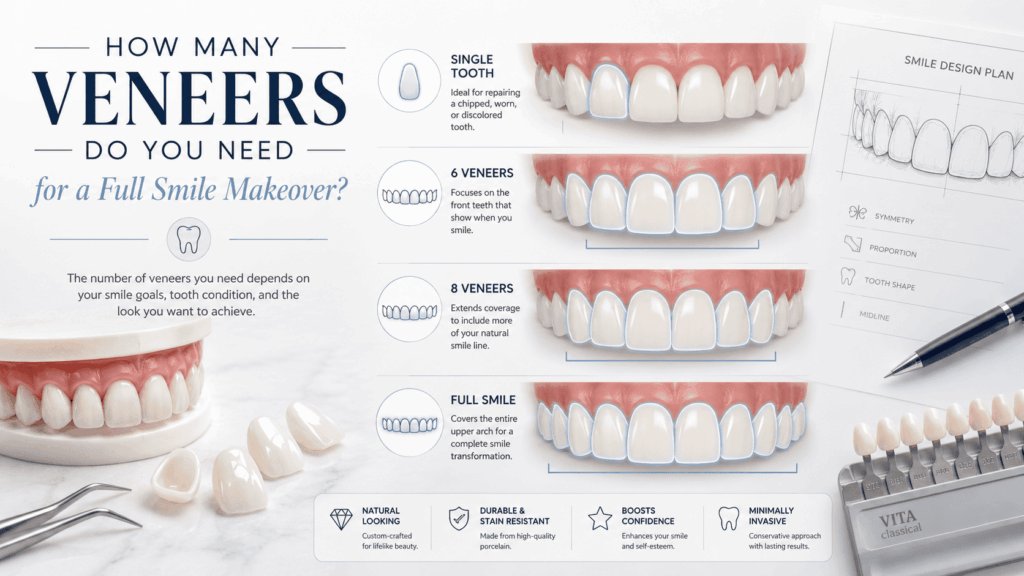
There’s a commonly discussed range for full smile makeovers, generally centered on the teeth that show during a natural smile, which for many people includes the front six to ten upper teeth. This isn’t a rule, though. It reflects what tends to be visible for an average smile, not what’s clinically necessary for every patient.
Smile Goal
Commonly Discussed Approach
Correcting one chip or discoloration
Often addressed with a single veneer, sometimes paired with bonding on an adjacent tooth
Improving a few visible teeth
Sometimes treated with two to four veneers to balance a specific area of the smile
A broader, more uniform smile change
Frequently involves the teeth that show during a natural smile, often in the six-to-ten range, though this varies by person
Full arch transformation including premolars
Occasionally extends further back for patients with a wide smile or significant visibility of posterior teeth
Some patients need fewer teeth treated than this general pattern suggests, while others need more, particularly if their smile shows further back toward the premolars. The material chosen also plays into the plan; our comparison of porcelain and composite veneers explains how material choice can factor into decisions about scope and coordination across multiple teeth.
Why Some Patients Only Need One or Two Veneers
Not every patient walks in wanting a full transformation. Someone with a single chipped front tooth, or one noticeably discolored tooth that didn’t respond to whitening, may only need that one tooth addressed. In cases like this, a dentist typically focuses on matching the new veneer carefully to the surrounding natural teeth rather than treating teeth that don’t need it. For smaller corrections like this, no-prep veneers sometimes come up as an option, since they’re designed for more conservative, targeted changes rather than broad smile transformations.
Factor
One Veneer
Several Veneers
Typical goal
Fixing an isolated chip, discoloration, or shape issue
Creating a more uniform look across a visible group of teeth
Shade matching challenge
Must be matched carefully to surrounding natural teeth
Matched to each other, offering more control over the final shade
Planning complexity
Generally simpler, often addressed in a single consultation
Requires more detailed planning to keep proportions balanced
Common patient type
Someone with one specific concern and otherwise satisfied teeth
Someone pursuing a broader cosmetic change across their smile
Treating only what genuinely needs treatment, rather than defaulting to a wider plan, tends to produce a more conservative and often more cost-effective outcome for patients whose concerns are limited to one or two teeth.
What Cosmetic Dentists Evaluate When Planning Veneer Count
Smile design is the process cosmetic dentists use to figure out which teeth need treatment and how many. It goes well beyond counting the teeth visible in a photo. A few specific factors tend to shape the final number.
Smile Width and How Much Shows When You Smile
Some people have a wider smile that reveals teeth further back toward the premolars, sometimes called a broader buccal display. Others show mostly the front four to six teeth, with the back corners of the mouth partially hidden by cheek tissue. A dentist evaluating your smile width determines how far back treatment realistically needs to extend to look natural and complete, rather than stopping arbitrarily at a fixed tooth count.
Smile Line and Lip Position
How your lips move when you smile and speak affects how much of your teeth and gums show at different moments. A dentist looks at your smile at rest, during a natural smile, and while talking, since these positions can reveal different amounts of tooth structure. Treatment planning accounts for all of these, not just a single posed photo.
Tooth Size and Proportion
Cosmetic dentistry often references general proportion guidelines when planning tooth width and length relative to each other, though these are used as a loose reference rather than a strict formula applied to every patient. Your natural tooth size and how your teeth relate to each other in width and length help determine which specific teeth benefit most from a veneer, versus which ones already fit well within a balanced smile.
Tooth Color
If your natural tooth shade varies significantly across your smile, treating only some teeth can leave an uneven color pattern once specific teeth are veneered. Your dentist considers how any untreated teeth will look next to new veneers, which sometimes expands or narrows the number of teeth recommended for treatment.
Existing Restorations
Old crowns, fillings, or bonding on certain teeth can affect how a veneer fits and how well it matches. In some cases, replacing an old restoration alongside new veneers gets folded into the same treatment plan, which can influence the total number of teeth involved.
Bite and Function
How your teeth meet when you bite down matters for planning veneer count and material choice. Patients with grinding or clenching habits sometimes need a different approach than patients with a stable, even bite. Our discussion of veneers for patients who grind their teeth covers how bruxism factors into candidacy and planning in more detail.
Facial Symmetry
Most faces aren’t perfectly symmetrical, and a good smile design plan works with that reality rather than chasing mathematical perfection. A dentist considers your facial midline, the balance between the left and right sides of your smile, and how your teeth relate to your overall facial proportions, rather than treating every tooth identically regardless of your face shape.
Your Own Goals
Two patients with nearly identical starting smiles might want very different outcomes. One may want a dramatic, uniformly bright transformation. The other may prefer a subtler change that still looks recognizably like their own smile. Your stated goals shape the number of veneers as much as any clinical measurement does.
Should Your Bottom Teeth Get Veneers Too?
For many patients, upper teeth alone address the visible parts of their smile, since the lower teeth show less during a typical smile. That said, some patients show more of their lower teeth than average, whether due to how their lips rest or how their bite is structured, which can make lower veneers a more relevant part of the conversation.
Approach
When It’s Typically Considered
Upper teeth only
Common for patients whose smile shows mostly upper teeth, which describes many people’s natural smile pattern
Upper and lower teeth
Considered for patients who show more of their lower teeth when smiling or speaking, or who have specific concerns with lower tooth appearance
Lower teeth only
Less common, but sometimes appropriate if lower teeth are the primary cosmetic concern and upper teeth are otherwise satisfactory
Whether lower teeth factor into your plan depends on your specific smile pattern, not a general rule that upper teeth are always sufficient or that lower teeth are always skipped.
Can Veneers Match Your Remaining Natural Teeth?
In many cases, yes, though matching veneers to untreated natural teeth takes careful shade selection and, sometimes, adjusting the treatment plan to include a few additional teeth for better color consistency. Natural teeth aren’t perfectly uniform in color, and neither are veneers meant to be forced into an artificial, flat match. A skilled shade-matching process aims for a result that looks cohesive rather than jarring next to teeth that weren’t treated.
This is one of the reasons dentists sometimes recommend treating slightly more or fewer teeth than a patient initially expected. The goal is a smile that reads as natural and even, not simply the smallest or largest number of veneers possible.
Can Whitening Reduce the Number of Veneers You Need?
Sometimes. If your main concern is overall discoloration rather than shape, size, or chips, whitening treated teeth first can occasionally reduce how many veneers are needed, since brightening the surrounding natural teeth may close the color gap that would otherwise require more veneers for a consistent look.
This isn’t guaranteed to work for every patient, since whitening doesn’t change tooth shape or address structural concerns like chips or unevenness. Your dentist can evaluate whether whitening first makes sense for your specific situation, or whether it wouldn’t meaningfully change the recommended veneer count.
Does Every Visible Tooth Need a Veneer?
No. A tooth that’s already a good color, shape, and size relative to its neighbors generally doesn’t need a veneer just because it’s visible when you smile. Treatment plans typically focus on the teeth that are actually contributing to the cosmetic concern, rather than every tooth within the smile zone by default. If crooked or misaligned teeth are part of what’s bothering you, how veneers relate to crooked teeth explains where cosmetic treatment tends to help and where it doesn’t.
Combining Veneers With Whitening, Bonding, or Orthodontics
A smile makeover doesn’t have to rely on veneers alone. Depending on your specific concerns, your dentist may suggest combining approaches rather than veneering every tooth in the smile zone. Dental bonding compared with veneers explains when a more conservative, lower-cost option might handle part of a plan instead of a veneer.
Smile Concern
Approaches Sometimes Considered
General discoloration across many teeth
Teeth whitening, sometimes on its own or alongside veneers on select teeth
A single chip or minor shape issue
Dental bonding or a single veneer, depending on the tooth and desired result
Mild rotation or small gaps
Veneers for cosmetic appearance, or orthodontic treatment if the position itself needs to change
Multiple concerns across visible teeth
A coordinated veneer plan, sometimes combined with whitening on untreated teeth to help shade match
Combining treatments this way can sometimes reduce the total number of veneers needed, since not every concern in your smile actually requires one.
How Dentists Decide Which Specific Teeth to Treat
Rather than starting from a target number and working backward, a thorough planning process starts with your specific concerns and works forward. Your dentist typically examines each visible tooth individually, notes which ones contribute to the issue you want addressed, and builds a plan around those teeth specifically. Digital photos, and sometimes a digital smile preview, help visualize how a proposed plan will look before any tooth is touched.
This individualized approach is part of why two patients with seemingly similar smiles can walk out of the same practice with very different treatment plans. The plan follows the smile, not the other way around.
Why Treatment Planning Matters More Than Choosing a Number
Choosing a number first, whether from a marketing page or a friend’s experience, can work against a natural-looking result. A fixed number may not account for your tooth proportions, colouring, or facial features. Letting your dentist create the plan after an evaluation usually helps achieve a smile that fits you rather than a generic template.
How Veneer Count Relates to Treatment Cost
It’s natural to associate a higher veneer count with a higher overall cost, and in general terms, treating more teeth does increase the total investment involved. That said, cost isn’t simply a matter of multiplying a per-tooth price by a number, since material choice, lab work, and case complexity all factor in as well. Our detailed breakdown of what affects porcelain veneer costs goes further into these variables. A consultation is the only reliable way to get a personalized estimate, since every treatment plan, and therefore every cost, is individualized to the patient.
Planning Your Smile Makeover With Dr. Pearl Zadeh in Woodland Hills
Dr. Pearl Zadeh evaluates smile width, tooth proportion, facial symmetry, and your personal goals before recommending a specific number of veneers, rather than starting from a standard package. Her approach to cosmetic treatment planning centers on building a plan around your individual smile rather than applying the same template to every patient. Patients exploring veneers in Woodland Hills can expect that same individualized evaluation, and our broader overview of cosmetic dentistry in Woodland Hills covers the full range of options available if your plan ends up including more than veneers alone.
The right number of veneers for your smile makeover comes from careful planning, not a standard package. Your tooth proportions, smile width, colour, and goals shape the number differently from another patient’s plan.
Dr. Pearl Zadeh and her Woodland Hills team can evaluate your smile and create a plan based on your goals. They focus on your specific features rather than starting with an arbitrary number.
Call (818) 716-6722 or click the button below to schedule your consultation online.
There’s a commonly discussed pattern centered on the teeth that show during a natural smile, often the front six to ten upper teeth, though this varies significantly based on your specific smile and goals.
2. Is eight veneers enough?
For many patients, yes, since eight often covers the visible upper front teeth. Some patients need fewer, and others need more if their smile shows further back or if lower teeth are also part of the plan.
3. Do I need veneers on my bottom teeth?
Not necessarily. Many patients only need upper veneers, since lower teeth show less during a typical smile. Patients who display more of their lower teeth, or who have specific concerns there, may benefit from including them.
4. Can I get veneers on only one tooth?
Yes, in many cases. A single veneer can address one chipped or discolored tooth, with careful shade matching to the surrounding natural teeth.
5. Will veneers match my natural teeth?
Generally, yes, when your dentist matches the shade carefully. Your dentist evaluates your remaining natural teeth to help the new veneers blend in rather than stand out.
A gap between your teeth can be a small detail that affects how you feel about your smile. You may have lived with it for years, or you may have noticed it changing recently.
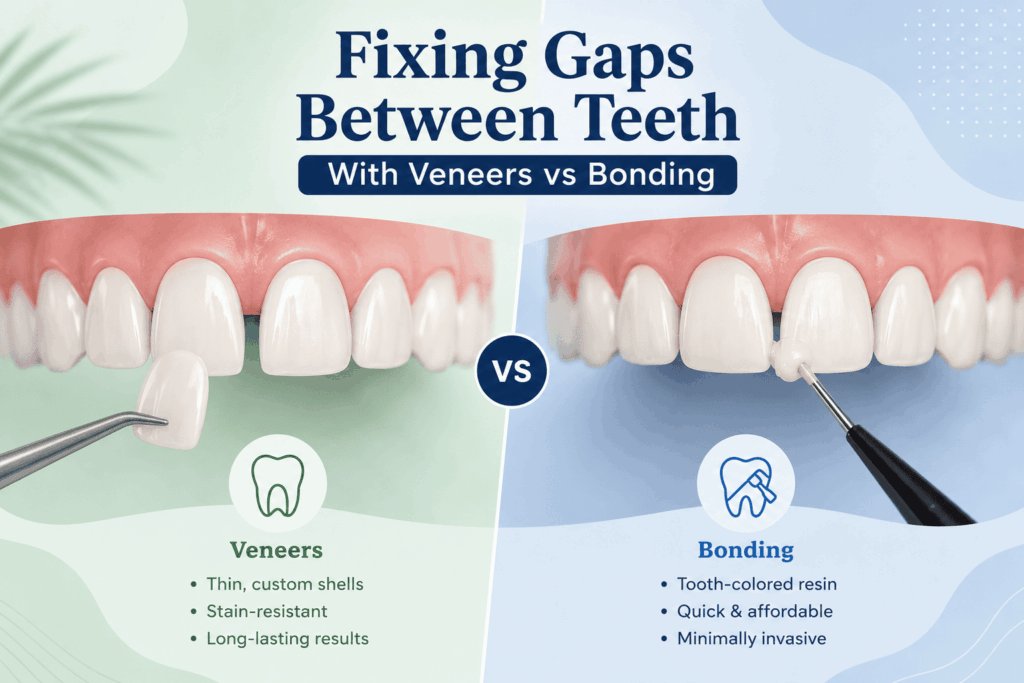
The good news is that you have more than one cosmetic option. Dental bonding and veneers can both improve the appearance of gaps, but they solve the problem in very different ways. The right choice depends on the size of the gap, your tooth structure, and the type of result you want to achieve.
How Bonding Closes a Gap
Dental bonding uses a tooth-coloured composite resin that your dentist applies directly to the teeth beside the gap. Your dentist carefully shapes the material to add width and improve tooth proportions.
After shaping the resin, your dentist hardens it with a curing light and polishes the surface. This helps the bonding blend with your natural teeth.
Bonding usually requires little to no enamel removal, which makes it a more conservative cosmetic option. Many patients complete treatment in a single appointment.
Because bonding adds material to the tooth surface, it often works best for smaller gaps. It can also help when patients need minor shape corrections or small cosmetic improvements.
How Veneers Close a Gap
Veneers approach gap correction in a different way. Instead of adding material directly to the tooth, your dentist places a custom-made shell over the front surface.
The veneer design can slightly change tooth width and shape to create a more balanced smile. Your dentist plans the size and proportions carefully so the teeth look natural together.
Our porcelain veneers guide and composite veneers overview explain how each material works and what patients can expect from each option.
Traditional veneers usually require removing a thin layer of enamel. This allows the veneer to sit naturally against the tooth instead of appearing bulky.
Veneer treatment often requires multiple visits, including planning, preparation, and final placement. Because veneers change the visible shape of the tooth, they can help create a more complete smile transformation when several cosmetic concerns exist.
Veneers vs Bonding for Gaps: Key Differences
The table below summarizes the general differences between the two approaches specifically as they relate to closing a gap. Individual results vary based on your teeth and treatment plan.
Consideration
Bonding
Veneers
How it closes the gap
Composite resin is added to the edges of the teeth bordering the gap
Custom shells are made slightly wider than the natural tooth to fill the space
Tooth preparation
Minimal to none
Typically involves removing a thin layer of enamel
Visits typically needed
Often one
Usually two or more
Typical durability
Generally shorter, varies by habits and maintenance
Generally longer, particularly with porcelain
Stain resistance
More prone to staining over time
Porcelain generally resists stains well
Reversibility
Often considered more conservative
Generally not considered reversible
Best-suited gaps
Small to moderate gaps, especially isolated ones
Larger gaps, or gaps addressed alongside other cosmetic goals
Neither option is universally better for every gap. Each tends to fit different situations, which is part of why an in-person evaluation matters more than a general preference for one approach.
What Determines Which Option Fits Your Gap?
A dentist looks at your entire smile before recommending bonding or veneers. The best option depends on why the gap exists, your tooth condition, and the result you want.
Size of the Gap
The size of your gap plays a major role in treatment planning. Smaller gaps often respond well to bonding because your dentist only needs to add a small amount of material.
Larger gaps may require more careful planning. Adding too much composite resin can sometimes make teeth look wider than natural.
Cleveland Clinic notes that gaps between teeth, also called diastema, often involve cosmetic concerns. However, a new or changing gap may sometimes relate to gum problems. Your dentist can evaluate the cause before recommending treatment.
What Is Causing the Gap?
The reason behind the gap matters as much as its size. Some gaps develop because teeth and jaw size do not match. These cases may respond well to cosmetic treatment.
Other gaps may connect to habits like tongue thrusting or changes in gum health. Your dentist may need to address these factors first. This helps reduce the chance of the gap returning after treatment.
Tooth Shape and Alignment
A gap rarely exists as the only cosmetic concern. Some patients also have teeth that look small, uneven, or differently shaped.
Veneers can sometimes address several concerns at once because they change the visible shape of the tooth. Bonding focuses more on adding small amounts of material where needed.
Enamel Condition
Your dentist checks your enamel before recommending veneers. Veneers need a stable tooth surface for proper bonding.
Bonding usually requires less change to your natural tooth structure. This makes it a more conservative choice for many minor corrections.
Bite Forces
Your bite affects how well cosmetic treatment holds up over time. The pressure between your upper and lower teeth can place stress on bonding or veneers.
Patients who grind or clench may put more stress on their restorations. Bonding may chip more easily under heavy pressure. Porcelain veneers often provide greater durability, but no material can resist all damage from excessive force.
Your Overall Smile Goals
Your goals help determine which option makes the most sense. If you only want to close a small gap, bonding may provide the improvement you need.
Some patients may also consider veneers for one or two teeth to create a more balanced appearance.
If you want to change tooth colour, shape, and several areas of your smile, veneers may fit better as part of a larger cosmetic plan.
Existing Dental Work
Previous dental work can influence your treatment options. Old fillings, crowns, or bonding near the gap may affect colour matching and overall appearance.
Your dentist reviews these restorations before recommending a treatment approach. This helps create a result that blends naturally with your existing smile.
When Bonding Is Often the Better Fit
Bonding often works well for smaller gaps between teeth that are otherwise healthy and similar in colour. It allows your dentist to add small amounts of composite resin and improve tooth shape without major changes.
Many patients choose bonding because it offers a more conservative approach. It may also suit those who want a quicker improvement or prefer not to alter their enamel.
Because dentists can adjust or repair bonding more easily, it can appeal to patients who want a simple first step before considering more involved treatment.
When Veneers Are Often the Better Fit
Veneers may suit patients with larger gaps or multiple cosmetic concerns. They can change tooth shape, colour, and proportions at the same time.
Patients who want a more complete smile transformation often consider veneers because they offer more control over the final appearance.
Can a Single Veneer or Bonding Close Just One Gap?
In many cases, yes. A single gap does not always require treatment across the entire smile.
Your dentist can focus on the affected teeth and match the colour, shape, and proportions carefully. Our discussion of getting veneers on just one tooth explains how dentists approach smaller cosmetic corrections.
What About Very Large Gaps?
Very wide gaps can present different challenges. Adding enough bonding material or making veneers wider may affect how natural the teeth look.
In these situations, your dentist may discuss orthodontic treatment. Braces or clear aligners can physically move teeth closer together before or instead of cosmetic treatment.
The best approach depends on your bite, tooth position, and overall smile goals.
Combining Gap Closure With a Broader Smile Makeover
Sometimes, a gap is only one part of a larger cosmetic concern. You may also want to improve tooth colour, shape, or overall smile balance.
Your dentist can help you decide whether treating only the gap or addressing multiple concerns makes more sense.
How Cost Factors Into the Decision
Bonding usually costs less than veneers because it requires less material, fewer appointments, and no dental laboratory process. However, the lowest upfront cost does not always represent the best long-term value.
Bonding may need adjustments or repairs over time, while veneers involve a larger initial investment. Your dentist considers your goals, treatment needs, and expected maintenance when comparing options.
The total cost depends on factors such as the number of teeth treated, chosen material, and case complexity. A consultation provides a more accurate estimate than a general comparison.
Choosing a Cosmetic Dentist in Woodland Hills
Closing a gap successfully requires careful planning. Your dentist needs to consider your tooth shape, bite, smile goals, and overall oral health.
A cosmetic dentist should recommend treatment based on your specific needs rather than using the same approach for every patient.
The right choice between bonding and veneers depends on your gap, tooth condition, and smile goals. A personalised evaluation can help you understand which option fits your needs.
Dr. Pearl Zadeh and her Woodland Hills team can examine your smile and explain whether bonding, veneers, or another treatment approach can help you achieve your goals.
Call (818) 716-6722 or click the button below to schedule your consultation online.
1. Is bonding or veneers better for closing a gap?
Neither is universally better. Bonding tends to suit smaller, isolated gaps and a more conservative approach, while veneers often fit larger gaps or cases involving other cosmetic goals. Your dentist can evaluate which fits your specific situation.
2. How long does bonding for a gap typically last?
Bonding’s lifespan varies based on habits, oral hygiene, and maintenance, and it’s generally shorter than veneers. Touch-ups or repairs over time are common and usually straightforward.
3. Can veneers close a large gap?
Often, yes, though very large gaps can sometimes require orthodontic treatment first or instead, since building up too much width with a veneer alone may look disproportionate.
4. Does closing a gap with bonding hurt?
Bonding is generally not painful and typically doesn’t require anesthesia, since it usually involves little to no alteration of the tooth itself.
5. Will veneers for a gap look natural?
Often, yes, when shade and proportion are planned carefully. Your dentist evaluates how a proposed veneer width and shade will look next to your other teeth before finalizing the design.
In the past decade there has been a dramatic interest in cosmetic dentistry. We all realize that having a healthy, bright, beautiful smile enhances our appearance and allows us to smile with confidence. Thanks to the advances in modern cosmetic dentistry, we are able to improve our teeth and smiles with quick, painless and surprisingly affordable treatments.
What can cosmetic dental treatments do?
Change the size, shape, and alignment of certain teeth.
Fill in unattractive spaces between teeth.
Improve or correct bites.
Lighten or brighten the color of teeth.
Repair decayed, broken, cracked, or chipped teeth.
Replace missing teeth.
Replace old, unattractive dental treatments.
Remember, your smile speaks before you even say a word!
Veneers are one of the most popular cosmetic dentistry treatments available, thanks to their ability to change the appearance of your smile quickly and effectively. If you have minor cracks and chips on your teeth, discoloration, or minor shape or spacing issues, dental veneers will cover those problems and give you an aesthetically pleasing smile. As with any kind of dental treatment, if you are considering veneers, you probably are wondering how long they will last. Here is what you need to know.
Veneers 101
Veneers are thin, wafer-like shells that are bonded to the front of your teeth. They are made of porcelain, and are custom-designed to match the shape and shade you desire. Your dentist will work with you to create your veneers so that they address the concerns you have with your teeth while blending seamlessly with your natural teeth. Your dentist may recommend veneers to correct misshapen or worn teeth, crooked or widely spaced teeth, and severe discoloration that does not respond to whitening treatments. Veneers can also be used to create a more uniform smile if your teeth are noticeably different in size.
It usually takes two visits to get veneers. During the first visit, your dentist will remove a small amount of tooth enamel to make room for the veneers. He or she will make impressions of your mouth so that your veneers can be custom-sized. Your dentist will also help you choose the color of your veneers during this visit. At your second appointment, your veneers will be bonded to your teeth after any necessary adjustments are made.
The Longevity of Dental Veneers
There are many factors that impact the longevity of veneers, including how you care for them and your overall oral health. Typically, veneers last for five to 10 years, though many people are able to get many more years out of them. Following your dentist’s care plan will dramatically increase the lifespan of your veneers.
To care for your veneers, maintain a high-quality oral hygiene routine, including brushing at least twice per day with a soft-bristled toothbrush and flossing at least once daily. Visit your dentist at least twice per year for a professional cleaning and check-up. If you grind your teeth, talk to your dentist about using a mouthguard to protect your veneers.
Could veneers give you the smile you’ve always wanted? Find out if you’re a good candidate for dental veneers by scheduling a consultation with Pearl Zadeh, DDS.
In-Office Teeth Whitening vs At-Home Options: What Works Best
Pearl Zadeh DDSCosmetic Dentistry
Many people want a brighter smile, but choosing between in‑office teeth whitening and at‑home products can be confusing. Each approach has pros and cons, and the right choice depends on your goals, time, and the level of improvement you want.
According to a national survey by the American Academy of Cosmetic Dentistry, most adults value a bright smile. In that study, 96% said an attractive smile makes someone more appealing, and 74% believe an unattractive smile can hurt career success. This shows why effective teeth whitening matters for both confidence and appearance.
What In‑Office Teeth Whitening Involves
In‑office whitening takes place under the supervision of a dental professional. A dentist or trained hygienist applies a strong whitening gel to your teeth and may use a light or laser to enhance the effect. Before treatment, your teeth are cleaned to remove surface build‑up and protect your gums.
This method delivers results quickly. After one session, many patients see several shades of improvement. Because a dentist controls the process, the treatment stays safe and precise.
According to dental sources, professional teeth whitening tends to deliver more consistent and noticeable results than over-the-counter options because dental professionals use higher-strength whitening agents and apply them under careful supervision. That makes in‑office whitening a reliable choice if you want effective teeth whitening with minimal guesswork.
Common At‑Home Whitening Options
At‑home whitening includes over‑the‑counter strips, whitening trays, toothpaste, and kits you can buy without a prescription. These products use milder bleaching agents compared with professional gels.
Some patients like at‑home options because they are easy to use and more affordable upfront. Whitening strips and gels attach directly to the teeth and slowly lift stains over days or weeks.
However, because the whitening strength is lower, at‑home kits usually take longer to show visible improvement. Results vary widely from person to person, and some products may not change the shade of deeper stains.
Key Differences Between the Two Approaches
Aspect
In-Office Teeth Whitening
At-Home Whitening Options
Speed of Results
Noticeable improvement often appears after a single visit.
Results usually take one to four weeks of daily use.
Whitening Strength
Uses stronger formulas that lift deeper stains from enamel.
Uses milder agents to reduce irritation risk.
Supervision and Safety
A dental professional oversees the process and manages sensitivity.
No professional supervision, which may lead to uneven results.
Cost
Higher upfront cost due to professional care and materials.
Lower initial cost but may require repeat purchases.
Who Benefits Most From Each Option
In‑office whitening suits people who want fast, predictable improvement, especially before a big event such as a wedding or graduation. It also works well for deeper stains that don’t respond to milder products.
At‑home whitening fits those who want gradual change and prefer a lower initial cost. It may be a good step if your staining is mild or you want to maintain brightness between professional sessions.
Caring for Your Whitening Results
After any whitening treatment, good habits help your results last longer. Brush and floss daily, limit coffee or red wine that can stain teeth, and schedule regular dental cleanings. Research shows that professional teeth whitening results may last from six months up to two years or more, depending on your daily habits and care.
Start Your Teeth Whitening Journey
If you are thinking about teeth whitening, the best place to start is with a professional consultation. A dental visit helps you understand which whitening option fits your needs, how much improvement you can expect, and how to maintain your results.
At Pearl Zadeh DDS, patients receive clear guidance and in-office teeth whitening designed to brighten smiles safely and effectively. Scheduling a visit gives you the chance to ask questions, review your options, and move forward with confidence.
Book a consultation today and take a simple step toward a whiter, healthier-looking smile.
Most patients feel little to no discomfort. Some people notice temporary sensitivity, which often fades within a few days.
2. Will whitening work on old dental work like crowns?
Whitening affects natural enamel but does not change the shade of crowns, veneers, or fillings.
3. Can at‑home kits replace professional whitening?
At‑home kits can improve mild stains, but they usually do not match the depth of whitening that in‑office treatment provides.
4. How long will the whitening results last?
Results from in‑office whitening can last several months to over a year, depending on your diet, oral habits, and follow-up care. Regular brushing and limiting stain-causing foods help maintain brightness.
5. Are there any risks with in‑office whitening?
When performed by a dental professional, in‑office whitening is generally safe. Some patients may experience temporary tooth sensitivity or mild gum irritation, which usually goes away within a few days.