Pearl Zadeh DDS

Category: Cosmetic Dentistry

  • Why Won’t My Teeth Whiten? Common Reasons Whitening Doesn’t Work

    Why Won’t My Teeth Whiten? Common Reasons Whitening Doesn’t Work

    You followed the instructions, waited the recommended time, and checked the mirror expecting a real change. Instead, your teeth look almost exactly like they did before you started. That’s genuinely frustrating, and it’s worth understanding why before assuming the product failed or you did something wrong. Maybe you tried strips for weeks, or sat through a professional treatment, and the difference feels barely noticeable either way.

    Whitening doesn’t produce the same result for everyone. Some discoloration responds well to bleaching. Other color changes have entirely different causes that whitening was never really built to address. A handful of specific reasons tend to explain most cases where results fall short.

    What Can Prevent Teeth From Whitening?

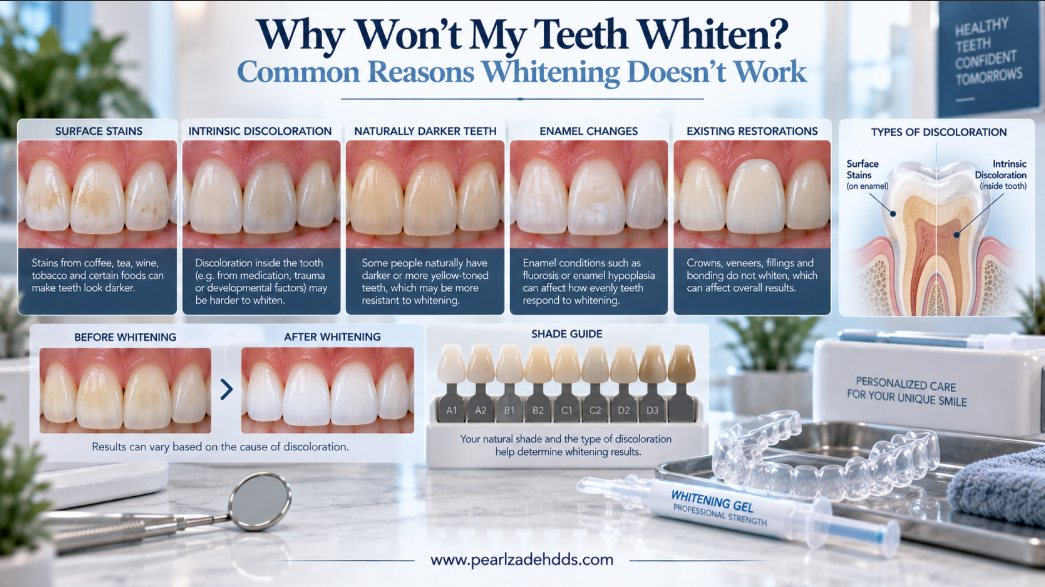
    Whitening works best on certain types of tooth discoloration, and the actual cause of your color matters more than which product you picked. Surface stains from things like coffee or tobacco tend to respond well. Deeper discoloration that developed within the tooth structure itself behaves differently.

    Sometimes what looks like a stain is simply your natural tooth color, or the result of existing dental work that doesn’t respond to whitening at all. None of these possibilities can be sorted out just by staring in the mirror, which is exactly why the reasons below are worth going through one at a time.

    1. The Stains May Not Respond Well to Whitening

    Dentists generally separate stains into two categories. Extrinsic stains sit on the surface of your teeth, usually from coffee, tea, tobacco, red wine, or other strongly pigmented foods and drinks. These tend to respond reasonably well to whitening and even professional cleaning. Intrinsic discoloration develops within the tooth structure itself, below the surface, and behaves quite differently under a whitening agent.

    The source and depth of your discoloration genuinely determines how much bleaching can actually change your tooth’s appearance. A whitening product that works beautifully on surface coffee stains may barely touch discoloration sitting deeper in the tooth.

    2. Your Teeth May Be Naturally More Yellow or Darker

    Tooth color varies naturally from person to person, and this has nothing to do with staining at all. Dentin, the layer underneath your enamel, is naturally yellow, and it contributes significantly to your overall tooth color. Thinner or more translucent enamel lets more of that dentin show through, which can make teeth look more yellow even when nothing is actually stained.

    Two people can have identical oral hygiene and identical diets, yet still end up with noticeably different baseline tooth shades simply because of how their enamel and dentin are naturally structured. None of this means naturally yellowish teeth are unhealthy. It simply means whitening has real limits when your underlying natural tooth color is doing most of the work, rather than an actual stain sitting on top of it.

    3. Enamel Changes Can Affect How Your Teeth Look

    Enamel naturally thins somewhat with age, and thinner enamel tends to become more translucent. The American Dental Association notes that as enamel becomes thinner and more translucent with age, more of the yellower dentin underneath shows through, which can darken overall tooth color. This isn’t the same thing as a stain, and it doesn’t mean every translucent or darker-looking tooth automatically needs whitening. It does mean that when this structural change is the real reason behind your tooth color, whitening isn’t addressing the actual underlying cause, and results may end up more limited than you expected.

    4. Certain Types of Intrinsic Discoloration Are Harder to Whiten

    Some discoloration develops within the tooth rather than sitting on its surface, and the specific cause genuinely affects how it responds to bleaching. The ADA lists several recognized causes of intrinsic discoloration, including dental fluorosis from excess fluoride exposure during childhood tooth development, certain antibiotics like tetracycline taken during those same developing years, tooth trauma, genetic conditions affecting enamel or dentin formation, and even prolonged use of certain antiseptic mouth rinses. This doesn’t mean intrinsic discoloration is untreatable, and it isn’t accurate to say whitening simply cannot work on it.

    The same ADA resource notes that brown staining from fluorosis or tetracycline tends to respond better to bleaching than white spot staining, which may simply become less noticeable as the rest of the tooth lightens around it. Tetracycline-related discoloration specifically can require several months of consistent nightly treatment to see meaningful change, considerably longer than what most patients expect from typical whitening. None of this can be diagnosed from a mirror. Some intrinsic discoloration responds incompletely to bleaching no matter how patiently you stick with it, and a different cosmetic approach may genuinely make more sense.

    5. Your Teeth May Have Dental Restorations

    This is a limitation many patients simply don’t expect. Natural tooth structure and dental restorations do not respond to bleaching the same way. Crowns, veneers, and tooth-colored fillings generally stay at whatever shade they were made in, regardless of what whitening does to the teeth around them. If some of your visible teeth are actually restorations, you may notice uneven color after whitening, with your natural teeth looking brighter while the restored ones stay exactly where they started. Our discussion of whitening before veneers or crowns goes further into that timing question. This doesn’t mean a restoration automatically needs replacing after whitening. It simply explains a mismatch that whitening itself won’t resolve.

    6. The Whitening Product May Not Match Your Type of Discoloration

    Whitening products genuinely differ in strength, formulation, application method, and what they’re designed to address. Whitening toothpaste primarily helps remove surface stains through mild abrasion and does not work like a true bleaching treatment. At-home strips and kits use peroxide-based agents at lower concentrations than those used by dentists in the office. Professional treatment typically offers stronger formulations along with an evaluation beforehand.

    Picture someone using whitening toothpaste every day for months to address discoloration that actually developed from a childhood medication. No amount of extra brushing with that toothpaste is going to touch that kind of stain, since it was never designed to. If you’ve been using a product designed mainly for surface stains on discoloration that’s actually intrinsic, the mismatch between product and problem, not a defective product, may explain your limited results.

    7. You May Not Have Given the Treatment Enough Time

    How quickly whitening results become noticeable varies considerably from person to person, and there’s no single number of days that applies to everyone. Some people see a visible change fairly quickly. Others need more time, or genuinely need a different treatment approach entirely rather than simply repeating the same one longer.

    Our discussion of how long professional teeth whitening actually takes goes further into what affects that timeline. If results seem slow, that’s a reason to talk to a dentist about what’s actually going on, not a reason to whiten more often or more aggressively on your own.

    8. An Underlying Dental Problem May Need Attention First

    Sometimes what looks like a whitening failure is actually a sign that something else needs attention. Tooth decay, gum disease, cracks, significant sensitivity, or other unexplained changes in tooth color can all affect how your teeth respond, or simply mean whitening isn’t the right priority yet. Our discussion of early signs of gum disease covers what’s worth watching for. None of this can be diagnosed from symptoms alone, but treating an underlying dental issue often needs to happen before cosmetic whitening makes sense.

    Can You Whiten Teeth That Did Not Respond the First Time?

    It depends entirely on why the first attempt produced limited results. A dentist considers what actually caused your discoloration, what type of whitening you already tried, whether you have existing restorations, your sensitivity level, your overall oral health, and what you’re actually hoping to achieve. Someone whose first attempt used a low-concentration strip on genuinely intrinsic staining might reasonably try a stronger, professionally supervised approach next.

    Someone whose discoloration comes mainly from natural tooth color or existing restorations may need an entirely different conversation instead. Simply reaching for a stronger product isn’t automatically the answer, and in some cases it isn’t the right answer at all. Understanding why the first round didn’t work is what actually determines whether trying again makes sense, and what that second attempt should look like.

    What If Whitening Still Doesn’t Give You the Result You Want?

    Whitening isn’t the only cosmetic option available, and depending on the cause and condition of your teeth, a dentist may discuss other approaches entirely. Our overview of cosmetic treatment options for stained teeth goes further into what else might apply depending on your specific situation. Veneers are sometimes part of that conversation, though they aren’t a universal solution either. What actually fits depends on your teeth, not a default upgrade path whenever whitening falls short.

    How a Dentist Can Determine Why Your Teeth Aren’t Whitening

    An evaluation typically starts with reviewing what you’ve already tried and how your teeth responded. Your dentist examines your actual tooth color and surfaces, checks for any restorations that might explain uneven results, assesses your enamel and overall tooth structure, and looks for oral health issues that might be part of the picture.

    That conversation also covers your actual cosmetic goals, since what counts as a good outcome varies from patient to patient. Identifying the real cause is what determines whether whitening still makes sense and what result is realistically achievable. Not every patient needs extensive testing to get there. Sometimes a straightforward exam and conversation is enough to explain what’s actually going on.

    How to Avoid Over-Whitening Your Teeth

    Repeatedly applying whitening products in pursuit of a stronger result isn’t necessarily the answer, and it can genuinely work against you. Overuse can contribute to tooth sensitivity, gum irritation, and simply chasing a shade that isn’t realistic for your specific teeth. Our discussion of teeth whitening for sensitive teeth and our look at whether whitening can damage enamel both go further into what excessive whitening can actually mean for your teeth. Following product directions and dental guidance protects your teeth far better than simply doing more of what already isn’t working.

    Speak With Dr. Pearl Zadeh About Whitening That Isn’t Working

    Whitening doesn’t work the same way for every type of discoloration. Dr. Pearl Zadeh, a dentist providing professional teeth whitening and cosmetic dentistry in Woodland Hills, can evaluate your teeth and help identify why results have been limited, and whether whitening or another cosmetic approach actually makes sense for you.

    Call (818) 716-6722 or click the button below to schedule your consultation online.

    Frequently Asked Questions

    Why won’t my teeth whiten even after using whitening products?

    Your discoloration may be intrinsic rather than surface-level, your natural tooth color may be contributing, or the product you used may not match the type of discoloration you actually have.

    Why are my teeth still yellow after whitening?

    Yellow tone often comes from dentin showing through thinner enamel, which is a natural characteristic rather than a stain that whitening can fully remove.

    Can some teeth not be whitened?

    Certain types of intrinsic discoloration, and existing restorations, respond incompletely or not at all to whitening, though the specific cause needs an evaluation to confirm.

    Why don’t my crowns or veneers whiten?

    Restorations don’t respond to bleaching the way natural tooth structure does, so they generally stay at their original shade regardless of whitening.

    Can intrinsic stains be whitened?

    Sometimes, depending on the cause. Certain intrinsic stains respond better than others, and some require significantly more time or a different approach entirely.

    This article is for informational purposes only and is not a substitute for professional dental advice. Please schedule a consultation with Pearl Zadeh DDS to discuss your specific situation.
  • Does Teeth Whitening Actually Damage Your Enamel?

    Does Teeth Whitening Actually Damage Your Enamel?

    Before whitening their teeth, many people ask the same question: Can whitening actually weaken or damage their teeth? It’s a reasonable concern before applying a bleaching agent. Conflicting claims online can also make the answer confusing. One source may call whitening harmless, while another claims it strips away enamel.

    The honest answer isn’t a simple yes or no. Whitening can cause temporary sensitivity. Your teeth may also respond differently based on the product and concentration. How you use the product also matters. Following evidence-based instructions and considering your existing dental health matter more than choosing one specific whitening method.

    Does Teeth Whitening Damage Enamel?

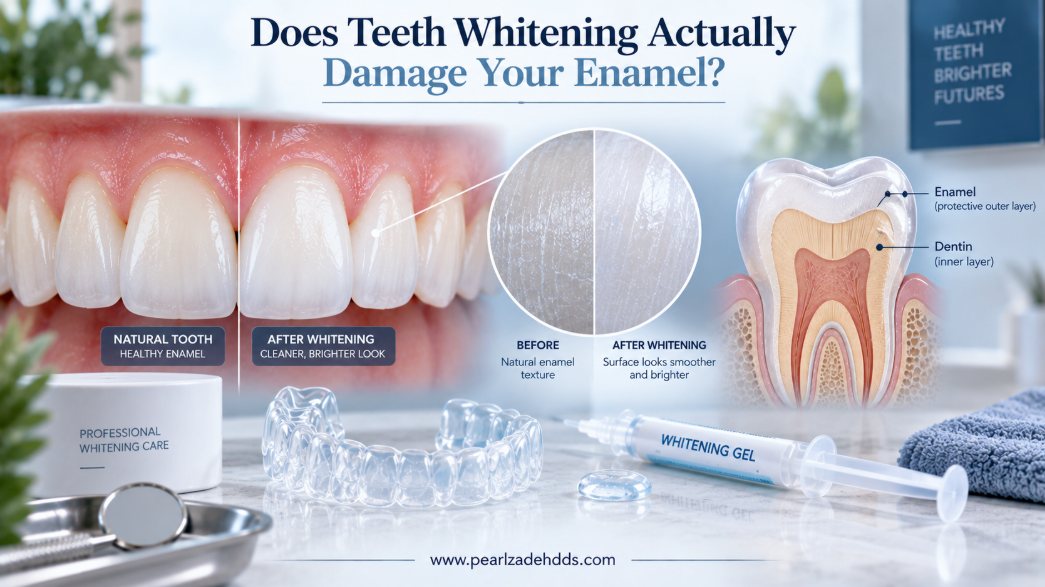
    Not in the way most people picture it. Whitening agents work by breaking down and altering the stain molecules within your tooth structure, not by physically scraping or dissolving away enamel. A 2026 systematic review and meta-analysis on enamel damage from tooth whitening found that peroxide-based bleaching produced statistically detectable but small reductions in enamel microhardness, without clear evidence that these changes are clinically meaningful.

    The review concluded that peroxide bleaching is unlikely to cause clinically meaningful enamel damage when used as recommended. However, that does not mean every whitening product is harmless in every situation. The concentration, contact time, frequency of use, and specific formulation can all affect the outcome.

    How Does Teeth Whitening Affect Your Enamel?

    Enamel forms the hard, mineral-rich outer layer of your tooth. Dentin sits underneath it and feels more sensitive to temperature and pressure. Microscopic channels connect dentin to the nerve inside your tooth.

    Whitening agents pass through the enamel and reach stain compounds that have built up over time. They break these compounds apart through a chemical process. This changes how light reflects off your teeth.

    During treatment, whitening can temporarily increase tooth permeability. This helps explain why some people experience sensitivity during or shortly after whitening. More stimuli can reach the channels that lead toward the nerve.

    Whitening can also cause minor changes in the tooth surface during treatment. Researchers have observed changes in microhardness and surface texture in laboratory studies. These changes generally do not indicate permanent structural damage to the enamel. The effects can vary based on the whitening agent, concentration, and treatment conditions.

    Can Teeth Whitening Cause Permanent Enamel Damage?

    Research on this genuinely depends on how closely the study conditions resemble what actually happens in your mouth. A peer-reviewed safety review on tooth whitening points out that studies replicating real intraoral conditions, meaning they included human saliva and normal fluoride exposure, generally found no clinically significant adverse effects on enamel. The same review is candid that this makes laboratory measurements on isolated, extracted teeth difficult to interpret as directly equivalent to what happens during actual clinical use.

    A separate narrative review of whitening agents and safety notes that higher-concentration formulations carry more documented concern for enamel surface alteration and microhardness reduction than lower-concentration ones. Excessive exposure time, using products incorrectly, or whitening far more often than recommended can genuinely raise the level of concern here. Normal, appropriately used whitening isn’t shown to inevitably cause permanent enamel damage, and it also isn’t accurate to say enamel is completely unaffected under every possible whitening condition. The honest answer sits between those two extremes.

    Why Does Whitening Sometimes Make Teeth Sensitive?

    Sensitivity is one of the more common temporary effects associated with whitening, often showing up as increased reaction to cold, heat, air, or sweet foods and drinks. This happens because whitening agents can temporarily affect how your tooth responds to these everyday triggers, not because your enamel has necessarily suffered permanent damage.

    People who already deal with sensitivity for unrelated reasons often notice whitening-related sensitivity more strongly, simply because their teeth were already more reactive to begin with. Our discussion of teeth whitening for sensitive teeth goes further into the mechanism and what actually helps.

    Does Professional Teeth Whitening Damage Enamel?

    Professional whitening isn’t automatically safer in every single circumstance, but dentist supervision offers real advantages worth naming. An evaluation before treatment can catch existing dental problems, a cavity, exposed dentin, or gum recession, that might affect how you respond to whitening before treatment ever starts.

    Product selection, treatment concentration, and exposure time can all be adjusted based on your specific teeth rather than a generic instruction sheet meant for a general population, and sensitivity can be actively managed as part of the process rather than discovered partway through with no plan for addressing it. Professional teeth whitening gives your dentist more control over the variables that actually affect enamel-related risk, which is a meaningfully different thing than a guarantee that supervised treatment carries zero risk.

    What About Whitening Strips and At-Home Products?

    At-home whitening products genuinely vary from one another, sometimes considerably. Results and side effects depend on the specific whitening agent used, its concentration, how long it stays in contact with your teeth, how often you use it, and whether you actually follow the manufacturer’s instructions. A product left on for twice the recommended time, or used daily instead of the intended schedule, isn’t behaving the way it was designed to, and that gap between intended use and actual use is where most problems tend to originate.

    It wouldn’t be accurate to label every whitening strip as dangerous, and it also wouldn’t be accurate to assume every over-the-counter product affects enamel identically. Sticking to the recommended usage, and not extending contact time or frequency beyond what the product actually calls for, matters more than which specific brand you choose.

    Can Whitening Toothpaste Damage Enamel?

    Whitening toothpaste works differently than peroxide-based treatments. Most whitening toothpastes primarily remove surface stains through mild abrasion rather than changing the color deep within your tooth structure, which is a fundamentally different mechanism than chemically breaking down stain molecules.

    Abrasivity genuinely matters here, particularly for people who already have some enamel wear or exposed dentin, since a more abrasive formulation can add unnecessary wear on top of an already thinner surface. This doesn’t mean every whitening toothpaste damages enamel. Formulations vary considerably in how abrasive they actually are, and anyone with significant sensitivity or existing enamel concerns is better off discussing the right product with a dental professional than guessing from a store shelf.

    Does Whitening Too Often Harm Your Teeth?

    Repeated or prolonged whitening genuinely can increase the likelihood of unwanted effects. This includes whitening more frequently than recommended, leaving treatment on longer than instructed, combining multiple whitening products at once, continuing treatment after you’ve already reached the shade you wanted, and pushing through persistent sensitivity instead of stopping. Each of these amounts to giving your teeth more exposure than the studied protocols actually accounted for, which is exactly the scenario where the research base gets thinner and the honest answer becomes more uncertain.

    There’s no universal maximum number of whitening sessions that applies to every patient across the board. Following whatever treatment plan or product instructions you were actually given matters far more than hitting some specific number.

    What Makes Whitening More Likely to Cause Problems?

    A handful of factors can genuinely raise the likelihood of discomfort or complications:

    • Existing tooth sensitivity
    • Enamel erosion or significant wear
    • Gum recession
    • Exposed dentin
    • Cavities
    • Cracked or damaged teeth
    • Excessive product use
    • Incorrect application
    • High-concentration products
    • Prolonged exposure time

    Several of these share a common thread. When enamel is already thinner or dentin is already exposed for some other reason, whitening agents have an easier path to reach the nerve, which can make sensitivity more pronounced than it would be for someone with fully intact enamel. None of these factors automatically means whitening is impossible for you. They generally mean your teeth are worth having evaluated before you start, rather than assuming your situation is identical to everyone else’s.

    Can You Whiten Teeth If Your Enamel Is Already Worn?

    This deserves real care rather than a simple yes or no. Worn enamel can change how sensitivity actually feels during whitening, sometimes making it more noticeable than it would be otherwise, since thinner enamel gives whitening agents a shorter distance to travel before reaching more sensitive structures underneath. The cause and severity of that wear genuinely matter here. Wear from years of normal use is a different situation than active, ongoing erosion or a cracked tooth that hasn’t been addressed.

    If you’re dealing with significant enamel loss, unexplained sensitivity, cavities, cracks, or other dental problems, whitening probably isn’t the first thing to address. None of this can be diagnosed from symptoms alone, which is exactly why an actual dental evaluation is the right next step rather than guessing at what’s going on.

    Does Teeth Whitening Damage Existing Dental Work?

    Whitening affects natural teeth differently than it affects restorations like veneers, crowns, or fillings, which generally don’t change shade the same way natural enamel does. Our discussion of whitening before veneers or crowns covers how that timing question actually plays out.

    How to Whiten Your Teeth More Safely

    1. Have unexplained sensitivity evaluated before you start.

    2. Follow the product instructions you were actually given.

    3. Avoid whitening more often than recommended.

    4. Don’t leave whitening products on longer than instructed.

    5. Discuss any existing dental problems before beginning treatment.

    6. Follow your dentist’s specific instructions for professional whitening.

    7. Stop and seek dental advice if symptoms feel severe or won’t go away.

    None of these steps guarantees a specific outcome, since individual response to whitening always varies somewhat. They genuinely reduce unnecessary risk, though, and following them consistently matters more than any single product choice.

    When Should You Talk to a Dentist Before Whitening?

    A few situations are worth a conversation first: persistent tooth sensitivity, severe sensitivity, sensitivity limited to one tooth, visible enamel wear, gum recession, cavities, cracks, tooth pain, existing veneers or crowns, or a notably strong reaction to whitening in the past. Whitening shouldn’t be used to cover up an unexplained dental problem that actually needs its own attention.

    Speak With Dr. Pearl Zadeh About Whitening Safely

    Teeth whitening isn’t a simple safe-or-unsafe question. The actual outcome depends on the method, how it’s used, how often it’s repeated, and the condition of your teeth going in. Dr. Pearl Zadeh, a dentist providing cosmetic dentistry and teeth whitening in Woodland Hills, can evaluate your teeth and help you understand whether whitening makes sense for your specific situation.

    Call (818) 716-6722 or click the button below to schedule your consultation online.

    Frequently Asked Questions

    Does teeth whitening damage enamel?

    Research shows small, statistically detectable changes in some laboratory studies, but no clear evidence that properly used whitening causes clinically meaningful enamel damage.

    Does teeth whitening weaken your teeth?

    Normal, appropriately used whitening isn’t shown to permanently weaken teeth, though excessive use or existing dental problems can change that picture.

    Can whitening cause permanent enamel damage?

    It isn’t shown to inevitably happen with normal use, but excessive exposure, incorrect use, or very frequent whitening can raise genuine concern.

    Why do my teeth hurt after whitening?

    Temporary sensitivity is common and relates to whitening agents temporarily affecting how your teeth respond to triggers like cold or heat, not necessarily permanent damage.

    Does professional teeth whitening damage enamel?

    It isn’t automatically risk-free, but professional supervision allows for evaluation, product selection, and sensitivity management tailored to your specific teeth.

    Do whitening strips damage enamel?

    Not inherently, though effects depend on the concentration, contact time, frequency of use, and whether instructions are followed correctly.

    This article is for informational purposes only and is not a substitute for professional dental advice. Please schedule a consultation with Pearl Zadeh DDS to discuss your specific situation.
  • Teeth Whitening Before Veneers or Crowns: What to Know

    Teeth Whitening Before Veneers or Crowns: What to Know

    You want a brighter smile, and you’re also planning a veneer or a crown. It seems reasonable to assume the order doesn’t matter much, since both treatments are heading toward the same goal. It actually does matter, because natural teeth and dental restorations respond to whitening in genuinely different ways. Maybe you’re picturing whitening now and adding a crown later, or getting veneers first and whitening the rest of your smile afterward.

    Getting the sequence right affects whether your final smile actually looks consistent. Dentists often think about the final tooth shade you’re aiming for before finalizing a restoration, precisely because of this difference.

    Should You Whiten Your Teeth Before Veneers or Crowns?

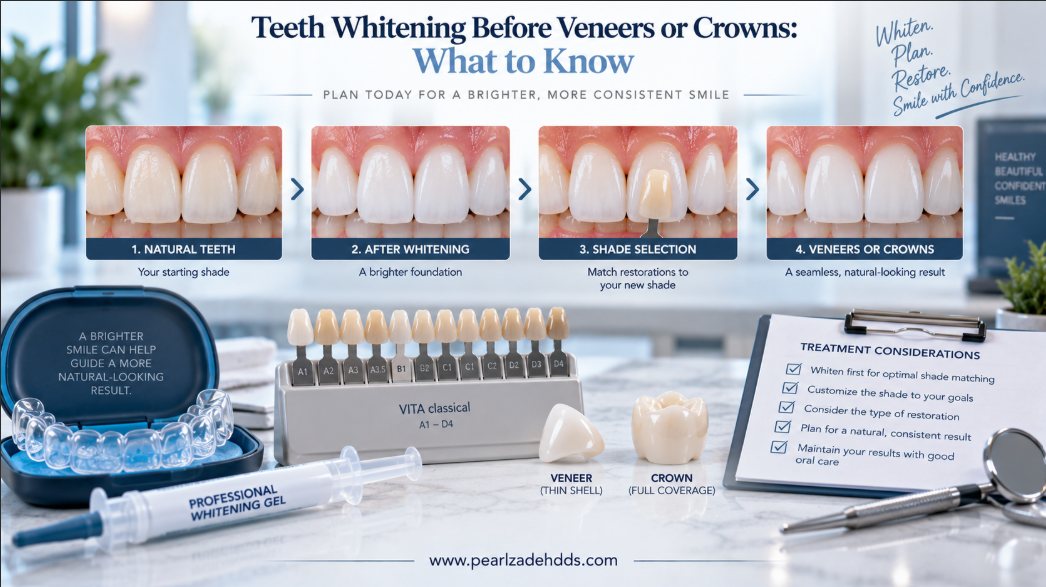
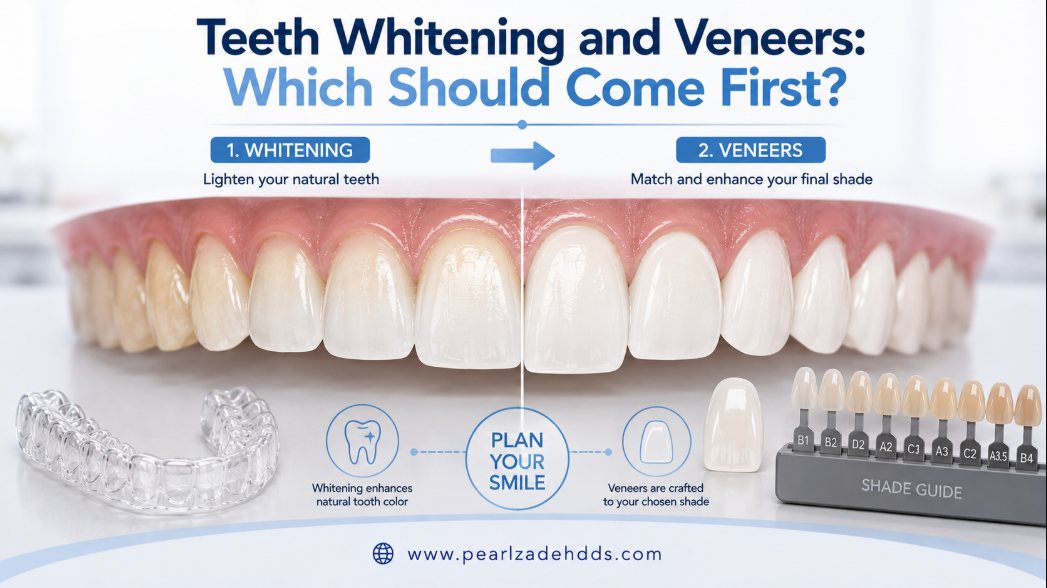
    Often, yes, when whitening is genuinely part of your goals. Whitening your natural teeth first lets your dentist see the shade you’re actually going to live with before selecting a shade for your new veneer or crown. That restoration can then be matched to your surrounding natural teeth as they’ll actually look, rather than matched to a darker starting shade you’re planning to change later anyway.

    Whitening isn’t automatically necessary before every veneer or crown, though. Plenty of patients are happy with their current shade and simply need a restoration that matches it. When both whitening and a restoration are genuinely part of your plan, your dentist should coordinate the two together rather than treating them as separate, unrelated decisions.

    Why Does Whitening Before Veneers or Crowns Matter?

    The core issue comes down to how each treatment actually changes color. Whitening lightens natural tooth structure through a chemical process. A veneer or crown, by contrast, is fabricated in a shade selected ahead of time and doesn’t lighten further once it’s made and placed. Picture a patient who gets a crown matched carefully to their natural teeth, then decides afterward to whiten those same natural teeth substantially.

    The crown stays exactly where it started, while the teeth around it get noticeably lighter. This doesn’t mean every whitening treatment after a restoration creates a dramatic, visible mismatch. Sometimes the difference is subtle. It’s simply a real possibility worth planning around rather than discovering afterward.

    Do Veneers Whiten?

    Not in the way natural teeth do. Whitening agents work on natural tooth structure through a chemical process that porcelain and other veneer materials don’t respond to the same way. The American Dental Association is direct on this point: only natural teeth can be whitened, not tooth-colored restorations. If your natural teeth have become noticeably darker or lighter than existing veneers, that’s worth bringing to your dentist rather than trying to whiten the veneers themselves, which won’t actually change their color.

    Do Crowns Whiten?

    The same principle applies. Existing crowns generally don’t change shade through conventional whitening the way natural teeth do, for the same reason veneers don’t. This matters most when you’re considering whitening after you already have a crown, particularly a visible one. Your surrounding natural teeth may lighten while the crown itself stays exactly where it started, which is exactly the kind of situation worth thinking through before you begin.

    How Long Should You Wait Between Whitening and Veneers or Crowns?

    There’s no universal number of days or weeks that applies to every patient here. The appropriate timing depends on the whitening method used, how much lightening you’re actually aiming for, your individual treatment plan, the type of restoration involved, how stable your new tooth shade actually is, and your dentist’s own clinical assessment of your teeth.

    Dentists often want your shade to settle and stabilize before finalizing a restoration shade, since selecting a shade too soon after whitening risks matching a color that hasn’t fully settled yet. Tooth shade can continue shifting slightly in the days after whitening as the treatment finishes taking effect, which is part of why patience at this stage tends to pay off later.

    What Happens If You Whiten After Getting Veneers or Crowns?

    Your natural teeth can become lighter while an existing veneer or crown stays at its original shade, which means the restoration may end up looking darker relative to the teeth around it. How noticeable this actually becomes varies quite a bit from patient to patient and depends on how much whitening you did and how visible the restoration is.

    This doesn’t mean everyone who whitens after restorative treatment needs a replacement. Replacing the restoration is only one possible option, and whether it’s actually worth considering depends entirely on how the mismatch looks and how much it bothers you.

    Can You Whiten Around Existing Veneers or Crowns?

    Yes, you can generally still whiten your natural teeth even with restorations already in your mouth. The restoration itself simply won’t lighten alongside them. Professional planning becomes genuinely useful when those restorations are visible in your smile, since your dentist can factor in the existing restoration shade before recommending an approach, rather than whitening blindly and hoping everything still looks cohesive afterward.

    What If You Already Have Veneers or Crowns That Don’t Match?

    This is a genuinely common concern, and it’s worth understanding why before deciding what to do about it. A few things can explain it: your natural tooth color may have changed over time, the restoration may have been placed years ago under different circumstances, whitening may have happened after the restoration went in, the original shade may have been selected under different lighting or conditions, or your natural teeth and the restoration may simply have aged differently, since teeth and dental materials don’t always change color at the same rate.

    A systematic review of restoration color stability notes that shade mismatch is actually a common reason restorations end up replaced, and that replacement carries its own cost and risk to otherwise healthy tooth structure. That’s exactly why the right response depends on understanding why the mismatch happened, rather than assuming replacement is automatically the answer. A dentist can evaluate the restoration and the surrounding teeth together before recommending anything.

    What Should You Do If You Want Both Whitening and Veneers?

    A coordinated plan generally looks something like this, though the exact order can vary by case:

    1. A dental examination to assess your overall oral health.

    2. An assessment of any existing restorations and your natural teeth.

    3. A conversation about the tooth shade you’re actually hoping to achieve.

    4. Whitening treatment, when it’s genuinely appropriate for your goals.

    5. Shade selection for the new veneer, based on your teeth once whitening has settled.

    6. Fabrication and placement of the restoration itself.

    7. Ongoing maintenance of both your natural teeth and the new restoration.

    This sequence exists precisely because cosmetic treatment works better planned as a whole rather than as separate, disconnected procedures. Our breakdown of the steps involved in a cosmetic veneer case goes further into that planning process.

    What About a Crown on Just One Tooth?

    Shade matching becomes especially important when a single crown sits right next to your natural teeth, since there’s nothing else nearby to visually blend it with. A slight mismatch that might go unnoticed across a full set of veneers becomes much more obvious on one isolated tooth surrounded by your natural teeth. The shade of your surrounding teeth genuinely drives the shade selected for that crown.

    If you’re also considering whitening, that plan needs to be discussed before the final crown shade gets locked in, not after, since whitening afterward would leave that one crown standing out even more than before. This doesn’t mean every single-tooth crown requires whitening beforehand. Plenty of patients are perfectly happy with their current shade and simply need the crown matched to it as it already is.

    Can You Whiten Teeth After Getting Veneers or Crowns?

    Often, yes, for your remaining natural teeth. The restoration itself generally won’t lighten alongside them, though, which can create a visible shade difference depending on how much whitening you do and how visible the restoration is. If you know whitening is something you might want down the road, mentioning that during your original restoration consultation, before the shade gets finalized, tends to work out better than deciding afterward.

    How Dentists Plan the Shade of Veneers and Crowns

    Shade selection considers your existing natural tooth color, the final shade you’re hoping to achieve, your surrounding teeth, any planned whitening, the restoration material itself, where the tooth sits in your smile, and your overall cosmetic goals together. A peer-reviewed discussion of dental shade selection notes that standardized shade guides, the same reference systems used to evaluate whitening results, are also used for restoration shade matching, which gives dentists a shared, consistent language for both processes.

    Shade matching genuinely helps create a natural, cohesive appearance, but it isn’t a perfectly precise science. Lighting, materials, and individual tooth translucency all play a role, and no dentist can promise an absolutely exact match in every situation.

    What If You Are Not Sure Whether You Need Whitening?

    Whitening isn’t required simply because you’re getting a veneer or a crown. You might already like your current shade just fine and simply need a restoration that matches it as it is. The decision genuinely depends on your own goals and what the rest of your treatment plan looks like.

    If you’re unsure, that’s worth discussing directly with your dentist rather than starting an independent whitening regimen on your own before any of this has been talked through.

    When Should You Talk to Your Dentist About Whitening?

    A few situations are worth bringing up before you start whitening on your own: you’re planning veneers, you need a crown on a visible front tooth, you already have veneers or crowns, you want a significant change in your tooth shade, an existing restoration already looks different from the teeth around it, or you’re considering replacing older cosmetic work. Coordinated planning in any of these situations genuinely helps avoid an unwanted shade difference showing up later.

    Speak With Dr. Pearl Zadeh About Whitening, Veneers, and Crowns

    If you want both a whiter smile and new veneers or crowns, treatment sequencing genuinely affects your final shade match. Dr. Pearl Zadeh, a Woodland Hills dentist providing cosmetic and restorative dental care, can evaluate your teeth and discuss teeth whitening and restoration options together, so your whitening goals factor into the plan from the start rather than becoming an afterthought.

    Call (818) 716-6722 or click the button below to schedule your consultation online.

    Frequently Asked Questions

    Should I whiten my teeth before getting veneers?

    Often, yes, if whitening is part of your goals, since it lets your dentist match the veneer to your intended final shade rather than a shade you’re planning to change.

    Should I whiten my teeth before getting a crown?

    It depends on your goals and where the crown sits. If whitening is part of your plan, discussing it before the shade is finalized generally makes sense.

    Do veneers whiten with teeth whitening?

    No. Veneers don’t respond to whitening the way natural tooth structure does.

    Do crowns whiten with teeth whitening?

    No. Crowns generally don’t change shade through conventional whitening the same way natural teeth do.

    Can I whiten my teeth if I already have veneers?

    Yes, your natural teeth can often still be whitened, though the veneers themselves won’t lighten alongside them.

    Can I whiten my teeth if I already have crowns?

    Yes, typically, though the crown will stay at its original shade while your natural teeth change.

    How long should I wait between whitening and veneers or a crown?

    There’s no universal timeframe. It depends on your whitening method, how much your shade changes, and your dentist’s assessment of when your color has stabilized.

    This article is for informational purposes only and is not a substitute for professional dental advice. Please schedule a consultation with Pearl Zadeh DDS to discuss your specific situation.
  • Teeth Whitening for Sensitive Teeth: Which Options Work Best?

    Teeth Whitening for Sensitive Teeth: Which Options Work Best?

    Tooth sensitivity makes plenty of people hesitant to try whitening at all. You want a brighter smile, but you’ve heard whitening can leave teeth aching afterward, and you already deal with discomfort from cold drinks or sweets more than you’d like. Maybe a friend mentioned their teeth throbbed for days after a whitening session, or you tried a kit once and swore off whitening entirely after the reaction you had.

    Sensitivity doesn’t automatically rule out whitening. The safest, most comfortable approach genuinely depends on why your teeth are sensitive in the first place and which whitening method you’re considering. No dentist can promise a pain-free experience or guaranteed results, but a thoughtful approach can make a real difference.

    Can You Whiten Sensitive Teeth?

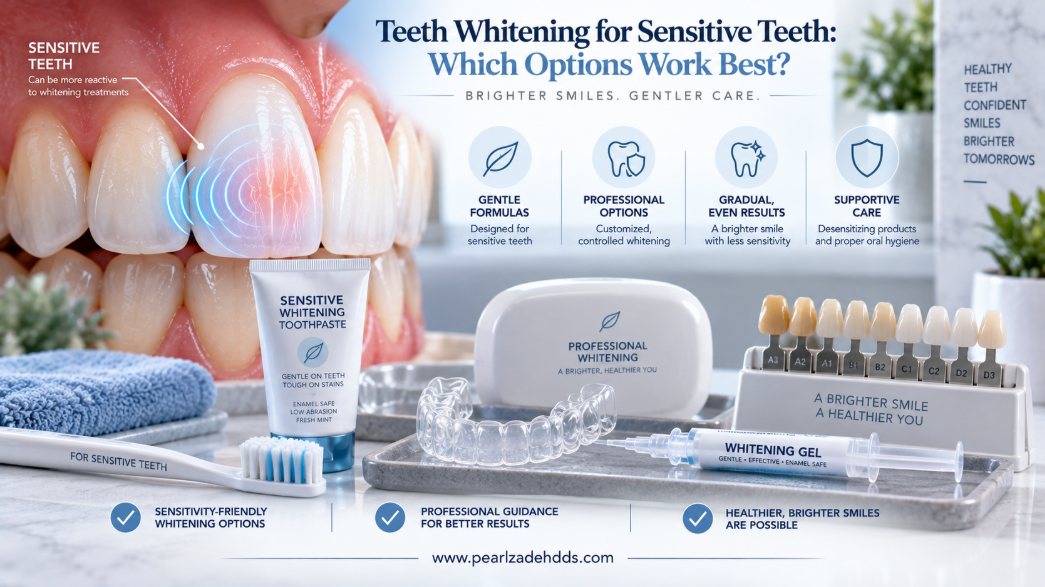
    Often, yes. People with sensitive teeth may still be reasonable candidates for whitening, but sensitivity is something to consider before treatment starts rather than something to discover partway through. Whitening agents can trigger temporary sensitivity in teeth that had no prior issues at all, which is different from sensitivity that already exists for other reasons.

    Existing sensitivity has plenty of possible causes, including exposed dentin, enamel wear, gum recession, cavities, cracks, or other dental problems. Not all sensitivity comes from whitening, and not all whitening-related sensitivity means something is actually wrong with your teeth.

    Why Does Teeth Whitening Cause Sensitivity?

    Whitening agents work by penetrating tooth structure to break down the compounds responsible for discoloration. A peer-reviewed study on dentin tubule treatments after in-office bleaching explains that this sensitivity occurs when bleaching agents penetrate the enamel and reach the dentin underneath, and that it’s generally temporary and subsides on its own.

    A separate clinical explanation of bleaching sensitivity adds an important detail: the peroxide molecule can pass through completely intact enamel and dentin, reaching the pulp within just 5 to 15 minutes, meaning sensitivity can happen even in teeth with no recession, cracks, or restorations at all. That rapid molecular penetration is followed by reversible pulpitis, a temporary inflammation, that tends to develop over the following days rather than happening instantly. This is a genuinely different mechanism than the sensitivity caused by actual exposed dentin from recession or wear.

    How much sensitivity someone experiences varies widely. A cross-sectional study on peroxide concentration and whitening sensitivity found that in-office whitening, which uses higher peroxide concentrations, was associated with sensitivity in roughly 60 to 90 percent of patients in the studies reviewed.

    Concentration, treatment duration, and frequency of application all factor into how likely and how intense sensitivity turns out to be, alongside a person’s existing sensitivity level, enamel wear, gum recession, and any other dental problems already present.

    What Are the Best Whitening Options for Sensitive Teeth?

    There’s no single option that’s universally best. What actually fits depends on your specific sensitivity and oral health.

    Professional Teeth Whitening

    A dentist can evaluate your teeth first and adjust the treatment approach based on what they find, including your level of sensitivity. That evaluation is genuinely valuable, since it can also catch problems that should be addressed before whitening begins at all.

    This doesn’t mean professional teeth whitening is automatically painless or that it always causes less sensitivity than other options. It means you have a professional adjusting the approach based on your actual mouth rather than a generic instruction sheet.

    At-Home Whitening

    At-home options include dentist-directed systems using custom trays and over-the-counter products you buy directly. Lower-intensity formulations or shorter treatment schedules are sometimes considered specifically for people who deal with sensitivity, since the same peroxide concentration research notes that lower-concentration at-home and over-the-counter products tend to come with reduced sensitivity compared to higher-concentration in-office treatment.

    No specific product can be responsibly recommended here without knowing your actual situation, but the general principle, lower concentration generally means less sensitivity risk, holds up reasonably well across the research.

    Whitening Strips for Sensitive Teeth

    Whitening strips can cause sensitivity in some users, influenced by the whitening concentration, how long the strips stay in contact with your teeth, how often you use them, and your individual sensitivity level. This doesn’t mean strips are inherently unsafe for everyone with sensitive teeth. If you already deal with significant sensitivity, talking to a dentist before starting strips on your own is a reasonable precaution, particularly if you’re unsure what’s actually causing your sensitivity in the first place.

    Whitening Toothpaste

    Whitening toothpaste works differently than peroxide-based whitening treatments. Many whitening toothpastes primarily remove surface stains through mild abrasion rather than meaningfully changing the underlying color of your teeth.

    For people with certain sensitivity concerns, the abrasive ingredients in some formulations can matter, though it wouldn’t be accurate to say every whitening toothpaste worsens sensitivity. Some are specifically formulated with sensitivity in mind, while others prioritize stain removal more aggressively.

    Professional Whitening vs. At-Home Whitening for Sensitive Teeth

    Each approach has genuine tradeoffs worth weighing. Professional treatment allows your oral health to be assessed first and gives your dentist more control over the process, including the concentration and duration used. At-home options offer convenience and, at lower concentrations, potentially reduced sensitivity, though with less oversight and less ability to adjust mid-treatment if something feels off.

    Existing dental conditions, the type of staining you’re dealing with, and how much control you want over the process all factor into which approach genuinely fits you better. Our comparison of professional and at-home whitening options goes further into these differences. Neither approach is universally superior for sensitive teeth. It depends on your specific situation.

    How Can You Reduce Sensitivity Before Whitening?

    A few practical steps can help going in. Address any existing dental problems, like a cavity or a cracked tooth, before starting whitening rather than layering treatment on top of an unresolved issue. Use appropriate oral-care products for your baseline sensitivity level in the weeks leading up to treatment, since building a foundation of comfort beforehand tends to matter more than reacting once sensitivity has already started.

    Avoid excessive or overly frequent whitening, since more isn’t automatically better and can work against you here. Follow whatever product instructions you’re actually given rather than improvising your own schedule based on what worked for someone else. Discuss your sensitivity history with your dentist beforehand, including any past reactions to whitening, so it can genuinely factor into the plan rather than being an afterthought. Depending on your situation, your dentist may consider adjustments to concentration, duration, or approach based specifically on what you tell them.

    How Can You Reduce Sensitivity After Whitening?

    If temporary sensitivity does show up, a few things can help manage it. Stick to the recommended whitening schedule rather than repeating treatment sooner than intended. Avoid unnecessary repeat sessions just because results haven’t fully set in yet, since results naturally fade at their own pace and rushing another treatment usually isn’t the answer. Your dentist may recommend sensitivity-focused oral-care products if appropriate for your situation.

    Avoiding extremely hot or cold foods and drinks temporarily can reduce discomfort while things settle. Not everyone experiences sensitivity after whitening at all, so this isn’t something to expect by default. If sensitivity is severe, persistent, or feels unusual compared to what you were told to expect, contact your dentist rather than waiting it out indefinitely.

    What If Your Teeth Are Already Very Sensitive?

    Severe or persistent sensitivity genuinely deserves an evaluation before whitening, not just extra caution during treatment. Possible underlying causes include gum recession, exposed dentin, tooth decay, cracked teeth, worn enamel, existing dental work that’s aging or failing, or other sources of dental sensitivity entirely unrelated to whitening. Each of these has its own appropriate treatment, and whitening doesn’t address any of them.

    Whitening shouldn’t simply be layered over an unexplained dental problem in the hope that it resolves on its own, or that a brighter smile will somehow distract from an underlying issue. Figuring out what’s actually causing the sensitivity comes first, and whitening can always be reconsidered once that’s been sorted out.

    When Sensitivity May Signal Another Dental Problem

    Temporary whitening sensitivity is one thing. Sensitivity that points toward something else is another, and it’s worth knowing the difference. Evaluation makes sense when sensitivity happens without any whitening involved, affects one specific tooth rather than several, is severe, persists longer than you were told to expect, occurs alongside pain when biting down, comes with visible damage to the tooth, appears together with gum changes, or simply keeps getting worse instead of settling.

    Our discussion of early signs of gum disease covers what gum-related changes are worth watching for specifically. None of these patterns can be diagnosed from a symptom list. Only an actual dental examination can determine what’s really going on.

    Can You Whiten Teeth Without Sensitivity?

    No whitening method can honestly guarantee zero sensitivity for every patient. That said, treatment can often be adjusted based on your specific sensitivity level and overall oral health, whether that means a lower concentration, a shorter duration, more spacing between sessions, or a different method altogether.

    Individualized planning matters more here than picking a single lowest-risk product off a shelf. Nobody should promise you pain-free whitening, and any claim that sounds that certain is worth being skeptical of.

    How to Choose a Whitening Approach for Sensitive Teeth

    A few general patterns are worth thinking through, though these are educational examples rather than instructions to follow without professional input. Mild sensitivity might mean a less intensive whitening approach or an adjusted schedule is worth discussing, rather than avoiding whitening altogether. Frequent sensitivity, meaning it shows up often even outside of whitening, is a reasonable prompt for a dental evaluation before starting any whitening at all.

    Severe or unexplained sensitivity generally means addressing the underlying cause takes priority over cosmetic whitening, since treating the symptom without understanding the cause rarely goes well. Healthy teeth with only occasional sensitivity during past whitening attempts might simply need a conversation about frequency and management rather than avoiding whitening altogether.

    When Should You Talk to a Dentist Before Whitening?

    A few situations deserve a conversation before you start whitening. These include persistent or severe sensitivity, sensitivity in one tooth, gum recession, suspected cavities, cracks, or visible damage. Existing dental restorations and strong reactions to past whitening also matter. A dentist can determine whether whitening suits you now or whether another dental issue needs attention first.

    Speak With Dr. Pearl Zadeh About Whitening for Sensitive Teeth

    Sensitive teeth do not automatically rule out whitening, but the cause and severity of your sensitivity matter. Dr. Pearl Zadeh provides cosmetic dentistry and teeth whitening in Woodland Hills. She can evaluate your teeth and determine whether whitening suits you. She can also recommend an approach that fits your oral health.

    Call (818) 716-6722 or click the button below to schedule your consultation online.

    Frequently Asked Questions

    Can you whiten sensitive teeth?

    Often, yes, though existing sensitivity should be discussed with a dentist first so the approach can be adjusted appropriately.

    What is the best teeth whitening for sensitive teeth?

    There’s no single best option for everyone. The right choice depends on the cause and severity of your sensitivity, evaluated individually.

    Do whitening strips make sensitive teeth worse?

    They can cause sensitivity for some users, depending on the concentration, contact time, and individual sensitivity. However, that does not mean whitening strips are unsafe for everyone.

    Is professional whitening better for sensitive teeth?

    It provides more oversight and allows your dentist to adjust the treatment. However, it does not guarantee a pain-free experience or less sensitivity than other options.

    Can whitening toothpaste help sensitive teeth?

    It can help remove surface stains, and some formulations target sensitivity. However, it works differently from peroxide-based whitening.

    How can I reduce sensitivity after teeth whitening?

    Follow your recommended schedule and avoid unnecessary repeat treatments. Avoid extreme temperatures temporarily, and contact your dentist if sensitivity feels severe or unusual.

    This article is for informational purposes only and is not a substitute for professional dental advice. Please schedule a consultation with Pearl Zadeh DDS to discuss your specific situation.
  • How Long Does Teeth Whitening Last? How to Keep Your Smile White

    How Long Does Teeth Whitening Last? How to Keep Your Smile White

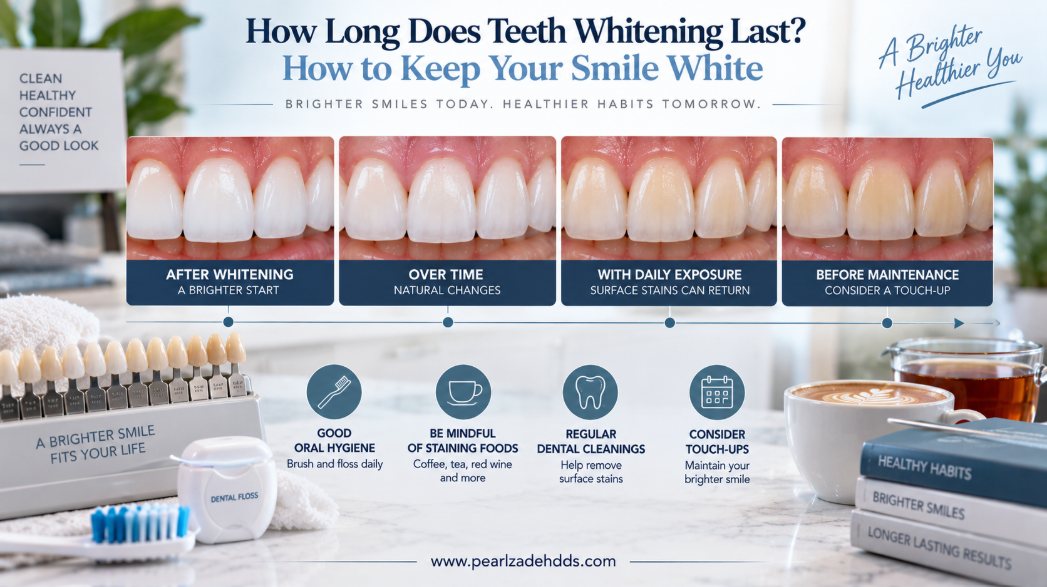
    Teeth whitening isn’t permanent. How long your results stay noticeable varies quite a bit from person to person, and there’s no single timeline that applies to everyone who walks out of a whitening appointment with a brighter smile.

    Lifestyle habits, oral hygiene, the specific type of discoloration you started with, and any maintenance you keep up with afterward all affect how quickly your teeth start looking less bright again. Setting realistic expectations from the start makes the whole process considerably less frustrating later.

    How Long Does Teeth Whitening Last?

    Whitening results fade gradually rather than disappearing all at once. A peer-reviewed narrative review of tooth whitening procedures found that both in-office and take-home tray bleaching showed good stability for up to two years in many patients, though this doesn’t happen for everyone. The same review cited earlier research finding regression in about 26% of cases by 18 months, and noted that the rate of color relapse is genuinely unpredictable, depending heavily on how often someone consumes staining foods and drinks, whether they smoke, and how consistent their oral hygiene actually is.

    A separate five-year clinical study on at-home whitening with 10% carbamide peroxide found the whitening effect remained clinically noticeable after five years, despite a gradual and expected amount of relapse along the way. Professional whitening, dentist-supervised at-home whitening, and over-the-counter products all differ somewhat in how they’re applied, but no method has been shown to reliably outlast the others for every patient. Our comparison of professional and at-home whitening options goes further into how these approaches actually differ.

    Why Do Teeth Become Stained Again After Whitening?

    It helps to separate two different things: the initial whitening result fading, and genuinely new discoloration developing on top of it. Pigments from food and drink can gradually accumulate on tooth surfaces again after treatment, the same way they did before you ever whitened. Right after whitening, tooth surfaces can be temporarily more porous and more receptive to picking up new pigment, which is part of why the first few days matter more than most people realize. Tobacco use contributes its own staining. Plaque buildup left behind by inconsistent brushing gives new stains something to cling to more easily.

    Natural aging continues regardless of any whitening you’ve had, since enamel thins gradually over the years and lets more of the naturally darker dentin underneath show through. Changes within the tooth itself, separate from anything happening on the surface, can also shift color slowly over time. Whitening doesn’t create permanent immunity to any of this. It resets the color at a point in time, and everyday life continues acting on your teeth from there.

    Which Foods and Drinks Can Stain Your Teeth?

    Frequently consuming strongly pigmented foods and beverages contributes to staining over time. Common culprits include coffee, tea, red wine, dark berries, tomato-based sauces, soy sauce, and other deeply colored drinks. None of this means you need to eliminate these foods permanently or follow some restrictive whitening diet.

    What actually matters is frequency and exposure, not any single cup of coffee or glass of wine. Rinsing your mouth with water after eating or drinking something pigmented, and not sipping a staining drink slowly over hours, both make a genuine difference without requiring you to give anything up entirely.

    Can You Drink Coffee After Teeth Whitening?

    Yes, in most cases, though it’s worth understanding why coffee affects your results. Coffee contains tannins and other compounds that readily adhere to tooth surfaces, particularly right after whitening when enamel can be temporarily more porous. There’s no universally agreed-upon waiting period backed by strong evidence, so treat any specific number of hours you see online with some skepticism.

    Practical habits help more than a strict rule: using a straw for iced coffee, rinsing with water afterward, and not nursing a cup over an extended stretch all reduce how much staining potential actually reaches your teeth. Nobody needs to give up coffee entirely because they whitened their teeth.

    Does Smoking Make Teeth Whitening Results Fade Faster?

    Yes, tobacco use is a genuine factor here. The American Dental Association notes that extrinsic tooth staining can be worsened by lifestyle habits including smoking and chewing tobacco, alongside poor oral hygiene and frequent exposure to pigmented food or drink. Smoking tends to contribute to yellow or brown discoloration that builds up steadily, which makes maintaining a brighter appearance genuinely harder for people who smoke regularly.

    This staining is separate from the broader oral health effects tobacco use can have, and it’s worth knowing about specifically because it tends to accumulate faster and more persistently than typical dietary staining alone. This isn’t meant as a judgment on anyone’s habits. It’s simply a real factor worth knowing about if whitening longevity matters to you.

    How Does Your Oral-Care Routine Affect Whitening Results?

    Brushing twice daily, cleaning between your teeth, keeping up with regular dental cleanings, using appropriate oral-care products, and maintaining healthy gums all help reduce plaque and surface staining that would otherwise build up faster.

    Our discussion of early signs of gum disease covers what’s worth watching for as part of that broader routine. None of this means brushing alone preserves professional whitening indefinitely. Good oral hygiene slows the return of new surface staining. It doesn’t stop the natural fading process that affects every whitening treatment eventually.

    Does Whitening Toothpaste Help Keep Teeth White?

    It can help with certain surface stains, but it doesn’t work the same way professional whitening does. The ADA notes that over-the-counter whitening products like toothpastes are effective primarily at removing extrinsic, surface-level stains, and generally have little meaningful effect on intrinsic staining or the underlying color of the tooth itself.

    There’s a real difference between removing surface stains that have accumulated since your last cleaning and actually changing the shade of your natural tooth structure, which is what professional whitening accomplishes. Whitening toothpaste is a reasonable maintenance habit between treatments. It isn’t a substitute for professional whitening, and it won’t maintain the exact result your original treatment achieved indefinitely.

    When Should You Get a Teeth Whitening Touch-Up?

    Some patients choose a maintenance or touch-up treatment once they notice their teeth gradually darkening again. Timing genuinely depends on how quickly staining actually returns for you, your diet, whether you use tobacco, what type of whitening you originally had, how bright a shade you’re hoping to maintain, any sensitivity you experience, and what your dentist actually recommends based on your teeth.

    A patient who drinks coffee daily and doesn’t floss consistently will likely notice fading sooner than someone with lighter dietary habits and a thorough hygiene routine, even if both had identical original treatments. There’s no universal touch-up schedule that applies to every patient. Repeatedly whitening on your own without any professional guidance isn’t necessarily appropriate, since it skips the evaluation that would normally catch whether something other than ordinary fading is actually going on.

    Can Whitening Your Teeth Too Often Cause Problems?

    More whitening isn’t automatically better, and this is worth taking seriously. Overusing whitening products or using them incorrectly can contribute to temporary tooth sensitivity and gum irritation. This doesn’t mean that normal, appropriately supervised professional whitening damages enamel when it’s used as directed.

    There’s a real difference between a dentist-guided treatment plan and repeatedly applying over-the-counter products on your own without any professional input. If you’re tempted to whiten again simply because results have faded faster than you’d like, that’s a reasonable moment to talk to your dentist first rather than reaching for another kit.

    What If You Have Veneers, Crowns, or Fillings?

    Whitening affects natural tooth structure differently than it affects dental restorations. Veneers, crowns, tooth-colored fillings, and other visible restorations generally don’t change shade the way natural enamel does when exposed to whitening agents. If you have restorations, especially visible ones near the front of your smile, your dentist may need to plan whitening carefully to avoid an uneven result between your natural teeth and the restored ones.

    Our overview of cosmetic treatment options for stained teeth goes further into what else might apply if restorations are part of your situation. Restorations don’t whiten like natural teeth, and no whitening treatment changes that.

    What Can You Do to Make Whitening Results Last Longer?

    1. Maintain consistent oral hygiene, since plaque gives new stains an easier surface to build on.

    2. Limit frequent exposure to heavily staining foods and drinks rather than eliminating them outright.

    3. Think about how you consume coffee, tea, and other staining beverages, not just how often.

    4. Avoid tobacco products, since they contribute their own steady discoloration over time.

    5. Keep up with regular dental visits, which help catch and remove buildup before it becomes noticeable staining.

    6. Follow whatever professional whitening instructions you were actually given, rather than improvising.

    7. Use touch-up treatment only when it’s actually appropriate for your situation, not on a fixed schedule you invented.

    8. Address new or unusual discoloration with an evaluation rather than repeatedly whitening over it.

    How Can You Maintain a Naturally White Smile?

    The goal doesn’t need to be the brightest possible shade. Natural tooth color varies considerably between people, ranging from warmer ivory tones to cooler, grayer whites, and none of these is inherently the correct baseline to aim for. Factors like aging and individual tooth characteristics affect what a realistic, healthy-looking result actually is for you, and pushing well past your teeth’s natural range often looks less convincing rather than more attractive.

    An extremely white smile isn’t inherently healthier or better than a more moderately bright one. What matters more is a smile that looks natural on you and that you’re genuinely comfortable maintaining, rather than chasing a shade that doesn’t suit your teeth or that requires constant upkeep to sustain.

    When Should You See a Dentist About New Tooth Discoloration?

    Certain patterns are worth an evaluation rather than another round of whitening. One tooth becoming noticeably darker than the others, sudden discoloration that appeared quickly, discoloration that doesn’t respond to whitening at all, pain or sensitivity associated with a discolored tooth, or visible damage or changes to the tooth itself all fall into this category. Some discoloration has an underlying dental cause that whitening simply won’t address, and a professional evaluation is what actually determines what’s going on rather than guessing and whitening again.

    Speak With Dr. Pearl Zadeh About Teeth Whitening

    Whitening results naturally fade over time, but thoughtful habits and appropriate maintenance can help you hold onto your smile longer. Dr. Pearl Zadeh, an accredited member of the American Academy of Cosmetic Dentistry, can evaluate your teeth and discuss professional whitening options suited to your goals, without promising results that aren’t realistic for your specific teeth.

    Call (818) 716-6722 or click the button below to schedule your consultation online.

    Frequently Asked Questions

    How long does professional teeth whitening last?

    Results vary by patient, with research showing good stability for up to two years in many cases, though this doesn’t happen for everyone. Diet, tobacco use, and oral hygiene all affect how long results actually hold.

    How can I keep my teeth white after whitening?

    Consistent oral hygiene, limiting frequent exposure to staining foods and drinks, avoiding tobacco, and keeping up with regular dental visits all help extend your results.

    Can I drink coffee after teeth whitening?

    Yes, though coffee can contribute to staining over time. Using a straw, rinsing afterward, and not sipping it slowly over hours all help reduce the effect.

    Does smoking make whitening results fade faster?

    Yes. Tobacco use contributes to yellow or brown discoloration and makes maintaining brighter results noticeably harder.

    Does whitening toothpaste help maintain whitening?

    It can help remove surface stains between treatments, but it doesn’t change the underlying tooth shade the way professional whitening does.

    This article is for informational purposes only and is not a substitute for professional dental advice. Please schedule a consultation with Pearl Zadeh DDS to discuss your specific situation.
  • How Much Does Professional Teeth Whitening Cost in Woodland Hills?

    How Much Does Professional Teeth Whitening Cost in Woodland Hills?

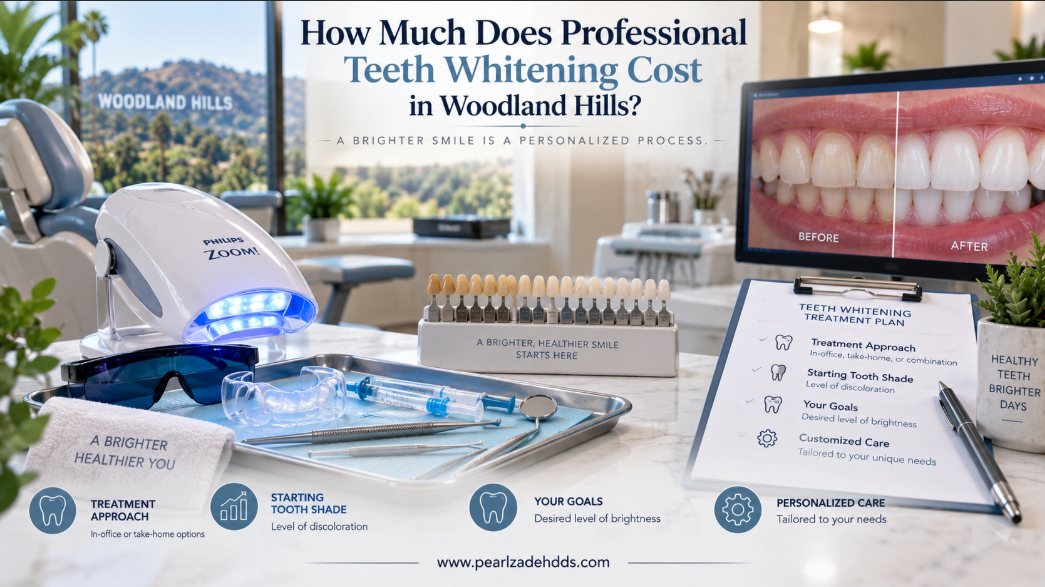
    Cost is one of the first things people want to know before scheduling professional teeth whitening. It’s a fair question. The honest answer is that no single price applies to every patient in Woodland Hills.

    Several factors affect the final cost. These include your treatment approach and the number of sessions you need. Your starting tooth shade and the type of discoloration also matter. The condition of your teeth and gums can affect the price too. Existing dental work and your specific whitening goals also factor into the final cost.

    Our professional teeth whitening services are planned around each patient individually rather than priced the same way for everyone who walks in.

    How Much Does Professional Teeth Whitening Cost in Woodland Hills?

    Our current whitening fee is best confirmed directly with the practice. Publishing an unverified number here would not give you a reliable answer. General whitening costs vary widely between sources. Prices also depend on location, treatment method, and the provider. Giving one figure could create a false sense of precision rather than provide useful information.

    A national average or price from another city does not tell you what your treatment will cost. It cannot account for your specific teeth, goals, or treatment needs. It’s more useful to understand what drives the cost. That way, you know what questions to ask and what to expect after your dentist evaluates your teeth and provides a personalized quote.

    What Affects the Cost of Professional Teeth Whitening?

    The Type of Whitening Treatment

    Professional whitening isn’t a single procedure. Dentists use different approaches based on your needs and goals. These include in-office whitening completed in one visit and dentist-supervised take-home trays used over several weeks. In-office whitening typically uses a higher-concentration whitening agent. The dental team applies it directly to your teeth, often producing a visible change after one appointment.

    Take-home trays use a lower-concentration whitening agent. You apply them yourself over several nights under your dentist’s guidance. This approach spreads the whitening process over time instead of concentrating it into one visit.

    The materials and whitening agent concentration can affect the cost. The treatment setting also matters. You may receive treatment in the office or at home under professional guidance.

    The right method isn’t necessarily the most expensive or cheapest option. It’s the one that fits your goals, schedule, and dental needs.

    How Much Whitening You Need

    Patients start from very different places. Some have mild surface staining that responds readily to whitening. Others have deeper discoloration that takes more time or a different approach to address. The American Dental Association notes that whitening can be effective on surface stains, but treats staining within the dentin layer very differently: removing that kind of deep, intrinsic staining through an external whitening procedure alone is considered close to impossible. Not every type of discoloration responds the same way, and no provider can honestly promise the same result for every patient walking through the door.

    Your Existing Oral Health

    A dentist typically needs to evaluate your teeth and gums before recommending whitening. Untreated decay, active gum problems, significant sensitivity, or cracked or damaged teeth can all affect whether whitening makes sense right now, or whether something else needs attention first. Whitening a tooth with an unresolved cavity underneath it, for example, doesn’t address the actual problem and can make it harder to monitor.

    Whitening isn’t something that should automatically happen before addressing an active dental problem. Our discussion of early signs of gum disease covers what’s worth watching for if you’re unsure where your gum health currently stands.

    What Is Included in Professional Teeth Whitening?

    Depending on the treatment approach, professional whitening may include a dental evaluation to check whether whitening is appropriate right now, treatment planning specific to your teeth and goals, professional-grade whitening materials that aren’t available over the counter, customization based on your particular sensitivity and discoloration pattern, professional application or supervision throughout the process, instructions for maintaining your results afterward, and follow-up recommendations when appropriate.

    A quoted price built around a genuine evaluation and a plan tailored to your teeth is a different thing than a flat fee for a generic product, even if the numbers happen to look similar on paper. Not every element applies to every treatment plan, and what’s specifically included in your case is something to confirm directly with your provider rather than assume from a general list like this one.

    Why Does Professional Whitening Cost More Than Whitening Strips?

    Professional treatments generally use stronger whitening formulations than what’s available over the counter, applied under a dentist’s supervision rather than on your own. The ADA confirms that professional whitening uses higher-concentration peroxide agents than over-the-counter products, which generally means visible change happens faster than it would with a lower-concentration product used at home. A dentist can also customize the approach and monitor for side effects along the way. Convenience matters too.

    A single supervised session accomplishes something that might take weeks of consistent at-home use to approach. This doesn’t mean professional whitening is always dramatically more effective for every patient and every type of staining. It means you’re generally paying for strength, customization, and oversight rather than the whitening product alone. Our comparison of professional and at-home whitening goes further into these differences.

    Does the Type of Staining Affect Whitening Cost?

    Yes, in a meaningful way. Surface stains from coffee, tea, red wine, or tobacco tend to respond well to standard whitening approaches, since they sit on the outer surface of the tooth rather than deep within it. Deeper, intrinsic discoloration, the kind that develops within the tooth structure itself, behaves differently and generally needs more time or a stronger approach to address.

    Age-related darkening happens gradually as enamel thins and the naturally darker dentin underneath becomes more visible. Certain medication-related staining, particularly from medications taken during childhood tooth development, can be especially resistant to standard whitening.

    Discoloration tied to past dental trauma or affecting a single tooth is its own category entirely, sometimes involving changes inside the tooth that external whitening simply can’t reach. In some cases, whitening alone may not fully resolve the concern, and a different cosmetic approach may be worth discussing instead. Our overview of cosmetic treatment options for stained teeth goes further into what else might apply depending on the type of discoloration involved.

    Can Crowns, Veneers, or Fillings Affect Whitening Cost?

    This is worth understanding before you start. Whitening changes the color of natural tooth structure. The ADA is direct on this point: only natural teeth can be whitened, not tooth-colored restorations like crowns, veneers, or fillings. If you have visible restorations, your dentist needs to consider whether your natural teeth will end up a noticeably different shade than the restored ones once whitening is complete.

    A front tooth with a crown sitting next to teeth that just got several shades lighter is exactly the kind of mismatch worth planning around ahead of time, not discovering afterward. This doesn’t mean restorations always need to be replaced after whitening, and it doesn’t mean whitening treatment changes the color of an existing restoration. It simply means shade matching is part of the conversation when restorations are involved, and it can affect what your dentist actually recommends.

    Does Tooth Sensitivity Make Professional Whitening More Expensive?

    Not automatically, though it’s a real factor in how treatment gets planned. The ADA identifies temporary tooth sensitivity and gum irritation as the most common side effects of whitening treatment. Existing sensitivity can influence which approach your dentist recommends, how the treatment is paced, or what concentration of whitening agent makes sense for you.

    A patient who already deals with sensitive teeth might do better with a lower-concentration approach spread over a longer period, rather than a single high-concentration session, even if that changes which specific treatment gets recommended. Sensitive teeth don’t automatically mean a more expensive treatment plan. They mean an individualized one. No provider can promise a completely sensitivity-free experience, but a thoughtful plan can help manage it, and any sensitivity that does occur is generally temporary.

    How Many Whitening Treatments Will You Need?

    This varies considerably based on your starting tooth shade, the type of discoloration involved, your desired result, the treatment method used, how your teeth actually respond, and how well you maintain results afterward. Some patients see the change they want after one session. Others need a follow-up treatment or ongoing touch-ups to maintain results over time, since whitening isn’t necessarily permanent and everyday habits like coffee, tea, or tobacco can gradually reintroduce staining.

    That maintenance factor is worth asking about directly, since it can affect the total cost of keeping your results over the following months and years, not just the initial treatment. No dentist can honestly promise a specific number of shades of improvement or a universal number of sessions before actually evaluating your teeth.

    Is Professional Teeth Whitening Worth the Cost?

    That depends on your goals, the type of staining you’re dealing with, your expectations, and whether you value professional supervision over a do-it-yourself approach. Whitening strips and whitening toothpaste are less expensive and more convenient for mild, gradual change, but they generally work more slowly and offer less customization than professional treatment. They also can’t account for existing restorations, sensitivity, or discoloration that needs a different approach entirely, since there’s no evaluation built into a box you pick up at the drugstore.

    Dentist-supervised at-home whitening sits somewhere in between, combining professional oversight with the convenience of treating your teeth at home. None of these options is universally better. What matters is which one actually fits what you’re trying to achieve, your budget, and your specific teeth.

    How Can You Find Out What Teeth Whitening Will Cost?

    The most accurate estimate comes from discussing your specific goals and dental condition directly with your provider. A few questions worth asking during that conversation: Which whitening method is being recommended for me? What’s actually included in the treatment? How many treatments might I realistically need? Are there any additional costs I should know about? Will my existing crowns, veneers, or fillings affect the plan? What should I expect after treatment? And what can I do to maintain the results once I have them?

    Speak With Dr. Pearl Zadeh About Teeth Whitening

    There’s no single price that fits every patient considering professional teeth whitening. Dr. Pearl Zadeh, an accredited member of the American Academy of Cosmetic Dentistry, can evaluate your teeth, discuss your goals, and help determine the right approach and current cost for your specific situation.

    Call (818) 716-6722 or click the button below to schedule your consultation online.

    Frequently Asked Questions

    How much does professional teeth whitening cost in Woodland Hills?

    Cost varies based on treatment method, the number of sessions needed, and your individual dental condition. The most accurate figure comes from a consultation with the practice.

    Why does professional teeth whitening have different prices?

    Treatment method, materials, the amount of discoloration involved, and whether existing dental work needs to be considered all influence the final cost.

    Is professional teeth whitening more expensive than whitening strips?

    Generally yes, since professional treatment uses stronger formulations under dental supervision, though the two options serve different needs and budgets.

    Does insurance cover professional teeth whitening?

    Cosmetic teeth whitening is generally not covered as a routine dental benefit, though coverage details can vary, so it’s worth checking directly with your insurance provider.

    Do crowns and veneers affect the cost of teeth whitening?

    They can factor into treatment planning, since restorations don’t whiten the same way natural teeth do, which may affect what approach makes sense for your smile.

    This article is for informational purposes only and is not a substitute for professional dental advice. Please schedule a consultation with Pearl Zadeh DDS to discuss your specific situation and current pricing.

  • Teeth Whitening and Veneers: Which Should Come First?

    Teeth Whitening and Veneers: Which Should Come First?

    You want a brighter smile, and you’re planning veneers on a couple of front teeth too. It seems simple enough. Get the veneers now, whiten everything later, done. One smile, two upgrades, whatever order works for your schedule.

    Not quite. Natural teeth can change shade with whitening. Porcelain veneers generally don’t respond to whitening the same way. That difference means treatment order can actually affect how consistently your teeth match once everything’s finished.

    The Short Answer: Whitening Often Comes First

    When whitening is part of your goal, it often makes sense before your final veneer shade gets selected, especially when only some of your visible teeth are getting veneers, you want the surrounding natural teeth to look noticeably lighter, or matching the veneers to your natural teeth matters to you. That said, whitening doesn’t automatically come first for every patient. Your dentist needs to look at your full treatment plan before deciding what sequence actually makes sense for you.

    Why Does the Order Matter?

    Whitening treatments work by lightening the natural structure of your tooth. Porcelain veneers are fabricated in a shade that’s selected and locked in during the lab process. Whitening treatment doesn’t lighten porcelain the way it lightens natural enamel. If you whiten your natural teeth after your veneers are already placed, you can end up with a visible color difference between the two.

    Worth being upfront about here: the specific research on bleaching timing and veneer color is mostly laboratory work on extracted or animal teeth, not real patient outcomes measured over time. One study looking at porcelain veneers found that whether bleaching happened right before or right after preparing the same tooth didn’t significantly change how well the veneer masked underlying discoloration, though that study was testing a narrower question than the everyday scenario of whitening teeth that sit next to veneers placed earlier. Separate laboratory research on composite veneer material found that bleaching can interact with a veneer’s thickness and shade to change its final appearance in more complex ways than a simple before-or-after rule would suggest. None of this settles the practical question with certainty. It’s part of why sequencing gets decided case by case rather than from a fixed formula.

    What Happens If You Whiten Before Getting Veneers?

    Whitening first lets your dentist see your natural teeth at their lighter color before finalizing anything. Veneers can then be matched to the shade you’re actually aiming for, rather than a shade based on darker, unwhitened teeth. This tends to help with color consistency specifically when only selected teeth are getting veneers and the rest of your smile stays natural.

    Your dentist likely won’t finalize your veneer shade the same day whitening ends. Tooth color can shift slightly as it settles, so allowing some time before making final restorative decisions is common. There’s no single universal waiting period that applies to every patient, and any specific number would be more confident than the evidence actually supports. Your dentist can give you a realistic timeframe based on your case.

    What Happens If You Whiten After Getting Veneers?

    Picture this: you get veneers on two front teeth, then decide to whiten the rest of your smile a year later. Your natural teeth lighten. Your veneers stay exactly where they started. The color difference between the two can become considerably more noticeable than it was before whitening.

    A professional cleaning may help with external surface staining sitting on top of a veneer, but that’s different from actually changing the veneer’s underlying shade. Whitening treatment doesn’t work on porcelain the way it works on natural enamel. Don’t attempt to whiten veneers yourself with an over-the-counter product hoping for a similar effect. It isn’t designed for that material and isn’t going to change the veneer’s actual color.

    Do You Always Need to Whiten Before Veneers?

    No. Some patients already like their natural tooth color and have no interest in changing it. Others are getting veneers on a larger number of visible teeth, which shifts how much surrounding natural tooth color even matters for the final look. Existing restorations elsewhere in the smile can also influence the overall shade plan in ways that make a different sequence more sensible. Your dentist may simply recommend a different order based on what your case actually needs. Our rundown of common veneer myths touches on a few other assumptions patients make about veneer treatment that don’t always hold up. The treatment plan should be what guides the sequence, not a general rule applied automatically.

    What If You’re Only Getting One or Two Veneers?

    Shade matching becomes especially important when just a couple of teeth are getting veneers, since those restorations need to blend in with everything around them rather than standing on their own. If whitening is part of your goal, bringing it up before your veneers are fabricated gives your dentist a real chance to plan the shade accurately around your intended result. That said, no dentist can promise a perfect, invisible match in every lighting condition. The goal is a genuinely good blend, not an unrealistic guarantee.

    What If You Already Have Veneers and Want Whiter Teeth?

    Your natural teeth may still be reasonable candidates for whitening, depending on your oral health and overall treatment plan. Your existing veneers, though, will generally stay at their original shade regardless of what whitening does to the teeth around them. That can create a mismatch between the veneers and your newly whitened natural teeth.

    Your dentist can evaluate what’s actually going on before recommending anything. The underlying concern might be surface staining, natural teeth that have genuinely darkened over time, existing veneers that simply look darker by comparison now, or an older restoration that no longer fits the rest of your smile the way it used to. None of these automatically means you need new veneers. It depends on what’s actually happening in your specific mouth.

    Can Whitening Remove Stains From Veneers?

    It helps to separate three different things: surface stains or buildup sitting on a veneer, changes happening in your surrounding natural teeth, and any change involving the veneer material itself. A professional cleaning can often address certain external stains sitting on the surface of a veneer. Whitening treatment itself doesn’t work on porcelain the way it works on natural enamel, since it’s designed to lighten tooth structure, not ceramic. A dentist should actually look at the veneer in question before recommending any specific approach.

    How Does a Dentist Choose the Final Veneer Shade?

    Choosing veneer color involves more than picking the brightest option on a shade guide. Your dentist may weigh:

    • Your natural tooth color
    • Your neighboring teeth
    • Your cosmetic goals
    • The thickness of the veneer itself
    • Its translucency
    • The color of the tooth underneath it
    • Any existing restorations nearby
    • How everything looks together as a full smile

    Our guide to preparing for your veneers appointment goes further into how that planning process actually works.

    Why Planning the Whole Smile Matters

    Whitening and veneers tend to work best together when your dentist knows your complete cosmetic goal from the start, not just the next single procedure. A patient who initially wants two veneers might later decide they want a noticeably brighter overall smile. Planning both goals together from the outset helps avoid an unexpected color mismatch showing up later. Our breakdown of the steps involved in a cosmetic veneer case covers that broader planning process in more depth.

    What About Existing Crowns, Fillings, or Bonding?

    Whitening can raise similar color-matching questions with other restorations, not just veneers. Crowns, composite bonding, bridges, and existing veneers all generally don’t respond to whitening the way natural teeth do. That doesn’t mean every restoration needs replacing the moment you whiten your natural teeth. Your dentist can evaluate whether your existing restorations still genuinely blend with the rest of your smile before recommending anything.

    Could Invisalign Come Before Whitening or Veneers?

    These treatments address genuinely different things. Invisalign moves teeth into new positions. Whitening changes the color of your natural teeth. Veneers change the visible shape and color of selected teeth without moving them. For some patients, tooth movement makes sense to address before finalizing cosmetic restorations, particularly when tooth position affects the overall smile design. Our comparison of Invisalign and veneers goes further into which fits different smile goals. This doesn’t mean Invisalign is a required first step before anyone can get veneers. It depends entirely on what your specific smile actually needs.

    What If You Want Whitening and Veneers as Part of the Same Smile Plan?

    Both treatments can genuinely be coordinated as one cosmetic plan rather than two separate decisions made at different times. Your dentist may consider:

    • Which teeth will receive veneers
    • How many are planned
    • Your current natural tooth shade
    • Your desired smile color
    • Any existing restorations
    • Tooth position
    • Your oral health
    • Your bite

    Our overview of cosmetic dentistry in Woodland Hills covers this broader planning approach if you’re weighing multiple cosmetic goals at once. Sequencing works best when it’s actually planned, rather than decided one procedure at a time as ideas come up.

    What Should You Ask Before Starting?

    A few genuinely useful questions for a consultation: Should I whiten before getting veneers in my specific case? Which teeth will actually receive veneers? Will my natural teeth match afterward? When should the final veneer shade get selected? What happens if I want whiter teeth later on? Will my existing crowns or bonding still match once I whiten? Can my treatment be planned around my final smile goal from the start? And do I need orthodontic treatment before cosmetic work makes sense?

    When Whitening May Not Be the First Step

    Cosmetic whitening usually isn’t the first priority if you’re dealing with untreated decay, gum disease, significant tooth damage, a cracked tooth, a restoration that needs attention, or bite concerns that haven’t been evaluated yet. Oral health generally comes before cosmetic treatment, not after it. None of this is something to self-diagnose. A consultation is what actually determines whether cosmetic treatment makes sense right now or whether something else needs attention first.

    The Main Takeaway

    If whitening is part of your smile goal, discussing it before your final veneer shade gets selected often makes sense. Natural teeth can respond to whitening. Porcelain veneers keep whatever shade they were fabricated in. Planning both treatments together generally leads to a more consistent result than tackling them separately without a shared plan. None of this makes whitening-before-veneers a universal requirement, though. The right sequence depends on your own teeth, your goals, and the treatment plan your dentist builds around them.

    Speak With Dr. Pearl Zadeh About Whitening and Veneers

    Whitening and veneers can absolutely work together, but treatment order can matter when color matching is part of your goal. Dr. Pearl Zadeh, an accredited member of the American Academy of Cosmetic Dentistry, can evaluate your natural teeth, any existing restorations, your oral health, and your cosmetic goals before recommending the sequence that actually fits your situation.

    Call (818) 716-6722 or click the button below to schedule a cosmetic dentistry consultation.

    Frequently Asked Questions

    Should I whiten my teeth before getting veneers?

    Often, yes, especially if only some teeth are getting veneers and you want them to match your natural teeth. It isn’t a universal rule, though, and depends on your specific plan.

    Can porcelain veneers be whitened after they’re placed?

    No. Whitening treatment doesn’t change the shade of porcelain the way it changes natural enamel. A professional cleaning can address some surface staining, but not the veneer’s underlying color.

    What happens if I whiten my teeth after already having veneers?

    Your natural teeth may lighten while your existing veneers stay at their original shade, which can create a noticeable color difference between the two.

    Do I need to whiten before every veneer treatment?

    No. Some patients already like their natural tooth color, or are getting veneers on enough visible teeth that surrounding tooth shade matters less. Your dentist’s recommendation depends on your specific case.

    How long should I wait after whitening before getting veneers?

    There’s no universal waiting period. Many dentists allow some time for tooth color to stabilize before finalizing a shade, though the specific timeframe depends on your case.

    This article is for informational purposes only and is not a substitute for professional dental advice. Please schedule a consultation with Pearl Zadeh DDS to discuss your specific situation.
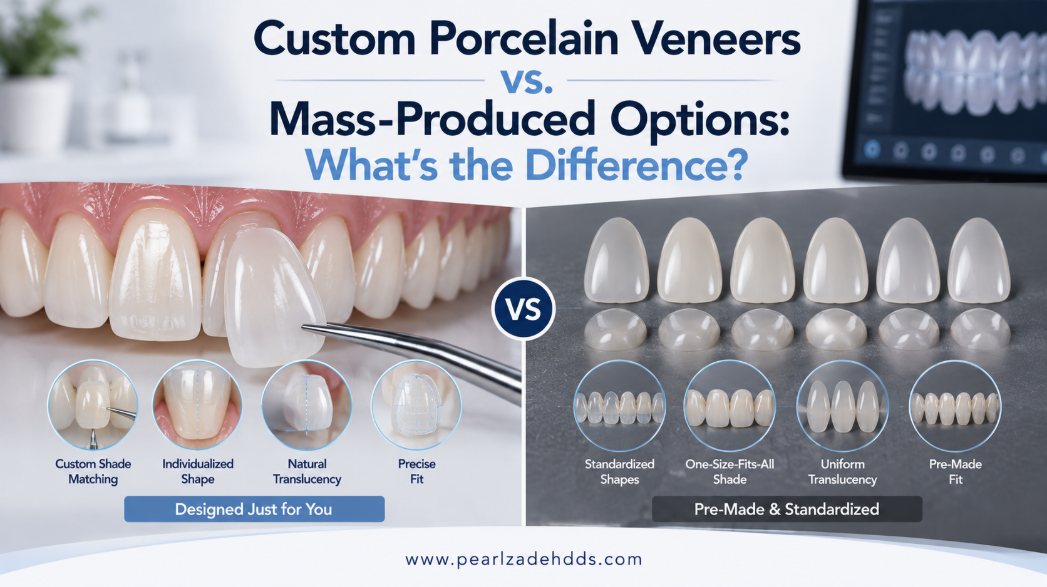
  • Custom Porcelain Veneers vs. Mass-Produced Options: What’s the Difference?

    Custom Porcelain Veneers vs. Mass-Produced Options: What’s the Difference?

    You’re comparing veneer options online and the prices swing wildly. One listing says custom porcelain veneers. Another advertises pre-made or prefabricated veneers at a fraction of the cost. Both cover your teeth. Both are described as porcelain. So why would one be so different from the other?

    Veneers aren’t simply pieces placed over teeth. How they’re planned, shaped, fitted, colored, and bonded can make a real difference in the result. That doesn’t automatically make one option the right answer for everyone reading this.

    What Are Custom Porcelain Veneers?

    A custom porcelain veneer is a thin shell of ceramic material designed and fabricated around one specific tooth, not selected from an existing catalog of shapes. The American College of Prosthodontists describes veneers generally as a thin, custom layer of material used to improve the appearance of teeth, often addressing staining, chips, or crooked teeth. Custom doesn’t simply mean more expensive. It describes how the restoration is planned and made, specifically for you rather than for a general category of patient. Customization can factor in:

    • Tooth shape
    • Tooth size
    • Facial proportions
    • Smile line
    • Shade
    • Translucency
    • How the veneer relates to neighboring teeth
    • Your bite
    • The specific cosmetic outcome you’re after

    What Are Mass-Produced or Prefabricated Veneers?

    Prefabricated or pre-made veneers are manufactured in standard shapes or sizes rather than individually fabricated from scratch for one particular tooth. This isn’t one single product. Options in this category can differ significantly in material, design, manufacturing process, and intended use. A prefabricated veneer meant as a temporary solution is a different thing than one intended for longer-term wear, and lumping every pre-made option together wouldn’t be an accurate way to think about this category.

    Custom vs. Mass-Produced: What’s Actually Different?

    A few specific areas tend to matter most to patients comparing these approaches.

    Shape and Fit

    A custom restoration is designed around your specific tooth rather than chosen from a standard shape closest to what you need. Fit affects more than comfort. It influences how the veneer looks against your gumline, how easy it is to keep clean, and how naturally it relates to the teeth next to it.

    Shade and Appearance

    Custom porcelain allows detailed planning of color, translucency, surface texture, and how the restoration reflects light, along with how closely it matches your neighboring teeth. This doesn’t mean every custom veneer looks completely indistinguishable from a natural tooth in every lighting condition. It means there’s considerably more room to fine-tune these details than a standard shape typically allows.

    Tooth Preparation

    How much of your natural tooth structure needs to be adjusted depends on your specific tooth and treatment plan, not on whether the veneer happens to be labeled custom. Custom veneers aren’t automatically “no-prep,” and prefabricated veneers don’t automatically require more reduction either. The real factors are your tooth position, the material being used, your desired result, and the specific restoration involved.

    Laboratory Fabrication

    Custom porcelain veneers typically involve real communication between your dentist and a dental laboratory technician. The lab fabricates the restoration based on your dentist’s clinical notes, photographs, digital scans or impressions, shade information, and treatment plan. That back-and-forth is part of what allows the level of detail custom work is known for.

    Why Does Customization Matter for Smile Design?

    Veneers don’t exist in isolation. A dentist planning a smile considers how your teeth relate to each other, your lips, your gums, your smile line, your bite, and your overall facial proportions. A single veneer that looks attractive sitting on its own might not look right once it’s placed next to your other teeth. That’s exactly why smile design involves more than picking a shade off a chart. It’s about how everything works together.

    Are Mass-Produced Veneers Always a Bad Choice?

    No. Pre-made or prefabricated options can have appropriate uses depending on the specific product and your situation. Where they tend to offer less flexibility is when you need highly specific changes to shape, shade, proportions, or fit that a standard option simply wasn’t designed to accommodate. The real question isn’t whether an option is prefabricated. It’s whether that particular option is actually appropriate for your clinical and cosmetic goals.

    Are Custom Porcelain Veneers Always Better?

    Not automatically. “Custom” describes how a restoration is designed and fabricated, but the quality of your overall treatment also depends on:

    • An accurate diagnosis
    • Thoughtful treatment planning
    • Your dentist’s experience
    • The material selected
    • The laboratory’s work
    • The bonding technique used
    • Your own oral health
    • Your bite
    • How well you maintain the result afterward

    The word custom by itself doesn’t guarantee a better outcome if any of those other pieces fall short.

    What Happens Before Custom Veneers Are Made?

    The process generally starts with a consultation and examination, followed by a conversation about your cosmetic goals. Your dentist evaluates your tooth and gum health and assesses your bite, then takes photographs or digital scans to guide smile planning. From there, tooth preparation gets discussed, a shade gets selected, and the restoration goes to fabrication. Depending on the case, you may have a try-in or evaluation step before final bonding. The exact sequence shifts somewhat depending on your specific case and the restoration being used.

    Can You Get Veneers Without Preparing Your Teeth?

    This comes up often, since patients frequently search for “no-prep veneers.” Some patients genuinely qualify for a minimal or no-preparation approach, but it isn’t appropriate for everyone. A nine-year comparative study of conventional and no-prep porcelain veneers notes that no-prep veneers rely on very thin feldspathic porcelain, often 0.2 to 0.3 millimeters, while veneers requiring more reduction typically use thicker ceramic. Whether a no-prep approach works for you depends on your tooth position, tooth size, existing enamel, the changes you’re hoping for, your bite, and any existing restorations. A separate clinical evaluation of a no-prep veneer protocol found genuinely good outcomes for appropriately selected patients, while also noting real controversy in the broader research about predictability. Avoiding tooth preparation isn’t always possible, and it isn’t automatically the preferable choice even when it is possible.

    How Does the Material Matter?

    Porcelain isn’t one single material with identical properties across every product. Different ceramic materials vary in strength, translucency, thickness, appearance, and how they’re fabricated, and thinner, more delicate materials generally call for a different approach to fit and bonding than thicker, stronger ones. The point isn’t to turn this into a materials science lecture. It’s that the specific material your dentist recommends should connect directly to what your teeth and goals actually need.

    What About Durability and Cost?

    Veneer longevity depends on several things working together:

    • The material
    • The quality of bonding
    • How much tooth preparation was involved
    • Your bite forces
    • Your oral hygiene
    • Whether you grind or clench your teeth
    • Habits like biting hard objects
    • How consistently you keep up with dental care

    Porcelain itself doesn’t make a restoration immune to chipping, fracture, or coming loose over time. It would be misleading to promise a specific lifespan without qualifying it heavily, since so much depends on your individual situation and habits.

    Cost follows a similar logic. Custom treatment often costs more because of individualized planning, the clinical appointments involved, laboratory fabrication, material selection, custom shade and shape work, and the expertise of both your dentist and the lab. A higher price doesn’t automatically mean higher quality, though. It’s worth comparing what’s actually included in a treatment plan rather than looking at the final number alone.

    What Should You Ask Before Choosing Veneers?

    A few genuinely useful questions to bring to a consultation: What type of veneer are you recommending, and why is it appropriate for my teeth? How much tooth preparation will I actually need? Can the shade and shape be customized to my face and smile? What material will be used, and will a dental laboratory fabricate them? How will these veneers be designed to match my other teeth? What happens if I don’t like the proposed shape or shade before it’s final? How does my bite factor into this? What are the risks, and how should I care for the result? What happens if one chips or comes loose down the line? And what’s actually included in the quoted fee?

    Is This the Right Time for Veneers?

    Custom porcelain veneers tend to be worth discussing when you want detailed changes to tooth shape, proportions, shade, symmetry, minor spacing, or certain other cosmetic imperfections. That said, veneers aren’t right for every patient at every point in time. A stable, healthy foundation matters. Some patients need other treatment first, whether that’s addressing decay, gum disease, significant tooth damage, an underlying bite problem, active grinding or clenching, or orthodontic movement, before cosmetic work makes sense. None of this is something to self-diagnose. A consultation is what actually determines whether veneers are the right next step or whether something else should come first.

    What If You’re Choosing Between Veneers and Invisalign?

    Veneers and Invisalign solve genuinely different problems. Invisalign primarily moves teeth into better positions. Veneers change the visible shape, color, and surface appearance of a tooth without moving it. Our comparison of Invisalign and veneers goes further into which fits different smile goals. Neither is universally the better choice. Some patients need orthodontic movement before cosmetic restoration makes sense, while others are reasonable candidates for veneers without any orthodontic treatment at all.

    Customization Is More Than Just Choosing a Shade

    Custom veneer treatment involves far more than picking a color from a chart. A well-planned restoration accounts for shape, size, proportion, tooth position, bite, smile line, neighboring teeth, material, and optical characteristics like translucency and light reflection together. The question worth asking isn’t simply “are these veneers custom?” It’s “how will these veneers actually be planned and made for my teeth and my goals?” That’s the question that tells you more about what to expect.

    Speak With Dr. Pearl Zadeh About Porcelain Veneers

    Choosing veneers involves more than picking a material or comparing prices. Dr. Pearl Zadeh, an accredited member of the American Academy of Cosmetic Dentistry, can evaluate your teeth, bite, gums, and smile goals before discussing whether porcelain veneers are appropriate for you. If veneers make sense, that conversation can also cover the type of restoration, the degree of customization involved, expected preparation, the overall process, and how to maintain the result afterward.

    Call (818) 716-6722 or click the button below to schedule a consultation online.

    Frequently Asked Questions

    Are custom porcelain veneers always better than prefabricated ones?

    Not automatically. Custom describes how a veneer is designed and made, but outcome quality also depends on diagnosis, planning, material, and bonding technique.

    Do custom veneers require less tooth preparation than mass-produced ones?

    Not necessarily. Preparation depends on your specific tooth, material, and treatment goals, not simply on whether the veneer is custom or prefabricated.

    Can I get veneers without any tooth preparation?

    Some patients qualify for a minimal or no-preparation approach, but it depends on tooth position, size, existing enamel, and your specific goals. It isn’t right for everyone.

    Why do custom porcelain veneers typically cost more?

    Individualized planning, laboratory fabrication, material selection, and the clinical time involved all factor into cost, though a higher price doesn’t automatically mean better quality.

    How long do porcelain veneers last?

    Longevity varies by patient and depends on the material, bonding, bite forces, oral hygiene, and habits like grinding. No veneer, regardless of material, is immune to chipping or wear over time.

    This article is for informational purposes only and is not a substitute for professional dental advice. Please schedule a consultation with Pearl Zadeh DDS to discuss your specific situation.

  • Invisalign vs Veneers: Which Fits Your Smile Goals?

    When you are unhappy with your smile, the first question is not always which treatment is better. It is what you actually want to change.

    Some patients want straighter teeth because of crowding, spacing, or teeth that have shifted out of alignment. Others are more concerned about the appearance of individual teeth, such as chips, discoloration, uneven shapes, or worn edges.

    That is where the difference between Invisalign and veneers becomes important. Invisalign focuses on moving your natural teeth into a better position, while veneers change the appearance of your teeth by covering the visible front surface. Both can improve a smile, but they solve very different concerns.

    Invisalign vs Veneers: What’s the Real Difference?

    Invisalign repositions your teeth using a series of custom clear aligners, gradually shifting them into a straighter, better-aligned position. It’s built for concerns like crowding, spacing, crooked teeth, and bite issues such as an overbite or underbite. Veneers work on the surface. They’re thin custom shells bonded to the front of your teeth to change shape, size, and color, addressing things like chips, wear, and minor cosmetic imperfections without moving anything underneath.

    Neither treatment is better than the other in a general sense. They’re built for different jobs, and figuring out which one you actually need starts with identifying what’s bothering you: the way your teeth are positioned, or the way they look.

    What Invisalign Actually Does

    Invisalign uses a series of clear, removable trays, each one slightly different, to gradually move your teeth toward a planned final position. You typically wear each set for about one to two weeks before switching to the next, and consistent wear matters, since removing the aligners too often can slow progress or affect the outcome. Common mistakes Invisalign patients make often come down to inconsistent wear time, which is worth understanding before starting treatment.

    Treatment planning happens upfront, often using a digital scanner like iTero to map your teeth in 3D rather than relying on traditional impressions, and each stage is planned before your first tray is made. How Invisalign treatment works step by step walks through that process in more detail. Invisalign can address a range of cases, from mild spacing to more involved alignment concerns, and it can also improve certain bite issues along the way. The American Dental Association notes that orthodontic treatment works by applying steady pressure to gradually shift teeth, and that wearing a retainer afterward helps prevent them from drifting back. Once treatment finishes, retainers become part of the routine for exactly that reason. If you’re weighing Invisalign against traditional braces, that comparison covers a different decision than the one this article focuses on.

    What Veneers Actually Do

    Veneers are thin, custom-made shells, usually porcelain, bonded to the front surface of a tooth. Rather than repositioning anything, they cover and reshape what’s already there. Our porcelain veneers guide explains how that process works in more detail. Veneers are commonly used for chipped teeth, tooth discoloration that hasn’t responded to whitening, uneven tooth shape, or general wear that’s changed how a tooth looks over time. They’re a cosmetic solution, built to change appearance rather than function.

    Can Veneers Fix Crooked Teeth?

    Sometimes, but only in a limited sense. Veneers can make mildly rotated or slightly uneven teeth look straighter by reshaping the visible surface, since a wider or reangled shell can visually minimize small irregularities. What veneers can’t do is move a tooth’s actual position or correct a misaligned bite. Our deeper look at veneers and crooked teeth explains this distinction further. For real movement, Invisalign is the tool built for that job, particularly when crowding, rotation, or bite alignment is the actual concern rather than just the appearance of it.

    Should You Straighten Your Teeth Before Getting Veneers?

    If your alignment concern is more than mild, generally yes. Placing veneers over significantly crooked teeth can lead to a less natural, sometimes bulky-looking result, and it doesn’t address whatever caused the misalignment in the first place, whether that’s a bite issue, crowding, or another underlying cause. Many patients complete Invisalign first, then consider veneers afterward for color, shape, or minor refinements once their teeth are already in a better position. This isn’t a rule that applies to everyone. Mild cases sometimes proceed straight to veneers, and your dentist can evaluate which sequence makes sense for your specific teeth.

    Invisalign vs Veneers: Side-by-Side Comparison

    The table below summarizes how these two treatments typically compare. Individual cases vary, and a consultation is what actually determines your specific timeline and plan.

    ConsiderationInvisalignVeneers
    Main purposeMoves teeth into better alignmentImproves the appearance of the tooth surface
    Treatment processA series of custom clear aligners worn in stagesCustom shells bonded to the front of prepared teeth
    TimelineVaries by case, often several months to over a yearOften completed within a few appointments
    Tooth changesRepositions teeth; enamel generally untouchedMay require removing a thin layer of enamel
    MaintenanceRetainers needed afterward to hold the resultNormal dental care, with attention to bite forces
    ResultsStraighter alignment and improved biteChanges to shape, size, and color

    Can You Get Both Invisalign and Veneers?

    Yes, and many patients do exactly this. A common sequence involves completing Invisalign to address alignment and bite concerns, then adding veneers afterward for cosmetic refinements like color or shape on specific teeth. Our look at whether Invisalign can fix overbite, underbite, and crowded teeth covers what Invisalign alone typically addresses, which helps clarify what might still be worth considering afterward. If you already have veneers and are now considering Invisalign, that’s also possible in many cases, though your dentist needs to evaluate how your existing veneers will hold up under the gentle pressure aligners apply.

    Attachments, the small tooth-colored bumps that give aligners extra grip, bond differently to porcelain than to natural enamel, and the contour of an existing veneer can affect how closely an aligner fits, so this evaluation matters more than it might seem. Getting veneers on just one or two specific teeth after Invisalign is also common, rather than assuming every tooth needs cosmetic work once alignment is finished.

    Which Option Lasts Longer, and Which Costs More?

    Invisalign can create a lasting alignment result when you wear your retainers as directed, since teeth naturally shift over time without ongoing support. Veneers have a separate lifespan and can hold up well for many years with proper care, depending on the material used and your daily habits. Our comparison of how long bonding and veneers last covers those differences in more detail.

    The cost of either treatment depends heavily on your specific situation. With Invisalign, factors like the amount of movement needed and treatment complexity affect the overall cost. With veneers, the number of teeth treated and the material selected play a major role. Our breakdown of what affects veneer cost explains these factors without listing a fixed price, since every treatment plan is different. Neither option is always cheaper. The right choice depends on what your smile actually needs.

    Choosing the Right Option With Dr. Pearl Zadeh in Woodland Hills

    Dr. Pearl Zadeh evaluates your bite, tooth position, and cosmetic goals before recommending Invisalign, veneers, or a combination of both, rather than defaulting to whichever treatment is more extensive. As an Invisalign Premier Provider, she brings specific experience with aligner cases ranging from mild to more involved, alongside her cosmetic dentistry background for veneers in Woodland Hills. For patients weighing Invisalign against other clear aligner brands as well as veneers, that evaluation covers the full picture rather than one option in isolation.

    You can learn more about Invisalign treatment in Woodland Hills directly, and her broader approach to cosmetic dentistry focuses on personalized treatment planning that matches the treatment, whether that means alignment, a smile makeover, or both, to your actual goals rather than the other way around.

    Schedule a Consultation With Dr. Pearl Zadeh

    Invisalign and veneers solve different problems: one moves your teeth, the other changes how they look. The right choice, or the right combination, depends entirely on your specific smile goals rather than a general preference for one treatment over the other.

    Dr. Pearl Zadeh and her Woodland Hills team can evaluate your teeth and talk through whether Invisalign, veneers, or both fit what you’re hoping to achieve.

    Call (818) 716-6722 or click the button below to schedule your consultation online.

    Frequently Asked Questions

    1. Is Invisalign better than veneers?

    Neither is universally better. Invisalign moves teeth into better alignment, while veneers change the appearance of the tooth surface. Which one fits depends on whether your concern is position or appearance.

    2. Does having veneers affect how Invisalign attachments are placed?

    Possibly. The small tooth-colored attachments used to help aligners grip bond differently to porcelain than to natural enamel, so your dentist evaluates existing veneers before finalizing an Invisalign plan.

    3. Do I need Invisalign before getting veneers?

    If your misalignment is more than mild, your dentist will often recommend straightening your teeth first to create a more natural, stable result. For mild cases, your dentist may recommend veneers directly after evaluating your teeth, bite, and overall smile goals.

    4. Which option gives a better smile, Invisalign or veneers?

    Neither is inherently better; they improve different things. Invisalign improves alignment and bite, while veneers improve shape, size, and color. The best result often comes from matching the treatment to what’s actually bothering you.

    5. Do I need Invisalign before getting veneers?

    If your misalignment is more than mild, your dentist will often recommend straightening your teeth first to create a more natural, stable result. In some mild cases, your dentist may recommend veneers directly after evaluating your smile and goals.

    This article is for informational purposes only and is not a substitute for professional dental advice. Please schedule a consultation with Pearl Zadeh DDS to discuss your specific situation.

  • 8 Common Veneer Myths That Just Aren’t True

    A friend tells you veneers ruin your real teeth. A forum post claims they look obviously fake up close. Someone else insists they’re only for actors and people with unlimited budgets. By the time most patients sit down for a veneer consultation, they’ve absorbed a mix of outdated information, half-truths, and a few things that were never accurate to begin with.

    Some of this comes from older techniques that have since changed. Some of it comes from a single bad experience someone had and generalized. Sorting the real veneer myths from what’s actually true makes it much easier to decide whether veneers are worth considering for you specifically.

    Myth 1: Veneers Damage Your Natural Teeth

    This one sticks around because it has a grain of truth buried in it. Traditional veneers do typically involve removing a thin layer of enamel, which is a permanent change to the tooth. People hear “permanent alteration” and translate that to “damage,” which isn’t quite accurate. Enamel removal, done properly, prepares the tooth to support the veneer and isn’t the same thing as harming it.

    The American Dental Association confirms that veneer treatment is generally not considered reversible, which is a fair thing to know going in, but that’s different from suggesting the tooth is worse off structurally. For patients who want to avoid enamel removal altogether, no-prep veneers are worth asking about, though they aren’t the right fit for every case. Your dentist evaluates your enamel thickness and tooth position to determine how much, if any, preparation your specific teeth actually need.

    Myth 2: Veneers Always Look Fake or Unnatural

    This myth usually traces back to older cosmetic work, or to veneers placed without much attention to shade and proportion. A poorly matched, overly white, uniformly shaped set of veneers can absolutely look artificial, and those are the cases people remember and talk about. Well-planned veneers, matched carefully to your natural shade and shaped to fit your face rather than a generic template, are designed to blend in rather than announce themselves.

    Digital Smile Design has made this planning process more precise for many patients, and choosing between porcelain and composite materials also affects how natural the final result looks, since porcelain in particular handles light similarly to real enamel. A dentist who takes shade matching and proportion seriously is working against this myth directly, not around it.

    Myth 3: Getting Veneers Is Painful

    The idea of enamel being removed sounds worse than the actual experience for most patients. Local anesthesia is commonly used during tooth preparation, so most people feel pressure or vibration rather than pain. Mild sensitivity in the days afterward is possible, but it’s typically manageable and temporary. Cleveland Clinic describes veneer placement as a typically outpatient procedure, with many patients going home the same day, which reflects how routine the process usually is.

    Our guide to preparing for a veneers appointment walks through what each stage of the process actually feels like, which tends to be far less dramatic than this myth suggests. Patients with significant dental anxiety understandably want more reassurance here, and that’s a reasonable thing to raise directly with your dentist before treatment begins.

    Myth 4: Veneers Stain Just Like Natural Teeth

    This depends heavily on material, which is exactly why it gets confused so often. Porcelain veneers are generally quite stain-resistant, holding up well against coffee, tea, and red wine in ways that surprise a lot of patients. Composite veneers are more porous and do stain more easily over time, closer to how natural enamel behaves. Cleveland Clinic specifically notes that veneers can still be stained by substances like berries, red wine, coffee, and tea, so material choice affects the degree of staining rather than eliminating the risk entirely.

    Our comparison of porcelain and composite veneers breaks this difference down in more detail. If stain resistance matters to you, it’s a legitimate factor to raise when discussing material choice with your dentist, rather than something to assume applies equally across every type of veneer.

    Myth 5: Veneers Break or Fall Off Easily

    Well-placed veneers, when cared for properly, can handle normal daily use without being fragile.

    This myth often comes from specific situations. A patient who grinds their teeth heavily without a night guard may face a higher risk. The same applies when a veneer does not receive a proper bond during placement.

    Patients who grind or clench their teeth face a higher risk of chipping. This is why Dr. Pearl Zadeh evaluates these habits before recommending treatment.

    Biting into very hard foods or using your teeth as tools can damage veneers. The same habits can also damage natural teeth.

    Under normal conditions, veneers handle everyday chewing and speaking comfortably without causing problems.

    Myth 6: Veneers Last Forever Once You Get Them

    This myth goes too far in the opposite direction of Myth 5. Veneers are durable, but they do not last forever without maintenance. Our comparison of how long bonding and veneers last explains realistic lifespan expectations in detail, but the short answer is that porcelain veneers often last a decade or longer with proper care, not indefinitely.

    Over time, normal wear, a chip, or changes in the shade of your surrounding natural teeth may mean you need a replacement. That is a normal part of maintaining cosmetic dental work, not a sign that the treatment failed.

    Myth 7: Everyone Is a Candidate for Veneers

    Veneers are versatile, but they’re not a universal fix for every dental concern. Active decay or gum disease generally needs treatment first. Significant misalignment or bite problems often call for orthodontic treatment rather than, or before, cosmetic work, a distinction covered in more depth in our discussion of veneers and crooked teeth. Insufficient enamel or certain bite patterns can also limit whether veneers are the right fit.

    This is exactly why a proper evaluation, not a general assumption either way, determines candidacy. Your dentist looks at your specific enamel, gums, bite, and oral health before recommending veneers as your path forward.

    Myth 8: Veneers Are Only for Celebrities or Wealthy Patients

    Veneers often get a reputation as an exclusive, red-carpet treatment. This comes partly from the dramatic celebrity transformations that receive so much attention.

    In reality, many everyday patients choose veneers to fix a single chipped tooth, close a small gap, or address one cosmetic concern. A full smile makeover is not always the goal.

    Our discussion of getting veneers on just one tooth explains how limited, targeted treatment can be more realistic than many people assume.

    The scope of treatment, not fame or unlimited funds, usually guides the treatment plan. Our breakdown of what affects veneer cost explains the factors behind pricing. These include the number of teeth treated and the materials selected, not celebrity status.

    How to Separate Veneer Facts From Fiction

    Most veneer myths share a common root: a specific bad experience, an outdated technique, or a dramatic story getting repeated and generalized until it sounds like a universal rule. The most reliable way to know what actually applies to you is a direct conversation with a dentist who’s willing to explain the reasoning behind their recommendations, not just hand you a treatment plan. Reading real patient experiences can help too. Our patient testimonials reflect a range of outcomes and concerns addressed, rather than a single idealized story.

    Choosing a Cosmetic Dentist in Woodland Hills

    Dr. Pearl Zadeh approaches veneer consultations by explaining what’s realistic for each patient’s specific teeth, including situations where veneers may not be the right fit, rather than presenting them as a solution for every concern. As a member of the American Academy of Cosmetic Dentistry, she stays current with cosmetic techniques and shade-matching standards, and she uses that knowledge when planning veneers in Woodland Hills at her practice.

    Her broader approach to cosmetic treatment planning, which she discusses on her practice page, focuses on helping patients understand their options instead of guiding them toward the most involved treatment by default.

    Schedule a Consultation With Dr. Pearl Zadeh

    Most veneer myths fall apart once you have an actual conversation about your specific teeth, rather than relying on secondhand stories or outdated information. The only way to know what applies to you is a real evaluation.

    Dr. Pearl Zadeh and her Woodland Hills team can walk you through what’s true, what’s outdated, and what depends on your individual situation before you make any decision.

    Call (818) 716-6722 or click the button below to schedule a consultation online.

    Frequently Asked Questions

    1. Are veneers actually bad for your teeth?

    Not inherently. Traditional veneers involve removing a thin layer of enamel, which is a permanent change, but this preparation is different from damage. Your dentist evaluates whether your specific teeth are good candidates.

    2. Do veneers look natural or fake?

    This depends heavily on planning and material choice. Well-matched, carefully shaped veneers are designed to blend in with your natural smile, while poorly planned ones are more likely to look artificial.

    3. Is getting veneers painful?

    Generally not. Local anesthesia is commonly used during preparation, so most patients feel pressure rather than pain. Mild, temporary sensitivity afterward is possible.

    4. Do all veneers resist staining?

    No. Porcelain veneers generally resist stains well, while composite veneers are more prone to staining over time, similar to natural enamel.

    5. Are veneers only for people with perfect teeth?

    No. Many patients get veneers to address one specific concern, like a chip or a gap, rather than pursuing a full smile transformation. Candidacy depends on your oral health and goals, not how flawless your smile already is.

    This article is for informational purposes only and is not a substitute for professional dental advice. Please schedule a consultation with Pearl Zadeh DDS to discuss your specific situation.