Pearl Zadeh DDS

Category: Cosmetic Dentistry

  • Do Dental Veneers Look Natural or Fake? What Makes the Difference
    Do Dental Veneers Look Natural or Fake? What Makes the Difference

    Do Dental Veneers Look Natural or Fake

    Some veneers look incredibly natural. Others stand out immediately. In most cases, the final result depends on the planning, materials, and overall smile design.

    Modern porcelain veneers are made to closely resemble real teeth. When the shape, color, and proportions are customized carefully, most people will not even notice someone has veneers. On the other hand, poor sizing, overly white shades, or unnatural proportions can make veneers look artificial.

    The experience of the cosmetic dentist also plays a major role. Small details often determine whether veneers blend in naturally or draw the wrong kind of attention.

    Why Some Veneers Look Fake

    You have probably seen them before. Teeth that look too white, too big, or too perfectly even. Instead of blending in, they stand out right away.

    In most cases, the issue starts with poor planning. Some treatments skip proper smile design and use a standard veneer shape without considering the patient’s face, lips, or existing teeth. When that happens, the result often feels out of place.

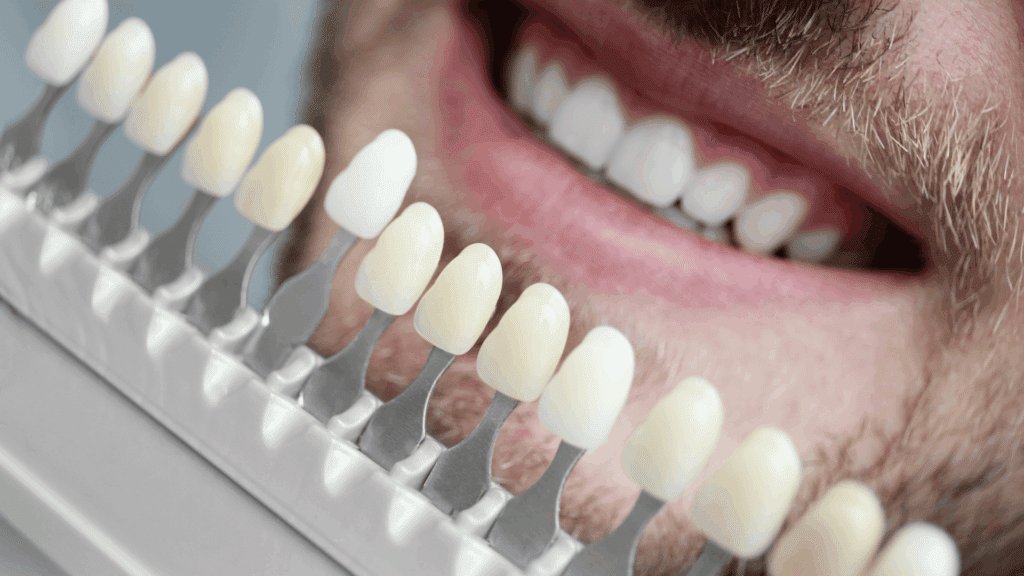
    Color choice is another common problem. A shade that is too bright or too opaque can look unnatural, especially under different lighting. Real teeth have depth and slight variation in color, and they reflect light in a soft way. When veneers do not match that, they become noticeable.

    Size and proportion also matter. Veneers that are too long or too wide compared to natural tooth structure can create an unbalanced look that draws attention for the wrong reason.

    Sometimes the issue is not the veneers themselves, but how many are placed. If only a few teeth are treated without blending them properly with the surrounding teeth, the contrast becomes obvious.

    Good veneer work is never just about a single tooth. It is about how everything fits together as a smile.

    What Makes Veneers Look Natural

    When veneers are done well, they blend in so naturally that most people will not notice them at all.

    One of the biggest factors is porcelain quality. High-quality porcelain reflects light in a way that is very similar to natural enamel. It has depth and subtle translucency, which helps the tooth look real rather than flat or overly bright. Lower-quality materials often lack this effect and can appear dull or too uniform over time.

    Shape and size also play a major role. Natural-looking veneers are designed to match the proportions of your face, lips, and jaw. A skilled cosmetic dentist will consider your smile line, tooth width, and natural facial balance before finalizing the design.

    The gum line is another detail that is often overlooked. If the gums are uneven, even well-made veneers can look off. In some cases, minor gum reshaping is done before or during treatment to create a more balanced frame for the teeth.

    The number of veneers placed also matters. Treating only a couple of front teeth without blending them into the surrounding smile can create contrast. For a more natural result, veneers are usually placed across the visible smile zone so the color and shape stay consistent.

    The Role of Smile Design and Dentist Experience

    This is where the outcome is truly shaped. Smile design is the planning stage that happens before any treatment begins. A cosmetic dentist studies your facial features, natural tooth proportions, and overall smile goals before deciding how your veneers should look.

    In many cases, digital smile design tools are used to show a preview of the final result. This helps patients understand how their new smile may look and allows adjustments to shape or size before anything is made permanent.

    Experience also plays a major role. Cosmetic dentistry is not only about technical skill. It also requires an understanding of facial balance and natural tooth appearance. When these details are considered carefully, veneers blend in naturally rather than standing out.

    The provider you choose can have a major impact on the final result. While many dentists can place veneers, working with someone who focuses on cosmetic cases often leads to more natural and balanced outcomes.

    Choosing the Right Shade and Shape

    One of the most common mistakes is choosing the brightest white shade available. While it may look appealing in photos, it often appears too harsh in real life, especially when it does not match a person’s natural skin tone and facial features.

    A well-planned smile usually involves more subtle shades. Warm whites, ivory tones, and slightly softer shades tend to blend better with natural teeth. The aim is not to create an artificial brightness, but to achieve a healthy, balanced smile that still looks like you.

    Shape is just as personal as color. The right veneer shape depends on facial structure, smile style, and personal preference. Rounded edges often create a softer, more feminine look, while slightly straighter edges can give a more defined appearance. Some people prefer a youthful smile, while others want something more understated.

    A thoughtful cosmetic dentist will guide these decisions with you, not for you. Your input matters throughout the process, and the goal is always to create a result that feels comfortable and natural for your face.

    Can People Tell You Have Veneers?

    With modern porcelain materials and proper smile design, the honest answer is usually no. When veneers are done well by an experienced cosmetic dentist, most people simply notice that the smile looks better. They rarely pinpoint exactly what has changed.

    In most cases, that is the ideal result. Well-designed veneers should lead to comments like “your smile looks great,” not questions about dental work.

    Looking at before and after photos from real patients can help set realistic expectations. The best results usually show a smile that looks refreshed and more balanced, rather than overly dramatic or artificial.

    Of course, results can vary. Clear communication during the planning stage plays a big role. Patients who share their preferences and stay involved in the process often feel more satisfied with the final outcome.

    Are Natural-Looking Veneers Worth It?

    For many patients, the answer is yes. Veneers can improve a wide range of concerns, including discoloration, chips, cracks, spacing issues, and uneven tooth shapes. When planned and placed properly, they can create results that are both functional and visually appealing.

    What matters most is having realistic expectations and working with the right cosmetic dentist. Natural-looking veneers are not a rare outcome. In fact, they are what most patients receive when treatment is planned carefully from the start.

    Because veneers are a long-term investment, the provider you choose plays a major role in the final result. The goal is simple: a smile that feels natural, looks balanced, and gives you confidence without drawing unwanted attention.

    Schedule a Consultation with Dr. Pearl Zadeh

    If you have been thinking about veneers but still feel unsure about how natural they might look, understanding what really affects the final result can help you make a clearer decision. Good veneers should not change who you are. They should blend with your facial features, support your natural smile, and feel like a subtle improvement rather than a noticeable change.

    Dr. Pearl Zadeh focuses on creating veneers that look natural and suit each patient’s individual features. Her approach to smile design is careful, detail-focused, and centered on results that fit the person, not just the teeth. If you are considering porcelain veneers and want to know what would work for your smile, you can schedule a consultation or call the office at (818) 716-6722. Our team is available to answer your questions and guide you through the next steps.

    Click the button below to book your consultation.

    Schedule a Consultation

    Frequently Asked Questions

    1. Do veneers always look fake?

    No, veneers do not always look fake. When they are designed properly with the right shape, shade, and proportions, they can look very natural and blend in with your existing teeth.

    2. What makes veneers look natural instead of artificial?

    Natural-looking veneers depend on proper smile design, correct tooth proportions, suitable shade selection, and the skill of the cosmetic dentist. Small details make a big difference in the final result.

    3. Why do some veneers look too white or bulky?

    Veneers can look unnatural when the shade is too bright, the size is too large, or when there is poor planning before placement. Lack of customization is usually the main reason.

    4. Can people tell if you have veneers?

    In most cases, no. Well-designed veneers usually look like natural teeth. People often notice an improved smile but cannot tell that veneers were placed.

    5. How do I make sure my veneers look natural?

    The best way is to work with an experienced cosmetic dentist who focuses on smile design. Clear communication and proper planning help ensure the final result fits your face and looks natural.
    Related Articles:

    1. How to Choose the Right Cosmetic Dentist in Woodland Hills
    2. Porcelain Veneers: A Practical Guide for Patients
    3. Composite Veneers: Everything You Need to Know
    4. Porcelain vs Composite Veneers: Choosing the Right Option for Your Smile
    5. Veneers vs Teeth Whitening: Which One Should You Choose?

  • Veneers for Teeth Grinders: Are You Still a Candidate?

    Veneers for Teeth Grinders: Are You Still a Candidate?

    Veneers for Teeth Grinders

    You finally feel ready to improve your smile, then one question changes everything: what if you grind your teeth? It’s a common concern, and many patients wonder whether veneers are still an option after learning they have bruxism. Teeth grinding doesn’t automatically rule out veneer treatment, but it does affect how your dentist plans your care.

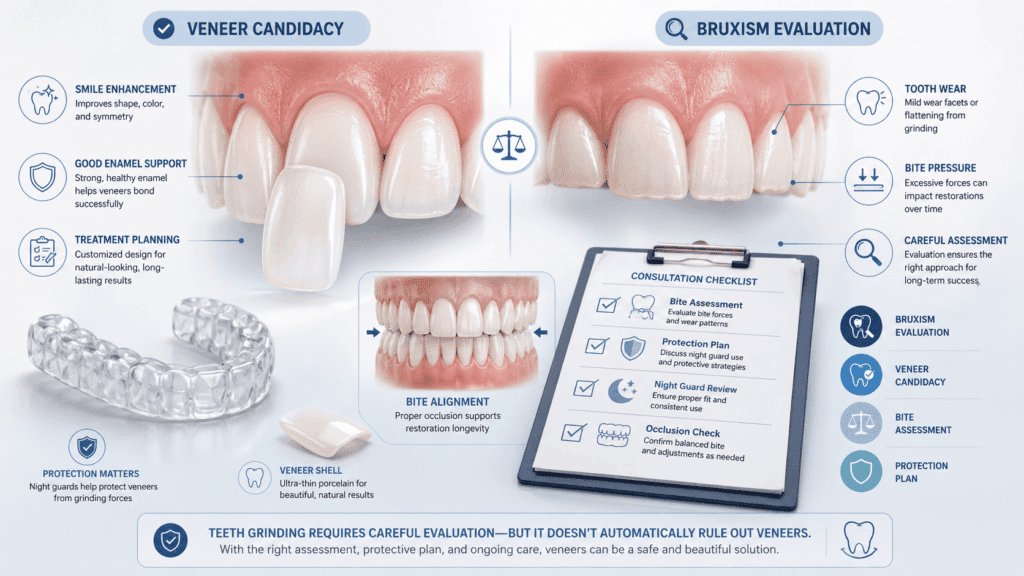
    Your consultation will focus on more than your smile goals alone. It will also consider your bite, tooth wear, and long-term oral health before recommending the right approach.

    What Bruxism Actually Is

    Bruxism refers to clenching, grinding, or gnashing your teeth, and it usually happens without you noticing. Cleveland Clinic describes it as a habit that can occur while you’re awake or asleep, and one that can put real strain on your teeth and jaw when it happens often enough. Plenty of people grind occasionally, especially during stressful stretches, without it becoming a lasting problem. The concern comes up more with frequent or forceful grinding over time.

    Nighttime Grinding vs Daytime Clenching

    Sleep bruxism, the kind that happens at night, tends to be harder to catch since most people aren’t aware they’re doing it. A partner mentioning the sound, or a dentist noticing unusual wear at a checkup, is often how it first gets flagged. Daytime clenching works differently. It’s more often tied to concentration or stress, and some patients notice it themselves once they start paying attention, like catching their jaw tight during a demanding meeting or a difficult drive.

    How Grinding Affects Natural Teeth

    Over time, frequent grinding can wear down enamel, flatten the biting edges of teeth, and in some cases lead to small chips or cracks. Jaw soreness and morning headaches are common complaints too, since the muscles doing the clenching work overtime while you sleep. None of this happens overnight, and plenty of people grind for years before it becomes noticeable enough to bring up at a dental visit.

    How Grinding Can Affect Veneers

    Veneers sit on the front surface of a tooth, and like the natural enamel they cover, they can absorb some of the force generated by grinding or clenching. That added pressure can, in some cases, increase the likelihood of chipping, cracking, or a veneer coming loose sooner than it might for a patient who doesn’t grind. This doesn’t mean damage is guaranteed. It means grinding is a factor your dentist weighs carefully when planning treatment and discussing what to expect.

    Can You Get Veneers If You Grind Your Teeth?

    In many cases, yes. Bruxism alone does not automatically rule out veneers. Your dentist will look at factors like the severity of your grinding, how well you manage it, and the condition of your teeth and bite. A patient with mild, controlled grinding may have a different treatment outlook than someone with severe, untreated bruxism and significant tooth wear.

    Your dentist can determine where you fall on that spectrum through an exam, and that evaluation is really what decides candidacy, not the presence of bruxism by itself.

    What Your Dentist Evaluates Before Recommending Veneers

    A thorough evaluation typically looks at several things together. Bite alignment matters, since an uneven bite can concentrate force unevenly across your teeth. Existing tooth wear gives your dentist a sense of how active and forceful your grinding has been over time, and how your teeth relate to alignment concerns more broadly can factor into that same conversation. Enamel condition, your jaw habits, general oral health, and your specific cosmetic goals all get weighed together, rather than any single factor deciding the outcome on its own.

    Why Treating Bruxism Matters Before or Alongside Cosmetic Treatment

    Placing veneers over teeth affected by active, unmanaged bruxism can set the treatment up for a harder road ahead. Many dentists recommend addressing or at least stabilizing the grinding first, whether that means a night guard, stress management, or treating an underlying cause like sleep apnea, before finalizing a cosmetic plan. This isn’t about delaying treatment unnecessarily. It’s about giving the veneers a more stable foundation to hold up against.

    Will a Night Guard Protect Your Veneers?

    A custom night guard, made specifically for your bite, can reduce the direct force your teeth and veneers experience during sleep. Many dentists recommend one for patients with bruxism who move forward with veneers, particularly for grinding that happens at night rather than during the day.

    A night guard can reduce the risk of damage, but it cannot eliminate it. Even with consistent use, some force still reaches your teeth. It also will not protect against daytime clenching if you only wear it while sleeping. Your dentist can explain what level of protection you can realistically expect and how consistently you should wear your night guard based on your specific situation.

    Porcelain vs Composite Veneers for Patients Who Grind

    Porcelain is generally considered more resistant to wear than composite resin, which is part of why it’s often discussed for patients with bruxism. That doesn’t mean composite is automatically off the table, or that porcelain is immune to damage from grinding. Our porcelain veneers guide and composite veneers overview both go into more detail on how each material tends to perform. Some patients also ask about no-prep veneers, which are thinner by design and generally considered less suited to heavier grinding forces, though your dentist can evaluate whether that’s true for your specific case.

    What Happens If You Grind After Getting Veneers

    If grinding continues after treatment, veneers can wear, chip, or occasionally come loose over time, similar to what can happen with natural teeth under the same forces. This is one of the reasons ongoing management matters, not just before treatment but afterward too. Routine checkups give your dentist a chance to catch early wear before it becomes a bigger repair, and to adjust your night guard or treatment plan if grinding patterns change.

    When Another Treatment Might Be Recommended First

    For patients with severe, active bruxism and significant existing tooth damage, a dentist may recommend stabilizing the bite or addressing the grinding before moving forward with veneers at all. In some cases, a more conservative option is considered first. Dental bonding compared with veneers is sometimes part of that conversation, since bonding can be simpler and less costly to repair if it’s affected by ongoing grinding. Once your bite and habits are more stable, veneers may become a more reasonable option to revisit.

    Lifestyle Habits That May Influence Veneer Longevity

    A few everyday habits tend to come up in these conversations. Chewing on ice, pens, or fingernails adds extra force beyond normal biting and can affect both natural teeth and veneers. High caffeine or alcohol intake has been associated with more frequent grinding for some people. Stress management, whether through better sleep, exercise, or simply identifying what triggers daytime clenching, can also play a role in how much force your teeth experience over time. None of these guarantee an outcome on their own, but they’re worth mentioning to your dentist as part of the bigger picture.

    Finding a Cosmetic Dentist in Woodland Hills Who Understands Bruxism

    Dr. Pearl Zadeh evaluates grinding and clenching as part of a complete workup before recommending veneers, rather than treating bruxism as an automatic disqualifier or ignoring it altogether. That evaluation looks at your bite, tooth wear, and your specific goals for treatment. Patients considering veneers in Woodland Hills can expect that same individualized approach, and our broader overview of cosmetic dentistry in Woodland Hills covers the full range of options if veneers turn out not to be the right first step.

    Schedule a Consultation With Dr. Pearl Zadeh

    Grinding your teeth doesn’t have to mean crossing veneers off your list before you’ve even had a conversation about it. Whether they’re a reasonable option for you depends on your specific bite, tooth condition, and grinding habits, not a blanket rule that applies to everyone with bruxism.

    Dr. Pearl Zadeh and her Woodland Hills team can evaluate your teeth directly and walk you through what’s realistic for your situation, including whether a night guard, treating the grinding first, or moving ahead with veneers makes the most sense.

    Call (818) 716-6722 or click the button below to schedule your consultation online.

    Schedule a Consultation

    Frequently Asked Questions

    1. Does grinding your teeth automatically disqualify you from getting veneers?

    No. Bruxism is one factor among several your dentist considers. Mild or well-managed grinding is generally viewed differently than severe, untreated grinding with significant existing tooth wear.

    2. Does teeth grinding damage veneers?

    It can, particularly if grinding is frequent or forceful and left unmanaged. The added pressure may increase the chance of chipping, cracking, or a veneer loosening sooner than expected, though this varies by patient.

    3. Will a night guard fully protect my veneers?

    A custom night guard can reduce the force on your teeth while you sleep, but it cannot eliminate the risk completely. If you also clench your teeth during the day, your dentist may recommend additional strategies, since wearing a night guard at night will not address daytime habits.

    4. Should bruxism be treated before getting veneers?

    In many cases, addressing or stabilizing grinding first gives cosmetic treatment a more stable foundation. Your dentist can determine whether that applies to your specific situation.

    5. Are porcelain veneers stronger than composite for people who grind?

    Porcelain may resist wear better than composite resin in some cases, so dentists often consider it for patients with bruxism. However, grinding can still damage either material over time.

    Related Articles:

    1. Porcelain Veneers: A Practical Guide for Patients
    2. Composite Veneers: Everything You Need to Know
    3. Porcelain vs Composite Veneers: Choosing the Right Option for Your Smile
    4. No-Prep Veneers and Traditional Veneers: What Is the Difference?
    5. Preparing for Your Veneers Appointment: A Complete Guide
    6. Veneers vs Teeth Whitening: Which One Should You Choose?
    7. Dental Bonding vs Veneers: Which Option Is Right for You?
    8. Can Veneers Fix Crooked Teeth? What They Can and Can’t Do
    9. Do Dental Veneers Look Natural or Fake? What Makes the Difference

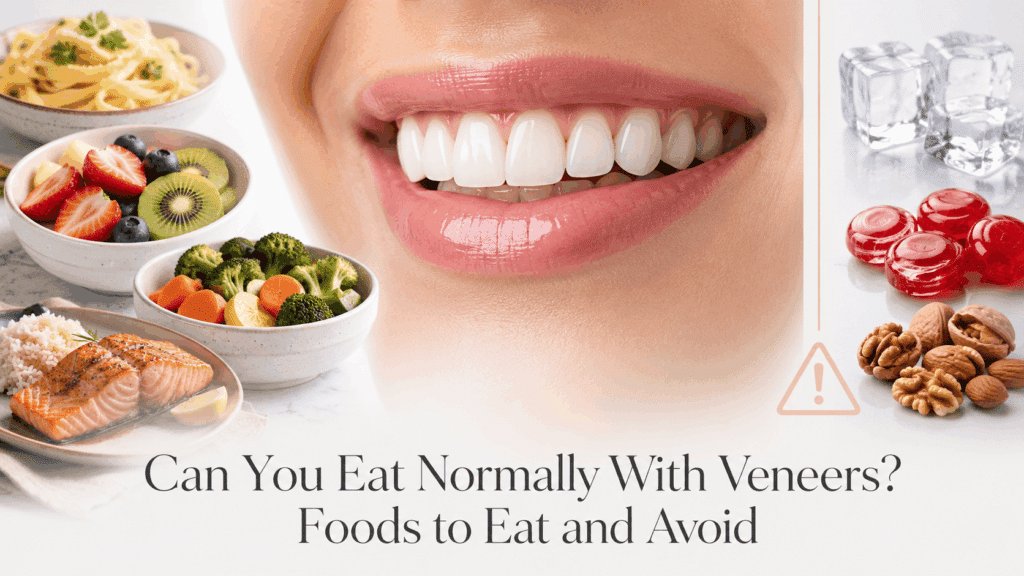
  • Can You Eat Normally With Veneers? Foods to Eat and Avoid

    Can You Eat Normally With Veneers? Foods to Eat and Avoid

    Can You Eat Normally With Veneers

    Many patients considering veneers have the same question before moving forward: Will my smile change how I live day to day?

    They want to improve the appearance of their teeth, but they also want to know whether veneers will affect simple things like eating their favourite foods, biting comfortably, or enjoying meals without worrying about damage.

    The good news is that most patients return to a normal diet after their veneers are placed. Veneers are designed to handle everyday chewing, but they still require the same care and attention you would give your natural teeth.

    Eating with veneers is usually easier than many patients expect. Knowing which foods require extra caution and which habits help prevent damage can make adjusting to your new smile much more comfortable.

    What Eating Feels Like Right After Placement

    The first day or two after getting veneers can feel slightly unfamiliar. Your teeth have a new shape, a new texture, and sometimes a new thickness.

    Some patients notice mild sensitivity to hot or cold foods in the first few days. This typically fades as the tooth settles underneath its new covering.

    Your bite may also feel slightly different at first. This is normal. Your jaw and tongue need a short adjustment period to learn the new shape of your teeth, especially if several veneers were placed at once.

    A new sensation doesn’t mean something went wrong. It simply means your mouth is adapting, the same way it does after any dental change.

    Most patients feel fully adjusted within one to two weeks and describe eating with veneers as completely natural after that point.

    What to Eat in the First Few Days

    Immediately after veneer placement, the bonding cement needs a short period to reach its full strength.

    Most dentists recommend softer foods for the first day or two, not because veneers are fragile, but because your mouth may still feel unfamiliar and mild tenderness can make chewing easier with soft textures.

    • Soft fruits like banana or ripe melon
    • Yogurt or soft cheese
    • Pasta, rice, or soft cooked vegetables
    • Eggs prepared any way
    • Soup or broth

    These aren’t permanent restrictions. They give your mouth a short, comfortable adjustment window.

    Foods You Can Eat Normally With Veneers

    Once the initial adjustment period passes, most patients eat a wide and normal variety of foods without issue.

    • Fruits and vegetables, including moderately firm ones like apples and carrots
    • Meat and poultry prepared normally
    • Bread, pasta, and rice
    • Fish and seafood
    • Cooked grains and legumes
    • Most restaurant and everyday home meals

    The goal of a veneer is to look and function like a natural tooth. When placed and cared for correctly, it achieves that in daily eating just as much as in appearance.

    Can You Bite Normally With Veneers?

    Yes. Veneers bond securely to the front surface of your teeth using a strong dental cement. They’re designed to handle normal biting and chewing forces.

    Biting into a sandwich, an apple, or a piece of meat is exactly what veneers are built to handle. Front teeth exist specifically for biting, and veneers don’t change that function.

    Where problems arise is when patients treat their veneered front teeth as tools, using them to tear packaging, bite thread, or crack hard objects. Natural teeth can chip from these habits too.

    If you grind or clench your teeth, that additional force becomes a more significant factor. More on that below.

    Foods and Habits That Increase the Risk of Damage

    Veneers don’t require a completely different diet, but a small number of foods and habits consistently create problems worth avoiding.

    Very Hard Foods

    The biggest risks to veneers are hard foods that concentrate sudden force on a small point of the restoration.

    • Biting directly into ice or chewing it as a habit
    • Hard candy that requires significant force to break
    • Unpopped popcorn kernels
    • Hard nuts bitten directly from the shell

    These same foods can chip natural teeth too. Veneers simply remove the margin for error that natural enamel has from years of gradual use.

    Sticky and Chewy Foods

    Very sticky foods create a pulling force when you chew and swallow, which puts stress on the bond between a veneer and the tooth underneath.

    • Caramel and toffee
    • Extremely sticky candy like taffy
    • Chewing very thick gum for extended periods

    Most sticky foods eaten in normal quantities don’t cause problems. The issue arises with foods that grip and pull strongly with every bite.

    Using Teeth as Tools

    This habit damages veneers faster than almost any food can. Biting nails, opening bags or bottles, pulling tags, or holding objects in your teeth all apply uneven lateral force.

    Front teeth were designed for controlled, vertical chewing motion. Twisting, levering, or gripping motions work against that design whether veneers are present or not.

    Coffee, Tea, Wine, and Staining Foods

    One of the most common questions patients ask before getting porcelain veneers is whether they have to give up coffee or red wine.

    Porcelain veneers resist staining significantly better than natural enamel does. Their smooth, glazed surface doesn’t absorb pigment the way enamel can after years of exposure.

    The catch is that natural teeth alongside the veneers can still stain over time, which creates a color contrast that makes the veneers look different from the surrounding teeth.

    Composite veneers, which use resin rather than porcelain, are more porous and can pick up stain gradually, especially with heavy coffee or red wine consumption.

    Good oral hygiene, including regular brushing and dental cleanings, goes a long way toward keeping everything looking consistent.

    The American Academy of Cosmetic Dentistry notes that porcelain’s glazed surface gives it substantially better color stability than unprotected enamel over time.

    Does the Type of Veneer Change What You Can Eat?

    Porcelain veneers and composite veneers behave slightly differently at the table.

    Factor Porcelain Veneers Composite Veneers
    Stain resistance High, glazed surface resists pigment Moderate, resin can absorb stain over time
    Hardness Comparable to natural enamel Slightly softer, may wear faster under grinding
    Chipping risk Can chip under sudden extreme force Slightly more likely to chip than porcelain
    Repairability Usually needs full replacement if chipped Often repairable in one visit

    For both types, the food restrictions are similar. The main practical difference comes down to staining potential and how repairs are handled if damage does occur.

    Veneers and Teeth Grinding

    Teeth grinding, known clinically as bruxism, applies repeated, heavy force to every surface of your teeth, including veneers.

    Patients who grind at night without a protective night guard carry a higher risk of chipping or fracturing a veneer than patients who don’t grind.

    This doesn’t automatically disqualify someone from getting veneers. Many patients who grind are still excellent candidates with proper planning and protection.

    If you grind your teeth and are considering veneers, a consultation with Dr. Pearl Zadeh helps clarify whether a night guard or other planning makes veneers a realistic option for you specifically.

    Wearing a custom night guard is one of the simplest and most effective ways to protect veneers for patients who clench or grind.

    Habits That Protect Veneers Over the Long Term

    Most of what protects a veneer long term is exactly what protects natural teeth. The differences are minor.

    • Brush twice daily with a non-abrasive toothpaste and a soft bristled toothbrush
    • Floss daily, since the gum margin around a veneer still accumulates plaque
    • Attend regular cleanings so your dentist checks for wear, margin gaps, or staining
    • Wear a night guard if you grind or clench
    • Avoid the hard food and tool-use habits mentioned above
    • Mention any sensitivity or change in how your bite feels to your dentist promptly

    The American Dental Association emphasizes that consistent oral hygiene and routine checkups significantly extend the lifespan of any dental restoration, including veneers.

    How Long Veneers Last With Good Habits

    Porcelain veneers typically last ten to fifteen years or longer with proper care. Composite veneers generally last five to seven years before needing replacement or significant repair.

    Daily eating habits make a real difference in where a patient lands within that range. Someone who avoids ice chewing, wears their night guard, and attends regular checkups often gets significantly more years from their veneers than someone who skips those habits.

    Veneer lifespan depends heavily on how well you care for your teeth, maintain good oral hygiene, and avoid habits that place unnecessary stress on your restorations.

    Schedule a Consultation With Dr. Pearl Zadeh

    Veneers are designed for daily life, including regular meals, everyday snacks, and the foods you enjoy most. While a few simple habits can help protect your veneers over time, most patients find that their diet requires very little adjustment after treatment.

    Patients who have gone through the process share their real-world experiences in our patient testimonials, including how eating and caring for their veneers felt before and after treatment.

    Dr. Pearl Zadeh‘s Woodland Hills cosmetic dentistry practice takes the time to explain what you can realistically expect before treatment begins, including how veneers may fit into your daily lifestyle.

    Call (818) 716-6722 or click the button below to schedule a consultation online and discuss whether veneers are the right option for your smile.

    Schedule a Consultation

    This article is for informational purposes only and is not a substitute for professional dental advice. Please schedule a consultation with Dr. Pearl Zadeh to discuss your specific situation.

    Frequently Asked Questions

    1. Can you eat normally after getting veneers?

    Yes, after a brief adjustment period of one to two weeks. Most patients describe eating as completely normal once they adapt to the feel of their new teeth.

    2. Can veneers come off while eating?

    It’s uncommon with well bonded veneers, but it can happen with sticky foods, a failing bond, or unusual force. Regular checkups catch early bond issues before they lead to this.

    3. Can you eat steak with veneers?

    Yes. Chewing a normally cooked steak doesn’t place unusual force on veneers. The front teeth bite through it, and the back teeth handle the heavier chewing load.

    4. Do you have to avoid coffee with veneers?

    Not necessarily. Porcelain veneers resist staining well. Heavy daily coffee consumption can still stain natural teeth around the veneers over time, which makes consistent hygiene more important.

    5. Can you eat hard foods with porcelain veneers?

    Most firm foods are fine. Directly biting into ice or very hard candy creates a risk for veneers, just as it does for natural teeth.

    Related Articles:

    1. Porcelain Veneers: A Practical Guide for Patients
    2. Composite Veneers: Everything You Need to Know
    3. Porcelain vs Composite Veneers: Choosing the Right Option for Your Smile
    4. Digital Smile Design for Veneers: How It Helps Plan Your Smile
    5. No-Prep Veneers and Traditional Veneers: What Is the Difference?
    6. Veneers for Older Adults: Are They a Good Option?

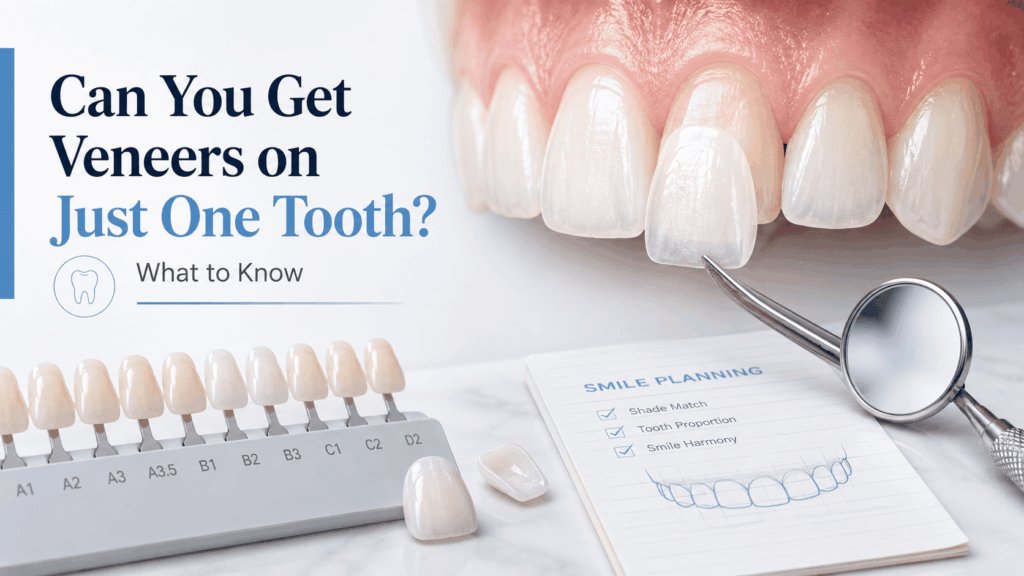
  • Can You Get Veneers on Just One Tooth? What to Know

    Can You Get Veneers on Just One Tooth? What to Know

    Can You Get Veneers on Just One Tooth

    One tooth chipped years ago in an accident, or one tooth has always looked a shade darker than the rest, and you’ve put off doing anything about it because you assume fixing it means treating your whole smile. That assumption stops a lot of people from ever asking the question.

    In many cases, a single tooth can be treated on its own, though whether that’s the right call depends on more than just how the tooth looks to you in the mirror.

    Yes, a Single Veneer Is Often Possible

    Placing a veneer on just one tooth is a legitimate, commonly performed treatment, not an exception dentists avoid. Many patients come in wanting exactly this: one chipped, discolored, or misshapen tooth addressed without touching the rest of their smile. Whether it’s the right approach for you specifically depends on how that tooth compares to its neighbors, and your dentist can determine that during an evaluation rather than from a description alone.

    Situations Where a Single Veneer May Be Considered

    A few common scenarios tend to bring patients in asking about treating just one tooth.

    A Chipped or Worn Front Tooth

    A chip from an accident, a fall, or years of minor wear on one front tooth is one of the more straightforward cases for a single veneer. If the surrounding teeth are otherwise in good shape and a similar color, treating just the affected tooth is often a reasonable starting point.

    A Single Discolored Tooth That Hasn’t Responded to Whitening

    Some teeth darken due to old trauma, a root canal, or other internal changes that whitening doesn’t reach, since whitening generally affects surface staining rather than internal discoloration. When one tooth stays noticeably darker than the rest despite whitening attempts, a veneer is sometimes considered as a way to cover that specific tooth rather than whitening the whole smile repeatedly with limited results.

    Minor Shape Differences Between Teeth

    A tooth that’s slightly shorter, narrower, or oddly shaped compared to its neighbor can sometimes be addressed with a single veneer, reshaping just that tooth to sit more evenly within the smile. This works best when the difference is cosmetic rather than related to the tooth’s actual position. If the concern is more about alignment than shape alone, how veneers relate to crooked teeth covers where cosmetic treatment helps and where it doesn’t.

    A Tooth That Looks Different From Its Neighbors

    Sometimes a tooth simply looks different, in texture, translucency, or subtle color, without an obvious chip or stain to point to. This can happen naturally or as a result of an old filling that’s changed color over time. A single veneer can sometimes even that difference out, though this is one of the more nuanced cases to plan for, discussed further below.

    Replacing an Old Veneer on One Tooth

    If an existing veneer on one tooth has chipped, discolored, or simply aged differently than the rest of your smile, replacing just that veneer is a common and often straightforward request. Your dentist evaluates the surrounding teeth and any other veneers already in place to make sure the replacement blends in, rather than assuming a simple swap will automatically match. Depending on the material involved, our comparison of porcelain and composite veneers may help you understand what a replacement might involve.

    Why Some Patients Need Multiple Veneers Instead

    Not every case stays limited to one tooth once a dentist takes a closer look. If several teeth show similar wear, if your natural tooth color varies significantly across your smile, or if your goals go beyond fixing one specific concern, your dentist may recommend treating more than one tooth to achieve a result that looks balanced rather than lopsided. Our breakdown of how many veneers a smile makeover typically involves goes further into how that broader decision gets made.

    This isn’t about upselling you into more treatment than you need. It’s about the fact that a single veneer surrounded by teeth that don’t match well can sometimes draw more attention to the difference rather than less. A dentist recommending additional teeth is often trying to protect the natural-looking outcome you’re actually after.

    The Real Challenge of a Single-Tooth Veneer

    Placing a veneer on one tooth is often considered one of the more demanding procedures in cosmetic dentistry, not because the physical process is unusually complex, but because the result has to disappear convincingly next to teeth that were never touched.

    Shade Matching With Surrounding Natural Teeth

    When several teeth are veneered together, a dentist and lab can apply the same shade and translucency across all of them, creating built-in consistency. With a single tooth, the veneer has to be matched precisely to teeth that weren’t altered, which involves careful color analysis, sometimes multiple rounds of adjustment with the lab, and an honest conversation about how close a match is realistically achievable.

    Matching Shape and Proportion

    Beyond color, a single veneer also needs to reflect the size, length, and contour of the tooth next to it. Even small differences in these proportions can be noticeable up close, particularly for front teeth that people tend to look at directly when talking with you.

    Porcelain vs Natural Enamel

    Porcelain and natural enamel do not behave identically under light. Enamel has its own translucency and subtle variations that are difficult to fully replicate in one restoration. A single veneer may not look exactly like a natural tooth in every lighting condition. However, it can still provide an excellent match when viewed in the dental chair. Our porcelain veneers guide and composite veneers overview explain how each material affects translucency and appearance.

    How Lighting Changes the Way Teeth Look

    Natural teeth and porcelain do not always react to light the same way, especially under fluorescent lighting, direct sunlight, or camera flashes. A veneer that looks seamless in one setting may appear slightly different in another. This can happen with any veneer, but the difference may become more noticeable when one veneer sits beside a natural tooth.

    Bite and Tooth Position

    The way a tooth contacts its opposing tooth during biting matters for a single veneer, just as it does for a full set. If the tooth sits differently from its neighbour or receives extra bite force, your dentist considers this when choosing the material and designing the veneer. Uneven pressure can affect the veneer’s long-term durability.

    How Dentists Decide Between One Veneer and Several

    There is no fixed rule that applies to every patient. A dentist considers how well a single veneer can match, how your other teeth vary in colour and shape, and the result you want. The table below highlights general differences between the two approaches, but your dentist will base recommendations on your specific situation.

    Consideration One Veneer Multiple Veneers
    Main purpose Address an isolated concern on a single tooth Create a coordinated, balanced look across several teeth
    Common situations A chip, a stubborn stain, or one misshapen tooth Broader discoloration, several visible concerns, or a full smile makeover
    Color matching Must match existing natural teeth precisely, which can be difficult Matched to each other, giving more control over the final shade
    Smile design considerations Limited mainly to how one tooth fits within the existing smile Involves broader planning across width, proportion, and symmetry
    Treatment planning Often simpler, though shade matching adds its own complexity More involved upfront, but shade consistency is easier to control

    If a single veneer can blend well with your smile and meet your goals, it may offer a more conservative starting point. If matching one tooth convincingly seems difficult, your dentist can explain why a broader treatment plan may work better.

    Alternatives to a Single Veneer

    Veneers are not the only way to address a single-tooth concern. Depending on the cause of the issue, another option may work better. Dental bonding is often a more conservative choice for minor chips or small shape corrections. It typically requires less tooth alteration and can sometimes be completed in a single visit.

    Teeth whitening may help when the concern involves surface staining rather than deeper colour differences. However, it usually will not correct internal discolouration caused by an old injury or root canal. Orthodontic treatment may be a better option if the main concern involves tooth position rather than colour or shape. Simple reshaping or contouring can also help with very minor irregularities. This approach gently adjusts the tooth edge or surface without adding material, so some patients may not need veneers or bonding.

    Which of these fits depends entirely on what’s actually behind the concern with that tooth, not a general preference for one option over another.

    Setting Realistic Expectations for a Single Veneer

    A single veneer can often look very natural, but no dentist can promise a perfect match in every lighting condition. They also cannot guarantee that it will look identical to your untreated teeth forever. The American Dental Association notes that veneers can chip, wear, or need rebonding over time, like other restorations. Your natural teeth will also continue to change colour as you age, which may affect how closely the veneer matches years later.

    None of this means a single veneer is a poor choice. It means going in in with a realistic sense of what a good outcome looks like, rather than expecting permanent, flawless invisibility under every condition.

    Choosing a Cosmetic Dentist in Woodland Hills for Single-Tooth Cases

    Single-tooth veneers reward a dentist who takes shade matching seriously rather than treating it as a quick add-on. Dr. Pearl Zadeh’s approach to cosmetic treatment planning includes the kind of detailed shade and shape analysis that single-tooth cases require, rather than defaulting to a broader plan by default. Patients considering veneers in Woodland Hills can expect an honest conversation about whether one tooth is a realistic option for their specific smile, and our overview of cosmetic dentistry in Woodland Hills covers the fuller range of options if your case calls for something beyond a single veneer.

    If a single veneer, or a small number of them, ends up being the right fit, our guide to preparing for a veneers appointment walks through what to expect, and some patients also ask about no-prep veneers as a more conservative option for smaller, single-tooth corrections.

    Schedule a Consultation With Dr. Pearl Zadeh

    Whether one tooth or several make sense for your smile depends on your specific teeth, not a general rule that applies to every patient asking the same question. A personalized evaluation is the only reliable way to know what a realistic, natural-looking result would involve for you.

    Dr. Pearl Zadeh and her Woodland Hills team can look closely at the tooth that’s bothering you, along with the teeth around it, and walk you through whether a single veneer or a broader plan fits your goals.

    Call (818) 716-6722 or click the button below to schedule your consultation online.

    Schedule a Consultation

    Frequently Asked Questions

    1. Can you get veneers on just one tooth?

    In many cases, yes. A single veneer can address an isolated chip, stain, or shape concern, though your dentist will evaluate whether it can realistically match your surrounding teeth first.

    2. Will one veneer look different from my natural teeth?

    It may, to some degree, depending on the lighting and how closely the dentist matches the shade and translucency. A careful shade-matching process can reduce noticeable differences, but it cannot guarantee a perfect match in every condition.

    3. Can a single veneer match surrounding teeth?

    Often, yes, though dentists consider this one of the more technically demanding aspects of cosmetic dentistry. The process typically requires careful shade analysis and may involve multiple adjustments with the dental lab.

    4. Should I get multiple veneers instead of one?

    This depends on how much your other teeth vary in color and shape, and on your overall goals. Your dentist may recommend additional teeth if matching just one convincingly isn’t realistic for your smile.

    5. Can I add more veneers later?

    In many cases, yes, though your dentist will need to evaluate how new veneers would match the existing one in shade and shape. This is worth raising during your original consultation if it’s something you’re considering.

  • Types of Porcelain Bridges: Which Option Is Best for Your Smile?

    Types of Porcelain Bridges: Which Option Is Best for Your Smile?

    Porcelain Bridges

    Missing teeth can affect how you chew, speak, and smile with confidence. Over time, gaps may also cause nearby teeth to shift out of place, leading to bite problems and discomfort. A porcelain bridge offers a fixed solution that restores both appearance and function.

    However, not all porcelain bridges work the same way. Different designs suit different dental needs. Understanding your options can help you choose the bridge that fits your smile best.

    What Is a Porcelain Bridge?

    A porcelain bridge replaces one or more missing teeth by filling the empty space with a custom-made artificial tooth. The bridge stays in place by attaching to nearby teeth or dental implants.

    Porcelain blends closely with natural enamel, so the bridge looks realistic while restoring your ability to chew and speak clearly. A porcelain teeth bridge also helps maintain the shape of your face and keeps surrounding teeth from drifting into the gap.

    Why There Are Different Types of Porcelain Bridges

    Every patient has a unique bite, tooth position, and level of chewing pressure. Because of this, dentists use different bridge designs depending on:

    • The number of missing teeth
    • The strength of nearby teeth
    • The location of the gap
    • Jawbone support
    • Long-term stability needs

    Choosing the right type ensures comfort, durability, and a natural appearance.

    Woodland Hills Porcelain Bridges

    Traditional Porcelain Bridge

    A traditional porcelain bridge is the most common option. It uses two crowns placed on the teeth next to the missing space. These crowns hold the replacement tooth securely in between.

    This type works well when healthy teeth exist on both sides of the gap. It provides strong support and allows normal chewing.

    Best for: One or two missing teeth with solid neighboring teeth
    Main benefit: Excellent stability and long-term function

    Cantilever Porcelain Bridge

    A cantilever bridge attaches to only one supporting tooth instead of two. This design works in areas where only one adjacent tooth is available for support.

    Dentists usually recommend this option for locations that do not receive heavy bite pressure. While it can be useful in certain cases, it requires careful planning.

    Best for: Gaps with only one healthy support tooth
    Main benefit: Preserves more natural teeth

    Maryland (Resin-Bonded) Porcelain Bridge

    A Maryland bridge uses thin wings bonded to the back of nearby teeth instead of full crowns. This method avoids reshaping healthy teeth and keeps most of the natural enamel intact.

    It works best for front teeth, where appearance matters more than chewing force. Because it relies on bonding, it may not suit areas with strong bite pressure.

    Best for: Front tooth gaps
    Main benefit: Minimal tooth alteration

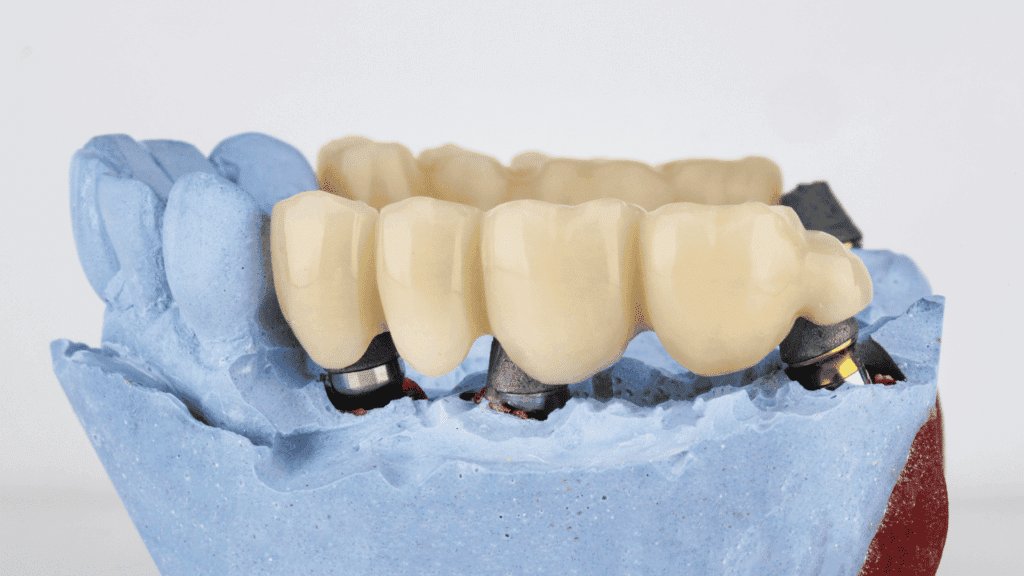
    Implant-Supported Porcelain Bridge

    An implant-supported bridge uses dental implants instead of natural teeth for support. Titanium posts placed in the jawbone act like artificial tooth roots. The porcelain bridge then attaches to these implants.

    This option works well for patients missing several teeth in a row. It also helps preserve jawbone structure and does not affect neighboring teeth.

    Best for: Multiple missing teeth
    Main benefit: Long-term strength and bone support

    Schedule a Consultation

    Comparison of Porcelain Bridge Types

    Type of Bridge Support Method Best For Key Advantage
    Traditional Porcelain Bridge Two natural teeth One or two missing teeth Strong and stable
    Cantilever Porcelain Bridge One natural tooth Limited support areas Requires only one anchor
    Maryland Bridge Bonded wings Front teeth Conservative design
    Implant-Supported Bridge Dental implants Multiple missing teeth Preserves jawbone

    Benefits of Choosing a Porcelain Bridge

    Porcelain bridges offer both functional and cosmetic advantages:

    • Restores chewing and clear speech
    • Keeps nearby teeth from shifting
    • Matches natural tooth color
    • Supports long-term oral health
    • Improves confidence when smiling

    A well-fitted porcelain teeth bridge can make everyday activities like eating and speaking feel normal again.

    Schedule Your Consultation

    Choosing the right porcelain bridge begins with a professional evaluation. At Pearl Zadeh DDS, every treatment plan focuses on comfort, precise digital scanning, and natural-looking results.

    If you are ready to restore your smile and replace missing teeth with a custom porcelain bridge, we are here to help.

    Call (818) 716-6722 or click the button below to book your consultation online and get started with Pearl Zadeh DDS today.

    Schedule a Consultation

    Frequently Asked Questions (FAQ)

    1. Which porcelain bridge looks the most natural?

    All porcelain bridges are designed to match natural teeth, but Maryland bridges and implant-supported bridges often provide the most seamless appearance for visible areas.

    2. Can a porcelain bridge replace more than one tooth?

    Yes. Bridges can replace several missing teeth in a row, especially when supported by implants.

    3. Is a porcelain bridge permanent?

    A porcelain bridge is a long-term solution. With proper oral hygiene and dental visits, it can last 10 to 15 years or longer.

    4. Does choosing a bridge stop teeth from moving?

    Yes. A bridge fills the gap and helps prevent nearby teeth from shifting into the empty space.

    5. Who is a good candidate for a porcelain teeth bridge?

    Patients with missing teeth and healthy gums and support teeth usually make good candidates for this treatment.

    Related Articles:

    1. Porcelain Bridges: What to Know Before Your Visit
    2. Porcelain Bridges vs. Dental Implants: Which Is Right for You?
    3. Types of Porcelain Bridges: Which Option Is Best for Your Smile?
    4. When Is a Dental Bridge Better Than an Implant?
    5. Temporary vs Permanent Dental Bridges: Key Differences and What to Expect
    6. Signs Your Dental Bridge Needs Replacement

  • Common Dental Misconceptions with teeth whitening, cavities filled, etc.

    Common Dental Misconceptions with teeth whitening, cavities filled, etc.

    Common Dental Misconceptions

    Whether you need a cavity fixed, a whitening treatment, or simply a routine dental cleaning, making regular visits to your dentist’s office is the surest way to keep your teeth and gums healthy and strong. During your visit, be sure to ask Dr. Pearl Zadeh any questions you may have about your oral health or about the treatment process. There are numerous popular misconceptions about dental care that Dr. Pearl Zadeh will be able to dispel. These are some common myths you may have heard:

    Misconception: Teeth whitening can damage your teeth.

    Reality: If you have teeth that are stained or yellowing, professional teeth whitening is a highly effective means of making your smile brighter and more attractive. Many people, however, are concerned that having their teeth whitened will somehow damage patients teeth. The truth is that the enamel in your teeth is very strong, and your enamel will not be damaged by the whitening process. The area of the teeth that is truly being whitened is the dentinal layer, the layer just below the enamel. People with thicker enamel will tend to have whiter looking teeth, and thinner enamel individuals will have a more yellow color to them. The best time to whiten your teeth is immediately after or very close to the time you have your teeth professionally cleaned. Make sure to always have your teeth whitening treatment administered by your dentist. The mall whitening kiosk can be dangerous. At the office of Dr. Pearl Zadeh, we isolate all of your soft tissues with a liquid rubber dam. This means that your gums, recession areas of your tooth, and cheeks are carefully and skillfully retracted. The chances of getting sever chemicals burns when proper isolation is not employed is very high. In preparation for whitening, sensitive patients may want to use products that can help to sensitize their teeth for 1-2 weeks prior to whitening. Some great products for patients that use fluoride are Sensodyne Toothpaste of MI paste Plus (which contains Fluoride). For the other group of patients that lie to be Fluoride-Free, I recommend MI Paste (the one with no fluoride). And of course, at the office of Dr. Pearl Zadeh we are aware there is a group of patients that really want to whiten professionally and their teeth are to sensitive. Over the counter Crest Whitening Strips can be effective, if used consistently and the patients are complaint with the directions on how to use. and as at-home kits are less reliable. I have a group of patients that are more cautious, or ‘reserved’, to jumping into professional whitening. For those patients over the counter products like Crest White Strips may be a cost effective and easy way to ease them into the process of whitening. Of course, cost is something that is frequently mentioned when it comes to professional whitening systems. There are some great new products that have come out for professional use, and that are very cost effective and still work great! Opalescence Go, is a great product, that utilizes dental trays, that are universally fitted opposed to a custom fitted tray. Opalescence Go comes in 10% and 15% Carbamide Peroxide, which if used consistently can produce great results!

    Misconception: It’s fine to get multiple fillings in one tooth.

    Reality: If you develop tooth decay in a tooth where you have already had one filling placed, there may not be a sufficient amount of healthy tooth structure to support another filling. Many dentist may tell you what you think you want to hear, in order to to capture your ‘loyalty’ or ‘business’. Unfortunately, many dentist don’t adhere to the oath they took to do no harm. Dr.Pearl Zadeh is not afraid to have the real and hard conversations with her patients about their true dental needs. The goal of Dr. Pearl Zadeh is to place the most healthy, functional and esthetic restoration possible. If a tooth has multiple composites and the overall integrity of the tooth is weekend, it maybe susceptible to fracture, and create a whole other host of problems. Our calculations on how we decided what type of restoration to place is simple, how much healthy tooth structure remains after the decay is excavated and any old composite is removed. If ample tooth structure exists, then a composite filling will be placed. If less tooth structure remains, an onlay, otherwise known as partial crown or three quarter crown is placed. If a gross amount of tooth structure is missing, then a full coverage crown is placed. It is very rare that Dr. Pearl Zadeh will place a full coverage crown on a tooth that did not previously have one.

    Dr. Pearl Zadeh practices Biomimetic Dentistry. This is a movement in dentistry that is gaining momentum, were the dentist utilizes the art of removing only the tooth structure that is necessary, taking a minimal approach. A majority of dentist take the more commonly excepted approach, of extending the preparation and removing more tooth structure than is considered healthy. Biomimetic Dentistry involves bonding in the restoration, not ‘cementing’. Bonding the new onlay or crown to the tooth, creates a chemical bond between the restoration and the tooth, which helps increase the longevity of the restoration, mimics the natural harmony of which the tooth was originally designed, and allows the tooth to be less susceptible to recurrent decay. As a holistically minded practitioner, Dr. Pearl Zadeh strives to save and retain as much of natural tooth structure as possible, which makes reduces the likeliness of root canals.

    Misconception: Once you have a filling, onlay or crown placed, you can’t get a cavity in that tooth again.

    Reality: Patients often assume that once a restoration is placed, whatever the type may be, that means that they will be protected for life from any further tooth decay in that tooth. Unfortunately, this could not be further from the truth. Insurance agencies, who generally like to decline all types of dental services, will pay for a new crown on the same crowned tooth, every 5 years. This is telling us, on average, how frequently a majority of the population is getting recurrent decay. As sad as it may be, Dr. Pearl Zadeh says that once a tooth is touched by a dentist, it begins the cycle of death of a tooth. Prevention, prevention, prevention when possible!!!! The reality is when a filling, onlay, or crown is placed, it is creating a new interface between the tooth and restoration, for bacteria to leak in. The skill of the clinician is paramount!

    A biologic dentist, like Dr. Pearl Zadeh, who employs healthy dental materials, and practices Biomimetic dentistry, take meticulous time to ensure that all proper isolation is taken to create the highest bond strength of her restorations, which intern creates the most longevity to her dental work. Partnership with the patient is a necessary and valuable tool as well. For patients must understand and value to the importance of ideal home care, as far as brushing, flossing and staying on top of routine hygiene visits.. If you don’t continue to brush and floss the tooth with a crown as diligently as you do with your other teeth, it can become vulnerable to cavities.

    Misconception: Cavities are reversible.

    Reality: Patients sometimes wonder if they can reverse the effects of a cavity by brushing and flossing even after tooth decay has started. Well, good news, this is partially true!?! The main variable in deciding if a cavity can be reversed, is the location of the decay. If the decay is limited to the enamel, which is the outer surface of the tooth, the cavity is indeed reversible, or at least arrestable. In biologic dentistry, trying to take a more holistic approach, Dr. Pearl Zadeh seeks to make the physical touching of the tooth her very last option. If there is a chance for remineralization of the enamel to take place, rest assured we will discuss this option with you! At the offices of Dr. Pearl Zadeh, we employ the latest in technology, which includes digital radiographs and fluorescence technology, to detect and gauge when in the time to treat dental decay.

    If you’re in need of a tooth filling, a crown replacement, or other professional dental work, don’t settle for anything less than the best. Dr. Pearl Zadeh offers holistic dental care to patients in the Woodland Hills area. Our practice is committed to providing our patients with a wonderful, comfortable, and beneficial dental experience. If you are interested in learning more about how our dental services can help you enjoy an improved smile, call our office at (818) 672-1071 for an appointment.

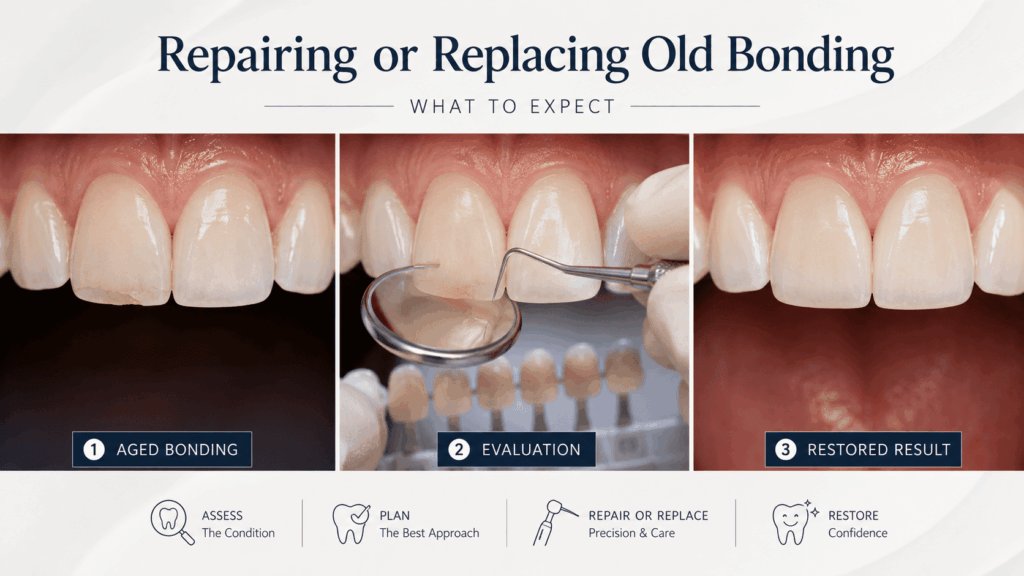
  • Repairing or Replacing Old Bonding: What to Expect

    Repairing or Replacing Old Bonding: What to Expect

    Repairing or Replacing Old Bonding

    You catch your reflection and notice that your smile looks slightly different. The bonding that once blended naturally with your teeth now appears darker, feels rough against your tongue, or shows a small chip along the edge.

    Changes like this do not always mean the bonding has failed. Composite bonding naturally changes over time as it experiences daily use. Sometimes a small adjustment or repair can restore the appearance. In other cases, replacing the bonding may create a better result.

    The right choice depends on the condition of the bonding, the health of the tooth underneath, and what you want your smile to look like today.

    Why Dental Bonding Changes Over Time

    Dental bonding uses a tooth-coloured composite resin designed to repair or improve the appearance of a tooth. Although the material is durable, it does not behave exactly like natural enamel or porcelain.

    Composite resin is slightly softer than these materials. Over the years, normal chewing, biting forces, and everyday habits can gradually affect its appearance and texture.

    Several factors can contribute to changes in older bonding, including:

    • Frequent exposure to coffee, tea, red wine, or other staining foods and drinks
    • Teeth grinding or clenching that places extra pressure on the material
    • Normal wear from chewing and daily use
    • Changes in the surrounding natural teeth over time

    These changes do not necessarily mean the original bonding was unsuccessful. Like many dental restorations, bonding requires maintenance because your teeth and materials continue to experience daily stress.

    If you want to understand how bonding is placed initially, our step-by-step look at the bonding procedure explains the planning, shaping, and finishing involved.

    Signs Your Bonding May Need Attention

    Old bonding does not always need replacement immediately. However, certain changes can indicate that it is time for your dentist to evaluate the restoration.

    The Bonding Feels Rough or Uneven

    A bonded tooth should feel smooth against your tongue. If the surface starts feeling rough, raised, or different from your natural teeth, the material may have experienced surface wear.

    Minor texture changes may sometimes be polished or adjusted. Your dentist can determine whether the bonding still has enough strength or needs further treatment.

    The Colour No Longer Matches

    Composite resin can absorb stains over time. Coffee, tea, tobacco exposure, and other staining habits may gradually affect the shade of older bonding.

    Unlike natural teeth, composite material does not respond to whitening treatments in the same way. If the bonding has become noticeably darker than the surrounding teeth, replacement may provide a better colour match.

    The Bonding Has Chipped or Cracked

    Small chips along the edge of bonding are common, especially on front teeth that experience repeated biting forces.

    A minor chip may only require a simple repair. Larger damage may require replacing more of the restoration, especially if the underlying tooth structure also needs attention.

    Your Smile Goals Have Changed

    Sometimes the bonding itself remains functional, but your expectations change over time.

    You may want a different tooth shape, a brighter shade, or a more complete smile improvement than the original bonding provided. In these cases, your dentist may discuss whether repairing the bonding or replacing it with another cosmetic option better fits your goals.

    This differs from a new chip caused by sudden damage. Our guide to bonding for chipped teeth explains how dentists approach those situations.

    What Affects How Long Bonding Lasts

    The lifespan of dental bonding varies from patient to patient. One person’s bonding may continue looking natural for many years, while another person’s repair may need attention sooner.

    Several factors influence how well bonding holds up over time.

    The location of the tooth matters. Front teeth usually experience less chewing pressure than back teeth, but they are more visible when changes occur. A small chip, edge wear, or colour difference may become noticeable sooner on front teeth because they are part of your smile.

    Bite forces also play an important role. Patients who grind or clench their teeth place additional stress on bonded areas. This repeated pressure can increase the risk of wear, cracks, or chips over time.

    Daily habits can affect the material too. Biting ice, chewing hard foods, or using your teeth to open packages places unnecessary pressure on bonding. Avoiding these habits helps protect both the restoration and your natural teeth.

    Your oral care routine matters as well. Regular brushing, flossing, and routine dental visits help protect the tooth underneath the bonding. Good oral health also reduces the risk of problems that could affect the restoration.

    Staining habits may change how bonding looks. Composite resin can absorb colour from coffee, tea, red wine, and tobacco over time. Since bonding does not whiten like natural enamel, stains may become more noticeable as the years pass.

    Changes in your natural teeth can affect the overall appearance. Your surrounding teeth may naturally change colour or wear slightly with age. Sometimes older bonding stands out because the rest of your smile has changed, not because the bonding itself has deteriorated.

    How a Dentist Evaluates Old Bonding

    Before recommending repair or replacement, your dentist examines both the bonding and the tooth beneath it.

    During the evaluation, your dentist checks:

    • The condition of the bonding material
    • Any chips, cracks, or rough areas
    • How well the colour and shape match nearby teeth
    • Whether decay or damage has developed underneath
    • How your bite affects the bonded tooth

    Your dentist also considers habits that may have contributed to the changes, such as teeth grinding or clenching.

    The age of the bonding alone does not determine whether it needs replacement. A well-maintained restoration may remain functional for years, while newer bonding may need attention if it experiences heavy wear or damage.

    When Repair Is Often the Right Approach

    Repair may be the better option when the concern is small and the tooth underneath remains healthy.

    For example, your dentist may repair older bonding if it has:

    • A small chip along the edge
    • Minor surface roughness
    • Slight shape changes
    • A small area that needs cosmetic refinement

    A repair usually involves adding fresh composite resin to the affected area, reshaping it, and polishing the surface so it blends with the existing bonding.

    This approach works best when the original bonding still provides a stable foundation and the issue is mainly cosmetic. It allows your dentist to restore the appearance without replacing the entire restoration.

    When Replacement May Make More Sense

    Replacing old bonding may become the better option when the restoration has reached a point where a small repair will no longer create the result you want.

    Your dentist may discuss replacement if the bonding has:

    • Significant wear or damage
    • Deep staining that does not blend well with your smile
    • Multiple repairs that have changed the shape or appearance
    • A cosmetic result that no longer matches your goals

    Replacement may also make sense when your expectations have changed since the original treatment. For example, you may want a different tooth shape, more length, or a more noticeable smile improvement than the original bonding provided.

    In these situations, starting with a fresh restoration can give your dentist more control over the final appearance. It avoids repeatedly adding material to an older restoration that may no longer provide the ideal foundation.

    If your original bonding helped close a gap and that area has changed over time, your dentist may consider whether a different approach would create a better long-term result. Our comparison of veneers and bonding for closing gaps explains how these options differ.

    Can Stained Bonding Be Whitened?

    No. Traditional whitening treatments do not change the colour of composite bonding in the same way they change natural teeth.

    Whitening products work by breaking down stains within natural enamel. Composite resin does not respond to whitening agents in the same way, which means the bonded area may remain the same shade while the surrounding teeth become lighter.

    This can sometimes make older bonding look more noticeable after whitening. A patient may expect the bonding to blend better, but the colour difference can become easier to see.

    If you are planning to whiten your teeth, your dentist may recommend completing whitening first. This allows the new bonding shade to match your updated smile rather than your previous tooth colour.

    What Happens During a Bonding Repair?

    A bonding repair is usually a simple and conservative process. Your dentist first evaluates whether the existing restoration can support additional composite material.

    If repair is appropriate, your dentist may:

    1. Prepare the worn or damaged area to help the new material attach.
    2. Apply fresh composite resin to rebuild the affected section.
    3. Shape the material so it matches the existing tooth contour.
    4. Polish the area to create a smooth, natural finish.

    Many repairs take less time than replacing the entire restoration because your dentist can preserve the healthy portions of the existing bonding.

    What Happens During a Bonding Replacement?

    Replacing bonding involves removing the older composite material and creating a new restoration from the beginning.

    Your dentist first removes the existing bonding and examines the tooth underneath. This allows them to check the health of the enamel and identify any issues that may have developed over time.

    The process then follows the same general principles as new bonding:

    • Selecting a shade that matches your smile
    • Applying composite resin in layers
    • Sculpting the shape carefully
    • Polishing the final surface

    Starting fresh gives your dentist a clean foundation. This can be especially helpful when the old bonding has significant staining, repeated repairs, or a shape that no longer fits your cosmetic goals.

    When Another Cosmetic Option Might Fit Better Than Rebonding

    Replacing old bonding can also be a good time to reconsider whether bonding still matches your long-term goals.

    If your bonding has needed several repairs, or if you now want larger cosmetic changes, your dentist may discuss other options. For example, veneers may provide more control over tooth colour, shape, and proportions when multiple cosmetic concerns are involved.

    This does not mean veneers are automatically the better choice. The right option depends on your tooth structure, bite, oral health, and the result you want to achieve.

    Our porcelain veneers guide and composite veneers overview explain what these treatments involve. Our comparison of bonding and veneers also covers the differences between these approaches in more detail.

    If your goals involve several areas of your smile, our overview of what a smile makeover typically includes explains how treatments such as bonding, veneers, and whitening may work together.

    How Cost Factors Into Repair or Replacement

    The cost of repairing or replacing bonding depends on the details of your specific case.

    Several factors can affect the overall investment, including:

    • The number of teeth involved
    • The extent of the damage or wear
    • Whether your dentist can repair the existing bonding or needs to replace it
    • Whether additional cosmetic treatments are part of the plan

    A small repair on one tooth and a full replacement involving multiple teeth require very different levels of time and treatment.

    Online estimates can provide general information, but they cannot account for the condition of your existing bonding or the needs of your smile. A consultation allows your dentist to evaluate the restoration directly and provide a more accurate recommendation.

    Choosing a Cosmetic Dentist in Woodland Hills for Bonding Repairs

    Choosing between repairing and replacing old bonding requires more than looking at the restoration itself. Your dentist also needs to evaluate the tooth underneath, your bite, and your overall cosmetic goals.

    Dr. Pearl Zadeh takes this detailed approach when evaluating older bonding and cosmetic concerns. Her goal is to help patients understand their options and choose a treatment that fits their smile, rather than recommending a more involved procedure without a clear reason.

    Patients considering cosmetic dental treatment can also review our overview of cosmetic dentistry in Woodland Hills to learn about other available options.

    Schedule a Consultation With Dr. Pearl Zadeh

    If your bonding no longer looks or feels the way it once did, that does not always mean something has gone wrong. Cosmetic dental work changes over time, and an evaluation can help you understand what options are available.

    Dr. Pearl Zadeh and her Woodland Hills team can examine your existing bonding and discuss whether a repair, replacement, or another cosmetic approach best fits your smile and goals.

    Call (818) 716-6722 or click the button below to schedule your consultation online.

    Schedule a Consultation

    Frequently Asked Questions

    1. How do I know if my bonding needs to be repaired or replaced?

    A dentist can evaluate the extent of the wear, staining, or damage, along with the health of the tooth underneath, to determine which approach fits your situation. Minor issues often just need a repair, while significant wear or repeated problems may call for replacement.

    2. How long does dental bonding typically last?

    Bonding is often cited in a range of roughly three to ten years, though this varies considerably based on location in the mouth, bite forces, habits, and how well it’s cared for over time.

    3. Can bonding be whitened if it becomes stained?

    Generally, no. Composite resin doesn’t respond to whitening treatments the way natural enamel does. Stained bonding is usually addressed by replacing the material rather than trying to whiten it.

    4. Is repairing bonding cheaper than replacing it?

    Often, yes, since a repair typically involves less material and less time than a full replacement. Exact cost depends on the extent of the issue, which your dentist can evaluate directly.

    5. Can old bonding be replaced with a veneer instead?

    In many cases, yes, particularly if you’re looking for more durability or a broader cosmetic change. Your dentist can evaluate whether your tooth is a good candidate for that transition.

    Related Articles:

    1. Dental Bonding for Chipped Teeth: What Patients Can Expect
    2. Fixing Gaps Between Teeth With Veneers vs Bonding
    3. Dental Bonding vs Veneers: Which Option Is Right for You?
    4. How Dental Bonding Works: The Procedure Step by Step

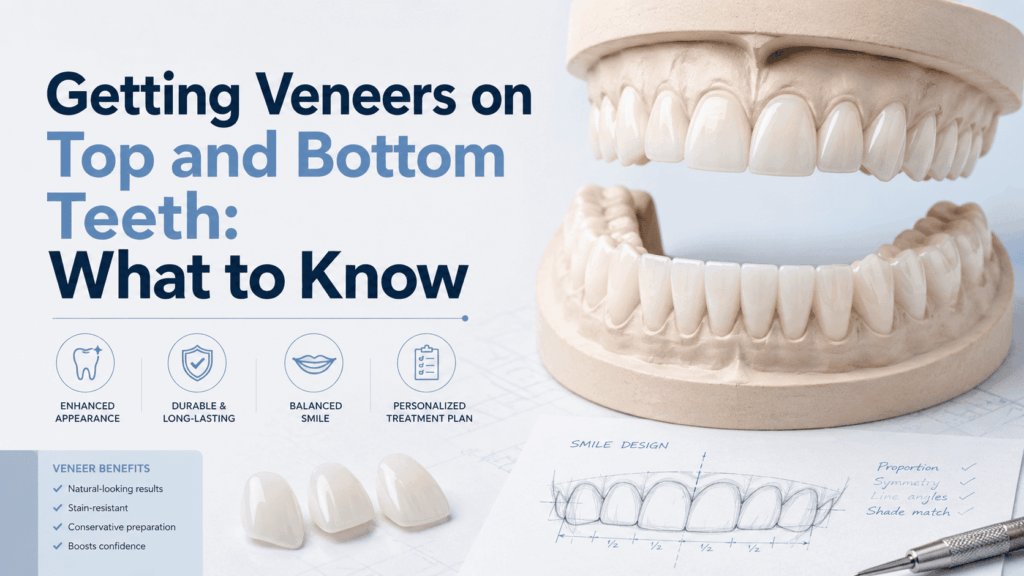
  • Getting Veneers on Top and Bottom Teeth: What to Know

    Getting Veneers on Top and Bottom Teeth: What to Know

    Getting Veneers on Top and Bottom Teeth

    You’ve decided you want a smile makeover, and now you’re stuck on a question that never came up in the before-and-after photos you’ve been saving: do your bottom teeth need veneers too, or will treating the top row be enough?

    It’s a fair question, and the answer depends on more than personal preference. It comes down to how your specific smile behaves when you talk, laugh, and smile naturally, not just how it looks in a still photo.

    What It Means to Get Veneers on Both Arches

    Getting veneers on top and bottom teeth means treating visible teeth in both the upper and lower arch as part of one coordinated plan, rather than focusing on the upper teeth alone. This isn’t automatically part of every smile makeover, and it isn’t a sign that a patient’s case is more severe than someone getting upper veneers only. It’s simply a different scope, chosen based on what a specific smile actually needs to look balanced.

    Why Many Smile Makeovers Focus Mainly on Upper Teeth

    For a lot of people, the upper front teeth do most of the visual work during a natural smile. Many patients show only their upper teeth, or upper teeth with a small amount of lower tooth visible, when they smile normally. Because of this, treating the upper arch alone is often enough to noticeably change how a smile looks and feels, without extending treatment further than necessary.

    This pattern isn’t universal, though. Some people show more of their lower teeth than average, whether due to how their lips rest, how their teeth are positioned, or simply how they smile. For these patients, stopping at the upper arch can leave a visible mismatch between a bright, refreshed top row and a lower row that still shows its original wear or color.

    Why Some Patients Consider Veneers on Both Top and Bottom

    A handful of situations tend to bring the lower teeth into the conversation. Some patients want a more comprehensive transformation and don’t want any visible tooth left untouched. Others notice a real color difference between their upper and lower teeth, sometimes because lower teeth stain more stubbornly due to more constant exposure to saliva and less benefit from whitening treatments. Patients who show a fair amount of lower tooth structure when smiling or speaking sometimes prefer treating both arches so the whole visible smile reads as consistent, rather than only the top half looking refreshed.

    Significant cosmetic concerns, such as noticeable wear, chips, or unevenness affecting several lower teeth, can also be a reason to include them in the plan. The unifying theme across these situations is a desire for one consistent, balanced appearance across everything that shows when the patient talks and smiles, not simply treating more teeth for its own sake.

    When Treating Lower Teeth May Improve Overall Balance

    Balance is really the key word here. A dentist isn’t just checking whether lower teeth are visible at all. They’re evaluating whether leaving them untreated would create a visible inconsistency once the upper teeth are refreshed. If your lower teeth are in reasonably good shape, similar in shade to the newly planned upper veneers, and not particularly visible during normal conversation, many patients are satisfied stopping at the upper arch. If the difference would be noticeable, treating some or all of the lower teeth may create a more cohesive result.

    When a Dentist May Recommend Treating Fewer Teeth

    Just as some patients end up needing both arches treated, others are steered toward a smaller plan than they originally expected. If your lower teeth are healthy, well-matched in color, and rarely visible, adding veneers there may not meaningfully change your smile’s appearance and would extend treatment without a clear benefit. Our breakdown of how many veneers a smile makeover typically involves goes further into how dentists narrow down a plan to the teeth that genuinely need it, rather than defaulting to every visible tooth.

    How Dentists Decide Which Teeth Should Receive Veneers

    Deciding whether a plan should include lower teeth, and which specific teeth in either arch, comes down to a detailed evaluation rather than a general rule. A few factors carry real weight in that decision.

    Smile Width and How Much Tooth Shows

    Some smiles reveal more teeth toward the back, while others show mostly the front four to six teeth per arch. A wider smile with more visible teeth on both the top and bottom naturally brings more of the lower arch into the conversation than a narrower smile would.

    Lip Movement and Speech

    A dentist typically watches how your lips move at rest, during a natural smile, and while you’re speaking, since these moments can reveal different amounts of upper and lower tooth structure. Some patients show very little lower tooth at rest but reveal quite a bit more while talking, which matters for planning.

    Tooth Proportions, Shape, and Size

    Lower front teeth are naturally smaller and sit closer together than upper front teeth. This affects the available space and how your dentist shapes the veneers. Proper design helps prevent a bulky or unnatural appearance next to neighbouring teeth.

    Existing Restorations

    Old fillings, crowns, or bonding on lower teeth can affect whether your dentist includes them in a veneer plan. This matters especially when existing restorations have changed colour or no longer match the planned shade.

    Tooth Color

    If your lower teeth are much darker than the planned shade for your upper veneers, the difference may become more noticeable after treatment. This is one reason dentists may recommend including some lower teeth in the treatment plan.

    Bite Relationship Between Upper and Lower Teeth

    How your upper and lower teeth meet when you close your mouth affects veneer design and material choice for either arch. Patients with a deep bite may have limited space between their upper and lower teeth. In these cases, dentists may recommend thinner veneers or a different approach to reduce excess pressure.

    If your bite involves noticeable misalignment rather than a cosmetic concern, our guide on veneers and crooked teeth explains when veneers may help and when orthodontic treatment may come first.

    Signs of Wear or Grinding

    Both upper and lower teeth are affected by grinding and clenching, and existing wear patterns give a dentist useful information about how forcefully your bite comes together. Our discussion of veneers for patients who grind their teeth covers how bruxism factors into candidacy and planning across both arches, not just the upper teeth.

    Overall Oral Health

    Active decay, gum disease, or other untreated dental issues typically need to be addressed before cosmetic treatment on either arch. A healthy foundation across your whole mouth matters more to a lasting result than which specific teeth receive veneers.

    Upper Veneers vs Lower Veneers: Key Differences

    Upper and lower veneers aren’t simply mirror images of the same treatment. The table below summarizes some general differences worth understanding, though your specific case is what ultimately shapes the plan.

    Consideration Upper Veneers Lower Veneers
    Visibility Typically the most visible teeth during a smile Often less visible when smiling, more visible when speaking or laughing
    Common reasons for treatment Discoloration, chips, gaps, and overall smile appearance Wear, stubborn discoloration, or visible unevenness during speech
    Planning considerations Smile width, lip position, and proportion relative to the face Available space, tooth size, and how they’ll look next to upper teeth
    Bite considerations Involved in how the bite closes and distributes force Often carry concentrated bite force, requiring careful evaluation

    Lower veneers in particular tend to require additional planning, since they sit on smaller teeth, interact directly with the opposing arch during every bite, and are seen differently depending on whether you’re smiling, talking, or at rest.

    Does Every Visible Tooth Need a Veneer?

    No. A visible tooth does not automatically need treatment. If a tooth already has a suitable shape, size, and colour compared with nearby teeth, your dentist may not recommend a veneer. Treatment plans usually focus on teeth that create a cosmetic concern or noticeable difference, rather than every visible tooth by default.

    Materials for Upper and Lower Veneers

    Both arches can generally receive porcelain or composite veneers. Material choice often depends on durability expectations, cosmetic goals, and the condition of the teeth being treated. It does not usually depend only on which arch needs veneers.

    Our porcelain veneers guide and composite veneers overview explain what each material involves. Our comparison of porcelain and composite veneers also covers the differences in more detail. Some dentists may use different materials within one treatment plan. For example, they may recommend porcelain for upper teeth and another option for lower teeth based on bite forces and cosmetic goals.

    Alternatives and Combined Treatments

    Veneers aren’t always the only piece of a smile makeover, upper or lower. Teeth whitening can sometimes address general discoloration without veneers at all, particularly on teeth that are otherwise well-shaped. Dental bonding may handle a minor chip or gap on a lower tooth without the more involved process a veneer requires. Orthodontic treatment may be worth discussing first if the concern is more about tooth position than color or shape. Combining these approaches, rather than defaulting to veneers on every visible tooth, is part of what a thorough smile makeover planning process looks like. Some patients achieve their goals with fewer veneers than they originally expected once these combined options are on the table.

    Are Upper and Lower Veneers Treated at the Same Time?

    This depends on your dentist’s process and the complexity of your case. Some practices treat both arches within the same overall timeline, staging preparation and placement so the process moves efficiently. Others prefer to complete one arch first, evaluate how it looks and feels, and then move to the second arch with that information in hand. Neither approach is inherently better, and your dentist can walk you through which sequence makes sense for your specific plan.

    Planning Your Smile Makeover in Woodland Hills

    Dr. Pearl Zadeh evaluates smile width, lip movement, bite relationship, and tooth condition across both arches before recommending whether a plan should include upper teeth alone or both top and bottom. Her approach to cosmetic treatment planning focuses on what your specific smile needs rather than defaulting to a broader plan than necessary. Patients considering veneers in Woodland Hills can expect that same individualized evaluation, and our overview of cosmetic dentistry in Woodland Hills covers the fuller range of options if your plan ends up combining veneers with other treatments.

    Once your plan is set, our guide to preparing for a veneers appointment walks through what to expect, whether your treatment involves one arch or both.

    Schedule a Consultation With Dr. Pearl Zadeh

    Whether your smile makeover should include your upper teeth or both arches depends on your smile, not a general assumption. A personalised evaluation helps determine what a balanced, natural-looking result requires for you.

    Dr. Pearl Zadeh and her Woodland Hills team can evaluate your smile width, bite, and tooth condition. They can help you decide whether upper veneers, lower veneers, or a combination approach fits your goals.

    Call (818) 716-6722 or click the button below to schedule your consultation online.

    Schedule a Consultation

    Frequently Asked Questions

    1. Can you get veneers on both top and bottom teeth?

    Yes, in many cases. Whether this makes sense for you depends on how visible your lower teeth are, their current color and condition, and your overall smile goals.

    2. Do most people need veneers on their lower teeth?

    Not necessarily. Many patients achieve their goals with upper veneers alone, since the upper teeth tend to be more visible during a natural smile. Some patients do benefit from including lower teeth, depending on their specific smile pattern.

    3. How many veneers are needed for a full smile makeover?

    This varies by patient and depends on smile width, tooth proportions, color, and personal goals rather than a fixed number that applies to everyone.

    4. Are upper veneers enough for a natural-looking smile?

    Often, yes, particularly for patients whose lower teeth are healthy, reasonably well-matched in color, and not especially visible when smiling or speaking. Your dentist can evaluate whether this applies to your specific smile.

    5. Do bottom veneers affect your bite?

    They can, since lower teeth interact directly with the upper teeth during every bite. Your dentist evaluates your bite relationship carefully before recommending lower veneers to help avoid uneven pressure or premature wear.

  • Veneers for Older Adults: Are They a Good Option?

    Veneers for Older Adults: Are They a Good Option?

    Veneers for Older Adults

    After years of putting your smile goals aside, you may finally feel ready for veneers. Then a question often appears: does age change your chances of success?

    Concerns about thinner enamel, changing gums, or previous dental issues can make the decision feel uncertain. However, age alone does not determine whether veneers make sense. Your current oral health, tooth condition, and smile goals matter far more than your age.

    Does Age Disqualify Anyone From Getting Veneers?

    No specific age automatically prevents someone from getting veneers. Your dentist looks at your gum health, enamel condition, bite, and overall oral health first.

    A 70-year-old with healthy gums and strong teeth may qualify more easily than a younger patient with untreated dental problems. Age gives your dentist useful context, but it does not make the decision alone.

    How Teeth and Gums Change With Age

    Your teeth and gums change over time, and those changes can affect veneer planning. A thorough evaluation helps your dentist determine what approach fits your smile.

    Enamel Thinning and Wear

    Years of chewing, acidic foods, drinks, and grinding can gradually wear enamel. Teeth may become shorter, more sensitive, or easier to chip as enamel becomes thinner.

    Veneers rely on the existing tooth structure for support. Your dentist checks how much healthy enamel remains before recommending treatment.

    Gum Recession

    Some people experience gum recession as they get older. This process exposes more of the tooth root and can change the appearance of the gumline.

    Gum recession can also affect veneer design. Your dentist needs to consider the gumline carefully to create a natural-looking result.

    Healthy gums provide an important foundation for cosmetic treatment, so your dentist may address gum concerns before planning veneers.

    Tooth Color Changes

    Teeth often develop a darker or more yellow appearance over time. This happens partly because enamel becomes thinner and reveals more of the naturally darker dentin underneath.

    This change does not mean you have poor oral hygiene. Your dentist considers your natural tooth colour during shade planning, especially when treating only certain teeth.

    What Dentists Evaluate Before Recommending Veneers for Older Patients

    A dentist does not use age alone to determine veneer candidacy. Instead, they evaluate several factors that affect your smile, oral health, and treatment outcome.

    Gum and Periodontal Health

    Healthy, stable gums create a stronger foundation for veneer treatment. If you have active gum disease, your dentist may recommend treating it before cosmetic work.

    Inflamed or unstable gum tissue can affect how veneers look and function over time. Advanced periodontal disease can also weaken the bone supporting your teeth. Your dentist considers this when evaluating whether veneers are appropriate.

    Bite and Wear Patterns

    Years of chewing, grinding, or clenching can change how your teeth meet. These habits can also affect how much pressure your teeth handle.

    Your dentist evaluates your bite and wear patterns before designing veneers. This helps them choose materials and designs that suit your specific needs.

    Dry Mouth and Medications

    Dry mouth, also called xerostomia, becomes more common with age. Certain medications for conditions like blood pressure, depression, and allergies can contribute to it.

    Cleveland Clinic notes that dry mouth can increase the risk of tooth decay and gum disease. This matters because decay near a veneer’s edge can affect the restoration over time.

    If dry mouth affects you, your dentist may suggest managing it before or alongside cosmetic treatment.

    Existing Restorations

    Many older adults have existing dental work, including fillings, crowns, or previous cosmetic treatments. These restorations can influence shade matching, treatment planning, and the final appearance.

    Your dentist reviews your existing restorations before deciding which teeth need treatment. They also consider how new veneers will blend with your current smile.

    Overall Medical History

    Your overall health can influence how your dentist plans treatment. Conditions such as diabetes or certain heart conditions may affect healing and gum health.

    Some medications may also influence your treatment plan. Sharing your complete medical history helps your dentist create a safer approach.

    Can Veneers Be Placed if You Have Gum Recession?

    In many cases, yes. However, the extent of recession and the condition of your gums matter.

    Mild or moderate gum recession does not always prevent veneer treatment. Your dentist can design veneers around your existing gumline when appropriate.

    More severe recession may require treatment before cosmetic work begins. Your dentist may also involve a periodontist in more complex cases.

    Gum recession does not automatically rule out veneers. A proper evaluation can show whether veneers fit your specific situation.

    Addressing Oral Health Concerns Before Cosmetic Treatment

    If you have gum disease, decay, or other oral health concerns, your dentist will usually address those first. This applies regardless of age.

    This approach does not delay cosmetic treatment without reason. Veneers need a healthy foundation to function well over time. Treating underlying problems first helps protect your smile investment.

    For many older patients, treatment planning may take longer than the veneer placement itself.

    Do Older Adults Need a Different Veneer Approach?

    Sometimes, but not always. Some older patients want to correct one specific concern, such as a chipped tooth or noticeable discolouration. Others want to improve several teeth for a broader smile change.

    Our discussion of getting veneers on just one tooth and our guide to veneers on top and bottom teeth explain how dentists plan treatment size. These considerations apply at any age, but older patients may also factor in existing dental work and long-term goals.

    A full smile makeover can be an option, but it does not suit every patient exploring veneers.

    Porcelain vs Composite: Does Age Change the Choice?

    Age alone does not determine whether porcelain or composite veneers fit better. However, factors that can change with age may influence the decision. These include enamel condition, bite pressure, and existing restorations.

    Our porcelain veneers guide and composite veneers overview explain what each material involves. our comparison of porcelain and composite veneers also covers the differences in more detail.

    Your dentist considers these factors alongside your goals and oral health. They do not choose a material simply because of your age.

    Cost also plays a role in the decision. Veneer costs vary based on the number of teeth treated, selected material, and case complexity. Our breakdown of what affects porcelain veneer costs explains the factors that influence pricing.

    Setting Realistic Expectations

    Veneers can create a noticeable improvement in your smile, but they cannot guarantee a specific outcome. Your existing teeth, gum health, and bite all influence the final result.

    A thorough consultation helps you understand what veneers can realistically achieve. It also helps you explore options that fit your needs.

    For many older patients, the goal is not a completely different smile. Instead, they want a refreshed and balanced version of their existing smile.

    Choosing a Cosmetic Dentist in Woodland Hills for Mature Smiles

    Dr. Pearl Zadeh evaluates each patient’s gum health, enamel condition, bite, and medical history before recommending treatment. She considers factors that may become more important as patients get older.

    Her approach focuses on your current oral health and smile goals rather than assumptions based on age. Patients considering veneers in Woodland Hills can expect a detailed evaluation before treatment recommendations.

    our overview of cosmetic dentistry in Woodland Hills explains other available options if veneers are not the best first choice.

    Once you have a treatment plan, our guide to preparing for a veneers appointment explains what to expect before your visit.

    Schedule a Consultation With Dr. Pearl Zadeh

    Veneers may or may not suit your smile goals at this stage of life. Your dentist needs to evaluate your gums, teeth, and oral health before making a recommendation.

    Dr. Pearl Zadeh and her Woodland Hills team can assess your smile and create a personalised plan based on your needs. They consider your starting point, goals, and available treatment options.

    Call (818) 716-6722 or click the button below to schedule your consultation online.

    Schedule a Consultation

    Frequently Asked Questions

    1. Am I too old to get veneers?

    Generally, no. Age alone doesn’t disqualify anyone. What matters more is the health of your gums, the condition of your enamel, your bite, and your overall oral health, which your dentist evaluates individually.

    2. Can I get veneers if I have gum recession?

    In many cases, yes, depending on how significant the recession is. Mild to moderate recession can often be planned around, while more advanced cases may need treatment first.

    3. Do veneers work differently for older patients?

    Not fundamentally, though older patients often have factors like enamel wear, existing restorations, or gum changes that shape the treatment plan differently than they might for a younger patient.

    4. Will dry mouth affect my veneer candidacy?

    It can be a factor, since dry mouth increases the risk of decay around a veneer’s margin. Your dentist may recommend managing dry mouth as part of your overall treatment plan.

    5. Do I need to fix my gums before getting veneers?

    If active gum disease or significant instability is present, addressing it first is generally recommended, regardless of age. A stable, healthy foundation tends to support a longer-lasting result.

    Related Articles:

    1. Porcelain Veneers: A Practical Guide for Patients
    2. Composite Veneers: Everything You Need to Know
    3. Porcelain vs Composite Veneers: Choosing the Right Option for Your Smile
    4. No-Prep Veneers and Traditional Veneers: What Is the Difference?
    5. Preparing for Your Veneers Appointment: A Complete Guide
    6. Veneers vs Teeth Whitening: Which One Should You Choose?
    7. Dental Bonding vs Veneers: Which Option Is Right for You?
    8. Can Veneers Fix Crooked Teeth? What They Can and Can’t Do
    9. Do Dental Veneers Look Natural or Fake? What Makes the Difference

  • What Should You Do If a Veneer Chips or Falls Off?

    What Should You Do If a Veneer Chips or Falls Off?

    What Should You Do If a Veneer Chips or Falls Off?

    A chipped or dislodged veneer can feel urgent, especially when it involves a front tooth. In many cases, the situation is still manageable with prompt care.

    The tooth underneath is often still healthy. The main concern is protecting it from sensitivity, damage, or further wear. What you do right after it happens can affect the outcome.

    Some veneers can be reattached if they remain intact and the tooth surface is in good condition. Others may need replacement if the bond has failed or the veneer has cracked. A dental exam helps determine the right approach.

    Immediate steps matter, including how the veneer is handled and how quickly dental care is scheduled. Treatment decisions depend on the condition of the veneer and the underlying tooth.

    First Steps: What to Do Right Away

    Stay calm and avoid chewing on the affected tooth. A damaged veneer is rarely a true emergency, but it still needs prompt attention to protect the tooth underneath.

    If possible, locate any pieces of the veneer and store them in a clean container or small bag. In some cases, the original veneer can be reused if it remains intact. Even broken fragments can help the dentist assess the extent of the damage.

    Contact your dentist as soon as possible to explain what happened and arrange an appointment. Most chipped veneers do not require same-day emergency care, but it is still important to be seen within a few days. Early evaluation helps prevent further damage and reduces the risk of exposing the tooth.

    How to Care for a Damaged Veneer Before Your Visit

    A damaged veneer can leave the underlying tooth sensitive to temperature and pressure. Simple care at home can help reduce discomfort until your dental visit.

    Rinsing with warm salt water helps keep the area clean and can ease irritation. Try to avoid chewing on the affected side, and choose soft foods that do not require heavy biting. If the edge feels sharp, dental wax can be placed over the area to protect your cheek and tongue. This is available at most pharmacies and provides temporary comfort.

    Over-the-counter pain relief may help if sensitivity develops. It also helps to avoid very hot or very cold foods and drinks until the tooth is evaluated.

    Do not use household adhesives or super glue on the veneer. These substances can damage the tooth surface and make proper repair more difficult.

    What to Avoid After a Veneer Chips or Falls Off

    Some actions can make a damaged veneer more difficult to repair.

    Do not try to reattach the veneer at home. Proper bonding requires dental materials and controlled conditions, and incorrect attempts can damage the tooth or lead to swallowing the veneer.

    It is also important not to delay care. Leaving the tooth exposed for too long can increase sensitivity and raise the risk of decay or further damage. The area becomes more vulnerable to bacteria once the veneer is off or chipped.

    Can Your Dentist Repair a Veneer?

    In many cases, a damaged veneer can be repaired or replaced depending on the extent of the issue.

    Your dentist will first examine the veneer and the underlying tooth. This includes checking how the bite comes together and identifying what caused the damage.

    If the veneer is intact and has come off cleanly, it can often be reattached. This process is called rebonding and works best when the surface is undamaged.

    Small chips may be repaired with tooth-colored composite material. This allows minor damage to be corrected without replacing the entire veneer.

    When a veneer is cracked or structurally compromised, replacement is usually the better option. This involves taking a new impression or digital scan to create a custom restoration over two visits.

    Repair or Replacement: What to Expect

    Your dentist will discuss the best option with you. Here is a clear comparison of the two approaches.

    Feature Composite Repair Replacing the Veneer
    When it is used Small chips, minor edge fractures Large breaks, cracks, or poor fit
    Procedure Done in one visit; adds material to the tooth Requires two visits; involves new impressions and lab work
    Durability A good temporary fix; may not last as long Provides a long-term, durable solution
    Cost More affordable as a quick fix Higher cost due to lab fabrication and materials

    Long-Term Care for Your Veneers

    Veneers can last for many years when they are cared for properly. Daily habits play a major role in protecting both the veneers and the natural teeth underneath.

    A custom night guard is often recommended for patients who grind their teeth. It helps reduce pressure during sleep and protects the veneers from unnecessary stress.

    It is also important to avoid using teeth as tools. Biting hard objects like ice, pens, or hard candy can increase the risk of chips or cracks.

    Good oral hygiene supports long-term stability. Regular brushing and flossing help keep the gumline healthy and reduce the risk of decay around the edges of the veneer.

    Routine dental visits allow early detection of small issues. Minor problems such as edge wear or loosening can often be managed before they progress.

    When to Seek Immediate Help

    Most veneer problems can wait a short time for a scheduled visit, but some symptoms need faster attention.

    Severe or increasing pain should be evaluated as soon as possible. The same applies if you notice swelling, signs of infection, or ongoing bleeding around the tooth or gums.

    A loose tooth or a veneer that comes off after a strong impact to the face also needs prompt assessment. These situations may involve deeper damage that requires immediate care.

    Schedule Your Consultation with Dr. Pearl

    A chipped veneer can feel stressful, but modern dentistry offers effective solutions. The key is acting quickly and contacting your dentist. Do not try to fix it yourself. Professional care protects your tooth and restores your smile.

    Dr. Pearl Zadeh and her team are here to help. We specialize in repairing and replacing damaged veneers. We use advanced materials for natural-looking results, and we also focus on identifying the underlying cause. This helps prevent the problem from recurring.

    Call our office at (818) 716-6722 or click the button below to schedule a consultation. Let us help you protect your smile.

    Schedule a Consultation

    Frequently Asked Questions

    1. Can a dentist reattach a veneer that fell off?

    Yes, dentists can often rebond an intact veneer. The success depends on the condition of the tooth and the veneer. It also requires a clean, dry surface for the new bond.

    2. Is a chipped veneer a dental emergency?

    No, a chipped veneer is not a true emergency. You can protect the tooth at home. Still, you should book an appointment with your dentist within a few days.

    3. Can a dentist fix a chipped veneer without replacing it?

    Yes, for small chips, a dentist can use composite resin to repair the damage. This is a quick and less expensive option.

    4. What happens if a veneer falls off and I swallow it?

    You will simply pass the veneer naturally. Contact your dentist to schedule a repair appointment.

    5. How can I prevent my veneers from chipping in the future?

    Wear a custom night guard if you grind your teeth. Avoid chewing on hard objects. Practice good oral hygiene. Visit your dentist for regular checkups.

    Related Articles:

    1. Porcelain Veneers: A Practical Guide for Patients
    2. Composite Veneers: Everything You Need to Know
    3. Porcelain vs Composite Veneers: Choosing the Right Option for Your Smile
    4. Veneers vs Teeth Whitening: Which One Should You Choose?
    5. Do Dental Veneers Look Natural or Fake? What Makes the Difference