Pearl Zadeh DDS

Tag: Cracked Tooth

  • Can a Cracked Tooth Wait Until Your Next Appointment?

    Can a Cracked Tooth Wait Until Your Next Appointment?

    A cracked tooth does not always require emergency care, but it should not automatically wait until your next routine appointment. The right timing depends on the symptoms and the condition of the tooth.

    Severe symptoms, such as facial swelling or fever, need prompt attention. If you suspect a crack, contact a dentist for advice rather than assuming it is safe to wait.

    Can a Cracked Tooth Wait for a Dental Appointment?

    No single waiting period is safe for every cracked tooth. The answer depends on the symptoms, the extent and location of the crack, and the tooth’s condition.

    A tooth that causes little pain may still have a significant crack. Severe pain can also have other causes, so discomfort alone cannot show how serious the problem is.

    Cleveland Clinic addresses chips or cracks that do not cause pain. It says it may be OK to wait until your dentist can see you. However, you cannot judge a crack’s depth at home, so call the dental office for advice.

    When you call, explain when the symptoms started, what triggers the pain, whether a piece of tooth has broken off, and whether you have swelling. These details can help the office advise how soon you should be seen.

    A suspected crack generally warrants a call to the dentist for guidance. Severe symptoms may require emergency care, as discussed below.

    Signs You Should Not Ignore

    These symptoms warrant a dental assessment:

    • Pain when chewing or releasing a bite.
    • Persistent or worsening sensitivity to temperature or sweets.
    • Pain that comes and goes without a clear cause.
    • A visible crack or a broken piece of tooth.
    • Swelling or severe pain.

    The American Association of Endodontists (AAE) describes erratic pain when chewing, possibly with the release of biting pressure. It adds that the pain may come and go.

    These symptoms can have other causes. They do not confirm a crack on their own.

    Some cracks cause little or no pain. Cleveland Clinic says cracked teeth do not always cause symptoms. A lack of symptoms does not show that the tooth is intact or that delaying assessment is safe. Only an examination can show which situation applies.

    When Should You Seek Urgent or Emergency Care?

    Not every suspected crack is an emergency. Some symptoms, however, call for prompt attention.

    Severe or rapidly worsening pain, facial or gum swelling, or fever with dental symptoms warrants prompt assessment. Call your dentist right away. MouthHealthy, the American Dental Association’s (ADA) consumer site, advises providing as much detail as possible about your condition. Cleveland Clinic notes that a badly cracked tooth may be a dental emergency.

    Difficulty breathing or swallowing requires emergency medical care. Mayo Clinic’s guidance on tooth abscess says to go to the emergency room for trouble breathing or swallowing. It also advises the emergency room for fever with facial swelling when you cannot reach your dentist.

    Do not wait for office hours or a scheduled visit if you have these symptoms.

    What Should You Do While Waiting for Your Appointment?

    These steps may reduce stress on the tooth. They do not repair the crack or replace a dental examination.

    • Avoid chewing on the affected side.
    • Choose softer foods.
    • Avoid hard, crunchy, sticky, or chewy foods.
    • Keep the area clean with gentle brushing.
    • Contact the dental office if symptoms worsen or new symptoms develop.

    MouthHealthy advises rinsing the mouth with warm water to clean the area after a crack. Do not test the tooth by biting hard objects or applying extreme heat or cold.

    If a sharp edge irritates your tongue or cheek, Cleveland Clinic suggests covering the area with orthodontic wax.

    Over-the-counter pain relievers may help some people. Follow the product label, and ask a pharmacist or clinician if you are unsure what is appropriate. Do not place aspirin on the tooth or gums. Mayo Clinic says a painkiller placed directly against the gums may burn the tissue.

    Our article on what to do if you have a cracked tooth covers immediate steps in more detail.

    What Happens When a Dentist Examines a Cracked Tooth?

    The dentist reviews your symptoms and dental history, then examines the tooth. A bite assessment may help identify the affected tooth. Further tests or imaging may follow when appropriate.

    Imaging has limits. StatPearls is a clinical reference hosted by the National Institutes of Health. It says a radiograph may reveal a thin line in some cracks. Usefulness depends on how the crack runs. A normal X-ray therefore does not always rule one out.

    Our article on how dentists diagnose a cracked tooth when an X-ray looks normal covers the methods they may use.

    Treatment depends on the extent of the damage. Cleveland Clinic explains that the right approach depends on how much of the tooth is affected. The crack’s location and depth also matter. Not every crack can be repaired, and a crown is not always necessary. Our article on cracked tooth treatment with bonding, an onlay, or a crown compares the options.

    Can a Cracked Tooth Get Worse If You Wait?

    Some cracks can. Cleveland Clinic says that even with treatment, tooth cracks sometimes continue to get bigger or split. Continued chewing and pressure may worsen some cracks, but the risk depends on the tooth and the crack. Symptoms alone cannot predict a timeline.

    Pain that fades does not mean the crack has healed. Read more about whether a cracked tooth can heal on its own.

    Symptoms cannot reliably show how deep a crack is. A dentist can advise how quickly the tooth should be assessed. Dr. Pearl Zadeh can examine the tooth and discuss what care may be appropriate. You can also read about dental crown treatment at Pearl Zadeh DDS. Crowns are one option dentists may discuss for some cracked teeth.

    Call (818) 716-6722 or click the button below to schedule your consultation online.

    Frequently Asked Questions

    Can I wait a few days if my cracked tooth does not hurt?

    No universal waiting period is safe. Some cracks cause little or no pain, so a lack of pain does not show the tooth is intact. Call your dentist, describe what you notice, and ask how soon to be seen.

    Should I go to the dentist if my tooth hurts only when I bite?

    Yes. Pain when biting warrants a dental assessment. It can have several causes, including a crack, and only an examination can identify which one applies.

    What should I avoid eating with a cracked tooth?

    Avoid hard, crunchy, sticky, and chewy foods, and avoid chewing on the affected side. Softer foods place less pressure on the tooth. These steps do not repair the crack.

    Can a cracked tooth get worse overnight?

    Symptoms can change, and some cracks worsen over time. Timing varies and cannot be predicted from symptoms alone. Contact your dentist if symptoms worsen or new ones appear.

    When does a cracked tooth require emergency care?

    Severe or rapidly worsening pain, facial or gum swelling, or fever with dental symptoms warrants prompt assessment. Difficulty breathing or swallowing requires emergency medical care.

    The information above is for informational purposes only and is not a substitute for professional dental advice. Please schedule a consultation with Pearl Zadeh DDS to discuss your specific situation.
  • Can Teeth Grinding Cause a Cracked Tooth? Signs and Prevention

    Can Teeth Grinding Cause a Cracked Tooth? Signs and Prevention

    Repeated grinding or clenching, known as bruxism, places ongoing stress on teeth. Over time, this pressure may contribute to enamel wear, chips, or cracks. However, grinding does not always cause a tooth to crack, and it is only one possible cause of tooth damage.

    A dental examination can help identify the cause of your symptoms and whether a crack is present. Recognizing the signs of grinding and tooth damage can help you know when to seek an evaluation and discuss ways to reduce stress on your teeth.

    How Can Teeth Grinding Damage Teeth?

    The National Institute of Dental and Craniofacial Research (NIDCR) is part of the National Institutes of Health. It says bruxism is when a person grinds, clenches, or gnashes teeth. This can happen while awake or asleep.

    Repeated pressure can wear down enamel, chip teeth, strain existing restorations, or contribute to cracks. NIDCR lists flattened, chipped, cracked, or loose teeth among possible effects. Mayo Clinic also lists damage to fillings, crowns, and other dental repairs.

    The effect varies by person. NIDCR says severe bruxism can lead to damaged teeth, jaw pain, and headache. Grinding does not always cause visible damage.

    Grinding is not the only cause of a cracked tooth. Cleveland Clinic notes that ice, hard candy, and popcorn kernels can crack teeth, and an injury to the mouth can also cause damage. Our article on common causes of cracked teeth covers other possible reasons.

    Signs You May Be Grinding Your Teeth

    Grinding often goes unnoticed. Mayo Clinic says some people may not know they have sleep bruxism until they have tooth or jaw problems. Possible signs include:

    • Flattened or worn tooth surfaces.
    • Jaw muscle soreness or tightness.
    • Jaw discomfort or headaches in the morning.
    • A dull headache around the temples.
    • Grinding sounds that a sleep partner reports.

    Cleveland Clinic lists headaches or facial pain, especially in the morning. These signs do not confirm bruxism on their own. Other conditions can cause jaw pain or headaches. A dental professional can assess what fits.

    Signs Grinding May Have Contributed to a Cracked Tooth

    A crack can cause different symptoms than general grinding soreness. The American Association of Endodontists (AAE) describes erratic pain when chewing, possibly with the release of biting pressure. Pain can also appear with temperature extremes.

    The pain may come and go, and it can be hard to pinpoint. According to the AAE, a dentist may have difficulty locating which tooth is causing the discomfort.

    Some cracks cause few or no symptoms. Cleveland Clinic says cracked teeth do not always cause symptoms.

    These symptoms overlap with other dental problems, so they cannot confirm a crack. A person may grind without a crack, and a cracked tooth may have another cause. Symptoms alone cannot establish the diagnosis.

    How Does a Dentist Check for Grinding and Tooth Cracks?

    A dentist reviews your symptoms and dental history. Mayo Clinic says dentists check for tenderness in the jaw muscles or joints. They also look for dental changes, such as flattened, broken, or missing teeth.

    The dentist also examines the teeth closely and assesses how they bite together. Further tests may follow when appropriate. Mayo Clinic notes that X-rays of the teeth and jaw may be needed.

    Some cracks are difficult to detect on standard X-rays, so a normal result does not always rule out a cracked tooth. Our article on how dentists diagnose a cracked tooth when an X-ray looks normal covers the methods they may use.

    How Can You Reduce the Risk of Further Tooth Damage?

    Practical measures include:

    • Asking a dentist whether a custom night guard is appropriate.
    • Avoiding chewing ice and other very hard objects.
    • Seeking an assessment for recurring jaw soreness or tooth pain.
    • Discussing persistent clenching or grinding with a dental professional.
    • Following the dentist’s advice if a crack or weakened tooth has already been identified.

    These steps can reduce certain risks. They cannot prevent every crack.

    On night guards, Cleveland Clinic says a dentist can make a custom mouth guard to protect your teeth. Mayo Clinic says guards keep the teeth apart during sleep. They may not stop bruxism itself.

    A guard can help protect teeth from grinding forces. It does not guarantee that cracks will never occur, and it does not heal an existing crack.

    Other management includes identifying possible triggers and improving sleep habits. Mayo Clinic says treating sleep problems may help lessen bruxism. It also advises avoiding stimulating drinks in the evening.

    Stress may play a role for some people. Mayo Clinic says relaxation practices may lessen the risk of clenching and grinding. Still, Cleveland Clinic says providers do not know exactly why some people grind and others do not. Relaxation alone may not stop grinding, so seek professional advice about persistent clenching.

    What If You Already Have a Cracked Tooth?

    Have the tooth assessed rather than relying on a night guard or home remedies alone. Reducing grinding may limit further stress on the tooth. It does not heal an existing crack.

    Cleveland Clinic notes that even with treatment, tooth cracks sometimes continue to get bigger or split. The right care depends on the crack’s location, depth, and effect on the tooth.

    Our article on cracked tooth treatment with bonding, an onlay, or a crown compares the options. You can also read about whether a cracked tooth can heal on its own and what to do if you have a cracked tooth.

    Persistent or recurring tooth pain, pain when biting, or suspected tooth damage warrants a dental assessment. Severe or worsening pain, swelling, or fever with dental symptoms requires prompt care.

    Mayo Clinic’s guidance on tooth abscess says to go to the emergency room for trouble breathing or swallowing. It also advises the emergency room for fever with facial swelling when you cannot reach your dentist.

    Grinding can contribute to tooth damage, but an examination is needed to find out whether a crack is present. Dr. Pearl Zadeh can examine the teeth, review your symptoms, and discuss what care may be appropriate. You can also read about dental crown treatment at Pearl Zadeh DDS. Crowns are one option dentists may discuss for some cracked teeth.

    Call (818) 716-6722 or click the button below to schedule your consultation online.

    Frequently Asked Questions

    Can grinding your teeth cause a cracked tooth?

    It can contribute. Repeated grinding or clenching places ongoing stress on teeth. Grinding does not always crack a tooth, and cracks have other causes too.

    Can you grind your teeth without knowing it?

    Yes. Mayo Clinic says some people do not know they have sleep bruxism until tooth or jaw problems develop. A sleep partner may notice the sounds, and a dentist may spot wear during an exam.

    Does a night guard prevent cracked teeth?

    A night guard can help protect teeth from grinding forces. It does not guarantee that cracks will never occur, and it does not heal an existing crack. Ask your dentist whether one suits you.

    Can a cracked tooth stop hurting even if the crack remains?

    Yes. The AAE says cracked-tooth pain may come and go, and Cleveland Clinic says cracks do not always cause symptoms. Less pain does not necessarily mean the crack has healed, so have the tooth assessed.

    When should I see a dentist for possible grinding-related tooth damage?

    See a dentist for persistent or recurring tooth pain, pain when biting, or suspected damage. Severe or worsening pain, swelling, or fever with dental symptoms needs prompt care. Trouble breathing or swallowing needs emergency care.

    The information above is for informational purposes only and is not a substitute for professional dental advice. Please schedule a consultation with Pearl Zadeh DDS to discuss your specific situation.
  • Cracked Tooth vs. Tooth Sensitivity: How to Tell the Difference

    Cracked Tooth vs. Tooth Sensitivity: How to Tell the Difference

    Tooth sensitivity and a cracked tooth can both cause discomfort with cold drinks or chewing. Certain symptom patterns may offer clues, but only a dental examination can identify the cause.

    Ordinary sensitivity often occurs after a specific trigger and fades soon after. A cracked tooth may cause unpredictable pain when chewing or biting. These patterns can overlap, so symptoms alone cannot confirm the cause.

    Knowing how the symptoms differ can help you describe what you feel to your dentist. Persistent or recurring discomfort should be checked rather than guessed at.

    What Does Ordinary Tooth Sensitivity Feel Like?

    Cleveland Clinic says sensitivity can make it painful to eat or drink something hot, cold, sweet, or sour. MouthHealthy, the American Dental Association’s (ADA) consumer site, also mentions discomfort with brushing or flossing.

    The discomfort often links to a particular trigger and may ease soon after the trigger goes away. That pattern is common, but it is not guaranteed.

    Sensitivity has several possible causes. MouthHealthy points to exposed dentin, gum recession, worn enamel, tooth decay, and worn fillings. Exposed dentin lets heat, cold, acidic foods, or sticky foods reach the nerves inside the tooth.

    Sensitivity does not automatically mean a crack. Cleveland Clinic says it can sometimes signal a bigger problem. Examples include a cavity, gum disease, or a cracked tooth. The page also notes that fillings, cleanings, or other treatments can cause short-term sensitivity.

    What Are the Signs of a Cracked Tooth?

    StatPearls is a clinical reference hosted by the National Institutes of Health (NIH). It calls sudden sharp pain upon biting down the most frequently reported symptom. Some patients also feel a fleeting sharp pain when they release the bite.

    The American Association of Endodontists (AAE) describes erratic pain when chewing, possibly with the release of biting pressure. Pain can also appear with temperature extremes.

    Cold drinks and food may trigger symptoms too. StatPearls adds that patients often struggle to identify which tooth is responsible.

    Cracks can also be quiet. Cleveland Clinic says cracked teeth do not always cause symptoms. Some cracks are also hard to see.

    Our article on chipped versus cracked teeth explains how they differ. You can also read about common causes of cracked teeth.

    Cracked Tooth vs. Tooth Sensitivity: Key Differences

    The table compares common patterns. Treat it as a general guide, not a set of diagnostic rules.

    FactorOrdinary tooth sensitivityPossible cracked tooth
    Common triggersOften a specific trigger, such as cold, heat, sweets, acidic foods, or brushingChewing or biting, and sometimes temperature changes or sweets; triggers can seem inconsistent
    Pain when biting or releasing pressureLess often the main complaint, though other dental problems can also cause itMay cause sharp pain on biting or a brief sharp pain when the bite is released
    How long discomfort may lastOften brief, and may ease soon after the trigger is removedVaries; the pain can be fleeting, and some cracks cause little or no discomfort
    Whether symptoms come and goOften follow the triggerMay be intermittent or erratic, which can make the tooth hard to identify
    Why the pattern cannot confirm the causeCracks, decay, and other conditions can also cause sensitivityCold, heat, and biting pain also occur with other dental problems

    These patterns overlap. A tooth that fits one column can still have the other problem, or a different one entirely.

    Why Can a Cracked Tooth Feel Like Tooth Sensitivity?

    A crack can change how a tooth responds to pressure and temperature. That overlap helps explain why cold drinks or chewing can hurt in both situations.

    Sources reflect this overlap. Cleveland Clinic names a crack or chip among the problems that can irritate a tooth and cause sensitivity. MouthHealthy lists fractured teeth as a cause too.

    Cold sensitivity therefore does not rule out a crack. A cracked tooth can react to cold or heat. Temperature sensitivity alone does not separate a crack from other dental problems.

    Pain location is not a reliable guide either. The AAE says a dentist may have difficulty locating which tooth is causing the discomfort. Decay or a damaged filling can add further overlap. Pain when biting does not always mean a crack.

    How Does a Dentist Find the Cause?

    A dentist usually starts with a conversation. Questions may cover when the pain began, what triggers it, and whether it comes and goes. StatPearls stresses an accurate history and diagnostic tests.

    The dentist then examines the tooth. Magnification and bright light may reveal fracture lines. A bite assessment can help pinpoint the affected tooth and cusp, according to StatPearls.

    Cleveland Clinic adds that dentists may use a staining dye to see a crack more clearly. Dental X-rays may also be part of the evaluation.

    Imaging has limits. StatPearls says a radiograph may reveal a thin line in some cracks. Visibility depends on how the crack runs relative to the film. It also says an X-ray helps rule out other problems.

    A normal X-ray therefore does not always rule out a crack. Dr. Pearl’s article on how a cracked tooth is diagnosed when an X-ray looks normal covers the methods.

    What Should You Do If You Are Unsure?

    Arrange a dental examination rather than guessing. Persistent or recurring pain, pain when biting, or unexplained sensitivity warrants assessment. Cleveland Clinic advises people to call their dentist if they have symptoms of a cracked tooth. Do not wait for symptoms to settle if you suspect a crack.

    Until the visit, avoid chewing hard foods on the painful tooth. Cleveland Clinic lists ice, hard candy, and fingernails among the things not to chew.

    Skip any home testing. Repeatedly biting hard objects or applying extreme temperatures can cause pain. It may also stress a damaged tooth.

    Notes can help the dentist assess the problem. Consider writing down:

    • When the pain started and how often it happens.
    • What triggers it, such as cold, heat, sweets, chewing, or releasing the bite.
    • How long each episode lasts.
    • Whether the pain comes and goes.
    • Any recent dental work on that tooth.

    Some symptoms need faster care. Facial swelling, fever with dental symptoms, or rapidly worsening pain requires prompt attention. Cleveland Clinic notes that a badly cracked tooth may be a dental emergency. Mayo Clinic’s guidance on tooth abscess says to go to the emergency room for trouble breathing or swallowing. It also advises the emergency room for fever with facial swelling when you cannot reach your dentist.

    Our article on what to do if you have a cracked tooth covers immediate steps to take. You can also learn whether a cracked tooth can heal on its own.

    Sensitivity and cracked-tooth symptoms can overlap, so persistent or recurring discomfort should be assessed rather than guessed at. Dr. Pearl Zadeh can examine the tooth, review your symptoms, and discuss the findings. Treatment depends on what the examination shows. You can also read about dental crown treatment at Pearl Zadeh DDS. Crowns are one option dentists may discuss for some cracked teeth.

    Call (818) 716-6722 or click the button below to schedule your consultation online.

    Frequently Asked Questions

    Can a cracked tooth cause sensitivity to cold?

    Yes, it can. StatPearls notes that patients with a cracked tooth may report sensitivity to cold drinks and food. Cold sensitivity alone cannot separate a crack from other dental problems.

    Does pain when biting always mean a tooth is cracked?

    No. A cracked tooth can cause pain with biting, but other dental problems can too. Only an examination can identify the cause.

    Can a dentist find a cracked tooth if the X-ray looks normal?

    Possibly. Some cracks do not show on X-rays. Dentists also rely on symptom history, a close examination, and bite assessment.

    Can tooth sensitivity go away without treatment?

    Sometimes. Cleveland Clinic says sensitivity sometimes goes away on its own. The cause matters, so ask your dentist about discomfort that persists or returns.

    When should I see a dentist for tooth sensitivity or possible crack symptoms?

    See a dentist for persistent or recurring pain, pain when biting, or unexplained sensitivity. Facial swelling, fever with dental symptoms, or rapidly worsening pain needs prompt attention. Trouble breathing or swallowing needs emergency care.

    The information above is for informational purposes only and is not a substitute for professional dental advice. Please schedule a consultation with Pearl Zadeh DDS to discuss your specific situation.
  • Can a Cracked Tooth Heal on Its Own? What You Need to Know

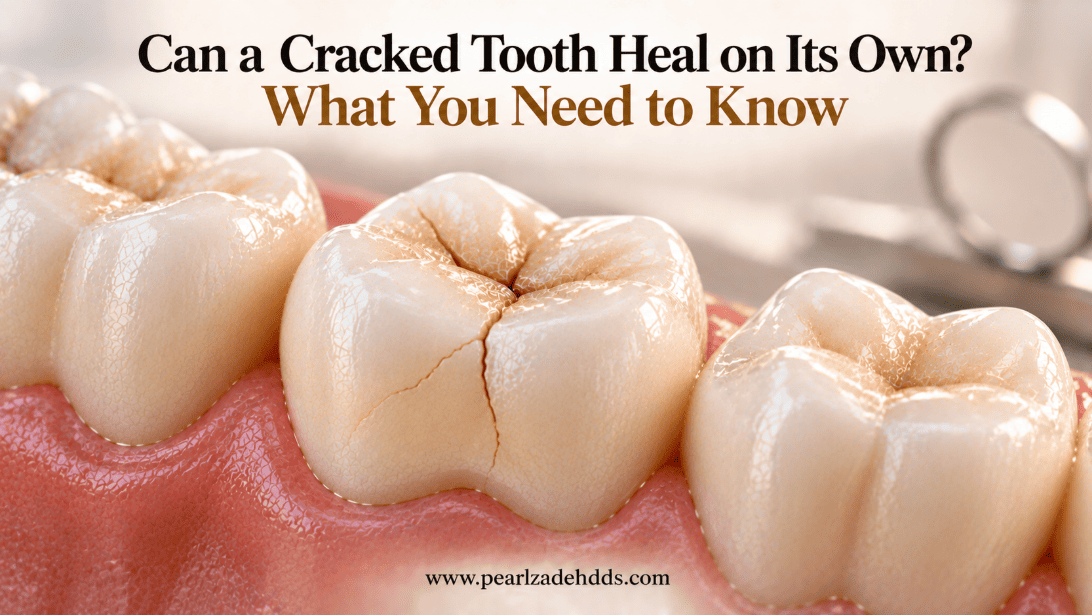
    Can a Cracked Tooth Heal on Its Own? What You Need to Know

    A cracked tooth cannot heal itself. Unlike a broken bone, a tooth cannot grow back together once its structure splits. The pain may fade or come and go, but that does not mean the crack has healed.

    Minor enamel changes are different. Early mineral loss at the tooth surface can sometimes be reversed through remineralization. A crack, however, is a physical split in the tooth structure, and remineralization does not close it.

    Pain from a cracked tooth may come and go, even when the crack remains. A dentist can assess the crack’s location, depth, and extent to determine the likely outlook and what treatment may help protect the tooth.

    Can a Cracked Tooth Repair Itself?

    Why a Crack Does Not Heal Like a Bone

    The American Association of Endodontists (AAE) says a cracked tooth’s fracture will not heal, unlike a broken bone. Cleveland Clinic gives the same answer: a cracked tooth cannot heal, but treatment might save the tooth.

    This means waiting does not close a crack. Time alone does not rejoin the two sides.

    Mineral Repair Is Not Crack Repair

    Teeth do have some ability to recover mineral. The National Institute of Dental and Craniofacial Research (NIDCR) explains how teeth lose and regain minerals all day long. Saliva supplies minerals, and fluoride helps. In the early stage, marked by a white spot, enamel can repair itself.

    That recovery has limits. NIDCR calls a cavity permanent damage that a dentist has to repair. Cleveland Clinic says lost enamel does not grow back. Mineral recovery applies to early surface changes. It does not turn a structural crack back into solid tooth.

    Not Every Line on a Tooth Is a Serious Crack

    Some lines are superficial. The AAE describes craze lines as tiny cracks that affect only the outer enamel. It says they cause no pain and matter only for appearance. Cleveland Clinic says some hairline cracks may not need treatment. That applies to cracks that cause no pain or infection and do not run deep.

    A visible line is not automatically a problem. Some cracks are hard to see. Only a dental exam can say which kind of line a tooth has.

    Why Does Cracked-Tooth Pain Come and Go?

    The AAE says cracked-tooth pain is often erratic, and it may come and go. Pain can appear with chewing, with the release of biting pressure, or with hot and cold. Chewing can move the cracked pieces, which irritates the pulp inside the tooth.

    StatPearls calls sudden sharp pain on biting the most frequently reported symptom. It also lists sensitivity triggered by cold drinks and food.

    Several things may affect how a crack feels on a given day. These include chewing pressure, temperature exposure, and the crack’s location and extent. A crack in one spot may rarely bear load. Another may flex with every bite.

    Some cracks cause little or no pain. Cleveland Clinic says cracked teeth do not always cause symptoms. The AAE notes that intermittent pain can make the affected tooth hard for a dentist to locate.

    Less Pain Does Not Mean the Crack Healed

    Pain often fades with time. A three-year National Dental PBRN study followed untreated back teeth with visible cracks. Most biting pain had resolved by a follow-up visit. The authors concluded that few of these pains are constant and most resolve over time.

    That finding concerns pain. The study recorded pain only as present or absent. Pain that fades does not show that a crack has healed. It also does not show that the tooth is safe to ignore.

    What Happens If a Cracked Tooth Is Left Untreated?

    Outcomes vary from tooth to tooth. Some cracks remain relatively stable. Others extend or lead to further damage. Predicting which path a given crack will take is hard.

    The AAE explains one way trouble can develop. Over time, the pulp may become damaged beyond its ability to heal. The tooth may then hurt without any trigger.

    The AAE says an untreated cracked tooth will progressively worsen. It adds that extensive cracks can lead to infection of the pulp. Cleveland Clinic says cracks sometimes continue to get bigger or split. It adds that an untreated crack may lead to an infection, called a tooth abscess.

    Other evidence shows a more varied picture. The PBRN study followed 2,858 teeth with visible cracks. About 80% of those recommended for monitoring stayed on monitoring for three years. Dentists chose patients they expected to keep their teeth. The authors say this likely contributed to the high retention rate.

    StatPearls, a clinical reference, calls cracked tooth syndrome occasionally unpredictable. It says patients should be told the condition may result in tooth loss, even with seemingly minor symptoms. That caution does not mean every crack will worsen. It means a dentist’s assessment matters more than how the tooth feels.

    Depending on the crack’s location and severity, a tooth may become more painful or develop complications. Not every crack reaches that point.

    Can a Dentist Save a Cracked Tooth?

    Sometimes. StatPearls says the extent, position, and direction of a crack determine the prognosis. Several details shape the outlook:

    • The crack’s depth.
    • The crack’s direction.
    • The crack’s location in the tooth.
    • Whether the crack extends into the root.
    • Whether the crack separates parts of the tooth.

    The AAE says a split tooth cannot be saved intact, though part of it may sometimes be saved. A crack that extends below the gum line is no longer treatable, it says. Extraction may be needed for a vertical root fracture, it notes.

    Other cracks fall short of those situations. The AAE says most treated cracked teeth function comfortably for years. It also says some cracks keep progressing after treatment. A crown does not guarantee success in every case.

    The right care depends on the individual tooth. No symptom or visible line can settle the question. StatPearls says early detection plays a crucial role in the prognosis of a cracked tooth.

    When Should You Have a Cracked Tooth Checked?

    Arrange a dental evaluation if you suspect a cracked tooth, even if the discomfort has improved. A suspected crack can be hard to confirm by sight alone. Dr. Pearl’s article on how a cracked tooth is diagnosed when an X-ray looks normal explains why an exam matters.

    Seek prompt assessment for significant pain or a recent injury. Cleveland Clinic says to call your dentist right away if an injury loosened a tooth.

    Severe swelling, fever, or difficulty swallowing or breathing needs urgent medical or dental care. Mayo Clinic says to go to the emergency room for trouble breathing or swallowing. It also advises the emergency room for fever with facial swelling if a dentist cannot be reached. For other steps to take before a visit, read Dr. Pearl’s article on what to do if you have a cracked tooth.

    Dr. Pearl Zadeh can examine the tooth, explain the findings, and discuss the options that fit.

    Call (818) 716-6722 or click the button below to schedule your consultation online.

    Frequently Asked Questions

    Can a small crack in a tooth heal naturally?

    No. Even a small structural crack does not heal on its own, according to the AAE. Superficial craze lines are different, since they affect only the outer enamel. A dentist can tell which kind a tooth has.

    Why does my cracked tooth stop hurting?

    Symptoms can shift with chewing pressure, temperature, and the crack’s location. Pain from cracks often fades over time. Stopped pain does not mean the crack closed.

    Can a cracked tooth get worse without pain?

    It can. Cleveland Clinic says cracked teeth do not always cause symptoms. The AAE says a vertical root fracture often has minimal symptoms. Not every crack worsens, but pain is not a reliable guide.

    Can a dentist save a cracked tooth?

    Sometimes. The outcome depends on the crack’s depth, direction, and location. It also depends on whether the crack reaches the root or splits the tooth. Some teeth can be preserved, while others have a poor outlook.

    Should I see a dentist if my cracked tooth does not hurt?

    Yes. A dentist can check whether a crack is present and how it looks. Some cracks are monitored instead of treated. In the PBRN study, about 80% of teeth recommended for monitoring stayed on monitoring for three years.

    The information above is for informational purposes only and is not a substitute for professional dental advice. Please schedule a consultation with Pearl Zadeh DDS to discuss your specific situation.
  • What Causes Teeth to Crack? Common Reasons and Risk Factors

    What Causes Teeth to Crack? Common Reasons and Risk Factors

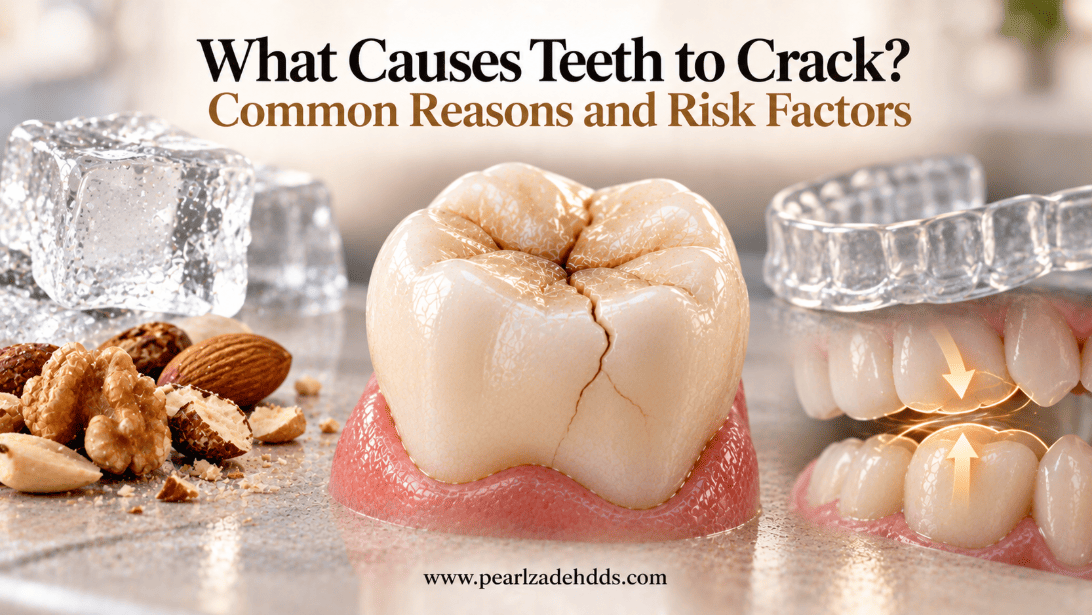
    A tooth may crack from a single hard bite or develop a crack after years of repeated stress. This can happen when the forces placed on a tooth exceed what its structure can withstand. In many cases, more than one factor contributes to the damage.

    Common causes include biting hard foods, grinding or clenching, mouth injuries, large fillings, long-term wear, and changes that occur with age. Sometimes, there is no obvious event or single cause.

    Having one or more of these risk factors does not mean a tooth will crack. Many people with similar habits or dental history never experience a crack. It helps to distinguish between an event that triggers a crack and conditions that may leave a tooth more vulnerable.

    If a crack is suspected but does not appear on a standard X-ray, learn more about how a cracked tooth is diagnosed when an X-ray looks normal. If you already have a cracked tooth, read what to do if you have a cracked tooth to learn how to protect it while arranging a dental evaluation.

    What Causes Teeth to Crack?

    A trigger is an event or force that may start a crack. Risk factors are conditions that may leave a tooth more vulnerable. The two often overlap, and one crack can involve both.

    Biting Hard Foods or Objects

    Hard items can place a sudden, concentrated load on a tooth. The AAE says a tooth can crack from injury or general wear and tear. It advises against chewing ice, unpopped popcorn kernels, or pens.

    MouthHealthy, the ADA’s consumer site, adds that chewing ice, popcorn kernels, and hard candy can crack a tooth. StatPearls, a clinical reference, lists nail biting among habits that can complicate cracked teeth.

    A hard bite does not always crack a tooth. The tooth’s size, structure, and condition all influence how it responds.

    Teeth Grinding and Clenching

    The National Institute of Dental and Craniofacial Research (NIDCR) defines bruxism as grinding, clenching, or gnashing the teeth. It can occur awake or asleep. Repeated forces from these habits may place stress on teeth. Cleveland Clinic says stress and other issues may lead a person to grind and, over time, crack a tooth.

    Stress may contribute to clenching or grinding in some people. Mayo Clinic says extra anxiety or stress can lead to teeth grinding and clenching. The grinding, in turn, may add to the load on teeth.

    Not everyone who grinds develops cracks. NIDCR says many cases of bruxism are mild. Mayo Clinic says bruxism does not cause serious complications for most people.

    Some people grind without knowing it. Mayo Clinic says some may not learn they have sleep bruxism until tooth or jaw problems appear. NIDCR also lists genetics, alcohol or caffeine use, smoking, and certain medications as possible contributors to bruxism.

    Accidents and Direct Trauma

    A blow to the mouth can crack a tooth. Cleveland Clinic lists falls, sports injuries, and vehicle accidents among the possible causes. MouthHealthy advises wearing a mouthguard during sports and recreational activities.

    Common Risk Factors That Make Teeth More Vulnerable

    Cracked tooth risk factors do not cause a crack on their own. They may lower the amount of force a tooth can tolerate. A tooth with several risk factors may respond differently from one with none.

    Large Fillings and Weakened Tooth Structure

    StatPearls says teeth weakened by restorations face a higher fracture risk under biting forces. Cleveland Clinic says large fillings or root canal treatment can weaken a tooth. That raises the chance of a crack, it adds, especially without a crown.

    The AAE adds that a fractured cusp often breaks around a filling. Extensive decay or previous dental work may leave less healthy tooth structure to share the load.

    StatPearls cites research that a restoration larger than one-quarter of the distance between cusps carries a higher fracture risk. Size alone does not decide the outcome, because placement and the tooth’s condition also matter. A large filling does not mean a crack will follow.

    Repeated Chewing Forces and Wear

    Chewing places force on teeth every day. StatPearls calls occlusal forces the leading cause of cracked tooth syndrome. Teeth absorb these forces during chewing and nighttime grinding. That does not mean ordinary chewing will crack a healthy tooth. Forces matter most when other risk factors are present.

    StatPearls reports that mandibular molars are the teeth most commonly affected, followed by maxillary premolars and molars. It also says tooth anatomy, such as deep grooves and steep cusps, can influence fracture risk.

    Age-Related Changes

    Cleveland Clinic says teeth wear down as you get older, which raises the chance of a crack. It reports that people age 50 and older are more likely to have cracks. StatPearls says the mechanical properties of teeth can change with age, potentially reducing their elasticity.

    Age ranges vary by source. StatPearls says the condition predominantly affects adults aged 30 to 50. Age acts as a risk factor rather than a trigger. It is one factor among several, and it does not make a crack inevitable.

    Sudden Temperature Changes

    Hot and cold more often appear as a symptom than as a cause. Cleveland Clinic and StatPearls both describe sensitivity to temperature as a sign of a cracked tooth. Neither source lists ordinary hot or cold foods as a cause. A tooth that reacts to hot or cold may be responding to an existing crack. Another problem, such as decay, may also be the reason.

    Whether extreme temperature changes add stress to tooth structure remains uncertain. They should not be treated as a known cause of cracks.

    Can a Tooth Crack Without an Obvious Injury?

    Yes. A crack does not require one dramatic event. The AAE says a tooth can crack from general wear and tear, not only from injury.

    Why teeth crack without an injury may come down to factors that build up over time. A large filling, regular grinding, and years of chewing may combine to stress a tooth. Any one of them alone may not crack it.

    StatPearls says cracked tooth syndrome can be further complicated in teeth with extensive restorations and parafunctional habits. A person may not remember an injury or identify one specific event. Not every crack traces back to a single, definite cause.

    A dentist may ask about habits, past dental work, and any recent injury. Those details can help explain why the tooth cracked, though some cases have no clear answer.

    Signs That May Warrant a Dental Evaluation

    Possible signs of a crack include:

    • Pain when biting down or when releasing the bite.
    • Sensitivity to hot or cold.
    • Discomfort that comes and goes.

    The AAE describes erratic pain when chewing, possibly with the release of biting pressure. Some cracks cause few noticeable symptoms, though. Cleveland Clinic says cracked teeth do not always cause symptoms. The AAE adds that pain that comes and goes can make the tooth difficult for a dentist to locate. It also says a vertical root fracture often has minimal symptoms.

    These signs can also have other causes. MouthHealthy lists decay, fractured teeth, worn fillings, and gum disease among causes of tooth sensitivity. Symptoms alone cannot confirm a crack or show how serious it is.

    When Should You See a Dentist?

    Arrange a dental evaluation if you suspect a cracked tooth, even if it does not hurt. Cleveland Clinic says to talk to a dentist if you have symptoms or notice a crack.

    Seek prompt care for significant pain or a recent dental injury. Cleveland Clinic says to call your dentist right away if an injury loosened a tooth. It also lists bleeding that will not stop, severe pain that medication does not relieve, and a broken jaw. These call for the emergency room.

    A crack’s seriousness depends on the tooth, the extent and location of the damage, and other individual factors. Dr. Pearl Zadeh can examine the tooth, explain the findings, and discuss the options that fit.

    Call (818) 716-6722 or click the button below to schedule your consultation online.

    Frequently Asked Questions

    What is the most common cause of a cracked tooth?

    No single cause applies to every person. StatPearls names occlusal forces, the forces of chewing and nighttime grinding, as the leading cause of cracked tooth syndrome. Hard bites, injury, and weakened tooth structure can also contribute.

    Can teeth crack from grinding?

    They can. Grinding may add repeated stress to teeth. NIDCR says severe bruxism can lead to damaged teeth and lists cracked teeth among the signs. Many cases are mild, though, and grinding does not always lead to a crack.

    Can a tooth crack without an injury?

    Yes. Gradual wear, chewing forces, and weakened tooth structure can contribute without any single event. Some people cannot recall when or how a crack began.

    Can a cracked tooth cause pain only when chewing?

    It can. The AAE lists erratic pain when chewing among the symptoms. Other dental problems can cause the same pattern, so the symptom alone does not confirm a crack.

    Should a cracked tooth be checked if it does not hurt?

    Yes, if a crack is suspected. Cracked teeth do not always cause symptoms. StatPearls says early detection plays a crucial role in the prognosis of a cracked tooth.

    The information above is for informational purposes only and is not a substitute for professional dental advice. Please schedule a consultation with Pearl Zadeh DDS to discuss your specific situation.
  • Chipped vs. Cracked Tooth: Differences, Symptoms, and Treatment

    Chipped vs. Cracked Tooth: Differences, Symptoms, and Treatment

    You run your tongue over a back tooth and notice a rough edge. Or you feel a sharp twinge when biting down. You may be wondering whether the tooth is chipped or cracked.

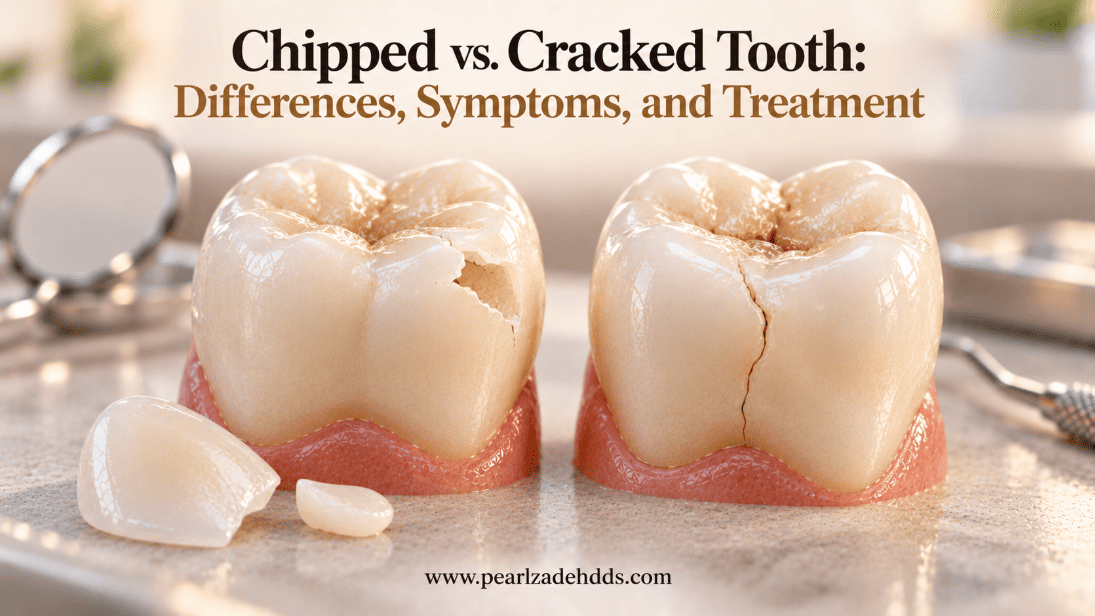
    A chip usually means a piece of the tooth has broken away. A crack is a line or split in the tooth structure. The symptoms can overlap, but the damage may differ in depth and severity. A more extensive fracture can reach deeper parts of the tooth and require different treatment.

    You cannot always tell how serious the damage is by looking at the tooth. A dental examination can help identify the problem and determine which treatment may be appropriate.

    What Is the Difference Between a Chipped, Cracked, and Fractured Tooth?

    Dental terms overlap, and different sources use the words differently. The categories below are not always mutually exclusive. Still, plain definitions help.

    Chipped tooth. A chip involves a piece of tooth structure breaking away. Small chips may affect only enamel. Larger chips can expose dentin or involve deeper structures. Cleveland Clinic describes a chipped tooth as one in which a fragment of enamel has broken off. Severe chips can expose the tissue beneath the enamel, it adds.

    Cracked tooth. A crack is a line or fracture within the tooth. Some cracks are hard to see. They may cause pain when biting or sensitivity, but symptoms vary. The American Association of Endodontists (AAE) describes a cracked tooth as a vertical crack toward the root. That tooth is not yet separated into pieces. It treats craze lines, which are tiny cracks in the outer enamel, as a separate and common finding.

    Fractured tooth. Fracture is a broad term for broken tooth structure. A fracture may be minor or extensive. It may involve a cusp, the crown of the tooth, or deeper structures. The AAE’s categories include a fractured cusp, a split tooth with separable segments, and a vertical root fracture. Because the categories overlap, a dentist’s exam matters more than the label you choose at home.

    What Do Chipped and Cracked Teeth Look or Feel Like?

    Chips and cracks can look and feel different. These signs are not a diagnostic checklist, because they can overlap. Common signs include:

    • A rough or uneven edge.
    • A visible piece missing from the tooth.
    • A fine line on the tooth surface.
    • Pain when biting or releasing pressure.
    • Sensitivity to hot, cold, or sweet foods.
    • Discomfort that comes and goes.
    • No obvious symptoms despite a crack.

    The AAE lists a variety of symptoms, including erratic pain when chewing, possibly with the release of biting pressure. It also lists pain with temperature extremes and notes that the pain may come and go. StatPearls, a clinical reference, calls sudden sharp pain on biting the most frequently reported symptom.

    Small chips may be painless, and cracks may not be visible in a mirror. The AAE adds that your dentist may have difficulty locating which tooth causes the discomfort. These signs also occur with other problems. MouthHealthy lists decay, fractured teeth, worn fillings, and gum disease among causes of tooth sensitivity. Do not diagnose yourself from symptoms alone.

    Neither appearance nor symptoms can reliably show how deep the damage goes.

    What Can Cause a Tooth to Chip or Crack?

    Several factors can contribute, and not every chipped or cracked tooth has the same cause. Common contributors include:

    • Biting hard foods or objects.
    • Sports injuries, falls, or other trauma.
    • Teeth grinding or clenching.
    • Large existing fillings or weakened tooth structure.
    • Normal wear over time.

    The AAE says a tooth can crack from an injury or from general wear and tear. It advises against chewing ice, unpopped popcorn kernels, or pens, and against clenching or grinding. A fractured cusp, it notes, often breaks around a filling. StatPearls says teeth weakened by restorations face a higher fracture risk under biting forces. It also notes that tooth properties can change with age.

    MouthHealthy advises wearing a mouthguard for sports and recreation. It also warns that chewing ice, popcorn kernels, and hard candy can crack a tooth.

    How Do Dentists Tell Whether a Tooth Is Chipped or Cracked?

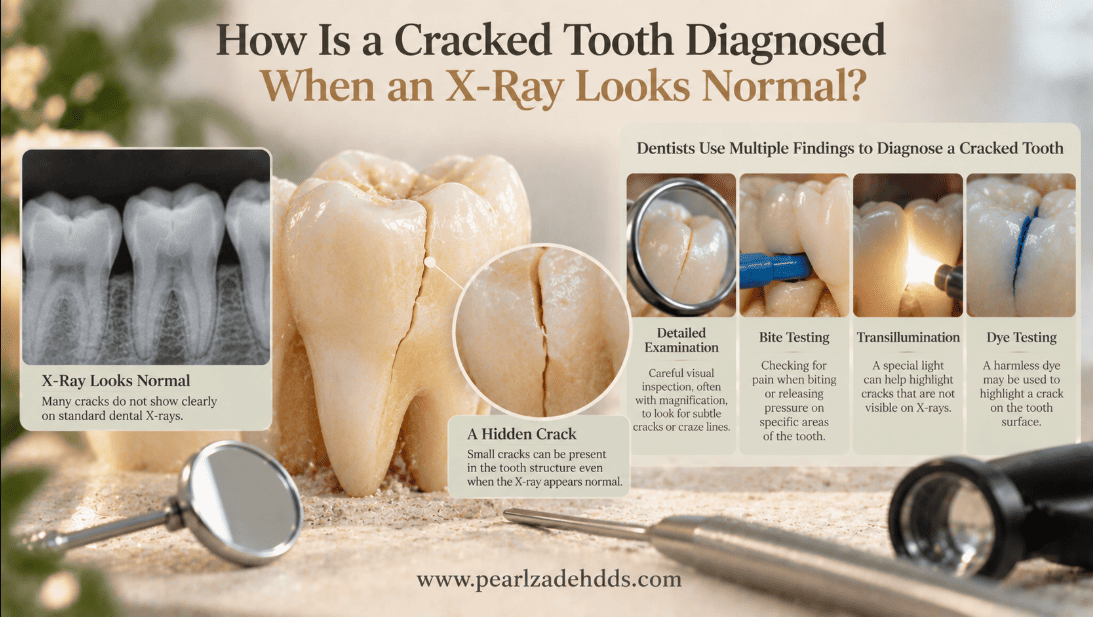
    A dentist considers your symptoms, dental history, examination findings, and appropriate diagnostic tests. Depending on the case, the dentist may use magnification, check the bite, apply transillumination, or take X-rays. Expect questions about when the pain occurs, what triggers it, and whether it has changed.

    StatPearls says a thorough visual exam with magnification and illumination may reveal fracture lines. It calls fiber-optic transillumination particularly valuable and says bite tests help pinpoint the affected tooth and cusp. A 2022 AAE newsletter adds that the naked eye often misses subtle details of cracks.

    X-rays have limits. StatPearls says a radiograph may show a thin line when the fracture runs in one direction. A crack running in another direction may not appear. Some cracks do not show on standard X-rays. An X-ray that looks normal does not always rule out a crack. Symptoms alone cannot confirm one either.

    Our article on how a cracked tooth is diagnosed when an X-ray looks normal covers the process in detail.

    How Is a Chipped Tooth Treated?

    Treatment depends on the amount of tooth structure lost and whether deeper structures are affected. The most conservative suitable option may preserve more natural tooth structure. Options include:

    • Smoothing or polishing a very small chip.
    • Composite bonding for selected minor to moderate chips.
    • Veneers for certain front-tooth defects when suitable.
    • Crowns for selected cases with more extensive damage or weakened tooth structure.
    • Additional treatment if the damage affects the pulp or other internal structures.

    Cleveland Clinic says a provider may polish and smooth a small chip so it blends with surrounding teeth. It describes bonding as filling in the chip with composite resin. Veneers suit a minor chip that needs more coverage than bonding provides. Crowns, it says, are caps that protect a weak or heavily damaged tooth. A chip that exposes the nerve may need a root canal, it adds.

    The AAE says most chipped teeth can be repaired. For a broken fragment, the NHS advises keeping it in milk or saliva and seeing a dentist. A dentist may be able to glue it back on.

    No chip automatically needs a crown or a veneer. Lost tooth structure does not grow back, though. A chip that needs no treatment is still worth showing your dentist.

    How Is a Cracked or Fractured Tooth Treated?

    Treatment depends on the crack’s location, depth, extent, and restorability. The AAE says treatment and outcome depend on the type, location, and extent of the crack. It also says that, unlike a broken bone, the fracture in a cracked tooth will not heal. Options include:

    • Monitoring selected superficial craze lines when no treatment is indicated.
    • Restorations for certain fractures involving a cusp or weakened portion of the tooth.
    • Crowns for selected cracks when additional coverage and protection are appropriate.
    • Root canal treatment when the crack reaches the pulp and the tooth can still be restored.
    • Extraction when a tooth cannot be restored, as with some split teeth or deep fractures.

    Craze lines cause no pain and are of no concern beyond appearances, according to the AAE. For a fractured cusp, it says a dentist can place a new filling or crown. If a crack reaches the pulp, it says a root canal and crown can keep it from spreading.

    The AAE also says a split tooth cannot be saved intact, though endodontic treatment may sometimes save a portion. It says a cracked tooth whose crack extends below the gum line cannot be saved. For a vertical root fracture, treatment may involve extraction. Which option fits depends on the whole picture, not on one finding.

    StatPearls describes a suitable restoration for cracked teeth without pulp symptoms. It also says cuspal coverage with a crown or onlay may work well as an external splint. Monitoring has a role too. In a National Dental PBRN observational study, 2,858 patients each had a visible crack in a back tooth. About 80% of teeth recommended for monitoring stayed on monitoring for three years.

    A crown cannot repair every crack or guarantee that a crack will not progress. The AAE says a crown provides maximum protection but does not guarantee success in all cases. If your dentist discusses a crown, you can read about dental crown treatment at Pearl Zadeh DDS.

    When Should You Seek Dental Care?

    A visible chip, a suspected crack, or new pain when biting warrants a dental evaluation. The NHS says to see a dentist if you chip, crack, or break a tooth. It describes these injuries as usually not serious. StatPearls says early detection plays a crucial role in the prognosis of a cracked tooth.

    Seek prompt care for significant pain, a large break, or sensitivity that persists or worsens. Cleveland Clinic says to call your dentist right away if an injury loosened a tooth.

    Facial trauma, uncontrolled bleeding, or difficulty breathing or swallowing calls for urgent emergency care. Cleveland Clinic lists bleeding that will not stop as an emergency room reason. Severe pain that medication does not relieve and a broken jaw are others. Mayo Clinic advises the emergency room for trouble breathing or swallowing.

    Our article on what to do if you have a cracked tooth covers immediate steps. Dr. Pearl Zadeh can examine your tooth and explain whether it is chipped, cracked, or fractured. Dr. Pearl can also discuss the options that fit.

    Call (818) 716-6722 or click the button below to schedule your consultation online.

    Frequently Asked Questions

    Can a cracked tooth look like a chip?

    Sometimes. A crack can lead to a missing piece, and a chip can sit near a crack. Appearance alone cannot show the depth of the damage, so a dentist needs to examine the tooth.

    Can a cracked tooth heal on its own?

    No. The AAE says that, unlike a broken bone, the fracture in a cracked tooth will not heal. A crack does not close the way a cut in skin does. Treatment depends on the type of damage and the tooth’s condition.

    Does a chipped tooth always need treatment?

    Not always. A very small chip may need only smoothing. Lost tooth structure does not grow back, and a chip can sit alongside deeper damage. A dentist can tell whether treatment is needed.

    Can a cracked tooth be saved?

    Sometimes. It depends on the crack’s location, depth, and extent and on how much healthy tooth remains. A split tooth or a crack that extends below the gum line may not be savable. Your dentist can explain what applies.

    Can a dentist see a cracked tooth on an X-ray?

    Not always. Some cracks do not appear on a standard X-ray, depending on the crack’s direction. Dentists also use symptoms, history, magnification, and other tests. A normal X-ray does not rule out a crack.

    The information above is for informational purposes only and is not a substitute for professional dental advice. Please schedule a consultation with Pearl Zadeh DDS to discuss your specific situation.
  • How Is a Cracked Tooth Diagnosed When an X-Ray Looks Normal?

    How Is a Cracked Tooth Diagnosed When an X-Ray Looks Normal?

    Your tooth hurts when you bite, or it twinges with cold. Then the X-ray comes back, and your dentist says everything looks normal. That result can feel confusing and frustrating. A normal X-ray does not necessarily rule out a cracked tooth. Some cracks are difficult to see on a standard dental X-ray.

    Your dentist may need to combine your symptoms, clinical tests, and imaging to identify the problem. For first steps, urgency, and treatment, see our article on what to do if you have a cracked tooth.

    Why Might a Cracked Tooth Not Show Up on an X-Ray?

    A standard dental X-ray produces a two-dimensional image. It compresses a three-dimensional tooth into a single view. Overlapping structures can hide fine details, and many cracks are extremely thin. The crack’s direction also matters. A StatPearls review notes that an X-ray may reveal a thin line when the crack runs from cheek to tongue. The X-ray becomes less useful when the crack runs parallel to the film.

    Some cracks also cause no visible changes in the surrounding bone or tooth structure. Without those changes, the image may provide little evidence of the crack. A 2025 mini review in Frontiers in Oral Health states that radiographs rarely diagnose cracks directly. Bone defects may appear at later stages, and these findings can raise suspicion.

    X-rays still play an important role. They can show bone, roots, decay, infection, and other conditions that may cause similar symptoms. A normal X-ray can help rule out some of these causes. It simply cannot rule out a cracked tooth on its own.

    What Can a Dentist Learn From Your Symptoms?

    Your description helps guide the evaluation. Pain when biting is a common clue. So is pain when you release the bite. Intermittent pain and sensitivity to temperature can also matter. Some symptoms are difficult to reproduce during an appointment, which makes a detailed history especially useful.

    Your dentist may also ask whether you recently bit something hard, such as a popcorn kernel or a fruit pit. Symptoms that consistently affect one specific tooth can help narrow the search.

    These symptoms provide clues, not proof. Other dental problems can cause similar pain. A symptom pattern can raise or lower suspicion, but it cannot confirm a crack on its own.

    What Does a Dentist Look for During the Examination?

    The examination gives your dentist information that an X-ray cannot. Your dentist inspects the tooth under good lighting and magnification. The American Association of Endodontists (AAE) notes that the naked eye can miss subtle details of cracks.

    Visible crack lines are one clue. Changes in tooth structure can provide additional information. So can fractured or loose areas, existing fillings or crowns, and changes around the gumline. Worn areas may also provide clues about your bite.

    Can a Bite Test Help Find a Cracked Tooth?

    A bite test asks you to bite down on a small instrument. Your dentist applies pressure to one part of the tooth at a time. StatPearls describes directing force through each cusp while you report which area triggers your symptoms. A cusp is a raised point on the chewing surface.

    If pressure on one spot reproduces your pain, it provides an important clue. The Frontiers mini review describes the bite test as useful but not confirmatory. Other dental problems can also cause pain when you bite. Your dentist interprets the result alongside the rest of the examination.

    What About Gum or Periodontal Probing?

    Dentists measure the depth of the gum pocket around a tooth with a thin probe. Checking the full perimeter in small steps can reveal a narrow, isolated deep area. The Frontiers review describes this finding as a finding that can raise suspicion of a crack.

    A localized deep pocket can provide useful information. It does not automatically mean the tooth is cracked. Gum disease and other problems can also deepen a pocket. Small crack-related pockets can also be easy to miss, so probing is only one part of the evaluation.

    Can CBCT Find a Cracked Tooth That an X-Ray Misses?

    A standard dental X-ray produces a flat image. Cone-beam computed tomography (CBCT) works differently. The machine rotates around your head and captures multiple images. Software then combines them into a three-dimensional view of the teeth and surrounding bone.

    That view may provide additional information in selected cases. StatPearls says CBCT can be valuable when radiographic assessment is inconclusive but a crack remains strongly suspected. An AAE publication notes that clinicians may consider CBCT when the clinical examination and standard X-rays are inconclusive. Your dentist should weigh its potential benefit against the additional radiation exposure.

    CBCT does not make every crack visible. Metal posts and root-filling materials can create image artifacts. A systematic review of vertical root fractures in root-filled teeth found pooled sensitivity of roughly 70% to 73%. The authors also called for more research. Some cracks remain difficult to visualize even with advanced imaging.

    What If the X-Ray Is Normal but the Pain Continues?

    A normal first X-ray does not end the investigation. Persistent symptoms still deserve further evaluation. Your dentist may reconsider several possibilities.

    Is the pain coming from the tooth you suspect? Pain can be referred, meaning you feel it in a different tooth from the one causing it. Does the symptom pattern fit a crack? How does the tooth respond to bite and pulp tests? Your dentist may also reassess the gums and existing restorations.

    Your dentist may consider other causes of dental pain. Additional imaging or a specialist evaluation may be appropriate in some cases. None of this means a crack is automatically the cause. Sometimes the evaluation points to a different problem.

    Could Something Other Than a Crack Cause the Same Symptoms?

    Several problems can mimic a cracked tooth. Decay can cause pain with biting or temperature changes. A defective or stressed filling may cause similar symptoms. Pulp inflammation can produce lingering sensitivity or an ache. Excessive bite forces from clenching can leave teeth sore. Simple tooth sensitivity can cause discomfort with cold. Gum problems can also cause discomfort when you chew.

    StatPearls lists dentine hypersensitivity, parafunctional pain, and galvanic pain among other possible mimics. These terms describe sensitivity from exposed tooth surfaces, pain associated with clenching or other excessive forces, and pain related to contact between different metals.

    Because several conditions can cause similar symptoms, no single symptom or X-ray can settle the diagnosis. A complete dental evaluation helps determine the most likely cause.

    How Does a Dentist Put All the Findings Together?

    How can a dentist diagnose a cracked tooth if the X-ray is normal? By combining your symptoms, clinical findings, imaging, and other diagnostic tests. The approach depends on the suspected location and type of crack.

    An AAE Communiqué article describes cracked teeth as diagnosed through clinical findings and several examination tests. These may include transillumination, periodontal probing, bite testing, and magnification. Dentists look for a pattern across the findings. Symptoms, clinical examination, bite testing, pulp testing, periodontal findings, and imaging each provide another piece of information.

    No single finding determines the diagnosis. One finding can fit several conditions. Several findings that point in the same direction build a stronger case. Even then, a dentist may not be able to identify the exact location of a crack. Some cases remain uncertain. Your dentist may then recommend monitoring, further testing, or a specialist evaluation.

    When Should You Have a Tooth Rechecked?

    Return to your dentist if symptoms persist, worsen, or return after a normal X-ray. Increasing pain, swelling, and pain when biting all deserve attention. Significant temperature sensitivity, a visible fracture, or a loose or broken tooth fragment also warrant a recheck. Difficulty chewing is another reason to contact your dentist.

    Not every mild twinge is an emergency. However, even occasional symptoms deserve follow-up if they continue. Swelling, severe pain, or a broken tooth that affects eating calls for faster attention. Learn more about urgent dental care on our website. Our article on cracked tooth symptoms and treatment covers the next steps in more detail.

    When Tooth Pain Does Not Match the X-Ray

    A normal dental X-ray does not always explain persistent tooth pain or sensitivity. Some cracks are difficult to see on standard images. Your dentist may need to combine your symptoms, clinical examination, and other diagnostic tests.

    If you continue to have pain when biting, temperature sensitivity, or another unexplained tooth symptom, schedule a dental evaluation. Your dentist can investigate the possible cause and determine whether further testing or treatment is appropriate.

    Call (818) 716-6722 or click the button below to schedule your consultation online.

    Frequently Asked Questions

    Can you have a cracked tooth if the X-ray looks normal?

    Yes. Some cracks are difficult to see on standard dental X-rays because of their size, location, or direction. A dentist may use your symptoms, clinical examination, bite testing, and other diagnostic methods to investigate further.

    How does a dentist find a cracked tooth that does not show on an X-ray?

    A dentist may combine several findings, including your pain pattern, visual examination, magnification, bite testing, transillumination, pulp testing, and periodontal probing. Additional imaging may also be considered when appropriate.

    Can a CBCT scan detect a cracked tooth?

    CBCT imaging can provide three-dimensional information that a standard X-ray cannot. However, it does not make every crack visible. Whether CBCT is useful depends on the suspected crack, symptoms, and other examination findings.

    Why does my tooth hurt when I bite if the X-ray is normal?

    Pain when biting can have several causes, including a cracked tooth, decay, a stressed restoration, pulp inflammation, or bite-related problems. A normal X-ray does not identify all of these conditions, so persistent pain may require a more detailed examination.

    What should I do if my tooth still hurts after a normal X-ray?

    If pain or sensitivity continues, schedule a dental evaluation rather than assuming nothing is wrong. Your dentist can review your symptoms, examine the tooth again, and decide whether additional testing or imaging is appropriate.

    This article is for informational purposes only and is not a substitute for professional dental advice. Please schedule a consultation with Pearl Zadeh DDS to discuss your specific situation.
  • What to Do If You Have a Cracked Tooth

    What to Do If You Have a Cracked Tooth

    A cracked tooth does not always hurt, but it still deserves a dental evaluation. Some cracks affect only the outer enamel, while others extend deeper into the tooth. The right response depends on the crack’s location, depth, and symptoms. Knowing what to do early can help protect the tooth and preserve more treatment options.

    What Should You Do First If You Think a Tooth Is Cracked?

    Rinse your mouth gently with warm water to clean the area. If swelling develops, apply a cold compress to the outside of your face. The American Dental Association advises seeing your dentist as soon as possible after a broken tooth.

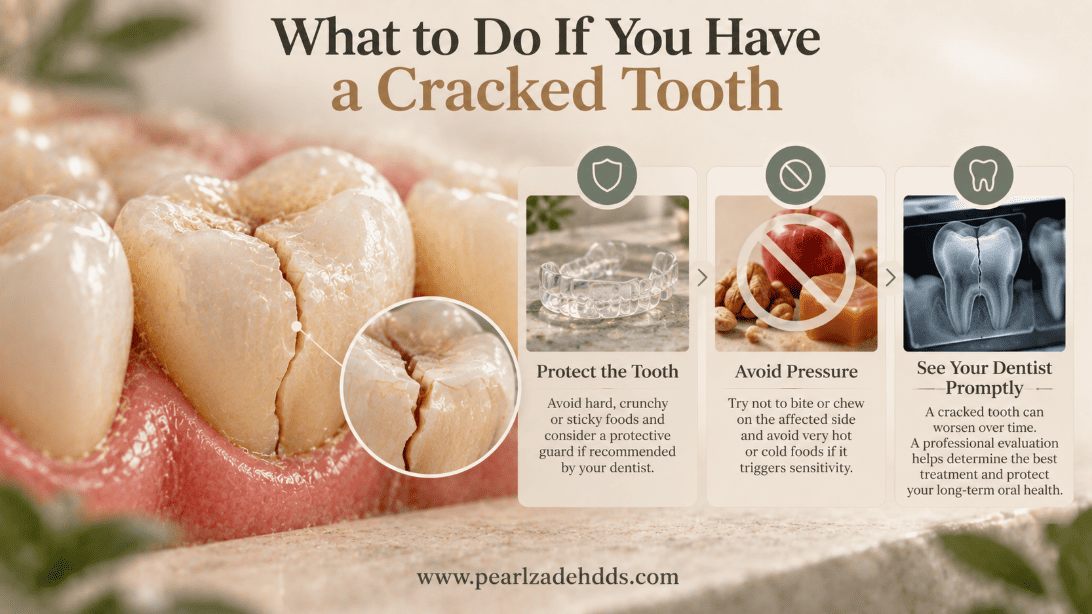
    A few simple habits can protect the tooth until your appointment. Stop chewing on the affected side and choose softer foods for now. Avoid very hot or cold foods if they trigger sensitivity. Keep brushing and cleaning the area as you normally would, using a soft brush and gentle pressure.

    Do not try to glue or repair the tooth yourself. Household glues are not made for use in the mouth. They can also make it harder for your dentist to evaluate the tooth.

    If you develop severe pain, significant swelling, or a large broken piece, contact a dentist promptly. The same applies if the pain makes it difficult to eat or sleep. Otherwise, schedule an appointment as soon as you reasonably can.

    Is a Cracked Tooth an Emergency?

    Not always. Many cracked teeth need prompt attention but not emergency care. Others require more urgent evaluation. The difference usually depends on your symptoms and the condition of the tooth.

    Contact a dentist promptly if you have severe or worsening pain. Significant swelling, fever, or pain that keeps you from eating or sleeping also warrants prompt attention. A tooth that has broken into a larger piece may need urgent care, especially after an injury.

    Facial swelling, difficulty swallowing, or difficulty breathing can signal a more serious problem. Go to an emergency room or call 911 if you have trouble breathing or swallowing.

    A lack of pain does not prove that a crack is harmless. Some cracks cause few or no symptoms. A dentist can determine whether the tooth needs treatment, monitoring, or no immediate treatment. You can learn more about urgent dental care on our website.

    What Does a Cracked Tooth Feel Like?

    Cracked tooth pain can feel different from typical cavity pain. The American Association of Endodontists (AAE) describes erratic pain when chewing and sudden sensitivity to hot or cold. The pain may also come and go.

    Many people notice pain when biting down or releasing the bite. Cold sensitivity is common, and heat can trigger discomfort too. You may also notice a rough edge with your tongue or a faint visible line. Some cracked teeth cause no symptoms at all.

    Why do the symptoms vary so much? A crack can open slightly under bite pressure and close again afterward. This movement can irritate the inner part of the tooth. Pain may appear with certain foods or bite angles and then disappear.

    This pattern can also make the source of the pain difficult to identify. You may feel discomfort somewhere along one side of your upper or lower teeth. A tooth can also feel different or rough without causing pain. Mention any unusual changes to your dentist.

    What Causes Teeth to Crack?

    Teeth can crack for many reasons, and several factors may contribute. Biting down on hard foods such as ice, hard candy, or unpopped popcorn kernels can place significant stress on a tooth. Dental trauma, such as a fall or sports injury, can also fracture a tooth suddenly.

    Other cracks develop gradually. Repeated chewing forces can create small cracks over time. A StatPearls review of cracked tooth syndrome identifies biting forces as a leading cause. It also lists age-related changes, poorly placed restorations, and tooth anatomy with steep cusps as contributing factors.

    Large fillings can leave less natural tooth structure to withstand these forces. Previous dental treatment can also change how a tooth handles stress.

    Clenching and grinding place repeated heavy forces on the teeth, often during sleep. Our article on how teeth grinding damages your teeth over the years explains how this repeated stress can affect teeth over time.

    No single cause explains every crack. Your dentist can review your dental history, bite, and symptoms to identify likely contributors.

    Are All Cracked Teeth the Same?

    No. Dentists classify cracks because treatment depends on the type and extent of the damage. The AAE describes five common categories. You cannot reliably tell which type you have on your own. A dentist needs to examine the tooth.

    Craze Lines

    Craze lines are tiny cracks in the outer enamel. Adult teeth very commonly have them. Most cause no pain, and many may not need treatment.

    Fractured Cusp

    A cusp is a pointed part of the chewing surface. Weakened cusps can break off, often around a filling. This type rarely damages the inner pulp of the tooth, according to the AAE. Treatment often focuses on restoring the broken area.

    Cracked Tooth

    A cracked tooth has a fracture that extends from the chewing surface toward the root. The tooth has not separated into pieces. Symptoms often come and go, which makes this type easy to overlook.

    Split Tooth

    A split tooth has a deeper crack that separates the tooth into distinct segments. It often develops from a cracked tooth that progresses over time. The AAE notes that a split tooth cannot be saved intact. Treatment is usually more extensive, and your dentist can explain what remains possible.

    Vertical Root Fracture

    A vertical root fracture begins in the root and extends toward the chewing surface. It often produces minimal signs and symptoms. Its causes and treatment considerations differ from other crack types. A dentist may need additional imaging to evaluate it.

    Can a Cracked Tooth Heal on Its Own?

    No. A cracked tooth does not heal the way a broken bone does. Bone contains living cells that rebuild a break. Enamel does not regrow once it is damaged.

    Some very minor surface lines, such as craze lines, may stay stable for years. That is stability, not healing. Deeper cracks are different. A crack that reaches the dentin or beyond can let the tooth flex under bite pressure.

    Symptoms may fade for a while. That does not mean the crack has healed. Cracked tooth pain often comes and goes, so a quiet week proves little.

    Not every crack will worsen. Infection is not inevitable either. An evaluation tells you which situation applies to your tooth.

    What Should You Eat With a Cracked Tooth?

    Softer foods such as yogurt, eggs, soup, mashed vegetables, and oatmeal are easier on a cracked tooth. Chew on the opposite side while you wait for your appointment.

    Avoid very hard foods such as nuts, hard candy, ice, and crusty bread. Sticky foods like caramel and taffy can pull on a weakened tooth, so it is best to avoid them too. If hot or cold foods trigger sensitivity, let them reach a moderate temperature before eating or drinking.

    You do not need to stop eating. Keep up your normal oral hygiene, brushing gently with a soft toothbrush and cleaning between your teeth. Do not avoid brushing the cracked tooth unless your dentist tells you otherwise.

    How Does a Dentist Diagnose a Cracked Tooth?

    Diagnosing a cracked tooth can be difficult. Cracks are often too fine to show clearly on a standard dental X-ray. The StatPearls review notes that X-rays become less useful when a crack runs parallel to the film. Dentists therefore combine several findings rather than relying on one test.

    Your dentist will review your medical and dental history and ask about your symptoms and pain patterns. A visual examination often follows, sometimes with magnification. Your dentist may also perform a bite test with a small instrument to see whether it reproduces your pain.

    Transillumination provides another way to look for cracks. The dentist shines a bright light through the tooth. A crack can block the light and appear as a dark line.

    Gum health can provide additional clues. The American Association of Endodontists notes that isolated gum pocketing associated with a crack may not always be easy to detect with a probe. Imaging can provide additional information. X-rays can also show the surrounding bone, root, and other possible causes of pain.

    When the findings remain unclear, your dentist may recommend additional imaging or a referral. No single test can identify every crack. Dentists use the full picture to determine what may be affecting the tooth.

    What Happens During a Cracked Tooth Evaluation?

    An evaluation usually starts with questions. Your dentist may ask when the pain began and what triggers it. They may also ask whether biting down or releasing the bite causes pain.

    Your dentist will likely ask about fillings, crowns, or other treatment on the tooth. Recent trauma matters too. So does grinding or clenching. It can help to remember which foods or movements trigger your symptoms.

    The dentist then examines the tooth and surrounding tissues. This includes the gums, your bite, and neighboring teeth. Most parts of the exam are noninvasive. Some tests, such as a bite or cold test, may cause brief discomfort. Tell your dentist if anything feels uncomfortable.

    After the evaluation, your dentist should explain what they found and what remains uncertain. They can also discuss your treatment options. Some cases require a follow-up visit or monitoring before the diagnosis becomes clearer.

    How Are Cracked Teeth Treated?

    Treatment depends on the crack’s depth, location, and effect on the tooth. It also depends on whether the tooth remains structurally restorable. Not every cracked tooth needs the same treatment.

    Minor craze lines often need only monitoring. A small chip may be smoothed or repaired when appropriate. Dental bonding can address some types of minor damage. A crown may help protect a tooth with more significant structural damage. Other restorative options depend on how much healthy tooth structure remains.

    A StatPearls review describes bonded restorations that can help stabilize a cracked tooth and limit movement. It also discusses crowns that help distribute biting forces across the tooth. Some cracks extend into the pulp or below the gum line. The American Association of Endodontists explains that cracks extending below the gum line can make a tooth difficult or impossible to save. Your dentist may refer you for specialized care when needed.

    If a tooth cannot be saved, your dentist can explain the available options. Our page on treatment for a cracked or broken tooth explains how Dr. Pearl Zadeh approaches damaged teeth.

    When Might a Cracked Tooth Need a Crown?

    A crown covers the tooth and can help protect it from chewing forces. It may help stabilize a tooth with significant structural damage. Not every crack requires a crown.

    Your dentist considers the crack’s location and how much healthy tooth structure remains. Bite forces and existing restorations also matter. Your symptoms and whether the tooth remains restorable help guide the decision.

    Crowns require reshaping some tooth structure, so the decision involves a trade-off. Your dentist needs to balance protecting the tooth with preserving as much natural structure as possible. You can learn more about dental crowns at Pearl Zadeh DDS.

    A crown does not guarantee that a cracked tooth will survive long term. The outcome depends on factors such as the extent of the crack, your bite forces, and the overall health of the tooth.

    What If the Crack Is in a Front Tooth?

    Front teeth can crack for several reasons. Trauma is a common cause, including falls, sports injuries, and accidents. Biting hard objects such as pen caps or bottle tops can also fracture an edge. Existing fillings or previous damage may weaken the tooth as well.

    Treatment depends on the type and extent of the damage. Smoothing or bonding may be enough for a minor chip. A larger edge fracture may require a different restoration. Deeper cracks need a more thorough evaluation of the entire tooth.

    Prompt attention matters if a front tooth feels loose or shifts after an injury. Your dentist can also consider your cosmetic concerns when planning treatment.

    Veneers are not automatically the right solution for a cracked front tooth. A good treatment plan starts with the most conservative option that suits the damage.

    What If a Tooth Cracks Around a Filling or Crown?

    Existing dental work can complicate the evaluation. Large fillings leave less natural tooth structure. The remaining tooth walls can crack under bite pressure. A crack can also begin beside a filling or crown.

    Crowns can chip, crack, or loosen. Looseness may mean the tooth underneath has changed. Cracks under a crown can be hard to see because the crown covers the tooth. Your dentist may rely on bite tests, symptoms, and imaging.

    The key question is whether the underlying tooth remains healthy and restorable. A damaged restoration does not always need replacement. Sometimes repair or monitoring is appropriate. Your dentist can tell you which applies.

    What Happens If You Ignore a Cracked Tooth?

    Some cracks remain stable for a long time. Others progress. Nobody can tell which type you have without an evaluation.

    Delay can make it harder to determine the original cause of the crack. Over time, symptoms and structural damage may develop. That can narrow the treatment options.

    Not every cracked tooth becomes infected, and not every cracked tooth is lost. Earlier evaluation simply gives your dentist more information. It also gives you more choices, and those choices are often more conservative.

    How Can You Prevent Cracked Teeth?

    No one can prevent every cracked tooth, but some habits can lower your risk. The AAE recommends avoiding hard objects, addressing grinding, and wearing a mouthguard during contact sports.

    Avoid chewing ice, pens, and other very hard objects. If you clench or grind, ask your dentist about a protective appliance. Wear a mouthguard during contact sports. Keep regular dental exams so your dentist can spot problems early.

    Replace damaged or worn restorations when your dentist recommends it. Treat cavities before they weaken the tooth. Follow your dentist’s advice if you have a tooth that is already weakened.

    When to Call a Dentist

    Call a dentist if you notice a visible crack, pain when you bite, lingering sensitivity, or a rough edge. A broken piece, swelling, or any other change that concerns you also warrants a call.

    Severe pain, facial swelling, or fever need faster attention. If you are unsure how urgent your symptoms are, our team can help you decide. Learn more about emergency dentistry in Woodland Hills.

    Dr. Pearl Zadeh is a Woodland Hills dentist who evaluates damaged and weakened teeth. Her approach focuses on conservative care and preserving natural tooth structure when clinically appropriate. She applies holistic and biomimetic principles where relevant and builds each treatment plan around an individual evaluation.

    Not every tooth can be saved. An honest evaluation can help you weigh your options. Call (818) 716-6722 or click the button below to schedule your consultation online.

    Frequently Asked Questions

    Can a cracked tooth heal itself?

    No. Teeth do not repair cracks the way bones heal. Some minor craze lines stay stable without treatment, but a dentist needs to tell the difference.

    Can you have a cracked tooth without pain?

    Yes. Some cracks cause no symptoms, especially early on. A painless tooth can still have a crack, so any visible change is worth checking.

    Is a cracked tooth an emergency?

    Usually not, but it deserves prompt attention. Severe pain, swelling, fever, or trouble swallowing or breathing call for urgent care.

    What should you avoid eating with a cracked tooth?

    Avoid very hard foods such as ice, nuts, and hard candy. Skip sticky foods if they pull on the tooth. Limit very hot or cold items if they trigger pain.

    Can a dentist save a cracked tooth?

    Often, yes, depending on the depth and location of the crack. Some teeth cannot be saved. Your dentist can explain what is realistic after an exam.

    How long can you wait with a cracked tooth?

    There is no safe waiting period that applies to everyone. Mild symptoms still deserve an appointment soon. Severe pain or swelling should be seen right away.

    This article is for informational purposes only and is not a substitute for professional dental advice. Please schedule a consultation with Pearl Zadeh DDS to discuss your specific situation.