Pearl Zadeh DDS

Category: General Dentistry

  • How Is a Cracked Tooth Diagnosed When an X-Ray Looks Normal?

    How Is a Cracked Tooth Diagnosed When an X-Ray Looks Normal?

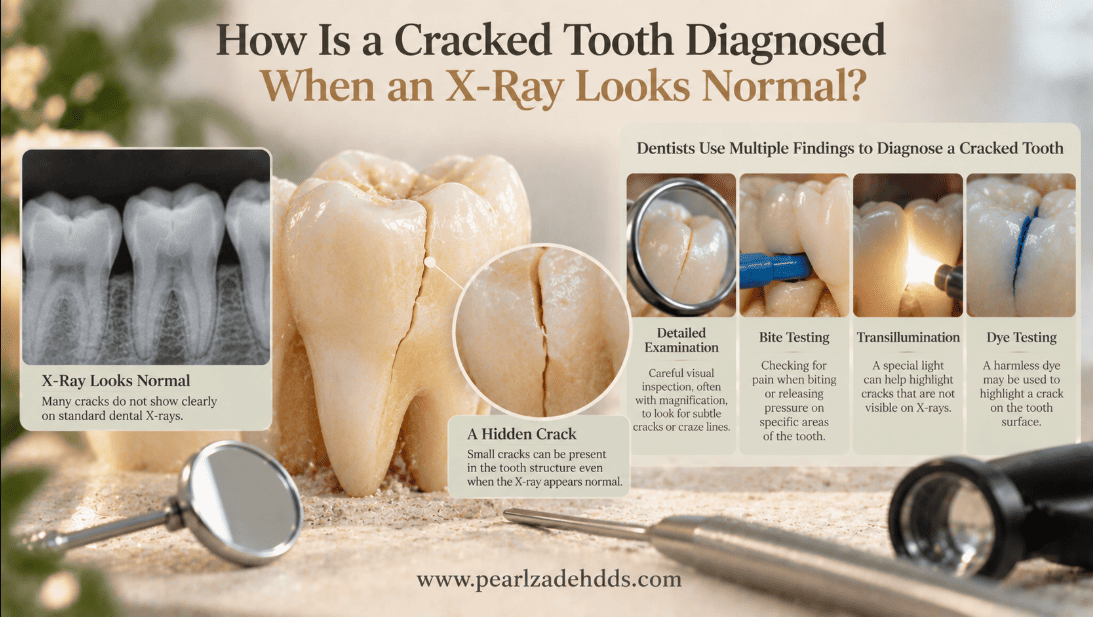
    Your tooth hurts when you bite, or it twinges with cold. Then the X-ray comes back, and your dentist says everything looks normal. That result can feel confusing and frustrating. A normal X-ray does not necessarily rule out a cracked tooth. Some cracks are difficult to see on a standard dental X-ray.

    Your dentist may need to combine your symptoms, clinical tests, and imaging to identify the problem. For first steps, urgency, and treatment, see our article on what to do if you have a cracked tooth.

    Why Might a Cracked Tooth Not Show Up on an X-Ray?

    A standard dental X-ray produces a two-dimensional image. It compresses a three-dimensional tooth into a single view. Overlapping structures can hide fine details, and many cracks are extremely thin. The crack’s direction also matters. A StatPearls review notes that an X-ray may reveal a thin line when the crack runs from cheek to tongue. The X-ray becomes less useful when the crack runs parallel to the film.

    Some cracks also cause no visible changes in the surrounding bone or tooth structure. Without those changes, the image may provide little evidence of the crack. A 2025 mini review in Frontiers in Oral Health states that radiographs rarely diagnose cracks directly. Bone defects may appear at later stages, and these findings can raise suspicion.

    X-rays still play an important role. They can show bone, roots, decay, infection, and other conditions that may cause similar symptoms. A normal X-ray can help rule out some of these causes. It simply cannot rule out a cracked tooth on its own.

    What Can a Dentist Learn From Your Symptoms?

    Your description helps guide the evaluation. Pain when biting is a common clue. So is pain when you release the bite. Intermittent pain and sensitivity to temperature can also matter. Some symptoms are difficult to reproduce during an appointment, which makes a detailed history especially useful.

    Your dentist may also ask whether you recently bit something hard, such as a popcorn kernel or a fruit pit. Symptoms that consistently affect one specific tooth can help narrow the search.

    These symptoms provide clues, not proof. Other dental problems can cause similar pain. A symptom pattern can raise or lower suspicion, but it cannot confirm a crack on its own.

    What Does a Dentist Look for During the Examination?

    The examination gives your dentist information that an X-ray cannot. Your dentist inspects the tooth under good lighting and magnification. The American Association of Endodontists (AAE) notes that the naked eye can miss subtle details of cracks.

    Visible crack lines are one clue. Changes in tooth structure can provide additional information. So can fractured or loose areas, existing fillings or crowns, and changes around the gumline. Worn areas may also provide clues about your bite.

    Can a Bite Test Help Find a Cracked Tooth?

    A bite test asks you to bite down on a small instrument. Your dentist applies pressure to one part of the tooth at a time. StatPearls describes directing force through each cusp while you report which area triggers your symptoms. A cusp is a raised point on the chewing surface.

    If pressure on one spot reproduces your pain, it provides an important clue. The Frontiers mini review describes the bite test as useful but not confirmatory. Other dental problems can also cause pain when you bite. Your dentist interprets the result alongside the rest of the examination.

    What About Gum or Periodontal Probing?

    Dentists measure the depth of the gum pocket around a tooth with a thin probe. Checking the full perimeter in small steps can reveal a narrow, isolated deep area. The Frontiers review describes this finding as a finding that can raise suspicion of a crack.

    A localized deep pocket can provide useful information. It does not automatically mean the tooth is cracked. Gum disease and other problems can also deepen a pocket. Small crack-related pockets can also be easy to miss, so probing is only one part of the evaluation.

    Can CBCT Find a Cracked Tooth That an X-Ray Misses?

    A standard dental X-ray produces a flat image. Cone-beam computed tomography (CBCT) works differently. The machine rotates around your head and captures multiple images. Software then combines them into a three-dimensional view of the teeth and surrounding bone.

    That view may provide additional information in selected cases. StatPearls says CBCT can be valuable when radiographic assessment is inconclusive but a crack remains strongly suspected. An AAE publication notes that clinicians may consider CBCT when the clinical examination and standard X-rays are inconclusive. Your dentist should weigh its potential benefit against the additional radiation exposure.

    CBCT does not make every crack visible. Metal posts and root-filling materials can create image artifacts. A systematic review of vertical root fractures in root-filled teeth found pooled sensitivity of roughly 70% to 73%. The authors also called for more research. Some cracks remain difficult to visualize even with advanced imaging.

    What If the X-Ray Is Normal but the Pain Continues?

    A normal first X-ray does not end the investigation. Persistent symptoms still deserve further evaluation. Your dentist may reconsider several possibilities.

    Is the pain coming from the tooth you suspect? Pain can be referred, meaning you feel it in a different tooth from the one causing it. Does the symptom pattern fit a crack? How does the tooth respond to bite and pulp tests? Your dentist may also reassess the gums and existing restorations.

    Your dentist may consider other causes of dental pain. Additional imaging or a specialist evaluation may be appropriate in some cases. None of this means a crack is automatically the cause. Sometimes the evaluation points to a different problem.

    Could Something Other Than a Crack Cause the Same Symptoms?

    Several problems can mimic a cracked tooth. Decay can cause pain with biting or temperature changes. A defective or stressed filling may cause similar symptoms. Pulp inflammation can produce lingering sensitivity or an ache. Excessive bite forces from clenching can leave teeth sore. Simple tooth sensitivity can cause discomfort with cold. Gum problems can also cause discomfort when you chew.

    StatPearls lists dentine hypersensitivity, parafunctional pain, and galvanic pain among other possible mimics. These terms describe sensitivity from exposed tooth surfaces, pain associated with clenching or other excessive forces, and pain related to contact between different metals.

    Because several conditions can cause similar symptoms, no single symptom or X-ray can settle the diagnosis. A complete dental evaluation helps determine the most likely cause.

    How Does a Dentist Put All the Findings Together?

    How can a dentist diagnose a cracked tooth if the X-ray is normal? By combining your symptoms, clinical findings, imaging, and other diagnostic tests. The approach depends on the suspected location and type of crack.

    An AAE Communiqué article describes cracked teeth as diagnosed through clinical findings and several examination tests. These may include transillumination, periodontal probing, bite testing, and magnification. Dentists look for a pattern across the findings. Symptoms, clinical examination, bite testing, pulp testing, periodontal findings, and imaging each provide another piece of information.

    No single finding determines the diagnosis. One finding can fit several conditions. Several findings that point in the same direction build a stronger case. Even then, a dentist may not be able to identify the exact location of a crack. Some cases remain uncertain. Your dentist may then recommend monitoring, further testing, or a specialist evaluation.

    When Should You Have a Tooth Rechecked?

    Return to your dentist if symptoms persist, worsen, or return after a normal X-ray. Increasing pain, swelling, and pain when biting all deserve attention. Significant temperature sensitivity, a visible fracture, or a loose or broken tooth fragment also warrant a recheck. Difficulty chewing is another reason to contact your dentist.

    Not every mild twinge is an emergency. However, even occasional symptoms deserve follow-up if they continue. Swelling, severe pain, or a broken tooth that affects eating calls for faster attention. Learn more about urgent dental care on our website. Our article on cracked tooth symptoms and treatment covers the next steps in more detail.

    When Tooth Pain Does Not Match the X-Ray

    A normal dental X-ray does not always explain persistent tooth pain or sensitivity. Some cracks are difficult to see on standard images. Your dentist may need to combine your symptoms, clinical examination, and other diagnostic tests.

    If you continue to have pain when biting, temperature sensitivity, or another unexplained tooth symptom, schedule a dental evaluation. Your dentist can investigate the possible cause and determine whether further testing or treatment is appropriate.

    Call (818) 716-6722 or click the button below to schedule your consultation online.

    Frequently Asked Questions

    Can you have a cracked tooth if the X-ray looks normal?

    Yes. Some cracks are difficult to see on standard dental X-rays because of their size, location, or direction. A dentist may use your symptoms, clinical examination, bite testing, and other diagnostic methods to investigate further.

    How does a dentist find a cracked tooth that does not show on an X-ray?

    A dentist may combine several findings, including your pain pattern, visual examination, magnification, bite testing, transillumination, pulp testing, and periodontal probing. Additional imaging may also be considered when appropriate.

    Can a CBCT scan detect a cracked tooth?

    CBCT imaging can provide three-dimensional information that a standard X-ray cannot. However, it does not make every crack visible. Whether CBCT is useful depends on the suspected crack, symptoms, and other examination findings.

    Why does my tooth hurt when I bite if the X-ray is normal?

    Pain when biting can have several causes, including a cracked tooth, decay, a stressed restoration, pulp inflammation, or bite-related problems. A normal X-ray does not identify all of these conditions, so persistent pain may require a more detailed examination.

    What should I do if my tooth still hurts after a normal X-ray?

    If pain or sensitivity continues, schedule a dental evaluation rather than assuming nothing is wrong. Your dentist can review your symptoms, examine the tooth again, and decide whether additional testing or imaging is appropriate.

    This article is for informational purposes only and is not a substitute for professional dental advice. Please schedule a consultation with Pearl Zadeh DDS to discuss your specific situation.
  • What to Do If You Have a Cracked Tooth

    What to Do If You Have a Cracked Tooth

    A cracked tooth does not always hurt, but it still deserves a dental evaluation. Some cracks affect only the outer enamel, while others extend deeper into the tooth. The right response depends on the crack’s location, depth, and symptoms. Knowing what to do early can help protect the tooth and preserve more treatment options.

    What Should You Do First If You Think a Tooth Is Cracked?

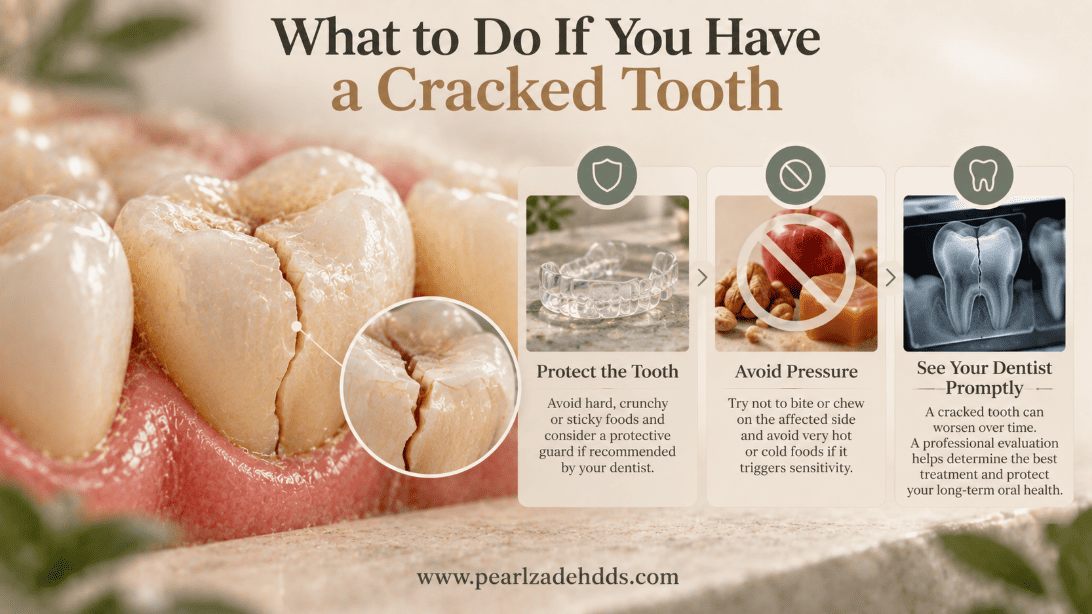
    Rinse your mouth gently with warm water to clean the area. If swelling develops, apply a cold compress to the outside of your face. The American Dental Association advises seeing your dentist as soon as possible after a broken tooth.

    A few simple habits can protect the tooth until your appointment. Stop chewing on the affected side and choose softer foods for now. Avoid very hot or cold foods if they trigger sensitivity. Keep brushing and cleaning the area as you normally would, using a soft brush and gentle pressure.

    Do not try to glue or repair the tooth yourself. Household glues are not made for use in the mouth. They can also make it harder for your dentist to evaluate the tooth.

    If you develop severe pain, significant swelling, or a large broken piece, contact a dentist promptly. The same applies if the pain makes it difficult to eat or sleep. Otherwise, schedule an appointment as soon as you reasonably can.

    Is a Cracked Tooth an Emergency?

    Not always. Many cracked teeth need prompt attention but not emergency care. Others require more urgent evaluation. The difference usually depends on your symptoms and the condition of the tooth.

    Contact a dentist promptly if you have severe or worsening pain. Significant swelling, fever, or pain that keeps you from eating or sleeping also warrants prompt attention. A tooth that has broken into a larger piece may need urgent care, especially after an injury.

    Facial swelling, difficulty swallowing, or difficulty breathing can signal a more serious problem. Go to an emergency room or call 911 if you have trouble breathing or swallowing.

    A lack of pain does not prove that a crack is harmless. Some cracks cause few or no symptoms. A dentist can determine whether the tooth needs treatment, monitoring, or no immediate treatment. You can learn more about urgent dental care on our website.

    What Does a Cracked Tooth Feel Like?

    Cracked tooth pain can feel different from typical cavity pain. The American Association of Endodontists (AAE) describes erratic pain when chewing and sudden sensitivity to hot or cold. The pain may also come and go.

    Many people notice pain when biting down or releasing the bite. Cold sensitivity is common, and heat can trigger discomfort too. You may also notice a rough edge with your tongue or a faint visible line. Some cracked teeth cause no symptoms at all.

    Why do the symptoms vary so much? A crack can open slightly under bite pressure and close again afterward. This movement can irritate the inner part of the tooth. Pain may appear with certain foods or bite angles and then disappear.

    This pattern can also make the source of the pain difficult to identify. You may feel discomfort somewhere along one side of your upper or lower teeth. A tooth can also feel different or rough without causing pain. Mention any unusual changes to your dentist.

    What Causes Teeth to Crack?

    Teeth can crack for many reasons, and several factors may contribute. Biting down on hard foods such as ice, hard candy, or unpopped popcorn kernels can place significant stress on a tooth. Dental trauma, such as a fall or sports injury, can also fracture a tooth suddenly.

    Other cracks develop gradually. Repeated chewing forces can create small cracks over time. A StatPearls review of cracked tooth syndrome identifies biting forces as a leading cause. It also lists age-related changes, poorly placed restorations, and tooth anatomy with steep cusps as contributing factors.

    Large fillings can leave less natural tooth structure to withstand these forces. Previous dental treatment can also change how a tooth handles stress.

    Clenching and grinding place repeated heavy forces on the teeth, often during sleep. Our article on how teeth grinding damages your teeth over the years explains how this repeated stress can affect teeth over time.

    No single cause explains every crack. Your dentist can review your dental history, bite, and symptoms to identify likely contributors.

    Are All Cracked Teeth the Same?

    No. Dentists classify cracks because treatment depends on the type and extent of the damage. The AAE describes five common categories. You cannot reliably tell which type you have on your own. A dentist needs to examine the tooth.

    Craze Lines

    Craze lines are tiny cracks in the outer enamel. Adult teeth very commonly have them. Most cause no pain, and many may not need treatment.

    Fractured Cusp

    A cusp is a pointed part of the chewing surface. Weakened cusps can break off, often around a filling. This type rarely damages the inner pulp of the tooth, according to the AAE. Treatment often focuses on restoring the broken area.

    Cracked Tooth

    A cracked tooth has a fracture that extends from the chewing surface toward the root. The tooth has not separated into pieces. Symptoms often come and go, which makes this type easy to overlook.

    Split Tooth

    A split tooth has a deeper crack that separates the tooth into distinct segments. It often develops from a cracked tooth that progresses over time. The AAE notes that a split tooth cannot be saved intact. Treatment is usually more extensive, and your dentist can explain what remains possible.

    Vertical Root Fracture

    A vertical root fracture begins in the root and extends toward the chewing surface. It often produces minimal signs and symptoms. Its causes and treatment considerations differ from other crack types. A dentist may need additional imaging to evaluate it.

    Can a Cracked Tooth Heal on Its Own?

    No. A cracked tooth does not heal the way a broken bone does. Bone contains living cells that rebuild a break. Enamel does not regrow once it is damaged.

    Some very minor surface lines, such as craze lines, may stay stable for years. That is stability, not healing. Deeper cracks are different. A crack that reaches the dentin or beyond can let the tooth flex under bite pressure.

    Symptoms may fade for a while. That does not mean the crack has healed. Cracked tooth pain often comes and goes, so a quiet week proves little.

    Not every crack will worsen. Infection is not inevitable either. An evaluation tells you which situation applies to your tooth.

    What Should You Eat With a Cracked Tooth?

    Softer foods such as yogurt, eggs, soup, mashed vegetables, and oatmeal are easier on a cracked tooth. Chew on the opposite side while you wait for your appointment.

    Avoid very hard foods such as nuts, hard candy, ice, and crusty bread. Sticky foods like caramel and taffy can pull on a weakened tooth, so it is best to avoid them too. If hot or cold foods trigger sensitivity, let them reach a moderate temperature before eating or drinking.

    You do not need to stop eating. Keep up your normal oral hygiene, brushing gently with a soft toothbrush and cleaning between your teeth. Do not avoid brushing the cracked tooth unless your dentist tells you otherwise.

    How Does a Dentist Diagnose a Cracked Tooth?

    Diagnosing a cracked tooth can be difficult. Cracks are often too fine to show clearly on a standard dental X-ray. The StatPearls review notes that X-rays become less useful when a crack runs parallel to the film. Dentists therefore combine several findings rather than relying on one test.

    Your dentist will review your medical and dental history and ask about your symptoms and pain patterns. A visual examination often follows, sometimes with magnification. Your dentist may also perform a bite test with a small instrument to see whether it reproduces your pain.

    Transillumination provides another way to look for cracks. The dentist shines a bright light through the tooth. A crack can block the light and appear as a dark line.

    Gum health can provide additional clues. The American Association of Endodontists notes that isolated gum pocketing associated with a crack may not always be easy to detect with a probe. Imaging can provide additional information. X-rays can also show the surrounding bone, root, and other possible causes of pain.

    When the findings remain unclear, your dentist may recommend additional imaging or a referral. No single test can identify every crack. Dentists use the full picture to determine what may be affecting the tooth.

    What Happens During a Cracked Tooth Evaluation?

    An evaluation usually starts with questions. Your dentist may ask when the pain began and what triggers it. They may also ask whether biting down or releasing the bite causes pain.

    Your dentist will likely ask about fillings, crowns, or other treatment on the tooth. Recent trauma matters too. So does grinding or clenching. It can help to remember which foods or movements trigger your symptoms.

    The dentist then examines the tooth and surrounding tissues. This includes the gums, your bite, and neighboring teeth. Most parts of the exam are noninvasive. Some tests, such as a bite or cold test, may cause brief discomfort. Tell your dentist if anything feels uncomfortable.

    After the evaluation, your dentist should explain what they found and what remains uncertain. They can also discuss your treatment options. Some cases require a follow-up visit or monitoring before the diagnosis becomes clearer.

    How Are Cracked Teeth Treated?

    Treatment depends on the crack’s depth, location, and effect on the tooth. It also depends on whether the tooth remains structurally restorable. Not every cracked tooth needs the same treatment.

    Minor craze lines often need only monitoring. A small chip may be smoothed or repaired when appropriate. Dental bonding can address some types of minor damage. A crown may help protect a tooth with more significant structural damage. Other restorative options depend on how much healthy tooth structure remains.

    A StatPearls review describes bonded restorations that can help stabilize a cracked tooth and limit movement. It also discusses crowns that help distribute biting forces across the tooth. Some cracks extend into the pulp or below the gum line. The American Association of Endodontists explains that cracks extending below the gum line can make a tooth difficult or impossible to save. Your dentist may refer you for specialized care when needed.

    If a tooth cannot be saved, your dentist can explain the available options. Our page on treatment for a cracked or broken tooth explains how Dr. Pearl Zadeh approaches damaged teeth.

    When Might a Cracked Tooth Need a Crown?

    A crown covers the tooth and can help protect it from chewing forces. It may help stabilize a tooth with significant structural damage. Not every crack requires a crown.

    Your dentist considers the crack’s location and how much healthy tooth structure remains. Bite forces and existing restorations also matter. Your symptoms and whether the tooth remains restorable help guide the decision.

    Crowns require reshaping some tooth structure, so the decision involves a trade-off. Your dentist needs to balance protecting the tooth with preserving as much natural structure as possible. You can learn more about dental crowns at Pearl Zadeh DDS.

    A crown does not guarantee that a cracked tooth will survive long term. The outcome depends on factors such as the extent of the crack, your bite forces, and the overall health of the tooth.

    What If the Crack Is in a Front Tooth?

    Front teeth can crack for several reasons. Trauma is a common cause, including falls, sports injuries, and accidents. Biting hard objects such as pen caps or bottle tops can also fracture an edge. Existing fillings or previous damage may weaken the tooth as well.

    Treatment depends on the type and extent of the damage. Smoothing or bonding may be enough for a minor chip. A larger edge fracture may require a different restoration. Deeper cracks need a more thorough evaluation of the entire tooth.

    Prompt attention matters if a front tooth feels loose or shifts after an injury. Your dentist can also consider your cosmetic concerns when planning treatment.

    Veneers are not automatically the right solution for a cracked front tooth. A good treatment plan starts with the most conservative option that suits the damage.

    What If a Tooth Cracks Around a Filling or Crown?

    Existing dental work can complicate the evaluation. Large fillings leave less natural tooth structure. The remaining tooth walls can crack under bite pressure. A crack can also begin beside a filling or crown.

    Crowns can chip, crack, or loosen. Looseness may mean the tooth underneath has changed. Cracks under a crown can be hard to see because the crown covers the tooth. Your dentist may rely on bite tests, symptoms, and imaging.

    The key question is whether the underlying tooth remains healthy and restorable. A damaged restoration does not always need replacement. Sometimes repair or monitoring is appropriate. Your dentist can tell you which applies.

    What Happens If You Ignore a Cracked Tooth?

    Some cracks remain stable for a long time. Others progress. Nobody can tell which type you have without an evaluation.

    Delay can make it harder to determine the original cause of the crack. Over time, symptoms and structural damage may develop. That can narrow the treatment options.

    Not every cracked tooth becomes infected, and not every cracked tooth is lost. Earlier evaluation simply gives your dentist more information. It also gives you more choices, and those choices are often more conservative.

    How Can You Prevent Cracked Teeth?

    No one can prevent every cracked tooth, but some habits can lower your risk. The AAE recommends avoiding hard objects, addressing grinding, and wearing a mouthguard during contact sports.

    Avoid chewing ice, pens, and other very hard objects. If you clench or grind, ask your dentist about a protective appliance. Wear a mouthguard during contact sports. Keep regular dental exams so your dentist can spot problems early.

    Replace damaged or worn restorations when your dentist recommends it. Treat cavities before they weaken the tooth. Follow your dentist’s advice if you have a tooth that is already weakened.

    When to Call a Dentist

    Call a dentist if you notice a visible crack, pain when you bite, lingering sensitivity, or a rough edge. A broken piece, swelling, or any other change that concerns you also warrants a call.

    Severe pain, facial swelling, or fever need faster attention. If you are unsure how urgent your symptoms are, our team can help you decide. Learn more about emergency dentistry in Woodland Hills.

    Dr. Pearl Zadeh is a Woodland Hills dentist who evaluates damaged and weakened teeth. Her approach focuses on conservative care and preserving natural tooth structure when clinically appropriate. She applies holistic and biomimetic principles where relevant and builds each treatment plan around an individual evaluation.

    Not every tooth can be saved. An honest evaluation can help you weigh your options. Call (818) 716-6722 or click the button below to schedule your consultation online.

    Frequently Asked Questions

    Can a cracked tooth heal itself?

    No. Teeth do not repair cracks the way bones heal. Some minor craze lines stay stable without treatment, but a dentist needs to tell the difference.

    Can you have a cracked tooth without pain?

    Yes. Some cracks cause no symptoms, especially early on. A painless tooth can still have a crack, so any visible change is worth checking.

    Is a cracked tooth an emergency?

    Usually not, but it deserves prompt attention. Severe pain, swelling, fever, or trouble swallowing or breathing call for urgent care.

    What should you avoid eating with a cracked tooth?

    Avoid very hard foods such as ice, nuts, and hard candy. Skip sticky foods if they pull on the tooth. Limit very hot or cold items if they trigger pain.

    Can a dentist save a cracked tooth?

    Often, yes, depending on the depth and location of the crack. Some teeth cannot be saved. Your dentist can explain what is realistic after an exam.

    How long can you wait with a cracked tooth?

    There is no safe waiting period that applies to everyone. Mild symptoms still deserve an appointment soon. Severe pain or swelling should be seen right away.

    This article is for informational purposes only and is not a substitute for professional dental advice. Please schedule a consultation with Pearl Zadeh DDS to discuss your specific situation.
  • Is Dental Sedation Safe? What Nervous Patients Should Know Before Treatment

    Is Dental Sedation Safe? What Nervous Patients Should Know Before Treatment

    Many patients feel relieved when they learn sedation dentistry is available, but safety questions often come next. They want to know whether they will remain awake, how dentists monitor them, and what happens if they have a health concern during treatment.

    Dental sedation can help nervous patients feel more comfortable, but it is not necessary for everyone. Understanding how sedation works and the safety measures dentists follow can help you decide whether it is the right choice for your needs.

    What Is Dental Sedation?

    Dental sedation uses medication to help patients relax during dental procedures. Dentists may recommend it for patients with dental anxiety, a strong gag reflex, difficulty sitting comfortably through treatment, or those who need longer appointments.

    Sedation is different from general anesthesia. General anesthesia places a patient into an unconscious state and is typically used for specific surgical procedures that require advanced monitoring. Most dental sedation allows patients to breathe independently and respond to their dentist during treatment.

    Sedation is available at different levels. Minimal sedation, such as nitrous oxide, helps patients feel calm while staying awake and responsive. Moderate sedation, often provided through oral medication, creates a deeper state of relaxation. Deep sedation, commonly associated with IV sedation, requires closer monitoring because patients enter a much more relaxed state.

    Is Dental Sedation Safe for Anxious Patients?

    Dental sedation is considered safe for many patients when it is provided by a trained dentist who properly evaluates their health history beforehand.

    Before recommending sedation, your dentist reviews factors such as your medical conditions, current medications, allergies, and previous experiences with sedation or anesthesia. This information helps determine which option is appropriate and whether any precautions are needed.

    For anxious patients, sedation can make dental care more manageable. However, it works best alongside other comfort measures, including clear communication, breaks during treatment, and a dental team that understands your concerns.

    What Are the Risks of Dental Sedation?

    Like any medical treatment, dental sedation has possible risks. Most side effects are temporary and may include drowsiness, mild nausea, headache, or light-headedness depending on the type of sedation used.

    The level of risk depends on the sedation method. Nitrous oxide is a lighter form of sedation, while oral and IV sedation create deeper levels of relaxation and require additional monitoring.

    Your dentist considers your overall health, the procedure being performed, and your anxiety level before recommending sedation. A proper evaluation helps reduce risks and ensures the treatment plan is appropriate for you.

    Sedation should only be provided by a dentist or provider trained in administering it and responding to potential complications. Before treatment, ask about their experience with the specific sedation option being recommended.

    How Dentists Keep Patients Safe During Sedation

    Patient safety begins long before your procedure starts. Every step, from your initial evaluation to your recovery, is designed to reduce risk and make sure sedation is appropriate for you.

    Before treatment, your dentist reviews your medical history, current medications, allergies, and any previous reactions to sedation or anesthesia. They may also ask about conditions such as heart disease, breathing disorders, or sleep apnea because these can influence which sedation option is safest.

    Based on this information, your dentist recommends the level of sedation that matches both your anxiety and your overall health. Not every patient needs the same type of sedation, and the safest approach is always the one that’s tailored to your individual needs.

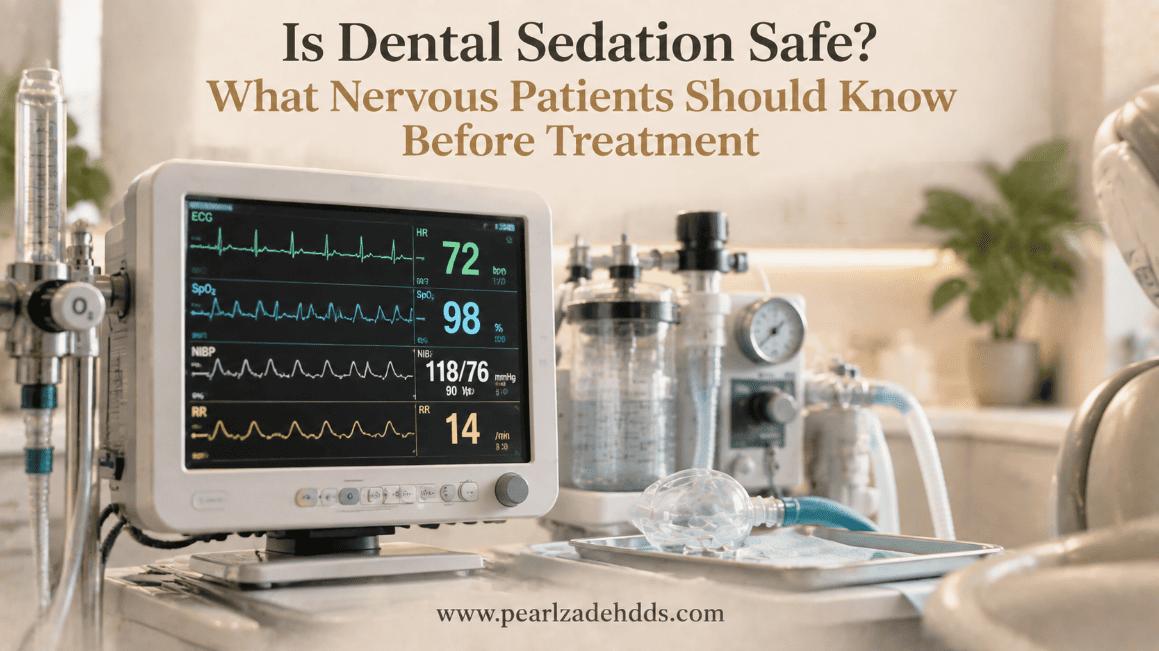
    During your procedure, your dental team closely monitors your breathing, heart rate, oxygen levels, and overall comfort. If needed, the sedation level can be adjusted throughout the appointment to help you stay relaxed while remaining safe.

    Before you leave, you’ll receive recovery instructions based on the type of sedation you received. Your dentist will explain when you can eat, return to normal activities, and whether you’ll need someone to drive you home.

    Who May Not Be a Good Candidate for Sedation?

    Although dental sedation is safe for many patients, it isn’t the right choice for everyone. Your dentist will evaluate your health carefully before recommending any form of sedation.

    Certain medical conditions, particularly some heart or lung conditions, may require extra precautions or a different approach. Pregnancy is another important consideration, as some sedation methods may not be recommended depending on the stage of pregnancy. Certain medications can also interact with sedatives, which is why it’s important to provide a complete list of everything you take, including over-the-counter medicines and supplements.

    These factors don’t automatically mean you can’t receive sedation. They simply help your dentist determine the safest option for your situation. If sedation isn’t recommended, there are many other ways to help you feel comfortable during treatment, including clear communication, shorter appointments, regular breaks, and other anxiety management techniques.

    Types of Dental Sedation and Their Safety Considerations

    Dental sedation is not a single approach. Dentists choose different types of sedation based on your anxiety level, the procedure being performed, and your overall health. Each option provides a different level of relaxation and requires different safety considerations.

    Nitrous Oxide (Laughing Gas)

    Nitrous oxide, commonly known as laughing gas, is one of the mildest forms of dental sedation. You breathe it through a small mask placed over your nose, and most patients begin to feel relaxed within a few minutes.

    You remain awake and able to communicate with your dentist throughout the appointment. Many patients describe feeling calm, slightly light-headed, or less focused on the sights and sounds of treatment.

    One of the reasons nitrous oxide is commonly used is its quick recovery time. Once the mask is removed and you breathe regular oxygen, the effects wear off within minutes. You can learn more about how nitrous oxide helps nervous patients feel more comfortable during dental visits.

    Oral Sedation

    Oral sedation involves taking a prescribed medication before your appointment to help you feel more relaxed. It provides a deeper level of sedation compared with nitrous oxide, and some patients feel drowsy or remember very little about the procedure afterward.

    Because the medication takes longer to leave your system, you will need someone to drive you home after your appointment. Your dentist will review your health history and explain what to expect before recommending this option.

    Oral sedation may be helpful for patients with moderate to severe dental anxiety, especially those who struggle with the thought of sitting through longer procedures.

    IV Sedation

    IV sedation delivers medication directly into your bloodstream, allowing the dentist to adjust the sedation level throughout your procedure. It is often considered for patients with significant anxiety or those undergoing longer or more complex treatments.

    Because IV sedation provides a deeper level of relaxation, your vital signs must be monitored throughout the appointment. It should only be administered by a dentist or provider with appropriate training and experience in IV sedation.

    What Questions Should You Ask Before Choosing Dental Sedation?

    Before choosing sedation, ask your dentist questions that help you understand what the experience will be like and how safety will be managed.

    You may want to ask:

    • Which type of sedation do you recommend for my anxiety level and procedure?
    • Why is this option a better choice for me than other sedation methods?
    • How will you monitor me during treatment?
    • What will I feel while I am sedated?
    • Will I need someone to drive me home afterward?
    • What should I expect during recovery?

    A dentist who takes time to explain these details can help you feel more prepared and confident about your decision.

    Dental Sedation vs Other Ways to Manage Dental Anxiety

    Sedation can be helpful for many anxious patients, but it is not the only way to make dental visits easier. Some patients feel more comfortable with simple techniques that help them stay relaxed and in control.

    Talking through each step before treatment begins can reduce fear caused by uncertainty. Many dentists also use a stop signal, such as raising your hand, so you can pause whenever you need a break.

    The tell-show-do approach can also help. Your dentist explains what will happen, shows you the instrument or process, and then continues only when you feel comfortable. Other strategies, such as listening to music, wearing headphones, and gradually building trust over multiple visits, may reduce anxiety without sedation.

    If you are deciding which approach is right for you, our article on choosing a dentist for dental anxiety explains what to look for before scheduling an appointment.

    Choosing an Anxiety-Friendly Dentist in Woodland Hills

    For many patients in Woodland Hills, choosing a dentist involves more than finding someone who offers sedation. They want a dentist who listens to their concerns, explains their options, and makes them feel comfortable throughout treatment.

    Dr. Pearl Zadeh works with anxious patients by offering sedation options when appropriate, taking time to discuss concerns, and creating a treatment approach based on each patient’s comfort level. You can learn more about Dr. Pearl Zadeh‘s approach, meet the team supporting patients during visits, and read patient testimonials from those who have shared their experiences.

    If you are still deciding whether sedation is right for you, our article on sedation dentistry for dental anxiety provides more details about how sedation can help nervous patients feel more comfortable during treatment.

    Schedule a Consultation With Dr. Pearl Zadeh

    Still have questions about whether dental sedation is right for you? A consultation with Dr. Pearl Zadeh in Woodland Hills gives you the opportunity to discuss your concerns, review your sedation options, and understand what to expect before treatment begins.

    Call (818) 716-6722 or click the button below to schedule your consultation online.

    Frequently Asked Questions

    Is dental sedation safe for everyone?

    Not automatically. Dental sedation is safe for most patients when it’s properly screened and administered by a trained provider, but certain health conditions, medications, and pregnancy can change which options are appropriate. A full medical history review determines what’s safe for you.

    Can you feel pain during dental sedation?

    Sedation helps you feel calmer and less aware of discomfort, but it’s typically paired with local anesthesia to manage pain directly at the treatment site. Sedation alone isn’t designed to replace numbing medication.

    Are you awake during dental sedation?

    It depends on the type. With nitrous oxide, you stay fully awake and responsive. With oral or IV sedation, you may feel drowsy or drift in and out of awareness, though you typically remain able to respond if needed.

    How long does dental sedation last?

    Nitrous oxide wears off within minutes after the mask is removed. Oral and IV sedation take longer to clear your system, often several hours, so you’ll need someone to drive you home and plan to rest for the remainder of the day.

    Can sedation help with severe dental anxiety?

    Yes, for many patients. Deeper sedation options like oral or IV sedation can help patients with significant fear get through necessary treatment. Results vary between patients, and a dentist evaluation helps determine the right approach.

    This article is for informational purposes only and is not a substitute for professional dental advice. Please schedule a consultation with Pearl Zadeh DDS to discuss your specific situation.
  • Oral Sedation Dentistry for Anxious Patients: What to Know Before Treatment

    Oral Sedation Dentistry for Anxious Patients: What to Know Before Treatment

    Many people who avoid the dentist are not avoiding care because they do not value their health. Often, the thought of sitting in the dental chair brings back fear, stress, or memories of difficult past experiences. If dental anxiety has made it hard to schedule or complete treatment, oral sedation dentistry may help you feel more comfortable and in control during your visit.

    Understanding how it works, what you will experience, and who it may benefit can help you decide if it is the right option for you.

    What Is Oral Sedation Dentistry?

    Oral sedation, sometimes called oral conscious sedation, uses a prescribed medication taken by mouth to help you relax before and during a dental procedure. Unlike nitrous oxide, which you inhale through a mask and which wears off within minutes, oral sedation is taken as a pill and takes longer to take effect and leave your system.

    It is also different from IV sedation, where medication is delivered directly into a vein and adjusted throughout the procedure. With oral sedation, you take the prescribed medication before your appointment, and its effects remain steady throughout treatment rather than being adjusted continuously.

    For patients with significant dental anxiety, oral sedation can reduce the physical and emotional stress that makes treatment difficult. It does not remove every concern, but it can help your body stay calmer during the appointment and make dental care easier to manage.

    Who Is a Good Candidate for Oral Sedation?

    Oral sedation may be a good option for patients with moderate to severe dental anxiety, especially when fear has caused them to delay or avoid appointments. It can also help patients who have had difficult dental experiences in the past and feel nervous about returning for care.

    A strong gag reflex is another reason some patients consider oral sedation. The relaxed state can make certain procedures more comfortable. Patients who need longer appointments or multiple treatments during one visit may also benefit from having support to stay calm throughout the procedure.

    However, oral sedation is not automatically the right choice for everyone. Your dentist will consider your anxiety level, medical history, current medications, and the type of treatment you need before recommending sedation. In some cases, another approach may be a better fit.

    How Does Oral Sedation Work?

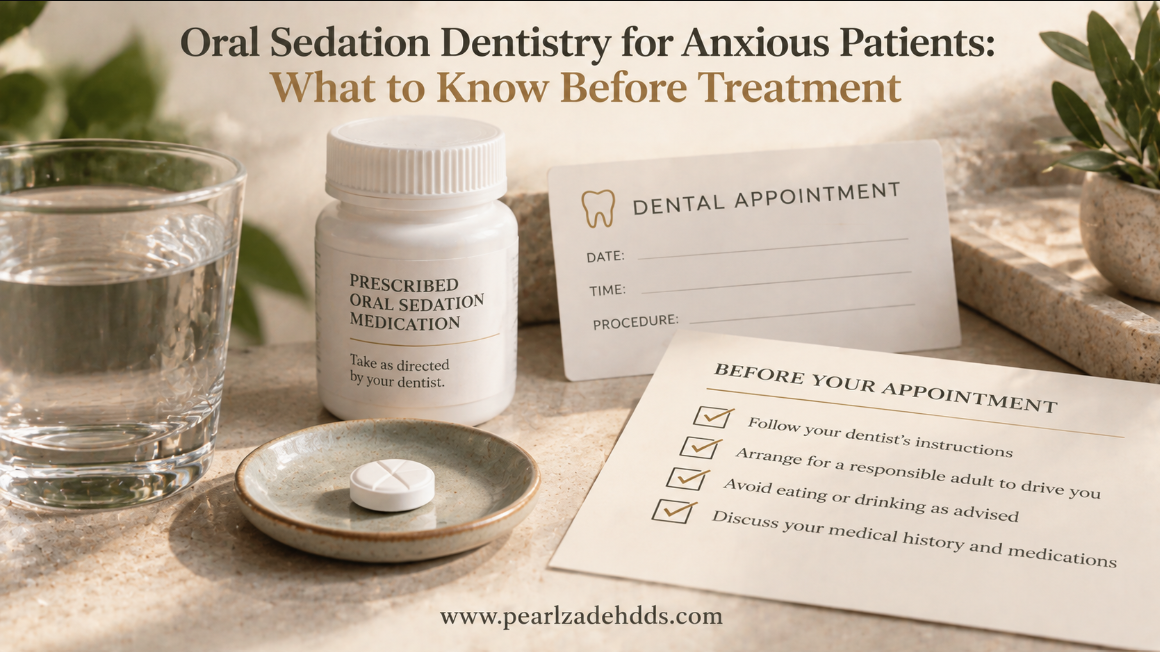
    Your dentist will typically prescribe medication to take before your appointment, allowing enough time for it to take effect before treatment begins. Because oral sedation can affect your alertness and coordination, you will usually need someone to drive you to and from the appointment.

    As the medication begins working, many patients feel relaxed, drowsy, or less aware of their surroundings. You remain awake throughout the procedure and can respond when your dentist speaks to you, but your body feels calmer and less reactive to the sights, sounds, and sensations of treatment.

    The experience varies between patients. Some people feel relaxed and alert throughout the appointment, while others enter a deeper state of relaxation and remember very little afterward. This reduced awareness is one reason oral sedation can help patients who feel overwhelmed by dental treatment.

    What Happens Before, During, and After Oral Sedation?

    Knowing what to expect before, during, and after oral sedation can make the process feel much less intimidating. Your dental team will guide you through each step and explain what you need to do before your appointment.

    Before Treatment

    Before recommending oral sedation, your dentist reviews your medical history, including any health conditions, allergies, and medications you currently take. This helps determine whether sedation is a safe option for you and whether any special precautions are needed.

    Your dentist will also provide instructions before your appointment. Depending on the medication used, you may need to avoid eating or drinking for a specific period of time.

    You will need to arrange transportation before your visit. Because oral sedation can affect your alertness and coordination, you should have someone drive you to and from the appointment. Some patients may also need someone to stay with them afterward while the medication continues to wear off.

    During Treatment

    Once the medication takes effect, your dental team monitors your comfort, responsiveness, and vital signs throughout the procedure. If your treatment requires local anesthesia, it is usually given after you feel relaxed from the sedation, which can make the process easier for patients who feel nervous about injections.

    You remain awake during oral sedation and can communicate with your dentist if needed. However, many patients feel calmer and less aware of the sights, sounds, and sensations that normally trigger anxiety.

    After Treatment

    After your procedure, you will spend some time in the office before leaving. Your dental team will make sure you are recovering properly and provide instructions for the rest of the day.

    Once you return home, you should plan to rest and avoid activities that require full concentration. Feeling tired, groggy, or having limited memory of the appointment can happen with oral sedation and usually improves as the medication wears off.

    Is Oral Sedation Safe?

    Oral sedation has been used in dentistry for many years and is considered safe when it is provided by a trained dentist who properly evaluates the patient beforehand and follows appropriate monitoring guidelines.

    The American Dental Association provides guidelines for sedation and anesthesia in dental settings, including recommendations for patient evaluation, monitoring, and safety practices.

    Before using oral sedation, your dentist reviews your health history and current medications to identify any factors that may affect your safety. During treatment, your dental team monitors your response and vital signs to make sure you remain comfortable throughout the procedure.

    Like any medication, oral sedation does carry some risks. A thorough evaluation, proper dosing, and careful monitoring help reduce those risks and allow your dentist to provide sedation in a safe and controlled way.

    Benefits of Oral Sedation for Patients With Dental Anxiety

    For patients who feel nervous about dental treatment, oral sedation can make appointments feel more manageable. By helping the body relax, sedation can reduce common anxiety responses such as muscle tension, restlessness, and feeling overwhelmed in the dental chair.

    It can be especially helpful for longer procedures or patients who have avoided dental care because of fear. Feeling calmer during treatment can make the appointment seem shorter and reduce the stress often associated with dental visits.

    For some patients, a more comfortable experience helps rebuild confidence in dental care. Returning for regular checkups becomes easier when past appointments are no longer associated with intense fear or discomfort.

    Possible Side Effects and Risks

    Understanding possible side effects helps you know what to expect after oral sedation. The most common effects include drowsiness, tiredness, and feeling less alert for several hours after the appointment.

    Some patients experience dry mouth, mild nausea, or temporary changes in memory. It is also common for patients to remember very little about the procedure, especially with stronger levels of oral sedation. These effects usually improve as the medication leaves the body.

    Contact your dentist if you experience symptoms that feel unusual or concerning, such as difficulty breathing, signs of an allergic reaction, or symptoms that do not improve as expected. Serious complications are uncommon when sedation is properly planned and monitored.

    Questions to Ask Before Choosing Oral Sedation

    Before deciding on oral sedation, take time to discuss your options with your dentist. Ask whether oral sedation is appropriate based on your health history, what medication will be used, and what you should expect during the appointment.

    It is also helpful to ask about possible risks, recovery time, and whether you will need someone to drive you to and from the office. A dentist who takes time to explain these details helps you feel informed and comfortable with your decision.

    Oral Sedation vs Nitrous Oxide: Which Is Better for Dental Anxiety?

    Neither option is automatically better for every anxious patient. The better choice depends on how intense your anxiety feels, the type of treatment you need, and how much support you need during your appointment.

    Nitrous oxide works quickly and wears off within minutes after treatment. Since you remain awake and alert, many patients prefer it for mild to moderate anxiety or shorter procedures. Most people can also drive themselves home afterward.

    Oral sedation creates a deeper sense of relaxation and lasts longer. It may be a better fit for patients with stronger dental fears, past traumatic experiences, or longer procedures that feel overwhelming without additional support. The tradeoff is that you will need someone to drive you home, and you may feel drowsy for several hours afterward.

    The best option is the one that matches your needs. A dentist should consider your anxiety level, medical history, and treatment plan before recommending sedation.

    Choosing an Anxiety-Friendly Dentist in Woodland Hills

    The sedation method matters, but the dentist you choose matters too. Patients with dental anxiety often need more than medication. They need a team that listens, explains each step, and gives them a sense of control during treatment.

    Before choosing a dentist, look for a practice that takes time to discuss your concerns, explains sedation options clearly, and allows you to ask questions without feeling rushed. Our article on choosing a dentist for dental anxiety covers what to look for before booking your appointment.

    Dr. Pearl Zadeh works with anxious patients throughout Woodland Hills by focusing on clear communication, patient comfort, and treatment plans based on each person’s needs. Whether you are returning after years away or preparing for a procedure that feels stressful, her team takes the time to understand your concerns.

    If you are still exploring sedation options, you can learn more about how sedation dentistry helps anxious patients and what safety factors to consider before treatment. Patients who have avoided dental care for years can also read about what to expect when returning to the dentist after a long break.

    You can also learn more about dental anxiety treatment options available at Dr. Pearl Zadeh’s practice.

    Schedule a Consultation With Dr. Pearl Zadeh

    Choosing oral sedation starts with understanding your options. Dr. Pearl Zadeh and her team in Woodland Hills can review your concerns, explain available sedation choices, and help you decide what approach feels right for your dental care.

    Call (818) 716-6722 or click the button below to schedule your consultation online.

    Frequently Asked Questions

    How long before my appointment do I take oral sedation medication?

    Most dentists instruct patients to take oral sedation medication about an hour before their appointment. This gives the medication enough time to start working before treatment begins. Your dentist will provide specific instructions based on the medication prescribed and your treatment plan.

    Will I remember my dental appointment after oral sedation?

    Many patients remember very little of their appointment after oral sedation. The medication helps reduce anxiety and creates a relaxed state that can make the procedure feel shorter or less noticeable. However, the level of memory loss varies, and some patients may remember parts of the visit.

    Can I eat before taking oral sedation medication?

    Your dentist will give you specific instructions about eating and drinking before your appointment. Some medications may require you to avoid food for a certain period beforehand, while others may have different guidelines. Always follow the instructions provided by your dental team.

    How long does it take to recover from oral sedation?

    Most patients should plan to rest for the remainder of the day after oral sedation. Feeling drowsy, groggy, or less alert for several hours is common. You should avoid driving, operating machinery, or making important decisions until the medication has fully worn off.

    Is oral sedation the same as being put to sleep?

    No. Oral sedation does not usually mean you are fully unconscious. Most patients remain awake, can respond to their dentist, and continue breathing normally during treatment. General anesthesia is different because it places a patient into a completely unconscious state and requires a different level of monitoring.

  • IV Sedation Dentistry: What Patients Should Know Before Treatment

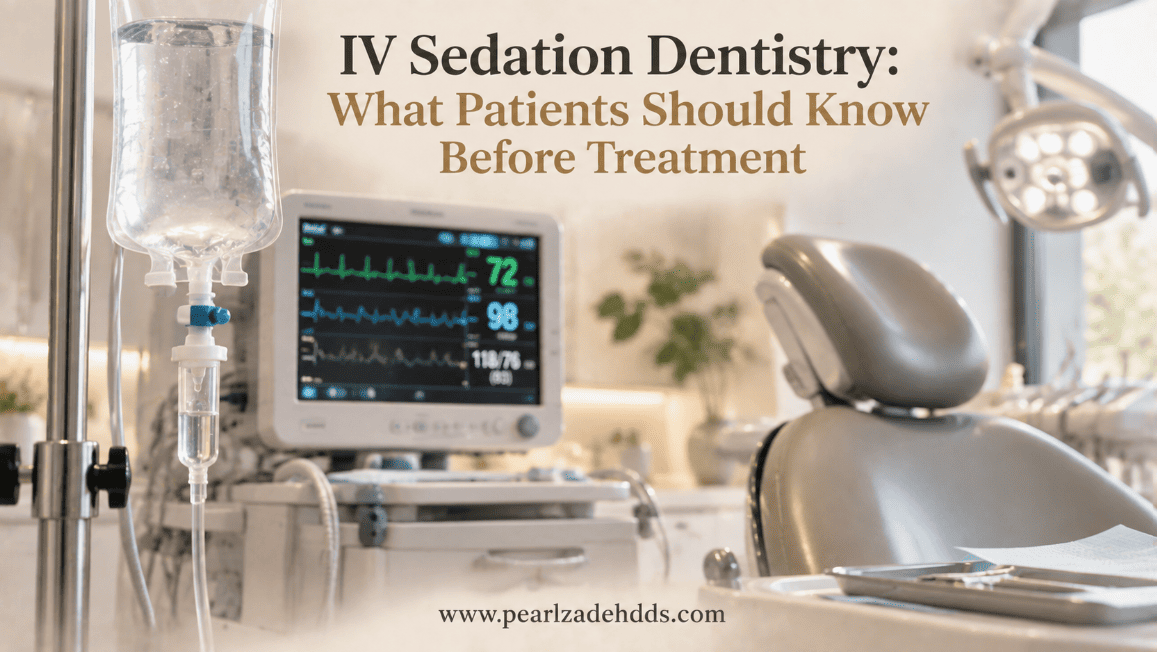
    IV Sedation Dentistry: What Patients Should Know Before Treatment

    For some patients, dental anxiety goes beyond feeling nervous before an appointment. A history of painful experiences, years of avoiding care, or the need for extensive treatment can make a dental visit feel overwhelming. In these situations, IV sedation dentistry may be an option worth discussing with your dentist.

    Before choosing IV sedation, it helps to understand how it works, who may benefit from it, what you may experience during treatment, and how dentists keep patients safe throughout the process.

    What Is IV Sedation Dentistry?

    IV sedation delivers medication directly into a vein through a small intravenous line. Because the medication enters the bloodstream directly, it can take effect quickly and allows the dental team to adjust the level of sedation during the procedure when needed.

    Unlike oral sedation, which relies on a medication taken before the appointment, IV sedation allows your dentist or trained provider to make adjustments based on how you respond during treatment.

    Many patients remain responsive to verbal instructions during IV sedation but feel deeply relaxed and less aware of the sights, sounds, and sensations of the procedure. The level of awareness varies depending on the medication and dosage used.

    IV sedation is different from general anesthesia. General anesthesia creates a controlled state of unconsciousness and usually requires a higher level of monitoring and support. IV sedation typically focuses on relaxation and anxiety control while maintaining patient responsiveness.

    Who May Benefit From IV Sedation?

    IV sedation may be considered for patients with significant dental anxiety who find traditional appointments difficult to manage. It can also be helpful for patients who need longer or more complex procedures and want additional support staying comfortable throughout treatment.

    Some patients who discuss IV sedation with their dentist include those who:

    • Have avoided dental care for years because of fear.
    • Have had difficult or stressful dental experiences in the past.
    • Have a strong gag reflex that makes treatment challenging.
    • Struggle to remain comfortable during longer appointments.
    • Need multiple procedures completed during one visit.

    These factors do not automatically mean IV sedation is the right option. A dentist will review your health history, medications, anxiety level, and treatment needs before recommending any form of sedation.

    How Does IV Sedation Work?

    Before treatment begins, a trained provider places a small IV line, usually in the hand or arm. The medication is then administered gradually while your response is monitored.

    As the sedation takes effect, many patients describe feeling calm, heavy, or detached from their surroundings. Some remain able to answer questions, while others become less aware of the details of the procedure.

    Because IV sedation can affect memory, many patients remember little of their appointment afterward. However, the experience varies between individuals depending on the medication used, dosage, and how their body responds.

    What Happens Before, During, and After IV Sedation?

    Knowing what to expect before, during, and after IV sedation can make the experience feel much less uncertain. Understanding each step helps many anxious patients feel more prepared before their appointment.

    Before Treatment

    Before recommending IV sedation, your dentist reviews your medical history, current medications, and any previous reactions to sedation or anesthesia. This information helps determine whether IV sedation is appropriate and what precautions may be needed during treatment.

    You may receive specific instructions before your appointment, including guidelines about eating and drinking. Because IV sedation can affect your alertness and coordination, you will need someone to drive you home afterward.

    Your dentist will also discuss the benefits, risks, and alternatives to sedation before treatment begins. This conversation gives you the opportunity to ask questions and understand what to expect.

    During Treatment

    Once sedation begins, your dental team monitors your response and important signs such as oxygen levels, blood pressure, and heart rate throughout the procedure. The sedation level can be adjusted based on how you respond and how comfortable you are during treatment.

    Local anesthesia is still used when needed because sedation helps reduce anxiety and awareness but does not replace numbing medication for pain control.

    After Treatment

    After the procedure, you will spend some time recovering in the office while your team makes sure you are alert and stable before leaving. Feeling groggy, tired, or having limited memory of the appointment can happen after IV sedation.

    You will need your escort to drive you home, and you should plan to rest for the remainder of the day. Avoid driving, operating machinery, or making important decisions until the effects of sedation have fully worn off and you have followed your dentist’s recovery instructions.

    Is IV Sedation Safe?

    IV sedation has a well-established safety record when it’s provided by a qualified provider who follows appropriate screening, monitoring, and safety protocols. Before recommending IV sedation, your dentist will review your medical history, current medications, and any previous reactions to sedation or anesthesia. This evaluation helps determine whether IV sedation is an appropriate option for you and whether any additional precautions are needed.

    During treatment, your dental team monitors important signs such as your heart rate, blood pressure, oxygen levels, and overall response to the medication. Monitoring allows the team to adjust the level of sedation when appropriate and respond promptly if any concerns arise.

    Dentists who provide IV sedation should have the necessary training, certifications, and emergency equipment required for this type of care. Like any medical procedure, IV sedation is not completely risk-free. Choosing an experienced provider who follows established safety guidelines is one of the most important steps you can take.

    Benefits of IV Sedation for Patients With Dental Anxiety

    For patients with significant dental anxiety, IV sedation can make treatment feel much more manageable. Many patients feel deeply relaxed during the procedure and remember little afterward. This can help people with difficult past dental experiences.

    IV sedation may also make longer or more complex procedures easier to tolerate. Your dentist can adjust the sedation level during treatment to maintain comfort. In some cases, this allows your dentist to complete multiple procedures in one visit. That can reduce the need for several separate appointments.

    For many patients, a positive sedation experience can also make future dental visits easier. They may feel more comfortable returning instead of continuing to postpone treatment.

    Possible Risks and Side Effects

    Like any form of sedation, IV sedation can cause temporary side effects. Feeling drowsy, groggy, or less alert for several hours after treatment is common. Some patients also experience mild nausea, dizziness, or temporary memory loss related to the procedure.

    Minor bruising or soreness around the IV site may occur and usually improves within a few days.

    Serious complications are uncommon when a trained provider properly administers and monitors IV sedation. However, contact your dentist promptly if you experience symptoms such as difficulty breathing, chest pain, persistent vomiting, significant swelling around the IV site, or any reaction that worsens instead of improving after you return home.

    IV Sedation vs Oral Sedation vs Nitrous Oxide

    Each type of dental sedation offers a different level of relaxation, and the best option depends on your individual needs.

    Nitrous oxide is the mildest option. It works quickly, wears off within minutes, and allows many patients to return to their normal activities shortly after treatment. Depending on your dentist’s instructions and how you feel afterward, many patients are able to drive themselves home.

    Oral sedation provides a deeper level of relaxation than nitrous oxide. Because it’s taken as a pill before your appointment, its effects cannot be adjusted once treatment begins. If you’d like to learn more, our article on oral sedation dentistry for anxious patients explains what to expect before, during, and after treatment.

    IV sedation offers the greatest flexibility because the medication is delivered directly into the bloodstream and can be adjusted throughout the procedure. This makes it a suitable option for some patients with severe dental anxiety, lengthy procedures, or complex treatment plans.

    Recovery from IV sedation generally takes longer than recovery from nitrous oxide. Similar to oral sedation, you’ll need someone to drive you home afterward.

    The most appropriate sedation option depends on several factors, including your level of anxiety, overall health, medical history, and the treatment being performed. Your dentist can explain the benefits and limitations of each option and help you decide which approach is most appropriate for your care.

    Questions to Ask Before Choosing IV Sedation

    Before deciding on IV sedation, have an open conversation with your dentist about whether it’s the right option for you. Some helpful questions include:

    • Am I a good candidate for IV sedation based on my medical history?
    • Who will administer the sedation, and what training or certifications do they have?
    • How will I be monitored during the procedure?
    • What should I expect during recovery?
    • How should I prepare before my appointment?

    A dentist who takes the time to answer these questions clearly and discuss both the benefits and potential risks can help you make a more informed decision about your care.

    Choosing an Anxiety-Friendly Dentist in Woodland Hills

    Choosing the right dentist is just as important as choosing the right type of sedation. Patients with dental anxiety often feel more confident when they work with a dentist who listens to their concerns, explains each step clearly, and recommends treatment based on their individual needs rather than a one-size-fits-all approach.

    If you’re still looking for the right practice, our guide on choosing a dentist for dental anxiety covers the questions worth asking before you schedule your first appointment.

    Dr. Pearl Zadeh works with anxious patients throughout Woodland Hills by taking time to explain every sedation option, discussing the benefits and considerations of each approach, and helping patients choose the level of support that best fits their comfort and treatment needs. For some patients, IV sedation may be appropriate. Others may feel comfortable with nitrous oxide, oral sedation, or non-sedation techniques.

    If you’ve been avoiding dental care for years, learn how to overcome fear of the dentist after avoiding care for years and what to expect at your first visit back. If you’re still deciding whether sedation is right for you, explore how sedation dentistry can help with dental anxiety or learn whether dental sedation is safe before making your decision. You can also visit our Dental Anxiety page to learn more about the different ways Dr. Pearl Zadeh and her team help nervous patients feel more comfortable before, during, and after treatment.

    Schedule a Consultation With Dr. Pearl Zadeh

    If dental anxiety has kept you from getting the care you need, you don’t have to make decisions about sedation on your own. Dr. Pearl Zadeh and her team in Woodland Hills will review your medical history, answer your questions, and help you determine whether IV sedation or another approach is the right fit for your treatment and comfort level.

    Frequently Asked Questions

    Does IV sedation put you fully to sleep?

    No. IV sedation does not usually cause complete unconsciousness like general anesthesia. Most patients remain responsive if spoken to, while feeling deeply relaxed and often remembering little of the procedure afterward.

    How long does it take to recover from IV sedation?

    Recovery time depends on the medication used, the dose, and how your body responds. Many patients feel groggy or tired for several hours after IV sedation, so your dentist will usually recommend avoiding driving, working, or making important decisions for the rest of the day.

    Will I need someone with me after IV sedation?

    Yes. Patients typically need someone to drive them home after IV sedation because the effects can continue after leaving the dental office. Your dentist may also recommend having someone stay with you for a period of time after treatment while the sedation wears off.

    Can IV sedation be used for multiple procedures in one visit?

    In some cases, yes. Because IV sedation allows the provider to adjust the medication level throughout the appointment, it may help certain patients tolerate longer or more involved procedures. Whether this is appropriate depends on your treatment plan and overall health.

    Is IV sedation more expensive than other sedation options?

    IV sedation may cost more than lighter sedation options, such as nitrous oxide, because it involves additional monitoring, equipment, and specialized training. Your dental office can explain the expected costs and discuss available payment or insurance options.

    What health conditions might affect whether I can receive IV sedation?

    Certain health conditions, medications, or previous reactions to sedation may affect whether IV sedation is appropriate for you. Conditions involving breathing, heart health, or medication interactions may require additional precautions. A thorough health history review helps your dentist determine the safest approach for your situation

    This article is for informational purposes only and is not a substitute for professional dental advice. Please schedule a consultation with Pearl Zadeh DDS to discuss your specific situation.
  • Probiotics for Oral Health: What the Research Shows

    Probiotics for Oral Health: What the Research Shows

    You may already think of probiotics as something you take for gut health. But what about your mouth?

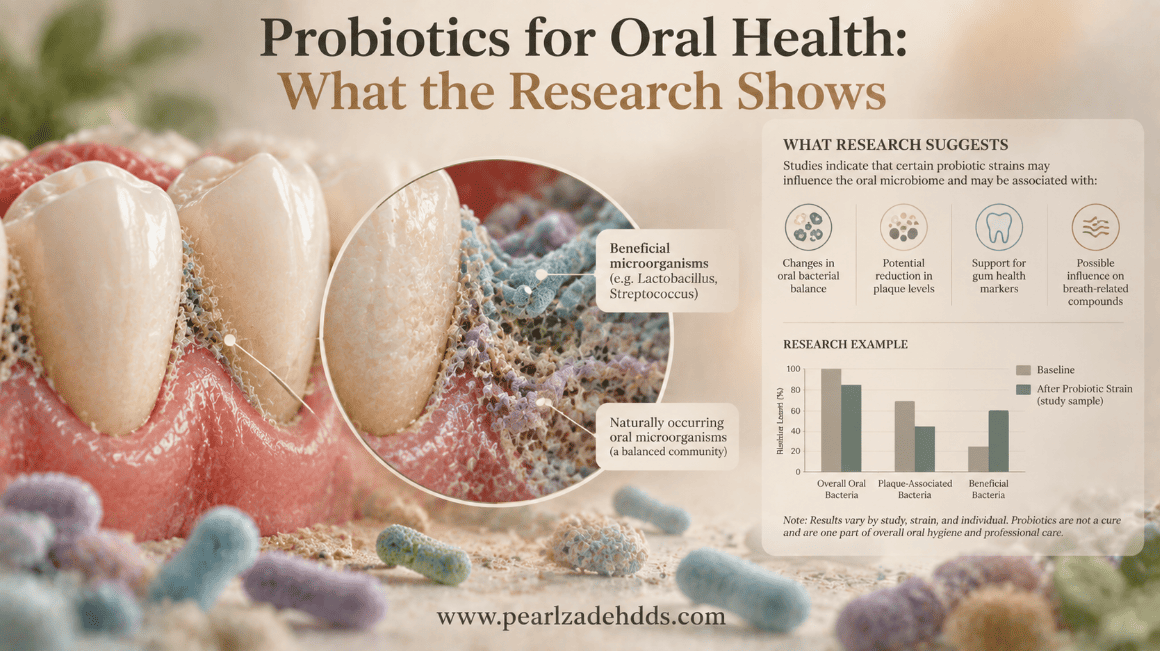
    Your mouth has its own microbial environment, and researchers are looking at whether certain probiotic strains can affect it. Some studies have found changes in oral bacteria, plaque, or gum inflammation. Those findings are interesting, but they do not automatically mean probiotics prevent cavities or gum disease.

    The more useful question is what probiotics have actually been shown to do for oral health, and how strong that evidence really is.

    What Are Probiotics?

    Probiotics are live microorganisms. They are intended to provide a health benefit when consumed in the right amounts. Most people know them from yogurt, fermented foods, or gut-health supplements. Not every probiotic strain works the same way. A strain studied for digestive health is not automatically effective in the mouth. Effects depend heavily on the specific organism, not the general category of probiotic.

    Why Are Researchers Studying Probiotics for Oral Health?

    The mouth hosts hundreds of bacterial species living in a delicate balance. Some contribute to health. Others contribute to cavities, gum inflammation, or bad breath when they grow out of proportion. Researchers are studying whether certain probiotic strains can interact with that existing community. Possible mechanisms include competing with harmful bacteria for space or nutrients. Some strains may also produce substances that influence the local environment. This is a more complicated process than simply swapping bad bacteria for good ones. The oral microbiome does not work like a light switch.

    Can Probiotics Improve the Balance of Oral Bacteria?

    Many studies measure changes in oral bacteria after probiotic use. A reduction in certain harmful species is a common finding. That is different from proving a meaningful health benefit. A shift in bacterial counts is a laboratory or clinical marker. It is not the same as fewer cavities or healthier gums in practice. This distinction matters throughout the rest of this discussion. Measuring bacteria is easier than measuring disease outcomes. That gap is part of why so much research stops at the bacterial level.

    Can Probiotics Help With Bad Breath?

    Bad breath, or halitosis, is often linked to bacteria that produce sulfur compounds. A recent systematic review found that several probiotic strains reduced these compounds in short-term studies. One study noted the effect persisting for several months after treatment stopped. The same review cautioned that study designs varied widely. Sample sizes were small, and long-term follow-up was limited in most trials. A short-term reduction in measured compounds is not the same as curing chronic bad breath. Persistent halitosis can also come from gum disease, dry mouth, sinus issues, or other causes. Those causes need a dental evaluation rather than a supplement. For another approach some people use alongside brushing, see our article on tongue scraping and oral health.

    Can Probiotics Help Prevent Cavities?

    Researchers are interested here because certain bacteria, especially Streptococcus mutans, play a central role in cavity formation. A systematic review and meta-analysis found that probiotics increased the odds of reducing S. mutans and Lactobacillus counts. The same analysis did not find a significant reduction in actual cavity incidence. Its authors described the current evidence as insufficient to recommend probiotics for managing cavities. Probiotics should not be treated as a replacement for fluoride, regular brushing, or other established cavity-prevention steps. Other ingredient-level approaches, like xylitol gum, face a similar gap between promising mechanisms and proven cavity prevention.

    Can Probiotics Help With Gingivitis?

    Gingivitis involves inflammation of the gums, usually from plaque buildup. Some studies have looked at whether probiotics reduce gum bleeding or visible inflammation. Results have been more encouraging here than for cavities. A systematic review and meta-analysis found that probiotics significantly reduced bleeding on probing. Gingival inflammation scores improved as well in that review. Modest improvements in gingivitis markers are not the same as treating established gum disease. They also do not mean probiotics can replace professional cleanings or daily plaque removal.

    What About Periodontal Disease?

    Periodontitis is different from gingivitis. It involves deeper structural damage, including bone and attachment loss around the teeth. The same systematic review found reductions in pocket depth as well as improvements in bleeding and gingival inflammation. Pocket depth is one of the main measurements of periodontitis severity. This finding was more encouraging than the review’s results for cavities. A separate article from the American Dental Association compared probiotics to antimicrobial treatments and found mixed results. Probiotics performed better on pocket depth and attachment loss in that comparison. Antimicrobial treatments performed better on plaque and gingival index scores. The strongest results came from combining probiotics with conventional antimicrobial treatment, not using probiotics alone. Probiotics should not be viewed as a replacement for periodontal treatment. Notice changes in your gums? Our article on early signs of gum disease covers what to watch for.

    Do Probiotic Foods Help Your Teeth?

    Yogurt and other fermented foods naturally contain live bacterial cultures. That does not automatically mean they benefit your teeth the same way a studied probiotic strain does. Most oral-health research uses specific strains in controlled doses, not whole foods. A food’s overall composition matters too. Some yogurts and fermented products contain added sugar. That sugar can work against any potential benefit from the live cultures. A probiotic food is not automatically good for your teeth simply because it contains probiotics. The rest of its ingredients matter just as much.

    Are Oral Probiotic Supplements Different From Regular Probiotics?

    Delivery method and strain both matter for oral effects. A capsule designed to survive stomach acid and reach the intestines is not built to linger in the mouth. Lozenges, chewable tablets, and some oral rinses are designed to stay in contact with oral tissues longer. Some research suggests this extended contact time may matter for strains studied specifically for oral use. That does not mean oral-specific products are automatically more effective than general probiotic foods or supplements. It only means they are designed around a different mechanism. As with other alternative ingredients, such as nano-hydroxyapatite toothpaste, product design and the underlying evidence deserve a closer look. Do not assume effectiveness.

    Do Gut Probiotics Also Benefit Your Mouth?

    This is a common assumption worth addressing directly. A probiotic supplement marketed for digestive health is not automatically effective for oral health. Benefits are strain-specific and often site-specific. A strain studied for reducing digestive symptoms was tested in the gut, not the mouth. Evidence for one part of the body does not automatically transfer to another. If oral benefits are the goal, look for strains studied specifically for oral outcomes. General gut-health products are a different question.

    How Strong Is the Evidence for Oral Probiotics?

    The honest answer is that the evidence is mixed and still developing. Several factors make it difficult to draw one universal conclusion. Studies use different probiotic strains, which do not all behave the same way. Doses and delivery methods vary considerably between products. Many studies run for only a few weeks or months. That limits what can be said about long-term effects. Participant groups are often small. Different studies measure different outcomes, from bacterial counts to gum bleeding to cavity incidence, which makes comparisons difficult. Baseline oral health varies between study populations too. Several reviews have found that benefits fade once probiotic use stops, rather than producing a lasting change. None of this means the research should be dismissed. It means the evidence is not yet strong enough to support broad, confident claims. That is similar to where the evidence currently stands for other emerging approaches like oil pulling.

    Are Probiotics Safe for Everyone?

    Most healthy adults tolerate common probiotic strains without issue. Safety is not automatically guaranteed simply because a product is labeled natural. Products vary in strain, dose, and quality control, and not all are studied equally. People with significant underlying medical conditions or weakened immune systems face different considerations. Authoritative medical guidance generally recommends discussing any new supplement, including probiotics, with a physician first in these situations. This article cannot assess your individual medical situation. General safety information is not a substitute for that conversation.

    Can Probiotics Replace Brushing, Flossing, or Dental Cleanings?

    No. Nothing in the current research supports using probiotics as a substitute for established oral hygiene. Brushing removes plaque mechanically, which no supplement can replicate. Cleaning between teeth reaches areas a toothbrush cannot. Fluoride, where appropriate, has decades of evidence behind it for cavity prevention. Limiting frequent sugar exposure reduces fuel for harmful bacteria. Regular dental exams catch problems before they become bigger ones. Professional cleanings remove buildup that a toothbrush alone cannot address. Even small daily habits, like whether you should rinse after brushing, are part of this larger picture. A probiotic cannot compensate for gaps in plaque control or untreated dental disease.

    Should You Add Probiotics to Your Oral-Care Routine?

    There is no universal yes or no answer here. The evidence supports some promising changes in bacteria, breath compounds, and gum inflammation markers. It does not yet support confident claims about preventing cavities or reversing periodontal disease. Someone might reasonably choose a specific, studied probiotic strain as one additional habit alongside their existing routine. That is different from expecting it to meaningfully change their cavity risk or gum disease on its own. Brushing, interdental cleaning, and regular dental visits still have considerably stronger evidence behind them. Oral probiotics have not caught up to that standard yet.

    What Should You Take Away About Probiotics for Oral Health?

    Probiotics may influence certain oral bacteria and show potential benefits for some aspects of oral health. However, the research is still developing, and changes in bacterial levels do not necessarily mean probiotics prevent cavities, gum disease, or other dental problems.

    For now, probiotics are better viewed as a possible addition to a healthy oral-care routine rather than a replacement for brushing, cleaning between your teeth, a balanced diet, or regular dental care.

    If you have concerns about your teeth, gums, sensitivity, persistent bad breath, or another oral-health problem, a dental evaluation can help identify what may be causing it and what care may be appropriate.

    Call (818) 716-6722 or click the button below to schedule your consultation online.

    Frequently Asked Questions

    Can probiotics prevent cavities?

    Current evidence is not strong enough to say probiotics prevent cavities. Studies often show reductions in cavity-causing bacteria, but far fewer show an actual reduction in new cavities.

    Can probiotics help bad breath?

    Some studies show probiotics reduce the compounds linked to bad breath in the short term. Evidence for long-term treatment of chronic halitosis remains limited.

    Do oral probiotics actually work?

    Effects vary by strain, dose, and the outcome being measured. Some changes in bacteria or symptoms have been shown, but proven long-term dental benefits are not yet well established.

    Are probiotic foods good for your teeth?

    Not automatically. A food’s overall content matters, including added sugar, and most oral-health research involves specific strains rather than whole foods.

    How long does it take for oral probiotics to work?

    There is no established timeframe, since effects depend on strain, dose, and what outcome is being measured. Reliable evidence for specific timelines is currently limited.

    This article is for informational purposes only and is not a substitute for professional dental advice. Please schedule a consultation with Pearl Zadeh DDS to discuss your specific situation.
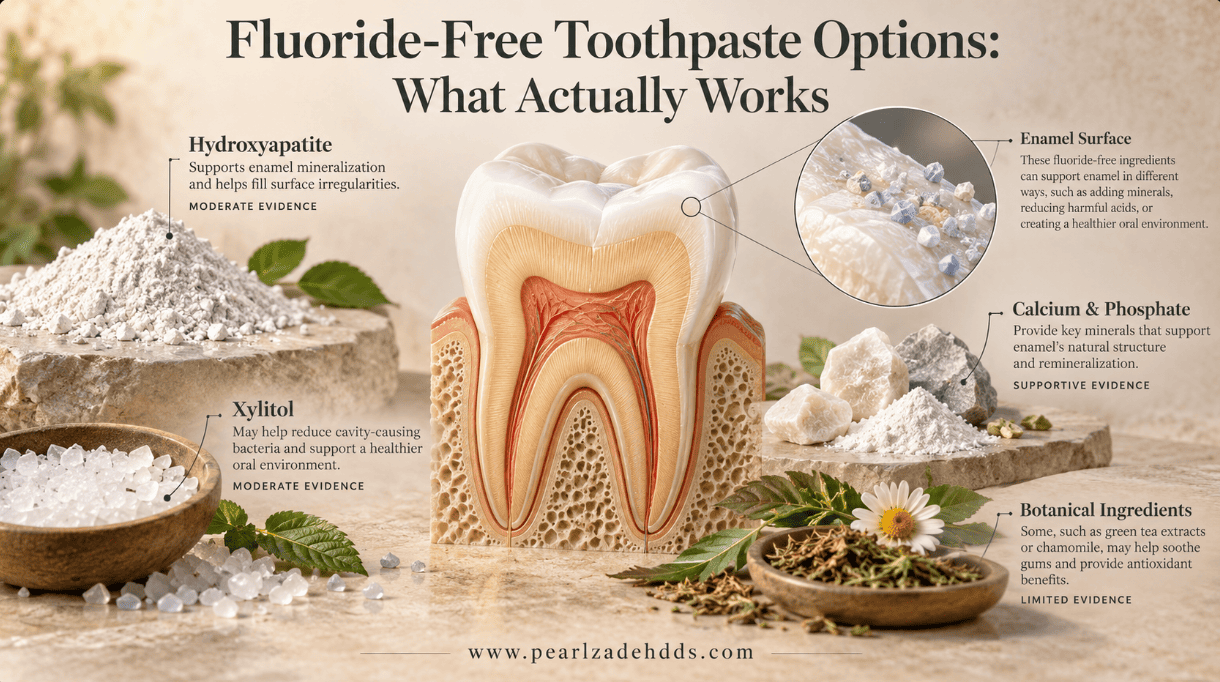
  • Fluoride-Free Toothpaste Options: What Actually Works

    Fluoride-Free Toothpaste Options: What Actually Works

    Choosing a fluoride-free toothpaste can feel surprisingly complicated. You may see hydroxyapatite, xylitol, calcium compounds, or herbal ingredients promoted as alternatives to fluoride. But the important question is not how impressive the ingredient list looks. It is whether the toothpaste can actually help protect your teeth from cavities.

    Fluoride has a long history of evidence behind its role in cavity prevention. Fluoride-free options have been studied too, but the evidence varies widely depending on the ingredient, formulation, and outcome being measured. Some may support enamel or help with specific oral-health concerns, while that does not necessarily mean they provide the same cavity protection as fluoride.

    If you are considering switching, it helps to look beyond the label and separate established benefits from promising but limited evidence.

    What Does Fluoride-Free Toothpaste Mean?

    Fluoride-free toothpaste is simply toothpaste that does not contain fluoride as an active ingredient. The term tells you what the formula leaves out, but not what it uses instead.

    That distinction matters because fluoride-free toothpaste is not one specific type of product. Formulations can differ considerably in their ingredients, intended benefits, and evidence.

    A toothpaste may be fluoride-free because it uses another ingredient intended to support enamel, reduce sensitivity, control plaque, or provide other oral-health benefits. Those purposes are not necessarily the same as preventing cavities.

    Why Do Some People Choose Fluoride-Free Toothpaste?

    People choose fluoride-free toothpaste for a range of personal reasons. Some simply prefer the taste or texture of a particular formula. Others have concerns about fluoride exposure, whether from personal research or family history. Some are drawn to a specific ingredient, such as hydroxyapatite, based on what they have read. Others may have switched after an unpleasant experience with a particular toothpaste.

    These reasons can explain why someone prefers a fluoride-free option, but they do not tell you how well that option protects your teeth. That question depends on the ingredients, formulation, and available evidence.

    What Ingredients Are Used in Fluoride-Free Toothpaste?

    Fluoride-free formulas can contain several different active ingredients, and they are not designed to work in exactly the same way.

    Nano-hydroxyapatite is a synthetic form of the mineral found in natural tooth enamel. It has been studied for its potential role in supporting enamel and early mineral loss.

    Xylitol is a sugar alcohol that may be included because of its effects on the oral environment and certain bacteria. Its presence does not mean the toothpaste provides the same cavity protection as fluoride.

    Calcium-based compounds appear in some formulations alongside phosphate. These ingredients are intended to provide minerals that may support the tooth surface.

    Arginine is an amino acid found in some toothpastes, particularly formulations designed for sensitivity. Some products also promote it for broader oral-health benefits.

    Herbal and botanical ingredients, such as neem or clove extracts, are common in naturally marketed toothpastes. They may serve different purposes, including flavor, but evidence for cavity prevention varies by ingredient and formulation.

    The important point is that “fluoride-free” describes what the toothpaste does not contain. It does not tell you what provides its active benefits. Looking at the specific ingredients is more useful than relying on terms such as “natural” or “fluoride-free.”

    Does Fluoride-Free Toothpaste Prevent Cavities?

    Cavity prevention depends on more than which toothpaste sits on your sink. According to the American Dental Association, fluoride helps strengthen enamel and supports the repair of early mineral loss caused by acids from oral bacteria. Its role in cavity prevention has been studied for decades.

    Fluoride-free ingredients have also been studied, but the available research varies by ingredient, formulation, and outcome. That makes it important to look at what a study actually measured rather than treating every positive finding as proof of cavity prevention.

    For example, a laboratory study using isolated tooth samples cannot tell us exactly how a toothpaste performs in everyday use. A reduction in certain plaque bacteria does not necessarily mean fewer cavities. Likewise, an improvement in a marker of remineralization does not automatically mean that an established lesion has reversed.

    These distinctions matter when comparing fluoride-free options. An ingredient may show a promising effect in one area without having the same level of evidence for preventing cavities in people.

    Is Nano-Hydroxyapatite a Good Alternative to Fluoride?

    Hydroxyapatite is a mineral that makes up much of natural tooth enamel. That structural similarity is one reason it has attracted interest as a fluoride-free toothpaste ingredient.

    An 18-month randomized clinical trial in adults examined changes in tooth surface damage related to cavities. About 89% of participants using hydroxyapatite showed no increase in the measured damage, compared with about 87% of those using fluoride. The study found hydroxyapatite to be statistically non-inferior to fluoride for the outcome it measured.

    A systematic review of hydroxyapatite research also found evidence supporting its effectiveness in the clinical studies it analyzed. However, the review included a relatively small number of trials, and some were considered to have limitations in study quality.

    That matters when interpreting the results. Several studies involved specific populations or relatively short follow-up periods, so the findings may not represent every adult or every toothpaste formulation. The research also does not yet match the depth and duration of the evidence supporting fluoride for cavity prevention.

    So, while nano-hydroxyapatite is a promising fluoride-free ingredient, the current evidence does not establish it as a universal replacement for fluoride. Its potential benefits should be considered alongside your cavity risk, oral-health needs, and the specific toothpaste formulation.

    For a closer look at how nano-hydroxyapatite works, see our guide to nano-hydroxyapatite toothpaste.

    Can Xylitol Help If You Use Fluoride-Free Toothpaste?

    Xylitol is a sugar alcohol, not a mineral, and it works differently from fluoride. Research suggests it may affect certain oral bacteria and the oral environment, but those effects do not automatically translate into fewer cavities.

    A Cochrane review of xylitol research found the evidence too limited and inconsistent to support firm conclusions about its ability to prevent tooth decay. The modest benefit identified in some research involved xylitol added to fluoride toothpaste, rather than a fluoride-free toothpaste containing xylitol.

    Chewing gum is also a separate category from toothpaste, and findings from xylitol gum cannot simply be applied to toothpaste. Our article on xylitol gum and cavity prevention looks at that evidence in more detail.

    For that reason, the presence of xylitol in a fluoride-free toothpaste should not be treated as proof that the product prevents cavities.

    Can Fluoride-Free Toothpaste Remineralize Enamel?

    Remineralization occurs when minerals are redeposited into enamel after it has started to lose them. This process is different from treating an established cavity, where tooth structure has already been lost.

    Early, non-cavitated enamel changes may respond to remineralization. Once decay has created a cavity, however, toothpaste cannot simply rebuild the missing tooth structure.

    Fluoride has a well-established role in supporting enamel remineralization and slowing the progression of early carious lesions. Hydroxyapatite and certain calcium-based ingredients are also being studied for their potential effects on enamel mineralization.

    The evidence for these fluoride-free ingredients depends on the specific compound, formulation, and study design. Some findings are promising, but they should not be interpreted as proof that every fluoride-free toothpaste can remineralize enamel to the same extent as a fluoride toothpaste.

    Is Fluoride-Free Toothpaste Good for Sensitive Teeth?

    Some fluoride-free formulas contain ingredients aimed at dentin sensitivity, including arginine or certain calcium compounds. These ingredients may reduce sensitivity by affecting the pathways involved in pain transmission.

    That benefit is separate from cavity prevention. A toothpaste can help reduce sensitivity without providing the same protection against cavities associated with fluoride.

    Sensitivity can also become more noticeable during or after whitening. Our guide to teeth whitening for sensitive teeth covers that issue in more detail.

    Can Fluoride-Free Toothpaste Whiten Teeth?

    Whitening ability depends on the ingredients and how they work. Many toothpastes, whether they contain fluoride or not, can help remove surface stains through mild abrasives. That is different from chemical bleaching, which changes the color of the tooth itself.

    Some fluoride-free formulas contain ingredients intended to help with surface staining, while others do not. The absence of fluoride does not make a toothpaste more or less effective for whitening.

    If whitening is the main goal, look at the specific whitening ingredients and their mechanism rather than the fluoride content alone.

    Is Fluoride-Free Toothpaste Safe?

    Safety depends on the specific formulation and how the product is used. A fluoride-free toothpaste is not automatically safer than a fluoride toothpaste, but choosing a fluoride-containing product does not make every formulation appropriate for every person either.

    When available, the ADA Seal of Acceptance can provide useful information about products that have met the ADA’s evaluation requirements.

    The more important question is whether the toothpaste fits your oral-health needs and provides the benefits you are looking for.

    Who May Need to Think Carefully Before Switching?

    Some people have a higher risk of developing cavities than others. That risk is worth considering before switching away from fluoride.

    Factors that can increase cavity risk include:

    • Frequent exposure to sugary or carbohydrate-rich foods and drinks
    • A history of previous cavities
    • Dry mouth or reduced saliva flow
    • Certain medications or medical conditions that affect saliva
    • Gum recession that exposes root surfaces
    • Difficulty maintaining consistent oral hygiene
    • Existing dental problems

    Root surfaces are more vulnerable to decay because they do not have the same protective enamel covering as the crowns of teeth.

    Having one or more of these risk factors does not automatically rule out fluoride-free toothpaste. It does mean that the potential benefits and limitations deserve closer consideration.

    What Matters More Than the Toothpaste Brand?

    Toothpaste is only one part of cavity prevention. Daily habits and your overall oral-health routine matter too.

    Brushing twice daily helps remove plaque from tooth surfaces. Cleaning between your teeth reaches areas a toothbrush cannot clean effectively. Limiting frequent sugar exposure reduces repeated acid challenges to the teeth. Managing dry mouth can also be important when saliva flow is reduced.

    Regular dental examinations provide another layer of prevention by allowing problems to be identified before they progress.

    Choosing a different toothpaste cannot make up for gaps in the rest of your oral-hygiene routine.

    Should You Switch to Fluoride-Free Toothpaste?

    There is no single answer that applies to every adult. The decision depends on why you want to avoid fluoride, your cavity risk, the specific formulation you are considering, and the evidence supporting its active ingredients.

    Someone with a low cavity risk may have different considerations from someone who has developed cavities repeatedly or has significant dry mouth.

    The important question is not whether fluoride-free toothpaste is universally good or bad. It is whether the particular product provides enough benefit for your individual needs and whether you understand what you may be giving up by switching.

    If you are unsure how your cavity risk affects that decision, a dentist can assess your oral health and discuss the options with you.

    Talk to Dr. Pearl Zadeh About Your Oral Health Routine

    Toothpaste is only one part of preventing cavities. The active ingredients, your personal cavity risk, and your daily routine all play a role together. Brushing technique, diet, and regular checkups matter just as much as what is in the tube.

    If you have questions about your cavity risk or your overall prevention plan, Dr. Pearl Zadeh and her Woodland Hills team can help you build a routine suited to your needs.

    Call (818) 716-6722 or click the button below to schedule your consultation online.

    Frequently Asked Questions

    What is the best fluoride-free toothpaste?

    There is no single best option, since fluoride-free formulas vary widely in ingredients and evidence. The right choice depends on your cavity risk, oral health needs, and what you are hoping to address.

    Does fluoride-free toothpaste prevent cavities?

    Some fluoride-free ingredients, particularly hydroxyapatite, have shown promising results in a limited number of studies. The evidence is not as extensive as the decades of research behind fluoride, and results vary by ingredient and formulation.

    Is fluoride-free toothpaste effective?

    Effectiveness depends on the specific active ingredient and what it is meant to do. Some ingredients have meaningful supporting evidence, while others have little research behind their cavity-prevention claims

    Is nano-hydroxyapatite better than fluoride?

    Current research suggests hydroxyapatite can perform comparably to fluoride in some studies, but the evidence base is smaller and newer. It has not been shown to definitively replace fluoride for every adult.

    Can fluoride-free toothpaste remineralize enamel?

    Some fluoride-free ingredients may support remineralization of early, non-cavitated changes in enamel. No toothpaste can fully rebuild enamel that has already been lost to an established cavity.

    This article is for informational purposes only and is not a substitute for professional dental advice. Please schedule a consultation with Pearl Zadeh DDS to discuss your specific situation.
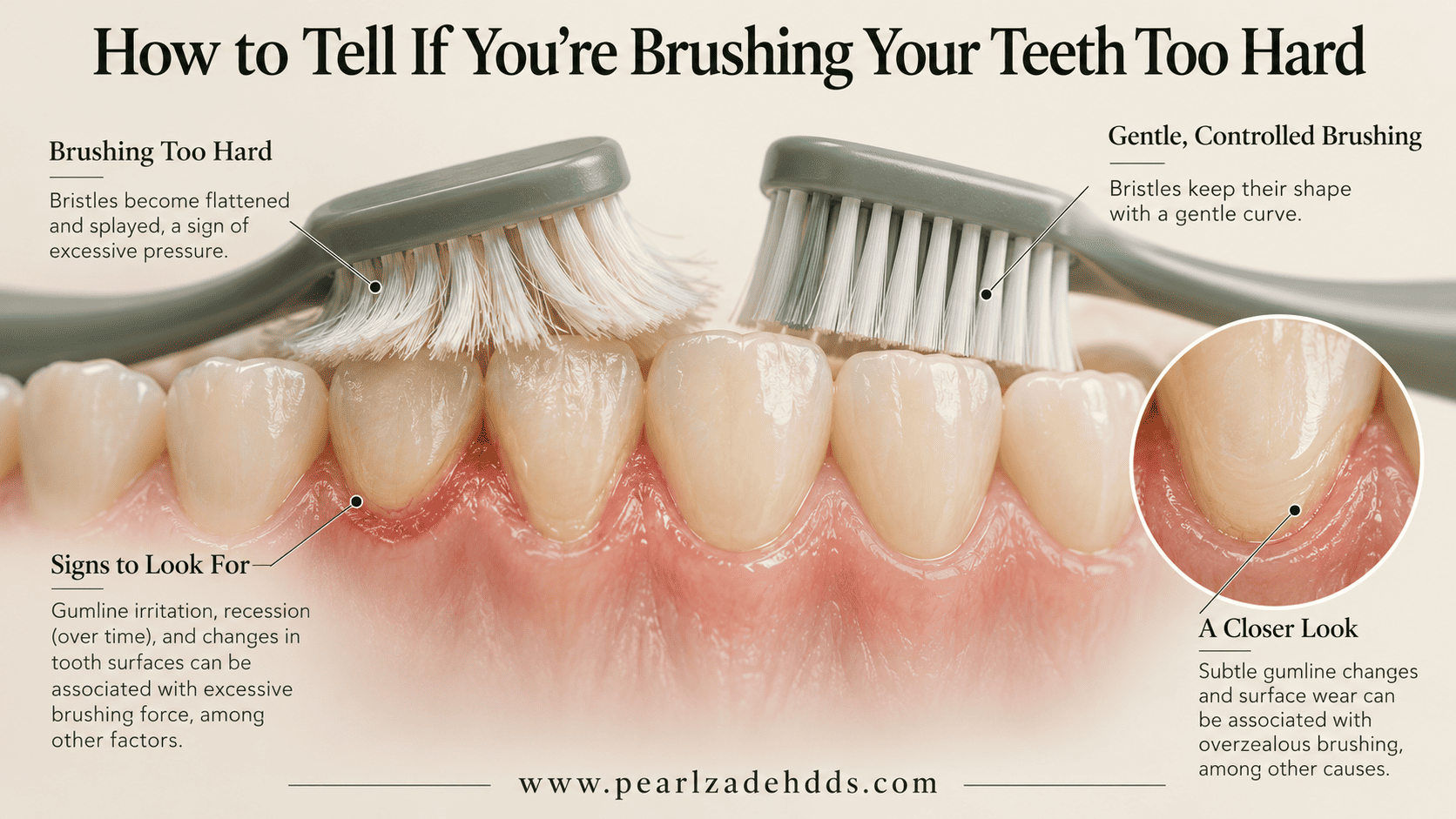
  • How to Tell If You’re Brushing Your Teeth Too Hard

    How to Tell If You’re Brushing Your Teeth Too Hard

    A toothbrush can leave your teeth feeling clean without leaving your gums sore afterward. If your bristles look worn out quickly, your gums feel tender after brushing, or certain teeth have become more sensitive, your brushing pressure may be part of the reason.

    The problem is not brushing thoroughly. Your teeth and gums need regular plaque removal. The issue is how much force you use to get there. Pressure, brushing technique, the type of toothbrush, and the condition of your gums and enamel can all affect how your mouth responds.

    Clues That You May Be Using Too Much Pressure

    Your toothbrush and your mouth can give you useful clues. Look at what happens during and after brushing rather than focusing on one symptom alone.

    Bristles that flatten or splay quickly can suggest that you are applying more force than necessary. Gum irritation or tenderness after brushing can be another clue. You may also notice sensitivity around certain teeth or visible changes near the gumline.

    Some people notice that their gums appear to sit lower around certain teeth. Others find themselves gripping the toothbrush tightly and pressing it firmly against their teeth because lighter brushing feels like it is not doing enough.

    None of these signs proves that brushing pressure is the cause. Gum inflammation, recession, enamel wear, and tooth sensitivity can have other causes. The pattern matters more than any single sign.

    Can Brushing Too Hard Damage Your Gums?

    Excessive mechanical force can contribute to gum irritation. In some cases, it can also contribute to recession over time. It helps to separate a few different things. Temporary irritation after a rough brushing session is not the same as gum recession. Inflammation caused by plaque buildup is different from mechanical trauma. Periodontal disease is a separate condition with its own causes. Naturally thin gum tissue can also make someone more prone to recession, regardless of brushing habits. Aggressive brushing is not the sole cause of gum recession. Recession can have several contributing factors, and brushing force is only one of them.

    Can Brushing Too Hard Wear Down Your Enamel?

    Enamel is the hard outer layer of a tooth. Dentin is the softer layer underneath it. Tooth wear can involve more than one factor at once. Mechanical abrasion from a toothbrush is one contributor. Acidic exposure from food and drinks is another. Abrasive toothpaste can play a role as well. Existing enamel loss can make a tooth more vulnerable to further wear. Brushing technique itself matters too. Ordinary brushing does not automatically wear away healthy enamel. It is not accurate to say that brushing too hard simply scrapes enamel off. The reality usually involves several factors working together over time.

    Why Are My Teeth Sensitive If I Brush Too Hard?

    Sensitivity can occur when dentin becomes exposed or when the gumline shifts. This does not automatically mean you have been brushing too hard. Several other things can cause sensitivity too. Gum recession from other causes. Enamel wear unrelated to brushing. Exposed root surfaces. Recent whitening treatments. Cavities, cracks, and other dental conditions. If whitening is part of the picture, our guide to teeth whitening for sensitive teeth covers that angle separately. Avoid diagnosing the cause yourself, since the wrong assumption can delay the right treatment.

    What Does a Toothbrush Look Like If You Brush Too Hard?

    Your toothbrush can offer a practical clue. Excessive force can cause bristles to flare outward. It can cause them to flatten sooner than expected. Bristles can bend permanently in one direction. Wear can also happen unevenly across the brush head. Compare this with a toothbrush that wears down gradually and evenly through normal use. Bristle condition alone cannot diagnose your brushing pressure. It is still a useful clue worth paying attention to.

    How Much Pressure Should You Use When Brushing?

    There is no single, universally agreed-upon pressure measurement to aim for. Brushing should feel controlled and gentle rather than forceful. Use enough pressure to keep the bristles in contact with your tooth surfaces and gumline. You should not need to scrub aggressively to feel clean. Some electric toothbrushes include a pressure sensor. This feature can alert you when you are pressing too hard, which may help some people recognize the habit. Not everyone needs an electric toothbrush to brush appropriately. It is simply one tool that can help certain people.

    Is a Soft-Bristled Toothbrush Better for Your Gums?

    Soft-bristled toothbrushes are commonly recommended by dental professionals. According to the American Dental Association, firm or medium-strength bristles may cause damage to your gums and enamel. Brush type is only one part of the picture, though. Technique, pressure, and brushing frequency matter too. So does toothpaste choice, including options like nano-hydroxyapatite toothpaste. The current condition of your teeth and gums plays a role as well. Soft bristles do not automatically prevent recession or enamel wear on their own. They are one piece of a larger routine.

    Does Brushing Harder Remove More Plaque?

    More pressure does not necessarily mean better plaque removal. Technique and thorough coverage matter more than force. Aggressive scrubbing can actually become counterproductive. It can cause discomfort that leads someone to avoid certain areas, leaving plaque behind in those spots. The goal is effective plaque disruption across every surface, not maximum force in a few areas. Habits like chewing xylitol gum between meals can support plaque control, but they do not replace brushing itself.

    How Should You Brush Without Scrubbing Too Hard?

    A few practical steps can help. Use a soft-bristled toothbrush. The American Dental Association recommends a 45-degree angle at the gumline, with short, gentle back-and-forth strokes. Clean all tooth surfaces systematically so nothing gets skipped. Avoid forceful scrubbing motions. Reach the inside, outside, and chewing surfaces of every tooth. Brush for about two minutes, twice a day. Replace your toothbrush once the bristles start to look worn. What you do right after brushing matters too, including whether you should rinse after brushing. No single brushing motion works identically for every person, so adjust these steps to fit your own mouth comfortably.

    What If Your Gums Bleed When You Brush?

    Bleeding does not automatically mean you are brushing too hard. It can happen for a few different reasons. Plaque-related gum inflammation is a common cause. Brushing technique can play a role. Existing gum problems can contribute as well. Other oral health conditions are possible too. If bleeding continues despite gentle brushing and consistent oral hygiene, a dental evaluation can help identify the cause. Our article on early signs of gum disease you should not ignore covers other warning signs worth watching for.

    Can Brushing Too Hard Cause Gum Recession?

    Brushing force can be one contributing factor to gum recession. It is rarely the only one. Gum tissue anatomy plays a role for some people. Periodontal disease is a separate and common cause. Tooth position can make certain areas more prone to recession. Physical trauma and other mechanical factors can contribute too. Brushing more gently will not reverse recession that has already happened. Once recession occurs, the right approach depends on its cause and how severe it is.

    What If You Already Have Sensitive Teeth or Receding Gums?

    People with existing sensitivity or exposed root surfaces often need to be more careful with brushing pressure. Gentler brushing alone will not fix an underlying dental problem, though. It helps to identify why the sensitivity or recession is present in the first place. Changing your entire routine drastically, without knowing the cause, is not usually the right first step. A dentist can help you figure out what is actually going on before you make major changes.

    Can an Electric Toothbrush Help You Stop Brushing Too Hard?

    Some electric toothbrushes include pressure sensors. These alert you when you are applying excessive force during brushing. This feature may help people who struggle to judge their own pressure by feel alone. An electric toothbrush does not automatically guarantee proper technique, though. You can still brush too hard, or miss areas, with any type of toothbrush. The right choice comes down to which tool helps you brush consistently and comfortably.

    How Often Should You Replace Your Toothbrush?

    Worn bristles clean differently than fresh ones and may become less effective over time. The American Dental Association recommends replacing your toothbrush every three to four months. Replace it sooner if the bristles look frayed or worn before then.

    What If Brushing Hurts?

    Brushing should not require painful pressure to feel effective. Persistent pain deserves attention, not just a change of toothbrush. A few different experiences are worth distinguishing. Mild gum tenderness after a rough brushing session. Sensitivity that is triggered specifically by brushing. Pain concentrated in one particular tooth. Pain that persists well beyond the moment of brushing. Pain associated with swelling or other symptoms. The exact cause is not something to diagnose from these details alone.

    When Should You See a Dentist?

    A few signs are worth a dental evaluation. Persistent gum bleeding that does not improve. Visible gum recession. Ongoing sensitivity that does not settle down. Exposed root surfaces. Pain concentrated in one tooth. Changes in the shape or appearance of a tooth. Suspected enamel or tooth wear. Symptoms that continue even after you adjust your brushing technique. A dental exam can help distinguish brushing-related wear from gum disease, decay, cracks, erosion, or other causes.

    Talk to Dr. Pearl Zadeh About Your Brushing Routine

    Effective brushing is about consistent plaque removal, not force. A gentle, controlled technique and a suitable toothbrush can help protect your teeth and gums. That keeps your daily routine effective without added risk.

    If you have persistent sensitivity, bleeding, recession, or pain, do not assume brushing pressure is the cause. Dr. Pearl Zadeh and her Woodland Hills team can help determine what is actually going on.

    Call (818) 716-6722 or click the button below to schedule your consultation online.

    Frequently Asked Questions

    How can I tell if I am brushing my teeth too hard?

    Common clues include bristles that flatten or splay quickly, gum tenderness after brushing, sensitivity near certain teeth, and gripping the brush tightly out of habit. One clue alone is not proof, so look at the overall pattern.

    What are the signs of brushing too hard?

    Signs include worn or splayed bristles, gum irritation, visible wear along the gumline, and gums that appear to pull away from certain teeth. Several of these signs can also have other causes.

    Can brushing too hard damage your gums?

    It can contribute to irritation and, in some cases, recession over time. It is not the only possible cause, since gum tissue type, periodontal disease, and other factors can contribute as well.

    Can brushing too hard wear down enamel?

    Mechanical abrasion from brushing can be one contributor to tooth wear, but it usually works alongside other factors like acidic exposure, abrasive products, and existing enamel condition. Ordinary brushing does not wear away healthy enamel on its own.

    Can brushing too hard cause sensitive teeth?

    It can, if dentin becomes exposed or the gumline changes. Sensitivity has many other possible causes too, so it should not be assumed to come from brushing pressure alone.

    This article is for informational purposes only and is not a substitute for professional dental advice. Please schedule a consultation with Pearl Zadeh DDS to discuss your specific situation.
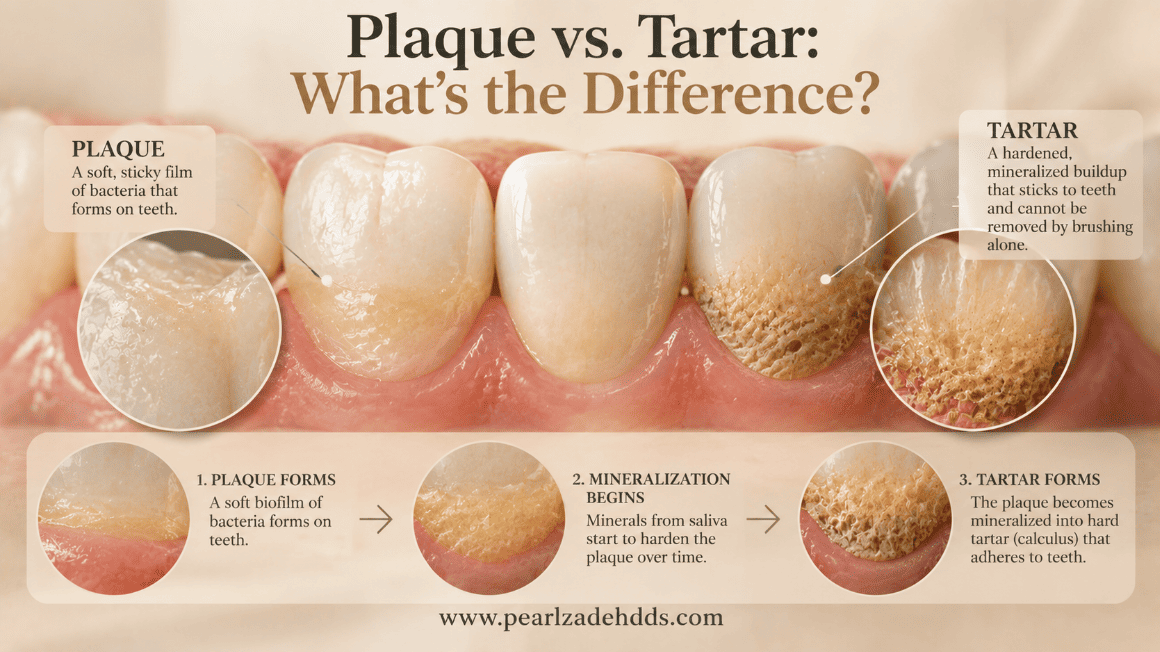
  • Plaque vs. Tartar: What’s the Difference?

    Plaque vs. Tartar: What’s the Difference?

    You run your tongue over your teeth and feel something rough near the gumline, maybe with a yellowish tint. Is that plaque, or has it already turned into something else?

    Plaque is a soft bacterial film that builds up on your teeth. Tartar is that same material after it has hardened into a mineral deposit. The distinction matters practically: daily brushing and flossing can disrupt plaque, but once it hardens into tartar, brushing alone generally cannot remove it. That difference shapes everything else about how each one gets handled.

    What Is Plaque?

    Plaque is a biofilm, a sticky layer of bacteria that forms continuously on tooth surfaces. The American Dental Association describes it as a sticky film containing bacteria that, after a meal or snack with sugar, can release acids that attack tooth enamel. Repeated acid attacks can break down enamel and eventually lead to cavities.

    It is not simply food stuck between your teeth, though food residue feeds the bacteria within it. Plaque forms naturally as part of ordinary bacterial activity in your mouth, whether you have eaten recently or not. It tends to build up most along the gumline, between teeth, and on chewing surfaces with grooves and pits.

    This is why plaque can feel fuzzy or slightly slippery when you run your tongue over your teeth, particularly later in the day. It starts reforming within hours of brushing, which is why daily cleaning is a repeated habit rather than a one-time fix. A toothbrush cannot fully clean between teeth or reach every groove, which is part of why plaque tends to persist in certain spots.

    What Is Tartar?

    Tartar, also called dental calculus, is not simply a thicker layer of plaque. It is a fundamentally different material: plaque that has mineralized and hardened onto the tooth surface, incorporating calcium and phosphate from saliva.

    Where plaque feels soft and can be wiped away, tartar feels hard and rough, often described as gritty or crusty. It commonly develops along the gumline, particularly in areas that are harder to clean thoroughly, and can form both above the gum (visible) and below it (not visible without a dental exam).

    Color varies. Tartar often appears yellow or tan, though it can look darker in some areas depending on staining from food, drinks, or tobacco. Appearance alone does not tell you how extensive the deposit is. A small visible patch can sit above a larger deposit below the gumline that you cannot see.

    Plaque vs. Tartar: What Is the Difference?

    The short version, side by side:

    PlaqueTartar
    Soft bacterial biofilmHardened, mineralized deposit
    Develops continuously, all dayForms only when plaque mineralizes
    Can often be disrupted by daily brushing and flossingUsually requires professional removal
    Often feels fuzzy or slipperyOften feels hard or rough
    Can contribute to cavities and gum inflammationCan make plaque control harder and contribute to gum problems

    The appearance of plaque and tartar can vary from person to person. If you notice unusual buildup, discoloration, or rough areas on your teeth, a dental professional can help identify what is causing it and whether it needs attention.

    Can Plaque Turn Into Tartar?

    Yes. When plaque is not adequately removed through regular brushing and interdental cleaning, minerals from saliva gradually incorporate into it, and it hardens. The ADA describes this directly: plaque left in place can eventually harden into calculus, making it more difficult to keep teeth clean going forward.

    How quickly this happens varies meaningfully between people. Saliva composition and flow rate play a role, and so does how consistently plaque gets removed day to day. There is no reliable universal timeframe that applies to everyone, despite how often specific numbers get repeated online. Some people notice hardened deposits forming quickly in certain spots; others rarely develop much at all, even with similar habits.

    Can You Brush Away Plaque?

    Largely, yes, from the surfaces your toothbrush can actually reach. Brushing twice daily with proper technique, angling bristles toward the gumline and covering all accessible tooth surfaces, disrupts and removes a meaningful amount of plaque before it has a chance to sit long enough to mineralize.

    Technique and consistency matter more than how hard you brush. Rushing, missing the gumline, or skipping areas leaves plaque in those spots, even if the rest of your mouth looks clean. Brushing does not remove every trace, particularly between teeth, which is why interdental cleaning is a separate, necessary step.

    Can You Brush Away Tartar?

    No, generally not, once plaque has actually hardened into calculus. At that point it is bonded to the tooth surface in a way ordinary brushing pressure cannot disrupt.

    Do not try to scrape it off with household objects, a metal pick, a fingernail, or a scaling tool bought online. Beyond simply not working well, aggressive scraping with the wrong instrument or technique can injure gum tissue or scratch tooth enamel, creating new problems without solving the original one. Removing established tartar safely requires a dental professional’s instruments and training.

    Can Flossing Remove Tartar?

    No, and this is worth being clear about since it is a common point of confusion. Floss and other interdental cleaners are effective at disrupting plaque between teeth before it has a chance to harden. Once that plaque has mineralized into tartar, floss simply is not designed to remove it. Our guide to flossing technique covers how to clean between teeth effectively, which is genuinely useful for preventing tartar buildup between teeth in the first place, even though it will not remove tartar that has already formed.

    What Does Tartar Look and Feel Like?

    Hard rather than soft is the defining physical trait, along with a rough or gritty texture you can sometimes feel with your tongue or notice when running floss across it. Color commonly runs yellow to tan, though darker deposits, brown or black in appearance, show up in some areas depending on staining. It tends to accumulate most noticeably behind the lower front teeth and around the molars.

    It is worth being cautious here: you should not assume tartar based on appearance alone. Other discoloration, from coffee, tea, tobacco, or certain foods, can look similar without being hardened calculus at all. What you are looking at is something a dental exam can identify accurately; guessing from a mirror often cannot.

    Why Does Tartar Build Up Behind the Lower Front Teeth?

    This specific location is not a coincidence. The openings of two major salivary glands sit near the floor of the mouth, close to the inner surface of the lower front teeth. Saliva flowing from those glands carries minerals, and that steady mineral exposure in this particular spot makes it a common site for calculus to form, more so than many other areas of the mouth.

    A similar pattern shows up near the upper back molars, close to another major salivary gland opening on the inside of the cheek. Noticing buildup in these two specific spots more than elsewhere is common and expected, not necessarily a sign that something else is wrong.

    Can Plaque and Tartar Cause Bad Breath?

    Plaque can, since the bacteria within it produce byproducts that contribute to oral odor. Tartar is not necessarily the direct cause of every case of bad breath on its own, but its rough surface gives plaque more places to cling to and accumulate, which can indirectly make odor worse over time.

    Persistent bad breath has several possible causes beyond tartar, including tongue coating, dry mouth, certain foods, and other oral or systemic factors. It should not automatically be attributed to tartar without an actual look at what is going on.

    Can Plaque and Tartar Cause Gum Disease?

    Plaque accumulation along the gumline can lead to gingivitis, the earliest stage of gum inflammation. In some people, persistent, unaddressed inflammation can progress to more serious periodontal disease over time, though susceptibility varies between individuals.

    Tartar’s role is somewhat different. Rather than being a direct, independent cause, its rough surface makes plaque control considerably more difficult once it is present, since plaque adheres to it more readily than to smooth enamel. That can indirectly contribute to ongoing gum irritation. Having tartar does not automatically mean someone has periodontal disease; it means plaque control in that area has gotten harder, which is worth addressing.

    How Can You Prevent Tartar From Forming?

    The approach is mostly about limiting how much plaque has the chance to sit long enough to mineralize. Brushing twice daily with fluoride toothpaste, cleaning between teeth daily, and paying particular attention to the gumline all help. Our article on whether to rinse after brushing covers one habit that affects how well fluoride toothpaste actually works between brushings.

    Regular dental exams and cleanings catch and remove buildup before it becomes extensive. None of this guarantees zero tartar for every person; individual saliva composition and other factors mean some people are simply more prone to it than others, even with excellent habits.

    How Is Tartar Removed?

    Dental professionals use specialized instruments, hand scalers or ultrasonic devices, to physically remove hardened deposits from the tooth surface, both above and below the gumline. The specific approach depends on how much calculus is present and where it has developed.

    A routine cleaning and a deeper periodontal treatment are not the same thing, and not every patient needs the latter. Someone with a modest amount of surface tartar typically needs a standard cleaning. Someone with significant gum disease and extensive subgingival calculus may need a different level of periodontal care, determined by an actual exam rather than assumed from how things look or feel at home.

    How Often Should You Get a Professional Cleaning?

    There is no single interval that fits every patient, and treating six months as a universal rule misses how individualized this actually is. Gum health, history of periodontal disease, how quickly plaque and calculus tend to build up for you specifically, cavity risk, and general oral hygiene all factor into what makes sense.

    Some people do well on a roughly six-month schedule. Others, particularly those with a history of gum disease or faster calculus buildup, benefit from more frequent visits. A dentist assessing your specific mouth is what actually determines the right interval, not a blanket recommendation applied the same way to everyone.

    What Happens If Tartar Is Left on Your Teeth?

    Left in place, tartar tends to make everyday plaque control progressively harder in that area, since its rough surface gives plaque more to grip onto. Over time this can contribute to persistent gum inflammation in the affected spot.

    How much this matters, and how it progresses, varies between individuals. It is not accurate to say tartar inevitably leads to tooth loss or severe disease for everyone who has it. It is accurate to say that untreated buildup does not resolve on its own and generally continues affecting the surrounding tissue until it is professionally removed.

    Is Tartar the Same as a Stain?

    No, and confusing the two is common. Plaque is a soft, active biofilm. Tartar is hardened, mineralized plaque. Extrinsic staining is a surface discoloration, from coffee, tea, wine, or tobacco, that sits on the tooth or on plaque and tartar without being either one itself. Your natural tooth color is a separate factor entirely, unrelated to any buildup.

    A dark or yellow area is not automatically tartar. It could be surface staining on otherwise clean enamel, staining sitting on top of existing tartar, or simply how a particular tooth is colored. Not every visible discoloration needs scraping, and assuming so can lead to unnecessary worry or, worse, someone trying to remove it at home with the wrong tool.

    Have Your Teeth Evaluated Rather Than Guessing

    Plaque is a soft biofilm that daily brushing and flossing can help control. Tartar is hardened calculus that generally needs professional removal once it forms. Keeping plaque buildup in check is what actually reduces how much tartar accumulates over time.

    If you have noticed rough or discolored areas on your teeth and are not sure what you are dealing with, Dr. Pearl Zadeh can take an actual look and let you know what it is and what, if anything, it needs.

    Call (818) 716-6722 or click the button below to schedule your consultation online.

    Frequently Asked Questions

    What is the difference between plaque and tartar?

    Plaque is a soft bacterial film that forms continuously and can be disrupted by daily brushing and flossing. Tartar is that same plaque after it has hardened into a mineral deposit, which generally requires professional removal.

    Can plaque turn into tartar?

    Yes. Plaque that is not adequately removed can absorb minerals from saliva and harden into tartar over time. How quickly this happens varies between individuals.

    Can you brush away plaque?

    Largely yes, from surfaces your toothbrush can reach, with proper technique and consistency. Brushing does not remove every trace, particularly between teeth, which is why interdental cleaning matters too.

    How long does it take for plaque to become tartar?

    There is no reliable universal timeframe. Individual factors, including saliva composition and how consistently you remove plaque, can affect it, so the timeframe varies from person to person.

    Why does tartar build up behind my bottom front teeth?

    Major salivary gland openings sit near the inner surface of the lower front teeth, exposing that area to a steady flow of mineral-containing saliva, which makes it a common site for calculus to form.

    This article is for informational purposes only and is not a substitute for professional dental advice. Please schedule a consultation with Pearl Zadeh DDS to discuss your specific situation.
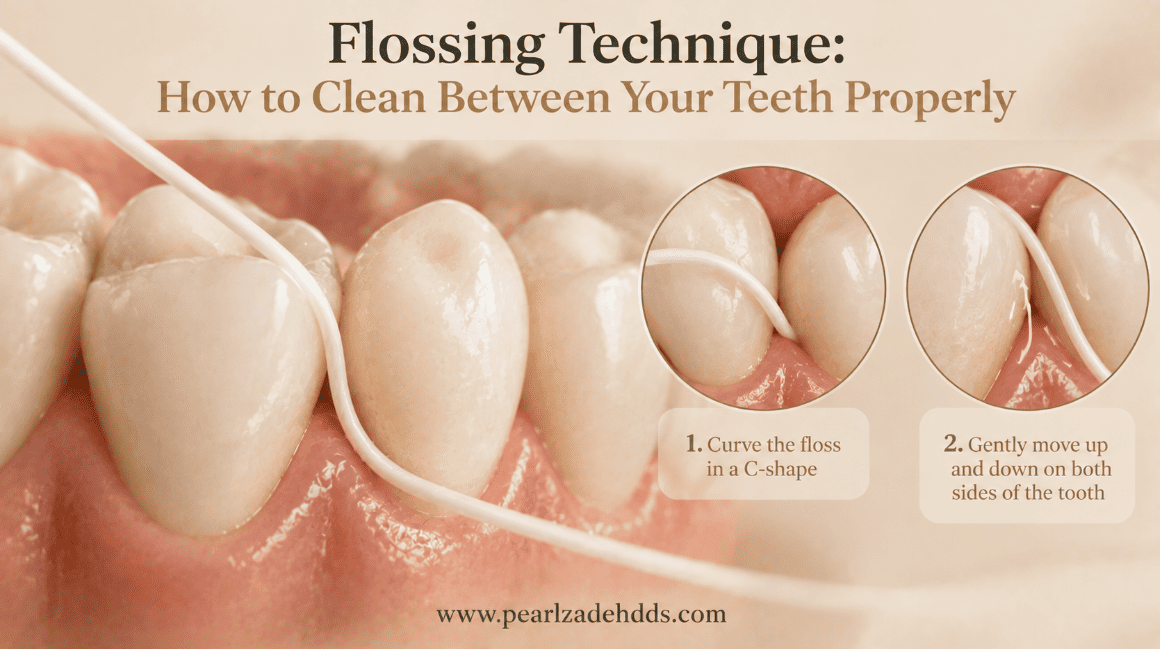
  • Flossing Technique: How to Clean Between Your Teeth Properly

    Flossing Technique: How to Clean Between Your Teeth Properly

    Plenty of people floss every day and still are not cleaning between their teeth effectively. Sliding floss into a gap and pulling it back out is not the whole technique, even though it is what most of us default to.

    Effective flossing means cleaning the side of each tooth on either side of that gap, and gently reaching the area just below where the gum meets the tooth. That is a different motion than simply passing floss through the space once. None of this requires perfect form. A few adjustments to what you are already doing make a real difference.

    Why Does Flossing Technique Matter?

    A toothbrush cleans the front, back, and chewing surfaces well. It cannot reach the tight space between two neighboring teeth, which collects plaque just as readily as any other surface. Interdental cleaning exists specifically to reach it.

    The goal is to physically disrupt and remove that plaque from the sides of both teeth and from just beneath the gumline, not to move a strand of floss up and down once and call it done. A single quick pass through the contact point without curving against each tooth surface leaves plaque behind on exactly the surfaces you were trying to clean.

    How to Floss Properly Step by Step

    1. Use enough floss

    A common recommendation is to break off around 18 inches, winding most around one middle finger and the rest around the other to take up used sections as you go. The exact length is not a strict requirement. The point is having enough to move to a fresh section for each space rather than reusing the same few inches across your whole mouth.

    2. Hold the floss correctly

    Pinch the floss tightly between your thumbs and index fingers, leaving about an inch of working length between your hands. This gives you the control to guide it precisely rather than letting it flop around.

    3. Guide the floss gently between your teeth

    Ease the floss through the contact point with a gentle back-and-forth motion rather than forcing it straight down, and never snap it into place. If it keeps catching or shredding at a particular spot, try a slightly different angle rather than pushing harder. A contact that resists every attempt is worth mentioning to your dentist.

    4. Curve the floss around one tooth

    This is the step most people skip, and it is where the actual cleaning happens. The ADA’s own instructions describe it precisely: when the floss reaches the gumline, curve it into a C shape against one tooth. Instead of keeping the floss stretched flat across the gap, wrap it around the side of a single tooth so it follows the tooth’s actual curve.

    5. Clean along the side of the tooth

    With the floss curved into that C shape, gently rub it up and down against the tooth surface, following its shape. This is what physically lifts plaque off the tooth rather than just passing by it. Both teeth bordering the gap need this same attention, not just one.

    6. Gently reach below the gumline

    Slide the floss slightly into the shallow space between the tooth and the gum tissue, holding it against the tooth and slightly away from the gum itself as the ADA describes. A light touch is all this takes. You are not digging into anything; you are letting the floss follow the natural curve of the tooth a small distance below where the gum meets it.

    7. Repeat on the other tooth

    Reposition the same section of floss into a C shape against the neighboring tooth and repeat the up-and-down motion there too. One pass through a single gap means cleaning two tooth surfaces, not one. Then move to a clean section of floss and the next gap, working all the way around, top and bottom.

    How Should You Floss Your Back Teeth?

    Molars get skipped more than any other teeth, mostly because reaching them comfortably takes more coordination. Working slowly and using shorter, more controlled movements tends to work better than long sweeping motions once you are that far back.

    If your fingers do not fit comfortably that far in, a floss holder or pick can make back teeth easier to manage without changing what the floss needs to do. A mirror helps some people see what they are doing; others find it easier by feel alone. Dexterity varies enough between people that what works for one may not suit another.

    How Much Pressure Should You Use?

    Less than you might think. Effective flossing removes plaque through gentle, repeated contact against the tooth surface, not through force. Pressing hard or sawing the floss back and forth does not clean better. It is more likely to injure the gum tissue.

    The difference to aim for is gentle contact with the tooth and the gumline, not forcing floss into the tissue itself. If a motion feels like it requires real effort to push through, that is a sign to ease up or adjust your angle, not to press harder.

    Should Floss Go Under the Gums?

    Yes, gently, into the shallow space that naturally exists between a healthy tooth and the surrounding gum tissue. That is a normal, small space, not something you are creating by flossing.

    This is not the same as pushing floss deeply into gum tissue or forcing it toward the bone. If you have periodontal pockets or existing gum disease, the appropriate depth and technique may be different from what works for healthy gum tissue, and that is worth discussing with a dentist or hygienist directly rather than guessing at how deep is too deep.

    Why Do My Gums Bleed When I Floss?

    Several things can cause this, and it does not always mean the same thing. Gum tissue inflamed by a plaque buildup tends to bleed more easily when finally disturbed. Restarting a flossing routine after a gap can produce bleeding for the first several days simply because the gums are reacting to attention they have not gotten in a while, and this often settles as tissue adjusts. Technique that is too aggressive, snapping floss or sawing at the gum tissue, can cause bleeding on its own. Existing gum problems can too.

    Bleeding is not automatically normal, and it is not automatically a sign of disease either; it depends on the pattern. Occasional light bleeding when you resume a routine is different from bleeding that persists week after week, or that comes with swelling, tenderness, or gum recession. Our overview of early signs of gum disease covers what patterns are worth having evaluated rather than waited out.

    Should You Floss Before or After Brushing?

    The ADA’s own position is direct: as long as you floss thoroughly, it does not matter when you do it. The most important thing is making it a daily habit at a time you will actually keep up with.

    A small 2018 randomized trial of 25 dental students found flossing before brushing significantly reduced interdental plaque and left more fluoride in contact with those areas. But a 2021 systematic review and meta-analysis pooling this evidence found no significant overall effect of sequence on plaque reduction. Individual small trials and the pooled analysis do not agree, which happens when a body of evidence is still thin. Given that, the ADA’s practical position, that consistency matters more than order, is the more useful takeaway.

    How Often Should You Floss?

    Once daily. That is the consistent recommendation across dental organizations, and it holds regardless of how clean your teeth look or feel on a given day. Plaque forms continuously, not just after meals that leave visible debris, so teeth that look and feel clean can still have plaque built up between them that a toothbrush never touched.

    What If Traditional Floss Does Not Work for You?

    String floss is not the only tool for this job, and it is not the right fit for everyone. Interdental brushes, small bristled tools sized to fit between teeth, water flossers, which use a pressurized stream of water, and floss picks, a pre-strung holder, all serve the same basic purpose through different mechanisms.

    The evidence does not point to one universal winner. A recent review of interdental cleaning research found moderate-quality evidence supporting interdental brushes for reducing plaque, alongside weaker evidence for water flossers on gingivitis scores specifically. A separate, more recent systematic review, rated at low certainty, reported that interdental brushes may be more effective than string floss in some comparisons. Weaker or lower-certainty evidence does not mean a tool does not work; it means fewer or less consistent studies have measured it.

    What actually fits best depends on your own situation: interdental spacing, gum health, orthodontic hardware, dexterity, and which tool you will actually use daily. A well-fitting device used consistently beats a technically ideal method left in a drawer.

    Flossing With Crowns, Bridges, or Other Dental Work

    Having dental work does not mean you should stop cleaning between your teeth. It can change which tool fits best. A bridge has a section without a natural gap the way two separate teeth have, and a floss threader or bridge floss can get underneath the connecting piece where ordinary floss cannot.

    Tight contacts around crowns, or hardware from braces, can make interdental brushes or floss threaders more practical than standard string floss. Not every restoration requires a special device; many people floss around crowns and bridges with standard floss without issue. If unsure what fits your dental work, that is a reasonable question for your next visit.

    Common Flossing Mistakes

    Snapping floss into the gums rather than easing it through. Cleaning only the empty space rather than rubbing floss against both tooth surfaces. Skipping the back teeth. Reusing the same dirty section across your whole mouth instead of advancing to a clean part. Moving too quickly to actually disrupt plaque. Stopping entirely the first time gums bleed, rather than continuing gently. Using more force than needed. And not adjusting technique or tool when tight spacing or dental work makes the standard approach genuinely difficult.

    What If Floss Keeps Getting Stuck or Shredding?

    A few things commonly explain this: very tight contact points that naturally resist floss, rough edges on an older filling or crown, irregular or overlapping tooth surfaces, or simply a damaged or low-quality strand of floss.

    If one particular spot repeatedly shreds floss no matter what you try, that is worth mentioning to your dentist rather than working around it indefinitely, since it could point to something at that specific spot worth a look. Forcing floss through a catching spot risks snapping it suddenly against the gum, exactly the motion to avoid.

    Can Flossing Damage Your Gums?

    Gentle, controlled flossing is not something to treat as inherently harmful. Aggressive technique, snapping floss or sawing it hard against the gum line, can genuinely irritate or injure gum tissue over time. The difference is almost entirely in the motion, not in the act of flossing itself.

    Correct technique matters more here than avoiding interdental cleaning because of occasional bleeding or mild tenderness. Backing off from flossing altogether because it is uncomfortable at first tends to make the underlying inflammation worse, not better, since the plaque causing that irritation is still building up untouched.

    Is Flossing Enough for Complete Oral Hygiene?

    No, and it was never meant to stand alone. Interdental cleaning is one part of a broader routine that includes brushing twice daily with fluoride toothpaste, regular dental visits, and paying attention to how often you expose your teeth to sugar. Some people also add tongue cleaning or a product like xylitol gum to that routine, though neither replaces the fundamentals. Your individual cavity and gum-disease risk also plays a role in what a complete routine should actually include for you specifically, which is part of what a dental visit is for.

    Get Personalized Guidance on Your Routine

    Effective interdental cleaning comes down to technique, consistency, and choosing a method that actually fits your teeth and gums. String floss works well for many people, but it is not necessarily the right tool for everyone, and there is no need to force it if something else fits your mouth better.

    Dr. Pearl Zadeh can look at your specific teeth, spacing, and gum health, and help you figure out which interdental cleaning approach actually makes sense for you.

    Call (818) 716-6722 or click the button below to schedule an appointment and discuss your oral health needs.

    Frequently Asked Questions

    What is the correct way to floss?

    Guide floss gently between your teeth, curve it into a C shape against one tooth, and rub it up and down along that surface and slightly below the gumline. Repeat on the neighboring tooth before moving to a clean section for the next gap.

    Should floss go under the gums?

    Yes, gently, into the small natural space between a healthy tooth and gum. This is different from forcing floss deep into the tissue, and depth may need to be adjusted for someone with gum disease.

    How much pressure should you use when flossing?

    Gentle pressure. Effective flossing comes from controlled contact with the tooth surface, not force. Pressing hard or sawing the floss increases the risk of irritating gum tissue without cleaning any better.

    Why do my gums bleed when I floss?

    Plaque-related inflammation, restarting a routine after a gap, overly aggressive technique, or existing gum issues can all cause it. Occasional light bleeding often settles within days; bleeding that persists or comes with swelling is worth having evaluated.

    Should I floss before or after brushing?

    The ADA says the order does not matter as much as doing it thoroughly and consistently. Some individual studies favor flossing first, but a systematic review pooling that research found no significant overall difference.

    This article is for informational purposes only and is not a substitute for professional dental advice. Please schedule a consultation with Pearl Zadeh DDS to discuss your specific situation.