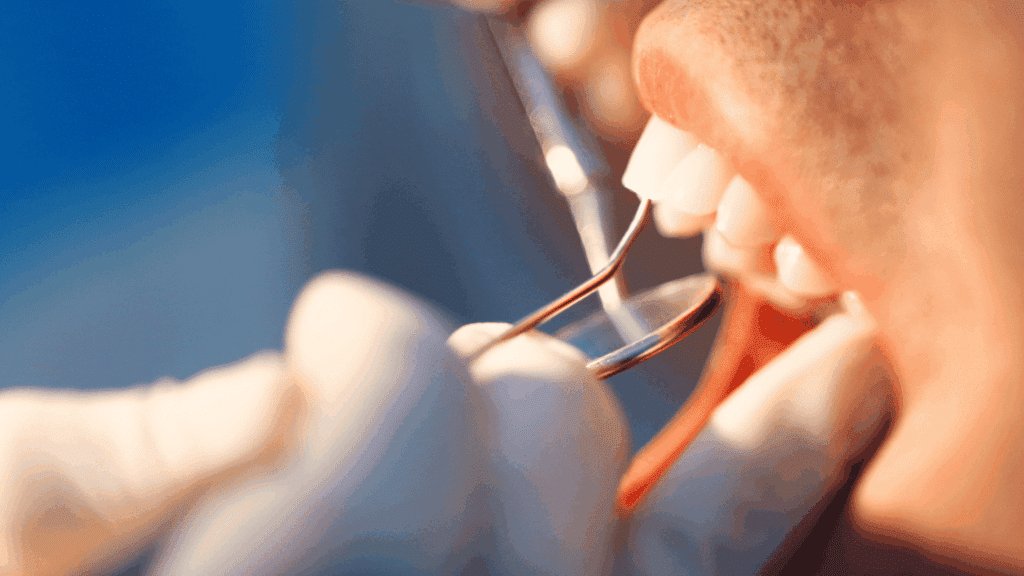
When Is It Better to Replace Teeth Instead of Repairing Them?
Pearl Zadeh DDSDentistry
A damaged tooth does not always mean it needs to be removed. In many cases, dentists try to save natural teeth whenever possible. However, there are situations where repairing a tooth may only provide a short-term fix. In those cases, replacing the tooth can offer a more stable and lasting solution.
Understanding the difference helps you make a better decision for your long-term oral health, not just a quick fix.
Repair vs. Replacement. What’s the Difference?
Repairing a tooth focuses on preserving what is already there. Treatments like fillings, crowns, bonding, or root canals aim to restore strength and function while keeping the natural tooth.
Replacement, on the other hand, involves removing a tooth that can no longer be saved and restoring it with an artificial option. This may include dental implants, bridges, or dentures.
Both approaches have their place. The key is knowing when one makes more sense than the other.
When Repairing a Tooth Makes Sense
In many cases, saving your natural tooth is still the best option. If the damage is limited and the structure of the tooth remains strong, repairs can work well and last for years.
For example, a small cavity or minor crack can usually be treated with a filling or crown. Even a tooth that needs a root canal can often be restored successfully if enough healthy structure remains.
The goal is to maintain stability. As long as the tooth can handle normal biting pressure without risk of breaking down, repair is often the right choice.
When It’s Better to Replace a Tooth
There are times when repairing a tooth may not hold up over time. In these cases, replacing the tooth can prevent repeated problems and additional cost.
Severe Tooth Damage
If a tooth is badly broken or has lost too much structure, it may not support a crown properly. Even if repaired, it can fail under pressure.
Advanced Decay
When decay reaches deep into the tooth and affects the core structure, removing the damage may leave too little healthy tooth behind.
Failed Previous Treatments
Some teeth have already gone through multiple fillings, crowns, or root canals. If these treatments continue to fail, it often means the tooth cannot provide long-term stability.
Infection or Bone Loss
Severe infections can spread beyond the tooth and affect the surrounding bone. In these cases, saving the tooth may not protect your overall oral health.
Loose or Unstable Teeth
Gum disease can weaken the support around a tooth. When a tooth becomes loose, repair alone cannot restore its stability.
Poor Long-Term Prognosis
Even if a repair is possible, it may not last. Choosing replacement early can help avoid repeated dental work and ongoing discomfort.
Comparing Long-Term Outcomes
Repairing a tooth is often quicker and less expensive at first. However, if the tooth continues to break down, you may need multiple treatments over time.
Replacement options, especially dental implants, tend to offer more stability in the long run. They are designed to handle daily pressure and reduce the risk of repeated issues.
The right choice depends on how long the solution is expected to last, not just the initial cost.
Tooth Replacement Options
When replacement is the better option, there are several ways to restore your smile.
Dental implants are often the most durable solution. They replace both the root and the visible part of the tooth, which helps maintain bone structure and provides a natural feel.
Bridges use nearby teeth to support a replacement tooth. They work well in certain cases but rely on surrounding teeth for support.
Dentures are used when multiple teeth are missing. They restore function and appearance, though they may not offer the same stability as implants.
Each option has its own benefits. The right choice depends on your dental condition and long-term goals.
How Dentists Decide What’s Best
Choosing between repair and replacement requires a full evaluation. Dentists look at how much healthy tooth structure remains, as well as the condition of the roots and surrounding bone.
Bite alignment also matters. If a tooth is under too much pressure, even a well-done repair may not last. Your overall oral health, habits like grinding, and long-term expectations all play a role in the decision.
This is why a personalized treatment plan is important. A quick fix is not always the best solution.
Some warning signs suggest that a tooth may not be worth saving.
You might notice repeated pain in the same tooth, even after treatment. In some cases, the tooth may feel weak when biting or appear visibly damaged.
Teeth that have been treated multiple times without lasting success often indicate a deeper issue. Ignoring these signs can lead to further complications.
Why Early Decision Matters
Waiting too long to replace a failing tooth can create bigger problems. Infection can spread, and surrounding teeth may shift into the empty space.
Bone loss is another concern. Once a tooth is lost, the bone in that area can begin to shrink. This may make future treatments, like implants, more complex.
Acting early helps protect both your oral health and your treatment options.
Make the Right Choice for Your Long-Term Oral Health
Choosing between repairing and replacing a tooth is not always simple. The right decision depends on stability, long-term outcomes, and your overall oral health.
Dr. Pearl Zadeh in Woodland Hills provides honest guidance and personalized treatment plans to help you choose the best option for your smile.
Call (818) 716-6722 or click the button below to schedule your consultation online and take the next step toward lasting dental health.
1. Is it better to save a tooth or replace it? Saving a natural tooth is usually preferred, but replacement may be better if the tooth cannot provide long-term stability.
2. How do I know if my tooth can be saved? A dental exam can determine how much healthy structure remains and whether the tooth can handle normal use.
3. Are dental implants better than crowns? They serve different purposes. Crowns restore existing teeth, while implants replace missing ones. Implants are often more durable when a tooth cannot be saved.
4. Does replacing a tooth hurt? Most procedures are done with anesthesia to keep you comfortable. Recovery is usually manageable.
5. How long do tooth replacements last? With proper care, dental implants can last many years. Other options like bridges and dentures also provide long-term function when maintained well.
Your Invisalign aligners are designed to stay clear and discreet, but daily use can change that quickly. After wearing them for a while, many patients notice their trays look cloudy, feel less fresh, or develop an odor they did not expect.
This often leads to the same question: Am I cleaning my Invisalign aligners the right way?
Because aligners are removable, it is easy to assume they need less care than your teeth. In reality, they collect saliva, bacteria, and residue throughout the day, which means proper cleaning plays an important role in keeping them clear, comfortable, and fresh during treatment.
Why Cleaning Your Aligners Actually Matters
Your aligners sit against your teeth for roughly 20 to 22 hours a day, which means saliva, food particles, and plaque build up on them just as they would anywhere else in your mouth. Left uncleaned, that buildup can lead to bad breath, a cloudy or yellowed appearance, and a higher risk of decay along the gumline, since the aligner traps bacteria against your teeth rather than letting saliva rinse it away naturally. The American Association of Orthodontists notes that orthodontic appliances create hard-to-reach spaces where plaque and bacteria tend to collect, and that staying diligent with cleaning between visits helps prevent cavities from developing in those areas.
Clear, well-maintained aligners are also part of why many patients choose Invisalign over traditional braces in the first place. Cloudy or visibly dirty trays work against that discretion, which is one more reason cleaning matters beyond hygiene alone.
How Often Should You Clean Your Aligners?
A quick rinse every time you remove your aligners, whether for a meal, a drink, or just to brush your teeth, helps prevent buildup from settling in. Beyond that rinse, a more thorough cleaning once or twice a day is generally recommended, along with a deeper soak once daily to clear out bacteria and odor that brushing alone tends to miss. Recommendations can vary somewhat by provider, so it’s worth confirming the specific routine your dentist suggests for your aligners.
The Right Way to Clean Invisalign Aligners
A simple, consistent routine covers most of what your aligners need.
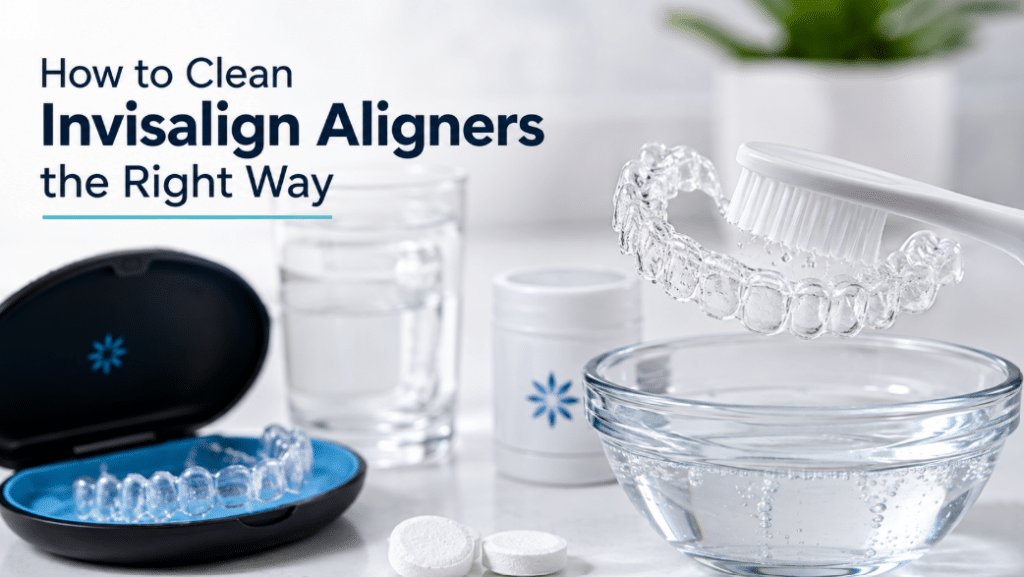
Rinse: As soon as you take your aligners out, rinse them with lukewarm water to wash away saliva and loose debris before it dries onto the surface.
Brush gently: Use a soft-bristled toothbrush and a clear, unscented antibacterial soap, with light pressure rather than scrubbing, since aligner plastic scratches more easily than tooth enamel.
Soak once a day: Soak the aligners in a cleaning solution made specifically for aligners, typically for about fifteen minutes.
Rinse again: Rinse thoroughly after soaking to remove any residue before the aligners go back in your mouth.
Brush and floss your own teeth first: Do this before reinserting the aligners, so food particles aren’t sealed against your teeth for the next several hours.
Store properly: Keep your aligners in their case any time they’re out of your mouth, rather than wrapped in a napkin or left loose in a bag, where they’re more likely to get lost, damaged, or contaminated.
Official Invisalign Cleaning Crystals dissolve in lukewarm water and are designed specifically for the daily soaking step, without scratching or discoloring the trays. Cleaning your case regularly matters too. A clean aligner placed back into a dirty case picks up bacteria right away, undoing the cleaning you just did.
Can You Brush Aligners With Toothpaste?
It’s best to avoid it. Most toothpaste contains mild abrasives that work well on enamel but are too rough for aligner plastic. Over repeated use, those abrasives create tiny scratches on the surface, which is exactly what makes aligners start looking cloudy or dull over time. A clear, unscented antibacterial soap does the job of cleaning without that abrasive effect, which is why it’s generally recommended over toothpaste specifically for the trays, even though toothpaste is exactly what you should keep using on your actual teeth.
What to Avoid When Cleaning Your Aligners
A handful of common products cause more harm than good here. Hot water can warp the plastic, changing the shape just enough to affect how the aligner fits, which can interfere with your treatment progressing as planned. Colored or scented soaps and dish detergents often contain dyes or fragrances that stain the plastic or leave an unpleasant taste. Mouthwash, particularly colored varieties, can discolor or degrade the material rather than clean it effectively.
Bleach and other harsh household chemicals are too aggressive for aligner plastic and aren’t designed for something you place in your mouth. When in doubt, a milder option is almost always the safer choice, and checking with your dentist before trying a new cleaning product is a reasonable habit to build.
How to Handle Cloudy, Stained, or Smelly Aligners
Cloudiness usually traces back to scratches from an abrasive cleaner, most often toothpaste, or from buildup that’s gone too long without a proper soak. Staining tends to come from colored drinks, coffee, tea, or wine consumed while wearing the aligners rather than removing them first. A persistent smell is almost always a sign of bacterial buildup that a quick rinse alone isn’t reaching.
In each case, returning to a consistent daily soak, along with gentle brushing rather than scrubbing, usually improves things noticeably within a few days. If an aligner stays cloudy, stained, or smells off despite consistent cleaning, it’s worth mentioning to your dentist rather than assuming it will resolve on its own.
How to Keep Aligners Clear Throughout Treatment
Staying ahead of buildup is easier than trying to reverse it later. Removing your aligners before eating or drinking anything other than plain water prevents most staining and food debris from ever reaching the trays. Rinsing immediately after removal, rather than setting them aside for later, keeps saliva and food particles from drying onto the surface.
A consistent daily soak, paired with gentle brushing, handles the rest. Aligners that get this routine from the start tend to stay noticeably clearer through the following weeks than ones that only get attention once they’ve already started looking dingy.
How Aligner Hygiene Connects With Brushing, Flossing, and Oral Health
Cleaning your aligners does not replace normal oral hygiene, and brushing your teeth does not replace cleaning your aligners. Both habits work together.
Brush and floss your teeth before putting your aligners back in. This helps remove food particles that could stay trapped against your teeth for hours. This matters even more with aligners because the trays hold close against the tooth surface.
Skipping either part of your routine, whether cleaning your teeth or your aligners, can lead to the same issues. These include bad breath, a higher risk of decay, and aligners that may need replacement sooner than expected.
Habits That Can Shorten Aligner Lifespan or Affect Their Appearance
Some everyday habits cause more wear and staining than many patients expect. Drinking coffee, tea, wine, or other dark or acidic beverages while wearing aligners is one of the most common issues. Chewing gum can also create problems because it may stick to the plastic and affect the aligner’s shape.
Hot water can warp the material and change the fit, even when used accidentally during cleaning. Skipping daily soaking and only rinsing your trays can also allow odors and cloudiness to build up faster. These habits will not ruin your aligners overnight, but they can affect their appearance and condition over the one to two weeks you wear each tray.
Getting Personalized Guidance From Dr. Pearl Zadeh in Woodland Hills
General cleaning guidelines cover most situations, but your dentist may recommend adjustments based on your specific aligners, your habits, or how your treatment is progressing. As an Invisalign Premier Provider, Dr. Pearl Zadeh walks patients through the care routine that fits their treatment plan during regular check-ins, rather than leaving them to guess. If you’re also weighing cosmetic treatment alongside Invisalign, our comparison of Invisalign and veneers explains how the two fit together.
Keeping your aligners clean is a small daily habit that can make a noticeable difference in comfort, appearance, and your overall Invisalign experience. A simple routine followed consistently is usually enough to keep most common issues under control.
Dr. Pearl Zadeh and her Woodland Hills team can guide you through proper aligner care based on your treatment plan. They can also answer any questions that come up during your Invisalign journey.
Call (818) 716-6722 or click the button below to schedule a consultation online.
1. How often should I clean my Invisalign aligners?
Rinse them every time you remove them, and plan on a full soak and gentle brushing at least once a day. Your dentist can confirm the specific routine that fits your treatment.
2. Can I use toothpaste to clean my aligners?
It’s best to avoid it. Toothpaste is mildly abrasive and can scratch aligner plastic over time, leading to a cloudy appearance. Use a clear, unscented antibacterial soap instead.
3. Why do my aligners smell bad?
A persistent smell usually points to bacterial buildup that rinsing alone doesn’t remove. A consistent daily soak in an aligner-safe cleaning solution typically resolves it within a few days.
4. Can hot water damage my aligners?
Yes. Hot water can warp the plastic enough to affect how the aligner fits, which can interfere with treatment. Always use lukewarm water for rinsing and soaking.
5. Is it normal for aligners to get a little cloudy?
Some patients notice mild cloudiness even with good care. However, significant or fast-developing cloudiness often points to abrasive cleaners or infrequent soaking. Both issues can usually be fixed with better cleaning habits.
This article is for informational purposes only and is not a substitute for professional dental advice. Please schedule a consultation with Dr. Pearl Zadeh to discuss your specific situation.
What Is IPR During Invisalign? What Patients Should Know
Pearl Zadeh DDSInvisalign
You expected clear trays gently nudging your teeth into place. Then your dentist mentions IPR, or says something about enamel reduction, and suddenly you’re picturing a drill near teeth you didn’t expect anyone to touch. It’s an understandable reaction. The name sounds more intimidating than the procedure itself.
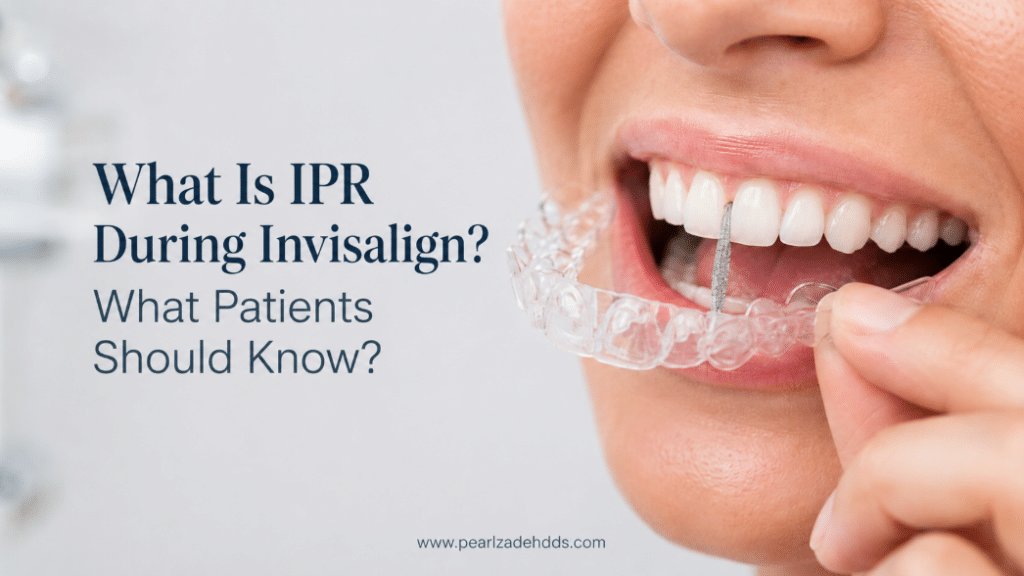
IPR stands for interproximal reduction. During Invisalign treatment, it means removing a very small, carefully measured amount of enamel from between selected teeth. The goal may be to create space for certain tooth movements or help the teeth fit together more effectively. Your dentist plans where and how much reduction is needed before the procedure. IPR isn’t performed on every tooth, and plenty of Invisalign patients never need it at all.
What IPR During Invisalign Actually Means
“Interproximal” means between neighboring teeth, at the contact point where one tooth meets the next. “Reduction” refers to removing a small amount of enamel from that area.
The procedure is planned around your specific treatment needs. Your dentist identifies which teeth need additional space and how much reduction is appropriate. A thin strip, disc, or another specialized instrument may then be used to carefully reduce the enamel between those teeth.
It isn’t random filing, and it doesn’t involve reshaping the entire tooth. Only the selected contact areas are treated, and the amount removed is kept small. Whether you need IPR depends on your teeth, bite, available space, and the movements your Invisalign plan needs to achieve.
Why Would I Need IPR During Invisalign?
Sometimes teeth need more room to move into the positions your treatment plan is aiming for than currently exists in your mouth. When that’s the case, your dentist has more than one way to create that space, depending on your specific situation. IPR is one option. It creates small amounts of space between selected teeth without removing an entire tooth.
It can help with crowding, support planned tooth movement, and improve how neighboring teeth contact each other. In some cases, it may also be part of managing tooth proportions as the overall smile is being planned. None of this means IPR is required for every crowded smile, and it isn’t automatically preferable to other approaches such as extraction. Your treatment plan, based on your specific teeth and bite, determines whether it makes sense for you.
Is This the Same Thing as “Shaving Your Teeth”?
You’ve probably seen that phrase somewhere, and it makes the procedure sound far more aggressive than it actually is. IPR removes a small, carefully planned amount of enamel from between selected teeth. It doesn’t reshape the entire tooth or make your teeth noticeably smaller. The goal is to create space at specific contact points, not change the visible shape of the tooth.
“Shaving” is casual shorthand, but it doesn’t really describe how targeted the procedure is. Your dentist controls where the enamel is reduced and how much is removed based on what your Invisalign treatment needs.
Does It Hurt?
There’s no cutting into your gums, no drilling into the center of the tooth, and nothing intended to come anywhere near the nerve. Most patients describe feeling pressure or a mild vibration during the procedure itself, along with a scraping or rubbing sensation as the instrument passes between the teeth. It’s not painless for absolutely everyone, and it’s fair to say some patients notice mild temporary sensitivity in the treated area afterward, particularly to cold. That typically settles within a day or two. If sensitivity is significant or sticks around longer than that, it’s worth a call to your dentist rather than waiting it out.
How Is IPR Actually Done?
Your dentist identifies which teeth and contact points actually need space, based on your treatment plan, and works out how much reduction each site calls for. The tooth surfaces involved are accessed carefully, and a specialized strip, disc, or similar instrument removes a small amount of enamel from between the selected teeth. Your dentist checks the resulting space and the condition of the tooth surfaces, then finishes and polishes the area so it’s smooth rather than rough. From there, your Invisalign treatment continues on schedule. This is a professional dental procedure performed with specific instruments and training. It isn’t something to attempt yourself under any circumstances.
How Much Enamel Actually Comes Off?
IPR involves a small amount of enamel. A recent peer-reviewed analysis of enamel thickness and IPR planning reports that enamel reduction at a single interproximal site is often planned within a range of about 0.20 to 0.50 millimeters. That range does not mean the same amount will be removed from every tooth or every patient.
The amount depends on which teeth are involved, how much space your treatment plan needs, the thickness and shape of your enamel at that contact point, and the movement your dentist is trying to achieve. Your dentist evaluates those factors before deciding whether IPR is appropriate and how much reduction is needed.
Does Enamel Grow Back After IPR?
No. Enamel doesn’t regenerate once it has been removed, whether through IPR or normal wear over time. That’s why the amount removed during IPR is planned carefully and kept within the limits appropriate for the tooth being treated.
Professional IPR is different from uncontrolled filing because your dentist determines exactly where the enamel needs to be reduced and how much space the treatment requires. The goal is to create the needed space while preserving as much healthy enamel as possible.
Can IPR Damage Your Teeth?
Before recommending IPR, your dentist considers your tooth anatomy, enamel thickness, how much space is actually needed, the health of your teeth and gums, the specific contact points involved, and how IPR fits into the rest of your treatment plan.
A systematic review of the dental and periodontal effects associated with IPR found that IPR appears clinically safe when performed with appropriate case selection, proper technique, and adequate finishing. The review did not find consistent evidence that properly performed IPR increases the risk of cavities, gum problems, or lasting sensitivity.
That doesn’t mean there is zero risk in every situation. Possible concerns include temporary sensitivity, a rough surface if the area isn’t finished and polished properly, excessive enamel removal, or gum irritation depending on the technique used. The purpose of professional IPR is controlled space creation, not removing enamel unnecessarily.
Will I Have Gaps After IPR, or Will My Teeth Look Smaller?
The small amount of space IPR creates is intentional and part of the treatment plan. As your aligners continue moving your teeth, that space is generally used to achieve the planned positions rather than remaining as a visible gap.
What your finished smile looks like depends on the entire treatment plan, not IPR alone. Your dentist considers the amount of space needed, tooth positions, and overall tooth proportions before deciding whether IPR is appropriate.
As for your teeth looking smaller, properly planned IPR shouldn’t noticeably change their visible size. The enamel is removed from the sides where neighboring teeth contact each other, rather than from the front surface you see when you smile.
If tooth proportions are part of your treatment goals, your dentist considers them when planning where IPR is needed and how much enamel should be removed.
Does Everyone Getting Invisalign Need IPR?
No. Plenty of Invisalign cases don’t require IPR at all. For others, it’s one part of a larger treatment plan.
Whether you need it depends on factors such as the amount of crowding, the shape and size of your teeth, the space already available, where your teeth need to move, your bite, and your overall treatment goals. IPR isn’t a standard step that every Invisalign patient automatically goes through.
Other Ways to Create Space: Extraction and Arch Expansion
IPR isn’t the only way to create space when teeth need more room. Extraction involves removing an entire tooth, so it’s a much different approach and may be considered when a case requires more space than IPR can provide. Some orthodontic cases call for extraction, while many can be treated without it.
Another option is arch expansion, which involves gradually widening the dental arch to create additional room. Whether that’s appropriate depends on the patient’s anatomy, tooth positions, and bite.
None of these approaches is automatically better than the others. Your dentist considers how much space the treatment needs and which approach is appropriate for your teeth and bite.
What Happens After IPR?
Your teeth may feel slightly different against your tongue for a little while. Some patients notice a subtly different texture where the enamel was reduced, and mild temporary sensitivity is possible.
The treated contact points may also feel slightly more open at first. Your aligners then continue moving the teeth according to the treatment plan.
Continue your usual brushing and flossing routine after the procedure. If you develop significant pain, swelling, or sensitivity that doesn’t start to settle after a couple of days, contact your dentist rather than waiting it out.
Does IPR Always Happen at the Start of Treatment?
Not necessarily. IPR may be performed before certain aligners are worn, during active treatment, or at another stage when your treatment plan calls for additional space.
Not every patient who needs IPR has it done on the first day. Your dentist may also reassess your teeth as treatment progresses. If the plan changes or additional space appears necessary, they’ll evaluate whether IPR is appropriate before making that decision.
This can sometimes come up alongside refinements, which are additional aligners used to fine-tune tooth movement after the initial series.
IPR and Attachments Are Two Different Tools
It’s easy to mix these up since both can come up during Invisalign planning, but they do very different jobs. Attachments are small tooth-colored shapes bonded to selected teeth. They give the aligner something to grip when certain movements need extra support.
IPR does the opposite. It removes a small amount of enamel between selected teeth to create space or improve how neighboring teeth fit together.
One adds material to the surface of a tooth. The other removes a small amount between two teeth. Your treatment plan may include one, both, or neither, depending on what your teeth need.
How IPR Fits Into Your Overall Treatment Plan
IPR is part of the treatment planning process, not something your dentist adds randomly during an appointment. Your dentist considers your tooth positions, crowding, tooth shape, bite, available space, and where your teeth need to end up.
This is also why two patients with similar-looking smiles can end up with different treatment plans. The amount of movement needed, the available space, and the way each person’s teeth fit together aren’t always visible just by looking at their smiles.
A more involved case may require IPR, but complexity alone doesn’t automatically mean you’ll need it. The decision comes down to the movements your specific treatment plan needs to achieve.
Does IPR Affect the Cost of Invisalign?
Whether IPR is included in your overall Invisalign fee or handled separately depends on your provider and treatment agreement. There isn’t one pricing rule that applies to every practice.
If IPR is part of your plan, ask whether the procedure is included in your quoted treatment fee or carries a separate charge. Getting that answer before treatment starts is better than assuming either way.
Speak With Dr. Pearl Zadeh About Your Invisalign Treatment
Hearing that your Invisalign plan includes IPR isn’t necessarily a reason to worry. It’s a planned technique your dentist may use when certain movements need additional space. Only the areas that need it are treated, and the amount of enamel removed is carefully determined as part of your treatment plan.
As an Invisalign Premier Provider, Dr. Pearl Zadeh can evaluate your teeth, bite, and treatment goals and explain whether IPR makes sense for you and why. Learn more about Invisalign in Woodland Hills.
Call (818) 716-6722 or click the button below to schedule a consultation online.
When properly planned and performed by a dental professional, IPR is a controlled way to create limited space between selected teeth, with research generally supporting its safety when done with appropriate technique and case selection.
2. Does IPR hurt?
Many patients tolerate it well. You may notice pressure, vibration, or a scraping sensation during the procedure, and some temporary sensitivity afterward.
3. Does enamel grow back after IPR?
No. Enamel doesn’t regenerate, which is exactly why the amount removed during IPR is planned so carefully and kept small.
4. Will IPR leave gaps between my teeth?
The procedure creates small spaces on purpose. Those spaces are part of the treatment plan and generally get used as your aligners continue moving your teeth.
5. Can IPR make my teeth sensitive?
Temporary sensitivity is possible, though significant or persistent sensitivity is worth discussing with your dentist.
This article is for informational purposes only and is not a substitute for professional dental advice. Please schedule a consultation with Dr. Pearl Zadeh to discuss your specific situation.
Understanding these differences helps you choose the option that fits your needs, not just in the short term, but for long-term comfort and oral health.
What Are Mercury (Amalgam) Fillings?
Mercury fillings, also known as amalgam fillings, are made from a mix of metals, including mercury, silver, tin, and copper. Dentists have used them for many years because they are strong and can handle heavy chewing pressure.
However, amalgam fillings do not bond directly to the tooth. Instead, they sit within the tooth structure, which may require removing more healthy tooth material to keep the filling in place.
What Are Composite Fillings?
Composite fillings use a tooth-colored resin material that blends with your natural teeth. Unlike amalgam, composite bonds directly to the tooth surface.
This bonding allows dentists to preserve more of the natural tooth structure. As a result, the restoration feels more secure and looks more natural.
Key Differences Between Mercury and Composite Fillings
Feature
Mercury (Amalgam) Fillings
Composite Fillings
Appearance
Silver, noticeable
Tooth-colored, blends naturally
Bonding
Does not bond to tooth
Bonds directly to tooth
Tooth Preparation
Requires removing more tooth structure
Preserves more natural tooth
Durability
Very strong under pressure
Durable but depends on location
Expansion
Expands and contracts with temperature
More stable with less expansion
Aesthetics
Not ideal for visible areas
Ideal for front and visible teeth
Appearance and Aesthetics
One of the biggest differences is how the fillings look. Amalgam fillings have a silver color, which makes them noticeable when you talk or smile.
Composite fillings match the color of your natural teeth. Because of this, they blend in and create a more natural appearance. Many patients prefer this option, especially for visible areas.
Strength and Durability
Amalgam fillings are known for their strength. They work well for back teeth that handle heavy chewing.
Composite fillings are also durable, but their performance depends on the size and location of the filling. With proper placement and care, they can last many years.
However, composite materials rely on proper bonding. This means the dentist’s technique plays a key role in long-term success.
Impact on Tooth Structure
Amalgam fillings often require removing more of the natural tooth to hold the material in place. Over time, this can weaken the remaining structure.
Composite fillings bond directly to the tooth, which allows for a more conservative approach. This helps preserve more healthy tooth structure and supports long-term strength.
Sensitivity and Comfort
Some patients notice sensitivity with amalgam fillings because the metal expands and contracts with temperature changes. This movement can create small gaps over time.
Composite fillings tend to be more stable. Since they bond to the tooth, they create a tighter seal, which can reduce sensitivity in many cases.
Longevity and Maintenance
Both types of fillings can last for many years with proper care. Amalgam may last longer in high-pressure areas, while composite offers a balance between durability and aesthetics.
Regular checkups are important for both. Dentists monitor for wear, cracks, or leakage to ensure the filling continues to protect the tooth.
Which Option Is Right for You?
The right choice depends on your specific needs. If strength under heavy pressure is the main concern, amalgam may still be considered in some cases.
However, many patients prefer composite fillings because they look natural and preserve more of the tooth. They also fit well with modern dental approaches that focus on both function and appearance.
A professional evaluation helps determine which option will work best for your situation.
Make the Right Choice for Your Smile
Choosing between mercury and composite fillings is not just about appearance. It also affects how your teeth function and how long your restoration lasts.
At Pearl Zadeh DDS, Dr. Pearl Zadeh offers both mercury (amalgam) and composite filling options based on your specific needs. She takes time to evaluate your teeth, explain each option clearly, and recommend what works best for your long-term oral health.
Call (818) 716-6722 or click the button below to schedule your consultation online and find the right solution for your smile.
Are composite fillings better than mercury fillings? Composite fillings offer better aesthetics and preserve more tooth structure, but the best option depends on your specific case.
Do mercury fillings need to be replaced? Not always. Dentists usually replace them if they show signs of damage, wear, or leakage.
Are composite fillings durable? Yes. With proper care, they can last many years, especially when placed correctly.
Do composite fillings look natural? Yes. They are designed to match your natural tooth color and blend in seamlessly.
Is it safe to replace old mercury fillings? Yes, when done using proper safety protocols by an experienced dentist.
Many patients notice small changes in their mouth before they ever think about a dental visit. A bit of blood when brushing, a slight sensitivity around one tooth, or breath that does not feel fresh later in the day.
These signs are easy to overlook, but they often point to early gum changes that develop quietly over time. Gum disease rarely starts with pain, which is why it can progress before it feels serious.
Dr. Pearl Zadeh and her Woodland Hills team often see patients at this stage, after symptoms have been present for a while. By then, early gum changes may already need professional care to prevent further progression.
Recognizing these signs early can make treatment simpler and help protect long-term gum health.
Why Early Detection Matters So Much
Gum disease often begins as gingivitis, which can still be reversed with proper care. Once it progresses to periodontitis, the damage becomes permanent, especially around the supporting bone.
The timing of treatment makes a real difference. Someone who responds early to bleeding gums may only need a professional cleaning. Waiting too long can lead to more advanced treatment, including deep cleaning or surgical care.
That difference is why small symptoms should never be ignored, even when they do not feel serious at first.
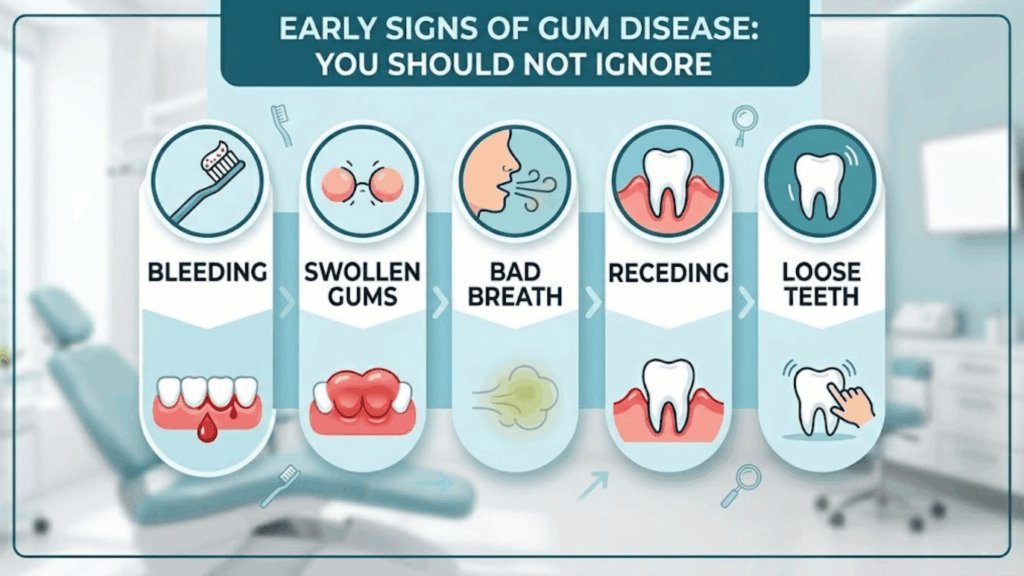
1. Gums That Bleed When You Brush or Floss
Bleeding gums are often the first sign of gum disease, but many people dismiss it as brushing too hard.
Healthy gums should not bleed during normal brushing or flossing. When bleeding does occur, it usually means plaque along the gumline is causing irritation and early inflammation in the tissue.
If bleeding shows up more than occasionally, it is worth paying attention to rather than adjusting your brushing technique and ignoring it.
2. Redness or Swelling Along the Gumline
Healthy gums are usually light pink and feel firm. When inflammation begins, they can look darker in color and appear puffy around the base of the teeth.
This change happens when bacteria along the gumline trigger an immune response. The swelling is part of your body reacting to that irritation.
If the gumline still looks swollen after a few days, even with regular brushing, it may point to early gum disease rather than temporary irritation.
3. Persistent Bad Breath
Bad breath after coffee or certain foods is normal and usually temporary. But breath that returns shortly after brushing can point to a deeper issue.
Bacteria along the gumline can release sulfur compounds that create an unpleasant smell. Mouthwash may cover it for a short time, but it does not remove the bacteria causing it.
If brushing, flossing, and rinsing still do not keep your breath fresh through the day, it may be linked to early gum disease.
4. Gums That Feel Tender or Sore
Sore or tender gums can appear even before any obvious redness or swelling. Some people notice a dull discomfort when chewing harder foods, while others feel sensitivity along the gumline when eating or drinking something cold.
This usually happens when inflammation has already started affecting the gum tissue. As it continues, the irritation can spread and become more noticeable over time.
5. Gums That Appear to Be Pulling Away From Teeth
This sign often points to a more advanced stage of gum disease. Healthy gums normally sit closely around each tooth with little visible space.
When gums begin to recede, more of the tooth surface becomes exposed, and teeth may start to look slightly longer than before. Small spaces can also form between the tooth and gum, which allows bacteria to collect more easily.
Once gum recession begins, it does not reverse on its own and usually needs professional care to manage and stabilize.
6. Loose or Shifting Teeth
Adult teeth should feel firmly stable in the gums. Even slight movement can be a sign that the bone supporting the tooth has started to weaken.
Some patients also notice changes in how their bite feels, almost as if their teeth are no longer lining up the same way. This can happen when the structures holding the teeth in place begin to break down.
Looseness in a tooth should be checked promptly, since it can progress more quickly than other early signs of gum disease.
7. A Bad Taste That Won’t Go Away
A persistent metallic or bitter taste in the mouth can sometimes point to bacteria collecting in gum pockets. It may improve briefly after brushing or rinsing, but often returns within a short time.
This tends to appear alongside bad breath, since both are linked to the same buildup of bacteria below the gumline.
8. Sensitivity to Hot, Cold, or Sweet Foods
Gum recession can expose the root surface of a tooth, which does not have the same protective enamel as the crown. This is why sensitivity may increase even without an obvious cavity.
A sudden sharp feeling when eating or drinking something that never used to cause discomfort can be an early sign of gum-related changes.
If that sensitivity appears suddenly or becomes more noticeable over time, it is worth mentioning at your next dental visit.
9. Pus Between the Teeth and Gums
Pus around the gums is a strong sign that an infection is present. It may appear when gently pressing the area near a tooth or sometimes become visible without any pressure.
This usually means the infection has progressed beyond early gum inflammation and needs professional care.
At this stage, brushing and flossing alone are not enough to resolve the issue, and a dental visit is important to treat the infection properly.
What Causes These Early Warning Signs?
Most early gum changes start with plaque. It forms as a sticky layer of bacteria on the teeth and can build up quickly, even after brushing.
Several everyday factors make this buildup more likely. Inconsistent brushing or flossing, skipping professional cleanings, smoking or vaping, and dry mouth from certain medications can all contribute. Health conditions like diabetes and hormonal changes during pregnancy or menopause can also increase sensitivity in the gums. Some people are simply more prone to inflammation due to genetics.
The American Dental Association notes that plaque buildup is the main driver behind gum disease at every stage. Keeping it under control through daily cleaning and regular dental visits remains the most effective way to prevent progression.
How Dr. Pearl Zadeh Checks for Early Gum Disease
At a routine visit, Dr. Pearl Zadeh measures the space between the gums and each tooth using a small periodontal probe. This helps identify changes that are not always visible during a basic visual exam.
In a healthy mouth, these spaces are usually shallow, around one to three millimeters. Deeper measurements can indicate early inflammation or bone loss, even before noticeable symptoms appear.
X-rays are also used to assess bone levels beneath the gums, giving a clearer picture of overall support around each tooth. Together, these evaluations help detect gum disease at an early stage, often before it becomes more advanced.
What to Do the Moment You Spot a Warning Sign
If you notice early symptoms, the best step is to schedule a dental visit rather than waiting for them to go away on their own.
Daily care also matters in the meantime. Brushing twice a day with a soft-bristled toothbrush helps reduce plaque along the gumline, and flossing once a day keeps buildup between teeth under control. Cutting back on frequent sugary snacks and drinks can also reduce irritation in the gums.
Tobacco use can slow healing and make early signs harder to notice, so avoiding it supports better gum health. Regular cleanings every six months, or more often if you have a history of gum issues, also play an important role in prevention.
The CDC notes that consistent brushing and flossing remain the most effective ways to control plaque between dental visits.
When a Symptom Needs Prompt Attention
Some symptoms should be checked sooner rather than later. These include pus around the gums, a tooth that feels loose, swelling that spreads beyond a small area, or pain that affects chewing or sleep.
At this stage, the issue may have progressed beyond early inflammation. Prompt care can still make a major difference and may help prevent more extensive treatment later.
Speak With a Dentist About Your Gum Health
Early signs of gum disease are often easy to overlook, especially when they do not cause pain. The concern is that waiting can allow a mild issue to progress into something more involved.
Dr. Pearl Zadeh’s Woodland Hills practice evaluates gum health through detailed periodontal screenings for both new and returning patients. If you have noticed any changes, scheduling a visit can help you understand what is going on and address it early, when treatment is still straightforward.
Call (818) 716-6722 or click the button below to schedule your consultation online.
Mild gingivitis can often improve with better brushing and flossing habits. Even so, a professional cleaning is important to remove hardened plaque that cannot be cleared at home.
2. How often should I watch for these signs?
It helps to be aware of your gums whenever you brush or floss. Small changes can develop gradually, so regular attention makes them easier to notice early.
3. Is bleeding during flossing always a bad sign?
Not always. Mild bleeding can happen if you have not flossed regularly. If it continues beyond several days to a week, it may indicate ongoing inflammation.
4. Can stress affect gum health?
Yes. Stress can weaken the body’s immune response, making it harder to control bacteria already present along the gumline.
5. Do electric toothbrushes help prevent these signs?
Electric toothbrushes can remove plaque more consistently than manual brushing for many people. When used twice daily with proper technique, they may help reduce the risk of early gum inflammation.
Preserving Your Smile: The Power of Minimally Invasive Dentistry by Dr. Pearl Zadeh
Pearl Zadeh DDSCosmetic Dentistry
Preserving Your Smile: The Power of Minimally Invasive Dentistry
Your smile is one of your most valuable assets, and protecting it should always come first. As dentistry advances, we now have the ability to treat dental issues more conservatively than ever before. This approach, known as minimally invasive dentistry, allows us to restore health and beauty while preserving as much of your natural tooth structure as possible.
As a cosmetic and restorative dentist, I believe less is often more. My goal is to achieve long-lasting results with the least amount of alteration to your natural teeth. In this article, I’ll share what minimally invasive dentistry means, how it benefits your oral health, and the treatments that make this modern approach possible.
What Is Minimally Invasive Dentistry?
Minimally invasive dentistry (MID) is a philosophy centered around prevention, early detection, and conservative treatment. Instead of waiting for problems to worsen and require major restorations, we intervene early, using advanced tools and techniques that protect natural tooth structure.
The Core Principles of Minimally Invasive Dentistry
Prevention first: Stopping decay and disease before they start through hygiene, fluoride, and sealants.
Early detection: Using advanced imaging and diagnostic tools to identify small issues early.
Conservation: Preserving healthy enamel and dentin whenever possible.
Precision treatment: Using microscopically precise methods to treat only the damaged areas.
This patient-centered approach combines cutting-edge technology with gentle care, resulting in stronger, healthier smiles that stand the test of time.
Why Preservation Matters
Natural enamel is one of the strongest materials in your body, and once it’s gone, it doesn’t grow back. Every time we remove part of a tooth, even for a filling or crown, we permanently alter its structure.
By embracing minimally invasive methods, we:
Reduce the need for extensive restorations later.
Maintain tooth strength and resilience.
Lower the risk of sensitivity and secondary decay.
Create restorations that look and feel more natural.
In short, minimally invasive dentistry focuses on preserving what nature gave you, not replacing it unnecessarily.
https://www.aobmd.org
Modern Tools That Make It Possible
Minimally invasive dentistry wouldn’t be possible without today’s advanced technologies. These tools allow us to diagnose, plan, and treat with unprecedented precision.
1. Digital Imaging & 3D Scanning
Digital X-rays and 3D scanners help identify even the smallest areas of decay or cracks, long before they become visible to the naked eye. They also eliminate the need for messy impressions and reduce radiation exposure.
2. Laser Dentistry
Dental lasers are revolutionizing how we treat both hard and soft tissues. Lasers can remove decay, reshape gums, and even treat periodontal disease, often without anesthesia or discomfort. They also promote faster healing and reduce the risk of infection.
3. Air Abrasion Technology
Instead of using a traditional drill, air abrasion uses a fine stream of particles to gently remove decayed areas. This technique is quiet, comfortable, and perfect for small cavities, especially for children or patients with dental anxiety.
4. Magnification and Microscopy
High-powered magnification and dental microscopes enable me to work with extreme precision, preserving more healthy tooth while ensuring a perfect seal for restorations.
Minimally Invasive Treatments for a Healthier Smile
Here are some of the most common ways we use minimally invasive techniques in my practice:
1. Preventive Care and Early Intervention
The foundation of minimally invasive dentistry is prevention. Professional cleanings, fluoride treatments, and sealants are simple, painless ways to stop cavities before they begin.
We also focus on patient education, teaching you how to maintain proper oral hygiene at home so that small issues don’t develop into big problems.
2. Conservative Fillings
When decay does occur, smaller cavities can often be treated with tooth-colored composite fillings that bond directly to enamel. These materials require minimal drilling and blend seamlessly with your natural teeth.
3. Inlays and Onlays
When more of the tooth needs to be restored but a full crown isn’t necessary, inlays and onlays are the ideal middle ground. These custom restorations strengthen the tooth while preserving more natural structure than a crown would.
4. Porcelain Veneers and Bonding
For cosmetic concerns like chips, discoloration, or uneven teeth, porcelain veneers or composite bonding can transform your smile without extensive reshaping. Today’s ultra-thin veneers require minimal or no reduction of enamel, yet deliver beautiful, natural results.
5. Laser Gum Contouring
For patients with uneven or “gummy” smiles, soft-tissue lasers allow precise reshaping of gumlines, without scalpels, sutures, or long recovery times. The result is a balanced, harmonious smile with minimal discomfort.
6. Guided Implant Placement
Even in restorative dentistry, minimal invasiveness plays a key role. Using 3D imaging and digital planning, dental implants can be placed with pinpoint accuracy, reducing trauma to surrounding tissue and shortening recovery times.
Benefits Beyond the Dental Chair
Minimally invasive dentistry isn’t just about techniques, it’s about the overall experience and long-term health outcomes.
Here’s what my patients appreciate most:
Less discomfort: Gentle, precise treatments often mean little to no pain or need for anesthesia.
Natural aesthetics: Your smile looks authentic because we preserve natural enamel and structure.
Lower long-term costs: By preventing major problems, you save on future dental work.
Greater peace of mind: Knowing your care is as conservative as possible builds confidence and trust.
Is Minimally Invasive Dentistry Right for You?
Almost every patient can benefit from a minimally invasive approach. However, the right treatment depends on your dental health, goals, and lifestyle.
You might be an excellent candidate if you:
Want to preserve your natural teeth as much as possible
Prefer gentle, comfortable dental care
Have mild to moderate decay or damage
Are interested in cosmetic improvements with minimal alteration
During your consultation, we’ll discuss your unique needs and create a customized treatment plan that reflects both your goals and the most conservative path to get there.
The Future of Dentistry Is Gentle, Smart, and Precise
As dental technology continues to evolve, our ability to care for teeth in the most precise, least invasive ways only gets better. Minimally invasive dentistry represents the future of oral care, one where prevention, precision, and preservation take center stage.
It’s about keeping your smile healthy, functional, and beautiful for decades, not just fixing problems when they arise.
Ready to Experience Minimally Invasive Dentistry?
Your smile deserves the best care, care that respects and preserves the natural beauty of your teeth. If you’re ready to explore the benefits of minimally invasive dentistry in Woodland Hills, I invite you to schedule a consultation at my office. Together, we’ll create a plan that enhances your oral health while keeping your treatment comfortable, conservative, and long-lasting.
Dr. Pearl Zadeh, DDS Cosmetic & Restorative Dentistry Woodland Hills, CA
Can Invisalign Correct an Open Bite? What Patients Should Know
Pearl Zadeh DDSInvisalign
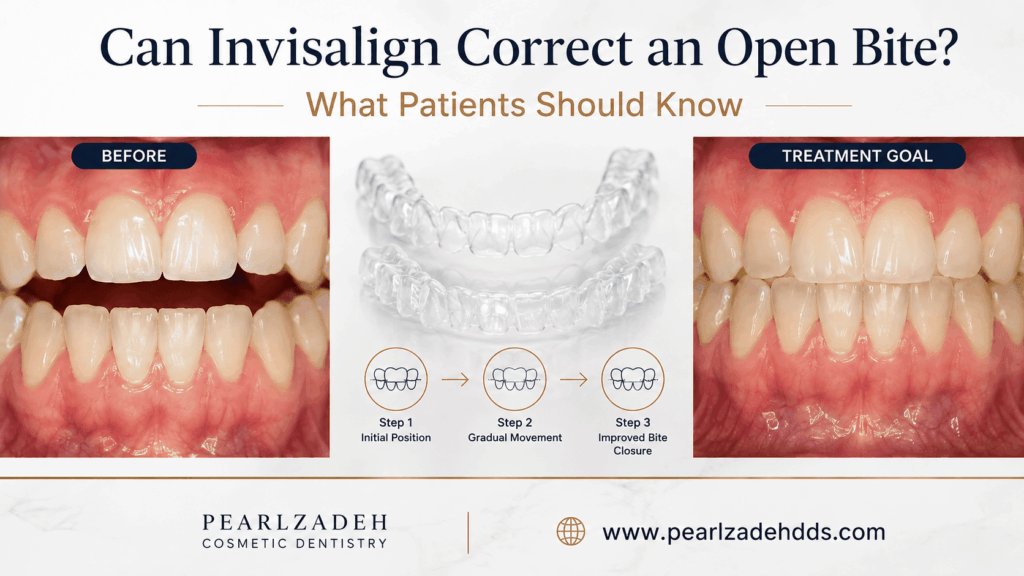
You close your teeth together, but your front teeth still leave a visible space. This is what many patients with an open bite experience, and it can affect more than just the appearance of their smile. An open bite may change how you bite into food, speak, or feel about your teeth.
Many people know Invisalign can straighten crowded teeth or close gaps, but they are less sure whether clear aligners can correct bite problems. The answer depends on several factors, including the type of open bite, its severity, and what is causing the teeth not to meet properly.
A proper evaluation can help determine whether Invisalign is a suitable option or whether another approach may better fit your smile goals.
What Is an Open Bite?
An open bite happens when some of your teeth don’t make contact when you bite down fully. Invisalign’s own patient resources describe two main types. An anterior open bite affects the front teeth, leaving a visible gap between your upper and lower teeth even when you close your back teeth together. A posterior open bite is less common and affects the back teeth instead, where the molars and premolars don’t meet even though the front teeth do. This is different from an overbite, underbite, or crowded teeth, which involve teeth overlapping, misaligning, or sitting too close together rather than failing to meet at all.
Beyond how it looks, an open bite can affect everyday function. Some patients notice difficulty biting into certain foods, changes in how certain sounds are pronounced, or a tendency for the tongue to rest between the front teeth. Left unaddressed for years, an open bite can also place uneven strain on the jaw joint for some patients. This isn’t true for everyone with an open bite, and severity plays a large role, but it’s part of why correction can matter beyond appearance alone.
What Causes an Open Bite?
Open bites usually come from one of a few sources. Childhood habits like prolonged thumb sucking or pacifier use can gradually push teeth out of position over years of repeated pressure. Tongue thrusting, where the tongue pushes against the front teeth during swallowing or speech, can have a similar effect. In other cases, the cause is skeletal rather than habitual, meaning the jaw itself grew in a way that creates the gap, sometimes described as a long-face or vertical growth pattern. Knowing which of these is behind your specific open bite matters, since it shapes what treatment approach actually makes sense.
Can Invisalign Correct an Open Bite?
In many mild to moderate cases, yes. Invisalign has shown reasonable success treating open bites caused primarily by tooth position rather than significant jaw structure issues. That said, not every open bite responds to Invisalign alone, and results vary considerably based on severity and cause. This isn’t a treatment that works identically for every patient with an open bite, which is exactly why an evaluation matters more than a general yes or no answer found online.
How Invisalign Works to Improve Bite Alignment
For many anterior open bite cases, Invisalign aligners are designed to act somewhat like bite blocks, applying gentle, sustained pressure that can help the back teeth settle slightly while allowing the front teeth to extrude, or move down, into contact. One study looking at anterior open bite predictability with clear aligners found that treatment achieved roughly two-thirds of what the software’s initial prediction had projected, a reminder that digital previews give a general direction rather than a guaranteed outcome. This is part of why regular monitoring throughout treatment matters, so your dentist can adjust the plan if your bite isn’t closing as expected. The general tooth-movement mechanics involved are similar to how Invisalign closes gaps between teeth, just applied to vertical movement rather than horizontal spacing.
What Determines Whether You’re a Good Candidate
Several factors shape whether Invisalign is a reasonable option for your specific open bite. Severity matters most: a small gap involving one or two teeth responds differently than an open bite spanning several teeth. How much tooth movement is actually needed factors in too, since more significant repositioning can push past what aligners alone reliably achieve. Whether the open bite is primarily dental, meaning it’s about tooth position, or skeletal, meaning it involves how the jaw itself developed, makes a substantial difference, since aligners work on tooth position and have real limits when it comes to jaw structure. Your overall oral health, including gum condition and any existing dental work, also factors into whether your teeth are ready for aligner treatment at all.
Mild cases, often limited to a few teeth with a primarily dental cause, tend to respond most predictably to Invisalign alone. Moderate cases may still be treatable but often need closer monitoring and sometimes additional tools, like small attachments that give aligners more precise grip on specific teeth. More complex cases, particularly those with a significant skeletal component, may need a combination of approaches or a different treatment path altogether. Open bite correction also tends to take longer than treatment focused mainly on crowding or spacing, since vertical tooth movement generally progresses more slowly than horizontal movement.
When Invisalign May Not Be the Ideal Option
Severe skeletal open bites, especially those linked to significant jaw growth patterns, may require more than Invisalign alone. In these cases, your dentist or orthodontist may recommend traditional braces for more controlled tooth movement. Some severe cases may also require a combination of orthodontic treatment and jaw surgery. This does not mean Invisalign is the wrong choice for everyone. It means a proper evaluation helps you choose the right treatment path. Starting with Invisalign when another approach fits better can delay progress and prevent you from reaching your desired outcome.
What to Expect During Evaluation and Treatment Planning
Your evaluation begins with photos, digital scans, and a close examination of your bite. Your dentist determines whether your open bite is dental or skeletal. They also assess how many teeth are involved and estimate a realistic treatment timeline. This is a good time to ask how treatment may affect your bite and smile line. Our discussion of Invisalign and facial changes explores that topic in more detail. A clear treatment plan makes it easier to track your progress throughout treatment.
Why Dentist Supervision Matters Throughout Treatment
Open bite correction requires ongoing monitoring throughout treatment. Regular check-ins help your dentist confirm your bite is closing as planned. If progress slows or changes unexpectedly, your dentist can adjust your aligner sequence or attachments. Catching these issues early helps keep treatment on track. Wearing your aligners as directed also plays a major role. Inconsistent wear is one of the most common reasons treatment takes longer or fails to fully correct an open bite.
How Retainers Help Maintain Results
Once your active treatment ends, wearing a retainer becomes part of your routine. Skipping it is one of the most common reasons an open bite can begin to return. Teeth naturally drift over time, including those moved with Invisalign. Wearing your retainer as directed helps keep your teeth in their new position and protects the results you achieved during treatment.
Getting an Open Bite Evaluation With Dr. Pearl Zadeh in Woodland Hills
Dr. Pearl Zadeh, an Invisalign Premier Provider, carefully evaluates your open bite before recommending Invisalign or another treatment. She determines whether your case is dental or skeletal. She also assesses how many teeth are involved and what outcome is realistic for your bite. Her goal is to give you an honest understanding of your options, so you know what to expect before committing to treatment.
Schedule a Consultation With Dr. Pearl Zadeh
Whether Invisalign can correct your open bite depends on your specific bite. No single answer applies to everyone. A professional evaluation is the only reliable way to determine what is realistic for your situation.
Dr. Pearl Zadeh and her Woodland Hills team can evaluate your open bite and explain your treatment options. They will help you decide whether Invisalign or another approach best fits your needs.
Call (818) 716-6722 or click the button below to schedule a consultation online.
In many mild to moderate cases, Invisalign can meaningfully improve or close an open bite, though results vary by severity and cause. Severe skeletal cases may need a different or combined approach.
2. How long does Invisalign take to correct an open bite?
Timelines vary widely based on severity and how many teeth are involved. Your dentist can give you a more specific estimate after evaluating your bite directly.
3. Can clear aligners correct a posterior open bite?
Posterior open bites are less common and can be more challenging to treat with aligners alone, depending on the cause. A dentist can evaluate whether your specific case is a good fit.
4. What happens if Invisalign doesn’t fully close my open bite?
Your dentist may recommend additional aligners, attachments, or, in some cases, a different treatment approach if progress isn’t matching the original plan. Regular monitoring is what catches this early.
5. Is an open bite always caused by childhood habits?
No. While habits like thumb sucking are common causes, some open bites are primarily skeletal, related to how the jaw developed, rather than habit-related.
This article is for informational purposes only and is not a substitute for professional dental advice. Please schedule a consultation with Dr. Pearl Zadeh to discuss your specific situation.
Losing some of your teeth can make everyday tasks like chewing or speaking feel challenging. Partial dentures provide a reliable way to replace missing teeth without affecting the healthy ones you still have. They restore your bite, improve your smile, and help you feel more confident in daily life.
Learning about the different types, how they work, and what to expect, including cost considerations, can make the process easier and help you choose the right solution for your needs.
What Are Partial Dentures?
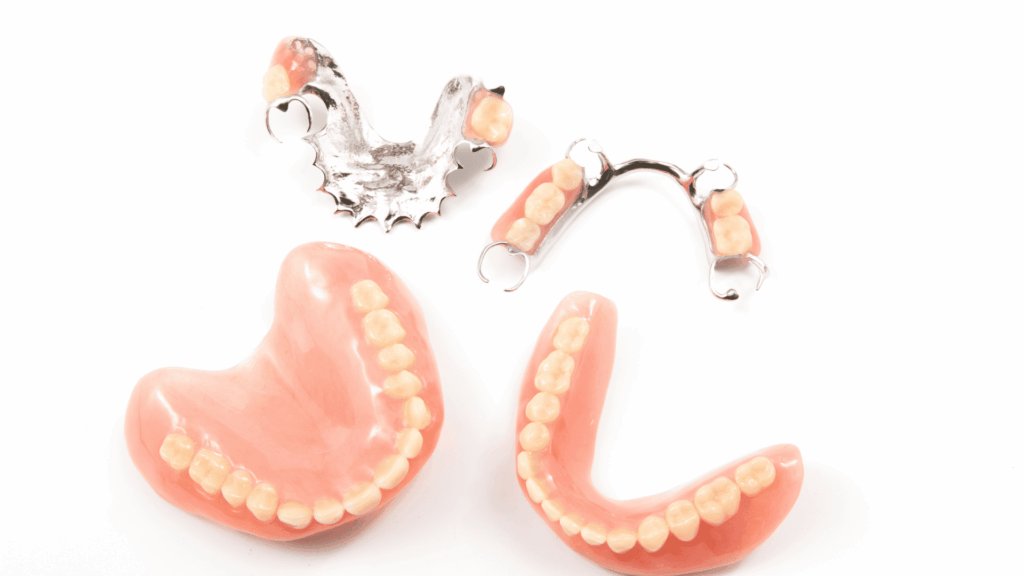
A partial denture is a removable dental appliance designed to replace one or more missing teeth. Unlike full dentures, partial dentures work alongside your natural teeth.
Partial dentures attach to your existing teeth using clasps or precision attachments. They fill empty spaces, restore chewing and speaking ability, and prevent neighboring teeth from shifting.
Who Can Benefit from Partial Dentures?
Partial dentures are ideal for people who:
Have lost some but not all teeth
Notice gaps that make chewing difficult
Experience shifting of natural teeth
Want to improve appearance and smile confidence
A dentist can help determine if a partial denture is the right option based on your oral health and dental goals.
Different patients need different solutions. Here are the main types:
Traditional / Metal Framework Partial Dentures
These partial dentures use a strong metal framework with clasps that attach directly to your natural teeth. They give stable support for multiple missing teeth and last for years. Patients often choose this type for long-term use when strength and reliability matter most.
Flexible Partial Dentures
Made from lightweight, gum-colored materials, flexible partial dentures bend slightly to fit comfortably over your gums. They are ideal for sensitive mouths and can adapt better to changes in tooth alignment. This type is often preferred for comfort and a more natural look.
Acrylic Partial Dentures
Acrylic partial dentures are made entirely of acrylic and are usually a more affordable, temporary option. They can replace one or several missing teeth and are often used while waiting for a more permanent solution. They can be upgraded later to metal or flexible dentures.
Each type has unique benefits depending on your oral structure, the number of teeth missing, and your personal comfort preferences.
Partial Dentures Cost
Many patients ask about partial dentures cost. Prices can vary based on:
Materials used (metal, acrylic, flexible)
Number of teeth being replaced
Complexity of the dental work
Level of customization
A general range can help guide expectations, but exact costs are determined during a consultation. We will review your needs and provide a detailed estimate before treatment begins.
How Partial Dentures Work
Partial dentures replace missing teeth and help your mouth function normally. They attach to your natural teeth using clasps or precision attachments, which hold the denture securely in place. By filling the gaps, they restore your ability to chew properly and speak clearly.
In addition, partial dentures support the teeth around the empty space, keeping them from shifting out of alignment. When fitted carefully and cared for daily, partial dentures feel comfortable, stable, and natural for everyday activities.
Preserve oral health by distributing bite pressure evenly
Schedule Your Partial Dentures Consultation
Missing some teeth can make eating, speaking, and smiling feel harder than it should. Partial dentures provide a reliable way to fill gaps while protecting your remaining teeth, restoring function, and boosting confidence. At Pearl Zadeh DDS in Woodland Hills, we create custom solutions designed to fit comfortably and look natural.
Call (818) 716-6722 or schedule your consultation online today to explore your partial denture options and find the right fit for your smile.
Yes. Most patients can enjoy a wide variety of foods after an initial adjustment period. Chewing efficiency is restored once you get used to the dentures.
2. Are partial dentures removable?
Yes. Partial dentures are designed to be removable for cleaning and daily maintenance.
3. How long do partial dentures last?
With proper care, partial dentures can last 5-10 years. Regular dental checkups ensure the fit remains secure.
4. What is the difference between flexible and traditional partial dentures?
Flexible partial dentures are made from lightweight, gum-colored materials and are often more comfortable. Traditional metal framework partial dentures are stronger and more durable.
5. How often should partial dentures be adjusted or checked?
It is recommended to have dentures evaluated at least once a year. Changes in your mouth over time may require adjustments for comfort and stability.
Onlay vs Crown: Which Dental Restoration Do You Need?
Pearl Zadeh DDSRestorative
A damaged molar often leaves one key question. Should the tooth be partially covered or fully protected?
The answer depends less on preference and more on how much healthy structure remains after decay or an old filling is removed.
Dr. Pearl Zadeh’s Woodland Hills practice evaluates each tooth individually and decides between dental onlays and full crowns based on what will best support long-term function.
The difference comes down to how each restoration works and how much of the natural tooth can still be preserved.
The Core Difference Comes Down to Tooth Removal
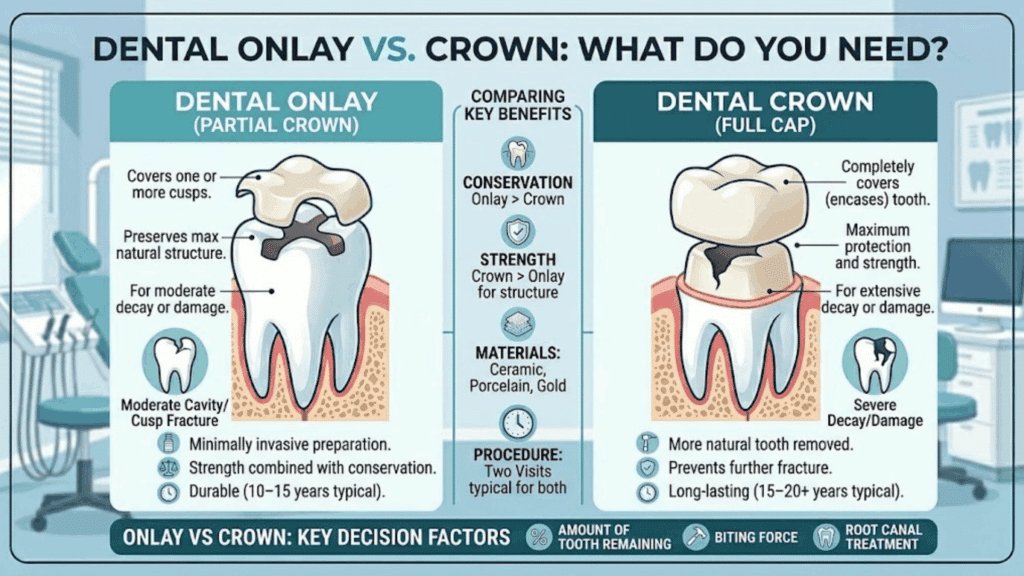
An onlay only covers the damaged part of the tooth, usually one or more cusps, while leaving the rest of the natural surface intact. A crown, on the other hand, covers the entire tooth from top to bottom.
To place a crown, a dentist has to reduce the tooth on all sides. This usually means removing about one to two millimeters of structure, including healthy enamel that cannot grow back.
An onlay takes a more conservative approach. It only replaces the areas affected by decay or damage, while preserving the healthy enamel wherever possible.
The same principle applies when comparing inlays and fillings. The less healthy tooth structure that needs to be removed, the more natural strength the tooth can often retain over time.
Why a Tooth Sometimes Needs a Crown Instead
The need for a crown usually comes down to how much of the tooth is still strong enough to support a restoration. An onlay only works when enough healthy structure remains to bond and reinforce.
When multiple cusps are fractured or badly decayed, there often isn’t enough solid tooth left to support an onlay. The same applies when a vertical crack extends below the gumline, since that area cannot be fully covered or protected by a partial restoration.
Teeth that have had root canal treatment also change the equation. Without a blood supply, the tooth becomes more brittle over time and more likely to fracture under pressure.
Severe wear from grinding can lead to the same issue. When the cusps are flattened, there is often nothing left for an onlay to properly cap.
A crown solves these problems by fully covering the tooth. It acts like a protective shell, helping distribute bite forces evenly and reducing the risk of the tooth splitting during normal chewing.
Why an Onlay Is Often the Better Choice When It’s an Option
Dentists usually try to preserve as much natural tooth structure as possible, as long as the tooth can still function safely.
An onlay supports that goal by covering only the damaged areas instead of reducing the entire tooth. This means less healthy enamel needs to be removed compared to a crown.
Because an onlay bonds directly to the remaining tooth, it helps distribute chewing forces across both the restoration and natural structure. In many cases, this allows the tooth to feel closer to how it functioned before damage occurred.
Treatment time can also be shorter since the preparation is more conservative than a full crown.
This approach is not about doing less. It is about keeping as much of the natural tooth as possible while still restoring strength and function for daily use.
How the Procedures Actually Differ
An onlay procedure focuses on removing only the damaged or decayed part of the tooth while keeping as much healthy structure as possible. Once the tooth is prepared, a scan or impression is taken to capture its exact shape. A temporary restoration is placed to protect the tooth while the final onlay is made. At the next visit, the finished onlay is bonded into place using resin cement and a curing light.
A crown procedure involves more reduction of the tooth. The entire tooth is reshaped to allow space for a full-coverage restoration. After preparation, a scan or impression is taken, and a temporary crown protects the tooth until the final version is ready. The completed crown is then cemented over the entire tooth.
The key difference comes down to how much natural tooth structure is removed. An onlay preserves more of the original tooth, while a crown requires more extensive reshaping that cannot be reversed.
Onlay vs Crown: Key Differences
Factor
Onlay
Crown
Coverage
One or more cusps
Entire visible tooth surface
Tooth structure removed
Only damaged areas
Roughly 1 to 2mm on every surface
Best for
Localized damage with intact remaining structure
Extensive damage, root canal treated teeth, severe cracks
Procedure reversibility
Can sometimes be replaced without major tooth loss
Tooth reduction is permanent once completed
Typical longevity
15 to 30 years with ceramic or gold
15 to 30 years with porcelain or zirconia
What Happens If You Choose an Onlay When You Actually Needed a Crown
An onlay depends on having enough healthy tooth structure to distribute chewing forces evenly. When that support is not there, the remaining tooth walls take on more stress than they should.
Over time, those weakened areas can start to flex with every bite. Without proper support, that stress can eventually lead to a crack that extends below the gumline.
At that stage, the tooth may no longer be restorable, and extraction can become the only option. In many cases, this outcome could have been avoided with a crown placed earlier.
This is why a careful evaluation matters before choosing between an onlay and a crown. The right decision depends on the actual strength of the remaining tooth, not just the visible damage.
What Happens If You Choose a Crown When an Onlay Would Have Worked
In this case, the tooth still gets restored, but more healthy structure is removed than necessary.
Once a tooth is reduced for a crown, that natural structure cannot be restored later. If the crown ever needs replacement, treatment usually stays within the crown category rather than shifting to a more conservative option.
Both approaches protect the tooth from decay and fracture, but unnecessary reduction means losing more natural enamel than required for the situation. Careful diagnosis helps avoid that trade-off from the start.
How Your Dentist Actually Makes This Call
During an exam, Dr. Pearl Zadeh looks closely at how much healthy cusp structure is still supporting the tooth. She also checks for hidden cracks and reviews X-rays to understand how deep the decay extends.
In some cases, the final decision only becomes clear once treatment begins. Decay often reaches further than what appears on an X-ray, so a planned onlay may need to change to a crown if more structure is compromised than expected.
This is a normal part of restorative dentistry. X-rays give important information, but they cannot fully show the strength or integrity of the remaining tooth.
Find the Right Restoration for Your Tooth
The choice between an onlay and a crown depends on how much healthy tooth structure is still present. It is less about preference and more about what the tooth can safely support. Many patients share their experiences through our patient testimonials, often highlighting how clear the diagnosis helped them feel confident about their treatment.
Dr. Pearl Zadeh’s Woodland Hills practice evaluates each tooth individually before recommending a restoration. If you are dealing with a damaged tooth, call (818) 716-6722 or click the button below to schedule your consultation online. A thorough evaluation can determine whether an onlay or a crown is the better choice for preserving your tooth.
1. Can an onlay protect a tooth as well as a crown?
When enough healthy tooth structure remains, yes. An onlay can strengthen and protect a damaged tooth while preserving more natural enamel than a crown.
2. Will my dentist know in advance which restoration I need?
Often, yes. X-rays and a clinical exam provide valuable information. However, the final decision sometimes becomes clear only after all decay is removed.
3. Does a root canal always mean I need a crown?
Not always, but crowns are commonly recommended after root canal treatment. These teeth become more brittle over time and often benefit from full coverage.
4. Is it possible to switch from a crown to an onlay later?
No. Once a tooth is prepared for a crown, the removed tooth structure cannot be restored. Future treatment typically involves replacing the crown rather than moving to a more conservative restoration.
5. How do I know if my onlay may be failing?
New sensitivity, pain when chewing, a visible crack, or changes around the restoration can all be warning signs. A dental exam can determine whether the restoration remains stable and whether additional treatment is needed.
Many patients wonder about the safety and process of mercury amalgam removal. Amalgam fillings, often called “silver fillings,” have been used for decades to restore teeth. While durable and cost-effective, some patients choose to replace them for cosmetic reasons, health concerns, or when fillings show signs of wear.
At Pearl Zadeh DDS in Woodland Hills, we follow strict safety protocols to ensure removal is precise, comfortable, and safe.
What Are Mercury Amalgam Fillings?
Mercury amalgam fillings are made from a blend of metals, including silver, tin, copper, and mercury. They were widely used because they are strong, durable, and relatively inexpensive.
Over time, however, these fillings can crack, leak, or discolor teeth. Some patients also prefer mercury-free alternatives for aesthetic or personal reasons.
Why Do Patients Consider Mercury Amalgam Removal?
There are several reasons people choose to remove amalgam fillings:
Aesthetic concerns: Dark metal fillings can show when you smile or talk.
Health considerations: Some patients prefer to replace mercury-containing fillings.
Damaged or failing fillings: Cracked or leaking fillings can compromise oral health.
Upgrading to modern materials: Tooth-colored composite or porcelain fillings improve appearance and function.
How Mercury Amalgam Removal Works
Removing mercury amalgam fillings is a careful process designed to minimize exposure and protect surrounding teeth. Here’s how it works:
Isolation and protection, We place barriers and use high-volume suction to prevent debris or mercury from entering the mouth.
Digital assessment, X-rays or scans help assess the extent of the filling and guide safe removal.
Step-by-step removal, The amalgam is removed in small pieces to reduce stress on the tooth.
Replacement, The cavity is restored with composite fillings, porcelain inlays, or other safe dental materials.
Using these measures, removal is both safe and precise, preserving as much natural tooth structure as possible.
At Pearl Zadeh DDS in Woodland Hills, patient safety is the top priority during mercury amalgam removal. Dr. Pearl follows IAOMT and Huggins Alliance protocols to protect patients, staff, and herself. Protective barriers, a dental dam, and high-volume suction reduce contact with mercury particles.
Water and air sprays keep the fillings cool, while an alternative oxygen source ensures safe breathing. The office also uses an air filtration system to capture any vapors. After removal, the mouth is thoroughly rinsed and cleaned to complete the process safely.
Replacing old mercury fillings provides multiple advantages:
Improves smile appearance with tooth-colored restorations.
Reduces risk of cracks or leaks in old fillings.
Replaces metal with safer, biocompatible materials.
Supports long-term oral health by protecting teeth from further decay.
A properly removed and replaced filling can restore both function and confidence in your smile.
Aftercare and Maintenance
After amalgam removal, caring for your new fillings is simple:
Brush at least twice a day and floss around the treated teeth.
Avoid very hard foods on the new filling for a few days.
Attend regular dental checkups to monitor the restoration.
Report any sensitivity or discomfort promptly.
With proper care, modern restorations can last many years while keeping your teeth healthy.
Who Should Consider Mercury Amalgam Removal?
Patients who may benefit include:
Those with cracked, worn, or leaking amalgam fillings.
Individuals replacing old fillings for cosmetic reasons.
Patients concerned about mercury exposure.
Anyone looking to upgrade to safer, tooth-colored materials while preserving oral health.
A professional exam can determine whether removal is appropriate and safe for your teeth.
Schedule a Consultation
If you’re thinking about mercury amalgam removal, Pearl Zadeh DDS in Woodland Hills offers careful, personalized treatment focused on comfort, precision, and natural-looking results.
Call (818) 716-6722 or book your consultation online today to discuss your options and get your teeth safely restored without metal fillings.
Most patients feel minimal discomfort. Local anesthesia keeps the area numb during the procedure.
2. Can children or pregnant patients safely undergo removal?
Yes, but special precautions are taken. Your dentist will discuss timing and safety measures.
3. What materials are used to replace amalgam fillings?
Safe alternatives include composite resin and porcelain, both of which match your natural tooth color.
4. How long does the procedure take?
Dentists usually complete single-tooth removals in one visit, while removing multiple fillings may require additional appointments.
5. How long do mercury-free fillings last after removal?
Modern tooth-colored fillings, such as composite or porcelain, offer long-lasting durability when you care for them properly. Brush and floss daily and visit your dentist for regular checkups to keep them strong, maintain their appearance, and support long-term oral health.