Pearl Zadeh DDS

Tag: Pearl Zadeh DDS

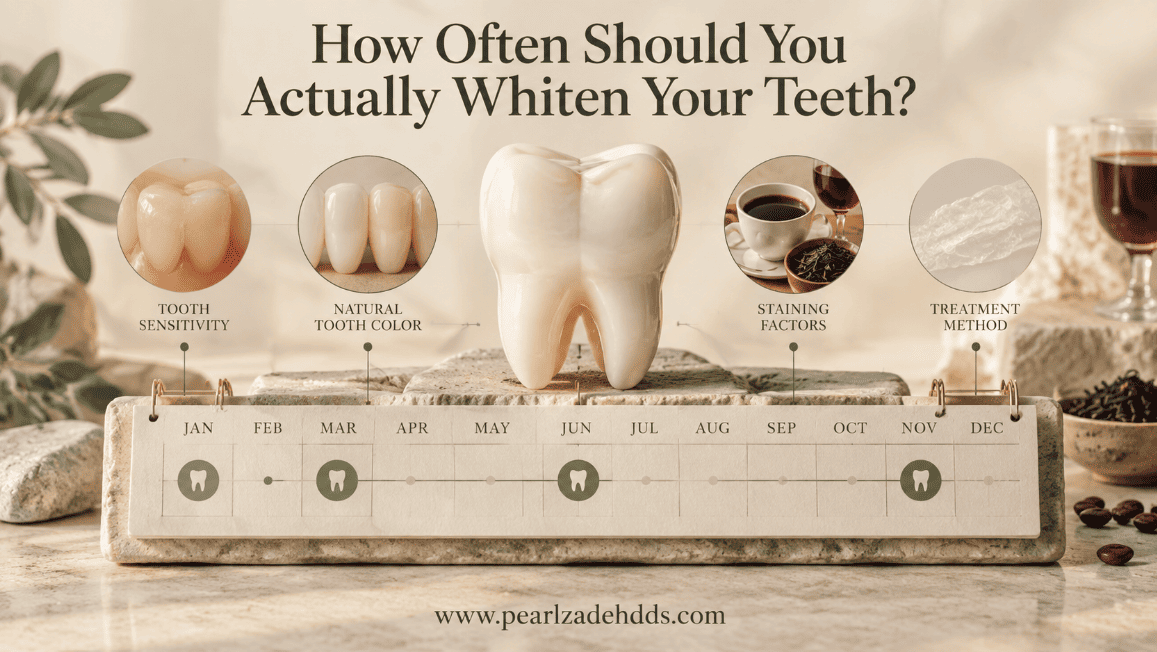
  • How Often Should You Actually Whiten Your Teeth?

    How Often Should You Actually Whiten Your Teeth?

    When you search for an answer to how often you should whiten your teeth, you will find a different number every time. Every two weeks. Every six months. Once a year. But none of those numbers comes from your mouth, so none can tell you what is right for your teeth.

    There is no single interval that works for everyone. How often you can whiten depends on your teeth, your sensitivity history, the method you use, and the type of staining you have. Your previous response to whitening matters too.

    Instead of chasing a fixed schedule, look at what your teeth need and why you want to whiten again.

    Why There Is No Universal Whitening Schedule

    Two people can use the same whitening product and need very different intervals before their next round. One drinks coffee daily and grinds slightly at night, wearing at their enamel. Another barely touches staining foods and has naturally resilient teeth. Age, enamel thickness, diet, and past dental work all shape how quickly color returns. They also shape how much whitening those teeth can comfortably handle. A schedule built for one mouth is not automatically safe for another.

    What Actually Happens to Your Teeth Each Time You Whiten

    Whitening works by allowing peroxide to pass through the enamel and reach the layer underneath. According to the American Dental Association, whitening peroxide can make enamel temporarily more permeable while it works. That process can also let the peroxide reach the nerve. This is part of why some people notice temporary sensitivity afterward. Between sessions, enamel has a chance to settle. That recovery window is part of why spacing sessions out matters. It is not just about the number of times a year you whiten.

    How Often Can You Safely Whiten at Home?

    At-home kits, whether trays, strips, or pens, are designed for a defined course rather than ongoing use. Most products are built around a set number of days or weeks, followed by a break. Using a product more often than directed does not typically speed up results. Neither does layering multiple products at once. Both mainly increase the chance of sensitivity, without a matching improvement in shade. The American Dental Association also notes that overuse of whiteners can damage enamel or gums. This is why following the printed directions matters. Stop earlier if your teeth or gums feel uncomfortable, rather than pushing through for a whiter result.

    How Often Can You Get Professional Whitening?

    Professional whitening is typically spaced out further than at-home touch-ups, and for good reason. According to the American Dental Association, people seeking whiter teeth are generally better served visiting their dentist. Once or twice a year is often enough, and that beats repeating whitening on their own more frequently. That is a general guideline, not a fixed rule for every patient. Your dentist can evaluate your enamel and gum health first. They can also factor in how your teeth responded to your last treatment before recommending your next one.

    What Are the Risks of Whitening Too Often?

    Whitening more often than your teeth can tolerate is not simply a matter of wasted product. The ADA has reported that overuse of whitening products has been shown to damage enamel and gums. It can also increase tooth sensitivity. In some cases it can lead to a more translucent look at the edges of teeth. The underlying layer becomes more visible. Occasional whitening, followed by a real recovery period, allows the enamel surface to remineralize between sessions. Repeated bleaching without those breaks does not give it that chance. That is why whitening more frequently is not automatically better or safer.

    What Signs Suggest You Are Whitening Too Frequently?

    A few patterns are worth watching for. Sensitivity that gets worse with each round, rather than settling between them. Gums that feel irritated after treatment. Teeth that look more translucent or gray at the edges, instead of simply whiter. Feeling like you need to whiten again almost immediately, just to hold the same shade. Any of these is a reasonable signal to stop. Let your teeth recover, and check in with your dentist before whitening again.

    Do Teeth Reach a Point Where They Stop Getting Whiter?

    Yes. Whitening lightens the natural color of your enamel and dentin. It cannot take a tooth past its own underlying shade. Once you reach the lightest shade your teeth are capable of, additional whitening will not lighten them further. It can still raise your risk of sensitivity and irritation, with no real benefit in return. A plateau despite continued whitening is generally a sign to stop, rather than a reason to intensify the routine.

    How Long Do Whitening Results Typically Last Before a Touch-Up?

    How long results hold up before color starts to return varies by person and habits. This is covered in more depth in our guide to how long teeth whitening results last. In general terms, diet, smoking, oral hygiene, and the whitening method all affect how quickly staining reappears. That timeline, not a fixed calendar date, is what should guide when a touch-up makes sense.

    What Factors Affect How Often You Should Whiten?

    Several things influence the right interval for you specifically. How porous or sensitive your enamel is. Whether you have dental work, like fillings, crowns, or veneers, that will not change color like natural enamel does. Your diet, including how often you have coffee, tea, or red wine. Whether you smoke or use tobacco. How your teeth and gums responded to your last treatment. Someone with a daily coffee habit and little rinsing afterward will typically need touch-ups sooner. That is true even if they started from a similar shade as someone with a lower-staining diet. A dentist weighing all of this together will generally land on a more useful answer. That beats any generic interval found online.

    Should You Whiten on a Set Schedule or Only When You Notice Fading?

    Both approaches exist. Some people prefer a loose schedule built around their dentist’s recommendation. That might mean a professional touch-up once or twice a year. Others prefer to whiten only when they notice visible fading. This can mean longer or shorter gaps, depending on how their teeth actually behave. What matters more than which approach you choose is this. You should not whiten reactively, out of habit or impatience. Give your teeth a real chance to recover between rounds.

    Is the Interval Different for Trays, Strips, and In-Office Treatment?

    Yes. Strips and at-home trays are generally used in short, defined courses with breaks built in. Touch-ups with these tend to happen more often than professional visits, though still not continuously. In-office treatment uses a stronger concentration under supervision. That is part of why it is typically spaced out further. It is often once or twice a year for most patients. If you are comparing the two, our guide to whitening pens, strips, or professional treatment breaks down the differences. Mixing methods, such as layering strips on top of a recent professional treatment, is more likely to cause irritation. It rarely improves results.

    What If You Have Sensitive Teeth?

    If your teeth are already sensitive, that changes how often whitening makes sense. It is not just about how it feels while you do it. It is worth reading our guide on what helps sensitive teeth after whitening. Also see our guide on whitening options for sensitive teeth. Do not assume your usual interval still applies. A history of sensitivity is generally a good reason to space treatments further apart, or use a lower concentration. It can also be a reason to check in with your dentist before restarting. That beats following the same schedule someone with no sensitivity history might use.

    Can Whitening Too Often Damage Your Enamel?

    This is one of the more common concerns. The honest answer is that it depends on frequency and technique, rather than whitening being inherently harmful. Our detailed look at whether teeth whitening damages enamel goes further into the evidence. The short version is that spacing treatments appropriately matters most for enamel health. No single session matters as much on its own.

    What About Touch-Up Whitening Between Full Treatments?

    A quick touch-up is not the same as a full whitening course, but it is not automatically risk-free either. Are you reaching for a touch-up product every few weeks just to maintain a shade? Mention that pattern to your dentist. It may mean the interval between full treatments should be adjusted, rather than patched over with frequent small doses.

    How Often Should You Whiten With Crowns, Veneers, or Fillings?

    Whitening lightens natural tooth enamel, but it does not change the color of crowns, veneers, bonding, or fillings. Whitening too often will not help match dental work to a shade it cannot reach. It can instead leave natural teeth looking noticeably whiter than the restored ones. If you have visible dental work, read our guide on whitening with fillings or crowns first. It covers how often, or whether, to keep whitening around them.

    Why Might One Tooth Need Different Attention Than the Rest?

    Not every tooth responds to whitening at the same pace. Repeating a whole course just because one tooth still looks slightly different is not always the answer. Our article on why one tooth may not whiten like the others explains some of the more common reasons. These range from natural variation to old dental work to deeper, internal staining that surface whitening cannot fully reach.

    What If Whitening Stops Working As Well As It Used To?

    If you feel like you are whitening more often just to get the same result, that is worth investigating. Do not simply increase frequency. Our guide on why teeth won’t whiten covers some of the underlying reasons results can stall. Several of these have nothing to do with how often you are whitening. They have more to do with the type of staining involved.

    How Can a Dentist Help You Build the Right Whitening Schedule?

    A dentist can look at your enamel condition, existing dental work, sensitivity history, and staining pattern. They can use all of that to recommend an interval built around your actual teeth. That beats a generic number. This is part of why professional evaluation tends to produce steadier, more predictable results over time. Repeated at-home whitening driven by guesswork often falls short. If you are weighing your options, our overview of what professional whitening involves is a useful starting point.

    Talk to Dr. Pearl Zadeh About Your Whitening Schedule

    There is no single number that tells you how often to whiten your teeth. Your enamel, your habits, and your dental history are not the same as anyone else’s. Guessing at a schedule is risky. So is whitening more often just because results seem to be fading. Both are more likely to cause sensitivity and irritation than a consistently bright smile.

    Dr. Pearl Zadeh and her Woodland Hills team can evaluate your teeth and build a whitening plan. That might mean an occasional professional treatment, a well-timed at-home routine, or a combination of the two. It depends on what your teeth actually need.

    Call (818) 716-6722 or click the button below to schedule your consultation online.

    Frequently Asked Questions

    How often can I safely whiten my teeth?

    It depends on your enamel, sensitivity history, and the method you use, so there is no single number that applies to everyone. Professional whitening is often spaced out to roughly once or twice a year for many patients, while at-home products are meant to be used in short, defined courses with breaks in between.

    Is it safe to whiten your teeth once a month?

    For most people, whitening every single month is more frequent than dentists generally recommend, particularly with stronger products. How often is appropriate depends on your individual teeth, so it is worth checking with a dentist rather than assuming a monthly routine is fine by default.

    How often should you get professional teeth whitening?

    Many patients are advised to consider professional whitening roughly once or twice a year, though the right interval depends on your enamel, staining habits, and how your teeth responded to previous treatment. Your dentist can tailor this to you specifically.

    Can you whiten your teeth too often?

    Yes. Whitening more often than your teeth can handle has been linked to enamel and gum irritation and increased sensitivity, without necessarily producing a whiter result once your teeth reach their natural limit

    What happens if you whiten your teeth too much?

    Possible effects include increased tooth sensitivity, gum irritation, and a more translucent look at the edges of teeth as the underlying layer becomes more visible. It does not continue making teeth whiter once they reach their natural shade limit.

    How long should you wait between whitening treatments?

    This varies by person and method. It depends on how your teeth and gums responded to the last treatment, your sensitivity history, and how quickly staining tends to return for you. A dentist can help you settle on a realistic interval.

    Frequently Asked Questions

    How often can I safely whiten my teeth?

    It depends on your enamel, sensitivity history, and the method you use, so there is no single number that applies to everyone. Professional whitening is often spaced out to roughly once or twice a year for many patients, while at-home products are meant to be used in short, defined courses with breaks in between.

    Is it safe to whiten your teeth once a month?

    For most people, whitening every single month is more frequent than dentists generally recommend, particularly with stronger products. How often is appropriate depends on your individual teeth, so it is worth checking with a dentist rather than assuming a monthly routine is fine by default.

    How often should you get professional teeth whitening?

    Many patients are advised to consider professional whitening roughly once or twice a year, though the right interval depends on your enamel, staining habits, and how your teeth responded to previous treatment. Your dentist can tailor this to you specifically.

    Can you whiten your teeth too often?

    Yes. Whitening more often than your teeth can handle has been linked to enamel and gum irritation and increased sensitivity, without necessarily producing a whiter result once your teeth reach their natural limit.

    What happens if you whiten your teeth too much?

    Possible effects include increased tooth sensitivity, gum irritation, and a more translucent look at the edges of teeth as the underlying layer becomes more visible. It does not continue making teeth whiter once they reach their natural shade limit.

    This article is for informational purposes only and is not a substitute for professional dental advice. Please schedule a consultation with Pearl Zadeh DDS to discuss your specific situation.
  • Sensitive Teeth After Whitening: What Helps?

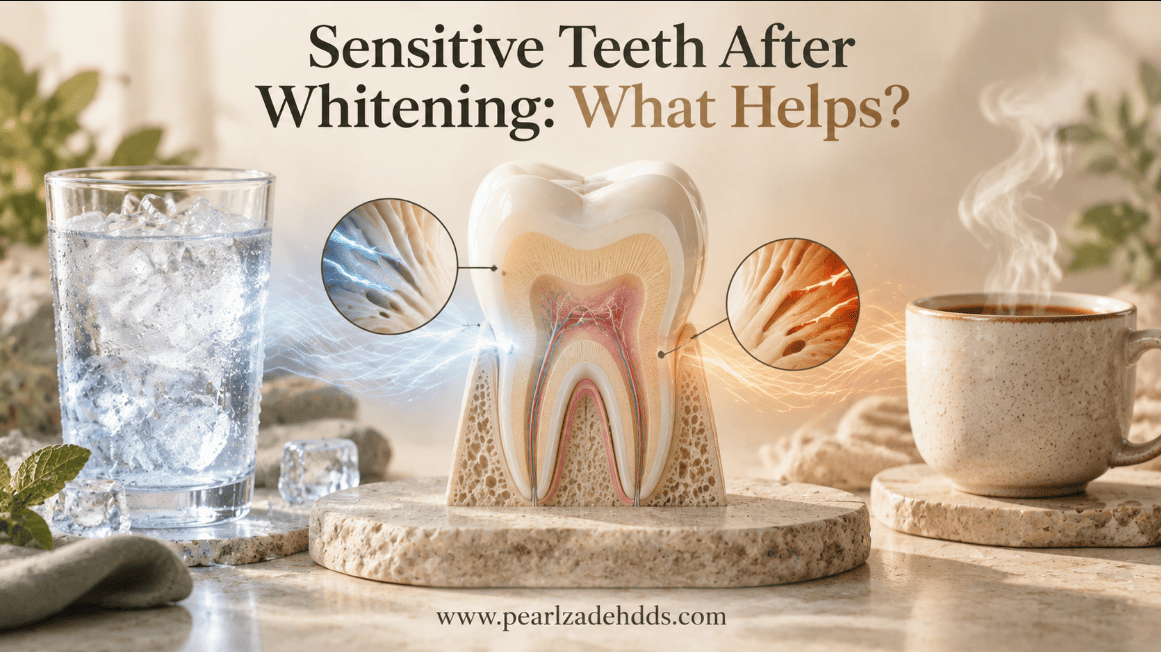
    Sensitive Teeth After Whitening: What Helps?

    Whitening can leave your teeth feeling more sensitive than usual, especially when you eat or drink something hot or cold. The sensation can be sharp and uncomfortable, but it does not necessarily mean the whitening harmed your teeth.

    For most people, whitening-related sensitivity is temporary. What matters is how severe it is, how long it lasts, and whether anything else could be causing the discomfort. A few simple changes may make your teeth more comfortable while the sensitivity settles.

    Why Are My Teeth Sensitive After Whitening?

    Whitening agents work by releasing peroxide, which needs to pass through the enamel and dentin to break apart the compounds causing discoloration. That same peroxide can also reach the pulp, the soft tissue at the center of the tooth where the nerves live, and cause mild, temporary inflammation there. Inflamed nerves tend to react more strongly to everyday triggers like cold air or a cold drink. This is a somewhat different pathway than ordinary sensitive teeth, which the American Dental Association explains usually comes from worn enamel or gum recession exposing the tubules that lead to the nerve. That difference is part of why whitening sensitivity can come on quickly and affect several teeth at once, rather than building up gradually in one spot.

    Several factors influence how noticeable this becomes, including sensitivity you already had before whitening, exposed dentin or tooth roots, enamel wear, gum recession, a stronger whitening concentration, longer or more frequent exposure, and simple differences in how one person’s teeth respond compared to another’s. Having sensitive teeth after whitening does not mean your enamel was damaged. It usually reflects a temporary pulpal response to the whitening process itself.

    What Does Whitening Sensitivity Feel Like?

    Most people describe it as a short, sharp zing rather than a dull, lingering ache. Common triggers include cold drinks, cool air, and sometimes hot foods or beverages. Some notice discomfort that comes and goes throughout the day, while others feel a more generalized sensitivity across several teeth rather than one specific spot.

    The pattern matters. Brief sensitivity that shows up with a specific trigger and fades once the trigger is gone fits the typical profile of whitening-related sensitivity. A single symptom is not enough to determine the cause, so it helps to watch how it behaves over the following days rather than trying to diagnose it from one uncomfortable moment.

    What Helps Sensitive Teeth After Whitening?

    A few practical steps tend to make the biggest difference while your teeth settle down.

    Give hot and cold foods a break for a few days if they trigger discomfort. Switch to a toothpaste formulated for sensitive teeth, since potassium nitrate and similar ingredients have shown modest evidence of reducing sensitivity intensity in some patients, even though the research on how often they prevent sensitivity outright is mixed. Keep brushing gently rather than skipping oral hygiene altogether. Hold off on any additional whitening while you are still uncomfortable. Follow the product’s directions closely rather than extending wear time or reapplying more often to speed results. And give your teeth time. For many people, sensitivity peaks in the first day or two and eases from there.

    No single remedy works the same way for everyone. If desensitizing toothpaste does not bring meaningful relief within a few days, that is a good reason to check in with your dentist rather than try increasingly aggressive home remedies.

    Should You Stop Whitening If Your Teeth Hurt?

    There is a difference between finishing a whitening plan your dentist already reviewed and reaching for more whitening because you have not hit the shade you wanted yet. If sensitivity develops, adding more sessions or leaving the product on longer to compensate tends to make things worse, not better. Whether to pause completely or simply finish a planned, limited course depends on how severe the sensitivity is, which method you are using, and the condition of your teeth going in. Mild discomfort that fits the typical pattern often does not require stopping a short, already-planned regimen. Anything more than mild calls for stopping and reassessing.

    How Long Does Tooth Sensitivity Last After Whitening?

    For most people, sensitivity is temporary. A recent review of research on bleaching-related sensitivity found that it is common but usually transient, and that discomfort tends to peak within the first one to three days after treatment before fading. There is no single timeline that applies to everyone, so it is not accurate to promise resolution within a specific number of hours.

    How long it lasts depends on the whitening method used, how much peroxide exposure your teeth had, whether you already dealt with sensitivity before whitening, and the general condition of your enamel and dentin. Sensitivity that peaks early and eases over a few days is different from sensitivity that lingers well beyond that window or keeps getting worse, and the second pattern deserves more attention.

    Does Sensitivity Mean Whitening Damaged Your Teeth?

    Not necessarily. Temporary sensitivity is a known, common side effect of the whitening process itself, not proof that your enamel was harmed. It generally reflects a short-term response inside the tooth rather than a lasting structural change. At the same time, it would be inaccurate to say whitening can never affect teeth or that professional whitening removes all risk. If you want a fuller picture of what the current evidence says about whether whitening can damage enamel, that is covered in more detail separately. The short version here is that sensitivity alone is not evidence of damage, and it is not something to try to self-diagnose from symptoms.

    What Should You Avoid While Your Teeth Are Sensitive?

    You do not need a strict diet, just a bit of common sense while things settle. Very cold drinks, very hot foods, and anything highly acidic can make discomfort more noticeable. Additional whitening during this window tends to compound the problem, and so can aggressive brushing or using a whitening product more often than directed. Outside these specific triggers, there is no need to overhaul your diet. Most people find avoiding the one or two things that clearly set off discomfort is enough.

    Can You Brush Your Teeth When They Are Sensitive After Whitening?

    Yes, and you should. Sensitivity is not a reason to skip brushing or flossing. Use a soft-bristled toothbrush, apply gentle pressure rather than scrubbing, and consider a toothpaste made for sensitive teeth if cold or hot triggers are bothering you. Keeping up with your normal oral hygiene routine matters just as much while your teeth are sensitive as it does the rest of the time, since skipping it can create other problems on top of the temporary discomfort.

    When Is Sensitivity After Whitening Not Normal?

    Most whitening-related sensitivity is mild, temperature-triggered, and short-lived. A few patterns fall outside that and are worth a dental evaluation: pain that feels severe, discomfort that persists or worsens over several days, pain concentrated in one specific tooth, pain that starts on its own without an obvious trigger like cold or heat, pain that lingers after the trigger is removed, any swelling, sensitivity that simply is not improving, or sensitivity that existed before whitening and has become noticeably more intense. These symptoms do not necessarily mean whitening caused a problem. They can point to something unrelated, such as decay, a crack, exposed roots, or gum issues, that whitening happened to make more noticeable. A dentist can examine the tooth and figure out what is actually going on rather than guessing from symptoms alone.

    Why Is One Tooth More Sensitive Than the Others?

    Sensitivity after whitening usually affects multiple teeth at once, so if one tooth stands out as noticeably worse than the rest, that is worth paying attention to. Possible explanations include gum recession affecting that area, more advanced dentin exposure there than elsewhere, thinner enamel, existing dental work, a crack or other structural issue, or an underlying problem unrelated to whitening. Sometimes it is simply natural variation between teeth. A single tooth becoming significantly more sensitive than its neighbors, especially if the sensation is new or does not fade like the rest, is a stronger signal for evaluation than generalized sensitivity across your whole smile.

    Can You Whiten Again After Your Teeth Become Sensitive?

    Not automatically, and not simply because the discomfort has faded. How soon it makes sense to whiten again depends on how strong the original reaction was, which method you used, the current condition of your teeth, and whether you had sensitivity even before the first treatment. There is no universal waiting period that applies to everyone, so resist the temptation to look for a fixed number of days online. Whitening again before the underlying sensitivity has genuinely settled tends to make the next round more uncomfortable, not less, which is part of why a brief check-in with your dentist before restarting is worth it.

    How Can You Prevent Sensitivity During Future Whitening?

    A history of sensitivity is useful information for planning your next session, not a reason to assume it will always happen. Tell your dentist about any sensitivity from a previous treatment, follow the product instructions exactly rather than extending exposure for faster results, and consider a more gradual approach if your teeth have reacted strongly before. It also helps to address any existing sensitivity or dental issues, such as cavities or exposed roots, before adding whitening on top of them. None of this guarantees a sensitivity-free experience, but going in with a plan tends to produce a more comfortable result than repeating the same approach that caused discomfort last time.

    Does Professional Whitening Cause Less Sensitivity?

    Professional whitening has one real advantage here: a dentist can look at your teeth and gums beforehand, check for existing sensitivity or issues like exposed roots, and adjust the concentration or approach accordingly. That planning can reduce the chances of an unpleasant surprise. It does not eliminate sensitivity as a possibility. Professionally supervised whitening can still cause it, particularly at higher concentrations. If you are weighing your options, how professional treatment compares in general is worth reading, but sensitivity risk is something to discuss directly with your dentist rather than assume away.

    What If You Already Had Sensitive Teeth Before Whitening?

    Pre-existing sensitivity is different from sensitivity that shows up for the first time after whitening, and it is worth mentioning to your dentist before you start. It does not mean you cannot whiten. It usually means the approach may need to be adjusted, whether that means a lower concentration, a more gradual schedule, desensitizing products used ahead of treatment, or addressing the underlying cause of your existing sensitivity first. If you already deal with sensitive teeth, the whitening options built around that starting point cover this in more depth.

    Talk to Dr. Pearl Zadeh About Your Sensitivity

    Temporary sensitivity after whitening is common, and for most people it settles on its own within a few days with a little care. But sensitivity that is severe, focused on one tooth, or simply is not improving deserves a closer look rather than being written off as a normal part of the process.

    Dr. Pearl Zadeh and her Woodland Hills team can help you figure out why your teeth are reacting the way they are, whether that means confirming it is a typical post-whitening response or identifying something else that needs attention.

    Call (818) 716-6722 or click the button below to schedule your consultation online.

    Frequently Asked Questions

    How long do sensitive teeth last after whitening?

    For most people, sensitivity peaks in the first one to three days after treatment and eases from there. There is no fixed timeline that applies to everyone, so sensitivity that lingers well beyond that or keeps worsening is worth having checked.

    What helps sensitive teeth after whitening?

    A toothpaste formulated for sensitive teeth, avoiding hot and cold triggers for a few days, gentle brushing, holding off on additional whitening, and giving your teeth time to recover all tend to help. No single remedy works identically for everyone.

    Why do my teeth hurt after whitening?

    Whitening peroxide can reach the pulp at the center of the tooth and cause temporary, mild inflammation there, which can make nerves react more strongly to cold, heat, or air. This is a known, usually short-lived response rather than a sign of damage.

    Can I use sensitive toothpaste after whitening?

    Yes. Toothpaste made for sensitive teeth, often containing potassium nitrate, may help reduce discomfort for some patients and is a reasonable first step while sensitivity settles.

    Should I stop whitening if my teeth become sensitive?

    It depends on how severe the sensitivity is. Mild discomfort during an already-planned, limited course may not require stopping, but adding extra whitening sessions to compensate for sensitivity usually makes things worse. When in doubt, pause and check with your dentist.

    Can I brush my teeth when they are sensitive after whitening?

    Yes, and you should keep brushing. Use a soft-bristled brush, gentle pressure, and a sensitive-teeth toothpaste if needed. Skipping oral hygiene is not a recommended way to manage sensitivity.

    This article is for informational purposes only and is not a substitute for professional dental advice. Please schedule a consultation with Pearl Zadeh DDS to discuss your specific situation.
  • Why Does One Tooth Not Whiten Like the Others?

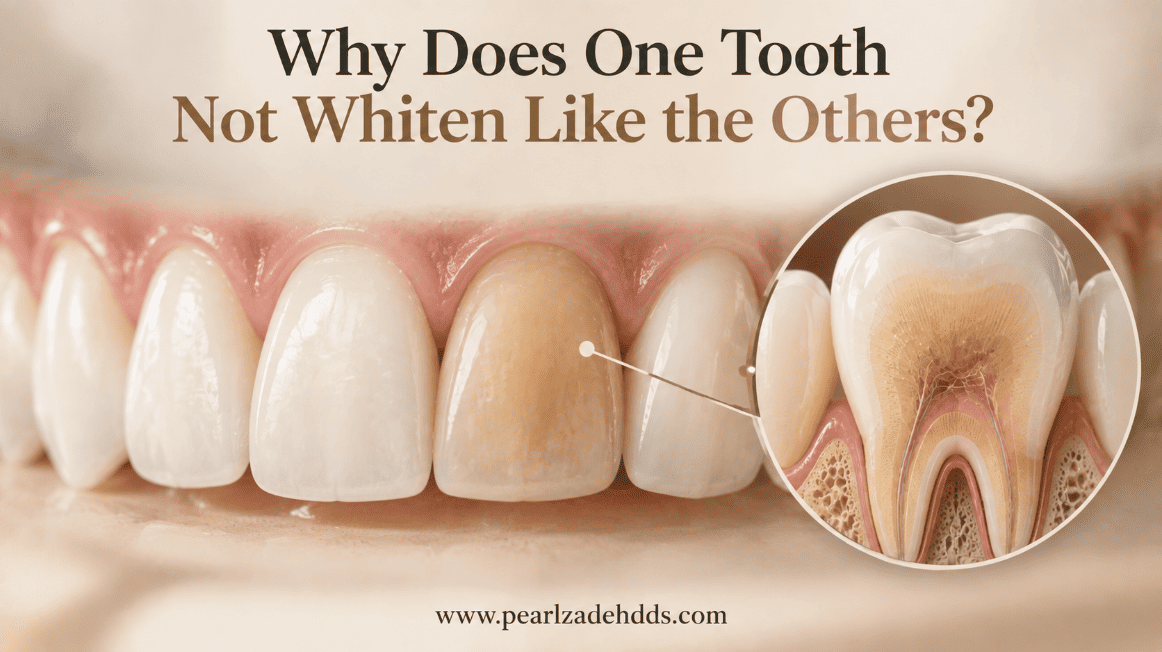
    Why Does One Tooth Not Whiten Like the Others?

    You whiten your teeth, follow the instructions carefully, and the results look great, except for one tooth. It sits a shade or two darker than the rest, and no amount of extra treatment seems to close the gap. If this sounds familiar, you are not imagining it, and you are not doing anything wrong.

    Teeth do not always respond to whitening the same way, even sitting right next to each other in your mouth. A tooth that lags behind usually has a specific reason, and understanding that reason can help you decide what to do next.

    What Can Make One Tooth Whiten Differently?

    In most cases, one tooth resists whitening because something about it is genuinely different from the teeth around it. That difference might be the type of stain it has, its natural color, a filling or crown, an old injury, or discoloration that sits deeper within the tooth.

    Whitening products work on the color of natural tooth structure. They cannot change the shade of a dental restoration, and they may not fully address deeper discoloration. So when one tooth looks different afterward, the explanation usually comes down to the type and location of the discoloration, not a flaw in how you whitened.

    The Tooth May Have a Different Type of Stain

    Tooth discoloration generally falls into two categories, and it matters for how well whitening works. According to the American Dental Association, extrinsic stains sit on the outer surface and typically come from coffee, tea, red wine, and tobacco. Intrinsic stains develop within the dentin layer beneath the enamel and are considered far harder to treat with external whitening, since the ADA notes that removing intrinsic stains within the dentin is considered near impossible with an external procedure.

    If most of your teeth have surface staining but one tooth has a stain that originated deeper, the whitening gel may lighten the surface stains on your other teeth while barely touching that one tooth. This is also why fluorosis and tetracycline staining behave differently under whitening. Brown fluorosis and tetracycline stains tend to respond somewhat better to bleaching, while white fluorosis spots may become less noticeable only as the surrounding tooth lightens around them.

    One Tooth May Naturally Be Darker

    Sometimes there is no stain involved at all. Teeth vary in color naturally, even in a healthy mouth. Canine teeth, for example, often appear darker than the incisors next to them, because canines tend to have a thicker layer of dentin relative to enamel, and dentin has more influence over a tooth’s overall shade than the thinner enamel covering it.

    Larger teeth, including molars and canines, often carry more of this darker undertone, and areas near the gumline can look slightly darker too, since enamel tends to be thinner there. None of this reflects a problem. It is simply how teeth are built, and whitening can only lighten a tooth within the range its own structure allows. If one of your teeth has always looked a little different, even before you considered whitening, that natural variation is a likely explanation.

    Previous Dental Work May Not Whiten Like Natural Teeth

    A crown, veneer, bonding, or filling on one tooth will not change color the way a whitening gel changes natural enamel. The ADA is direct about this: only natural teeth can be whitened, and tooth-colored restorations do not respond to bleaching agents. If you have a filling or crown on the tooth that looks darker, that restoration is very likely why it did not lighten with everything else.

    This works in both directions. A restored tooth can look darker than its whitened neighbors because the material stayed the same shade while the surrounding enamel lightened, or a restoration matched before whitening can end up looking lighter once your natural teeth catch up. Either way, the mismatch is a material issue, not a sign that anything went wrong with the whitening itself.

    A Previous Injury Could Affect Tooth Color

    A tooth that took a hit at some point, even years ago, can end up a different color than the teeth around it. Trauma can affect the blood supply and soft tissue inside a tooth, and depending on what happens afterward, the tooth may darken, take on a gray or brown tint, or shift color gradually over time.

    Color change after an injury does not automatically mean the tooth is dying or infected, and it does not always mean the change is permanent. In some documented cases involving traumatic injuries, discoloration that appeared shortly after the injury faded on its own within weeks to months as the tooth recovered. In other cases, the change persists and reflects a more lasting shift inside the tooth.

    Because there is a real range of possible causes and outcomes, a tooth with a history of trauma that looks different from its neighbors is worth having evaluated by a dentist rather than assumed to be either harmless or serious. A clinical exam, sometimes with an X-ray, is the only reliable way to understand what is happening inside that tooth.

    Some Discoloration Is Deeper Within the Tooth

    Even without an obvious cause like a filling or an old injury, some discoloration simply sits too far inside the tooth for a topical whitening gel to reach. Whitening agents work by penetrating the enamel and lightening the dentin just beneath it. When the pigment sits deeper than that, or the dentin itself has darkened significantly, results can be limited no matter how consistently you use the product. If a tooth simply will not whiten no matter what you try, this kind of deeper discoloration is often part of the explanation, and it is one reason dentists sometimes recommend an evaluation before continuing to whiten on your own.

    What If One Tooth Is Gray, Brown, or Much Darker?

    A single tooth that looks distinctly gray or brown, rather than just a shade off from its neighbors, deserves a closer look. This kind of shift can point to several things: internal staining from an old injury, changes related to a previous root canal, a restoration, or changes inside the tooth that have not caused any pain or other symptoms.

    Gray and brown discoloration is not automatically a sign of infection or a dying tooth, and it is not something to diagnose from color alone. A dentist can check the tooth’s health with a clinical exam and, when needed, an X-ray, then explain what is happening and what options exist.

    Can You Whiten Just One Tooth?

    In some situations, yes. If a single tooth is genuinely lagging behind because it simply needs more exposure to a whitening agent, a dentist may be able to target that tooth specifically, often using a custom tray or a more concentrated approach applied just to that area under professional supervision.

    This tends to work best when the tooth has extrinsic or moderate staining that has not fully responded yet, rather than a tooth affected by a restoration, deep intrinsic staining, or past trauma. Your dentist can evaluate the tooth and let you know whether targeted whitening is likely to help or whether the underlying cause needs a different treatment altogether.

    What If Whitening Makes the Difference More Noticeable?

    This happens more often than people expect, and it can feel discouraging. If your natural teeth lighten several shades while one tooth, whether due to a restoration, an old injury, or deep intrinsic staining, stays roughly the same, the contrast becomes more obvious rather than less. Before whitening, the difference may have been subtle enough to go unnoticed. Afterward, it can stand out.

    This is not a sign that anything went wrong with your treatment. It simply reflects the fact that your other teeth changed color and that particular tooth did not, or did not change by the same amount.

    Should You Keep Whitening Until the Darker Tooth Matches?

    It depends on why that tooth is not responding. Ordinary extrinsic staining that simply needs more time may narrow the gap with continued whitening under your dentist’s guidance. A restoration, deep intrinsic staining, or a color change related to past trauma usually will not, and continuing to whiten may just mean more exposure to a bleaching agent without the payoff you want. There is also a limit to how much whitening a tooth’s enamel can safely tolerate, so whitening indefinitely in pursuit of a perfect match is not typically recommended. Your dentist can tell you honestly whether more whitening is worth pursuing.

    When Should You See a Dentist About One Darker Tooth?

    A dental evaluation is a reasonable next step any time one tooth looks noticeably different, especially if it has a history of trauma, the color is gray, brown, or distinctly different rather than just a shade off, it has ever had sensitivity or pain, whitening has been used consistently for several weeks without change, or you simply are not sure why. None of these are cause for alarm on their own. They are signs the color difference has a specific cause worth identifying.

    How Can a Dentist Determine Why One Tooth Looks Different?

    A dentist typically starts with a visual exam, comparing the tooth with its neighbors and sometimes using a shade guide to document the difference, along with questions about your dental history: whether the tooth was ever injured, whether it has a filling or crown, and any childhood exposure to certain medications or high fluoride levels.

    An X-ray is often part of this evaluation, since it can reveal things not visible from the outside, such as changes related to an old injury or a previous root canal. Sensibility testing, which checks how the tooth responds to temperature, is sometimes used as well, though results are interpreted cautiously since a traumatized tooth does not always respond predictably.

    Can the Tooth Be Made to Match the Others?

    Often, yes, though the right approach depends entirely on the cause. If the tooth simply needs more whitening, your dentist may recommend a targeted approach. A mismatched restoration may need replacement with a shade that matches your newly whitened teeth. Deeper intrinsic staining or discoloration from a past injury may require bonding or a veneer on that specific tooth instead.

    A dentist will generally walk through these possibilities once the cause is clear, explaining what each option involves and what a realistic outcome looks like, rather than assuming one solution fits every situation.

    Talk to Dr. Pearl Zadeh About Your Smile

    A tooth that will not whiten like the rest usually has a clear, identifiable reason behind it, even when that reason is not obvious from looking in the mirror. Whether it turns out to be a natural shade difference, an old restoration, or something that deserves a closer look, a dental evaluation is the most reliable way to understand what is happening and what your options are.

    Dr. Pearl Zadeh and her Woodland Hills team can evaluate the tooth, help explain why it is behaving differently from the rest of your smile, and walk you through the options that make sense for your situation.

    Call (818) 716-6722 or click the button below to schedule an appointment and discuss your oral health needs.

    Frequently Asked Questions

    Why does whitening work on most of my teeth but not one?

    The tooth that is not responding usually has something different about it, such as a restoration, a deeper intrinsic stain, a naturally darker shade, or a history of injury. Whitening only affects natural enamel and dentin, so anything outside that scope will not change color the same way.

    Is it normal for one tooth to be darker than the rest?

    Yes, in many cases. Teeth naturally vary in shade, and canines in particular often appear darker than the teeth beside them due to differences in enamel and dentin thickness. This is a normal variation rather than a sign of a problem.

    Can a crown or filling be whitened to match my other teeth?

    No. Whitening products only work on natural tooth structure. Crowns, veneers, and fillings keep their original shade after whitening. If the restoration no longer matches, your dentist may recommend replacing it.

    Could an old injury be why one tooth looks darker?

    It is possible. Trauma can affect the tissue inside a tooth and cause gray or brown discoloration. Some trauma-related discoloration fades over time. Other cases cause lasting changes. A dental evaluation can determine what is causing the color change.

    Should I keep whitening if one tooth is not changing?

    It depends on the cause. If the tooth needs more time, continued whitening may help. Your dentist can guide the process. If a restoration or deep staining causes the difference, more whitening may not help. Your dentist can suggest a more effective option.

    This article is for informational purposes only and is not a substitute for professional dental advice. Please schedule a consultation with Pearl Zadeh DDS to discuss your specific situation.
  • Plaque vs. Tartar: What’s the Difference?

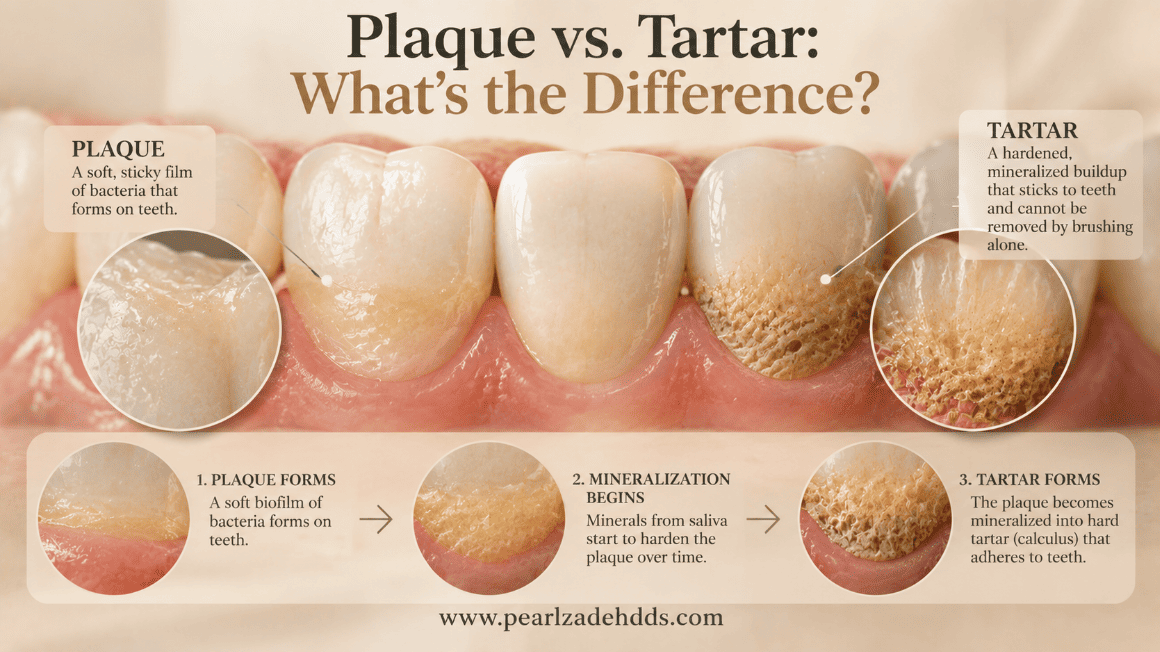
    Plaque vs. Tartar: What’s the Difference?

    You run your tongue over your teeth and feel something rough near the gumline, maybe with a yellowish tint. Is that plaque, or has it already turned into something else?

    Plaque is a soft bacterial film that builds up on your teeth. Tartar is that same material after it has hardened into a mineral deposit. The distinction matters practically: daily brushing and flossing can disrupt plaque, but once it hardens into tartar, brushing alone generally cannot remove it. That difference shapes everything else about how each one gets handled.

    What Is Plaque?

    Plaque is a biofilm, a sticky layer of bacteria that forms continuously on tooth surfaces. The American Dental Association describes it as a sticky film containing bacteria that, after a meal or snack with sugar, can release acids that attack tooth enamel. Repeated acid attacks can break down enamel and eventually lead to cavities.

    It is not simply food stuck between your teeth, though food residue feeds the bacteria within it. Plaque forms naturally as part of ordinary bacterial activity in your mouth, whether you have eaten recently or not. It tends to build up most along the gumline, between teeth, and on chewing surfaces with grooves and pits.

    This is why plaque can feel fuzzy or slightly slippery when you run your tongue over your teeth, particularly later in the day. It starts reforming within hours of brushing, which is why daily cleaning is a repeated habit rather than a one-time fix. A toothbrush cannot fully clean between teeth or reach every groove, which is part of why plaque tends to persist in certain spots.

    What Is Tartar?

    Tartar, also called dental calculus, is not simply a thicker layer of plaque. It is a fundamentally different material: plaque that has mineralized and hardened onto the tooth surface, incorporating calcium and phosphate from saliva.

    Where plaque feels soft and can be wiped away, tartar feels hard and rough, often described as gritty or crusty. It commonly develops along the gumline, particularly in areas that are harder to clean thoroughly, and can form both above the gum (visible) and below it (not visible without a dental exam).

    Color varies. Tartar often appears yellow or tan, though it can look darker in some areas depending on staining from food, drinks, or tobacco. Appearance alone does not tell you how extensive the deposit is. A small visible patch can sit above a larger deposit below the gumline that you cannot see.

    Plaque vs. Tartar: What Is the Difference?

    The short version, side by side:

    PlaqueTartar
    Soft bacterial biofilmHardened, mineralized deposit
    Develops continuously, all dayForms only when plaque mineralizes
    Can often be disrupted by daily brushing and flossingUsually requires professional removal
    Often feels fuzzy or slipperyOften feels hard or rough
    Can contribute to cavities and gum inflammationCan make plaque control harder and contribute to gum problems

    The appearance of plaque and tartar can vary from person to person. If you notice unusual buildup, discoloration, or rough areas on your teeth, a dental professional can help identify what is causing it and whether it needs attention.

    Can Plaque Turn Into Tartar?

    Yes. When plaque is not adequately removed through regular brushing and interdental cleaning, minerals from saliva gradually incorporate into it, and it hardens. The ADA describes this directly: plaque left in place can eventually harden into calculus, making it more difficult to keep teeth clean going forward.

    How quickly this happens varies meaningfully between people. Saliva composition and flow rate play a role, and so does how consistently plaque gets removed day to day. There is no reliable universal timeframe that applies to everyone, despite how often specific numbers get repeated online. Some people notice hardened deposits forming quickly in certain spots; others rarely develop much at all, even with similar habits.

    Can You Brush Away Plaque?

    Largely, yes, from the surfaces your toothbrush can actually reach. Brushing twice daily with proper technique, angling bristles toward the gumline and covering all accessible tooth surfaces, disrupts and removes a meaningful amount of plaque before it has a chance to sit long enough to mineralize.

    Technique and consistency matter more than how hard you brush. Rushing, missing the gumline, or skipping areas leaves plaque in those spots, even if the rest of your mouth looks clean. Brushing does not remove every trace, particularly between teeth, which is why interdental cleaning is a separate, necessary step.

    Can You Brush Away Tartar?

    No, generally not, once plaque has actually hardened into calculus. At that point it is bonded to the tooth surface in a way ordinary brushing pressure cannot disrupt.

    Do not try to scrape it off with household objects, a metal pick, a fingernail, or a scaling tool bought online. Beyond simply not working well, aggressive scraping with the wrong instrument or technique can injure gum tissue or scratch tooth enamel, creating new problems without solving the original one. Removing established tartar safely requires a dental professional’s instruments and training.

    Can Flossing Remove Tartar?

    No, and this is worth being clear about since it is a common point of confusion. Floss and other interdental cleaners are effective at disrupting plaque between teeth before it has a chance to harden. Once that plaque has mineralized into tartar, floss simply is not designed to remove it. Our guide to flossing technique covers how to clean between teeth effectively, which is genuinely useful for preventing tartar buildup between teeth in the first place, even though it will not remove tartar that has already formed.

    What Does Tartar Look and Feel Like?

    Hard rather than soft is the defining physical trait, along with a rough or gritty texture you can sometimes feel with your tongue or notice when running floss across it. Color commonly runs yellow to tan, though darker deposits, brown or black in appearance, show up in some areas depending on staining. It tends to accumulate most noticeably behind the lower front teeth and around the molars.

    It is worth being cautious here: you should not assume tartar based on appearance alone. Other discoloration, from coffee, tea, tobacco, or certain foods, can look similar without being hardened calculus at all. What you are looking at is something a dental exam can identify accurately; guessing from a mirror often cannot.

    Why Does Tartar Build Up Behind the Lower Front Teeth?

    This specific location is not a coincidence. The openings of two major salivary glands sit near the floor of the mouth, close to the inner surface of the lower front teeth. Saliva flowing from those glands carries minerals, and that steady mineral exposure in this particular spot makes it a common site for calculus to form, more so than many other areas of the mouth.

    A similar pattern shows up near the upper back molars, close to another major salivary gland opening on the inside of the cheek. Noticing buildup in these two specific spots more than elsewhere is common and expected, not necessarily a sign that something else is wrong.

    Can Plaque and Tartar Cause Bad Breath?

    Plaque can, since the bacteria within it produce byproducts that contribute to oral odor. Tartar is not necessarily the direct cause of every case of bad breath on its own, but its rough surface gives plaque more places to cling to and accumulate, which can indirectly make odor worse over time.

    Persistent bad breath has several possible causes beyond tartar, including tongue coating, dry mouth, certain foods, and other oral or systemic factors. It should not automatically be attributed to tartar without an actual look at what is going on.

    Can Plaque and Tartar Cause Gum Disease?

    Plaque accumulation along the gumline can lead to gingivitis, the earliest stage of gum inflammation. In some people, persistent, unaddressed inflammation can progress to more serious periodontal disease over time, though susceptibility varies between individuals.

    Tartar’s role is somewhat different. Rather than being a direct, independent cause, its rough surface makes plaque control considerably more difficult once it is present, since plaque adheres to it more readily than to smooth enamel. That can indirectly contribute to ongoing gum irritation. Having tartar does not automatically mean someone has periodontal disease; it means plaque control in that area has gotten harder, which is worth addressing.

    How Can You Prevent Tartar From Forming?

    The approach is mostly about limiting how much plaque has the chance to sit long enough to mineralize. Brushing twice daily with fluoride toothpaste, cleaning between teeth daily, and paying particular attention to the gumline all help. Our article on whether to rinse after brushing covers one habit that affects how well fluoride toothpaste actually works between brushings.

    Regular dental exams and cleanings catch and remove buildup before it becomes extensive. None of this guarantees zero tartar for every person; individual saliva composition and other factors mean some people are simply more prone to it than others, even with excellent habits.

    How Is Tartar Removed?

    Dental professionals use specialized instruments, hand scalers or ultrasonic devices, to physically remove hardened deposits from the tooth surface, both above and below the gumline. The specific approach depends on how much calculus is present and where it has developed.

    A routine cleaning and a deeper periodontal treatment are not the same thing, and not every patient needs the latter. Someone with a modest amount of surface tartar typically needs a standard cleaning. Someone with significant gum disease and extensive subgingival calculus may need a different level of periodontal care, determined by an actual exam rather than assumed from how things look or feel at home.

    How Often Should You Get a Professional Cleaning?

    There is no single interval that fits every patient, and treating six months as a universal rule misses how individualized this actually is. Gum health, history of periodontal disease, how quickly plaque and calculus tend to build up for you specifically, cavity risk, and general oral hygiene all factor into what makes sense.

    Some people do well on a roughly six-month schedule. Others, particularly those with a history of gum disease or faster calculus buildup, benefit from more frequent visits. A dentist assessing your specific mouth is what actually determines the right interval, not a blanket recommendation applied the same way to everyone.

    What Happens If Tartar Is Left on Your Teeth?

    Left in place, tartar tends to make everyday plaque control progressively harder in that area, since its rough surface gives plaque more to grip onto. Over time this can contribute to persistent gum inflammation in the affected spot.

    How much this matters, and how it progresses, varies between individuals. It is not accurate to say tartar inevitably leads to tooth loss or severe disease for everyone who has it. It is accurate to say that untreated buildup does not resolve on its own and generally continues affecting the surrounding tissue until it is professionally removed.

    Is Tartar the Same as a Stain?

    No, and confusing the two is common. Plaque is a soft, active biofilm. Tartar is hardened, mineralized plaque. Extrinsic staining is a surface discoloration, from coffee, tea, wine, or tobacco, that sits on the tooth or on plaque and tartar without being either one itself. Your natural tooth color is a separate factor entirely, unrelated to any buildup.

    A dark or yellow area is not automatically tartar. It could be surface staining on otherwise clean enamel, staining sitting on top of existing tartar, or simply how a particular tooth is colored. Not every visible discoloration needs scraping, and assuming so can lead to unnecessary worry or, worse, someone trying to remove it at home with the wrong tool.

    Have Your Teeth Evaluated Rather Than Guessing

    Plaque is a soft biofilm that daily brushing and flossing can help control. Tartar is hardened calculus that generally needs professional removal once it forms. Keeping plaque buildup in check is what actually reduces how much tartar accumulates over time.

    If you have noticed rough or discolored areas on your teeth and are not sure what you are dealing with, Dr. Pearl Zadeh can take an actual look and let you know what it is and what, if anything, it needs.

    Call (818) 716-6722 or click the button below to schedule your consultation online.

    Frequently Asked Questions

    What is the difference between plaque and tartar?

    Plaque is a soft bacterial film that forms continuously and can be disrupted by daily brushing and flossing. Tartar is that same plaque after it has hardened into a mineral deposit, which generally requires professional removal.

    Can plaque turn into tartar?

    Yes. Plaque that is not adequately removed can absorb minerals from saliva and harden into tartar over time. How quickly this happens varies between individuals.

    Can you brush away plaque?

    Largely yes, from surfaces your toothbrush can reach, with proper technique and consistency. Brushing does not remove every trace, particularly between teeth, which is why interdental cleaning matters too.

    How long does it take for plaque to become tartar?

    There is no reliable universal timeframe. Individual factors, including saliva composition and how consistently you remove plaque, can affect it, so the timeframe varies from person to person.

    Why does tartar build up behind my bottom front teeth?

    Major salivary gland openings sit near the inner surface of the lower front teeth, exposing that area to a steady flow of mineral-containing saliva, which makes it a common site for calculus to form.

    This article is for informational purposes only and is not a substitute for professional dental advice. Please schedule a consultation with Pearl Zadeh DDS to discuss your specific situation.
  • Flossing Technique: How to Clean Between Your Teeth Properly

    Flossing Technique: How to Clean Between Your Teeth Properly

    Plenty of people floss every day and still are not cleaning between their teeth effectively. Sliding floss into a gap and pulling it back out is not the whole technique, even though it is what most of us default to.

    Effective flossing means cleaning the side of each tooth on either side of that gap, and gently reaching the area just below where the gum meets the tooth. That is a different motion than simply passing floss through the space once. None of this requires perfect form. A few adjustments to what you are already doing make a real difference.

    Why Does Flossing Technique Matter?

    A toothbrush cleans the front, back, and chewing surfaces well. It cannot reach the tight space between two neighboring teeth, which collects plaque just as readily as any other surface. Interdental cleaning exists specifically to reach it.

    The goal is to physically disrupt and remove that plaque from the sides of both teeth and from just beneath the gumline, not to move a strand of floss up and down once and call it done. A single quick pass through the contact point without curving against each tooth surface leaves plaque behind on exactly the surfaces you were trying to clean.

    How to Floss Properly Step by Step

    1. Use enough floss

    A common recommendation is to break off around 18 inches, winding most around one middle finger and the rest around the other to take up used sections as you go. The exact length is not a strict requirement. The point is having enough to move to a fresh section for each space rather than reusing the same few inches across your whole mouth.

    2. Hold the floss correctly

    Pinch the floss tightly between your thumbs and index fingers, leaving about an inch of working length between your hands. This gives you the control to guide it precisely rather than letting it flop around.

    3. Guide the floss gently between your teeth

    Ease the floss through the contact point with a gentle back-and-forth motion rather than forcing it straight down, and never snap it into place. If it keeps catching or shredding at a particular spot, try a slightly different angle rather than pushing harder. A contact that resists every attempt is worth mentioning to your dentist.

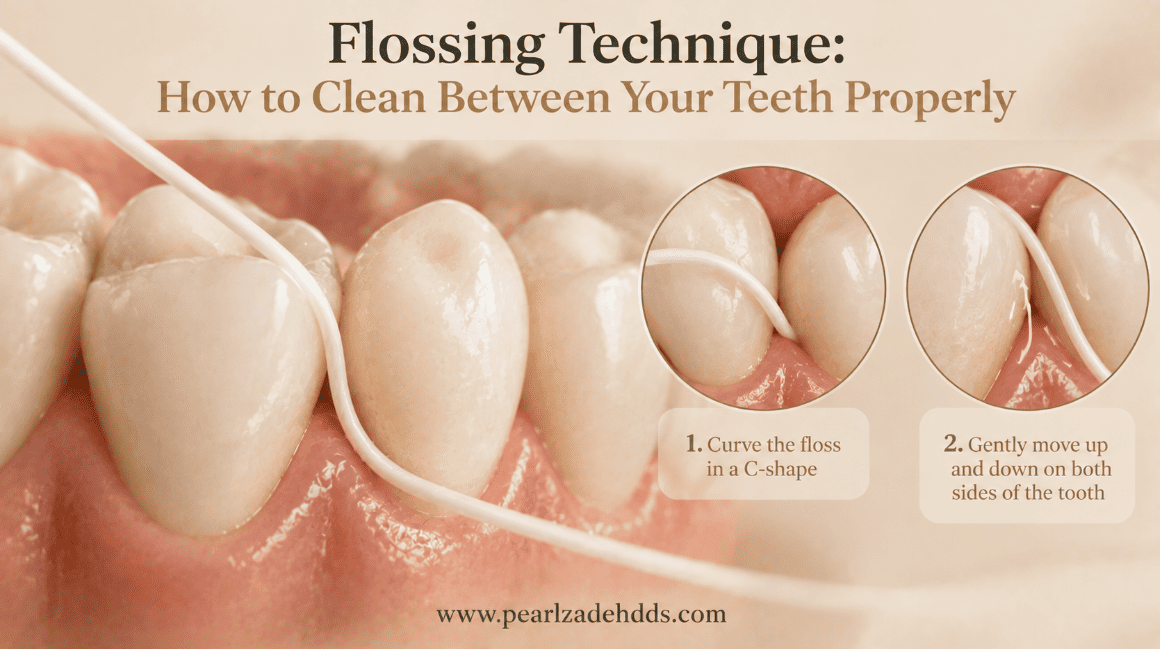
    4. Curve the floss around one tooth

    This is the step most people skip, and it is where the actual cleaning happens. The ADA’s own instructions describe it precisely: when the floss reaches the gumline, curve it into a C shape against one tooth. Instead of keeping the floss stretched flat across the gap, wrap it around the side of a single tooth so it follows the tooth’s actual curve.

    5. Clean along the side of the tooth

    With the floss curved into that C shape, gently rub it up and down against the tooth surface, following its shape. This is what physically lifts plaque off the tooth rather than just passing by it. Both teeth bordering the gap need this same attention, not just one.

    6. Gently reach below the gumline

    Slide the floss slightly into the shallow space between the tooth and the gum tissue, holding it against the tooth and slightly away from the gum itself as the ADA describes. A light touch is all this takes. You are not digging into anything; you are letting the floss follow the natural curve of the tooth a small distance below where the gum meets it.

    7. Repeat on the other tooth

    Reposition the same section of floss into a C shape against the neighboring tooth and repeat the up-and-down motion there too. One pass through a single gap means cleaning two tooth surfaces, not one. Then move to a clean section of floss and the next gap, working all the way around, top and bottom.

    How Should You Floss Your Back Teeth?

    Molars get skipped more than any other teeth, mostly because reaching them comfortably takes more coordination. Working slowly and using shorter, more controlled movements tends to work better than long sweeping motions once you are that far back.

    If your fingers do not fit comfortably that far in, a floss holder or pick can make back teeth easier to manage without changing what the floss needs to do. A mirror helps some people see what they are doing; others find it easier by feel alone. Dexterity varies enough between people that what works for one may not suit another.

    How Much Pressure Should You Use?

    Less than you might think. Effective flossing removes plaque through gentle, repeated contact against the tooth surface, not through force. Pressing hard or sawing the floss back and forth does not clean better. It is more likely to injure the gum tissue.

    The difference to aim for is gentle contact with the tooth and the gumline, not forcing floss into the tissue itself. If a motion feels like it requires real effort to push through, that is a sign to ease up or adjust your angle, not to press harder.

    Should Floss Go Under the Gums?

    Yes, gently, into the shallow space that naturally exists between a healthy tooth and the surrounding gum tissue. That is a normal, small space, not something you are creating by flossing.

    This is not the same as pushing floss deeply into gum tissue or forcing it toward the bone. If you have periodontal pockets or existing gum disease, the appropriate depth and technique may be different from what works for healthy gum tissue, and that is worth discussing with a dentist or hygienist directly rather than guessing at how deep is too deep.

    Why Do My Gums Bleed When I Floss?

    Several things can cause this, and it does not always mean the same thing. Gum tissue inflamed by a plaque buildup tends to bleed more easily when finally disturbed. Restarting a flossing routine after a gap can produce bleeding for the first several days simply because the gums are reacting to attention they have not gotten in a while, and this often settles as tissue adjusts. Technique that is too aggressive, snapping floss or sawing at the gum tissue, can cause bleeding on its own. Existing gum problems can too.

    Bleeding is not automatically normal, and it is not automatically a sign of disease either; it depends on the pattern. Occasional light bleeding when you resume a routine is different from bleeding that persists week after week, or that comes with swelling, tenderness, or gum recession. Our overview of early signs of gum disease covers what patterns are worth having evaluated rather than waited out.

    Should You Floss Before or After Brushing?

    The ADA’s own position is direct: as long as you floss thoroughly, it does not matter when you do it. The most important thing is making it a daily habit at a time you will actually keep up with.

    A small 2018 randomized trial of 25 dental students found flossing before brushing significantly reduced interdental plaque and left more fluoride in contact with those areas. But a 2021 systematic review and meta-analysis pooling this evidence found no significant overall effect of sequence on plaque reduction. Individual small trials and the pooled analysis do not agree, which happens when a body of evidence is still thin. Given that, the ADA’s practical position, that consistency matters more than order, is the more useful takeaway.

    How Often Should You Floss?

    Once daily. That is the consistent recommendation across dental organizations, and it holds regardless of how clean your teeth look or feel on a given day. Plaque forms continuously, not just after meals that leave visible debris, so teeth that look and feel clean can still have plaque built up between them that a toothbrush never touched.

    What If Traditional Floss Does Not Work for You?

    String floss is not the only tool for this job, and it is not the right fit for everyone. Interdental brushes, small bristled tools sized to fit between teeth, water flossers, which use a pressurized stream of water, and floss picks, a pre-strung holder, all serve the same basic purpose through different mechanisms.

    The evidence does not point to one universal winner. A recent review of interdental cleaning research found moderate-quality evidence supporting interdental brushes for reducing plaque, alongside weaker evidence for water flossers on gingivitis scores specifically. A separate, more recent systematic review, rated at low certainty, reported that interdental brushes may be more effective than string floss in some comparisons. Weaker or lower-certainty evidence does not mean a tool does not work; it means fewer or less consistent studies have measured it.

    What actually fits best depends on your own situation: interdental spacing, gum health, orthodontic hardware, dexterity, and which tool you will actually use daily. A well-fitting device used consistently beats a technically ideal method left in a drawer.

    Flossing With Crowns, Bridges, or Other Dental Work

    Having dental work does not mean you should stop cleaning between your teeth. It can change which tool fits best. A bridge has a section without a natural gap the way two separate teeth have, and a floss threader or bridge floss can get underneath the connecting piece where ordinary floss cannot.

    Tight contacts around crowns, or hardware from braces, can make interdental brushes or floss threaders more practical than standard string floss. Not every restoration requires a special device; many people floss around crowns and bridges with standard floss without issue. If unsure what fits your dental work, that is a reasonable question for your next visit.

    Common Flossing Mistakes

    Snapping floss into the gums rather than easing it through. Cleaning only the empty space rather than rubbing floss against both tooth surfaces. Skipping the back teeth. Reusing the same dirty section across your whole mouth instead of advancing to a clean part. Moving too quickly to actually disrupt plaque. Stopping entirely the first time gums bleed, rather than continuing gently. Using more force than needed. And not adjusting technique or tool when tight spacing or dental work makes the standard approach genuinely difficult.

    What If Floss Keeps Getting Stuck or Shredding?

    A few things commonly explain this: very tight contact points that naturally resist floss, rough edges on an older filling or crown, irregular or overlapping tooth surfaces, or simply a damaged or low-quality strand of floss.

    If one particular spot repeatedly shreds floss no matter what you try, that is worth mentioning to your dentist rather than working around it indefinitely, since it could point to something at that specific spot worth a look. Forcing floss through a catching spot risks snapping it suddenly against the gum, exactly the motion to avoid.

    Can Flossing Damage Your Gums?

    Gentle, controlled flossing is not something to treat as inherently harmful. Aggressive technique, snapping floss or sawing it hard against the gum line, can genuinely irritate or injure gum tissue over time. The difference is almost entirely in the motion, not in the act of flossing itself.

    Correct technique matters more here than avoiding interdental cleaning because of occasional bleeding or mild tenderness. Backing off from flossing altogether because it is uncomfortable at first tends to make the underlying inflammation worse, not better, since the plaque causing that irritation is still building up untouched.

    Is Flossing Enough for Complete Oral Hygiene?

    No, and it was never meant to stand alone. Interdental cleaning is one part of a broader routine that includes brushing twice daily with fluoride toothpaste, regular dental visits, and paying attention to how often you expose your teeth to sugar. Some people also add tongue cleaning or a product like xylitol gum to that routine, though neither replaces the fundamentals. Your individual cavity and gum-disease risk also plays a role in what a complete routine should actually include for you specifically, which is part of what a dental visit is for.

    Get Personalized Guidance on Your Routine

    Effective interdental cleaning comes down to technique, consistency, and choosing a method that actually fits your teeth and gums. String floss works well for many people, but it is not necessarily the right tool for everyone, and there is no need to force it if something else fits your mouth better.

    Dr. Pearl Zadeh can look at your specific teeth, spacing, and gum health, and help you figure out which interdental cleaning approach actually makes sense for you.

    Call (818) 716-6722 or click the button below to schedule an appointment and discuss your oral health needs.

    Frequently Asked Questions

    What is the correct way to floss?

    Guide floss gently between your teeth, curve it into a C shape against one tooth, and rub it up and down along that surface and slightly below the gumline. Repeat on the neighboring tooth before moving to a clean section for the next gap.

    Should floss go under the gums?

    Yes, gently, into the small natural space between a healthy tooth and gum. This is different from forcing floss deep into the tissue, and depth may need to be adjusted for someone with gum disease.

    How much pressure should you use when flossing?

    Gentle pressure. Effective flossing comes from controlled contact with the tooth surface, not force. Pressing hard or sawing the floss increases the risk of irritating gum tissue without cleaning any better.

    Why do my gums bleed when I floss?

    Plaque-related inflammation, restarting a routine after a gap, overly aggressive technique, or existing gum issues can all cause it. Occasional light bleeding often settles within days; bleeding that persists or comes with swelling is worth having evaluated.

    Should I floss before or after brushing?

    The ADA says the order does not matter as much as doing it thoroughly and consistently. Some individual studies favor flossing first, but a systematic review pooling that research found no significant overall difference.

    This article is for informational purposes only and is not a substitute for professional dental advice. Please schedule a consultation with Pearl Zadeh DDS to discuss your specific situation.
  • How to Store Your Toothbrush Properly Every Day

    How to Store Your Toothbrush Properly Every Day

    Your toothbrush needs more than a quick rinse after brushing. Where you leave it affects how well it dries between uses. You do not need to keep it sterile, but you should avoid leaving it wet in a closed space.

    The basic routine is simple: rinse it, store it upright, and let it air dry. These habits take little effort and give your toothbrush a better chance to dry between uses.

    Why Toothbrush Storage Matters

    Your mouth naturally hosts hundreds of species of bacteria, and some of them end up on your toothbrush during normal use. Bacteria from the surrounding environment can settle on a stored brush too. This is normal and unavoidable, not a sign something has gone wrong. Toothbrushes are not even sold in sterile packaging to begin with, according to the Journal of the American Dental Association, which notes they can carry bacteria right out of the box.

    As Consumer Reports has reported, a toothbrush can harbor bacteria even when it looks perfectly clean, and there is no evidence that this causes adverse health effects for ordinary, healthy adults. That distinction is worth holding onto through the rest of this article. Storage habits are worth getting right because they support a good routine, keep your brush working well, and take almost no extra effort, not because an ordinary bathroom turns your toothbrush into a health hazard that needs correcting.

    Where storage genuinely matters is moisture. A wet toothbrush left in a sealed, airless space gives bacteria a far better environment to multiply in than the same brush left out in the open. That single distinction, damp and enclosed versus dry and open, explains most of the specific recommendations below.

    How to Store Your Toothbrush Properly

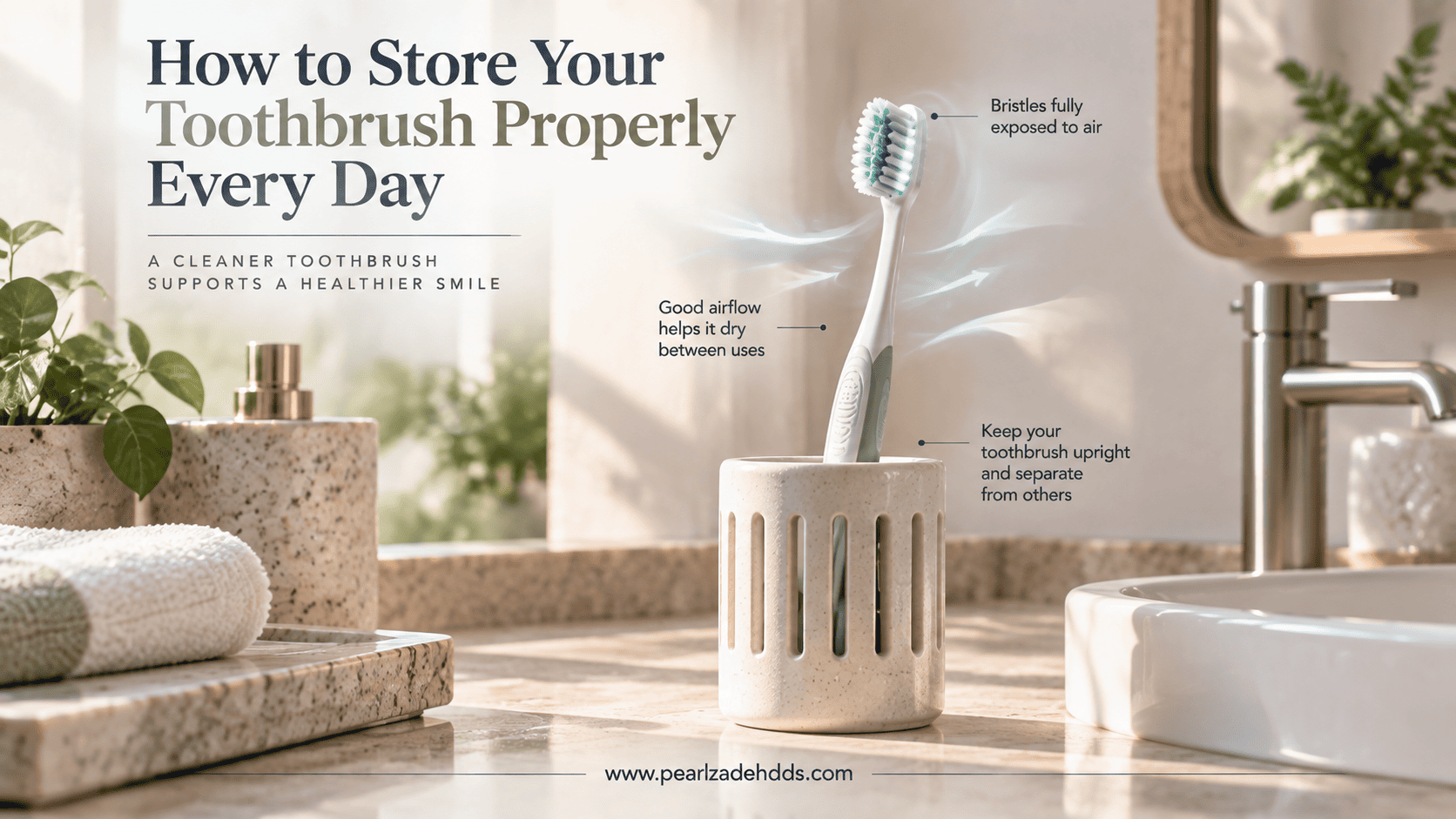
    The American Dental Association’s own guidance comes down to a short routine. Rinse the toothbrush thoroughly with tap water after each use to clear off toothpaste and debris. Store it upright rather than lying flat, and let it air dry fully before it gets used again or covered. If more than one brush shares a holder, keep them separated so they are not touching. Avoid a consistently damp, enclosed spot, since moisture is what actually lets bacteria multiply, not the open air of a bathroom.

    That is the whole routine. Nothing about it requires special products or extra time, and none of it needs repeating multiple times a day. Do it once, after your last brushing session before the toothbrush sits unused for a while, and you have covered what actually matters.

    Should You Use a Toothbrush Cover?

    Generally, no, at least not for everyday home use. The ADA is specific here: storing a moist toothbrush in a closed container promotes microbial growth more than leaving it exposed to open air. A cover placed over a still-wet brush traps that moisture right against the bristles, which is the opposite of what you want.

    Travel is the one situation where a cover makes practical sense, since you are usually packing a brush that has not fully dried and need to protect it from a bag’s contents. Even then, take the brush out of the case and let it air dry again as soon as you can, rather than leaving it sealed up for the whole trip. A travel case with small ventilation holes handles this better than a fully sealed tube.

    How Far Should Your Toothbrush Be From the Toilet?

    A toilet flush can send a fine mist of water droplets into the air for a short distance, a phenomenon that has been documented for decades. That is a real, measurable event. It is a much smaller concern than it sounds when repeated online, and there is no evidence connecting it to actual illness for people brushing their teeth normally in a typical home.

    Even so, a few practical habits cost nothing and address the concern directly: close the toilet lid before flushing, and keep your toothbrush holder a reasonable distance away, on a separate counter or in a cabinet, rather than propped on the tank. Some public-health guidance suggests a rough distance of a few feet as a practical benchmark, though this is a sensible habit rather than a precisely studied safety threshold. Following it is a low-effort precaution, not a sign that your bathroom is unsafe if you have not been doing it.

    Can You Store Multiple Toothbrushes Together?

    Yes, with one consistent rule: keep the heads from touching. The ADA recommends separating toothbrushes stored together to prevent cross-contamination between household members. A standard holder with individual slots handles this easily. If your current holder lets bristles lean against each other, angling the brushes differently or spacing out the slots you use solves it.

    This matters more in a shared bathroom with several people brushing at similar times than it does for someone living alone, but it is a simple enough habit to keep either way. Families with young children often find that color-coded holders or brushes make it easy to keep everyone’s separated without much thought.

    Should You Keep Your Toothbrush in a Cabinet?

    A cabinet or drawer works fine, as long as the toothbrush can still dry out before the door closes on it. The problem was never darkness or being out of sight. It is trapped moisture.

    If you keep your brush in a cabinet, let it air dry in the open for a while after use, then put it away once it is no longer wet. A cabinet with a bit of airflow, or a holder that keeps the bristles upright and unenclosed even inside the cabinet, works better than tossing a damp brush directly into a closed drawer. A small upright holder placed inside a cabinet with the door left slightly ajar for the first hour or so is an easy middle ground for anyone who prefers their toothbrush out of sight.

    What About Electric Toothbrush Heads?

    The same basic principles apply. Rinse the head thoroughly after brushing to clear off toothpaste residue, let any water drain off, and store it upright so it can air dry rather than sitting wet against the base or a cover.

    Many electric toothbrush bases are designed with this in mind, holding the head upright while charging. If yours does not, standing the handle in a cup or holder the same way you would a manual brush works just as well. If you have more than one head in the household, or swap heads between users, keep them from touching each other for the same reason you would separate manual brushes. A charging base tucked into a closed cabinet has the same moisture problem a covered manual brush does, so the same fix applies: let it dry before closing anything around it.

    When Should You Replace Your Toothbrush?

    The ADA recommends replacing a toothbrush roughly every three to four months, or sooner if the bristles start to fray or splay outward. This is about effectiveness, not about the brush becoming dangerous on a fixed schedule. Worn, bent bristles simply clean your teeth less thoroughly than fresh ones do, which is the actual reason the recommendation exists.

    Children’s toothbrushes often need replacing more often, since kids can wear down bristles faster, and it is worth checking theirs on a similar schedule rather than waiting for an obvious sign. Anyone recovering from an illness that involved a lot of coughing or a sore throat might reasonably swap their brush out afterward too, more as a fresh start than a strict medical necessity. Bristles that look fine at a glance can still be splayed enough at the base to clean less effectively, so a quick check every few months is worth the few seconds it takes.

    What If Your Toothbrush Touches a Dirty Surface?

    If it briefly touches a clean-ish surface, like a bathroom counter, rinsing it thoroughly under running water is a reasonable response before you use it again. There is no need to treat a minor bump against the sink as an emergency.

    If it falls into something clearly contaminated, drops into the toilet, or lands somewhere visibly unclean, replacing it is the simpler and more sensible choice. A new toothbrush costs very little, and there is no need to disinfect your way around a situation like that. Skip the elaborate disinfecting methods generally: the ADA notes that toothbrush sanitizers, including UV devices, have not been shown to provide a meaningful health benefit, and public health guidance similarly discourages running a toothbrush through a dishwasher or microwave. Normal rinsing plus replacement when needed covers what you actually need.

    Simple Toothbrush Storage Habits That Actually Matter

    Rinse it after every use. Stand it upright. Let it dry fully before covering or packing it away. Keep multiple brushes from touching. Skip the sealed containers and the sanitizing gadgets. Replace it every three to four months, sooner if the bristles wear out. That is the entire list, and none of it takes more than a few extra seconds a day.

    Build Habits That Actually Support Your Oral Health

    Good toothbrush storage is a small, easy habit, but it is not the foundation of a healthy mouth. Brushing twice daily with fluoride toothpaste, cleaning between your teeth, and keeping up with regular visits do far more for your teeth and gums than anything about where your toothbrush sits overnight.

    Dr. Pearl Zadeh’s Woodland Hills practice takes a practical, patient-centered approach to preventive care, focused on habits you can actually keep up with rather than perfection.

    Call (818) 716-6722 or click the button below to schedule an appointment and discuss your oral health needs.

    Frequently Asked Questions

    Should I store my toothbrush upright?

    Yes. Standing it upright lets water drain away from the bristles and helps it air dry fully before the next use, which is what the ADA recommends.

    Should I cover my toothbrush after brushing?

    Not for everyday use. Covering a wet brush traps moisture against the bristles, which encourages bacterial growth rather than preventing it. A cover is more useful for travel, once the brush has already dried.

    How far should my toothbrush be from the toilet?

    There is no exact required distance, but keeping it on a separate counter or in a cabinet, away from the toilet, and closing the lid before flushing are simple, reasonable habits.

    Can I store my toothbrush in a closed cabinet?

    Yes, as long as it has fully air dried first. A closed space is fine; a closed space around a still-wet brush is what actually promotes bacterial growth.

    Should toothbrushes touch each other?

    No. Keep multiple toothbrushes separated in their holder to avoid transferring bacteria between household members.

    This article is for informational purposes only and is not a substitute for professional dental advice. Please schedule a consultation with Pearl Zadeh DDS to discuss your specific situation

  • Tongue Scraping: Does It Actually Improve Oral Health?

    Tongue Scraping: Does It Actually Improve Oral Health?

    You look in the mirror, notice a filmy coating across your tongue, and wonder if that has anything to do with your breath. Tongue scrapers have become a standard item in a lot of bathroom cabinets, often picked up after a recommendation from a friend or a wellness video rather than a dentist.

    That coating is real, and it is made of ordinary things: bacteria, food debris, shed cells, and mucus that accumulate in the grooves of the tongue’s surface. Removing it may help with certain things. It does not automatically follow that scraping your tongue prevents dental disease or replaces anything else in your routine.

    What Is Tongue Scraping?

    A tongue scraper is a small tool, usually a thin curved strip of plastic or metal, designed to be drawn across the surface of the tongue from back to front. The curved edge contacts the tongue’s surface directly and pulls debris forward, where it is wiped or rinsed away.

    This is different from brushing your tongue with a toothbrush, which uses bristles to agitate the surface rather than a solid edge to lift material off it. People commonly use a scraper first thing in the morning, when tongue coating tends to be most noticeable, though there is no medical requirement tying it to a specific time of day.

    Traditional and commercial instructions generally suggest one or two gentle passes from the back of the tongue toward the tip, rinsing the scraper between passes. This is a common practice, not an established clinical protocol with a single required technique or duration.

    What Does Tongue Scraping Actually Remove?

    Tongue coating is a biofilm made up of several things at once: bacteria, food debris, cells that have naturally shed from the tongue’s surface, mucus, and small amounts of blood and salivary components. The tongue’s surface is covered in tiny projections called papillae, and the grooves between them trap this material, particularly toward the back third of the tongue.

    A visible coating is not automatically a sign of poor oral hygiene or an underlying problem. Some degree of coating is considered a normal, physiological feature of a healthy mouth. How much coating someone has, and how visible it looks, varies naturally based on diet, hydration, saliva flow, and other individual factors, not just how recently they last cleaned their tongue.

    Does Tongue Scraping Help Bad Breath?

    A 2010 systematic review in the International Journal of Dental Hygiene examined seven experiments across five studies. The studies compared tongue cleaning with a scraper or brush against toothbrushing alone. All seven found a positive effect on measures of oral malodor. The review concluded that mechanical tongue cleaning may reduce breath odor and tongue coating. However, evidence remained insufficient for its effect on chronic halitosis.

    A separate 2013 systematic review and meta-analysis in Nursing Research combined five randomized trials involving 251 participants. It found that adding tongue cleaning to toothbrushing reduced volatile sulfur compounds and tongue coating more than toothbrushing alone. However, the review found insufficient evidence to recommend a specific frequency, duration, or cleaning method.

    An earlier Cochrane review from 2006 included only two trials with 40 participants. Neither trial measured the review’s primary outcome, which was self-reported or examiner-assessed breath odor. However, both trials found that tongue cleaning reduced measured VSC levels more than toothbrushing alone. One trial also found that the effect lasted longer with tongue cleaning than with a toothbrush.

    Taken together, research has consistently found short-term reductions in odor-causing compounds after tongue cleaning. However, a temporary change in a lab measurement does not mean tongue scraping permanently treats chronic halitosis. Persistent bad breath can have several causes and may need a dental evaluation rather than ongoing tongue scraping alone.

    Does Tongue Scraping Reduce Bacteria?

    The tongue hosts an enormous and genuinely diverse bacterial population, more so per surface area than most other places in the mouth, largely because its grooved structure protects bacteria from the flushing action of saliva.

    Physically removing tongue coating removes some of the bacteria living within it, which is part of the mechanism behind the breath-odor findings above. That is different from creating a broadly healthier oral microbiome. Bacteria repopulate the tongue’s surface quickly after cleaning, and reducing the numbers of specific measured species in a study is not the same as permanently altering the balance of organisms living in your mouth. It would be inaccurate to describe tongue scraping as killing harmful bacteria; the available evidence points to a temporary, partial mechanical reduction, not an antimicrobial effect.

    Can Tongue Scraping Prevent Cavities?

    There is not enough evidence to present tongue scraping as a proven way to prevent cavities. It also targets a different surface from where cavities develop.

    Cavities form on tooth enamel when plaque builds up on the teeth. Tongue scraping does not remove plaque from tooth surfaces. Cavity prevention depends on several factors, including fluoride exposure, thorough brushing, and cleaning between teeth. How often and how long your teeth contact sugar also matters. Saliva flow and your individual cavity risk can play a role too. Tongue scraping has no established direct role in these factors.

    Can Tongue Scraping Prevent Gum Disease?

    No clinical evidence supports tongue scraping as a way to prevent or treat gum disease. Gingivitis and periodontal disease are driven primarily by plaque and bacterial buildup at and below the gumline, an area a tongue scraper does not reach or address. Our overview of early signs of gum disease covers what actually indicates a problem developing, and none of it involves tongue coating. Tongue scraping does not replace brushing or cleaning between your teeth, which remain the established tools for managing gum health.

    Is Tongue Scraping Better Than Brushing Your Tongue?

    Neither method has proven universally superior. Both a dedicated scraper and a toothbrush can physically remove tongue coating. Reviews have found benefits from both methods compared with no tongue cleaning.

    Some research and clinical observations suggest that a scraper may lift more coating in one pass than bristles. This may be more noticeable on a heavily coated tongue. However, research has not established a meaningful difference in outcomes such as breath odor.

    In practice, choose the method that feels comfortable and works well for you. Some people find that a scraper reaches farther back without triggering their gag reflex. Others find that a toothbrush works just as well.

    How Often Should You Scrape Your Tongue?

    There is no clinically established, universally required frequency. The 2013 meta-analysis cited above explicitly found insufficient evidence to recommend a specific frequency, duration, or delivery method for tongue cleaning, despite finding a benefit from doing it at all. Many people who use a scraper do so once daily, typically in the morning, simply because that is when coating is most noticeable and it fits naturally into an existing routine.

    Scraping more often, or pressing harder, does not appear to provide a greater benefit and is more likely to cause irritation than to meaningfully improve results. This is not a habit where more effort produces a proportionally better outcome.

    Can Tongue Scraping Damage Your Tongue?

    Used gently, tongue scraping is a low-risk habit for most people. The tongue’s surface is sensitive tissue, though, and excessive pressure or repeatedly scraping the same spot can cause irritation, soreness, or minor bleeding.

    Use a light touch and draw the scraper from back to front once or twice. You do not need to press hard. Gentle tongue scraping should not damage healthy tongue tissue. If you notice persistent soreness, bleeding, or discomfort, reduce the pressure or frequency. Mention ongoing symptoms to your dentist.

    Can Tongue Scraping Remove a White or Coated Tongue?

    Some surface coating can be mechanically lifted off with a scraper, and many people see a visible difference immediately after use. That is not true of every white or discolored appearance, though. Certain changes to the tongue’s surface are not loose debris sitting on top of otherwise normal tissue, and scraping will not remove them because there is nothing removable there.

    A coating that does not visibly improve with gentle scraping, that returns unusually quickly, that is accompanied by pain or a burning sensation, or that looks patchy or textured rather than a uniform film is worth having a dentist look at rather than assuming a firmer scraping technique will fix it.

    What If Your Tongue Still Looks Coated After Scraping?

    Persistent coating has several possible explanations, and appearance alone does not point to a specific one. Some people simply have a naturally more textured or deeply grooved tongue surface that recoats more visibly than others. Dry mouth reduces the saliva flow that would otherwise help clear debris naturally. Diet, tobacco use, certain medications, and your overall oral hygiene routine can all influence how quickly and how visibly coating reaccumulates. Some oral conditions also affect tongue appearance independently of hygiene.

    None of this can be diagnosed from a description of how your tongue looks. If a coating persists despite reasonable home care, that is a reasonable thing to bring up at your next dental visit rather than something to solve by scraping harder or more often.

    Is Tongue Scraping Necessary for Everyone?

    No. Tongue scraping is a reasonable, optional addition to an oral hygiene routine for someone who notices a coated tongue or is concerned about breath odor. It is not an essential requirement that every adult needs to add to their routine to maintain good oral health.

    Some people notice a clear difference in how their tongue looks or how fresh their breath feels. Others try it and notice little change, particularly if their tongue coating was already minimal to begin with. Both are normal outcomes, and neither means you are doing something wrong.

    Where Does Tongue Scraping Fit Into Your Oral-Hygiene Routine?

    It belongs as an addition, not a foundation. The habits with the strongest, most established evidence remain brushing your teeth twice daily with fluoride toothpaste, cleaning between your teeth daily, managing how often you expose your teeth to sugar, and keeping up with regular dental visits. Xylitol gum and nano-hydroxyapatite toothpaste occupy a similar place in a routine: reasonable things to consider once the fundamentals are covered, not substitutes for them. Tongue scraping sits alongside those, worth trying if it appeals to you, without needing to treat it as essential.

    Talk to Dr. Pearl Zadeh About Your Oral-Hygiene Routine

    Tongue scraping can be a reasonable habit for someone who notices tongue coating or wants to address breath odor, without being essential for everyone or a replacement for brushing, cleaning between teeth, and regular dental visits. What actually matters most for your mouth depends on your own habits, risk factors, and history.

    Call (818) 716-6722 or click the button below to schedule your consultation online.

    Frequently Asked Questions

    Does tongue scraping actually work?

    For removing visible tongue coating and reducing measured breath odor in the short term, evidence supports some benefit. For broader oral health outcomes like cavities or gum disease, evidence does not support it as an effective method.

    Does tongue scraping help bad breath?

    Research shows it can reduce measured odor compounds in the short term. Evidence for treating chronic, ongoing halitosis specifically remains limited, and persistent bad breath is worth having evaluated.

    Does tongue scraping remove bacteria?

    It mechanically removes some of the bacteria living in tongue coating, which is temporary. It does not eliminate harmful bacteria or create a lasting change to your oral microbiome.

    Can tongue scraping prevent cavities?

    No. Cavities form from plaque on tooth surfaces, not on the tongue, and no evidence shows tongue scraping affects that process.

    Can tongue scraping prevent gum disease?

    No. Plaque and bacteria at the gumline drive gum disease, and tongue scraping does not reach that area. Brushing and cleaning between your teeth remain the established ways to control plaque.

    This article is for informational purposes only and is not a substitute for professional dental advice. Please schedule a consultation with Pearl Zadeh DDS to discuss your specific situation.
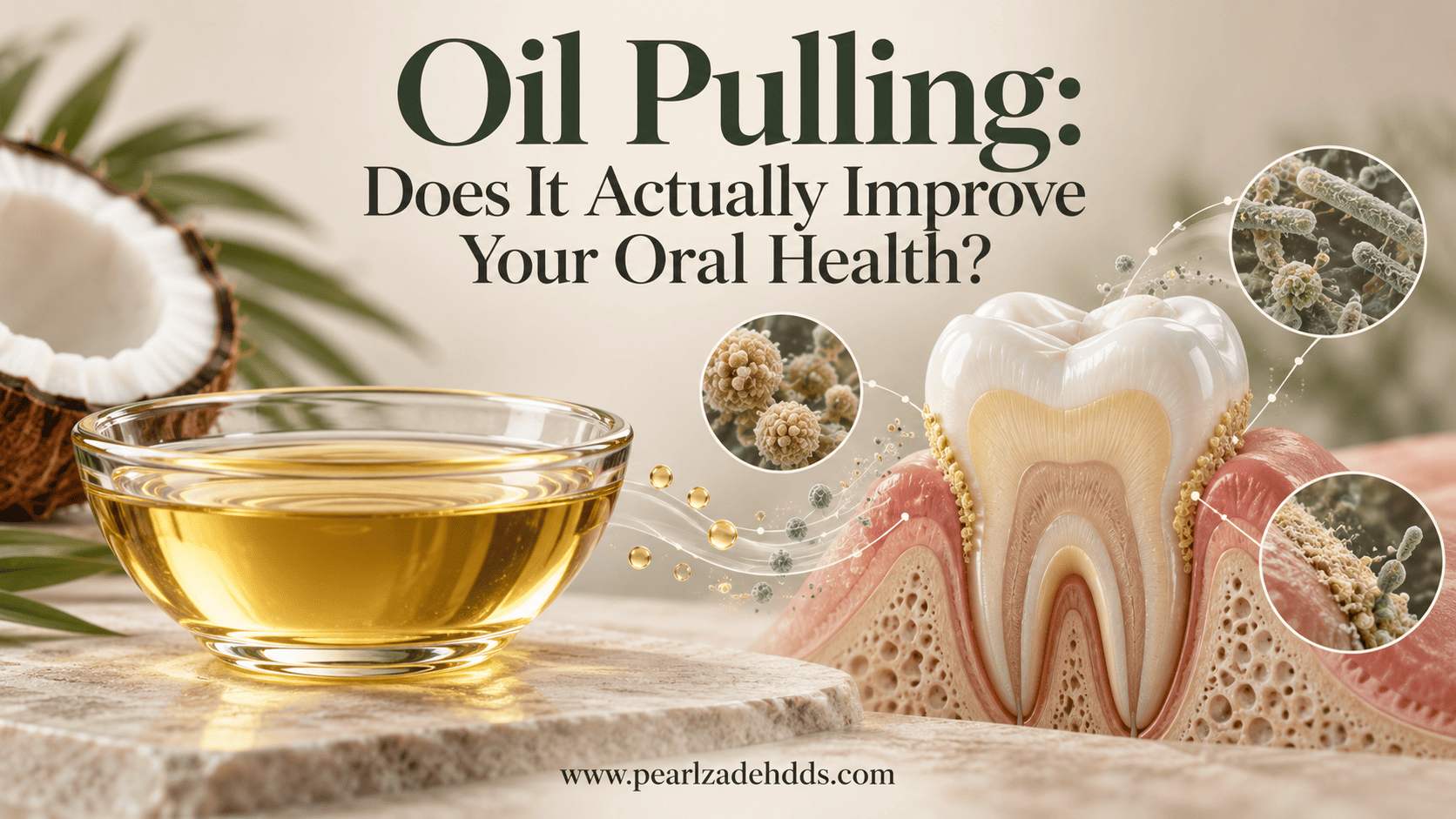
  • Oil Pulling: Does It Actually Improve Your Oral Health?

    Oil Pulling: Does It Actually Improve Your Oral Health?

    Oil pulling shows up constantly online, promoted for cleaner teeth, fresher breath, whiter smiles, healthier gums, fewer cavities, and pulling toxins out of the mouth. Some of that has been studied. Some of it has not. A few claims run ahead of what the research actually supports.

    Several clinical trials have looked at oil pulling in recent years, including a comprehensive 2024 review comparing it against mouthwash and chlorhexidine. The evidence shows some plausible effects on specific measures, alongside real limitations that matter for anyone deciding whether to try it.

    What Is Oil Pulling?

    Oil pulling involves swishing oil around the mouth for an extended period, then spitting it out. It traces back to Ayurvedic tradition, where it is referred to as Kavala or Gandusha.

    Traditional instructions commonly call for about a tablespoon of oil, swished for anywhere from several minutes up to 15 to 20 minutes, on an empty stomach before brushing. Sesame oil and coconut oil are the two most studied options, though sunflower and other oils appear in some research and traditional use. The oil is spit into a trash can rather than a sink, since oil can clog pipes over time, and it should not be swallowed.

    These are traditional and commonly cited instructions, not a medically established protocol. No dental or medical organization has issued an official recommended duration or frequency.

    Why Do People Try Oil Pulling?

    Reasons vary. Some people are drawn to natural oral-care practices generally, or specifically want to avoid alcohol-based mouthwashes. Some are chasing fresher breath or a brighter-looking smile. Many encounter it through social media, where it is often presented with far more confidence than the underlying research supports. Some believe it removes toxins from the body, a claim rooted in traditional belief rather than demonstrated biological mechanism.

    Why someone tries oil pulling and what the evidence actually shows are two different questions. The rest of this article focuses on the second one.

    Does Oil Pulling Actually Remove Plaque?

    Plaque is the sticky bacterial film that builds up on teeth throughout the day. Left in place, it can lead to gum inflammation and, over time, cavities. Physically disrupting it matters, which is the whole rationale behind brushing.

    Several trials have measured plaque index before and after oil pulling. A 2024 systematic review and meta-analysis in the International Journal of Dental Hygiene pooled this evidence and found that chlorhexidine mouthwash remained more effective than oil pulling at reducing plaque scores. The review rated the overall certainty of the evidence as very low.

    Two separate randomized trials from the Medical University of Innsbruck, run by the same research group with a similar design, add real nuance here rather than a clean answer. A 2024 trial using pure sesame oil against distilled water, in 40 adults over eight weeks, found sesame oil pulling significantly outperformed water on the same plaque index (a median reduction of 18.98% versus 10.49%). A second, later trial from the same team tested a different product, a commercial “sesame-based tooth oil” blended with mint, turmeric, lemon, eucalyptus, clove, myrrh, Manuka, and sage oils, against distilled water, in a separate group of 40 adults. That trial found both groups improved significantly with no difference between them.

    The two trials are not simply contradictory noise. They tested different products, one plain sesame oil and the other a multi-ingredient blend, which may partly explain the different results. The honest picture from this specific research group’s own work is mixed, not settled, and which product was tested matters as much as whether oil pulling was done at all.

    Can Oil Pulling Help With Gingivitis?

    Gingivitis is inflammation of the gums, usually driven by plaque that has been left in place long enough to irritate gum tissue. It shows up as redness, puffiness, and bleeding when you brush or floss.

    The 2024 systematic review and meta-analysis found that, compared with non-chlorhexidine mouthwashes, oil pulling produced a clinically and statistically significant improvement in modified gingival index scores. The authors described this as a probable benefit for gingival health. That finding came with the same caveat as the plaque results: very low certainty in the underlying evidence, and the studies it drew from varied in oil type, duration, and design.

    Both Innsbruck trials above agree on this specific measure: neither found a significant difference between oil pulling and plain water on gingival index, even though they disagreed on plaque. That is accurate to describe as a probable improvement compared with certain mouthwashes in some research, and not accurate to describe as oil pulling treating or curing gingivitis, which is a clinical diagnosis a dentist manages, typically alongside professional cleaning.

    Does Oil Pulling Prevent Cavities?

    There is currently insufficient evidence to say oil pulling prevents cavities. This is worth stating plainly, because it is one of the most commonly repeated claims about the practice and one of the least studied.

    Multiple reviews of the oil pulling literature, including the 2024 meta-analysis above, note that none of the included trials directly measured dental caries as an outcome. Studies have measured plaque, gingival index, and bacterial counts, which are related to cavity risk but are not the same as counting actual new cavities over time.

    Cavity prevention depends on more than any single practice. Fluoride exposure, consistent mechanical plaque removal, how often and how long teeth are exposed to sugar, saliva flow, your individual cavity history, and your overall hygiene routine all factor in. A reduction in a bacterial count on a lab report does not, by itself, establish that fewer cavities will follow.

    Can Oil Pulling Whiten Teeth?

    Some people report their teeth look brighter after oil pulling, and that is plausible without meaning much clinically. Swishing oil, like swishing anything, may help dislodge some surface debris and loose staining. That is different from changing the intrinsic color of a tooth, which is what professional teeth whitening does through a bleaching agent that penetrates the tooth structure.

    Oil pulling does not chemically bleach teeth, and no clinical trial has established a meaningful whitening effect from it. Anecdotal reports of a brighter smile after a few sessions are exactly that: anecdotal, and easily explained by removing surface debris rather than by any lightening of the tooth itself.

    Does Oil Pulling Kill Harmful Bacteria?

    This claim is more complicated than the marketing around it suggests. Your mouth hosts hundreds of species of bacteria, most of them harmless or even helpful. “Killing bacteria” broadly is not the same thing as creating a healthier oral environment, and indiscriminately reducing bacterial counts is not automatically a good outcome.

    Some studies have measured reductions in specific bacteria after oil pulling, including Streptococcus mutans, a species associated with cavity formation. Findings across studies are inconsistent, with some trials reporting significant reductions and others, including the 2023 Innsbruck trial, finding no significant microbiological change at all.

    It is not accurate to say oil pulling kills all harmful oral bacteria, detoxes the mouth, or eliminates the organisms responsible for dental disease. The available evidence points to modest, inconsistent effects on specific bacterial counts in some studies, not a broad antimicrobial sweep.

    Can Oil Pulling Replace Brushing and Flossing?

    No. Nothing in the current research suggests oil pulling should substitute for mechanical plaque removal.

    Toothbrushing with fluoride toothpaste, cleaning between your teeth daily, and regular professional dental care remain the established foundation of oral hygiene, with a far larger and more consistent body of evidence behind them than oil pulling currently has. The 2024 review noted that oil pulling appears to have limited ability to reach bacteria below the gumline, an area that a toothbrush, floss, or a dental hygienist’s instruments reach more effectively. If you enjoy oil pulling and want to continue it, doing so alongside your regular routine, not instead of it, is what the evidence actually supports.

    Is Oil Pulling Safe?

    For most healthy adults using it as an occasional addition to their routine, oil pulling carries modest, manageable risks rather than significant danger.

    Swallowing a large amount of oil can cause an upset stomach or a laxative effect in some people, so spitting it out rather than swallowing matters. Disposing of the oil in the trash rather than the sink prevents drain buildup over time. Prolonged, vigorous swishing could plausibly aggravate jaw discomfort in someone who already has jaw pain or a temporomandibular joint issue, similar to how extended gum chewing might.

    There is also a genuine, if rare, documented risk worth naming honestly: case reports in the medical literature describe lipoid pneumonia, a lung condition caused by inhaling oil, occurring in people who practiced oil pulling repeatedly. These cases are uncommon and generally involved either an underlying difficulty with swallowing or repeated, extended practice over time, not a single occasional session in a healthy adult. The practical takeaway is straightforward: keep the oil in your mouth, do not inhale or aspirate it, and stop if you have any condition affecting your ability to safely swish and spit.

    None of this makes oil pulling inherently dangerous for everyone. It does mean treating it with the same ordinary care you would give any oral-care habit, rather than assuming natural automatically means risk-free.

    Does Coconut Oil Work Better Than Other Oils?

    Coconut oil is the most popular choice online, partly due to its antimicrobial reputation and partly due to taste and marketing. Popularity is not the same as demonstrated superiority. A 2020 systematic review focused specifically on coconut oil pulling identified four eligible randomized trials with 182 total participants, lasting 7 to 14 days. It found significant reductions in salivary bacterial colony counts and plaque index scores, while explicitly concluding that the data were insufficient for conclusive findings, given mixed study quality and a high risk of bias across the included trials.

    A separate randomized crossover trial compared sesame oil directly against coconut oil in the same 24 participants, measuring plaque regrowth after professional cleaning. Direct oil-to-oil comparisons like this remain limited in number. Existing research does not support ranking coconut oil above sesame oil, or any other studied oil, as clinically superior. Choosing one oil over another based on current evidence comes down more to preference and availability than to a proven difference in effectiveness.

    What Does the Research Actually Show?

    Sorting the evidence into what is plausible and what remains unestablished gives a clearer picture than treating oil pulling as either a proven remedy or a complete waste of time.

    Findings with some supporting evidence: measurable short-term reductions in plaque index in several trials, though not clearly more effective than a control condition in at least one rigorous recent trial; a probable improvement in gingival index scores compared with non-chlorhexidine mouthwashes, per meta-analysis, though rated very low certainty; and inconsistent reductions in specific oral bacteria across individual studies.

    Not established by current evidence: reliable prevention of cavities, since no trial has directly measured caries outcomes; genuine tooth whitening through any bleaching mechanism; oil pulling as a replacement for brushing and flossing; broad detoxification effects anywhere in the body; and prevention of serious oral disease beyond the specific, modest measures studied.

    Across nearly all of this research, the same limitations recur: small sample sizes, short study durations often measured in days or weeks rather than months or years, inconsistent oil types and swishing durations between studies, and, as the 2024 meta-analysis explicitly concluded, very low overall certainty in the evidence. Future trials with longer follow-up and more standardized protocols would meaningfully improve what can be said here.

    Focus on What Your Teeth Actually Need

    Oil pulling may be a reasonable optional addition for someone who enjoys the practice, alongside, not instead of, brushing with fluoride toothpaste, cleaning between teeth, and regular dental visits. Current evidence does not support treating it as a substitute for established preventive care. Early signs of gum disease are worth knowing regardless of which home-care habits you use, since catching them early is what actually protects your teeth and gums.

    What your mouth needs depends on your own risk factors, habits, and history, not on a single trending practice. Dr. Pearl Zadeh can assess your oral health and help you build a routine grounded in what the evidence actually supports.

    Call (818) 716-6722 or click the button below to schedule your consultation online.

    Frequently Asked Questions

    Does oil pulling actually work?

    For some specific, narrow measures like short-term plaque and gingival index scores, some studies suggest a modest effect. For broader claims like cavity prevention or detoxing the body, evidence is lacking.

    Can oil pulling prevent cavities?

    No trial has directly measured whether oil pulling reduces cavities. Current evidence does not support this specific claim, even though related measures like plaque have shown some change.

    Does oil pulling whiten teeth?

    Not through bleaching. It may help remove some surface debris, which can look like brightening, but it does not chemically change the intrinsic color of teeth the way professional whitening does.

    Can oil pulling help gingivitis?

    Some research found a probable improvement in gingival index scores compared with certain mouthwashes, rated very low certainty. It should not be treated as a cure or substitute for dental evaluation.

    Can oil pulling replace brushing?

    No. Brushing with fluoride toothpaste and cleaning between teeth have far stronger, more established evidence, and oil pulling appears limited in reaching bacteria below the gumline.

    Is coconut oil good for oil pulling?

    It is commonly used and studied, but evidence does not show it working better than sesame or other studied oils. Choice largely comes down to preference.

    This article is for informational purposes only and is not a substitute for professional dental advice. Please schedule a consultation with Pearl Zadeh DDS to discuss your specific situation.
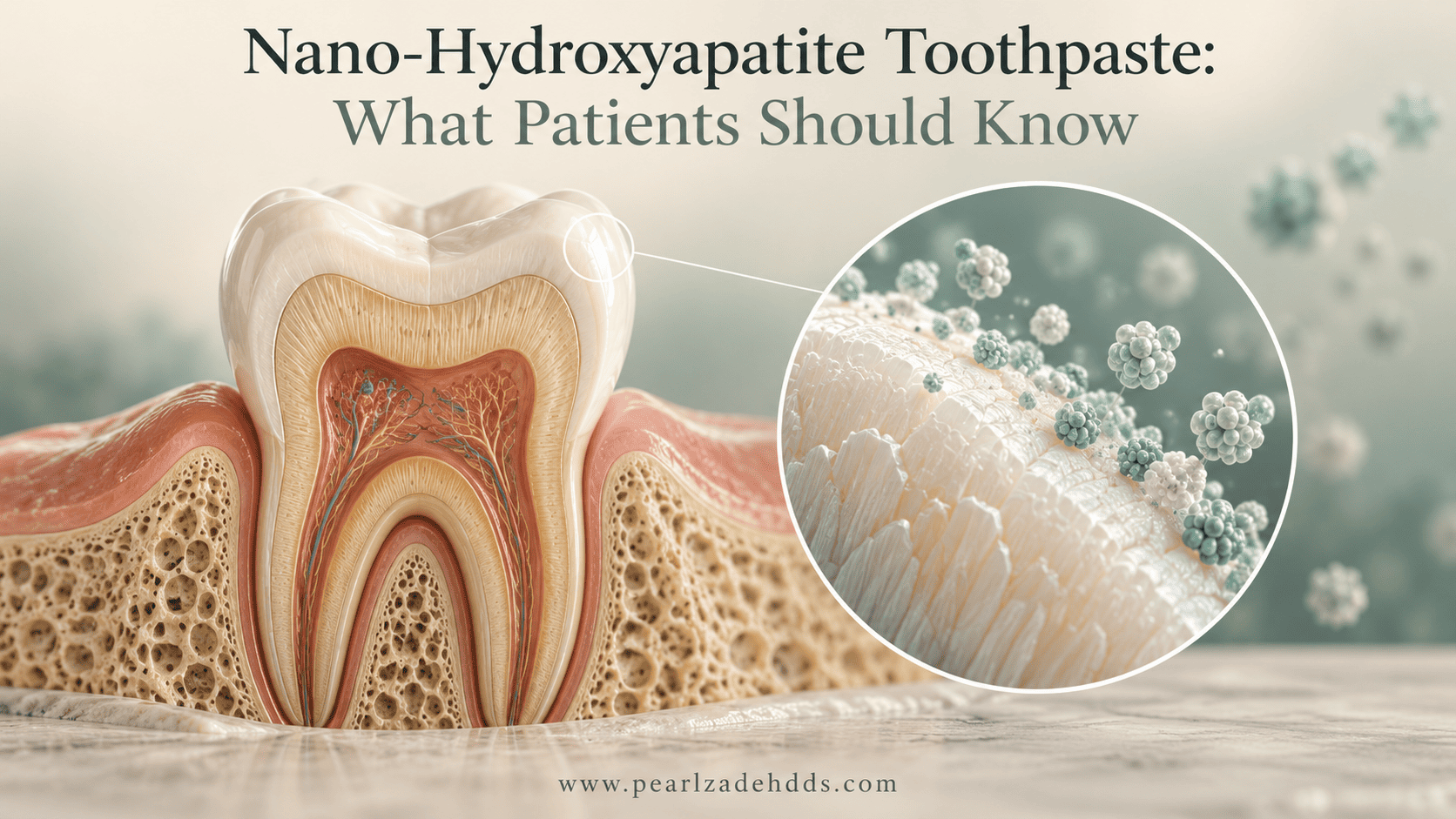
  • Nano-Hydroxyapatite Toothpaste: What Patients Should Know

    Nano-Hydroxyapatite Toothpaste: What Patients Should Know

    Nano-hydroxyapatite toothpaste has moved from a niche product into mainstream oral care shelves, often marketed as a fluoride-free alternative that repairs enamel. It has genuinely attracted scientific attention, not just marketing attention, because it resembles the mineral your teeth are actually made of.

    Nano-hydroxyapatite toothpaste is a promising option with growing clinical evidence. It is not yet established as equivalent to fluoride toothpaste for every adult, and the two evidence bases differ substantially in size and maturity.

    What Is Nano-Hydroxyapatite?

    Hydroxyapatite is a calcium phosphate mineral that makes up most of your tooth enamel and dentin, quite literally the mineral your teeth are built from. Nano-hydroxyapatite refers to that same mineral engineered into particles at the nanoscale, far smaller than natural crystal structures. The small particle size affects how the material behaves on a tooth surface, including how it settles into microscopic irregularities.

    It shows up in some toothpastes, mouth rinses, and other oral-care products, usually as a standalone active ingredient in fluoride-free formulations, though some products combine it with fluoride. Using it does not mean a new layer of natural enamel forms over your teeth. Enamel does not regenerate that way, with any ingredient.

    How Does Nano-Hydroxyapatite Work on Teeth?

    Researchers have studied several proposed mechanisms, best kept separate rather than treated as one settled fact. Nano-hydroxyapatite may interact with the outer tooth surface, in some studies appearing to settle into small defects or porous areas. It can contribute calcium and phosphate, the same minerals enamel is made of, involved in natural remineralization. Under certain laboratory and clinical conditions, it has been associated with reduced mineral loss and support for remineralizing early enamel changes.

    A genuinely important distinction belongs here. Remineralizing an early, non-cavitated lesion is not repairing an established cavity. Once decay has progressed to an actual hole, no toothpaste ingredient reverses that. This research addresses the earlier stage, before a cavity has fully formed.

    Can Nano-Hydroxyapatite Remineralize Enamel?

    Remineralization is a normal, ongoing process. Enamel constantly loses and regains minerals in small amounts, a balance between acid from oral bacteria pulling minerals out and saliva and mineral sources helping put them back. When that balance tips toward loss, an early lesion can develop. When conditions favor mineral gain, early lesions can sometimes be arrested or partially reversed.

    A 2025 systematic review and meta-analysis in the Journal of Dentistry examined fluoride-free hydroxyapatite toothpaste against fluoride toothpaste for preventing and remineralizing initial caries lesions. Out of 68 studies screened, only four in-situ randomized trials met the eligibility criteria, involving children, adolescents, and young adults under 25. On the main measures, lesion development and progression, the meta-analysis found no statistically significant difference between the two. Two secondary measures did differ significantly: lesion size and a fluorescence-based measurement, both at six months.

    Four eligible trials in a younger population is a small evidence base. This finding is encouraging for that specific comparison and age group. It is not proof that hydroxyapatite remineralizes enamel equivalently to fluoride across all ages.

    Does Nano-Hydroxyapatite Prevent Cavities?

    Several different things get treated as interchangeable in this conversation: a laboratory finding, a remineralization measurement, a change in an early lesion, a shift in cavity-related bacteria, and an actual measured reduction in cavities. Only the last one directly answers the patient’s question.

    A 2024 updated systematic review and meta-analysis reviewed clinical trials comparing hydroxyapatite oral-care products against placebo, no intervention, or fluoride controls. Of 18 studies retrieved, 5 clinical trials showed higher odds of caries prevention with hydroxyapatite toothpaste versus placebo. The authors concluded that clinical evidence for fluoride-free hydroxyapatite in reducing dental caries has expanded, and that it is effective as an active ingredient without fluoride.

    This review deserves a direct disclosure. Two of the six authors are senior scientists employed by a company that manufactures hydroxyapatite toothpaste, and all six authors received travel grants from that company. That does not mean the findings are wrong. It means the favorable framing should be read alongside that relationship, not treated as fully independent.

    A separate, earlier 2022 review in Clinical Oral Investigations reached a more cautious conclusion on nano-hydroxyapatite specifically. The authors stated that no conclusive evidence on efficacy could be obtained, citing the low number of clinical studies, relatively short follow-up periods, high risk of bias, and study conditions that do not reflect everyday use.

    The honest summary: evidence for hydroxyapatite reducing actual cavities has grown, some of it from researchers with a manufacturer connection, while an earlier review found the same evidence inconclusive. Neither the enthusiastic framing nor blanket dismissal fully represents where the research sits.

    Is Nano-Hydroxyapatite as Effective as Fluoride?

    Fluoride has decades of clinical evidence behind it. The ADA cites studies finding fluoride toothpaste prevented caries ranging from 16% per tooth to 31% per surface versus placebo. That base spans decades and many independent research groups. Hydroxyapatite’s evidence base is newer, smaller, and concentrated among fewer groups.

    Some studies have found comparable outcomes under specific conditions, as the in-situ remineralization comparison above showed. Other research has found differences depending on what was measured, and rigorous head-to-head trials remain far fewer than what exists for fluoride.

    It would be inaccurate to say nano-hydroxyapatite is just as effective as fluoride for everyone. It would be equally inaccurate to dismiss it as having no supporting evidence. Some studies have reported comparable results in specific comparisons. That does not establish universal equivalence across every patient, every formulation, and every outcome that matters for caries prevention.

    Why Do Some People Choose Fluoride-Free Toothpaste?

    Reasons vary and are worth taking seriously without judgment: personal preference for alternative ingredients, concerns about fluoride, sensitivity to certain formulations, or a specific recommendation from a dental professional.

    The ADA does not treat fluoride as inherently dangerous at normal toothpaste use. Fluorosis, a cosmetic enamel change in developing teeth, is addressed through recommended amounts by age, not by avoiding fluoride entirely. Choosing fluoride-free for personal reasons differs from avoiding fluoride on the belief it is generally toxic, which current evidence does not support.

    Can Nano-Hydroxyapatite Help With Tooth Sensitivity?

    Hydroxyapatite has been studied specifically for dentin hypersensitivity, and this is one area where its evidence base is more established than for cavity prevention. The proposed mechanism involves physically occluding the microscopic tubules in exposed dentin, which reduces the fluid movement inside those tubules that triggers pain signals when dentin is exposed to cold, air, or touch.

    It does not work for everyone, and it is not a guaranteed treatment. Sensitivity has several possible causes, including exposed dentin, gum recession, enamel wear, acid erosion, cracks, and cavities. A desensitizing toothpaste addresses the symptom rather than diagnosing the cause.

    Sensitivity that persists despite a desensitizing product, or appears suddenly, deserves an actual evaluation rather than indefinite continued use.

    Can Nano-Hydroxyapatite Whiten Teeth?

    Not the way professional whitening does. The ADA distinguishes abrasive agents, which may whiten by physically removing surface stains, from peroxide, used to lighten intrinsic color through actual bleaching. Nano-hydroxyapatite functions more like the former: it may polish the surface and remove some staining.

    Research on nano-hydroxyapatite and white spot lesions specifically is informative. A 2024 systematic review and meta-analysis looked at its effect on white spot lesions, including color change. Most of the 14 included studies were laboratory based, with only three in vivo and one in-situ study. On color specifically, the meta-analysis found no significant improvement in appearance.

    Surface polishing is a real, modest effect, not the same as bleaching. Anyone hoping for a noticeably whiter smile is describing a cosmetic goal that a professional whitening treatment is actually built to address.

    Is Nano-Hydroxyapatite Safe?

    Hydroxyapatite has been studied in oral-care applications for decades, and it is chemically similar to what teeth are already made of, part of why it has drawn research interest. Available safety evidence for nano-hydroxyapatite formulations has not raised red flags suggesting it is unsafe for normal brushing use. Laboratory and material-science research on nanoparticles generally should not be extrapolated onto every commercial formulation, since concentration and particle characteristics vary between products.

    It is not accurate to claim nano-hydroxyapatite particles routinely enter the bloodstream or accumulate in organs from normal toothpaste use, a claim that circulates online but goes beyond available evidence. It is also inaccurate to claim it is inherently safer than fluoride; both have their own, separately studied safety profiles. Normal brushing, where toothpaste is spit out, differs from intentionally ingesting toothpaste, which is not recommended regardless of active ingredient.

    Can Adults Use Nano-Hydroxyapatite Toothpaste?

    Adults can and do use fluoride-free nano-hydroxyapatite toothpaste. Whether switching makes sense depends on more than curiosity about the ingredient: your history of cavities, current caries risk, enamel condition, sensitivity, gum health, diet, dry mouth, medications, and the rest of your routine. Not every adult needs to switch, and a fluoride-free product is not automatically appropriate for every risk level without discussion first.

    Should You Switch From Fluoride to Nano-Hydroxyapatite?

    Do not make this decision based on marketing claims alone. Frequent cavities, high caries risk, dry mouth, exposed root surfaces, or orthodontic appliances can make fluoride particularly relevant. Discuss these factors with your dentist before switching away from fluoride toothpaste. Nobody has to use fluoride toothpaste, but people with higher cavity risk should consider their individual oral health when making that choice.

    If your caries risk is low and you strongly prefer a fluoride-free product, a dentist can discuss whether hydroxyapatite toothpaste is reasonable for your situation. The right answer depends on the person asking, not a universal rule.

    Can You Use Nano-Hydroxyapatite and Fluoride Together?

    The two ingredients are not mutually exclusive, and some commercial products combine them. A systematic review of nano-hydroxyapatite combined with fluoride for remineralizing white spot lesions found only five eligible studies, assessing 151 lesions. The authors called it a promising strategy while noting the evidence has limited quantity and only moderate quality.

    Layering extra active ingredients on top of an existing routine does not produce a better result by default. If a combination product interests you, that is a reasonable question for your dentist rather than something to assemble on your own.

    What Should You Look for in a Nano-Hydroxyapatite Toothpaste?

    Look past the phrase on the box. Check the full ingredient list and whether the product contains fluoride, since some hydroxyapatite products include both. The ADA Seal of Acceptance is useful context: a product earns it by submitting safety and efficacy data, and any toothpaste carrying a cavity-protection claim with the Seal must currently contain fluoride.

    A hydroxyapatite toothpaste can have a well-formulated ingredient profile without making that specific seal claim, since the claim relates to fluoride. The word “hydroxyapatite” on the packaging does not, by itself, prove that a product prevents cavities. Marketing claims also do not replace evidence from reliable research.

    What Nano-Hydroxyapatite Toothpaste Cannot Do

    Remineralization often gets overstated in dental marketing. Toothpaste of any kind cannot rebuild a tooth that has lost substantial structure. It cannot fill an established cavity or repair a broken tooth. It also cannot reverse every type of enamel damage beyond the earliest, non-cavitated stage. Toothpaste does not replace professional treatment or regular dental checkups.

    At its most meaningful, remineralization helps very early, non-cavitated enamel changes stabilize or recover before they progress. That makes remineralization a useful benefit for some toothpaste ingredients. However, it is a much smaller claim than repairing damaged teeth, and the two should not be confused.

    What Matters Most for Preventing Cavities?

    Nano-hydroxyapatite, if you use it, sits within a larger picture rather than replacing it. The ADA recommends brushing twice daily with fluoride toothpaste for two minutes as the foundation of routine caries prevention, built on a far larger evidence base than any single alternative. Cleaning between teeth daily, limiting how often you expose teeth to sugar, maintaining saliva flow, addressing dry mouth, and regular dental exams all matter as much or more than any single ingredient.

    Retaining that fluoride benefit also depends on a habit many people get wrong. Our discussion of whether to rinse after brushing covers what actually affects how much benefit you get from fluoride toothpaste.

    Get Personalized Preventive Dental Care

    Choosing a toothpaste is only one part of protecting your teeth. Your cavity risk, enamel condition, sensitivity, gum health, diet, and daily habits all matter.

    Dr. Pearl Zadeh can evaluate your overall oral health, identify factors that may increase your risk of dental problems, and discuss preventive care based on your individual needs.

    Call (818) 716-6722 or click the button below to schedule your consultation online.

    Frequently Asked Questions

    What is nano-hydroxyapatite toothpaste?

    It is toothpaste containing hydroxyapatite, the mineral that makes up most of tooth enamel, engineered into nanoscale particles. It is often marketed as a fluoride-free option, though some products combine it with fluoride.

    Is nano-hydroxyapatite toothpaste safe?

    Available evidence has not raised significant safety concerns for normal brushing use. Claims that it enters the bloodstream or causes systemic harm go beyond what current evidence actually supports.

    Does nano-hydroxyapatite prevent cavities?

    Evidence has expanded and some reviews report encouraging findings, though the evidence base is smaller than for fluoride and includes reviews with industry-connected authors. It has not been established as a definitive cavity-prevention method for all patients.

    Is nano-hydroxyapatite as effective as fluoride?

    Some studies have found comparable results in specific comparisons. Fluoride has a substantially larger, longer-established evidence base overall, so this does not mean universal equivalence.

    Can nano-hydroxyapatite rebuild enamel?

    It cannot rebuild enamel that has been physically lost. Research suggests it may support remineralization of very early, non-cavitated enamel changes, which is a smaller and different claim.

    This article is for informational purposes only and is not a substitute for professional dental advice. Please schedule a consultation with Pearl Zadeh DDS to discuss your specific situation.
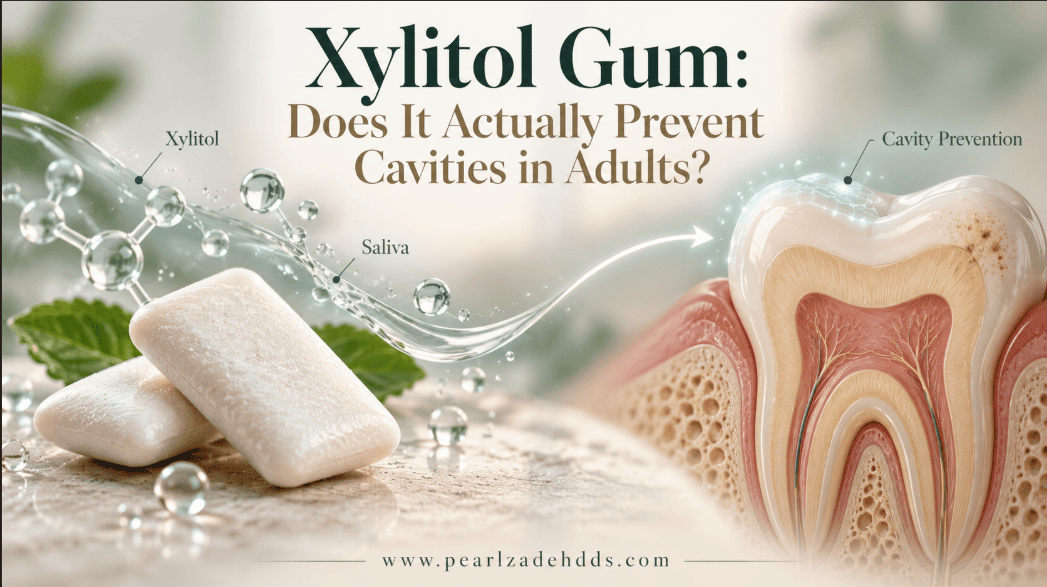
  • Xylitol Gum: Does It Actually Prevent Cavities in Adults?

    Xylitol Gum: Does It Actually Prevent Cavities in Adults?

    Xylitol gum gets marketed as a cavity fighter, and packaging often implies more than the research supports. If you are deciding whether it deserves a place in your routine, the honest answer sits between the marketing and the skepticism.

    Xylitol gum may offer a useful preventive benefit for some adults. Current evidence does not support treating it as a standalone way to prevent cavities. Several different things get bundled together in this conversation, and separating them makes the evidence much easier to read.

    What Is Xylitol?

    Xylitol is a sugar alcohol, also called a polyol, used as a sweetener in some sugar-free gums, mints, and other products. The American Dental Association notes that sugar-free gums are sweetened with polyols such as xylitol, sorbitol, mannitol or maltitol, which are noncariogenic: they taste sweet but are not a suitable substrate for oral bacteria to use as an energy source.

    That is the core difference from sucrose. Plaque bacteria metabolize fermentable sugars and produce acid as a byproduct, and that acid is what demineralizes enamel. Xylitol does not feed that process in the same way.

    Two practical points. Xylitol is a food ingredient, not a medication or a dental treatment. And not every sugar-free gum contains it, since several different polyols are used for the same purpose.

    How Could Xylitol Gum Help Your Teeth?

    Three separate mechanisms get discussed, and they are not equally well established.

    Increased saliva

    Chewing stimulates salivary flow. The ADA notes that chewing gum after a meal can increase salivary flow by stimulating both mechanical and taste receptors in the mouth. Saliva helps wash away food debris, buffer acids, and deliver calcium and phosphate that support the natural remineralization of enamel.

    This benefit comes from chewing, not from xylitol specifically. Any sugar-free gum stimulates saliva. It is probably the single biggest reason sugar-free gum is associated with oral health benefits at all.

    Less fermentable sugar exposure

    Swapping sugary gum for sugar-free gum removes a source of fermentable sugar from your day. If you chew gum regularly, that change matters on its own, independent of which polyol sweetens the replacement.

    Effects on oral bacteria

    Research has examined whether xylitol specifically affects Streptococcus mutans and related bacteria associated with cavities. This is where xylitol-specific claims usually originate, and where the evidence needs the most careful reading.

    Does Xylitol Actually Prevent Cavities in Adults?

    Four different things get treated as interchangeable in marketing: a plausible biological mechanism, a measured change in bacterial levels, a measured change in plaque, and an actual reduction in cavities. Only the last one is what patients care about, and it is the least well supported.

    A 2025 systematic review in BMC Oral Health examined exactly this split. The authors reviewed clinical studies comparing xylitol gum against a polyol control gum, which isolates any xylitol-specific effect from the general effect of chewing. Across the included studies, xylitol gum significantly decreased mutans streptococci counts in 12 of 14 studies compared with sorbitol gum. Plaque accumulation decreased in 6 of 10 studies. Caries occurrence decreased in 3 of 5 trials.

    Read those three numbers together. The evidence is most consistent for bacterial counts, less consistent for plaque, and thinnest for cavities themselves, where only five trials existed to review. Fewer bacteria is an encouraging intermediate finding. It is not the same as demonstrating that a person will develop fewer cavities.

    A separate 2024 systematic review reached a more cautious conclusion. Reviewing nine clinical trials in humans, the authors reported that the preventive effect of xylitol against dental caries cannot be confirmed, and called for further research using standardized protocols. They noted that study groups, evaluation periods, and daily xylitol doses varied considerably between trials, which makes results difficult to compare.

    So the accurate summary is not yes or no. Some studies suggest benefit. The effect on bacteria appears real. Whether that translates into meaningfully fewer cavities in adults has not been established.

    Is Xylitol Better Than Other Sugar-Free Gum?

    The 2025 review is the most relevant evidence here, because its comparison group chewed sorbitol gum rather than no gum. That design asks whether xylitol adds anything beyond chewing itself.

    On bacterial counts, it generally did: 12 of 14 studies favored xylitol. On cavities, the picture is thinner, with 3 of 5 trials showing a decrease. A difference in bacterial levels does not automatically establish a clinically meaningful difference in cavity prevention, and five trials is a small base for a confident conclusion.

    Sorbitol, mannitol, maltitol, and erythritol are all used in sugar-free gum, and all avoid feeding plaque bacteria the way sucrose does. Xylitol is not universally superior for everyone’s teeth. Choosing sugar-free at all is the larger step; which polyol sweetens it is a smaller question.

    How Long Should Adults Chew Xylitol Gum?

    There is no universal rule requiring a specific number of minutes or pieces per day.

    General guidance for sugar-free gum often suggests chewing for roughly twenty minutes after meals, which is a practical suggestion rather than an established optimal dose. Research protocols have used a wide range of xylitol amounts and schedules, and as the 2024 review noted, that variation is one reason the trials are hard to compare.

    More xylitol does not reliably mean more protection. If you want a number that applies to your teeth specifically, that is a question for your dentist rather than a package label.

    Can You Chew Xylitol Gum After Meals?

    Yes, and after meals is when it makes the most sense. Eating lowers the pH in your mouth, and stimulated saliva helps buffer that acid while clearing food debris from tooth surfaces. Gum can be useful at times when brushing is not practical, such as after lunch at work.

    This is a supporting habit, not a requirement. Nobody needs to chew gum after every meal.

    Is Xylitol Gum a Substitute for Brushing?

    No. The ADA states this directly: while there is some evidence that regular use of sugar-free gum may reduce caries risk, gum is not to be used as a substitute for a regular oral hygiene routine consisting of twice daily brushing with a fluoride toothpaste and daily cleaning between teeth.

    Xylitol does not do what fluoride does, and the two should not be treated as interchangeable. Chewing gum also does not replace cleaning between your teeth, limiting frequent sugar exposure, or regular dental examinations. Our article on whether to rinse after brushing covers one small habit that affects how much benefit you get from fluoride toothpaste, which matters considerably more than gum choice.

    What About People Who Are at Higher Risk for Cavities?

    Cavity risk varies widely between adults. Frequent sugar or carbohydrate exposure, reduced salivary flow, a history of previous or active decay, certain medications, exposed root surfaces, and oral hygiene factors can all raise risk.

    Xylitol gum is not sufficient on its own for someone at elevated risk. People in that position generally benefit from an individualized prevention plan, which may include specific fluoride recommendations and a tailored recall schedule. Your own risk level is something a dentist assesses, not something to infer from a single habit.

    Can Xylitol Gum Help With Dry Mouth?

    Chewing gum stimulates saliva, so some people with dry-mouth symptoms find it helpful for comfort. That is a reasonable use.

    It does not treat whatever is causing the dryness. Persistent dry mouth has many possible causes, including medications and medical conditions, and it raises cavity risk in its own right because there is less saliva available to buffer acids and clear debris. If your mouth is persistently dry, that deserves evaluation rather than more gum.

    Can Xylitol Gum Cause Any Problems?

    For most adults, no. Two things are worth knowing.

    Sugar alcohols including xylitol can cause gastrointestinal symptoms such as bloating, gas, or a laxative effect when consumed in larger amounts. Tolerance varies between individuals.

    Prolonged or vigorous gum chewing can also be uncomfortable for people with existing jaw pain or joint problems. This does not mean gum causes those conditions. If you have persistent jaw pain, clicking accompanied by pain, or limited jaw movement, discuss gum chewing with your dentist rather than working it out alone. Our overview of early signs of gum disease covers a separate reason that regular dental monitoring matters beyond cavity prevention alone.

    What Should You Look for in a Sugar-Free Gum?

    Sugar-free is the first thing to check. Beyond that, the ADA Seal of Acceptance is useful information: only sugar-free gums are considered for it, and a company earns it by demonstrating that its product meets requirements for safety and efficacy, which may include indications such as reducing plaque acids, promoting remineralization, reducing cavities, or reducing gingivitis.

    The Seal indicates that a specific product met evaluated criteria. It does not mean the product will prevent cavities for every person who chews it. Xylitol appearing in an ingredient list also does not establish that a particular gum prevents cavities, since formulations and the evidence behind them differ.

    What Is More Important Than Xylitol Gum?

    Brushing twice daily with fluoride toothpaste. Cleaning between your teeth daily. Limiting how often you consume sugary foods and drinks, since frequency matters as much as quantity. Keeping up with regular dental visits. Addressing dry mouth if you have it. And following whatever individualized recommendations your dentist has given you based on your actual risk.

    Xylitol gum sits alongside those as a possible extra. It is not a foundation to build on.

    So, Should Adults Chew Xylitol Gum?

    For many adults, sugar-free gum can be a reasonable addition to an oral-care routine, largely because chewing increases saliva flow. Xylitol may provide additional benefits, particularly on bacterial levels, but current evidence does not establish it as a guaranteed way to prevent cavities.

    Whether it is worth adding depends on your cavity risk, your saliva flow, any existing dental conditions, whether your jaw is comfortable chewing gum, your diet, and what the rest of your routine looks like. Not every adult needs to start chewing it.

    Speak With Dr. Pearl Zadeh About Cavity Prevention

    No single product or habit determines whether you get cavities. What actually helps depends on your own risk factors, your saliva, your diet, and the routine you already have in place. Dr. Pearl Zadeh can assess where your risk actually sits and discuss which preventive measures are worth your attention, whether or not gum turns out to be one of them.

    Call (818) 716-6722 or click the button below to schedule your consultation online.

    Frequently Asked Questions

    Does xylitol gum really prevent cavities?

    Not conclusively. Research consistently shows reductions in cavity-associated bacteria, but evidence for fewer actual cavities is limited. A 2024 systematic review concluded the preventive effect against caries cannot yet be confirmed.

    Is xylitol better than regular sugar-free gum for your teeth?

    Studies comparing xylitol gum with sorbitol gum generally favor xylitol on bacterial counts. Whether that produces meaningfully fewer cavities is unclear. Choosing sugar-free at all matters more than which polyol sweetens it.

    How does xylitol help prevent tooth decay?

    Plaque bacteria cannot use xylitol as an energy source the way they use sugar, so it does not fuel acid production. Chewing also stimulates saliva, which buffers acid and helps remineralize enamel.

    How long should you chew xylitol gum?

    There is no established optimal duration. Guidance for sugar-free gum often suggests around twenty minutes after meals as a practical habit. Research protocols have varied widely in dose and schedule.

    Should you chew xylitol gum after every meal?

    It is not required. After meals is when gum is most useful, since saliva helps buffer acid and clear debris, but this is a supporting habit rather than an obligation.

    This article is for informational purposes only and is not a substitute for professional dental advice. Please schedule a consultation with Pearl Zadeh DDS to discuss your specific situation.