Pearl Zadeh DDS

Tag: Cosmetic Dentist

  • Whitening for Tetracycline-Stained Teeth: What to Expect

    Whitening for Tetracycline-Stained Teeth: What to Expect

    If your teeth have a gray, brown, or banded discoloration that whitening toothpaste never touched, tetracycline staining may be the reason. The question most people arrive with is whether professional whitening can actually change it.

    The honest answer is that it often can, though results depend heavily on how severe the staining is and where it sits on the tooth. Tetracycline discoloration is not like coffee or wine staining. It developed inside the tooth rather than on it, and that changes what whitening has to work through.

    What Causes Tetracycline-Stained Teeth?

    Tetracyclines are a family of antibiotics used to treat bacterial infections. They have a chemical property that matters here: they bind to calcium. When someone is exposed to tetracycline while their teeth are still forming, the antibiotic can be incorporated into the developing tooth structure along with the minerals being laid down.

    That is why the discoloration is described as intrinsic. It is built into the tooth rather than deposited on the surface. Timing is what determines whether it happens at all. Exposure during the years when permanent teeth are mineralizing, including before birth through early childhood, is when incorporation can occur. Exposure as an adult, after the teeth have fully formed, does not cause discoloration by this route, since there is no developing tooth structure left for the antibiotic to be built into. One derivative, minocycline, has separately been associated with tooth discoloration in adults through a different mechanism, so adult-onset color changes are worth discussing with a dentist rather than ruled out.

    The appearance varies between patients because the amount of antibiotic, how long it was taken, and exactly which stage of tooth development it coincided with all differ. None of this reflects anything the patient or their parents did wrong. Tetracycline was widely prescribed before this effect was well understood, and it was often the appropriate medication at the time.

    What Do Tetracycline-Stained Teeth Look Like?

    Presentations differ, but some patterns are common. Some patients have gray or gray-brown discoloration, which tends to be the more noticeable presentation. Others show yellow-brown tones that can look closer to ordinary staining at a glance. Horizontal bands or stripes across the teeth are a recognizable pattern, reflecting the period of development during which exposure occurred. Severity ranges from a mild, fairly uniform shade change to deep banding that is obvious at conversational distance. Discoloration is often uneven between teeth, since different teeth mineralize on different schedules.

    Appearance alone does not confirm the cause. Gray, brown, and banded discoloration can also result from other developmental conditions, trauma, or enamel changes unrelated to medication. An examination and a history are what actually establish what you are looking at.

    Can Tetracycline-Stained Teeth Be Whitened?

    Often, yes, though the results are less predictable than with surface staining. A 2021 clinical paper in the British Dental Journal describes tetracycline as one of the most difficult stains to bleach, while also concluding that vital tooth bleaching should be considered the initial treatment for tetracycline-stained teeth, and that it can have a dramatic effect as a conservative sole therapy in some cases. Both of those statements are true at once, which is the core of what patients need to understand here.

    The variability comes from the staining itself. Discoloration that extends deep into the tooth, or that concentrates near the gumline, tends to respond less predictably than a milder, more evenly distributed shade change. Two people with tetracycline staining can undergo similar treatment and see quite different degrees of improvement.

    Why Are Tetracycline Stains Harder to Whiten?

    The difference comes down to where the color actually lives.

    Extrinsic discoloration sits on or near the outer surface of the tooth. Pigments from coffee, tea, wine, or tobacco accumulate on the enamel and in the thin protein layer covering it. Whitening agents reach that pigment readily, which is why surface staining tends to respond well.

    Intrinsic discoloration is different in kind, not just in degree. With tetracycline, the antibiotic was incorporated into the tooth structure during formation, primarily into the dentin beneath the enamel. Enamel is translucent, so the color of the dentin underneath shows through it. A whitening agent has to penetrate the enamel and act on discoloration located inside the tooth. That is a longer and less certain path than lifting pigment off a surface. Our breakdown of why whitening sometimes doesn’t work covers the other causes of limited results, but tetracycline is a distinct case because the discoloration is structural in origin.

    Does Professional Teeth Whitening Work Better for Tetracycline Stains?

    Professional treatment offers something more useful than simply a stronger product: an assessment of what you are actually dealing with. Professional teeth whitening begins with a dentist evaluating the pattern and severity of the discoloration, checking the condition of your enamel and gums, noting any existing restorations, and discussing what degree of change is realistic for your specific teeth.

    That last part matters more with tetracycline staining than with almost any other whitening case. Setting expectations accurately at the start is part of the treatment, not a disclaimer attached to it. A patient who knows in advance that banding may lighten rather than disappear is in a very different position than one who expected it to vanish, even if both end up with identical teeth at the end. Satisfaction with these cases tracks closely with what the patient was told to expect going in.

    How Long Does Whitening Take for Tetracycline-Stained Teeth?

    Longer than for ordinary staining, and there is no single timeline. Research on this has used extended treatment rather than short courses. A longitudinal study following patients for 90 months after treatment reported that tetracycline-stained teeth can be whitened successfully using extended treatment time, and that the shade change remained stable for at least 90 months afterward. That study involved six months of active nightly treatment with a 10% carbamide peroxide gel in custom trays, and the long-term follow-up reached 15 of the 21 original participants.

    That is a specific research protocol rather than a recommendation for your teeth, and it illustrates the scale involved. Tetracycline cases are generally planned in months, not in a single appointment. Our overview of how long professional whitening takes covers the more typical timelines for comparison.

    What If Whitening Does Not Remove All the Discoloration?

    Partial improvement is a common and legitimate outcome here, not a failed treatment. Bleaching can lighten intrinsic discoloration substantially while still leaving some banding visible, particularly near the gumline where the staining often concentrates. That reflects the limits of what bleaching can do with deeply located color, not an error in how it was carried out.

    From there, a dentist may consider continuing or adjusting whitening if it is still producing change, reassessing whether something other than tetracycline is contributing, or discussing restorative options. Our overview of cosmetic treatment options for stained teeth covers what else may apply. None of these is automatically the right next step. The appropriate choice depends on how much change you actually got, how much more you want, and what your teeth can support.

    Can Veneers Cover Tetracycline Staining?

    Veneers can change the visible color of a tooth, since they cover the front surface with a new material in a selected shade. They are sometimes considered when intrinsic discoloration remains noticeable after bleaching. Shade selection and planning matter considerably with dark underlying teeth, because a very dark tooth can show through a thin restoration. Our breakdown of the steps in a cosmetic veneer case walks through that planning process, and our veneer service page covers the treatment itself.

    Worth knowing: bleaching first can make restorative treatment more conservative. The same British Dental Journal paper notes that bleaching performed before restorative work in complex tetracycline cases can require less reduction of tooth structure and produce better results. Veneers are not necessary for everyone with tetracycline staining, and they involve permanently altering the teeth, which is a genuine consideration rather than a formality.

    What About Existing Crowns, Fillings, or Veneers?

    Conventional whitening works on natural tooth structure. The American Dental Association states that only natural teeth can be whitened, not tooth-colored restorations. If you already have crowns, veneers, or tooth-colored fillings, they will generally hold their existing shade while the natural teeth around them lighten, which can create a mismatch. Our discussion of whitening before veneers or crowns covers how that sequencing is usually handled.

    Does Tetracycline Staining Mean Your Teeth Are Unhealthy?

    No. Color and health are separate questions. A tooth can carry intrinsic discoloration from childhood antibiotic exposure and still be structurally sound, cavity-free, and functioning normally. The antibiotic affected how the tooth looks, not whether it works. The staining is a cosmetic characteristic, not a disease process.

    A dentist will still want to examine your teeth before cosmetic whitening, for the same reasons that apply to any patient: checking for decay, assessing gum health, and noting enamel condition. That examination is about making sure whitening is appropriate, not about treating the discoloration as a health problem.

    Is Whitening Safe for Tetracycline-Stained Teeth?

    No whitening approach is entirely risk-free, and the longer treatment courses used for tetracycline cases make a few factors worth weighing. Your existing enamel condition, any history of sensitivity, gum health, and existing restorations all belong in the conversation. The ADA identifies temporary tooth sensitivity and gum irritation as the most commonly reported side effects of whitening. The British Dental Journal paper is direct that sensitivity can, in some patients, rule out bleaching as an option.

    More aggressive treatment is not automatically the answer when progress is slow. Our discussion of whitening and enamel and our guide for sensitive teeth both cover what that means in practice.

    What Should You Do Before Whitening Tetracycline-Stained Teeth?

    1. Have the likely cause of the discoloration identified rather than assumed.

    2. Get your teeth and gums examined, including enamel condition and any sensitivity.

    3. Discuss what degree of change is realistic for your specific pattern of staining.

    4. Account for any existing crowns, veneers, or visible fillings.

    5. Decide whether whitening alone is likely to get you close enough to your goal.

    6. Ask what the options are if intrinsic discoloration remains after treatment.

    Get a Clearer Plan for Tetracycline-Stained Teeth

    Tetracycline staining can be challenging to whiten, especially when discoloration runs deeper within the tooth. The right approach depends on the type, pattern, and severity of the staining, as well as the condition of your teeth and any existing dental work.

    Dr. Pearl Zadeh can evaluate your discoloration, explain what whitening may realistically accomplish, and discuss other cosmetic options if whitening alone may not achieve the result you want.

    Call (818) 716-6722 or click the button below to schedule your consultation online.

    Frequently Asked Questions

    Can tetracycline-stained teeth be whitened?

    Often, yes. Research supports bleaching as an initial treatment for tetracycline staining, though results vary with severity and typically require extended treatment.

    Does teeth whitening remove tetracycline stains?

    It can lighten them, sometimes substantially, but complete removal is not a realistic expectation for every patient, particularly with severe or banded staining.

    Is professional whitening effective for tetracycline discoloration?

    It can be. Its main advantage is evaluation and planning, since tetracycline cases need an accurate assessment of severity before treatment starts.

    How long does it take to whiten tetracycline-stained teeth?

    Longer than ordinary staining. Published research has used extended treatment measured in months rather than a single appointment.

    Can severe tetracycline staining be whitened?

    Severe cases often improve but are less predictable. Deep or gumline banding may lighten without disappearing entirely.

    Can veneers cover tetracycline stains?

    Yes, veneers can change a tooth’s visible color. They are not necessary for everyone, and bleaching first may allow more conservative restorative work.

    This article is for informational purposes only and is not a substitute for professional dental advice. Please schedule a consultation with Pearl Zadeh DDS to discuss your specific situation.
  • Whitening Pens, Strips, or Professional Treatment: What’s the Difference?

    Whitening Pens, Strips, or Professional Treatment: What’s the Difference?

    A drugstore aisle can hold a dozen whitening products at a dozen price points, and a dental practice offers something different again. Pens, strips, and professional treatment all promise whiter teeth, which makes them look interchangeable. They aren’t.

    These methods differ in how the whitening agent actually reaches your teeth, how evenly and consistently it stays there, and how much of the process a dentist is involved in. Those differences matter, but so does something people rarely consider first: why your teeth are discolored in the first place.

    Whitening Pens, Strips, or Professional Treatment?

    A whitening pen paints a gel directly onto the tooth surface with a brush tip. A whitening strip is a flexible film coated with gel that you press across several teeth at once and leave in place. Professional whitening starts with a dental evaluation and uses stronger formulations applied under supervision, or dentist-directed trays used at home.

    Results vary between these options, and they vary considerably between two people using the same option. The method affects how much whitening agent contacts your enamel and for how long. Your specific discoloration affects whether that contact accomplishes anything. No single method suits every type of stain.

    How Whitening Pens Work

    A pen dispenses a peroxide-based gel through a brush or applicator tip. You paint it directly onto the teeth you want to treat, and the gel is formulated to cling to enamel on its own. A peer-reviewed review of over-the-counter whitening products describes these paint-on products as gels that adhere to enamel without any physical barrier such as a tray or strip holding them in place.

    That design is the source of both the appeal and the limitation. Application is genuinely targeted: you can treat a single darker tooth rather than your whole smile, or touch up one area before an event. But nothing covers the gel once it’s applied, so saliva, lips, and tongue can dilute or wipe it away before the full contact time has passed. How evenly you paint it, and how long it actually stays put, varies from application to application and from person to person. Following the product’s instructions matters more here than with a product that holds itself in position.

    How Whitening Strips Work

    A strip is a thin, flexible film pre-coated with peroxide gel. You press it against the front surfaces of several teeth at once, and the film holds the gel in contact with the enamel for the wear time on the label. Because the strip covers the teeth, it also acts as a partial barrier against saliva.

    That gives strips fairly consistent coverage across the teeth they reach, though the fit is not perfect for everyone. Strips are cut to a standard shape, so they may not conform well to crowded, rotated, or unusually shaped teeth, and they typically do not reach back teeth. Gel that squeezes past the edges can contact the gums, which is one reason temporary gum irritation is a recognized side effect. Wear times differ by product, so the instructions on your specific box are the ones that apply.

    How Professional Teeth Whitening Differs

    The biggest difference is not the gel. It’s what happens before the gel goes on. Professional teeth whitening begins with an examination: the condition of your enamel, the health of your gums, any existing restorations in your smile line, your sensitivity history, and what type of discoloration you actually have. The American Dental Association notes that professional whitening uses higher-concentration peroxide than over-the-counter products, applied with the soft tissues protected.

    Supervision also changes how problems get handled. If sensitivity appears mid-treatment, the approach can be adjusted. If your discoloration turns out to be something bleaching won’t address, that gets identified before you spend weeks on a product that was never going to work. None of this makes professional treatment automatically the right choice for every patient. It makes it a different kind of choice, with evaluation built into the front of it.

    Whitening Pens vs Strips: What’s the Practical Difference?

    The practical difference comes down to coverage and contact. Strips hold gel against several teeth at once under a film; pens place gel precisely but leave it exposed. Research has compared these directly. A randomized clinical trial assigned 52 adults to peroxide whitening strips, a peroxide paint-on gel, or a water rinse control, and found the strips produced the greatest end-of-treatment reduction in yellowness. Worth noting: the two products were used on different schedules, strips twice daily for 7 days and the gel twice daily for 14 days, so this compares the products as labeled rather than the delivery methods head to head under identical conditions.

    The broader evidence picture differs between the two as well. The same review of over-the-counter products points in two directions here. It notes a clinical study in which a 6% hydrogen peroxide paint-on system showed significant efficacy whether a dentist or the patient applied it. It also cites a systematic review and meta-analysis that found the effectiveness of paint-on systems inconclusive, largely because few studies were available to assess. Inconclusive evidence is not the same as evidence that pens don’t work. It means the research base behind strips is currently larger.

    Practically, a pen is easier to carry and use on one tooth, and easier to apply without a mirror and full attention. A strip covers more teeth at once with less technique involved, but treats whatever it covers rather than what you choose. Neither is universally better. They suit different goals.

    At-Home Whitening vs Professional Treatment

    The gap between at-home and professional whitening is narrower than marketing on either side suggests. A systematic review and meta-analysis compared over-the-counter whitening strips with the dentist-directed tray approach using 10% carbamide peroxide and found similar tooth whitening and similar rates of tooth and gum sensitivity between them, while cautioning that the available studies have limitations and do not establish that strips can simply replace the tray technique.

    What genuinely changes when a dentist is involved is the evaluation, the planning, and the ability to adjust. Our comparison of professional and at-home whitening goes further into those differences, and our overview of how long professional whitening takes covers the practical side of an appointment.

    Which Option Works for Different Types of Stains?

    This is where the method matters less than the cause. Surface staining, the kind that builds up from coffee, tea, red wine, or tobacco, sits on the outside of the enamel and tends to respond to peroxide-based whitening across all three approaches.

    Intrinsic discoloration develops within the tooth structure itself, from causes including aging, certain medications taken during tooth development, or past trauma. It responds differently, sometimes slowly and sometimes not much at all, and stronger products are not reliably the answer.

    Natural tooth color is not a stain. Dentin is naturally yellow, and thinner or more translucent enamel lets more of it show through. Whitening has limits when your baseline shade is doing most of the work.

    Enamel changes such as white spots are demineralized enamel rather than surface discoloration, and they need evaluation rather than a whitening product. Our breakdown of why whitening sometimes doesn’t work walks through each of these possibilities in more detail.

    What About Tooth Sensitivity?

    Temporary tooth sensitivity and gum irritation are the most commonly reported side effects of whitening, according to the ADA. These effects can occur with different whitening methods, and no approach guarantees a sensitivity-free experience. Sensitivity during whitening does not necessarily mean you damaged your enamel. It usually remains temporary and resolves after treatment.

    If you already experience sensitivity, consider it before choosing a whitening method. Your dentist can adjust the concentration, contact time, and frequency based on your needs. Our discussion of whitening for sensitive teeth covers how that planning works.

    Can Whitening Pens or Strips Whiten Veneers, Crowns, or Fillings?

    No, and this applies to professional whitening too. The ADA is direct that only natural teeth can be whitened, not tooth-colored restorations. Porcelain and composite do not respond to peroxide the way natural enamel does. If you have visible crowns, veneers, or fillings, whitening your natural teeth can leave those restorations looking darker by comparison. That doesn’t mean they need replacing. It means the shade relationship deserves thought before you start. Our guide to whitening when you already have veneers and our discussion of whitening before veneers or crowns cover both situations.

    When Should You Talk to a Dentist Before Whitening?

    A few situations are worth raising first: significant or lingering sensitivity, gum irritation that persists after you stop a product, discoloration you can’t explain, chalky white spots, color that’s uneven from tooth to tooth, existing restorations in your smile line, whitening that has already produced little change, or any concern about the condition of your enamel. None of these means whitening is off the table. They mean it’s worth knowing what you’re treating before you treat it.

    How to Choose a Whitening Approach

    A whitening pen may suit someone who wants targeted, portable application, perhaps for one tooth that reads darker than its neighbors, and who is comfortable with results that depend partly on technique.

    Whitening strips may suit someone who wants to treat several visible teeth at once with less technique involved, and who has fairly even, well-aligned front teeth for the strip to sit against.

    Professional treatment may suit someone who wants their teeth and gums evaluated first, who has restorations or sensitivity to work around, or whose previous whitening attempts didn’t accomplish much.

    These are starting points rather than rules. The same person might reasonably choose differently depending on what their teeth actually need.

    How Long Do Whitening Results Last?

    Results are not permanent with any of these methods. Staining returns gradually as your teeth encounter the same foods, drinks, and habits that discolored them before. How quickly depends on your diet, whether you use tobacco, your oral hygiene routine, the type of staining you had, and the method you used. Our discussion of how long whitening results last covers what actually affects that timeline and how maintenance works.

    Find the Whitening Approach That Fits Your Smile 

    Not every whitening method works the same way, and the right choice depends on more than how white you want your teeth to look. Your discoloration, sensitivity, oral health, and existing dental work can all affect which option makes sense.

    Dr. Pearl Zadeh can evaluate your teeth, explain what each option can realistically achieve, and help you choose a whitening approach based on your smile and goals.

    Call (818) 716-6722 or click the button below to schedule your consultation online.

    Frequently Asked Questions

    Are whitening pens as effective as whitening strips?

    Research comparing them directly has favored strips, though fewer studies exist on pens overall. That reflects a smaller evidence base rather than proof that pens don’t work.

    Is professional teeth whitening more effective than strips?

    Professional whitening uses higher concentrations and includes an evaluation first. Research comparing strips with dentist-directed tray whitening has found similar results between those two approaches.

    Can whitening pens damage your teeth?

    Used according to instructions, peroxide whitening products are not shown to cause lasting enamel damage. Overuse or ignoring directions is where problems are more likely.

    Which whitening method works for coffee stains?

    Coffee causes surface staining, which generally responds to peroxide-based whitening across all three methods. How much change you see still depends on your teeth.

    Why didn’t my whitening treatment work?

    The discoloration may be intrinsic rather than surface-level, may reflect your natural tooth color, or may involve restorations or enamel changes that whitening does not address.

    Should I see a dentist before whitening my teeth?

    It’s particularly worth it if you have sensitivity, restorations, unexplained discoloration, or whitening attempts that produced little change.

    This article is for informational purposes only and is not a substitute for professional dental advice. Please schedule a consultation with Pearl Zadeh DDS to discuss your specific situation.
  • Whitening After Braces or Invisalign: When to Start

    Whitening After Braces or Invisalign: When to Start

    Your braces come off, or your last aligner comes out, and you finally see your straightened teeth. Then you notice the color. Maybe the shade looks duller than you expected, or there are pale marks where the brackets used to sit.

    Whitening can be a reasonable next step after orthodontic treatment. The right time to start depends on the condition of your teeth and gums, not on a fixed number of weeks. What follows is what actually affects that timing.

    Can You Whiten Your Teeth After Braces or Invisalign?

    Often, yes. Many patients are reasonable candidates for whitening once orthodontic treatment is complete. Before starting, though, your teeth deserve an actual look: sensitivity, gum health, enamel condition, and the specific type of discoloration you’re seeing all affect whether whitening makes sense and what it can realistically do. Not every color change after braces is a stain, and that distinction matters more than any waiting period.

    When Can You Whiten After Braces?

    Removing brackets changes several things at once. Teeth are often temporarily sensitive after debonding. Gums that sat under wires and brackets for months can be irritated or inflamed, especially if brushing and flossing were difficult during treatment. Plaque and staining may have accumulated in spots that were hard to reach, particularly along the gumline and in the corners where brackets met enamel. And the enamel that was covered by each bracket may look different from the enamel around it, sometimes in a way that becomes more obvious a few days after debonding rather than immediately.

    That last point is the one worth slowing down for. Some post-braces color differences are surface staining. Others are areas of enamel demineralization, often called white spot lesions, which form when plaque sits against enamel and produces acid. A review of post-orthodontic white spot lesions in Seminars in Orthodontics reports that roughly a third of orthodontic patients finish treatment with at least one white lesion, though reported estimates vary widely between studies, depending on how lesions are assessed. The more useful finding for timing is what happens next: these lesions often shrink on their own in the weeks after appliance removal, with about half of the original lesion remineralizing within about six months without any specific treatment. That natural recovery is one practical reason not to rush into whitening the week your brackets come off.

    Whitening is also not the right tool for every kind of discoloration here. It lightens natural tooth structure. It does not rebuild demineralized enamel, and it does not treat decay. Getting an accurate read on what you’re actually looking at comes first.

    When Can You Whiten After Invisalign?

    Invisalign presents a different situation. There are no brackets bonded across the front of your teeth, so you generally won’t see the bracket-shaped color differences that fixed braces can leave behind. Gum irritation from hardware is usually less of a factor too. What does matter is attachments, the small tooth-colored bumps bonded to certain teeth to help aligners grip and move them.

    While attachments are in place, they cover part of the tooth surface. Whitening during that period can leave the covered areas a different shade than the rest of the tooth once the attachments are removed. That’s the main reason many patients prefer to wait until treatment is finished and attachments are off. It isn’t a blanket rule, though, and it doesn’t mean whitening during aligner treatment is never appropriate. Some patients have no attachments on their most visible teeth, and some whitening approaches work alongside aligner wear. Your provider can tell you what applies to your case.

    Keeping aligners clean during treatment also affects how your teeth look at the end. Our guide to cleaning Invisalign aligners covers the habits that keep staining from building up in the first place. It’s also worth confirming that treatment is genuinely complete, since refinement aligners sometimes follow the main set, occasionally with new attachments.

    Why Your Teeth May Look Uneven After Braces

    Several different things can produce uneven color, and they call for different responses.

    Surface staining sits on the outside of the enamel, usually from food, drinks, or plaque that accumulated around hardware. This is the type most likely to respond to cleaning and whitening.

    Natural tooth-color variation is simply how your teeth are. Canines are often slightly more yellow than incisors, and that difference can become more noticeable once teeth are straightened and visible from a new angle. Teeth that were previously overlapped or rotated may also be showing surfaces you have not really seen before.

    White spot lesions are demineralized enamel, not stains. They look chalky or opaque rather than yellow or brown, and they typically appear along the gumline or in a rectangle-shaped outline where a bracket sat. These are an early stage of enamel breakdown, and they need a dentist’s assessment rather than a whitening kit.

    Other enamel changes, including deeper discoloration from trauma or developmental causes, behave differently again and may not respond to whitening at all.

    If whitening has already produced less change than you hoped, our breakdown of the common reasons whitening doesn’t work walks through these possibilities in more detail.

    Should You Whiten Before or After Your Retainer?

    There’s no universal sequence here, and your orthodontic provider’s instructions should come first. A few practical points do come up often. Retention usually begins immediately after treatment, which means your retainer is part of the picture from day one. Some whitening approaches use custom trays, and how those interact with your retainer schedule is worth asking about directly. If your retainer is a bonded wire behind your front teeth, that changes the cleaning picture rather than the whitening picture, since it sits out of sight. The practical step is simply telling both your dentist and your orthodontic provider what you’re planning, so the two schedules fit together.

    What If Your Teeth Are Sensitive After Orthodontic Treatment?

    Sensitivity after orthodontic treatment is common and usually temporary. Teeth that have been moving are often tender, and recently debonded enamel can react to temperature for a while. Whitening itself can also cause temporary sensitivity: the American Dental Association identifies tooth sensitivity and gum irritation as the most common side effects of whitening. Existing sensitivity doesn’t mean whitening is off the table. It does mean the approach, concentration, and timing deserve more thought than a generic plan. Our discussion of whitening for sensitive teeth goes further into how that gets managed.

    Can Whitening Remove Stains Left After Braces?

    It depends entirely on what the marks actually are. Surface staining often responds well. White spot lesions are a more interesting case, and the evidence is genuinely mixed rather than one-sided. A study in The Angle Orthodontist looked at ten patients with inactive white spot lesions after fixed braces and found that bleaching lightened both the lesions and the surrounding sound enamel, with the sound enamel lightening more, which improved how well the two areas matched. That is a small study, and it looked specifically at lesions that were no longer active. It does not mean whitening is the standard answer for white spots, and it does not mean whitening repairs the enamel underneath. The demineralization is still there.

    Other approaches exist specifically for white spot lesions, including remineralizing treatments and micro-invasive options that mask the lesion. Which one fits, if any, depends on how deep the lesion is and whether it’s still active. That’s a clinical judgment, not a product choice.

    What About Fillings, Crowns, or Veneers?

    Whitening changes the color of natural tooth structure. The ADA is direct that only natural teeth can be whitened, not tooth-colored restorations. If you have visible fillings, a crown, or veneers, whitening your natural teeth can leave those restorations looking darker by comparison. This doesn’t mean they need replacing. It means the shade relationship is worth planning around before you start. Our discussion of whitening before veneers or crowns covers the sequencing question, and our guide to whitening when you already have veneers covers what to do when restorations are already in place.

    Professional Whitening After Orthodontic Treatment

    The value of an evaluation before whitening after orthodontics is mostly diagnostic. A dentist can look at your current tooth color, check the condition of your enamel, ask about sensitivity, assess whether your gums have settled after months of hardware, note any existing restorations, and identify what type of discoloration you’re actually dealing with. That last point is where post-braces cases differ most from ordinary whitening cases. Professional teeth whitening starts from that assessment rather than from a guess, which matters more when white spots or enamel changes may be part of the picture.

    If you’re weighing what’s involved, our overview of how long professional whitening takes and how long results tend to last cover the practical side.

    How to Prepare for Whitening After Braces or Invisalign

    A few things genuinely help, and most of them are about making sure whitening is working on a clean, settled starting point. Get your oral hygiene routine back to full strength, which is easier once hardware is gone and brushing and flossing are straightforward again. Give irritated gums time to settle, and mention any bleeding or tenderness rather than working around it. Have any concerning discoloration evaluated before assuming it’s a stain. Tell your dentist about sensitivity you’re experiencing, including how long it’s been going on. Complete any needed dental treatment first, since whitening over an untreated cavity doesn’t address the cavity. And once you have a plan, follow the instructions you’re given rather than extending treatment time on your own.

    When Should You Ask a Dentist Before Whitening?

    Some situations are worth raising before you start anything: significant or persistent sensitivity, gum irritation that hasn’t settled well after your hardware came off, chalky white marks on your teeth, discoloration you can’t explain, any pain, enamel that looks rough or pitted rather than simply discolored, and existing fillings or crowns in your smile line. None of these automatically rules out whitening. They’re reasons to have someone look before you spend time and money on a product that may not address what’s actually going on.

    Plan Your Whitening After Orthodontic Treatment

    Finishing braces or Invisalign does not mean you need to whiten your teeth right away. Your teeth may need time to settle, and discoloration or sensitivity can affect what makes sense next.

    Dr. Pearl Zadeh can examine your teeth and gums, identify the type of discoloration you’re seeing, and help you decide whether whitening is appropriate for your smile.

    Call (818) 716-6722 or click the button below to schedule your consultation online.

    Frequently Asked Questions

    Can I whiten my teeth immediately after getting my braces off?

    It’s generally worth waiting until sensitivity settles and your teeth have been evaluated, particularly since some post-braces marks are enamel changes rather than stains.

    How long after braces can I whiten my teeth?

    There’s no universal waiting period. The right timing depends on your sensitivity, gum health, and the type of discoloration present.

    Can I whiten my teeth after Invisalign?

    Often, yes. You can usually whiten your teeth once treatment ends and your dentist removes the attachments. However, confirm the timing with your provider based on your specific situation.

    Can you whiten teeth with Invisalign attachments?

    Attachments cover part of the tooth, so whitening while they’re in place can leave those areas a different shade once they come off.

    Does whitening remove white spots after braces?

    White spots occur when enamel loses minerals. They are not surface stains. Whitening does not repair them, though research suggests it may sometimes make them less noticeable. A dentist should evaluate them before you start whitening.

    This article is for informational purposes only and is not a substitute for professional dental advice. Please schedule a consultation with Pearl Zadeh DDS to discuss your specific situation.
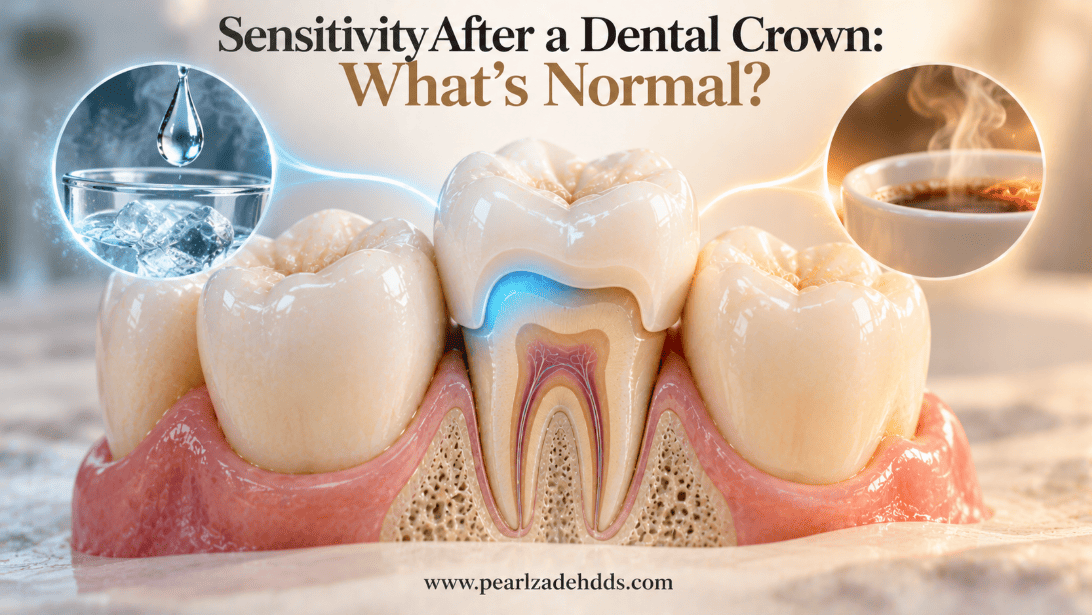
  • Can You Whiten Teeth With Veneers? What Patients Should Know

    Can You Whiten Teeth With Veneers? What Patients Should Know

    Whitening treatments work differently on natural teeth than they do on dental restorations. If you have veneers, your natural teeth can respond to whitening and become lighter, while your veneers generally stay close to their existing shade. This isn’t a flaw or a failure of either the veneer or the whitening product. It’s simply how two different materials respond to the same treatment.

    This matters most if you have veneers on only some of your teeth, rather than a full set covering your entire smile. A shade difference between your natural teeth and your veneers is a real possibility worth understanding before you start whitening, not something to discover afterward.

    Can You Whiten Teeth With Veneers?

    Yes, for your natural teeth, though the veneers themselves generally won’t change shade the same way. Natural tooth enamel responds to whitening agents chemically, while porcelain veneers and composite veneers are made from entirely different materials that don’t respond the same way.

    The American Dental Association is direct on this point: only natural teeth can be whitened, not tooth-colored restorations. Whitening products generally don’t change the intrinsic shade of a veneer the way they change natural tooth color. This isn’t an absolute rule for every possible product or circumstance, but it’s the general pattern worth planning around.

    Do Veneers Whiten Like Natural Teeth?

    Not in the same way. Whitening agents penetrate natural tooth structure and break down compounds that cause discoloration. This chemical process works because of the structure of enamel and the dentin underneath it.

    A veneer, whether porcelain or composite, uses a separate material bonded to the front of your tooth. It does not have the same internal structure for whitening agents to act on.

    The specific material used for your veneer genuinely matters here, since porcelain and composite behave differently from each other, not just differently from natural teeth. A veneer generally keeps close to its original shade regardless of what whitening does to the teeth around it. This is exactly why whitening a smile that includes both natural teeth and veneers takes more planning than whitening a smile made up entirely of natural teeth.

    What Happens If You Whiten Natural Teeth Around Veneers?

    Your natural teeth can become lighter through whitening while your veneers stay close to where they started. Depending on how visible your veneers are and how much your natural teeth actually lighten, this can create a noticeable shade difference, with your natural teeth ending up lighter than the surrounding veneers and the smile looking less uniform than before. Picture a patient with veneers on their two front teeth who whitens the rest of their smile substantially.

    Those front veneers, once perfectly matched, can end up looking noticeably darker simply because everything around them changed while they stayed the same. Greater contrast around the restoration is possible, especially the closer the veneer sits to teeth that whitened significantly. This doesn’t mean a mismatch will always happen. Some patients whiten mildly enough, or have veneers positioned further back in the smile, that any difference stays minimal or unnoticeable.

    Can You Whiten Porcelain Veneers?

    Traditional whitening methods do not lighten porcelain veneers. Porcelain has a fired, glazed surface that is essentially non-porous. This quality helps veneers resist staining and maintain their color over time. It also means whitening agents generally cannot penetrate or chemically affect the material, whether you use them professionally or at home.

    Professional cleaning and polishing can remove minor surface deposits and restore some shine to a porcelain veneer. However, that process differs from bleaching the material to a lighter shade. If a porcelain veneer looks noticeably darker than before, something other than the porcelain itself usually causes the change.

    Can You Whiten Composite Veneers?

    Composite veneers are made from a resin material that behaves differently from both natural teeth and porcelain. Composite is more porous than glazed porcelain, meaning it can gradually pick up surface staining from coffee, tea, wine, and similar sources over time. A peer-reviewed in vitro study on stained composite veneering material tested bleaching and re-polishing on a composite material stained with several pigmented substances, and found that bleaching can act on the surface of composite resin through the same kind of oxidative reaction it uses on natural tooth pigments, offering some restoration of the stained composite alongside polishing.

    This is a genuinely different situation than porcelain, where whitening agents essentially have nothing to work with. That said, this doesn’t mean every composite material or every whitening product produces a meaningful result, and the outcome depends heavily on the composite formulation and how it was originally finished. Cleaning and polishing remain the more predictable tools for restoring a composite veneer’s appearance.

    What If Your Veneers Look Yellow or Stained?

    A few different things can explain this, and the right response depends on which one is actually going on. Surface staining or deposits from food, drinks, or plaque buildup are one possibility, and this tends to build up gradually rather than appearing overnight. Changes in the natural teeth surrounding the veneer, either lightening from whitening or darkening from aging, can make a veneer look different by comparison even if the veneer itself hasn’t changed at all. Picture a veneer placed years ago that hasn’t changed color at all, sitting next to natural teeth that have gradually darkened with age.

    The veneer would look progressively brighter by comparison, even though nothing actually happened to the veneer itself. The original veneer shade may simply not be what you’re hoping for anymore, since your goals may have shifted since it was placed. Ordinary aging and wear on the restoration’s surface can dull its appearance over time too. Our discussion of common reasons whitening doesn’t work covers a similar kind of troubleshooting for natural teeth. Replacement isn’t the automatic answer here. Figuring out the actual cause comes first.

    Can Veneers Be Professionally Cleaned?

    Yes, and it’s worth distinguishing what cleaning actually accomplishes from what it doesn’t. Professional cleaning removes surface deposits and buildup, which can meaningfully improve how a veneer looks if surface staining is the issue, sometimes bringing back shine that looked dulled by months of accumulated residue. It doesn’t change the actual underlying color of the restoration material itself, no matter how thoroughly it’s polished.

    A dental evaluation helps determine whether what you’re seeing is genuine surface staining, a change in the restoration’s own appearance over time, or simply a growing difference between the veneer and the natural teeth around it. Professional cleaning won’t restore every discolored veneer to how it looked on day one, particularly if the cause isn’t surface staining at all.

    What If Your Veneers No Longer Match Your Natural Teeth?

    This is a common situation, and there’s no single universal fix. Depending on what’s actually driving the difference, a few approaches may apply: evaluating your natural teeth to understand what’s changed, a professional cleaning if surface buildup is contributing, whitening your natural teeth when that’s appropriate for your goals, an honest conversation about whether your existing veneer shade still works for you, or considering replacement of the restoration when that’s clinically or cosmetically appropriate.

    A patient whose natural teeth have simply darkened with age might do well with whitening alone. Someone whose veneers were placed many years ago under different lighting or shade-matching standards might genuinely be better served by replacement. What actually makes sense depends entirely on your specific restoration and the teeth around it, not a default next step that applies to everyone in this situation.

    Can Whitening Damage Veneers?

    This is worth separating into two questions. Whitening products generally do not damage veneer material. Porcelain and composite do not respond to bleaching agents like natural teeth do. They also do not undergo a chemical reaction that causes structural damage.

    The more relevant safety concerns involve your natural teeth and gums. These concerns apply to anyone who uses whitening products, whether they have veneers or not. You may also experience temporary sensitivity in your remaining natural teeth.

    Professional whitening still may not suit every patient or restoration without an evaluation. This matters especially when visible margins connect the veneer to your natural tooth. A darker-looking veneer does not necessarily mean the restoration has failed or needs urgent attention. One of the causes discussed above usually explains the color change rather than a structural problem with the veneer itself.

    Should You Whiten Before Replacing Old Veneers?

    If you’re planning to replace existing veneers, the shade you want your natural teeth to be is worth deciding before the new restoration’s shade gets finalized. Our discussion of whitening before veneers or crowns goes into that sequencing question in detail, along with how shade selection fits into a cosmetic veneer case more broadly.

    When Should You Talk to Your Dentist?

    A few situations are worth bringing up directly: your veneers look darker than you expected, your natural teeth no longer match your veneers the way they used to, staining has developed around a restoration, you’re hoping for a noticeably whiter smile, you’re considering replacing existing veneers, or you’re genuinely unsure whether you’re looking at staining or an actual change in the restoration.

    An evaluation before repeatedly trying whitening products on your own tends to save both time and frustration, especially since whitening won’t do anything for a veneer regardless of how many times you try it. Repeated at-home whitening attempts aimed at a veneer that simply won’t respond can also mean unnecessary exposure of your natural teeth to whitening agents they didn’t need.

    Get the Right Whitening Plan for Your Smile

    Whitening your natural teeth may be appropriate, but it will not change the shade of your existing veneers in the same way. A professional evaluation can help determine whether whitening, cleaning, or another approach makes sense for your smile.

    Dr. Pearl Zadeh can assess your natural teeth and existing veneers, explain your options, and help you avoid a noticeable shade mismatch.

    Call (818) 716-6722 or click the button below to schedule your consultation online.

    Frequently Asked Questions

    Can you whiten teeth with veneers?

    Your natural teeth can often be whitened, but the veneers themselves generally won’t change shade the same way.

    Can you whiten porcelain veneers?

    Not with traditional whitening methods. Porcelain’s non-porous surface doesn’t respond to bleaching agents the way natural teeth do.

    Can you whiten composite veneers?

    Composite responds differently than porcelain and may show some limited change with bleaching, though cleaning and polishing remain the more reliable options.

    Do veneers whiten?

    Generally, no, not the way natural teeth do. Both porcelain and composite behave differently from natural tooth enamel under whitening agents.

    Can you whiten natural teeth if you have veneers?

    Yes, your natural teeth can typically still be whitened, though the veneers themselves will stay close to their existing shade.

    What happens if you whiten your teeth with veneers?

    Your natural teeth may become lighter while your veneers stay the same, which can create a visible shade difference depending on your specific situation.

    This article is for informational purposes only and is not a substitute for professional dental advice. Please schedule a consultation with Pearl Zadeh DDS to discuss your specific situation.
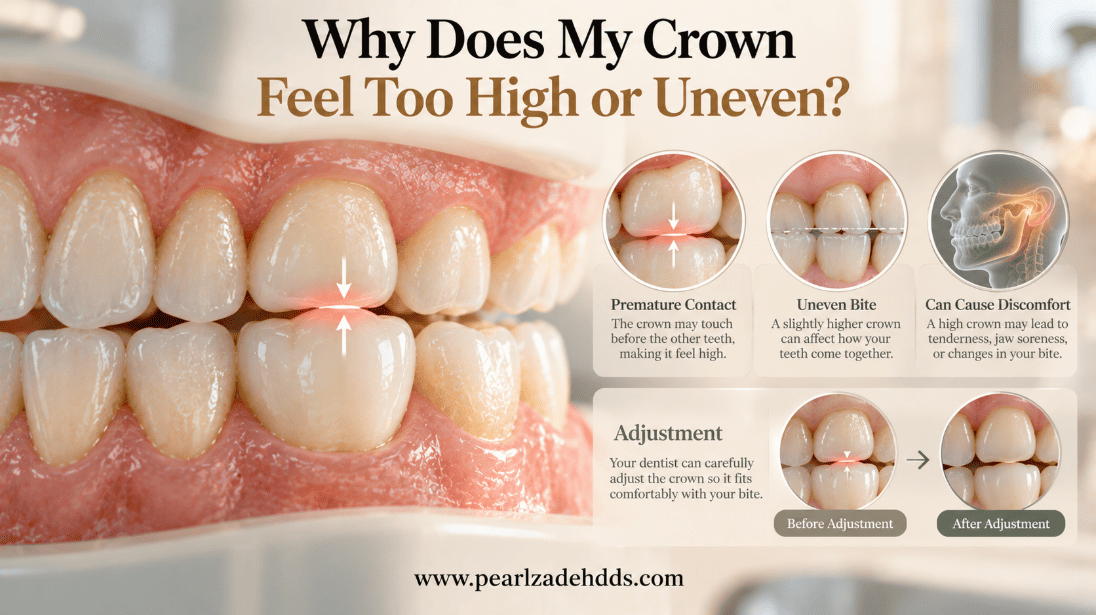
  • How to Whiten Teeth Stained by Coffee and Wine

    How to Whiten Teeth Stained by Coffee and Wine

    You notice it in photos before you notice it in the mirror. Your teeth look a little more yellow than they used to, maybe with a faint gray tint if wine is part of your regular routine. Coffee and wine are both genuinely known contributors to tooth staining, and if you’ve been drinking either regularly for years, some visible change is understandable rather than surprising.

    The real question is whether these particular stains can actually be whitened, and if so, what approach actually makes sense. That depends on more than just how many cups or glasses you’ve had over the years.

    Why Do Coffee and Wine Stain Your Teeth?

    Both beverages contain compounds called chromogens, deeply pigmented substances that bind to a thin protein layer on your teeth called the pellicle. Coffee’s staining potential comes largely from its tannins and related plant compounds, while red wine combines tannins with its own natural pigments in a way that tends to bind especially well.

    A peer-reviewed study on dental staining from beverages tested how a range of beverages stained actual tooth enamel, alongside a chlorhexidine rinse used in the study protocol. Black tea and red wine produced the highest staining among the beverages tested, with coffee also causing significant discoloration compared to water.

    Interestingly, white wine produced staining comparable to plain water, suggesting the deep pigment in red wine, not the alcohol or acidity alone, is doing most of the work. Since the study measured staining alongside a chlorhexidine rinse rather than in an ordinary mouth, the exact numbers may not translate directly to everyday coffee or wine drinking, though the relative pattern, red wine and dark tea staining more than lighter drinks, matches what dentists generally observe in practice.

    Staining tends to build up gradually with repeated exposure, especially alongside other staining habits or inconsistent brushing. Someone drinking coffee occasionally with a consistent brushing routine is unlikely to see the same buildup as someone drinking several cups daily with a less consistent routine. Not everyone who drinks coffee or wine develops noticeable staining. How visible it becomes varies from person to person.

    Can Whitening Remove Coffee and Wine Stains?

    Often, at least partially, particularly when the staining sits on the surface of your enamel rather than deeper within the tooth. Surface staining, sometimes called extrinsic staining, tends to respond reasonably well to whitening. Deeper, intrinsic discoloration behaves differently, and your natural tooth color or existing dental restorations can also contribute to what you’re actually seeing in the mirror.

    Results genuinely depend on the cause, severity, and depth of your specific discoloration, not simply how much coffee or wine you’ve consumed over the years. Our discussion of common reasons whitening doesn’t work goes further into why some staining responds better than others.

    Does Professional Teeth Whitening Work for Coffee and Wine Stains?

    It often can, particularly for surface staining that hasn’t been complicated by deeper discoloration or existing dental work. A dental evaluation helps determine whether your specific staining is the kind likely to respond well before you commit to treatment.

    Professional teeth whitening starts with that evaluation rather than guessing at what product might work. This isn’t a promise of a specific result. It’s a more informed starting point than trial and error.

    Can Whitening Toothpaste Remove Coffee and Wine Stains?

    It can help with milder surface staining through its cleaning action, gently lifting some of the pigment sitting on your enamel as you brush. This isn’t the same mechanism as professional bleaching, which chemically changes the color of the tooth rather than simply cleaning its surface. Brushing harder or more aggressively isn’t a better solution here. It mainly risks irritating your gums or wearing at your enamel without meaningfully improving the actual stain.

    Should You Get a Dental Cleaning Before Whitening?

    Cleaning and whitening actually serve different purposes. A professional cleaning removes plaque, calculus, and surface deposits that have built up over time, while whitening changes the actual color of your tooth structure. Someone with a layer of surface buildup might see disappointing whitening results simply because the whitening agent has to work through that buildup first, which is one reason these two steps often get discussed together even though they aren’t interchangeable.

    A dentist may recommend evaluating your overall oral health before starting cosmetic whitening, partly to make sure nothing else needs attention first. That said, not every patient needs a cleaning immediately before whitening. Whether it makes sense depends on when you were last seen and what your teeth actually look like.

    What If Coffee and Wine Stains Do Not Respond to Whitening?

    If whitening produced less change than you expected, a few explanations are worth considering. The discoloration may extend deeper than the surface. Your teeth may simply have a naturally darker underlying shade that whitening can’t fully overcome. Enamel characteristics, including thickness and translucency, can affect how your teeth appear regardless of staining. The stain you’re seeing may not actually be the primary source of the color at all, especially if you’ve had years of buildup alongside natural aging happening at the same time.

    Existing restorations, if any are visible, generally don’t respond to whitening the way natural teeth do. Simply reaching for a stronger whitening product isn’t the answer when one of these factors is actually behind your results. Our discussion of common reasons whitening doesn’t work goes further into each of these possibilities.

    How to Prevent Coffee and Wine From Staining Your Teeth

    A few realistic habits can meaningfully reduce staining without requiring you to give up either beverage entirely. Rinsing with plain water after drinking coffee or wine helps clear some of the pigment before it has a chance to settle into the pellicle layer on your teeth. Regular brushing and flossing matters more than any single habit, since consistent removal of surface buildup keeps new staining from accumulating as quickly, and it also keeps the surface of your enamel smoother, which gives new pigment less to grip onto.

    Avoiding prolonged sipping, letting a single cup or glass linger for hours rather than finishing it in one sitting, reduces how long your teeth actually stay in contact with staining compounds. A straw can help somewhat with cold coffee drinks, though it’s less practical for wine or hot coffee. Keeping up with regular dental appointments lets your dentist catch and address buildup before it becomes a visible concern. None of these habits completely prevents staining on their own, and how much any individual habit actually helps varies from person to person.

    Can You Drink Coffee After Teeth Whitening?

    It’s reasonable to be more cautious about staining beverages for a period after whitening, since your teeth can be more receptive to picking up new pigment right afterward. There’s no single universally agreed waiting period here, so any specific number of hours you see online is worth taking with some skepticism unless it comes directly from your treatment instructions.

    Our discussion of how long teeth whitening lasts goes further into what affects that timeline. Recommendations can genuinely vary depending on the whitening method used and your specific situation, so it’s worth asking directly rather than assuming a number you found online applies to you.

    Can You Drink Wine After Teeth Whitening?

    The same general caution applies. Wine, particularly red wine, can contribute to new staining, and continued exposure shortly after whitening may affect how well your results hold up, especially since your teeth may be temporarily more receptive to picking up pigment right after treatment.

    There’s no arbitrary safe number of hours or days that applies universally here either, despite what various product packaging or websites might claim with more confidence than the evidence actually supports. The practical takeaway is being mindful rather than avoiding wine entirely, and checking with your dentist about your own treatment’s specific guidance rather than following a generic rule you found online.

    What About Coffee, Wine, Crowns, Veneers, and Fillings?

    Natural teeth and dental restorations respond to whitening differently. Whitening doesn’t simply lighten every material in your mouth the way it lightens natural enamel. Crowns, veneers, and fillings generally stay at their original shade regardless of what whitening does to the teeth around them. If your natural teeth become noticeably lighter after whitening, an existing restoration can end up looking mismatched by comparison, even if it was well matched originally.

    Our discussion of whitening before veneers or crowns covers that timing question in more depth. This doesn’t mean a restoration automatically needs replacing after whitening. It simply explains a mismatch whitening itself won’t fix on its own.

    What If You Have Sensitive Teeth?

    Whitening can cause temporary sensitivity for some people, regardless of whether coffee or wine is part of your routine. If you already deal with sensitivity, discussing your specific approach with a dentist beforehand often leads to a more comfortable experience.

    Our discussion of teeth whitening for sensitive teeth and our look at whether whitening can damage enamel both go further into what’s actually happening. Sensitivity on its own doesn’t mean your enamel has been damaged.

    How Long Will Whitening Results Last If You Drink Coffee or Wine?

    Results aren’t permanent, and continued exposure to staining beverages can affect how long your results actually hold up. There’s no specific duration that applies to every patient here. How long results last depends on your individual habits, oral care routine, overall diet, and the specific whitening method you used. Our discussion of how long teeth whitening lasts covers what actually affects that timeline in more depth.

    When Should You See a Dentist About Tooth Discoloration?

    Discoloration that’s persistent, unusual, uneven, or simply doesn’t match what you’d expect from ordinary coffee or wine staining deserves an actual evaluation. Not every change in tooth color comes from something you drink. Changes in gum health can sometimes play a role too.

    Our discussion of early signs of gum disease covers what else is worth watching for. None of this can be determined from color alone. A dentist can assess the likely cause of your specific discoloration before recommending any cosmetic treatment.

    Get a Clearer Plan for Coffee and Wine Stains

    Coffee and wine can leave stubborn stains, but whitening is not the right approach for every type of discoloration. A dental evaluation can help identify what is affecting your tooth color and whether professional whitening is likely to help.

    Dr. Pearl Zadeh can assess your smile, discuss your whitening goals, and recommend an approach based on your teeth and existing dental work.

    Call (818) 716-6722 or click the button below to schedule your consultation online.

    Frequently Asked Questions

    Can coffee stains be removed from teeth?

    Often, at least partially, particularly when the staining is on the surface rather than deeper within the tooth structure.

    Can red wine stains be removed from teeth?

    Surface staining from red wine can often be reduced with whitening, though results depend on how deep the discoloration actually is.

    What is the best way to whiten teeth stained by coffee?

    There isn’t one universal best option. The right approach depends on the severity of the staining, your sensitivity, and your overall oral health.

    Does whitening toothpaste remove coffee stains?

    It can help with milder surface staining through its cleaning action, though it doesn’t work the same way as professional bleaching.

    Can professional teeth whitening remove wine stains?

    Often, yes, for surface staining, though a dental evaluation helps determine whether your specific discoloration is likely to respond well.

    This article is for informational purposes only and is not a substitute for professional dental advice. Please schedule a consultation with Pearl Zadeh DDS to discuss your specific situation.
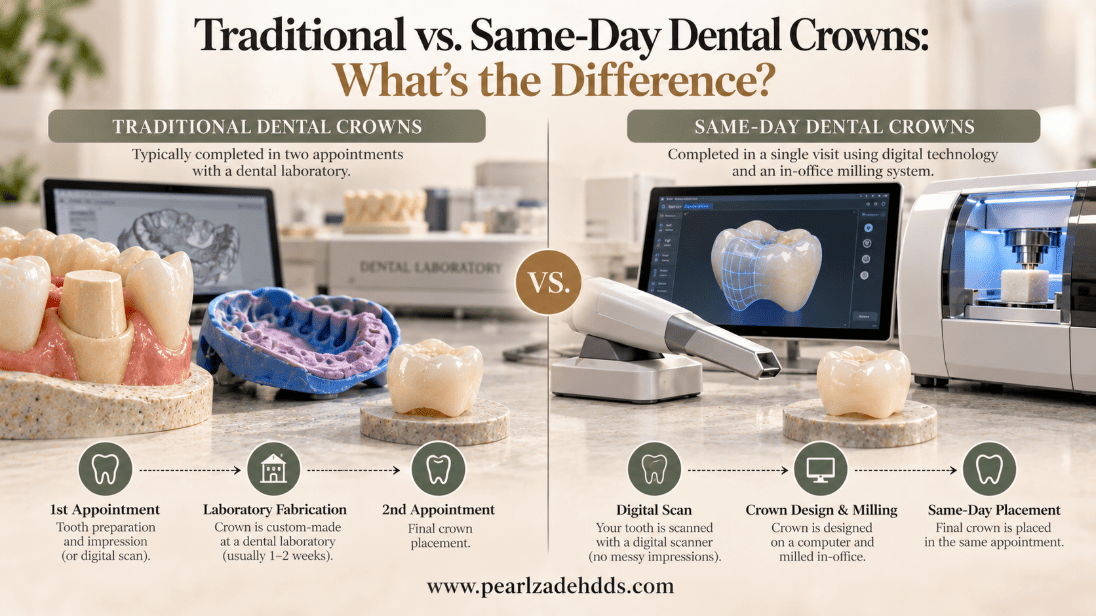
  • Teeth Whitening for Smokers: What Actually Works

    Teeth Whitening for Smokers: What Actually Works

    You catch a glimpse of your teeth in a photo and notice the yellow or brown tint that’s crept in over the years. You want a cleaner-looking smile, and whitening seems like the obvious place to start. Maybe you’ve already tried a drugstore kit or a box of strips, and the results felt underwhelming compared to what the packaging promised.

    Tobacco-related discoloration often comes from staining sitting on the tooth surface, but the color you’re seeing can have other contributing factors too. Before picking a product off a shelf, it helps to understand what whitening can actually change for your specific teeth.

    How Does Smoking Stain Your Teeth?

    Tobacco smoke contains substances that settle onto tooth surfaces with repeated exposure. Nicotine itself is colorless, but it turns yellow to brown when it reacts with oxygen, and tar deposits a dark, sticky residue that clings readily to enamel. A 2023 systematic review and meta-analysis on tobacco and nicotine staining discusses research showing that cigarette smoke exposure can cause surface pits and other irregularities in enamel, which may make the tooth surface more susceptible to picking up staining compounds over time.

    This helps explain why stains tend to become more noticeable the longer smoking continues, and why they can build up in places that are harder to reach with regular brushing, like along the gumline and between teeth. Someone who smokes occasionally for a few years will generally see less staining than someone who has smoked daily for decades, since the exposure simply adds up over time rather than happening all at once. Smoking isn’t the only thing that causes yellow or brown teeth, though. Coffee, tea, certain foods, and simple aging all contribute to similar-looking discoloration in people who’ve never smoked at all.

    Can Teeth Whitening Remove Smoking Stains?

    Often, yes, at least partially. Whitening tends to help most with surface staining, the kind sitting on top of your enamel rather than developed within the tooth structure itself. How much actual improvement you see depends on the type and depth of your discoloration, not just how long you’ve smoked. Two people with a similar smoking history can end up with genuinely different whitening results, since one might have mostly surface staining while the other has discoloration that’s partly settled deeper into the tooth. Our discussion of common reasons whitening doesn’t work goes further into why some stains respond differently than others.

    What Whitening Options Can Help With Smoking Stains?

    A few different approaches exist, and none of them is automatically the right choice for every patient. What actually fits depends on your specific staining, your budget, and how much oversight you’d prefer during treatment.

    Professional Teeth Whitening

    A dentist can evaluate your specific discoloration and let you know whether it’s the kind of staining likely to respond well to whitening, before you commit time and money to treatment. Professional teeth whitening gives you that evaluation up front, along with a treatment plan tailored to what your teeth actually need. This isn’t a promise of a specific outcome. It’s an evaluation-first approach rather than trial and error with whatever product is on the shelf.

    Whitening Strips and At-Home Products

    Over-the-counter strips and kits use lower-concentration whitening agents than what a dentist can use, generally applied over a longer stretch of time rather than in a single session. Results genuinely vary depending on your specific staining and how consistently you use the product. These can be a reasonable starting point for milder, more surface-level discoloration, though they aren’t guaranteed to work the same way for everyone.

    Whitening Toothpaste

    Whitening toothpaste primarily works through its cleaning action, helping remove surface stains as you brush rather than chemically bleaching the tooth. It isn’t designed to produce the same effect as professional bleaching treatments, and it generally works best as a maintenance habit rather than a standalone solution for more established staining.

    Why Can Smoking Stains Be Difficult to Whiten?

    A few things can make tobacco-related discoloration more resistant to whitening than expected. The staining may simply be heavy or long-standing, having built up over years rather than months, which generally takes more time and consistency to lighten than staining that developed more recently. Some of the discoloration may not sit entirely on the surface, meaning whitening reaches part of the problem but not all of it, particularly once tar and nicotine have had years to work into small surface irregularities in the enamel.

    Your natural tooth color plays a role too, since teeth vary in shade regardless of staining, and whitening can only lighten what’s actually stained rather than change your underlying tooth color entirely. Enamel changes that happen with age can alter how light reflects off your teeth in ways whitening doesn’t directly address, since thinner enamel lets more of the naturally yellower dentin underneath show through.

    Existing restorations don’t respond to whitening the way natural teeth do, so a crown or filling placed years ago will stay exactly where it started regardless of how well your natural teeth respond. And sometimes the whitening approach being used simply doesn’t match what’s actually causing the discoloration, the same way a product built for coffee stains won’t necessarily work as well on years of accumulated tar. Reaching for a stronger product isn’t automatically the fix when one of these factors is actually at play.

    What If Whitening Barely Changes Your Teeth?

    If you’ve already tried whitening with little visible improvement, that doesn’t necessarily mean the product was defective or that you did something wrong. Limited results are often a sign that the color you’re seeing isn’t the type whitening addresses well. Someone who’s used whitening strips faithfully for weeks with barely noticeable change may actually be dealing with discoloration that goes deeper than what surface-focused products can reach. Identifying the actual source of your discoloration matters more than trying yet another product.

    A dentist can assess whether your color comes from surface staining, deeper intrinsic discoloration, your natural tooth shade, or existing dental restorations. Our overview of cosmetic treatment options for stained teeth goes further into what else might apply depending on what’s actually going on. No single alternative is automatically the better choice. What fits depends on the cause and your own goals.

    Does Smoking Make Teeth Whitening Results Fade Faster?

    Continued exposure to tobacco smoke can contribute to new staining building up after whitening, since the same substances that caused the original discoloration are still reaching your teeth. There’s no guaranteed duration for how long whitening results actually last. How quickly maintenance becomes necessary depends on your individual habits, oral hygiene routine, diet, and the specific whitening treatment you used. Our discussion of how long teeth whitening lasts goes further into what actually affects that timeline.

    Can You Whiten Crowns, Veneers, or Fillings That Have Smoking Stains?

    Natural tooth structure and restorative materials respond to whitening differently. Whitening doesn’t simply change the shade of every material in your mouth the way it changes natural enamel. Crowns, veneers, and fillings generally stay at whatever shade they were originally made in, regardless of what whitening does to your natural teeth. Picture a front tooth crown placed years ago, discolored on its surface from years of smoking.

    Cleaning can remove some of that surface buildup, but the crown itself won’t lighten the way a natural tooth would under a whitening agent. If your surrounding natural teeth become noticeably lighter, an existing restoration can end up looking mismatched by comparison. Our discussion of whitening before veneers or crowns covers that timing question in more depth. This doesn’t mean a restoration always needs replacing after whitening. It simply explains a mismatch that whitening itself won’t resolve on its own.

    What About Sensitive Teeth?

    Whitening can cause temporary sensitivity for some people, regardless of smoking history. Nicotine and tar don’t make teeth inherently more or less sensitive to whitening on their own. If you already deal with sensitivity, a more individualized approach to concentration, timing, or product choice often makes sense. Our discussion of teeth whitening for sensitive teeth and our look at whether whitening can damage enamel both go further into what’s actually happening when sensitivity shows up. Experiencing sensitivity doesn’t automatically mean your enamel has been damaged.

    Can You Keep Teeth White If You Continue Smoking?

    Realistically, continued smoking can contribute to new staining building up over time, which can make it harder to maintain a lighter appearance for as long as you might like. This doesn’t mean whitening is pointless if you continue to smoke. It means maintenance and touch-ups become a more regular part of the picture, and consistent oral hygiene along with periodic professional cleanings genuinely help slow new staining down.

    Rinsing with water after smoking, keeping up with regular brushing, and not letting stretches go by without a dental cleaning all make a real difference in how quickly new discoloration reappears. If quitting smoking is something you’re considering for your own reasons, it can also reduce how quickly new discoloration develops, though that’s ultimately a personal decision separate from whether whitening is worth pursuing now.

    When Should You See a Dentist About Tooth Discoloration?

    Discoloration that’s persistent, unusual, uneven between teeth, or simply doesn’t match what you’d expect from typical staining deserves an actual evaluation. Color changes can sometimes come from causes entirely unrelated to smoking, including changes in gum health.

    Our discussion of early signs of gum disease covers what else is worth watching for. None of this can be determined from color alone. A dental examination can identify what’s actually causing your specific discoloration and whether whitening is an appropriate next step before any treatment begins.

    Speak With Dr. Pearl Zadeh About Tobacco-Related Staining

    Tobacco-related discoloration doesn’t respond the same way in every patient, and whitening isn’t a one-size-fits-all solution. Dr. Pearl Zadeh can evaluate the actual source of your discoloration, whether it’s surface staining, natural tooth color, existing restorations, or something else entirely, and discuss whether professional whitening fits your goals.

    Call (818) 716-6722 or click the button below to schedule your consultation online.

    Frequently Asked Questions

    Can teeth whitening remove smoking stains?

    Often, at least partially, particularly for surface staining. How much improvement you see depends on the type and depth of your specific discoloration.

    What is the best teeth whitening for smokers?

    There isn’t one universally best option. The right approach depends on the type of discoloration, any sensitivity, your overall oral health, and your specific goals.

    Can smokers get professional teeth whitening?

    Yes, smoking itself doesn’t rule out professional whitening. A dental evaluation can determine whether your specific discoloration is likely to respond well.

    Do whitening strips remove cigarette stains?

    They can help with milder, surface-level staining, though results vary and strips generally use lower concentrations than professional treatment.

    Why are my teeth still yellow after whitening?

    Your natural tooth color, enamel changes, or discoloration that extends beneath the surface can all limit how much visible change whitening produces.

    Will smoking make my teeth turn yellow again after whitening?

    Continued exposure to tobacco can contribute to new staining over time, so ongoing maintenance is often part of keeping results looking their best.

    This article is for informational purposes only and is not a substitute for professional dental advice. Please schedule a consultation with Pearl Zadeh DDS to discuss your specific situation.
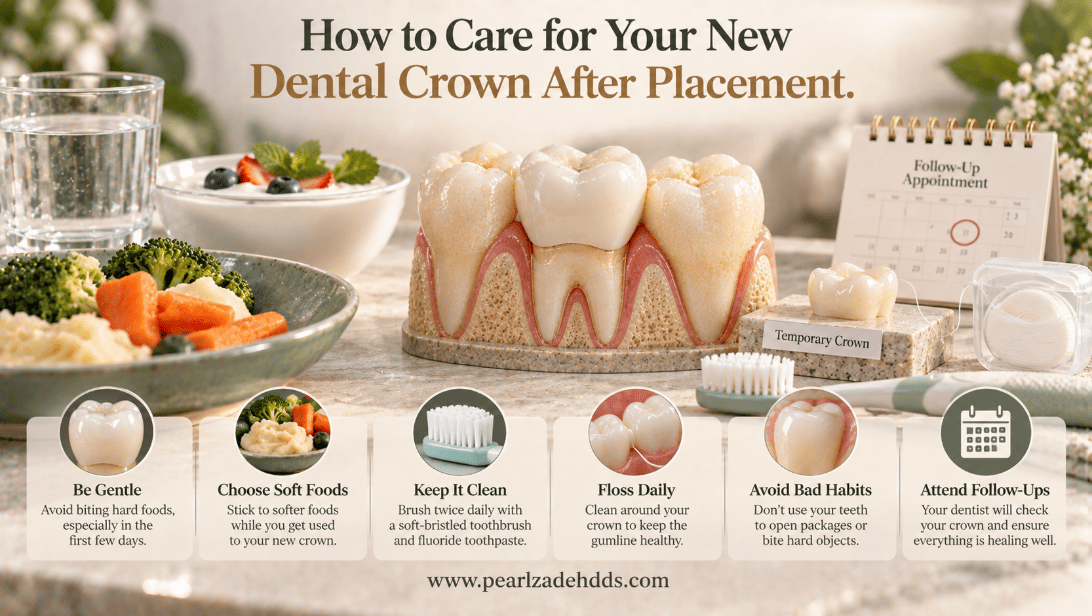
  • Why Won’t My Teeth Whiten? Common Reasons Whitening Doesn’t Work

    Why Won’t My Teeth Whiten? Common Reasons Whitening Doesn’t Work

    You followed the instructions, waited the recommended time, and checked the mirror expecting a real change. Instead, your teeth look almost exactly like they did before you started. That’s genuinely frustrating, and it’s worth understanding why before assuming the product failed or you did something wrong. Maybe you tried strips for weeks, or sat through a professional treatment, and the difference feels barely noticeable either way.

    Whitening doesn’t produce the same result for everyone. Some discoloration responds well to bleaching. Other color changes have entirely different causes that whitening was never really built to address. A handful of specific reasons tend to explain most cases where results fall short.

    What Can Prevent Teeth From Whitening?

    Whitening works best on certain types of tooth discoloration, and the actual cause of your color matters more than which product you picked. Surface stains from things like coffee or tobacco tend to respond well. Deeper discoloration that developed within the tooth structure itself behaves differently.

    Sometimes what looks like a stain is simply your natural tooth color, or the result of existing dental work that doesn’t respond to whitening at all. None of these possibilities can be sorted out just by staring in the mirror, which is exactly why the reasons below are worth going through one at a time.

    1. The Stains May Not Respond Well to Whitening

    Dentists generally separate stains into two categories. Extrinsic stains sit on the surface of your teeth, usually from coffee, tea, tobacco, red wine, or other strongly pigmented foods and drinks. These tend to respond reasonably well to whitening and even professional cleaning. Intrinsic discoloration develops within the tooth structure itself, below the surface, and behaves quite differently under a whitening agent.

    The source and depth of your discoloration genuinely determines how much bleaching can actually change your tooth’s appearance. A whitening product that works beautifully on surface coffee stains may barely touch discoloration sitting deeper in the tooth.

    2. Your Teeth May Be Naturally More Yellow or Darker

    Tooth color varies naturally from person to person, and this has nothing to do with staining at all. Dentin, the layer underneath your enamel, is naturally yellow, and it contributes significantly to your overall tooth color. Thinner or more translucent enamel lets more of that dentin show through, which can make teeth look more yellow even when nothing is actually stained.

    Two people can have identical oral hygiene and identical diets, yet still end up with noticeably different baseline tooth shades simply because of how their enamel and dentin are naturally structured. None of this means naturally yellowish teeth are unhealthy. It simply means whitening has real limits when your underlying natural tooth color is doing most of the work, rather than an actual stain sitting on top of it.

    3. Enamel Changes Can Affect How Your Teeth Look

    Enamel naturally thins somewhat with age, and thinner enamel tends to become more translucent. The American Dental Association notes that as enamel becomes thinner and more translucent with age, more of the yellower dentin underneath shows through, which can darken overall tooth color. This isn’t the same thing as a stain, and it doesn’t mean every translucent or darker-looking tooth automatically needs whitening. It does mean that when this structural change is the real reason behind your tooth color, whitening isn’t addressing the actual underlying cause, and results may end up more limited than you expected.

    4. Certain Types of Intrinsic Discoloration Are Harder to Whiten

    Some discoloration develops within the tooth rather than sitting on its surface, and the specific cause genuinely affects how it responds to bleaching. The ADA lists several recognized causes of intrinsic discoloration, including dental fluorosis from excess fluoride exposure during childhood tooth development, certain antibiotics like tetracycline taken during those same developing years, tooth trauma, genetic conditions affecting enamel or dentin formation, and even prolonged use of certain antiseptic mouth rinses. This doesn’t mean intrinsic discoloration is untreatable, and it isn’t accurate to say whitening simply cannot work on it.

    The same ADA resource notes that brown staining from fluorosis or tetracycline tends to respond better to bleaching than white spot staining, which may simply become less noticeable as the rest of the tooth lightens around it. Tetracycline-related discoloration specifically can require several months of consistent nightly treatment to see meaningful change, considerably longer than what most patients expect from typical whitening. None of this can be diagnosed from a mirror. Some intrinsic discoloration responds incompletely to bleaching no matter how patiently you stick with it, and a different cosmetic approach may genuinely make more sense.

    5. Your Teeth May Have Dental Restorations

    This is a limitation many patients simply don’t expect. Natural tooth structure and dental restorations do not respond to bleaching the same way. Crowns, veneers, and tooth-colored fillings generally stay at whatever shade they were made in, regardless of what whitening does to the teeth around them. If some of your visible teeth are actually restorations, you may notice uneven color after whitening, with your natural teeth looking brighter while the restored ones stay exactly where they started. Our discussion of whitening before veneers or crowns goes further into that timing question. This doesn’t mean a restoration automatically needs replacing after whitening. It simply explains a mismatch that whitening itself won’t resolve.

    6. The Whitening Product May Not Match Your Type of Discoloration

    Whitening products genuinely differ in strength, formulation, application method, and what they’re designed to address. Whitening toothpaste primarily helps remove surface stains through mild abrasion and does not work like a true bleaching treatment. At-home strips and kits use peroxide-based agents at lower concentrations than those used by dentists in the office. Professional treatment typically offers stronger formulations along with an evaluation beforehand.

    Picture someone using whitening toothpaste every day for months to address discoloration that actually developed from a childhood medication. No amount of extra brushing with that toothpaste is going to touch that kind of stain, since it was never designed to. If you’ve been using a product designed mainly for surface stains on discoloration that’s actually intrinsic, the mismatch between product and problem, not a defective product, may explain your limited results.

    7. You May Not Have Given the Treatment Enough Time

    How quickly whitening results become noticeable varies considerably from person to person, and there’s no single number of days that applies to everyone. Some people see a visible change fairly quickly. Others need more time, or genuinely need a different treatment approach entirely rather than simply repeating the same one longer.

    Our discussion of how long professional teeth whitening actually takes goes further into what affects that timeline. If results seem slow, that’s a reason to talk to a dentist about what’s actually going on, not a reason to whiten more often or more aggressively on your own.

    8. An Underlying Dental Problem May Need Attention First

    Sometimes what looks like a whitening failure is actually a sign that something else needs attention. Tooth decay, gum disease, cracks, significant sensitivity, or other unexplained changes in tooth color can all affect how your teeth respond, or simply mean whitening isn’t the right priority yet. Our discussion of early signs of gum disease covers what’s worth watching for. None of this can be diagnosed from symptoms alone, but treating an underlying dental issue often needs to happen before cosmetic whitening makes sense.

    Can You Whiten Teeth That Did Not Respond the First Time?

    It depends entirely on why the first attempt produced limited results. A dentist considers what actually caused your discoloration, what type of whitening you already tried, whether you have existing restorations, your sensitivity level, your overall oral health, and what you’re actually hoping to achieve. Someone whose first attempt used a low-concentration strip on genuinely intrinsic staining might reasonably try a stronger, professionally supervised approach next.

    Someone whose discoloration comes mainly from natural tooth color or existing restorations may need an entirely different conversation instead. Simply reaching for a stronger product isn’t automatically the answer, and in some cases it isn’t the right answer at all. Understanding why the first round didn’t work is what actually determines whether trying again makes sense, and what that second attempt should look like.

    What If Whitening Still Doesn’t Give You the Result You Want?

    Whitening isn’t the only cosmetic option available, and depending on the cause and condition of your teeth, a dentist may discuss other approaches entirely. Our overview of cosmetic treatment options for stained teeth goes further into what else might apply depending on your specific situation. Veneers are sometimes part of that conversation, though they aren’t a universal solution either. What actually fits depends on your teeth, not a default upgrade path whenever whitening falls short.

    How a Dentist Can Determine Why Your Teeth Aren’t Whitening

    An evaluation typically starts with reviewing what you’ve already tried and how your teeth responded. Your dentist examines your actual tooth color and surfaces, checks for any restorations that might explain uneven results, assesses your enamel and overall tooth structure, and looks for oral health issues that might be part of the picture.

    That conversation also covers your actual cosmetic goals, since what counts as a good outcome varies from patient to patient. Identifying the real cause is what determines whether whitening still makes sense and what result is realistically achievable. Not every patient needs extensive testing to get there. Sometimes a straightforward exam and conversation is enough to explain what’s actually going on.

    How to Avoid Over-Whitening Your Teeth

    Repeatedly applying whitening products in pursuit of a stronger result isn’t necessarily the answer, and it can genuinely work against you. Overuse can contribute to tooth sensitivity, gum irritation, and simply chasing a shade that isn’t realistic for your specific teeth. Our discussion of teeth whitening for sensitive teeth and our look at whether whitening can damage enamel both go further into what excessive whitening can actually mean for your teeth. Following product directions and dental guidance protects your teeth far better than simply doing more of what already isn’t working.

    Speak With Dr. Pearl Zadeh About Whitening That Isn’t Working

    Whitening doesn’t work the same way for every type of discoloration. Dr. Pearl Zadeh, a dentist providing professional teeth whitening and cosmetic dentistry in Woodland Hills, can evaluate your teeth and help identify why results have been limited, and whether whitening or another cosmetic approach actually makes sense for you.

    Call (818) 716-6722 or click the button below to schedule your consultation online.

    Frequently Asked Questions

    Why won’t my teeth whiten even after using whitening products?

    Your discoloration may be intrinsic rather than surface-level, your natural tooth color may be contributing, or the product you used may not match the type of discoloration you actually have.

    Why are my teeth still yellow after whitening?

    Yellow tone often comes from dentin showing through thinner enamel, which is a natural characteristic rather than a stain that whitening can fully remove.

    Can some teeth not be whitened?

    Certain types of intrinsic discoloration, and existing restorations, respond incompletely or not at all to whitening, though the specific cause needs an evaluation to confirm.

    Why don’t my crowns or veneers whiten?

    Restorations don’t respond to bleaching the way natural tooth structure does, so they generally stay at their original shade regardless of whitening.

    Can intrinsic stains be whitened?

    Sometimes, depending on the cause. Certain intrinsic stains respond better than others, and some require significantly more time or a different approach entirely.

    This article is for informational purposes only and is not a substitute for professional dental advice. Please schedule a consultation with Pearl Zadeh DDS to discuss your specific situation.
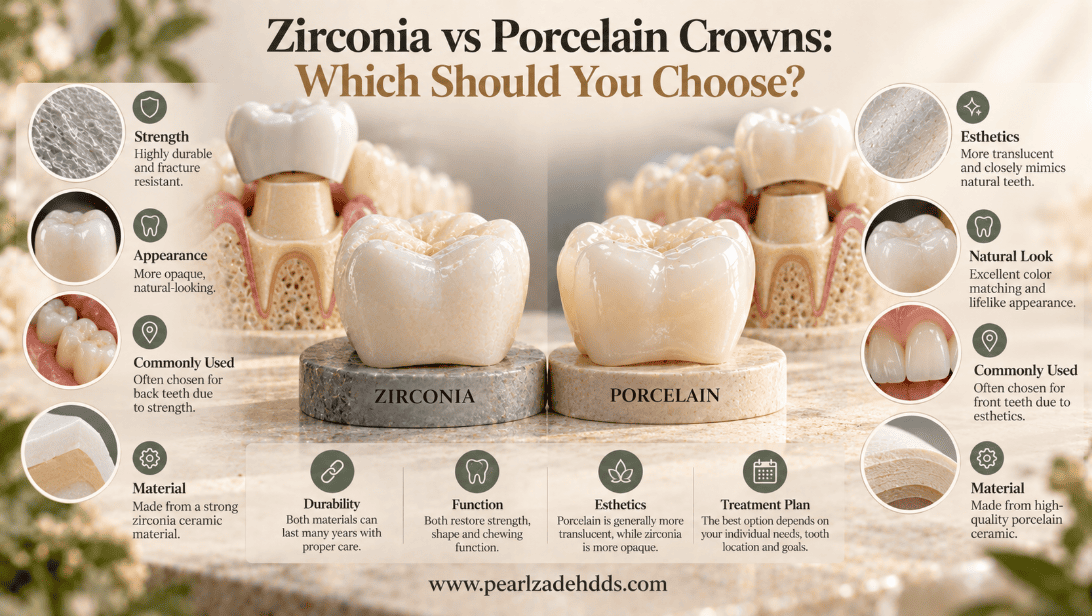
  • Does Teeth Whitening Actually Damage Your Enamel?

    Does Teeth Whitening Actually Damage Your Enamel?

    Before whitening their teeth, many people ask the same question: Can whitening actually weaken or damage their teeth? It’s a reasonable concern before applying a bleaching agent. Conflicting claims online can also make the answer confusing. One source may call whitening harmless, while another claims it strips away enamel.

    The honest answer isn’t a simple yes or no. Whitening can cause temporary sensitivity. Your teeth may also respond differently based on the product and concentration. How you use the product also matters. Following evidence-based instructions and considering your existing dental health matter more than choosing one specific whitening method.

    Does Teeth Whitening Damage Enamel?

    Not in the way most people picture it. Whitening agents work by breaking down and altering the stain molecules within your tooth structure, not by physically scraping or dissolving away enamel. A 2026 systematic review and meta-analysis on enamel damage from tooth whitening found that peroxide-based bleaching produced statistically detectable but small reductions in enamel microhardness, without clear evidence that these changes are clinically meaningful.

    The review concluded that peroxide bleaching is unlikely to cause clinically meaningful enamel damage when used as recommended. However, that does not mean every whitening product is harmless in every situation. The concentration, contact time, frequency of use, and specific formulation can all affect the outcome.

    How Does Teeth Whitening Affect Your Enamel?

    Enamel forms the hard, mineral-rich outer layer of your tooth. Dentin sits underneath it and feels more sensitive to temperature and pressure. Microscopic channels connect dentin to the nerve inside your tooth.

    Whitening agents pass through the enamel and reach stain compounds that have built up over time. They break these compounds apart through a chemical process. This changes how light reflects off your teeth.

    During treatment, whitening can temporarily increase tooth permeability. This helps explain why some people experience sensitivity during or shortly after whitening. More stimuli can reach the channels that lead toward the nerve.

    Whitening can also cause minor changes in the tooth surface during treatment. Researchers have observed changes in microhardness and surface texture in laboratory studies. These changes generally do not indicate permanent structural damage to the enamel. The effects can vary based on the whitening agent, concentration, and treatment conditions.

    Can Teeth Whitening Cause Permanent Enamel Damage?

    Research on this genuinely depends on how closely the study conditions resemble what actually happens in your mouth. A peer-reviewed safety review on tooth whitening points out that studies replicating real intraoral conditions, meaning they included human saliva and normal fluoride exposure, generally found no clinically significant adverse effects on enamel. The same review is candid that this makes laboratory measurements on isolated, extracted teeth difficult to interpret as directly equivalent to what happens during actual clinical use.

    A separate narrative review of whitening agents and safety notes that higher-concentration formulations carry more documented concern for enamel surface alteration and microhardness reduction than lower-concentration ones. Excessive exposure time, using products incorrectly, or whitening far more often than recommended can genuinely raise the level of concern here. Normal, appropriately used whitening isn’t shown to inevitably cause permanent enamel damage, and it also isn’t accurate to say enamel is completely unaffected under every possible whitening condition. The honest answer sits between those two extremes.

    Why Does Whitening Sometimes Make Teeth Sensitive?

    Sensitivity is one of the more common temporary effects associated with whitening, often showing up as increased reaction to cold, heat, air, or sweet foods and drinks. This happens because whitening agents can temporarily affect how your tooth responds to these everyday triggers, not because your enamel has necessarily suffered permanent damage.

    People who already deal with sensitivity for unrelated reasons often notice whitening-related sensitivity more strongly, simply because their teeth were already more reactive to begin with. Our discussion of teeth whitening for sensitive teeth goes further into the mechanism and what actually helps.

    Does Professional Teeth Whitening Damage Enamel?

    Professional whitening isn’t automatically safer in every single circumstance, but dentist supervision offers real advantages worth naming. An evaluation before treatment can catch existing dental problems, a cavity, exposed dentin, or gum recession, that might affect how you respond to whitening before treatment ever starts.

    Product selection, treatment concentration, and exposure time can all be adjusted based on your specific teeth rather than a generic instruction sheet meant for a general population, and sensitivity can be actively managed as part of the process rather than discovered partway through with no plan for addressing it. Professional teeth whitening gives your dentist more control over the variables that actually affect enamel-related risk, which is a meaningfully different thing than a guarantee that supervised treatment carries zero risk.

    What About Whitening Strips and At-Home Products?

    At-home whitening products genuinely vary from one another, sometimes considerably. Results and side effects depend on the specific whitening agent used, its concentration, how long it stays in contact with your teeth, how often you use it, and whether you actually follow the manufacturer’s instructions. A product left on for twice the recommended time, or used daily instead of the intended schedule, isn’t behaving the way it was designed to, and that gap between intended use and actual use is where most problems tend to originate.

    It wouldn’t be accurate to label every whitening strip as dangerous, and it also wouldn’t be accurate to assume every over-the-counter product affects enamel identically. Sticking to the recommended usage, and not extending contact time or frequency beyond what the product actually calls for, matters more than which specific brand you choose.

    Can Whitening Toothpaste Damage Enamel?

    Whitening toothpaste works differently than peroxide-based treatments. Most whitening toothpastes primarily remove surface stains through mild abrasion rather than changing the color deep within your tooth structure, which is a fundamentally different mechanism than chemically breaking down stain molecules.

    Abrasivity genuinely matters here, particularly for people who already have some enamel wear or exposed dentin, since a more abrasive formulation can add unnecessary wear on top of an already thinner surface. This doesn’t mean every whitening toothpaste damages enamel. Formulations vary considerably in how abrasive they actually are, and anyone with significant sensitivity or existing enamel concerns is better off discussing the right product with a dental professional than guessing from a store shelf.

    Does Whitening Too Often Harm Your Teeth?

    Repeated or prolonged whitening genuinely can increase the likelihood of unwanted effects. This includes whitening more frequently than recommended, leaving treatment on longer than instructed, combining multiple whitening products at once, continuing treatment after you’ve already reached the shade you wanted, and pushing through persistent sensitivity instead of stopping. Each of these amounts to giving your teeth more exposure than the studied protocols actually accounted for, which is exactly the scenario where the research base gets thinner and the honest answer becomes more uncertain.

    There’s no universal maximum number of whitening sessions that applies to every patient across the board. Following whatever treatment plan or product instructions you were actually given matters far more than hitting some specific number.

    What Makes Whitening More Likely to Cause Problems?

    A handful of factors can genuinely raise the likelihood of discomfort or complications:

    • Existing tooth sensitivity
    • Enamel erosion or significant wear
    • Gum recession
    • Exposed dentin
    • Cavities
    • Cracked or damaged teeth
    • Excessive product use
    • Incorrect application
    • High-concentration products
    • Prolonged exposure time

    Several of these share a common thread. When enamel is already thinner or dentin is already exposed for some other reason, whitening agents have an easier path to reach the nerve, which can make sensitivity more pronounced than it would be for someone with fully intact enamel. None of these factors automatically means whitening is impossible for you. They generally mean your teeth are worth having evaluated before you start, rather than assuming your situation is identical to everyone else’s.

    Can You Whiten Teeth If Your Enamel Is Already Worn?

    This deserves real care rather than a simple yes or no. Worn enamel can change how sensitivity actually feels during whitening, sometimes making it more noticeable than it would be otherwise, since thinner enamel gives whitening agents a shorter distance to travel before reaching more sensitive structures underneath. The cause and severity of that wear genuinely matter here. Wear from years of normal use is a different situation than active, ongoing erosion or a cracked tooth that hasn’t been addressed.

    If you’re dealing with significant enamel loss, unexplained sensitivity, cavities, cracks, or other dental problems, whitening probably isn’t the first thing to address. None of this can be diagnosed from symptoms alone, which is exactly why an actual dental evaluation is the right next step rather than guessing at what’s going on.

    Does Teeth Whitening Damage Existing Dental Work?

    Whitening affects natural teeth differently than it affects restorations like veneers, crowns, or fillings, which generally don’t change shade the same way natural enamel does. Our discussion of whitening before veneers or crowns covers how that timing question actually plays out.

    How to Whiten Your Teeth More Safely

    1. Have unexplained sensitivity evaluated before you start.

    2. Follow the product instructions you were actually given.

    3. Avoid whitening more often than recommended.

    4. Don’t leave whitening products on longer than instructed.

    5. Discuss any existing dental problems before beginning treatment.

    6. Follow your dentist’s specific instructions for professional whitening.

    7. Stop and seek dental advice if symptoms feel severe or won’t go away.

    None of these steps guarantees a specific outcome, since individual response to whitening always varies somewhat. They genuinely reduce unnecessary risk, though, and following them consistently matters more than any single product choice.

    When Should You Talk to a Dentist Before Whitening?

    A few situations are worth a conversation first: persistent tooth sensitivity, severe sensitivity, sensitivity limited to one tooth, visible enamel wear, gum recession, cavities, cracks, tooth pain, existing veneers or crowns, or a notably strong reaction to whitening in the past. Whitening shouldn’t be used to cover up an unexplained dental problem that actually needs its own attention.

    Speak With Dr. Pearl Zadeh About Whitening Safely

    Teeth whitening isn’t a simple safe-or-unsafe question. The actual outcome depends on the method, how it’s used, how often it’s repeated, and the condition of your teeth going in. Dr. Pearl Zadeh, a dentist providing cosmetic dentistry and teeth whitening in Woodland Hills, can evaluate your teeth and help you understand whether whitening makes sense for your specific situation.

    Call (818) 716-6722 or click the button below to schedule your consultation online.

    Frequently Asked Questions

    Does teeth whitening damage enamel?

    Research shows small, statistically detectable changes in some laboratory studies, but no clear evidence that properly used whitening causes clinically meaningful enamel damage.

    Does teeth whitening weaken your teeth?

    Normal, appropriately used whitening isn’t shown to permanently weaken teeth, though excessive use or existing dental problems can change that picture.

    Can whitening cause permanent enamel damage?

    It isn’t shown to inevitably happen with normal use, but excessive exposure, incorrect use, or very frequent whitening can raise genuine concern.

    Why do my teeth hurt after whitening?

    Temporary sensitivity is common and relates to whitening agents temporarily affecting how your teeth respond to triggers like cold or heat, not necessarily permanent damage.

    Does professional teeth whitening damage enamel?

    It isn’t automatically risk-free, but professional supervision allows for evaluation, product selection, and sensitivity management tailored to your specific teeth.

    Do whitening strips damage enamel?

    Not inherently, though effects depend on the concentration, contact time, frequency of use, and whether instructions are followed correctly.

    This article is for informational purposes only and is not a substitute for professional dental advice. Please schedule a consultation with Pearl Zadeh DDS to discuss your specific situation.
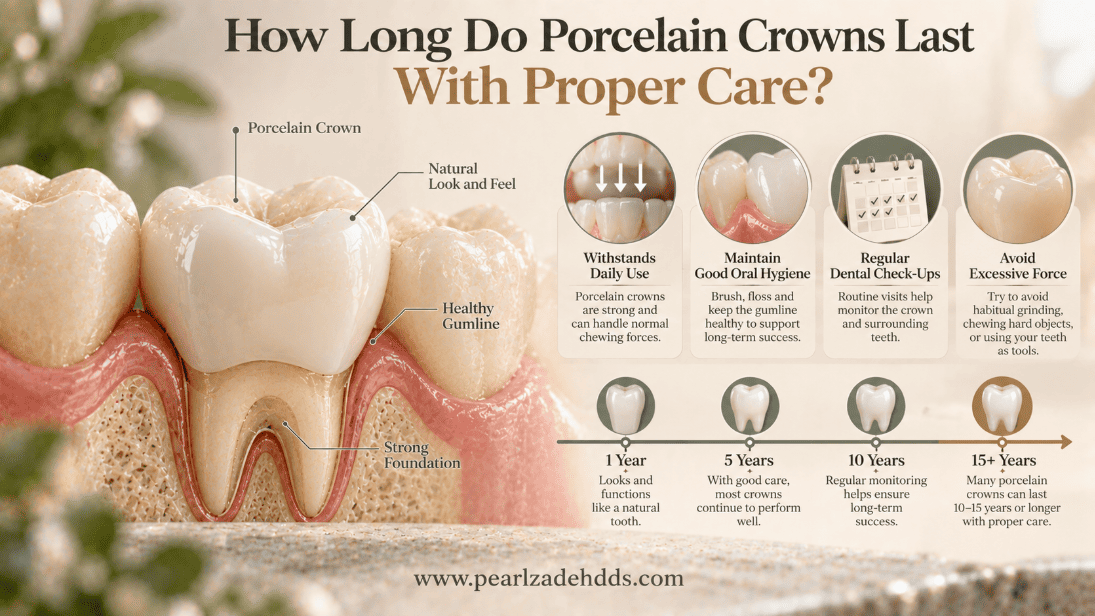
  • Teeth Whitening Before Veneers or Crowns: What to Know

    Teeth Whitening Before Veneers or Crowns: What to Know

    You want a brighter smile, and you’re also planning a veneer or a crown. It seems reasonable to assume the order doesn’t matter much, since both treatments are heading toward the same goal. It actually does matter, because natural teeth and dental restorations respond to whitening in genuinely different ways. Maybe you’re picturing whitening now and adding a crown later, or getting veneers first and whitening the rest of your smile afterward.

    Getting the sequence right affects whether your final smile actually looks consistent. Dentists often think about the final tooth shade you’re aiming for before finalizing a restoration, precisely because of this difference.

    Should You Whiten Your Teeth Before Veneers or Crowns?

    Often, yes, when whitening is genuinely part of your goals. Whitening your natural teeth first lets your dentist see the shade you’re actually going to live with before selecting a shade for your new veneer or crown. That restoration can then be matched to your surrounding natural teeth as they’ll actually look, rather than matched to a darker starting shade you’re planning to change later anyway.

    Whitening isn’t automatically necessary before every veneer or crown, though. Plenty of patients are happy with their current shade and simply need a restoration that matches it. When both whitening and a restoration are genuinely part of your plan, your dentist should coordinate the two together rather than treating them as separate, unrelated decisions.

    Why Does Whitening Before Veneers or Crowns Matter?

    The core issue comes down to how each treatment actually changes color. Whitening lightens natural tooth structure through a chemical process. A veneer or crown, by contrast, is fabricated in a shade selected ahead of time and doesn’t lighten further once it’s made and placed. Picture a patient who gets a crown matched carefully to their natural teeth, then decides afterward to whiten those same natural teeth substantially.

    The crown stays exactly where it started, while the teeth around it get noticeably lighter. This doesn’t mean every whitening treatment after a restoration creates a dramatic, visible mismatch. Sometimes the difference is subtle. It’s simply a real possibility worth planning around rather than discovering afterward.

    Do Veneers Whiten?

    Not in the way natural teeth do. Whitening agents work on natural tooth structure through a chemical process that porcelain and other veneer materials don’t respond to the same way. The American Dental Association is direct on this point: only natural teeth can be whitened, not tooth-colored restorations. If your natural teeth have become noticeably darker or lighter than existing veneers, that’s worth bringing to your dentist rather than trying to whiten the veneers themselves, which won’t actually change their color.

    Do Crowns Whiten?

    The same principle applies. Existing crowns generally don’t change shade through conventional whitening the way natural teeth do, for the same reason veneers don’t. This matters most when you’re considering whitening after you already have a crown, particularly a visible one. Your surrounding natural teeth may lighten while the crown itself stays exactly where it started, which is exactly the kind of situation worth thinking through before you begin.

    How Long Should You Wait Between Whitening and Veneers or Crowns?

    There’s no universal number of days or weeks that applies to every patient here. The appropriate timing depends on the whitening method used, how much lightening you’re actually aiming for, your individual treatment plan, the type of restoration involved, how stable your new tooth shade actually is, and your dentist’s own clinical assessment of your teeth.

    Dentists often want your shade to settle and stabilize before finalizing a restoration shade, since selecting a shade too soon after whitening risks matching a color that hasn’t fully settled yet. Tooth shade can continue shifting slightly in the days after whitening as the treatment finishes taking effect, which is part of why patience at this stage tends to pay off later.

    What Happens If You Whiten After Getting Veneers or Crowns?

    Your natural teeth can become lighter while an existing veneer or crown stays at its original shade, which means the restoration may end up looking darker relative to the teeth around it. How noticeable this actually becomes varies quite a bit from patient to patient and depends on how much whitening you did and how visible the restoration is.

    This doesn’t mean everyone who whitens after restorative treatment needs a replacement. Replacing the restoration is only one possible option, and whether it’s actually worth considering depends entirely on how the mismatch looks and how much it bothers you.

    Can You Whiten Around Existing Veneers or Crowns?

    Yes, you can generally still whiten your natural teeth even with restorations already in your mouth. The restoration itself simply won’t lighten alongside them. Professional planning becomes genuinely useful when those restorations are visible in your smile, since your dentist can factor in the existing restoration shade before recommending an approach, rather than whitening blindly and hoping everything still looks cohesive afterward.

    What If You Already Have Veneers or Crowns That Don’t Match?

    This is a genuinely common concern, and it’s worth understanding why before deciding what to do about it. A few things can explain it: your natural tooth color may have changed over time, the restoration may have been placed years ago under different circumstances, whitening may have happened after the restoration went in, the original shade may have been selected under different lighting or conditions, or your natural teeth and the restoration may simply have aged differently, since teeth and dental materials don’t always change color at the same rate.

    A systematic review of restoration color stability notes that shade mismatch is actually a common reason restorations end up replaced, and that replacement carries its own cost and risk to otherwise healthy tooth structure. That’s exactly why the right response depends on understanding why the mismatch happened, rather than assuming replacement is automatically the answer. A dentist can evaluate the restoration and the surrounding teeth together before recommending anything.

    What Should You Do If You Want Both Whitening and Veneers?

    A coordinated plan generally looks something like this, though the exact order can vary by case:

    1. A dental examination to assess your overall oral health.

    2. An assessment of any existing restorations and your natural teeth.

    3. A conversation about the tooth shade you’re actually hoping to achieve.

    4. Whitening treatment, when it’s genuinely appropriate for your goals.

    5. Shade selection for the new veneer, based on your teeth once whitening has settled.

    6. Fabrication and placement of the restoration itself.

    7. Ongoing maintenance of both your natural teeth and the new restoration.

    This sequence exists precisely because cosmetic treatment works better planned as a whole rather than as separate, disconnected procedures. Our breakdown of the steps involved in a cosmetic veneer case goes further into that planning process.

    What About a Crown on Just One Tooth?

    Shade matching becomes especially important when a single crown sits right next to your natural teeth, since there’s nothing else nearby to visually blend it with. A slight mismatch that might go unnoticed across a full set of veneers becomes much more obvious on one isolated tooth surrounded by your natural teeth. The shade of your surrounding teeth genuinely drives the shade selected for that crown.

    If you’re also considering whitening, that plan needs to be discussed before the final crown shade gets locked in, not after, since whitening afterward would leave that one crown standing out even more than before. This doesn’t mean every single-tooth crown requires whitening beforehand. Plenty of patients are perfectly happy with their current shade and simply need the crown matched to it as it already is.

    Can You Whiten Teeth After Getting Veneers or Crowns?

    Often, yes, for your remaining natural teeth. The restoration itself generally won’t lighten alongside them, though, which can create a visible shade difference depending on how much whitening you do and how visible the restoration is. If you know whitening is something you might want down the road, mentioning that during your original restoration consultation, before the shade gets finalized, tends to work out better than deciding afterward.

    How Dentists Plan the Shade of Veneers and Crowns

    Shade selection considers your existing natural tooth color, the final shade you’re hoping to achieve, your surrounding teeth, any planned whitening, the restoration material itself, where the tooth sits in your smile, and your overall cosmetic goals together. A peer-reviewed discussion of dental shade selection notes that standardized shade guides, the same reference systems used to evaluate whitening results, are also used for restoration shade matching, which gives dentists a shared, consistent language for both processes.

    Shade matching genuinely helps create a natural, cohesive appearance, but it isn’t a perfectly precise science. Lighting, materials, and individual tooth translucency all play a role, and no dentist can promise an absolutely exact match in every situation.

    What If You Are Not Sure Whether You Need Whitening?

    Whitening isn’t required simply because you’re getting a veneer or a crown. You might already like your current shade just fine and simply need a restoration that matches it as it is. The decision genuinely depends on your own goals and what the rest of your treatment plan looks like.

    If you’re unsure, that’s worth discussing directly with your dentist rather than starting an independent whitening regimen on your own before any of this has been talked through.

    When Should You Talk to Your Dentist About Whitening?

    A few situations are worth bringing up before you start whitening on your own: you’re planning veneers, you need a crown on a visible front tooth, you already have veneers or crowns, you want a significant change in your tooth shade, an existing restoration already looks different from the teeth around it, or you’re considering replacing older cosmetic work. Coordinated planning in any of these situations genuinely helps avoid an unwanted shade difference showing up later.

    Speak With Dr. Pearl Zadeh About Whitening, Veneers, and Crowns

    If you want both a whiter smile and new veneers or crowns, treatment sequencing genuinely affects your final shade match. Dr. Pearl Zadeh, a Woodland Hills dentist providing cosmetic and restorative dental care, can evaluate your teeth and discuss teeth whitening and restoration options together, so your whitening goals factor into the plan from the start rather than becoming an afterthought.

    Call (818) 716-6722 or click the button below to schedule your consultation online.

    Frequently Asked Questions

    Should I whiten my teeth before getting veneers?

    Often, yes, if whitening is part of your goals, since it lets your dentist match the veneer to your intended final shade rather than a shade you’re planning to change.

    Should I whiten my teeth before getting a crown?

    It depends on your goals and where the crown sits. If whitening is part of your plan, discussing it before the shade is finalized generally makes sense.

    Do veneers whiten with teeth whitening?

    No. Veneers don’t respond to whitening the way natural tooth structure does.

    Do crowns whiten with teeth whitening?

    No. Crowns generally don’t change shade through conventional whitening the same way natural teeth do.

    Can I whiten my teeth if I already have veneers?

    Yes, your natural teeth can often still be whitened, though the veneers themselves won’t lighten alongside them.

    Can I whiten my teeth if I already have crowns?

    Yes, typically, though the crown will stay at its original shade while your natural teeth change.

    How long should I wait between whitening and veneers or a crown?

    There’s no universal timeframe. It depends on your whitening method, how much your shade changes, and your dentist’s assessment of when your color has stabilized.

    This article is for informational purposes only and is not a substitute for professional dental advice. Please schedule a consultation with Pearl Zadeh DDS to discuss your specific situation.

  • Teeth Whitening for Sensitive Teeth: Which Options Work Best?

    Teeth Whitening for Sensitive Teeth: Which Options Work Best?

    Tooth sensitivity makes plenty of people hesitant to try whitening at all. You want a brighter smile, but you’ve heard whitening can leave teeth aching afterward, and you already deal with discomfort from cold drinks or sweets more than you’d like. Maybe a friend mentioned their teeth throbbed for days after a whitening session, or you tried a kit once and swore off whitening entirely after the reaction you had.

    Sensitivity doesn’t automatically rule out whitening. The safest, most comfortable approach genuinely depends on why your teeth are sensitive in the first place and which whitening method you’re considering. No dentist can promise a pain-free experience or guaranteed results, but a thoughtful approach can make a real difference.

    Can You Whiten Sensitive Teeth?

    Often, yes. People with sensitive teeth may still be reasonable candidates for whitening, but sensitivity is something to consider before treatment starts rather than something to discover partway through. Whitening agents can trigger temporary sensitivity in teeth that had no prior issues at all, which is different from sensitivity that already exists for other reasons.

    Existing sensitivity has plenty of possible causes, including exposed dentin, enamel wear, gum recession, cavities, cracks, or other dental problems. Not all sensitivity comes from whitening, and not all whitening-related sensitivity means something is actually wrong with your teeth.

    Why Does Teeth Whitening Cause Sensitivity?

    Whitening agents work by penetrating tooth structure to break down the compounds responsible for discoloration. A peer-reviewed study on dentin tubule treatments after in-office bleaching explains that this sensitivity occurs when bleaching agents penetrate the enamel and reach the dentin underneath, and that it’s generally temporary and subsides on its own.

    A separate clinical explanation of bleaching sensitivity adds an important detail: the peroxide molecule can pass through completely intact enamel and dentin, reaching the pulp within just 5 to 15 minutes, meaning sensitivity can happen even in teeth with no recession, cracks, or restorations at all. That rapid molecular penetration is followed by reversible pulpitis, a temporary inflammation, that tends to develop over the following days rather than happening instantly. This is a genuinely different mechanism than the sensitivity caused by actual exposed dentin from recession or wear.

    How much sensitivity someone experiences varies widely. A cross-sectional study on peroxide concentration and whitening sensitivity found that in-office whitening, which uses higher peroxide concentrations, was associated with sensitivity in roughly 60 to 90 percent of patients in the studies reviewed.

    Concentration, treatment duration, and frequency of application all factor into how likely and how intense sensitivity turns out to be, alongside a person’s existing sensitivity level, enamel wear, gum recession, and any other dental problems already present.

    What Are the Best Whitening Options for Sensitive Teeth?

    There’s no single option that’s universally best. What actually fits depends on your specific sensitivity and oral health.

    Professional Teeth Whitening

    A dentist can evaluate your teeth first and adjust the treatment approach based on what they find, including your level of sensitivity. That evaluation is genuinely valuable, since it can also catch problems that should be addressed before whitening begins at all.

    This doesn’t mean professional teeth whitening is automatically painless or that it always causes less sensitivity than other options. It means you have a professional adjusting the approach based on your actual mouth rather than a generic instruction sheet.

    At-Home Whitening

    At-home options include dentist-directed systems using custom trays and over-the-counter products you buy directly. Lower-intensity formulations or shorter treatment schedules are sometimes considered specifically for people who deal with sensitivity, since the same peroxide concentration research notes that lower-concentration at-home and over-the-counter products tend to come with reduced sensitivity compared to higher-concentration in-office treatment.

    No specific product can be responsibly recommended here without knowing your actual situation, but the general principle, lower concentration generally means less sensitivity risk, holds up reasonably well across the research.

    Whitening Strips for Sensitive Teeth

    Whitening strips can cause sensitivity in some users, influenced by the whitening concentration, how long the strips stay in contact with your teeth, how often you use them, and your individual sensitivity level. This doesn’t mean strips are inherently unsafe for everyone with sensitive teeth. If you already deal with significant sensitivity, talking to a dentist before starting strips on your own is a reasonable precaution, particularly if you’re unsure what’s actually causing your sensitivity in the first place.

    Whitening Toothpaste

    Whitening toothpaste works differently than peroxide-based whitening treatments. Many whitening toothpastes primarily remove surface stains through mild abrasion rather than meaningfully changing the underlying color of your teeth.

    For people with certain sensitivity concerns, the abrasive ingredients in some formulations can matter, though it wouldn’t be accurate to say every whitening toothpaste worsens sensitivity. Some are specifically formulated with sensitivity in mind, while others prioritize stain removal more aggressively.

    Professional Whitening vs. At-Home Whitening for Sensitive Teeth

    Each approach has genuine tradeoffs worth weighing. Professional treatment allows your oral health to be assessed first and gives your dentist more control over the process, including the concentration and duration used. At-home options offer convenience and, at lower concentrations, potentially reduced sensitivity, though with less oversight and less ability to adjust mid-treatment if something feels off.

    Existing dental conditions, the type of staining you’re dealing with, and how much control you want over the process all factor into which approach genuinely fits you better. Our comparison of professional and at-home whitening options goes further into these differences. Neither approach is universally superior for sensitive teeth. It depends on your specific situation.

    How Can You Reduce Sensitivity Before Whitening?

    A few practical steps can help going in. Address any existing dental problems, like a cavity or a cracked tooth, before starting whitening rather than layering treatment on top of an unresolved issue. Use appropriate oral-care products for your baseline sensitivity level in the weeks leading up to treatment, since building a foundation of comfort beforehand tends to matter more than reacting once sensitivity has already started.

    Avoid excessive or overly frequent whitening, since more isn’t automatically better and can work against you here. Follow whatever product instructions you’re actually given rather than improvising your own schedule based on what worked for someone else. Discuss your sensitivity history with your dentist beforehand, including any past reactions to whitening, so it can genuinely factor into the plan rather than being an afterthought. Depending on your situation, your dentist may consider adjustments to concentration, duration, or approach based specifically on what you tell them.

    How Can You Reduce Sensitivity After Whitening?

    If temporary sensitivity does show up, a few things can help manage it. Stick to the recommended whitening schedule rather than repeating treatment sooner than intended. Avoid unnecessary repeat sessions just because results haven’t fully set in yet, since results naturally fade at their own pace and rushing another treatment usually isn’t the answer. Your dentist may recommend sensitivity-focused oral-care products if appropriate for your situation.

    Avoiding extremely hot or cold foods and drinks temporarily can reduce discomfort while things settle. Not everyone experiences sensitivity after whitening at all, so this isn’t something to expect by default. If sensitivity is severe, persistent, or feels unusual compared to what you were told to expect, contact your dentist rather than waiting it out indefinitely.

    What If Your Teeth Are Already Very Sensitive?

    Severe or persistent sensitivity genuinely deserves an evaluation before whitening, not just extra caution during treatment. Possible underlying causes include gum recession, exposed dentin, tooth decay, cracked teeth, worn enamel, existing dental work that’s aging or failing, or other sources of dental sensitivity entirely unrelated to whitening. Each of these has its own appropriate treatment, and whitening doesn’t address any of them.

    Whitening shouldn’t simply be layered over an unexplained dental problem in the hope that it resolves on its own, or that a brighter smile will somehow distract from an underlying issue. Figuring out what’s actually causing the sensitivity comes first, and whitening can always be reconsidered once that’s been sorted out.

    When Sensitivity May Signal Another Dental Problem

    Temporary whitening sensitivity is one thing. Sensitivity that points toward something else is another, and it’s worth knowing the difference. Evaluation makes sense when sensitivity happens without any whitening involved, affects one specific tooth rather than several, is severe, persists longer than you were told to expect, occurs alongside pain when biting down, comes with visible damage to the tooth, appears together with gum changes, or simply keeps getting worse instead of settling.

    Our discussion of early signs of gum disease covers what gum-related changes are worth watching for specifically. None of these patterns can be diagnosed from a symptom list. Only an actual dental examination can determine what’s really going on.

    Can You Whiten Teeth Without Sensitivity?

    No whitening method can honestly guarantee zero sensitivity for every patient. That said, treatment can often be adjusted based on your specific sensitivity level and overall oral health, whether that means a lower concentration, a shorter duration, more spacing between sessions, or a different method altogether.

    Individualized planning matters more here than picking a single lowest-risk product off a shelf. Nobody should promise you pain-free whitening, and any claim that sounds that certain is worth being skeptical of.

    How to Choose a Whitening Approach for Sensitive Teeth

    A few general patterns are worth thinking through, though these are educational examples rather than instructions to follow without professional input. Mild sensitivity might mean a less intensive whitening approach or an adjusted schedule is worth discussing, rather than avoiding whitening altogether. Frequent sensitivity, meaning it shows up often even outside of whitening, is a reasonable prompt for a dental evaluation before starting any whitening at all.

    Severe or unexplained sensitivity generally means addressing the underlying cause takes priority over cosmetic whitening, since treating the symptom without understanding the cause rarely goes well. Healthy teeth with only occasional sensitivity during past whitening attempts might simply need a conversation about frequency and management rather than avoiding whitening altogether.

    When Should You Talk to a Dentist Before Whitening?

    A few situations deserve a conversation before you start whitening. These include persistent or severe sensitivity, sensitivity in one tooth, gum recession, suspected cavities, cracks, or visible damage. Existing dental restorations and strong reactions to past whitening also matter. A dentist can determine whether whitening suits you now or whether another dental issue needs attention first.

    Speak With Dr. Pearl Zadeh About Whitening for Sensitive Teeth

    Sensitive teeth do not automatically rule out whitening, but the cause and severity of your sensitivity matter. Dr. Pearl Zadeh provides cosmetic dentistry and teeth whitening in Woodland Hills. She can evaluate your teeth and determine whether whitening suits you. She can also recommend an approach that fits your oral health.

    Call (818) 716-6722 or click the button below to schedule your consultation online.

    Frequently Asked Questions

    Can you whiten sensitive teeth?

    Often, yes, though existing sensitivity should be discussed with a dentist first so the approach can be adjusted appropriately.

    What is the best teeth whitening for sensitive teeth?

    There’s no single best option for everyone. The right choice depends on the cause and severity of your sensitivity, evaluated individually.

    Do whitening strips make sensitive teeth worse?

    They can cause sensitivity for some users, depending on the concentration, contact time, and individual sensitivity. However, that does not mean whitening strips are unsafe for everyone.

    Is professional whitening better for sensitive teeth?

    It provides more oversight and allows your dentist to adjust the treatment. However, it does not guarantee a pain-free experience or less sensitivity than other options.

    Can whitening toothpaste help sensitive teeth?

    It can help remove surface stains, and some formulations target sensitivity. However, it works differently from peroxide-based whitening.

    How can I reduce sensitivity after teeth whitening?

    Follow your recommended schedule and avoid unnecessary repeat treatments. Avoid extreme temperatures temporarily, and contact your dentist if sensitivity feels severe or unusual.

    This article is for informational purposes only and is not a substitute for professional dental advice. Please schedule a consultation with Pearl Zadeh DDS to discuss your specific situation.