Pearl Zadeh DDS

Tag: Cosmetic Dentist

  • Getting a Second Opinion on a Dental Crown: What to Ask

    Getting a Second Opinion on a Dental Crown: What to Ask

    A second opinion can be helpful when a dentist recommends a crown. It gives you another chance to understand why the crown may be needed and whether other treatments are suitable for your tooth.

    Getting another opinion does not mean the first dentist was wrong. A crown may be the right choice for a damaged or weakened tooth, but another dentist may identify a different treatment option based on your dental condition.

    A second opinion can help you compare recommendations, prepare questions, and decide how to proceed. Bringing your dental X-rays and treatment records can also help the next dentist assess your case.

    Why Might a Dentist Recommend a Crown?

    A crown covers a tooth to restore its shape and function and to protect it. Cleveland Clinic says dentists use crowns to restore a decayed, broken, weak, or worn-down tooth.

    MouthHealthy is the American Dental Association’s (ADA) consumer site. It says a crown can strengthen a tooth with a large filling when not enough tooth remains. A crown can also protect a weak tooth from breaking.

    Common reasons include a broken or weak tooth. Another is a large filling with too little tooth left to support it. The recommendation depends on an examination and the specific condition of the tooth.

    Cracked teeth are one example. Our article on when a cracked tooth needs a dental crown explains why the extent of the crack matters.

    When Should You Consider a Second Opinion?

    Patients ask for another assessment for several reasons. Common ones include:

    • Uncertainty about what the diagnosis means.
    • A wish to compare reasonable treatment options.
    • Questions about the expected benefits or costs.
    • A need for more information before agreeing to treatment.

    The ADA’s Code of Ethics says dentists should inform patients of the proposed treatment and any reasonable alternatives. Dentists should do this in a way that lets patients become involved in treatment decisions. Asking about alternatives fits that standard.

    A recommendation to replace an existing crown can raise its own questions. Our article on signs a dental crown needs to be replaced explains common warning signs. We also cover whether a crown can be repaired instead of replaced.

    What a Second Opinion Can and Cannot Do

    Another dentist may agree with the original recommendation. Or the second dentist may suggest a different approach. A different recommendation does not automatically mean either dentist is wrong.

    Dentists can weigh the same findings differently, and an examination may reveal different details. A second opinion adds information. It does not settle the decision for you.

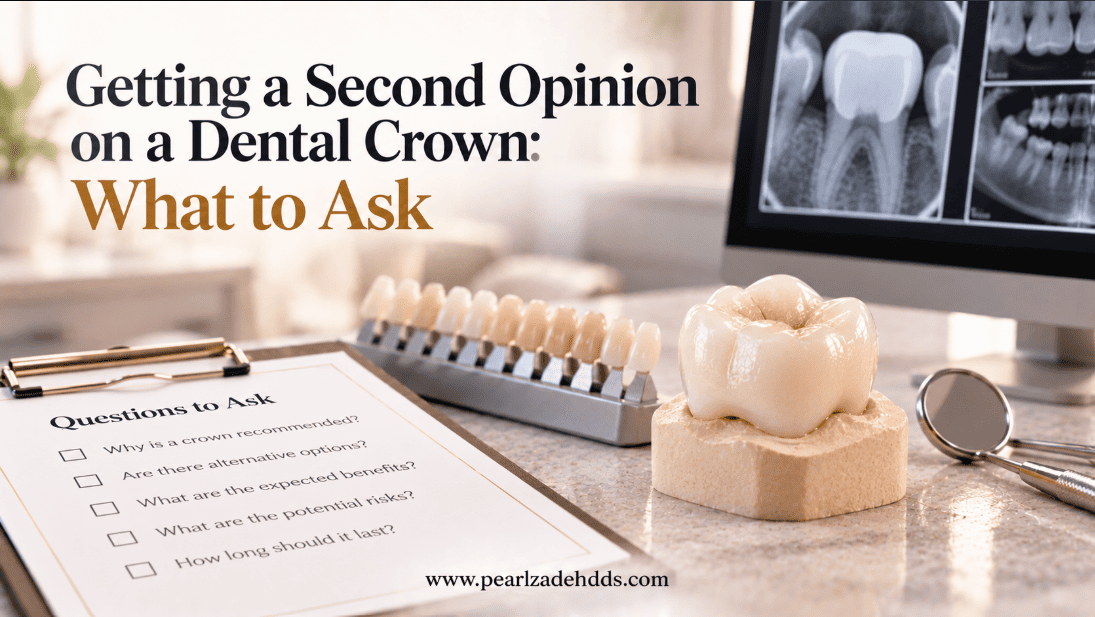
    Questions to Ask Before Agreeing to a Crown

    These questions can guide the conversation. They are prompts, not a checklist that points to one particular outcome.

    • What problem does the crown address?
    • What findings support this recommendation?
    • How much of the tooth is damaged or weakened?
    • Could a filling, bonding, or onlay be appropriate in this case?
    • What are the benefits and limitations of each reasonable option?
    • What are the risks of each option?
    • How long might the restoration be expected to last?
    • What could happen if treatment waits?
    • What material is being recommended, and why?
    • How many appointments will treatment require?
    • What costs should be expected, including any additional treatment the tooth may need?

    Ask the dentist to explain each answer in plain language. Questions about X-rays and examination findings also belong in the conversation, when they are relevant to the tooth.

    Comparing Fillings, Bonding, Onlays, and Crowns

    These options are not interchangeable. The right one depends on the amount and location of the damage. Cleveland Clinic says onlays can restore teeth too damaged for a filling but too healthy for a crown. A less extensive treatment is not always preferable, though. Teeth with little remaining structure may need more coverage.

    Our article on cracked tooth treatment with bonding, an onlay, or a crown explains how these options differ.

    Crown materials also vary. Our article on zirconia versus porcelain crowns compares two common choices.

    Appointments and cost deserve direct answers. Cleveland Clinic says crown placement usually requires two appointments and that crowns may be expensive. Individual plans vary, so ask for a written estimate.

    What Records Should You Bring?

    Existing records help another dentist review the case. Ask the first office for copies of:

    • Relevant X-rays.
    • Examination findings and notes.
    • The treatment plan.
    • Cost estimates.

    The ADA says HIPAA lets patients ask covered practices to send copies of their records to a designated person. Requests must be written and signed by the patient. Access can vary by state, the ADA adds.

    X-rays can often be forwarded. MouthHealthy says a new dentist may ask for copies instead of ordering new ones. It advises asking both dentists for help forwarding the X-rays.

    Records support the review, but they do not replace it. The second dentist may need to perform an independent examination. Additional imaging may also be needed, depending on the circumstances.

    How Do You Compare Two Different Recommendations?

    Recommendations can differ for several reasons. The tooth’s condition may be changing. Each dentist may observe different findings. Clinical approaches also vary, and some situations allow more than one reasonable path.

    Ask each dentist to explain the reasoning. Useful points to compare include:

    • The expected benefits of the recommended treatment.
    • The risks and limitations.
    • The alternatives considered.
    • The likely consequences of delaying treatment.

    Compare the reasoning, not only the price or how extensive the treatment sounds. If questions remain, return to the first dentist with what you learned. A clear explanation from either office helps you decide.

    What If the Tooth Needs Treatment Soon?

    The risks of waiting depend on the tooth’s condition. Some problems may worsen without treatment. Others may allow time for further assessment.

    Cracks show this range. Cleveland Clinic says that even with treatment, tooth cracks sometimes continue to get bigger or split. It also says a cracked tooth that causes no pain or infection may not need treatment.

    Taking time for another opinion may be reasonable when the tooth is stable and symptoms are mild. Ask your dentist how long waiting is reasonable for your tooth.

    Severe or worsening pain, swelling, fever, or difficulty swallowing warrants prompt dental or medical assessment. Do not delay urgent care while seeking another opinion. Mayo Clinic’s guidance on tooth abscess says to go to the emergency room for trouble breathing or swallowing. It also advises the emergency room for fever with facial swelling when you cannot reach your dentist. Cleveland Clinic notes that a badly cracked tooth may be a dental emergency.

    A second opinion works best as a way to understand your options. It is not a test of the first dentist. Dr. Pearl Zadeh can examine the tooth, explain the findings, and discuss the options that fit. You can also read about dental crown treatment at Pearl Zadeh DDS.

    Call (818) 716-6722 or click the button below to schedule your consultation online.

    Frequently Asked Questions

    Is it reasonable to get a second opinion before getting a dental crown?

    Yes. Patients may want clearer answers about the diagnosis, the alternatives, or the cost. A second opinion does not mean the first recommendation was wrong, and another dentist may agree with it.

    Can another dentist recommend a filling instead of a crown?

    Possibly, depending on the examination findings and the amount and location of the damage. Fillings, onlays, and crowns are not interchangeable, and the less extensive option is not always better.

    Should I bring my dental X-rays to a second opinion?

    Yes, if they are available. Ask the first office to send copies or forward them. The second dentist may still examine the tooth and may take new images.

    Is a second opinion necessary if my tooth does not hurt?

    Not necessarily. Whether a tooth hurts is only one part of the picture, and examination findings also matter. A second opinion can help if more information would make the decision clearer.

    Can I wait before getting a recommended dental crown?

    It depends on the tooth’s condition. Ask the dentist how long waiting is reasonable and what to watch for. Severe pain, swelling, fever, or trouble swallowing should not wait.

    The information above is for informational purposes only and is not a substitute for professional dental advice. Please schedule a consultation with Pearl Zadeh DDS to discuss your specific situation.
  • Should You Whiten Your Teeth Before Getting a Dental Crown?

    Should You Whiten Your Teeth Before Getting a Dental Crown?

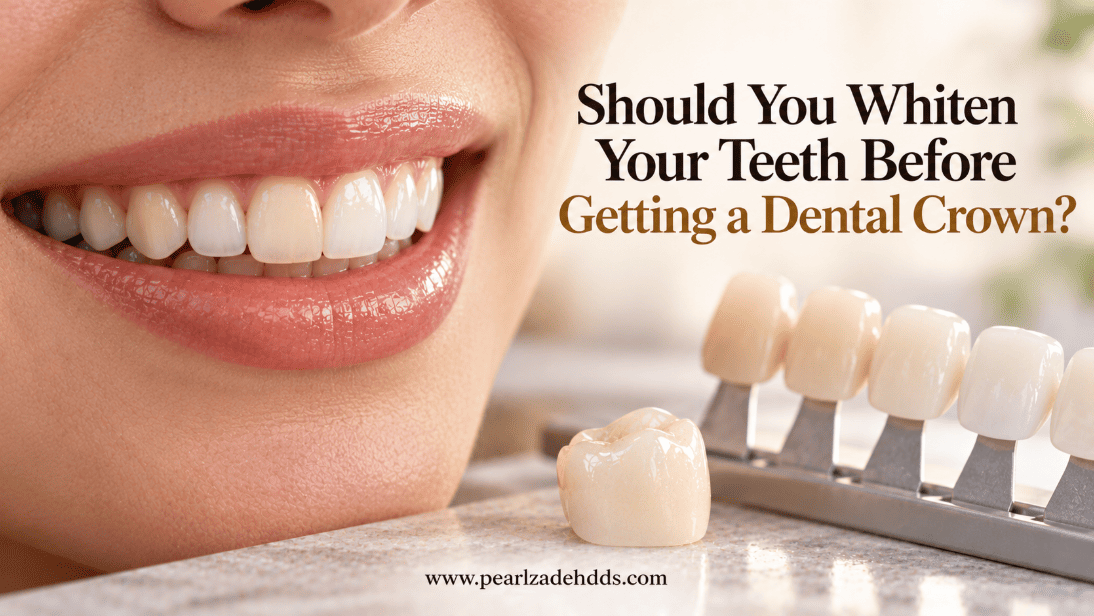
    Whitening your teeth before getting a dental crown can be a good option if you want a lighter smile. Whitening first allows the dentist to select a crown shade that matches your teeth after treatment.

    Porcelain and zirconia crowns do not respond to whitening products like natural teeth. If you whiten your surrounding teeth after the crown is made, the crown may look darker than the teeth next to it.

    Whitening is not suitable for everyone, so a dental evaluation can help determine whether it is right for you and when to schedule it before crown treatment.

    Why Whitening Before a New Crown Can Matter

    A dentist typically chooses a crown shade by looking at the natural teeth around it. If those teeth later become lighter, the crown stays exactly as it was made.

    The American Dental Association (ADA) notes that restorations generally do not change color during whitening. That could result in differences between natural teeth and restorations.

    Treatment order solves much of this problem. Whitening first lets the dentist select the crown shade from the teeth as they will look afterward. Doing it second means the crown was matched to teeth that have since changed.

    Not every patient wants whitening. Some prefer to keep their natural shade, and the crown can be matched to it. The goal is the color you want, not the lightest color possible.

    Even with good planning, no dentist can promise an exact match. The result depends on your natural tooth color, the crown material, and your clinical needs.

    How Dentists Select a Crown Shade

    A crown has to blend with the natural teeth beside it, so the dentist studies those teeth. Cleveland Clinic says dentists can match porcelain-fused-to-metal crowns to the shade of your own teeth. Many dentists compare the teeth with a shade guide and pass that information to the lab.

    Lighting, the tooth’s natural translucency, and the crown material can all affect how a shade looks. That is why the dentist selects the shade from the teeth as they currently appear.

    Do Dental Crowns Whiten Like Natural Teeth?

    No. The ADA says only natural teeth can be whitened, not tooth-colored restorations. It lists crowns among the restorations the bleaching agent does not affect. MouthHealthy, the ADA’s consumer site, says whitening will not work on caps, veneers, crowns, or fillings.

    Natural teeth contain stains that bleaching agents can lighten. Crown materials are different. Porcelain and zirconia are ceramics made in a lab. They carry their shade from the day they are fabricated.

    Cleveland Clinic says all-ceramic and porcelain crowns mimic the appearance of tooth enamel more than any other crown type. It describes zirconia as a popular, durable ceramic. Dr. Pearl’s article on zirconia versus porcelain crowns compares the two materials.

    Because a crown’s shade is set when it is made, whitening cannot adjust it later. Planning the shade correctly the first time matters more.

    How Long Should You Wait to Get a Crown After Whitening?

    No single waiting period fits every patient. The right timing depends on the patient, the whitening method, the condition of the tooth, and the treatment plan.

    A dentist may recommend allowing the shade to stabilize before choosing the final crown color. That way, the shade reflects how your teeth look once they settle, not how they look right after whitening.

    Follow your dentist’s recommendation instead of choosing a date on your own. Starting whitening without telling your dentist about an upcoming crown can complicate the plan.

    Temporary Crowns Versus Final Crowns

    A temporary crown and a final crown serve different purposes. Cleveland Clinic says that while you wait on your final crown, your dentist places a temporary one. The page adds that crown placement usually requires two appointments.

    The final crown’s shade is selected as part of the restorative process. Not every temporary crown must be color-matched after whitening. Your dentist decides based on the tooth and the plan.

    Cleveland Clinic says the dentist checks the shape, color, and fit of the new crown at the second visit.

    What If You Already Have a Crown?

    Whitening your natural teeth around an existing crown can change how the two compare. Natural teeth may become lighter, while the crown keeps its original shade.

    The ADA notes that patient expectations may not be met without addressing cosmetic issues with existing restorations. Whitening does not lighten the crown, and ordinary whitening treatment cannot change it.

    Cleveland Clinic adds that lab studies suggest whiteners may react chemically with ceramic crowns. Those studies did not involve living teeth. Still, ask your dentist before using whitening products around a crown.

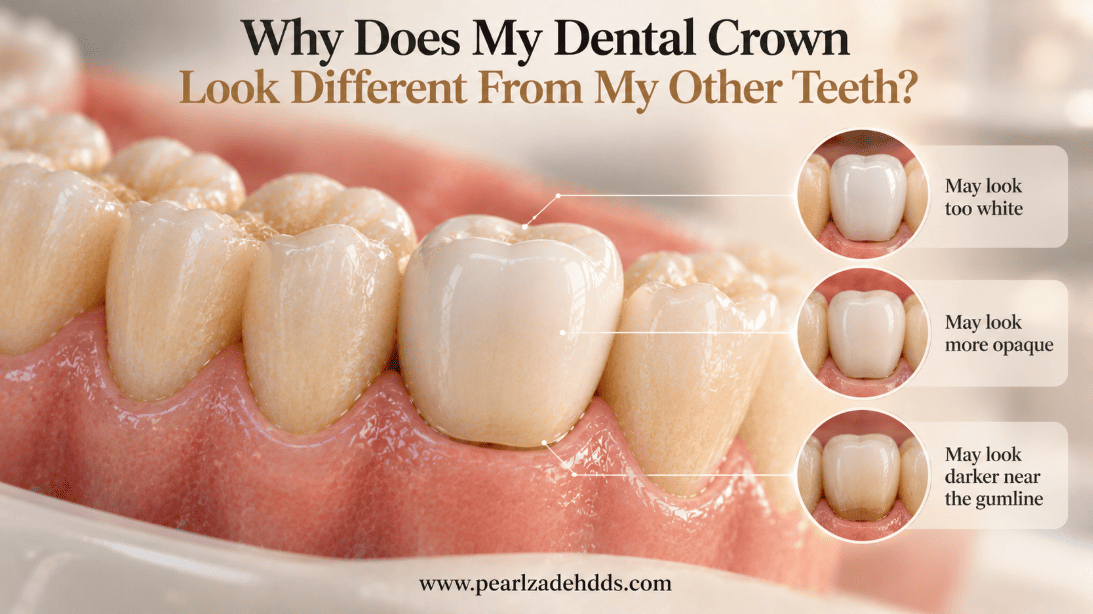
    If your crown already looks different from your other teeth, Dr. Pearl’s article on why a dental crown can look different from other teeth explains common reasons.

    Should Everyone Whiten Before Getting a Crown?

    No. Whitening is not suitable for everyone, and a dentist should assess your oral health first. The ADA supports educating the public to consult a licensed dentist about whether whitening is appropriate. Several factors can affect that decision:

    • Tooth sensitivity, which can be a side effect of whitening.
    • Untreated cavities.
    • Gum problems.
    • Existing restorations, which will not change color.
    • The cause of the discoloration.

    Cleveland Clinic advises getting teeth healthy before starting whitening. It adds that tackling concerns like gum disease or cavities beforehand is also important. Temporary sensitivity and gum irritation are common with whitening, per the same page.

    Color matters too. MouthHealthy says yellow teeth will probably bleach well, while teeth with gray tones may not bleach at all. It adds that whitening will not be effective if medications or a tooth injury caused the discoloration. A dentist can help identify the cause before you invest in whitening.

    A dental evaluation also helps decide whether whitening makes sense alongside a crown. You can read about teeth whitening at Pearl Zadeh DDS before your visit.

    How Dr. Pearl Zadeh Plans Crown Shade and Treatment

    Crown planning starts with a conversation. Tell Dr. Pearl what shade you want before the final crown is made, and mention any whitening you are considering.

    Dr. Pearl considers your natural tooth color, the crown material, and your clinical needs. Your preferred shade matters, along with what is realistic for your teeth.

    The crown process typically involves two appointments. The permanent crown is placed after it has been fabricated.

    You can read more about dental crown treatment at Pearl Zadeh DDS. For advice on daily care after placement, see the article on caring for your new dental crown.

    Choosing the crown shade before treatment helps the dentist plan for a result that complements your smile, whether you whiten your teeth first or keep their natural color.

    Call (818) 716-6722 or click the button below to schedule your consultation online.

    Frequently Asked Questions

    Should I whiten my teeth before getting a crown?

    If whitening is appropriate, finishing it before the final crown shade is selected may help the crown match. A dentist should evaluate your teeth and plan first, since whitening does not suit everyone.

    Will teeth whitening change the color of my crown?

    No. Whitening products affect natural teeth, not crowns. Lightening the teeth beside a crown can make the crown look darker by comparison.

    How long should I wait after whitening before getting a crown?

    No single period applies to everyone. Timing depends on the patient, the whitening method, the tooth’s condition, and the treatment plan. Follow your dentist’s recommendation.

    Can I whiten my teeth if I already have a crown?

    Sometimes, if a dentist finds whitening suitable. The crown will keep its shade, so the contrast with your natural teeth may increase. Ask your dentist before starting.

    Can a new crown be made to match whitened teeth?

    A dentist can select the crown shade after whitening, which may help the crown blend in. An exact match cannot be guaranteed, because results depend on natural tooth color, crown material, and clinical needs.

    The information above is for informational purposes only and is not a substitute for professional dental advice. Please schedule a consultation with Pearl Zadeh DDS to discuss your specific situation.
  • Can a Dental Crown Be Repaired Instead of Replaced?

    Can a Dental Crown Be Repaired Instead of Replaced?

    You notice a small chip in your dental crown, or it feels different when you bite down. You may wonder whether your dentist can repair it or if you need a replacement.

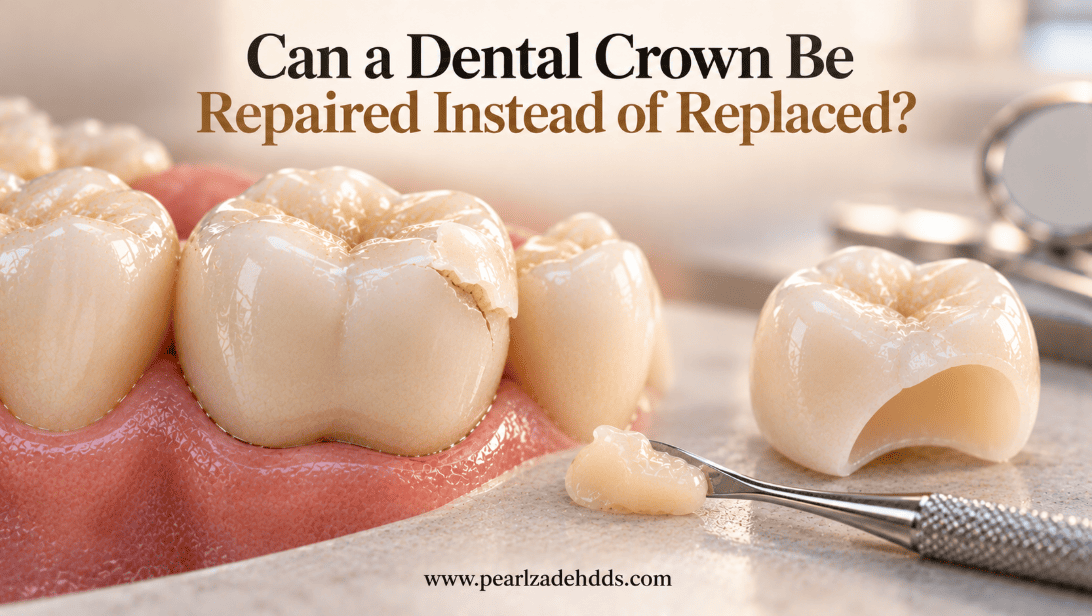
    A crown can sometimes be repaired, depending on the type of damage and its location. A small chip may be manageable, while a loose crown, a poor fit, or damage to the tooth underneath may call for replacement or further treatment. Not every damaged crown needs to be replaced, but some problems cannot be fixed with a simple repair.

    Your dentist can examine the crown and the tooth beneath it to determine what needs attention.

    Can a Dental Crown Be Repaired?

    Sometimes. Repair may be possible when damage is limited and the crown stays stable, functional, and suitable for continued use. A 2016 Operative Dentistry article on intraoral repair says repair is mainly indicated for localized shortcomings of restorations. It says replacement is indicated when problems are multiple or severe and repair is not feasible.

    Your dentist considers several factors:

    • The type and location of the damage.
    • Whether the crown is still securely attached.
    • The crown material.
    • The condition of the underlying tooth.
    • Whether the crown’s margins and fit remain acceptable.

    A dentist must evaluate these factors before recommending repair. Sometimes a small chip is the only problem. It may also accompany a fit or tooth problem that needs attention. Fit deserves special attention. A gap at the margin may allow bacteria to reach the tooth. Polishing or patching the visible surface does not close that gap. Your dentist checks the margins before deciding whether repair makes sense.

    What Types of Dental Crown Damage Can Sometimes Be Repaired?

    Small chips or rough edges. Minor damage may sometimes be smoothed, polished, or repaired with a restorative material. The options depend on the crown material and the location of the chip. Mention any rough spot that irritates your tongue or cheek.

    WebMD says a small chip on a porcelain or porcelain-fused-to-metal crown can be repaired with composite resin. The crown stays in your mouth during the repair. WebMD calls this usually a temporary fix and says extensive chipping may mean replacement. A dentist-focused Dental Update article calls repair of metal-ceramic and all-ceramic restorations a reliable, low-cost, low-risk technique. It says the technique may be of value for loss or fracture of porcelain from a crown or bridge. Sources differ, so outcomes vary.

    Surface wear or minor cosmetic defects. Polishing or another limited correction may improve a surface in some cases. Not every discoloration or defect can be corrected this way. The Operative Dentistry article adds that some minor margin defects, such as minor discoloration, may need only monitoring. Your dentist can explain whether a defect is cosmetic or affects function.

    A loose crown. Sometimes a loose crown may be recemented if the crown and tooth remain suitable. Colgate’s oral health site says a dentist first makes certain the crown is intact and still fits properly. It also notes that a badly broken or decayed tooth may not be strong enough to hold the crown.

    The crown may be reusable, or a new one may be needed. A dentist-reviewed Healthline article says the dentist decides whether to reinstall the crown or make a new one. Recementation does not suit every loose crown.

    Damage to the underlying tooth. Repairing the crown alone may not address decay, a fracture, or other problems in the tooth beneath it. WebMD notes that when cement washes out, bacteria can leak in and cause decay in the remaining tooth. In that case, the tooth needs attention too.

    Major cracks, extensive fractures, and significant structural damage are not routine repairs. Your dentist can tell you whether your crown is a candidate.

    When Does a Dental Crown Need to Be Replaced?

    Repair may not be reliable or appropriate in these situations:

    • A large chip or fracture that affects the crown’s strength.
    • Extensive cracking or structural damage.
    • A crown that no longer fits properly.
    • Damage or decay affecting the tooth underneath.
    • Repeated loosening or failure.
    • Problems with the bite or surrounding gum tissue that cannot be addressed adequately while keeping the crown.

    A large fracture can leave too little crown to withstand chewing. Repair may not restore that strength. In that case, replacement may be the more dependable option.

    Repeated loosening deserves a closer look. One retrospective study of 1,037 tooth-supported single crowns found loss of retention and recurrent caries the most common complications. That study reflects one dental school clinic, so it cannot predict your crown.

    Bite forces matter as well. Mayo Clinic says severe grinding may damage fillings, crowns, and other dental repairs. If bite forces keep damaging a crown, your dentist may need to address the cause, not only the damage.

    Replacement is not automatic whenever a crown has a problem. Depending on the findings, your dentist may recommend repair, recementation, replacement, or treatment of the underlying tooth.

    Our article on signs your dental crown needs to be replaced covers the warning signs in detail. Age alone does not decide the question either. Our article on how long porcelain crowns last with proper care explains what affects crown lifespan.

    Does Crown Material Affect the Repair Options?

    Yes, but not in a simple way. Repair techniques and their predictability vary by material, the type of damage, and where the crown sits. Some surface defects may be polished or repaired. A repair may not restore the original strength or appearance in every case. Location matters too. Back teeth take heavier chewing forces than front teeth. The same chip may call for different decisions in different places. Ask your dentist how your crown’s material affects the plan.

    The Operative Dentistry article says the composition of the repaired surface is the most important factor in success. Its repair protocols cover metal-ceramic and zirconia fixed restorations, not crowns alone. On metal, air abrasion followed by a metal primer increases adhesion significantly. For zirconia, air abrasion followed by a silane containing MDP monomer was the most effective conditioning method. The article still says achieving a sustainable chemical bond to zirconia remains problematic.

    The ADA’s page on indirect restorative materials describes complications by material. All-ceramic crowns commonly show fracture and chipping. Zirconia-based restorations commonly show chipping and fracture. A 2021 ADA survey cited on the same page found debonding the most common zirconia problem. Porcelain-fused-to-metal crowns commonly show veneer chipping. For gold restorations, secondary caries and retention failure are among the most common reasons for failure.

    Those lists describe what tends to go wrong. They do not rank repairability. No material is universally easier to repair, and none is immune to damage. Our article on how zirconia and porcelain crowns compare explains material differences in more depth.

    What Happens During a Dental Crown Repair Appointment?

    The process depends on the problem. Expect questions about when you noticed it and what you feel when you chew. Your dentist may also ask about habits such as grinding or chewing hard objects. They can affect the plan. A typical evaluation includes these steps:

    1. Your dentist examines the crown, its margins, and the underlying tooth.
    2. The damage is assessed, and the crown’s stability and bite are checked.
    3. Imaging, such as X-rays, may be used when indicated.
    4. You and your dentist discuss whether repair, recementation, replacement, or other treatment is suitable.
    5. If repair is appropriate, your dentist explains the procedure and its limitations.

    Imaging helps because X-rays can reveal damage or disease not visible during an exam, according to MouthHealthy. A crown can look fine while the tooth beneath it has a problem.

    Not every repair is finished in one appointment. Timing depends on the problem and the treatment needed. The Operative Dentistry article also notes that repair is not always risk-free, because the preparation sometimes needs extending. After any crown work, daily cleaning still matters. Our article on caring for a new dental crown covers habits that protect a crown.

    Can You Repair a Dental Crown at Home?

    No. Do not use household glue, superglue, or other non-dental adhesives on a crown. Also do not force a damaged or loose crown back into place. It may not seat correctly, and the tooth underneath may need treatment. Do not file or trim a rough edge yourself either.

    If a crown comes off, keep it in a safe, clean container. Avoid chewing on the affected tooth and contact your dentist for instructions. Healthline says the most important step is to retrieve the crown and take it to a dentist. Our article on what happens if your dental crown falls off covers that situation in detail.

    Temporary dental products exist, and some websites suggest them. They do not replace a professional evaluation, and they do not suit every situation. Ask your dentist before using one.

    Is Repair Cheaper Than Replacing a Dental Crown?

    Cost depends on the type of repair and the crown material. It also depends on the tooth underneath and whether additional treatment is needed. A simple polish differs from a repair that needs added material. Recementation differs from replacement.

    Repair is not always cheaper over time. A repair that does not hold may lead to other treatment later. Your dentist can give a more useful estimate after assessing the crown and the tooth. Ask what each option involves and what it may not solve. Also ask whether the estimate covers the tooth underneath.

    A damaged crown does not always need replacing, but not every crown can be repaired. Dr. Pearl Zadeh can examine your crown and the tooth beneath it and explain which options apply. You can learn more about dental crown treatment at Pearl Zadeh DDS.

    Call (818) 716-6722 or click the button below to schedule your consultation online.

    Frequently Asked Questions

    Can a chipped dental crown be repaired?

    Sometimes. A small chip may be smoothed, polished, or repaired, depending on the material and location. Large chips that weaken the crown may need replacement. Your dentist decides after an exam.

    Can a loose dental crown be recemented?

    Sometimes. A dentist checks that the crown is intact, fits properly, and sits on a sound tooth. If decay or damage is present, recementation may not be suitable. Do not use household glue.

    Can a cracked porcelain crown be repaired?

    Extensive cracking is not a routine repair. A small, localized defect may be a candidate. Cracks that affect the crown’s strength or involve the tooth may need replacement. Only an exam can tell which applies.

    Is it better to repair or replace a dental crown?

    Neither is better for every crown. Repair may suit limited damage on a stable, well-fitting crown. Replacement may suit extensive damage, poor fit, or tooth problems. Your dentist weighs these findings.

    Can I eat with a damaged dental crown?

    Avoid chewing on the affected tooth until your dentist gives guidance. This matters most if the crown is loose, fractured, or painful. Healthline advises soft foods and avoiding the affected side. Call your dentist for instructions.

    The information above is for informational purposes only and is not a substitute for professional dental advice. Please schedule a consultation with Pearl Zadeh DDS to discuss your specific situation.
  • How to Fix a Chipped Front Tooth: Bonding, Veneers, or Crowns?

    How to Fix a Chipped Front Tooth: Bonding, Veneers, or Crowns?

    You bite into something hard and notice a rough edge with your tongue. Part of your front tooth has chipped, and the damage is visible when you smile. You want to know how it can be repaired.

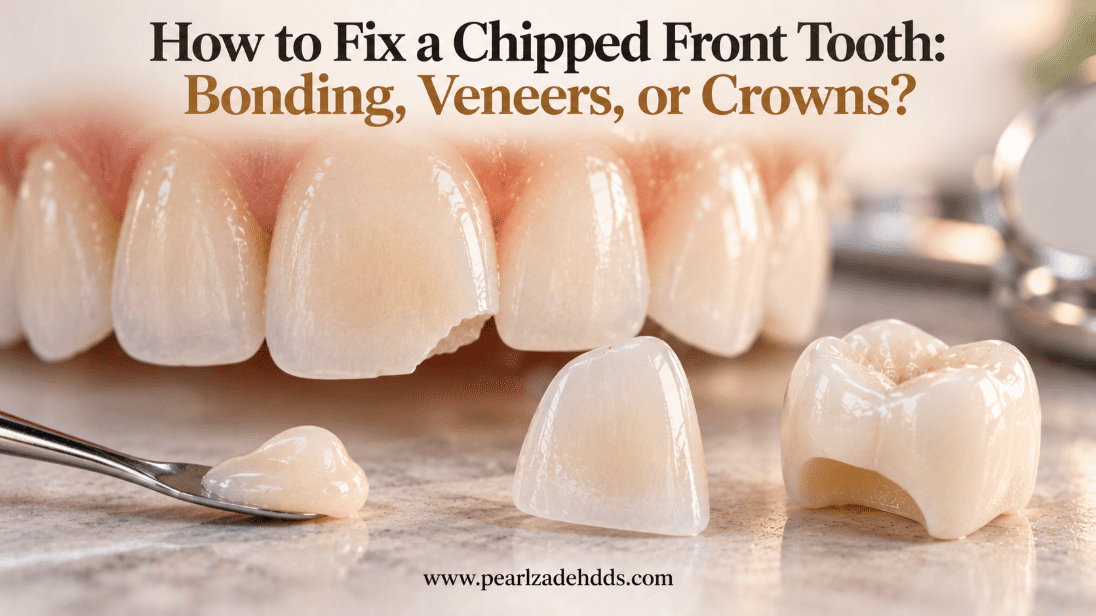
    The best way to fix a chipped front tooth depends on the size and location of the chip, the condition of the tooth, and the result you want. A small chip may need only smoothing or dental bonding. A larger chip may be better suited to a veneer or crown.

    Each option repairs the tooth differently. A dental exam can help determine which treatment is appropriate for your tooth.

    What Should You Do If You Chip a Front Tooth?

    Have the tooth evaluated, especially if the chip is large, painful, or sensitive. Cleveland Clinic advises scheduling an appointment as soon as possible after you notice a chip. It says an untreated chip can cause other problems if the damage goes beyond the enamel.

    Until your dentist assesses the tooth, avoid biting hard foods with it. Choose soft foods and keep the area clean. Cleveland Clinic suggests covering jagged edges with orthodontic wax. Bring any broken piece you can find to your appointment.

    A chip that follows an injury needs closer attention. Significant pain, bleeding that does not stop, or other signs of serious injury warrant prompt professional care. Cleveland Clinic says to call your dentist right away if an injury loosened a tooth. It lists bleeding that will not stop as a reason to go to an emergency room. Severe pain that medication does not relieve is another.

    How Do Dentists Choose the Right Repair?

    Dentists weigh several factors before recommending a repair. No single factor decides the plan. They include:

    • The size, depth, and location of the chip.
    • Whether the damage involves enamel only or extends into dentin.
    • Whether the tooth has a crack or other structural damage.
    • How much healthy tooth structure remains.
    • The tooth’s color, shape, and position.
    • Bite forces and habits such as grinding.
    • Your cosmetic goals and expectations.

    Cleveland Clinic explains that with a chip, some enamel breaks off, while a crack runs through the tooth. You need a dental provider to know for sure which you have. Slight chips usually cause no major issues. Severe chips that expose the tissue beneath the enamel need dental work to protect the tooth.

    Appearance alone cannot determine the best treatment. A small chip may hide a deeper problem. Likewise, a large chip may be simple to restore. Your dentist may need to examine the tooth and assess the surrounding structures, sometimes with X-rays.

    Habits matter, too. Grinding, nail biting, and chewing hard objects add stress to a repair. Mayo Clinic says severe grinding may damage fillings, crowns, and other dental repairs. Tell your dentist about any of these habits.

    Your goals count as well. Some patients want the least possible tooth removal. Others want a change in shape or color. Share your priorities so your dentist can match the options to them.

    Can Dental Bonding Fix a Chipped Front Tooth?

    Often, yes. Composite resin bonding can restore a tooth’s shape by adding material to the damaged area. Whether it suits your tooth depends on the chip and the tooth’s condition.

    Cleveland Clinic says bonding can improve the appearance of minor chips. The AAE says most chipped teeth can be repaired. Options include reattaching the broken piece of enamel or bonding a tooth-colored filling or crown in place. Bonding may suit smaller chips, especially when enough healthy tooth remains to support the material.

    Cleveland Clinic describes the process in several steps. The dentist selects a resin shade, roughens the tooth surface, and applies a liquid. Putty-like resin is then molded, smoothed, and hardened with a curing light. Final adjustments and polishing follow.

    Bonding is a conservative approach. Cleveland Clinic says it typically does not require enamel removal, unlike veneers or crowns. That may help preserve more natural tooth structure.

    Bonding also has limits. Cleveland Clinic notes that resin does not resist stains as well as porcelain and can chip over time. The ADA lists potential staining and discoloration as disadvantages of composite resin. Color matching varies, too. Your dentist selects a shade to blend with your natural teeth, but no one can promise an exact match.

    Bonding may not provide enough support in some cases. A large chip, little remaining structure, or heavy bite forces may call for another restoration. Bonding is also not permanent. It may need polishing, repair, or replacement over time.

    When Might a Veneer Be Better for a Chipped Front Tooth?

    A veneer covers the front surface of a tooth. Your dentist may consider one when a chip affects appearance and enough healthy structure remains to support it. A veneer is not automatically better than bonding.

    Veneers differ from bonding in scope. Bonding rebuilds the damaged area. Cleveland Clinic describes veneers as custom-made shells that fit over the front surfaces of teeth. They can conceal chips and stains. A veneer may help when shape, color, or surface concerns extend beyond the chip. The same page notes that veneers do not necessarily strengthen or repair a tooth.

    Your dentist must evaluate the enamel and the tooth’s overall condition first. Cleveland Clinic says veneers are an option only if you are free of extensive cavities and gum disease. MouthHealthy adds that porcelain placement involves removing a small amount of enamel, while composite veneers may require less. It says the treatment is not reversible because enamel is removed.

    A veneer is not suitable for every chipped tooth. MouthHealthy says veneers may not be a good choice if you clench, grind, or have a deep overbite. A large chip or limited enamel may also point to another option. Your dentist will explain why a veneer does or does not fit your tooth.

    When Does a Chipped Front Tooth Need a Crown?

    A crown covers the tooth more fully than a veneer does. Dentists may consider one when damage is extensive or the tooth needs more structural protection. Cleveland Clinic describes crowns as caps that protect a tooth that is weak or has experienced major damage. These situations may lead a dentist toward a crown:

    • Larger chips or fractures that leave the tooth weakened.
    • Significant loss of tooth structure.
    • Existing restorations or other factors that affect strength.

    A crown also differs from a veneer in coverage. Cleveland Clinic says a crown covers the entire tooth structure to add strength and protection. Its page on dental crowns says preparation involves removing some natural enamel and placement usually requires two appointments. Your schedule depends on the tooth and your treatment plan.

    Before choosing a crown, your dentist must decide whether the tooth can be predictably restored. That depends on the remaining structure, the condition of the inner tooth, and the bite. If a chip reaches the inner tissue, other treatment may be needed first. A crown is not the answer for every chipped front tooth.

    If a crown is planned, material is another decision. Our article on how zirconia and porcelain crowns compare explains the options. Front teeth also raise color questions. Our article on why a dental crown can look different from your other teeth covers what affects the match.

    Bonding vs. Veneers vs. Crowns: How Do They Compare?

    The table below summarizes general differences. Treat it as a guide, not a set of rules. The exact preparation and coverage depend on the clinical situation.

    FactorDental bondingVeneerCrown
    Typical purposeRepairing smaller chips and reshaping teethImproving the front surface’s appearance in selected casesRestoring and covering a more extensively damaged tooth
    Tooth coverageLimited to the repaired areaPrimarily the front surfaceCovers most or all of the visible tooth, depending on design
    Tooth preparationOften minimalMay require enamel removalUsually requires more extensive preparation
    MaintenanceMay need polishing or repairRequires ongoing oral care and monitoringRequires ongoing oral care and monitoring
    Best choiceDepends on the chip and tooth conditionDepends on the tooth’s structure and cosmetic needsDepends on the extent of damage and need for protection

    Appearance, durability, and treatment needs differ for each option and vary from tooth to tooth. Your dentist can explain how those trade-offs apply to your chip.

    How Long Does a Chipped Front Tooth Repair Last?

    Longevity varies. Material, bite forces, oral hygiene, and restoration size all play a role. Habits such as nail biting or chewing hard objects matter, too. No option lasts longest in every case, and no repair carries a guarantee.

    Cleveland Clinic says bonding typically lasts three to ten years before it needs a touch-up or replacement. It adds that lifespan depends on habits and the number of teeth treated. The ADA’s direct restorations page says patient behavior is reportedly the most significant factor in composite longevity.

    Veneers and crowns need the same daily care and regular exams. Their lifespan also varies with the tooth, the material, and your habits. Regular checkups let your dentist monitor any repair and polish or fix it when needed.

    Our article on how long porcelain crowns last with proper care explains what affects crown longevity in more detail.

    Can a Chipped Front Tooth Be Whitened Instead of Repaired?

    No. Whitening changes tooth color. It does not rebuild missing tooth structure. MouthHealthy says bleaches break stains into smaller pieces, which does nothing for a missing piece of tooth. A chip still needs a suitable restorative approach.

    Your dentist may discuss whitening when color is also a concern. MouthHealthy says whitening will not work on caps, veneers, crowns, or fillings. Bonding is made of tooth-colored resin, so ask your dentist how it will respond. Existing and new restorations do not whiten the way natural teeth do. You can read about teeth whitening at Pearl Zadeh DDS to learn more.

    A chipped front tooth can often be repaired, but the right option depends on your tooth. Dr. Pearl Zadeh can examine it, explain what the findings mean, and discuss the options that fit. You can learn more about dental crown treatment or explore cosmetic dentistry at Pearl Zadeh DDS.

    Call (818) 716-6722 or click the button below to schedule your consultation online.

    Frequently Asked Questions

    Can a small chip in a front tooth be repaired with bonding?

    Often, yes. Bonding may suit a small chip when enough healthy tooth remains to support the material. Your dentist confirms that after an exam and may find that smoothing the edge is enough.

    Is bonding or a veneer better for a chipped front tooth?

    Neither is better for every tooth. Bonding is more conservative and may suit a smaller chip. A veneer may help when changes in shape or color extend beyond the chip. Your dentist compares both for your tooth.

    When does a chipped front tooth need a crown?

    A crown may be considered for a large chip, major structure loss, or a tooth that needs protection. Not every chipped tooth needs one. Your dentist must decide whether the tooth can be predictably restored.

    Can a chipped front tooth be repaired in one appointment?

    Some repairs may be completed in one visit. Cleveland Clinic says bonding usually takes a single office visit. It describes a second visit for veneers and two appointments for crowns. Timing depends on the treatment and the condition of your tooth.

    Will a repaired front tooth look natural?

    A repair can blend well with neighboring teeth, but no one can promise a perfect result. The material, shade selection, and condition of your natural teeth all affect the outcome. Share your cosmetic goals before treatment.

    The information above is for informational purposes only and is not a substitute for professional dental advice. Please schedule a consultation with Pearl Zadeh DDS to discuss your specific situation.
  • When Does a Cracked Tooth Need a Dental Crown?

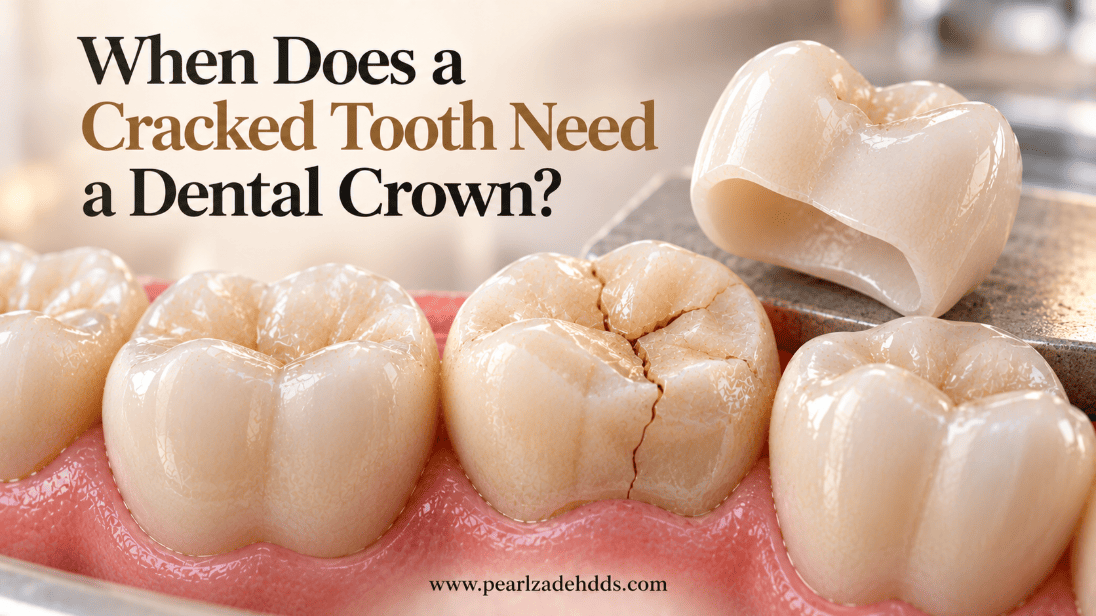
    When Does a Cracked Tooth Need a Dental Crown?

    A dentist finds a crack in a back tooth and recommends a crown. You may have expected a simple filling, so the recommendation might come as a surprise.

    A crown is not necessary for every cracked tooth. The best option depends on the crack’s location and depth, along with how much healthy tooth structure remains. Some cracks can be managed with monitoring or a smaller restoration. Others may need more extensive treatment, and a crown may not be enough.

    A dentist can examine the tooth and explain whether a filling, onlay, or crown is appropriate. If the crack extends too far into the tooth or root, a different treatment may be necessary.

    When Does a Cracked Tooth Need a Crown?

    A cracked tooth may need a crown when it is weakened and can still be restored predictably. Your dentist makes that call after an exam. It is not a rule for every crack.

    A crown covers the visible part of the tooth above the gum. That coverage can support a weakened tooth and shield it from chewing forces. Cleveland Clinic lists protecting and supporting a cracked tooth among the reasons dentists place crowns.

    Several different problems all get called cracks, and the type points toward different treatment. The AAE describes these types:

    • Craze lines: tiny cracks in the outer enamel that cause no concern beyond appearance.
    • Fractured cusp: a break in a chewing point of the tooth, which rarely damages the pulp.
    • Cracked tooth: a crack that runs vertically toward the root, in a tooth not yet separated into pieces.
    • Split tooth: a crack with distinct segments that can be separated.
    • Vertical root fracture: a crack that begins in the root and extends toward the chewing surface.

    For a fractured cusp, the AAE says a dentist can place a filling or crown to protect the tooth. So cusp damage points toward a crown in some cases, not all.

    Crowns become more likely when a crack involves a cusp or runs into the chewing surface. Even then, full coverage is not automatic. Cleveland Clinic says you may not need treatment for a cracked tooth that causes no infection or pain. That applies only if the crack does not extend very deep or far into the tooth. It also advises talking to a dentist whenever you notice a crack.

    Monitoring can be a reasonable plan for some teeth. In a National Dental PBRN study, 2,858 patients each had a visible crack in a back tooth. About 80% of teeth recommended for monitoring at the start stayed on monitoring for three years. The authors concluded that dentists can effectively evaluate patient, tooth, and crack features to choose between treatment and monitoring.

    What Determines Whether a Crown Can Save the Tooth?

    No single symptom or X-ray finding decides treatment. Dentists weigh several findings together. The AAE says treatment and outcome depend on the type, location, and extent of the crack. These factors matter most:

    • The crack’s location and depth.
    • Whether the crack extends below the gumline or into the root.
    • How much healthy tooth structure remains.
    • Whether the tooth is split or has separated segments.
    • Symptoms and findings from the clinical examination.
    • Whether the tooth can be predictably restored.

    Location and depth come first. A crack confined to the visible part of the tooth differs from one that runs toward the root. The AAE describes a cracked tooth whose crack extends below the gum line as no longer treatable.

    Remaining tooth structure matters because a crown needs sound tooth to hold onto. Earlier decay, a large filling, or the crack itself can reduce what remains. Your dentist may also check whether the pulp appears healthy.

    Symptoms and exam findings guide the decision, but each has limits. Pain on biting, temperature sensitivity, and a visible line can occur with several conditions. Our article on how a cracked tooth is diagnosed when an X-ray looks normal covers that evaluation.

    The final question is practical. Can the tooth be restored in a way that is likely to function? Dentists answer that by combining every factor above, not by relying on one.

    When Is a Filling or Onlay Enough?

    A filling, an onlay, and a crown differ mainly in how much of the tooth they cover. Cleveland Clinic describes inlays and onlays as custom restorations. They suit a cavity too big for a filling but too small for a crown. An onlay covers at least one cusp. A crown fits over the entire tooth.

    That range explains why treatment varies. A smaller defect may need a more conservative restoration. In contrast, a weakened tooth may need more coverage. An article on onlays and crowns, medically reviewed by a dentist, calls an onlay the more conservative option. It says the extent of damage and the condition of your teeth determine which one you receive.

    Research points toward coverage for some cracked teeth, though not all. In the same PBRN study, treatment failures were associated with intracoronal restorations rather than full or partial coverage. Intracoronal restorations sit within the tooth, like fillings. Among 478 teeth that received one recommended restoration, about 14% were determined to have failed. Dentists enrolled a convenience sample, so the results may not predict your outcome.

    No one option is best for every crack. Your dentist weighs the crack, the remaining tooth, your bite, and the pulp before recommending a restoration.

    If a crown or onlay is planned, material is a separate decision. Our article on how zirconia and porcelain crowns compare outlines the choices.

    When Might a Crown Not Be Enough?

    A crown cannot reliably repair every crack. The AAE notes that, unlike a broken bone, the fracture in a cracked tooth will not heal. A crown protects the tooth. It does not heal the crack. These situations may call for a different plan:

    • A crack that extends into the root.
    • A split tooth with separated segments.
    • Too little healthy tooth structure to support a crown.

    The AAE says a split tooth cannot be saved intact. Endodontic treatment may sometimes save a portion of it. For a vertical root fracture, it says treatment may involve extraction.

    Too little remaining structure creates a similar problem. A crown needs enough sound tooth to hold onto and seal against. When that is missing, your dentist may discuss other options.

    Root canal treatment and crown placement solve different problems. A root canal removes inflamed or infected pulp from inside the tooth. The crown covers and protects the outside. If a crack reaches the pulp and the pulp is irreversibly damaged, a tooth may need both. Your dentist decides that after testing and will explain who would provide each part of the care.

    The two treatments often work together. A 2024 systematic review in the Journal of Dentistry looked at cracked teeth with root canal treatment. It reported a higher extraction risk when the tooth had no full crown.

    Extraction may be recommended when a tooth cannot be restored predictably. Cleveland Clinic says a dentist may recommend removing the tooth when a crack severely damages the root and nerves. That decision should follow an exam and a discussion of your options.

    What Happens When a Dentist Treats a Cracked Tooth With a Crown?

    The exact process and timing depend on your tooth and your treatment plan. A typical sequence includes these steps:

    • Assessment of the crack, the remaining tooth structure, and your symptoms, with imaging when appropriate.
    • Treatment of any problem inside the tooth first, if the pulp is involved.
    • Preparation of the tooth, which involves removing some enamel and sometimes building up the tooth with filling material.
    • An impression or digital scan to guide the making of the crown.
    • A temporary restoration to protect the tooth while the permanent crown is made, when needed.
    • Placement of the permanent crown after a check of its fit, bonded with dental cement.

    Cleveland Clinic says crown placement usually requires two appointments. A dental lab usually takes two to three weeks or longer to make the crown. Your schedule may differ, especially if the tooth needs other treatment first. Ask your dentist to explain the plan and what to expect between visits.

    Can a Crown Prevent a Cracked Tooth From Getting Worse?

    Appropriate coverage may help protect certain cracked teeth from chewing forces. It does not make a tooth immune to further damage.

    The 2024 review included 27 studies. In cracked teeth with vital pulp, direct restorations without cuspal coverage were associated with higher risks than full crowns. Those risks included pulp complications and extraction. The authors also concluded that monitoring without restorative treatment might be an option for a cracked tooth without symptoms. They strongly recommended full crowns for cracked teeth with symptoms and for those with root canal treatment. Those pooled findings guide your dentist’s judgment. They cannot predict what will happen to your tooth.

    No crown guarantees a result. The AAE says a crown provides maximum protection but does not guarantee success in all cases. Cleveland Clinic adds that, even with treatment, cracks sometimes continue to get bigger or split. That can result in tooth loss.

    Long-term results also depend on the tooth and the crown. Our article on how long porcelain crowns last with proper care discusses crown longevity in general.

    When Should You Have a Cracked Tooth Evaluated?

    Schedule an evaluation if you have pain when you bite, sensitivity to temperature, or a visible crack. These signs have several possible causes, and only an exam can tell them apart. Early evaluation may give your dentist more options to discuss.

    Severe pain, swelling, or other worsening symptoms warrant prompt professional advice. Our article on what to do if you have a cracked tooth covers immediate steps.

    A crown may be the right treatment for some cracked teeth. It is not the answer for all of them. Dr. Pearl Zadeh can examine your tooth, explain what the findings mean, and discuss the options that fit it. You can learn more about dental crown treatment at Pearl Zadeh DDS.

    Call (818) 716-6722 or click the button below to schedule your consultation online.

    Frequently Asked Questions

    Does every cracked tooth need a crown?

    No. Craze lines and some small cracks may need no crown, and some teeth are monitored. Treatment depends on the type, location, and extent of the crack and the tooth structure that remains.

    Can a crown fix a cracked tooth?

    A crown can protect and support a cracked tooth that can be restored. It does not heal the crack, and it cannot fix every crack. A split tooth or a crack into the root may need a different plan.

    Is a crown better than a filling for a cracked tooth?

    Not always. A filling may be enough for a smaller defect, and an onlay may suit damage in between. For a weakened tooth, a crown gives more coverage. Your dentist compares the options for your tooth.

    Can a cracked tooth still need a root canal?

    Yes. If a crack reaches the pulp, root canal treatment may be needed. A root canal treats the inside of the tooth, and a crown protects the outside. Some teeth need both.

    Can a cracked tooth split even after getting a crown?

    It can happen. The AAE says a crown on a cracked tooth does not guarantee success in all cases. Some cracks keep progressing despite treatment. Regular exams help your dentist watch the tooth over time.

    The information above is for informational purposes only and is not a substitute for professional dental advice. Please schedule a consultation with Pearl Zadeh DDS to discuss your specific situation.
  • Signs Your Dental Crown Needs to Be Replaced

    Signs Your Dental Crown Needs to Be Replaced

    Your crown may look fine, but chewing might feel different. The gum around it may be irritated, or you may notice a chip, crack, or gap along the edge.

    An old crown does not always need replacing, and one unusual sensation does not automatically mean something is wrong. Your dentist needs to examine the crown and the tooth underneath it to determine whether it needs repair or replacement.

    What Are the Signs Your Dental Crown May Need to Be Replaced?

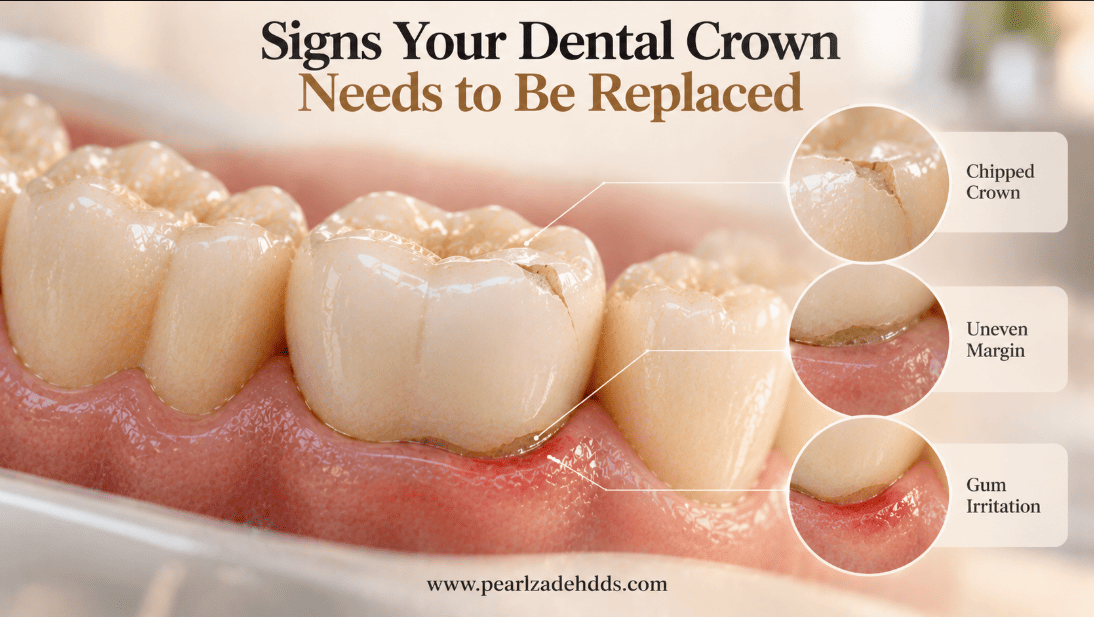
    Some signs come from the crown, such as a chip or a loose fit. Others point to the tooth or the gums, such as pain or a changed margin. Telling them apart is part of the exam. These signs warrant evaluation:

    • A crown that feels loose or moves.
    • A visible chip, crack, or broken section.
    • Persistent or worsening pain or sensitivity.
    • Changes around the crown margin, where the crown meets the tooth.
    • Repeated food trapping or difficulty cleaning around the crown.
    • A noticeable change in how the crown fits or meets the opposing teeth.

    None of these automatically means replacement. Some come from the crown, some from the tooth beneath it, and some from the gums. Cleveland Clinic lists a loose crown, cracks or chips, and sharp edges among reasons to call your dentist. A crown that moves slightly deserves a call even if it has not come off.

    Can a Loose Dental Crown Be Saved?

    Sometimes. A crown may loosen for several reasons. The cement may lose its hold, the underlying tooth may change, or the crown itself may be damaged. Your dentist may also check how much natural tooth remains to hold the crown.

    Loss of retention is a recognized problem. One retrospective study of 1,037 tooth-supported single crowns found loss of retention and recurrent caries the most common complications. The authors counted a crown as failed if it was removed or replaced. Loss of retention accounted for 26.5% of the 230 failures. That study reflects one dental school clinic, so it cannot predict your crown.

    Your dentist will examine the crown and the supporting tooth. Depending on the findings, the crown may sometimes be recemented. In other cases, another treatment may be needed.

    Do not wiggle the crown, use household glue, or try to recement it yourself. If it comes off, save it and call your dentist. Our article on what to do if your dental crown falls off explains the steps.

    Does a Cracked or Chipped Crown Need Replacement?

    Not always. The extent and location of the damage matter. A minor surface defect may be managed differently from a deeper crack. Damage that affects the crown’s integrity or exposes the tooth underneath is a different situation.

    Material plays a role. The ADA’s page on indirect restorative materials describes fracture and chipping as common complications of all-ceramic crowns. It also calls veneer chipping a common complication of porcelain-fused-to-metal crowns. Our article on how zirconia and porcelain crowns compare covers material differences.

    Repair is sometimes an option. A 2016 Operative Dentistry article says repair of restorations is mainly indicated for localized shortcomings. It says replacement is indicated when problems are multiple or severe and repair is not feasible. A Dental Update article on defective restorations says repair may be of value for porcelain loss or fracture.

    Your dentist weighs the crown material, the size of the damaged area, and the condition of the supporting tooth. A chipped crown cannot always be repaired. Not every visible defect needs a new crown. Mention any rough spot your tongue notices. A small rough area can still matter if it catches food or irritates your cheek.

    Can Pain or Sensitivity Mean a Crown Needs Replacing?

    Pain and sensitivity have several possible causes:

    • Bite contact that needs assessment.
    • Irritation of the tooth following treatment.
    • Decay or damage affecting the underlying tooth.
    • A crack in the tooth.
    • Gum or surrounding tissue problems.
    • A loose or damaged restoration.

    The AAE says sharp pain on biting may reflect decay, a loose filling, or a crack. It also notes that cracked-tooth pain may come and go, which can make the tooth hard to find. A dentist-focused Dental Economics article says complaints soon after placement are frequently caused by a high spot.

    MouthHealthy lists decay, fractured teeth, worn fillings, and gum disease among causes of sensitivity. Several of those involve the tooth or gums, not the crown.

    Describe when it hurts: with cold, with heat, when you bite, or with no trigger. Those details help narrow the cause. Pain alone does not prove a crown needs replacing. Your dentist must identify the cause before recommending treatment. Severe, worsening, spontaneous, or persistent pain warrants prompt evaluation.

    What If There Is Decay Under the Crown?

    A crown does not make the underlying tooth immune to decay. Decay can develop around the crown margin or in exposed natural tooth structure. In the Hawthan study, recurrent caries affected 8.6% of crowns. Cleveland Clinic notes that a poorly fitting crown can trap bacteria and lead to decay. Warning signs worth a check include a rough edge, food catching at the margin, or a bad taste. They do not prove decay.

    Your dentist may examine the margins, the surrounding tissues, and the tooth. X-rays can reveal damage or disease not visible during an exam, according to MouthHealthy. That means appearance alone cannot always show decay.

    Decay does not always mean the crown must be replaced. Treatment depends on the extent of the decay, the remaining tooth structure, and the condition of the crown. Daily cleaning matters here, as our article on caring for a new dental crown explains.

    What Do Changes Around the Crown Margin Mean?

    A dark line, a visible margin, or gum recession can have different explanations. Some changes relate to the crown material or how the crown meets the tooth. Others involve the gums or the underlying tooth. WebMD lists gum disease, aggressive brushing, and grinding or clenching among causes of gum recession.

    A dark margin does not automatically prove decay. Gum recession does not always require crown replacement. A dental evaluation can separate an esthetic concern from a structural or biological problem. Note what you see and when you first noticed it. Photos taken in the same light over time can help.

    What If Your Crown No Longer Fits Comfortably?

    You may notice a change in your bite. Chewing may be uncomfortable, food may keep trapping, or the crown may feel shifted.

    These symptoms have several possible causes. The restoration, the tooth, or the surrounding tissues may have changed. Your dentist can check the bite and the fit before deciding what suits you.

    Depending on the findings, the answer may be an adjustment, a repair, recementation, or replacement. Not every bite concern requires a new crown. If you recently had other dental work, mention it, since changes nearby may affect how your bite feels.

    Does an Old Dental Crown Always Need to Be Replaced?

    No. Age alone does not decide whether a crown needs replacement. The crown’s condition, fit, and margins matter more than a fixed age. So do the supporting tooth, your gums, and your symptoms.

    Regular exams let your dentist watch the margins and the surrounding tissue over time. Some crowns stay serviceable for many years. Others develop problems sooner. No universal replacement schedule applies, and a crown does not follow a predictable timetable. Our article on how long porcelain crowns last discusses lifespan in more depth.

    What Happens If Your Dentist Recommends Replacing a Crown?

    Your dentist will assess the situation first. The process usually includes these steps:

    • Reviewing your symptoms and dental history.
    • Examining the crown, margins, gums, and underlying tooth.
    • Checking your bite when indicated.
    • Taking X-rays when clinically appropriate.
    • Deciding whether repair, adjustment, recementation, or replacement is suitable.

    Replacement means removing the existing crown and placing a new one. The details depend on your tooth and your treatment plan. If the underlying tooth needs treatment, that may need to be addressed before a new crown is placed. Ask what the exam found, which options apply, and what each involves. Your dentist may also discuss the material and design for a new crown. Those choices depend on your tooth and your bite.

    When Should You Contact Your Dentist About a Crown?

    Arrange an evaluation if a crown is loose, damaged, painful, or noticeably changed. You do not need to wait until it falls off or breaks completely. If you are unsure whether a problem is urgent, call and describe it. The office can advise your next step.

    Seek prompt assessment for worsening pain, swelling, or signs of infection. Facial swelling with difficulty breathing or swallowing needs emergency medical attention. Mayo Clinic advises going to the emergency room for trouble breathing or swallowing, in its guidance on tooth abscess.

    Have the Crown and the Tooth Examined Together

    A loose crown, visible damage, persistent discomfort, or changes around the crown can warrant an exam. None of them automatically proves that replacement is necessary. Your dentist must assess both the crown and the tooth underneath to choose the right treatment. Even mild or unclear changes deserve a look, since an exam can reassure you or catch a problem early. Dr. Pearl Zadeh can evaluate your crown and explain your options. You can learn more about dental crown treatment at Pearl Zadeh DDS.

    Call (818) 716-6722 or click the button below to schedule your consultation online.

    Frequently Asked Questions

    How do I know if my dental crown needs replacing?

    You cannot tell from symptoms alone. Looseness, damage, pain, or margin changes warrant an exam. Your dentist decides whether repair or replacement fits.

    How long should a dental crown last before replacement?

    No fixed schedule applies. Replacement depends on the crown’s condition, the tooth, the gums, and your symptoms, not on age alone.

    Can a dentist repair a damaged crown instead of replacing it?

    Sometimes. It depends on the material, the size of the damage, and the condition of the tooth. Some damage cannot be repaired.

    Can a tooth develop decay under a dental crown?

    Yes. A crown does not make the tooth immune to decay. Regular cleaning and exams help your dentist catch problems.

    Should a loose dental crown be replaced immediately?

    It should be evaluated promptly. Replacement is not always needed. Your dentist may recement the crown or recommend another treatment.

    The information above is for informational purposes only and is not a substitute for professional dental advice. Please schedule a consultation with Pearl Zadeh DDS to discuss your specific situation.
  • What Is a Temporary Crown and How to Care for It?

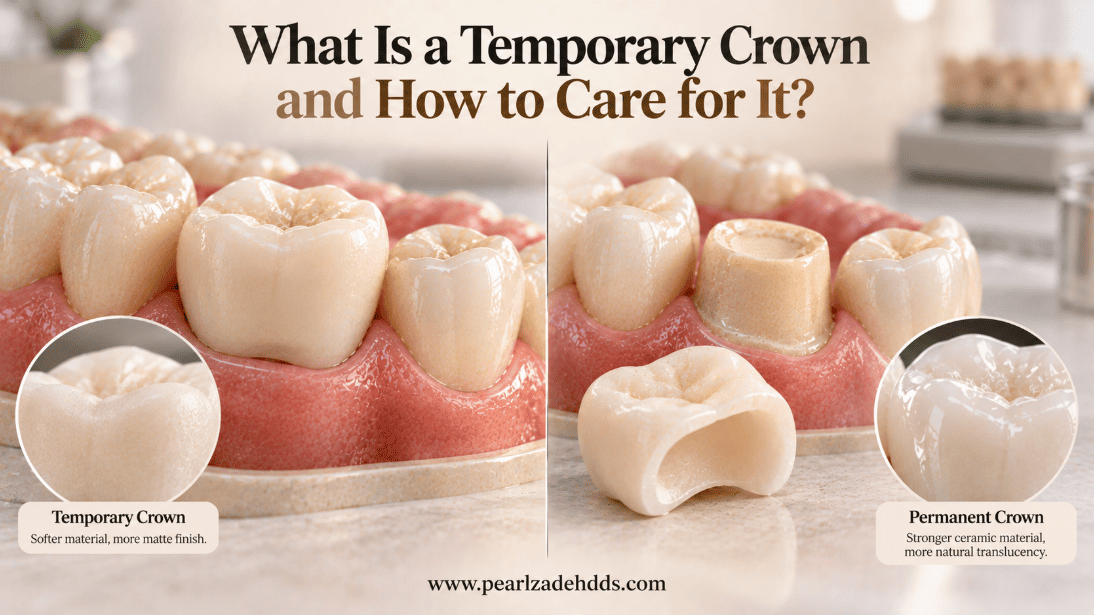
    What Is a Temporary Crown and How to Care for It?

    Your tooth has been prepared for a crown, and the numbness is fading. A temporary restoration now covers the tooth while your final crown is made. You may wonder how careful you need to be.

    A temporary crown serves a different purpose from a permanent one. It protects the tooth for a limited time, and it often needs extra care. Your dentist’s own instructions come first.

    Temporary crowns come in different materials and designs, so your care may differ from another patient’s. Ask your dentist what applies to your tooth.

    What Is a Temporary Dental Crown?

    Dentists use a temporary crown to cover and protect a prepared tooth until the permanent restoration is ready. A 2023 British Dental Journal article says provisionals should protect the pulp and secure positional stability, function, and esthetics. Common purposes include:

    • Protecting the prepared tooth.
    • Reducing sensitivity and discomfort.
    • Helping maintain the tooth’s shape and position.
    • Supporting chewing and appearance during the waiting period.

    Materials vary. A dentist-reviewed Healthline article quotes a dentist describing relatively weak plastics such as ethyl methacrylates and bisacrylics. One review in the Journal of the Irish Dental Association says the literature tends to favor acrylic resin. It adds that no ideal material exists. That review dates from 2004.

    The material and design depend on the clinical situation and your dentist’s workflow. Not every temporary crown offers the same protection or strength. A temporary may also look different from your final crown, since its shape and shade can differ.

    Why Do You Need a Temporary Crown?

    A permanent crown may need laboratory fabrication or additional preparation before placement. One dentist-reviewed WebMD article says a lab may need two to three weeks to make a permanent crown. Your timeline may differ.

    The temporary crown protects the prepared tooth during that interval. It also lets your dentist assess the tooth and proceed with the planned restoration at a later appointment.

    Healthline says a temporary crown protects the tooth and gums, helps you chew, and keeps spacing between teeth. Those jobs matter while the tooth waits.

    The number of appointments and the time between them vary. They depend on your treatment plan, the material, and your individual case.

    How Long Does a Temporary Crown Last?

    A temporary crown is built for short-term use, not long-term service. How long it stays in place depends on several factors:

    • The material and the fit of the crown.
    • The cement used to hold it.
    • The tooth’s location and the chewing forces on it.
    • Your individual habits.

    Heavier chewing forces on back teeth may affect how securely a temporary stays in place. Habits such as grinding can matter too.

    No universal number of days or weeks applies. The Healthline article quotes a dentist describing a weakened temporary cement purposely designed not to last long. Follow your dentist’s instructions and the appointment schedule they planned.

    Contact the office if the crown becomes loose or damaged before your permanent appointment. Permanent crowns follow a different timeline. Our article on how long porcelain crowns last covers that contrast.

    What Can You Eat With a Temporary Crown?

    You do not need a restrictive diet. A few sensible habits go a long way. If chewing feels awkward at first, soft foods such as eggs, yogurt, or cooked vegetables are an easy choice. Keep these habits in mind:

    • Choose foods that are comfortable to chew.
    • Cut firmer foods into smaller pieces.
    • Chew on the opposite side when possible.
    • Be cautious with sticky, chewy, hard, or crunchy foods.

    Those foods may dislodge or damage a temporary restoration. Examples include chewing gum, caramel, hard sweets, ice, and very crunchy foods. One student-written handout from the University of the Pacific dental school offers an example. It advises avoiding sticky, hard, and crunchy foods on that side to keep the temporary in place.

    Cleveland Clinic warns that ice cubes, extremely hard nuts, popcorn kernels, and sticky taffy can damage or dislodge crowns. The right precautions depend on the tooth, the restoration, and your dentist’s instructions.

    How Should You Brush and Floss Around a Temporary Crown?

    Keep cleaning your teeth, but do it carefully. MouthHealthy advises brushing twice a day with a soft-bristled brush. Brush gently around the crown and along the gumline. Aggressive scrubbing can irritate the gums and may loosen the temporary.

    Clean between your teeth daily. Do not stop flossing. Technique matters, though, because pulling floss upward against a temporary crown may dislodge it in some situations. Sources describe slightly different methods. The Pacific handout says to pull the floss out from the side instead of lifting it up. Healthline says to slide floss gently in and out rather than pulling it down.

    Ask your dentist which technique suits your crown and how to remove floss around it. MouthHealthy also says never to snap floss into the gums.

    Is Sensitivity Normal With a Temporary Crown?

    Some sensitivity to temperature, pressure, or chewing can occur after tooth preparation. The Pacific handout says sensitivity to cold or pressure may occur when the anesthetic wears off. Symptoms vary, and they should not automatically be dismissed as normal. Do not assume pain is normal simply because the crown is temporary.

    The American Association of Endodontists says recent dental work may inflame the tooth’s pulp and cause a temporary symptom. It advises a dentist or endodontist to check the tooth if pain persists or worsens. A 2019 literature review notes that this inflammatory response can be transient or persist.

    Mild sensitivity that is improving differs from pain that is severe, persistent, worsening, or spontaneous. Sensitivity may relate to the prepared tooth, the surrounding tissues, your bite, or another dental problem. Tell your dentist which triggers you notice: cold, heat, pressure, or chewing. Those details help narrow the cause. Contact your dentist if your symptoms concern you.

    What Should You Avoid While Wearing a Temporary Crown?

    These precautions protect the restoration and the tooth beneath it:

    • Avoid chewing ice or very hard objects.
    • Avoid sticky foods that may pull on the crown.
    • Do not use the crowned tooth to open packaging.
    • Avoid biting directly into very firm foods with the temporary.
    • Do not file, grind, glue, or adjust the crown yourself.

    MouthHealthy warns that chewing ice and using teeth as tools can crack teeth. Temporary crowns can be less durable and less securely retained than permanent ones. The Irish review notes that low strength and crack propagation are common causes of failure in acrylic restorations.

    What Should You Do If Your Temporary Crown Feels Loose or Falls Off?

    Stay calm. A loose temporary is a common problem, and a clear response helps:

    • Contact the dental office for instructions.
    • Save the crown, and any pieces, in a clean container if it comes off.
    • Avoid chewing on the affected tooth.
    • Keep the area clean without aggressive brushing.
    • Do not use household glue or force the crown back into place.

    If the crown comes off after hours, check your dentist’s voicemail or website for instructions.

    Your dentist may be able to recement or replace the temporary, depending on its condition and the tooth. Healthline notes that your dentist is likely to replace it with another temporary crown. Our article on what to do if a dental crown falls off gives more detailed instructions.

    Significant pain, swelling, or signs of infection warrant prompt assessment. Mayo Clinic advises going to the emergency room for trouble breathing or swallowing. Seek emergency medical attention for those symptoms.

    When Should You Contact Your Dentist About a Temporary Crown?

    Contact your dentist if the temporary crown does any of the following:

    • Comes loose or falls off.
    • Cracks or breaks.
    • Feels noticeably high or uneven when you bite.
    • Causes significant or worsening pain.
    • Is associated with swelling or persistent gum irritation.

    WebMD notes that a temporary crown may be taller than the other teeth and inflame a nearby tooth. Symptoms alone cannot identify the cause. Your dentist can evaluate the crown, the prepared tooth, your bite, and the surrounding tissues. Call even if the problem seems small, and the office can tell you whether you need a visit.

    Why Is It Important to Attend Your Permanent Crown Appointment?

    A temporary crown is not meant to replace the final crown indefinitely. Your final crown is made for your tooth, and the temporary is only a stand-in. The dentist needs to assess the tooth and place the planned permanent restoration when appropriate.

    Delaying the appointment can leave the prepared tooth dependent on a temporary restoration for longer than intended. Not every delay causes damage. The risk depends on the tooth, the restoration, and the clinical circumstances. At placement, your dentist can also check the permanent crown’s fit and bite.

    Some treatment plans use provisional restorations for longer periods for specific reasons. Follow the schedule your dentist gave you. If you need to reschedule, contact the office. Bring questions to the visit, and mention any sensitivity or bite changes you noticed while wearing the temporary.

    A Temporary Crown Needs Careful Handling Until the Permanent Crown Arrives

    A temporary crown protects a prepared tooth while the permanent restoration is made. It needs careful handling during that period. Follow your dentist’s instructions, call if the crown loosens or symptoms worsen, and attend your planned appointment. Dr. Pearl Zadeh can evaluate your tooth and explain next steps. For broader aftercare, see our article on caring for a new dental crown. You can also learn more about dental crown treatment at Pearl Zadeh DDS.

    Call (818) 716-6722 or click the button below to schedule your consultation online.

    Frequently Asked Questions

    How long can you keep a temporary crown?

    No universal timeline applies. A temporary crown is meant for short-term use. Follow your dentist’s schedule and call if it loosens or breaks

    Can you brush and floss with a temporary crown?

    Yes. Brush gently and clean between your teeth daily. Ask your dentist how to remove floss without lifting the crown.

    What foods should you avoid with a temporary crown?

    Be cautious with sticky, chewy, hard, and crunchy foods, such as caramel, gum, hard sweets, and ice. Chew on the other side when you can.

    What should you do if your temporary crown falls off?

    Call your dental office. Save the crown in a clean container and avoid chewing on that tooth. Do not use household glue or force it back.

    Is pain normal after getting a temporary crown?

    Some sensitivity can occur. Severe, persistent, worsening, or spontaneous pain deserves a call to your dentist.

    The information above is for informational purposes only and is not a substitute for professional dental advice. Please schedule a consultation with Pearl Zadeh DDS to discuss your specific situation.
  • What Happens If Your Dental Crown Falls Off?

    What Happens If Your Dental Crown Falls Off?

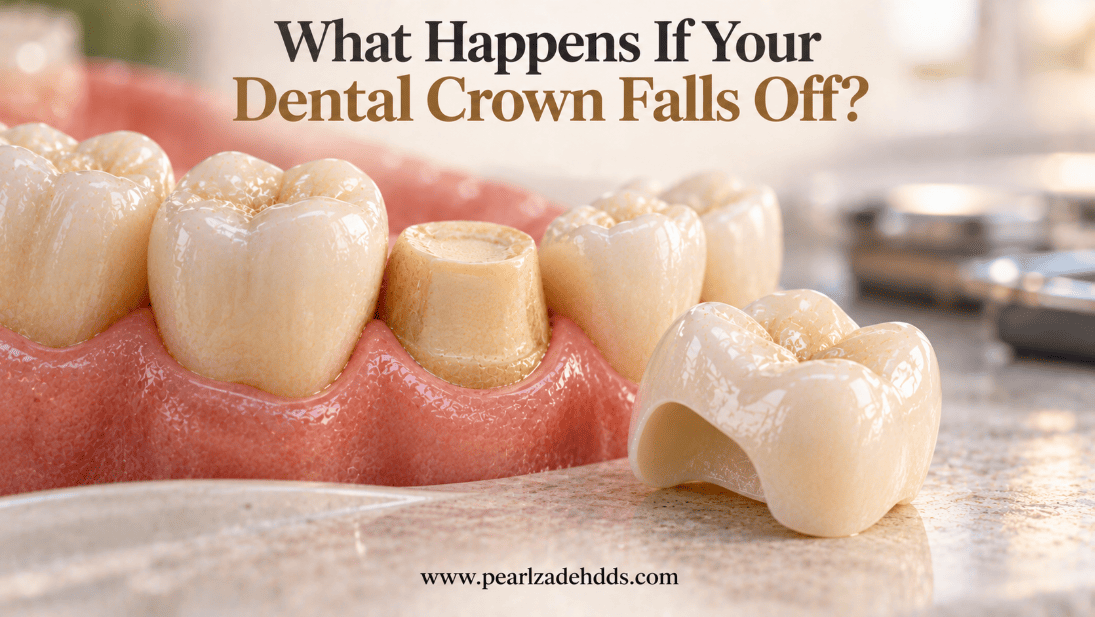
    Your crown just came off, and the tooth underneath feels exposed. It may react to air, cold, or chewing. You may also wonder whether this is an emergency.

    A crown that comes off leaves the prepared tooth uncovered. The right next step depends on your symptoms and on the condition of the crown and the tooth. Often, the first step is a prompt call to your dentist.

    You may notice a sharp edge, a gap, or sensitivity. Those observations help your dentist, but they do not show the cause.

    What Should You Do If Your Dental Crown Falls Off?

    Follow this sequence:

    1. Stay calm and look for the crown. Do not swallow it.
    2. Handle it carefully and store it in a clean container.
    3. Rinse your mouth gently with water.
    4. Avoid chewing on the affected side.
    5. Contact your dentist for instructions and an appointment.
    6. Protect the exposed tooth from foods and temperatures that trigger discomfort.

    These steps protect the tooth and the crown until you are seen. They do not replace an exam.

    Write down when the crown came off and what you felt. Note any food or event involved. Those details help your dentist.

    A dentist-reviewed Healthline article also advises saving the crown and calling your dentist to ask about special instructions. For a broken crown, Cleveland Clinic advises seeing your dentist as soon as possible and bringing the restoration.

    Do not force the crown back into place. If it feels unstable, does not fit easily, or hurts when you position it, leave it out. Call your dentist instead. Do not use household glue or other unapproved adhesives.

    A crown that came off intact differs from one that broke. It also differs from one that took part of the tooth with it. Tell the office which one you have.

    Is It a Dental Emergency If a Crown Falls Off?

    A fallen crown does not always need an emergency-room visit, but do not ignore it. Cleveland Clinic defines a dental emergency as any dental problem that requires immediate attention. Not every detached crown is equally urgent. If you are unsure whether your symptoms are urgent, call and describe the pain, any swelling, and any fever. Check your dentist’s voicemail or website for after-hours instructions if the office is closed.

    A crown that came off with mild sensitivity usually calls for prompt contact with your dentist. Some symptoms call for urgent assessment:

    • Severe or worsening pain.
    • Facial or gum swelling.
    • Fever or signs of spreading infection.
    • Significant damage to the tooth.
    • Difficulty swallowing or breathing.

    The American Association of Endodontists notes that gum swelling with constant, severe pain may indicate an abscess. Mayo Clinic advises going to the emergency room for trouble breathing or swallowing. It gives the same advice for facial swelling with fever when you cannot reach your dentist.

    Difficulty breathing or swallowing, or rapidly spreading facial or neck swelling, needs emergency medical attention. An emergency room can treat pain and swelling. Cleveland Clinic notes that ER staff do not perform restorative treatments such as crowns. You will still need your dentist afterward.

    Why Did My Dental Crown Fall Off?

    Several explanations are possible, and symptoms alone cannot show which one applies:

    • Weakening or loss of the cement holding the crown.
    • Decay affecting the underlying tooth.
    • Damage to the crown or the supporting tooth.
    • Heavy biting forces, clenching, or grinding.
    • Changes in the tooth or restoration over time.
    • Problems with the fit or retention of the restoration.

    The Healthline article lists similar causes, including decay under the crown and too little cement. One retrospective study of 1,037 tooth-supported single crowns found loss of retention and recurrent caries the most common complications. Loss of retention occurred in 9.9% of crowns over a mean follow-up of about 11 years. The authors also found that bruxism significantly influenced crown survival.

    That study describes one group of patients. It cannot predict what happened with your crown. A crown that loosened gradually may feel different from one that came off suddenly while chewing. Neither pattern shows the cause.

    A crown coming off does not automatically mean your dentist made an error. It also does not always mean decay. An exam is needed to identify the cause.

    What Should You Do With the Crown That Fell Off?

    Keep it safe. Place it in a clean container and bring it to your appointment. Do not scrub it aggressively. Never bend any attached parts or try to repair it. Bring any pieces too, since a small fragment can matter.

    Tell your dentist if the crown is cracked, broken, or missing part of its structure. That helps them judge whether it can be used again.

    If you cannot find the crown, still contact the dental office. Your dentist can evaluate the exposed tooth without the original restoration.

    Can You Put a Dental Crown Back On Yourself?

    No. Do not force a crown back into place. Also avoid household glue, superglue, and other non-dental adhesives.

    Temporary dental repair products are sold over the counter. Contact your dentist before using one. The crown may not fit correctly, and the tooth underneath may need treatment. Reseating a crown over decay or a crack may hide a problem that still needs care.

    Your dentist needs to check the fit, the condition of the tooth, and your bite. Only then can they decide whether the crown can be recemented.

    What Happens If You Leave the Tooth Without Its Crown?

    A prepared tooth may be more vulnerable when left unprotected. Possible problems include sensitivity, discomfort, damage, or further deterioration.

    The level of risk depends on the tooth’s condition and how much natural tooth structure remains. Damage is not inevitable. Not every exposed tooth develops decay. Waiting still adds uncertainty, and your dentist can judge the risk for your tooth.

    Still, do not wait for pain to develop. The Healthline article advises soft foods, chewing on the other side, and gentle brushing until you are seen. Avoid sticky, hard, or chewy foods too. Watch for new sensitivity, a rough edge, a crack, or gum irritation while you wait. Report anything new when you call.

    Skip home remedies for pain. MouthHealthy warns against placing aspirin on an aching tooth or gums because it may burn the tissue.

    What Happens at the Dentist After a Crown Falls Off?

    Your visit will likely include several steps:

    • Your dentist asks when the crown came off and whether symptoms have changed.
    • They examine the crown and the underlying tooth.
    • They check for decay, cracks, damage, and other problems.
    • They assess the fit and condition of the crown.
    • They may use additional testing or X-rays when indicated.

    Your dentist may also check your bite, since bite forces can contribute to a crown loosening.

    X-rays can reveal damage or disease not visible during an exam, according to MouthHealthy. Not every patient needs every test.

    The outcome depends on what the exam finds:

    • The existing crown may be suitable for recementation if it and the tooth remain in good condition.
    • The tooth may need treatment before a crown can be replaced.
    • A new crown may be necessary if the original is damaged, no longer fits, or cannot be used safely.

    The original crown cannot always be reused. Your dentist will explain what applies to your tooth. Ask what the exam found and what each option involves.

    What If a Temporary Crown Falls Off?

    Temporary crowns are generally less securely retained than permanent ones. The Healthline article describes a temporary crown as a placeholder held with temporary cement. It may come loose before final placement.

    Contact your dental office for instructions. Avoid chewing on the affected side. A dentist-reviewed WebMD article advises avoiding hard, sticky, very hot, or very cold foods with a temporary crown.

    A temporary crown that falls off still deserves attention, even if it causes little or no pain. Your dentist can advise how to protect the tooth until your next appointment. Bring the temporary crown to your visit if you have it. Do not try to reseat it yourself.

    How Can You Reduce the Risk of Losing a Crown Again?

    No routine guarantees a crown will stay in place. These habits help:

    • Follow your dentist’s instructions after crown placement.
    • Brush and clean between your teeth consistently.
    • Attend recommended dental examinations.
    • Avoid chewing ice or using your teeth to open packaging.
    • Tell your dentist if you clench or grind regularly.
    • Seek an assessment if a crown begins to feel loose or changes when you bite.

    Early attention matters. A crown that feels loose may be easier to address before it comes off.

    MouthHealthy warns that chewing ice and using teeth as tools can crack teeth. It also says a dentist may recommend a night guard for grinding. Good hygiene alone cannot prevent every crown from loosening. Our article on caring for a new dental crown covers daily habits.

    Save the Crown, Skip the Glue, and Call Your Dentist

    If a crown comes off, save it if possible and avoid do-it-yourself repairs. Protect the exposed tooth and contact your dentist for instructions. Your dentist will decide whether the original crown can be reused or whether another treatment is needed. If you have trouble breathing or swallowing, seek emergency medical care instead. Dr. Pearl Zadeh can evaluate the crown and the tooth and explain your next steps. You can learn more about dental crown treatment at Pearl Zadeh DDS.

    Call (818) 716-6722 or click the button below to schedule your consultation online.

    Frequently Asked Questions

    Can I eat if my dental crown falls off?

    You can eat carefully. Chew on the other side and choose soft foods. Avoid sticky, hard, very hot, or very cold foods until you are seen.

    How soon should I see a dentist after a crown falls off?

    Call as soon as you can. Your dentist’s office will advise how soon to come in. Severe pain, swelling, or fever needs prompt attention.

    Can a dentist put my old crown back on?

    Sometimes. It depends on the condition of the crown and the tooth beneath it. If the crown is damaged or no longer fits, a new one may be needed.

    What should I do if my crown falls off but does not hurt?

    Still call your dentist. A painless tooth can still be vulnerable. Your dentist can advise how to protect it until you are seen.

    Can a crown fall off because of tooth decay?

    Yes, decay is one possible cause. Worn cement, grinding, and fit problems are others. Only an exam can show which applies.

    The information above is for informational purposes only and is not a substitute for professional dental advice. Please schedule a consultation with Pearl Zadeh DDS to discuss your specific situation.
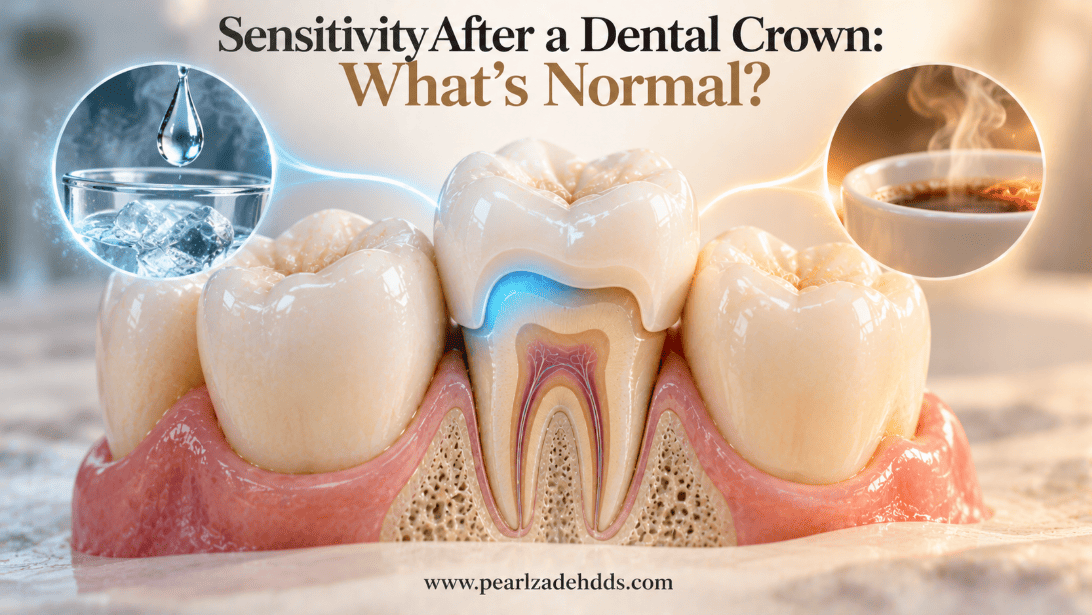
  • Why Does My Dental Crown Look Different From My Other Teeth?

    Why Does My Dental Crown Look Different From My Other Teeth?

    Your crown looks too white. Or it looks too dark, too opaque, or just slightly off next to the teeth beside it. Patients often notice this in daylight or in a photo.

    A crown restores a tooth’s function and appearance. Matching a natural tooth is still challenging. The reason for the difference decides which solutions may be possible.

    Some crowns never matched. Others looked fine at first and changed later. A shade mismatch, surface staining, changes in natural teeth, and material limits are different problems. Each one calls for a different response.

    Why Does My Dental Crown Look Different From My Other Teeth?

    Several factors can combine to make a crown stand out:

    • Shade mismatch. The crown may be lighter or darker than the neighboring teeth.
    • Translucency differences. Natural enamel lets light pass through and scatter. Some crown materials reproduce that differently.
    • Surface texture and finish. Gloss, contour, and texture change how a crown reflects light.
    • Changes in natural teeth. Neighboring teeth can darken or stain while the crown keeps much of its original shade.
    • Lighting. A crown can look different in daylight, indoor light, and flash photos.
    • Material and design. Different ceramic systems have different optical properties.

    Materials do differ. The ADA’s page on indirect restorative materials says lithium disilicate is more translucent than any zirconia. It also says framework zirconia is veneered with porcelain or glass-ceramic for a tooth-like look because of its opacity. Our article on how zirconia and porcelain crowns compare covers the details.

    A crown’s appearance depends on more than its basic shade. Shape, translucency, surface characteristics, and the surrounding teeth all affect the result. Natural teeth also often vary in color from the gumline to the biting edge. Reproducing that variation is difficult.

    Why Does My New Crown Look Too White or Too Dark?

    A crown that looks too white may have a shade that does not match its neighbors. It may also look too opaque, or reflect light differently from the teeth beside it. An opaque crown can look flat next to translucent neighbors. Shape and surface gloss can also make a crown look brighter than its neighbors when the shade is close.

    A crown that looks too dark may reflect a shade mismatch or a different translucency. Surrounding teeth that have changed color can also make it look darker. A dark appearance does not automatically mean the crown is damaged or decaying.

    Lighting can exaggerate differences. A Dental Products Report article for dentists on shade matching lists poor lighting as a common problem. It advises confirming a shade in daylight and under a second light source. Photographs and bathroom lighting may also exaggerate differences.

    If the crown looked acceptable at first, ask what has changed: the crown, the neighboring teeth, or the lighting. That question narrows the possibilities. Do not try to diagnose the cause from appearance alone. If the difference persists in different lighting, have it assessed.

    Can a Dental Crown Change Color Over Time?

    Natural teeth change. MouthHealthy, the ADA’s consumer site, lists coffee, tea, red wine, tobacco, trauma, and some medications as causes of discoloration. It also notes that enamel thins over time, so more yellowish dentin shows through.

    Crown materials behave differently from enamel. Ceramic crowns are often relatively resistant to discoloration, but materials differ. In a 2021 laboratory study of CAD/CAM materials, coffee caused color changes the authors called clinically acceptable. The three materials tested did not change equally. Polished surfaces were rougher than glazed ones. The authors tested only coffee and one polishing kit.

    Finish matters too. A 2025 systematic review of lithium disilicate found that polished specimens changed color more than glazed ones. All the included studies were laboratory studies, and the results varied widely. None of this proves how your own crown will behave.

    Natural tooth optics shift with age as well. A 2015 review in the Journal of Biomedical Optics reports that enamel translucency increases with age. Dentin changed little. The author notes that few clinical measurements exist.

    A crown can also look different because the neighboring teeth darkened. Its surface may have worn or been damaged. A crown that looks different over time has not necessarily changed color itself. Wear or damage to its surface may also scatter light differently, so the crown can look duller than before.

    No crown is guaranteed to stay stain-free. Daily cleaning helps limit surface deposits, as our article on caring for a new dental crown explains. For a longer view, see how long porcelain crowns last.

    Can You Whiten a Dental Crown?

    Not in the usual way. Conventional whitening does not lighten the underlying shade of an existing crown as it lightens natural teeth. MouthHealthy states that whitening will not work on caps, veneers, crowns, or fillings. The ADA says only natural teeth can be whitened, not tooth-colored restorations.

    Whitening your natural teeth can make a mismatch more noticeable. The ADA notes that bleaching could result in differences between natural teeth and restorations, which will not change color. Our page on professional teeth whitening covers whitening for natural teeth. That is a separate decision from fixing a crown. Your dentist can tell you whether it suits your situation.

    Professional cleaning may help when the difference comes from removable surface deposits. The result depends on the material and the crown’s condition. Cleaning cannot correct every intrinsic shade mismatch. A cleaning also lets your dentist judge what is surface and what is shade.

    Stronger products, longer sessions, and abrasive toothpaste will not change a crown’s underlying color. Do not try home polishing or color correction.

    How Can a Dentist Correct a Crown Color Mismatch?

    Your dentist starts by working out which problem you have. A surface stain, a shade mismatch, and a change in the neighboring teeth need different responses. Matching the response to the cause avoids unnecessary treatment.

    Treatment depends on the cause, the material, the tooth’s location, and the crown’s condition. Possible approaches include:

    • Professional cleaning or polishing. This may help with certain surface stains or deposits when it suits the restoration.
    • Minor surface refinishing. This may be considered for specific surface or finish concerns, depending on the material and the adjustment needed.
    • Whitening the natural teeth. This may fit when the natural teeth are darker than desired and the crown’s shade is otherwise acceptable. The crown will not whiten with them.
    • Replacing the crown. This may be considered when a shade or translucency mismatch is significant and less invasive methods cannot correct it.

    Not every crown can be recolored, polished, or modified to match naturally. Replacement is not automatically necessary for every difference in appearance.

    Does Replacing a Crown Mean the New One Will Match Better?

    Replacement may allow your dentist and the dental laboratory to choose a different shade, translucency, contour, and surface finish. A better match is possible, but it is not guaranteed.

    The result depends on the assessment, shade selection, material, and design. Communication with the laboratory matters when one is involved. So do the clinical circumstances.

    Your dentist should also consider the surrounding teeth and the appearance you want. If you plan to whiten, discuss the timing and the final shade before the replacement crown is made. No crown can be promised as indistinguishable from natural teeth.

    Tell your dentist what bothers you about the current crown. Say whether it looks too white, too dark, or too flat. Specific feedback helps with shade selection.

    Should You Whiten Your Teeth Before Getting a New Crown?

    Planning matters here. Whitening changes natural tooth color, but a new crown is made to a selected shade. The ADA notes that restorative materials generally do not change color. It also warns that patient expectations may not be met without addressing cosmetic issues with existing restorations. They may also be unrealistic.

    Your dentist may recommend coordinating whitening and shade selection. That way the final restoration is planned around the tooth color you want.

    If a crown is being replaced and you plan to whiten, tell your dentist early. That allows one coordinated plan instead of two separate decisions.

    No universal waiting period applies after whitening. Timing depends on the whitening method, your circumstances, and your dentist’s recommendations.

    When Should You Have a Crown’s Appearance Checked?

    A cosmetic difference alone is not always an emergency. Still, a dentist should evaluate a crown that develops a new or unexplained change in appearance. Pay particular attention to these signs:

    • A chip, crack, or rough area.
    • A crown that feels loose.
    • Pain or sensitivity.
    • Swelling or bleeding around the crown.
    • A visible dark area near the crown margin.

    Cleveland Clinic lists cracks, chips, and a loose crown among reasons to call your dentist. A dark line or color change does not by itself prove decay. Only an exam can assess the crown, the tooth, and the surrounding tissues. Note when you first noticed a change. Photos taken in the same light over time can help show whether anything has changed.

    The Right Fix Depends on Why the Crown Looks Different

    A crown may look different because of its shade, translucency, surface, staining, or changes in the neighboring teeth. The right correction depends on the cause, the material, and the crown’s condition. Surface stains and intrinsic shade mismatches are different problems, and only an exam can separate them. If a crown’s appearance concerns you, Dr. Pearl Zadeh can evaluate it and explain your options. You can learn more about dental crown treatment at Pearl Zadeh DDS.

    Call (818) 716-6722 or click the button below to schedule your consultation online.

    Frequently Asked Questions

    Can a dental crown be whitened?

    Not like natural teeth. Whitening does not lighten the underlying shade of an existing crown. Cleaning may remove surface deposits.

    Why does my crown look whiter than my natural teeth?

    The shade may be lighter than your neighbors, or the crown may look more opaque. Natural teeth can also darken over time while the crown keeps its shade.

    Can a dentist change the color of an existing crown?

    Sometimes a surface stain can be addressed. An intrinsic shade mismatch usually cannot be recolored. Your dentist can tell which applies.

    Will whitening my natural teeth make my crown look darker?

    It can look that way. Your natural teeth lighten, but the crown does not change. The mismatch may become more noticeable.

    Does a crown that changes color need to be replaced?

    Not always. Surface staining or changes in neighboring teeth may have other solutions. An exam shows which options fit.

    The information above is for informational purposes only and is not a substitute for professional dental advice. Please schedule a consultation with Pearl Zadeh DDS to discuss your specific situation.

  • Sensitivity After a Dental Crown: What’s Normal?

    Sensitivity After a Dental Crown: What’s Normal?

    Your new crown looks right, but the tooth feels off. A cold drink may sting. Hot coffee may send a jolt. Chewing may feel tender, or the gum around the tooth may ache.

    Some of these sensations can occur after crown treatment. The cause and the expected course vary, so the type and pattern of your symptoms matter. Mild sensitivity that is improving differs from pain that is severe, lingering, or getting worse. Your dentist can evaluate any symptom that concerns you.

    Is Tooth Sensitivity Normal After a Dental Crown?

    It can occur. Preparing a tooth for a crown means reshaping it. That can irritate the tooth for a time, and the tooth may react to temperature or pressure.

    A 2019 literature review of 43 articles covers sensitivity after fixed prosthesis treatment. It notes that prepared vital teeth go through a pulpal inflammatory process during preparation. That response can be transient or persist. The authors called the evidence on mechanism and prevention not conclusive.

    The American Association of Endodontists (AAE) says recent dental work may inflame the tooth’s pulp, causing a temporary symptom. It advises a dentist or endodontist to check the tooth if pain persists or worsens.

    Not every patient has sensitivity. It does not always fade on its own. The tooth’s condition before treatment can shape how it reacts. Severity and pattern help separate mild, improving sensitivity from symptoms that need attention.

    What Does Sensitivity After a Crown Feel Like?

    Patients describe several patterns:

    • Sensitivity to cold drinks or foods.
    • Sensitivity to hot foods or beverages.
    • Brief discomfort when biting or chewing.
    • Tenderness around the treated tooth.

    MouthHealthy is the ADA’s consumer site. It describes sensitive teeth as pain from a sip of hot coffee or a taste of ice cream. You may notice one pattern or several. Symptoms may come only with certain triggers, or they may seem to come and go. These symptoms can have different causes. No single symptom proves a specific diagnosis.

    Why Is My Tooth Sensitive After a Crown?

    Several explanations are possible. Your dentist can sort out which one fits:

    • Irritation after tooth preparation and restorative treatment.
    • Temporary inflammation of the dental pulp, the tissue inside the tooth.
    • Changes in how the tooth responds to temperature.
    • A crown or bite-related issue that needs assessment.
    • An existing crack, decay, or another underlying tooth problem.
    • Gum or surrounding tissue irritation.

    Some of these have support. The AAE says a crack, decay, or a loose filling may cause sharp pain on biting. MouthHealthy lists decay, fractured teeth, worn fillings, and gum disease among causes of sensitivity.

    Gum irritation near the crown edge can add tenderness. Bleeding gums are a separate concern from tooth sensitivity. Our article on bleeding gums after a dental crown covers it.

    Pulp inflammation can be temporary or can persist, so the course varies. Sensitivity does not automatically mean the crown was poorly made. It does not automatically mean the tooth needs a root canal. The exam findings decide what comes next.

    How Long Does Sensitivity Last After a Crown?

    No single timeline applies to everyone. Duration depends on the tooth’s condition before treatment, the procedure, and the nature of your symptoms. Other individual factors play a role too.

    Offices give different guidance. One student-written handout from the University of the Pacific dental school says some discomfort is expected. It says that discomfort usually fades in a couple of days. The handout asks patients to call if sensitivity lasts beyond a few days. Treat that as one example, not a rule for your tooth. Teeth that were inflamed, cracked, or deeply restored before treatment may respond differently from healthier teeth. Your dentist knows your history and can set expectations for your tooth.

    Pattern matters more than a day count. The AAE describes lingering pain after hot or cold foods as a possible sign of pulp damage. It says this pain typically lasts more than 30 seconds. The page advises seeing a dentist or endodontist as soon as possible. A Journal of the Canadian Dental Association article describes irreversible pulpitis. Its listed symptoms include intense, lingering pain to temperature changes and spontaneous pain. Only a dentist can make that diagnosis.

    Brief sensitivity that gradually improves differs from pain that lingers after a temperature trigger. Pain with no obvious trigger deserves attention, and so does pain that grows more intense. These descriptions do not let you diagnose yourself.

    Is Sensitivity Different With Temporary and Permanent Crowns?

    A temporary crown protects the prepared tooth while the permanent crown is made. Temporary crowns can differ from permanent ones in material, shape, and cement. The tooth may feel different at each stage.

    The Pacific handout offers one example. For a temporary, it says sensitivity to cold or pressure may occur once the anesthetic wears off. A final crown differs, the handout says. It may feel tight, and hot or cold sensitivity may appear.

    Follow your dentist’s instructions for each stage. Contact the office if a temporary crown loosens or falls out. A loose temporary may leave the tooth exposed. Call as well if your symptoms concern you. Mention any sensitivity you noticed during the temporary stage at your permanent crown visit.

    What Can Help With Sensitivity After a Crown?

    These steps are cautious and practical:

    • Follow your dentist’s aftercare instructions.
    • Avoid foods or drinks that reliably trigger discomfort while the tooth is sensitive.
    • Choose comfortable foods if chewing is uncomfortable.
    • Keep brushing gently and cleaning between your teeth daily.
    • Ask your dentist or pharmacist about over-the-counter pain relief, given your health conditions and medications.

    Give the tooth time to settle, but do not ignore changes. Note what you feel each day so you can describe it clearly.

    Skip home remedies. MouthHealthy warns against placing aspirin on an aching tooth or gums because it may burn the tissue. Do not stop cleaning around the tooth. Never file or adjust the crown yourself.

    When Should You Contact Your Dentist?

    Call if you notice any of the following:

    • Severe pain, or pain that is getting worse.
    • Sensitivity that persists or lingers after a hot or cold trigger.
    • Pain that begins without an obvious trigger.
    • Pain when you bite.
    • Swelling near the tooth or in the gum.
    • A crown that feels loose or looks damaged.

    When you call, describe the trigger, how long the pain lasts, and which tooth hurts. Those details help your dentist decide how soon to see you.

    Mild sensitivity that is steadily improving usually needs no alarm. Still, you can always ask. Seek emergency medical care for facial swelling with trouble breathing or swallowing. Mayo Clinic advises going to the emergency room for trouble breathing or swallowing. It also advises it for facial swelling with fever when you cannot reach your dentist.

    How Does a Dentist Evaluate Sensitivity After a Crown?

    Not every patient needs every step. Your dentist may do the following:

    • Ask when symptoms started and what triggers them.
    • Examine the crown, the tooth, and the surrounding gums.
    • Check your bite if the symptoms suggest a contact issue.
    • Test the tooth’s response to temperature or other stimuli when appropriate.
    • Take dental X-rays when indicated.

    Your dentist may also look for decay or a crack, since either can cause similar symptoms.

    X-rays can reveal damage or disease not visible during an exam, according to MouthHealthy. The right frequency depends on each patient. Per the AAE, cracked-tooth pain may come and go, which can make the source hard to find.

    The findings show whether the symptoms reflect normal post-treatment irritation, the crown, or another dental problem. Your dentist can refer you to a specialist when the findings call for it. Ask what the exam found and what happens next, since treatment depends on the cause.

    Can Sensitivity Mean Something Is Wrong With the Crown?

    Sensitivity alone does not show that a crown is defective. The crown, the tooth underneath, the bite, and the surrounding tissues may all need review.

    A dentist-focused article in Dental Economics says patients sometimes return with sensitivity, pain, or a bite that feels off. It adds that the cause is frequently a high spot on the new restoration.

    An adjustment may help when an exam finds excessive bite contact. It will not address every cause of sensitivity. Other findings call for different care. Persistent sensitivity can also trace back to the tooth rather than the crown. That is why an exam looks at both.

    How Can You Care for Your Crown While the Tooth Recovers?

    Keep the routine simple. MouthHealthy advises brushing twice a day with a soft-bristled brush and ADA-accepted fluoride toothpaste. Clean between your teeth daily. Brush gently around the crown edge. Healthy gums support the tooth beneath the crown, so daily cleaning matters.

    Follow any instructions for a temporary crown. Avoid habits that can damage restorations, such as biting ice or hard objects. Tell your dentist if you grind your teeth, since MouthHealthy says a dentist may recommend a night guard. Keep your recommended dental visits. Mention new symptoms at those visits, even if they seem minor.

    For more detail, see our article on caring for a new dental crown.

    Sensitivity After a Crown Depends on the Tooth and the Pattern

    Mild sensitivity may occur after crown placement, but the cause and duration vary. Contact your dentist if symptoms are severe, persistent, worsening, or otherwise concerning. Dr. Pearl Zadeh evaluates crowns, addresses concerns after placement, and provides individualized restorative care. You can learn more about dental crown treatment at Pearl Zadeh DDS.

    Call (818) 716-6722 or click the button below to schedule your consultation online.

    Frequently Asked Questions

    Is it normal for a tooth to be sensitive after a crown?

    Some sensitivity can occur, especially after tooth preparation. It is not guaranteed, and it is not always harmless. Severe, persistent, or worsening symptoms deserve an exam.

    How long should a tooth be sensitive after a crown?

    No timeline fits everyone. Mild sensitivity that steadily improves differs from pain that lingers or intensifies. Follow your dentist’s advice and call if you are unsure.

    Why does my crowned tooth hurt when I drink something cold?

    The tooth may be irritated after treatment. Other causes include decay, a crack, or gum irritation. Only an exam can show which applies.

    Should I be worried if my crown hurts when I bite down?

    Pain on biting deserves a call. A bite contact issue is one possible cause, and a crack or other tooth problem is another. Your dentist can check.

    When should I call my dentist about sensitivity after a crown?

    Call for severe, persistent, worsening, or spontaneous pain, or pain that lingers after hot or cold. Also call for swelling, a loose crown, or damage.

    The information above is for informational purposes only and is not a substitute for professional dental advice. Please schedule a consultation with Pearl Zadeh DDS to discuss your specific situation.