Pearl Zadeh DDS

Tag: Porcelain Crowns

  • How Long Does a Crown Appointment Actually Take?

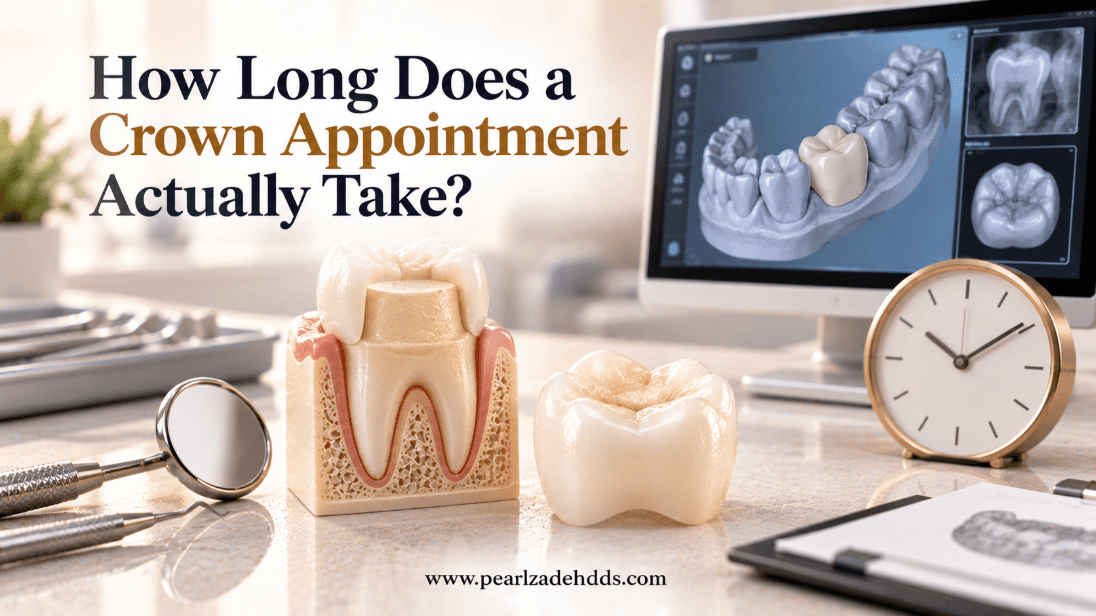
    How Long Does a Crown Appointment Actually Take?

    A dental crown appointment often takes 60 to 90 minutes for the first visit, when the dentist prepares the tooth and takes impressions or scans. The second visit, when the permanent crown is fitted and secured, is usually shorter.

    These are general estimates, not guaranteed appointment lengths. The time needed depends on the tooth’s condition, the amount of damage, and the treatment required.

    Knowing what happens at each visit can help you plan your schedule. It is also useful to know how to prepare and when to contact the dental office if you have concerns.

    What Is the Typical Time for Each Crown Appointment?

    A traditional crown usually takes two appointments, so the answer has two parts. One visit prepares the tooth. A later visit places the permanent crown. Cleveland Clinic says dental crown placement usually requires two appointments.

    The same source says a dental lab usually needs two to three weeks, sometimes longer, to make the crown. Ask the office how long the laboratory takes in your case.

    Do not count on a fixed length for either visit. Appointment times differ from patient to patient. Teeth vary in position, condition, and treatment needs.

    How Long Does Crown Preparation Take?

    Dental crown preparation commonly takes around 60 to 90 minutes. That is a general estimate, and some appointments run longer. The dentist reshapes the tooth to make room for the crown. Cleveland Clinic says the dentist will need to remove some of your natural enamel.

    What Happens During the First Appointment?

    Not every patient needs every step. A typical preparation visit may include:

    • An examination of the tooth and the surrounding tissues.
    • X-rays, if they are clinically appropriate.
    • Tooth preparation, with local anesthetic when appropriate.
    • Dental impressions or digital scans, when available.
    • Shade selection for a visible tooth.
    • Placement of a temporary crown, when needed.

    X-rays help when an examination cannot show everything. MouthHealthy is the American Dental Association’s (ADA) consumer site. It says they can reveal damage or disease not visible during a dental exam. You may not need an X-ray at every visit, it adds.

    Impressions give the laboratory a model of the prepared tooth. Cleveland Clinic describes two types. One uses physical impressions made with a putty-like material. The other uses digital impressions taken with a handheld scanner. Shade selection helps a visible crown blend with neighboring teeth.

    Some offices begin with a separate crown consultation. Others combine the examination with the preparation visit. Ask which approach applies to you.

    Before you leave, the dentist usually places a temporary crown. It stays in place while the laboratory makes the permanent one.

    How Long Does Permanent Crown Placement Take?

    The second appointment is often shorter. At this visit, the dentist removes the temporary crown, if you have one. Cleveland Clinic says the dentist then checks the new crown’s shape, color, and fit. The crown is bonded in place with dental cement.

    The dentist also checks how the crown meets your bite. Permanent crown placement often takes around 30 to 45 minutes. Adjustments can add time, so treat this as a general estimate, not a promise.

    You can read more about caring for your new dental crown after placement for practical aftercare tips.

    Why Do Some Crown Appointments Take Longer?

    Several factors can extend a visit:

    • The tooth’s location in the mouth.
    • Existing damage or decay.
    • A need for additional treatment.
    • Difficulty accessing the tooth.
    • Bite adjustments to help the crown fit comfortably.

    Bite adjustments, for example, can add time at the second visit. A tooth that needs other treatment first may add time or another appointment.

    Each tooth differs, so the dentist can give a better estimate after an examination. Plan extra time in case treatment takes longer than expected.

    Why Are Two Appointments Usually Needed?

    Traditional crowns are generally made by a dental laboratory after the tooth is prepared. Cleveland Clinic explains that a lab technician uses the impressions to make the crown. That work takes time, so the permanent crown arrives later.

    In the meantime, you will usually wear a temporary crown, which protects the prepared tooth while the permanent one is made. Cleveland Clinic notes that temporary crowns are often made from resin. For practical advice, see how to care for a temporary crown.

    Dr. Pearl follows the traditional crown process, with the permanent crown placed at a second appointment. See how traditional and same-day crowns differ.

    How Can You Prepare for Your Crown Appointment?

    A few steps can help:

    • Confirm the expected appointment length when you book.
    • Share relevant medical and dental information, including your medications.
    • Ask about eating and medication instructions, if they apply.
    • Allow extra time in case treatment takes longer.
    • Bring questions about the process and what to expect.

    When Should You Contact the Dentist?

    Report a loose temporary crown, significant pain, swelling, or a change in your bite to the dental office. Cleveland Clinic also lists a loose crown among reasons to call. It says some sensitivity is normal after a crown. The page adds that you should not have pain or discomfort that keeps you up at night.

    The office can assess what is happening. Avoid guessing the cause on your own.

    Difficulty breathing or swallowing requires emergency medical care. Mayo Clinic’s guidance on tooth abscess says to go to the emergency room for trouble breathing or swallowing.

    The exact appointment time depends on your tooth and your treatment plan. Contact the practice to discuss what to expect. You can also read about dental crown services at Pearl Zadeh DDS.

    Call (818) 716-6722 or click the button below to schedule your consultation online.

    Frequently Asked Questions

    How long does it take to prepare a tooth for a crown?

    Preparation commonly takes around 60 to 90 minutes. That is a general estimate, and some appointments run longer depending on the tooth and the treatment needed.

    How long does permanent crown placement take?

    The second appointment is often shorter, commonly around 30 to 45 minutes. At this visit, the dentist checks fit, bite, and appearance before cementing the crown. Adjustments can add time.

    Why do dental crowns usually require two appointments?

    A dental laboratory generally makes a traditional crown after the tooth is prepared. In the meantime, a temporary crown stays in place. The permanent crown is placed at the second visit.

    Can I eat normally while wearing a temporary crown?

    Follow the instructions your dentist gives you. Cleveland Clinic advises avoiding ice cubes, extremely hard nuts, and popcorn with kernels. It also lists super sticky foods such as taffy and caramels. That applies to temporary and permanent crowns.

    Will my dental crown appointment take longer if my tooth is damaged?

    It may. Existing damage or decay, additional treatment, and difficulty accessing the tooth can all extend a visit. The dentist can give a better estimate after examining the tooth.

    The information above is for informational purposes only and is not a substitute for professional dental advice. Please schedule a consultation with Pearl Zadeh DDS to discuss your specific situation.
  • Crown Cost vs. Onlay Cost: Comparing Your Options

    Crown Cost vs. Onlay Cost: Comparing Your Options

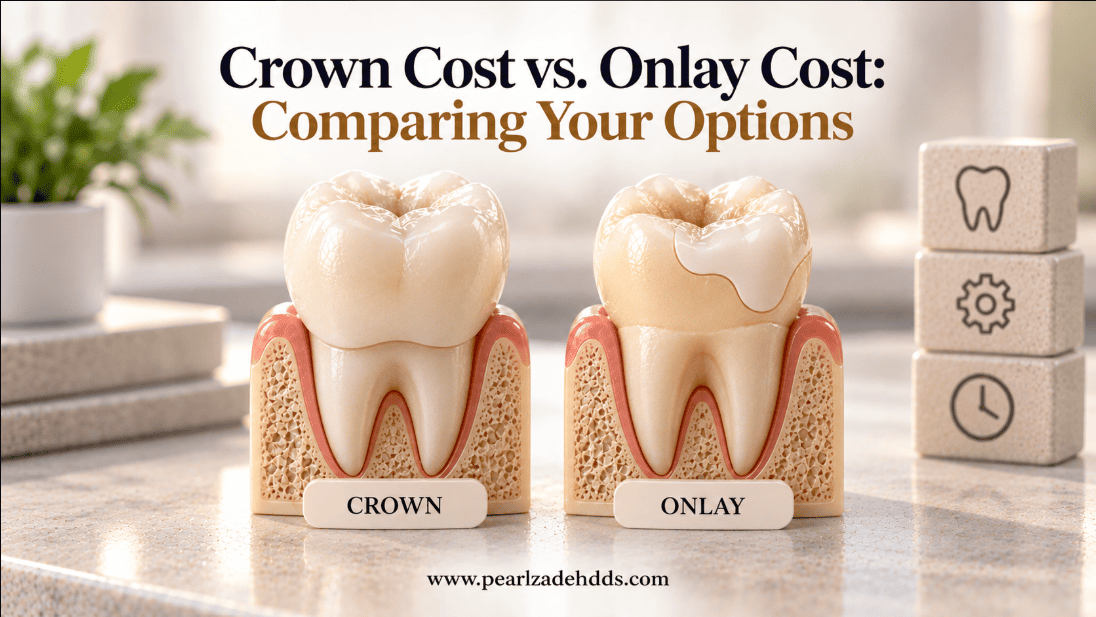
    A dental crown covers the entire visible part of a tooth, while an onlay covers only the damaged area and may extend over one or more cusps. The cost of each depends on the restoration needed and the tooth’s condition.

    Neither option is always cheaper or more suitable. A dental examination helps determine which restoration may work for the tooth and what the treatment may cost.

    The differences between crowns and onlays, the factors that affect their cost, and the questions to ask before choosing can help you prepare for a discussion with your dentist. Exact prices vary based on your clinical needs and treatment plan.

    What Is the Difference Between a Dental Crown and an Onlay?

    A crown covers the visible portion of a tooth. It restores shape, strength, and function when a tooth has substantial damage or needs added protection. Cleveland Clinic says a crown fits over your entire tooth.

    An onlay restores a damaged part of a tooth. Cleveland Clinic says an inlay fills the area between the cusps. An onlay also covers at least one cusp. A cusp is a raised point on the chewing surface.

    Picture a crown as a cap over the whole tooth. An onlay, by contrast, is a custom piece. It replaces a damaged section and covers part of the chewing surface.

    The amount of tooth structure involved also differs. Cleveland Clinic says the dentist will need to remove some of your natural enamel for a crown. An onlay covers less of the tooth, so it may preserve more natural structure in suitable cases.

    Neither restoration is automatically better. Preserving structure does not make an onlay right for every tooth. A crown is not automatically the stronger or more suitable choice either.

    When Might a Dentist Recommend an Onlay?

    Cleveland Clinic says a cavity can be too big for a filling, but too small for a crown. The dentist might recommend an inlay or onlay in that case.

    An onlay may be considered when damage affects part of the tooth, such as a cusp. The tooth must still have enough healthy structure to support the restoration.

    Not every damaged tooth qualifies. The dentist assesses how much healthy tooth remains, where the damage sits, and how the tooth functions.

    Our article on cracked tooth treatment with bonding, an onlay, or a crown compares these treatment options.

    When Might a Dental Crown Be More Appropriate?

    A crown may suit a tooth with more extensive damage or one that needs broader coverage. Cleveland Clinic says dentists use crowns to repair large cavities or restore broken teeth. MouthHealthy is the American Dental Association’s (ADA) consumer site. It says a crown can strengthen a tooth with a large filling when not enough tooth remains.

    That does not mean every cracked, weakened, or heavily restored tooth needs a crown. The right restoration depends on the tooth’s condition. Learn more about when a cracked tooth may need a dental crown.

    Crown Cost vs. Onlay Cost: What Affects the Price?

    Several factors can influence the cost of either restoration:

    • The extent and location of the tooth damage.
    • The complexity of the restoration.
    • The material selected.
    • Laboratory fabrication requirements.
    • Additional treatment that may be needed.
    • Insurance benefits and coverage limitations.

    Material is one factor. Cleveland Clinic notes that crowns can be made from metal, resin, porcelain, and other materials. Zirconia and porcelain are two common ceramic options, with differences in strength and appearance.

    Laboratory work matters too, since both restorations are custom made. Some teeth also need other treatment before a restoration is placed. The dentist can explain what applies after an examination.

    No option is always cheaper than the other. Cost depends on the individual case and the treatment recommended.

    Insurance adds another variable. Cleveland Clinic’s overview of dental insurance places crowns under major care. It says dental benefit plans vary widely. Deductibles, annual maximums, and waiting periods can also affect what you pay.

    Which Option Offers Better Value?

    Value depends on more than price. It reflects the tooth’s condition, how suitable the restoration is, and how much healthy tooth structure it preserves. Expected function and durability matter as well.

    The lowest-cost option may not fit the tooth. Cleveland Clinic notes that resin crowns are generally less expensive than other crown types. It also says they are fragile and more likely to break than porcelain-fused-to-metal crowns.

    The choice should reflect the tooth’s condition, its functional needs, and its long-term prognosis, not cost alone.

    No restoration is guaranteed to last a set time. Neither option is always the more economical choice over the long term.

    Already have a crown with a problem? Learn more about when a crown can be repaired instead of replaced.

    Questions to Ask Before Choosing a Restoration

    Consider bringing these questions to your consultation:

    • Why is this restoration recommended for my tooth?
    • Could an onlay or another option be appropriate?
    • How much healthy tooth structure remains?
    • What are the benefits and limitations of each suitable option?
    • Will I need any additional treatment?
    • What will my treatment plan include?
    • What will my estimated out-of-pocket cost be?
    • What should I confirm with my dental insurance provider?

    Ask for clear answers. You can request clarification at any point before you decide.

    How Can You Find Out What Your Crown or Onlay Will Cost?

    An individualized assessment lets the dentist determine the appropriate restoration and prepare a treatment estimate. Ask for the estimate for your tooth, and ask what it includes.

    Confirm your benefits with your insurer as well. Cleveland Clinic suggests finding out specifically what services your plan covers and excludes. It also notes that a pre-treatment estimate is not a guarantee of payment.

    Schedule a consultation with Dr. Pearl Zadeh DDS to discuss your tooth, suitable restorative options, and the expected cost. A consultation does not guarantee a particular treatment or price.

    The right restoration depends on the condition of the tooth, not cost alone. Discuss the appropriate options and pricing with the dentist before you decide. You can also read about dental crowns at Pearl Zadeh DDS.

    Call (818) 716-6722 or click the button below to schedule your consultation online.

    Frequently Asked Questions

    Is an onlay generally less expensive than a dental crown?

    Not necessarily. Relative costs vary by case, material, laboratory work, and treatment needs. Ask for an individualized estimate for your tooth.

    Does an onlay preserve more natural tooth structure?

    In suitable cases, it can, because it covers less of the tooth than a crown. Cleveland Clinic says a crown requires removing some natural enamel. Not every tooth qualifies for an onlay, and preservation is only one factor.

    How does a dentist decide between a crown and an onlay?

    The dentist examines the tooth. Key factors include how much healthy structure remains, where the damage sits, and how the tooth functions. Clinical findings drive the decision, not cost alone.

    Does dental insurance cover crowns and onlays?

    It depends on your plan. Coverage and out-of-pocket costs vary with benefits, deductibles, annual maximums, waiting periods, and treatment details. Confirm your benefits with your insurer and request an estimate.

    How can I find out the cost of a crown or onlay for my tooth?

    Schedule a consultation to discuss your tooth, your treatment options, and the expected cost. The dentist can assess the tooth and prepare an estimate for the recommended treatment. A consultation does not guarantee a particular treatment or price.

    The information above is for informational purposes only and is not a substitute for professional dental advice. Please schedule a consultation with Pearl Zadeh DDS to discuss your specific situation.
  • What to Expect During a Dental Crown Consultation

    What to Expect During a Dental Crown Consultation

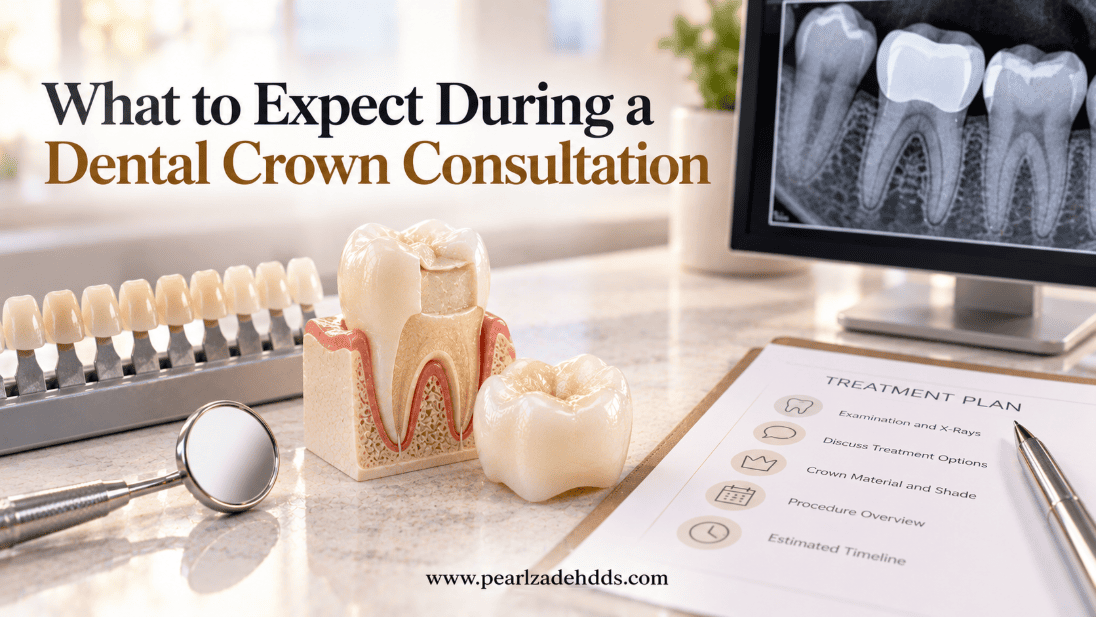
    A dental crown consultation usually involves discussing your concerns, examining the tooth, and reviewing X-rays when needed. The dentist then explains whether a crown or another treatment may be suitable.

    The visit is an evaluation, not the crown procedure itself. You can ask questions, review your options, and take time to decide how to proceed.

    During the consultation, the dentist may explain why a crown is recommended, discuss alternative treatments, and review expected costs and timing. Knowing what to expect can help you prepare questions and make an informed decision.

    Why Might You Need a Dental Crown Consultation?

    A crown is a tooth-shaped cap that fits over a tooth. Cleveland Clinic says it restores a decayed, broken, weak, or worn-down tooth.

    Common reasons for an evaluation include a cracked or weakened tooth, extensive decay, or a large existing filling. MouthHealthy is the American Dental Association’s (ADA) consumer site. It says a crown can strengthen a tooth with a large filling when not enough tooth remains.

    A consultation helps the dentist assess the specific problem. It does not commit you to a crown. The dentist may find that another treatment fits better, or that monitoring is reasonable.

    What Happens During the Consultation?

    The exact process varies with your needs. A typical visit may follow this sequence:

    • Discussing your symptoms and dental history.
    • Examining the affected tooth and the surrounding gums and tissues.
    • Reviewing X-rays or recommending imaging when needed.
    • Assessing the tooth’s condition and how much healthy structure remains.
    • Discussing the findings and possible treatment options.

    Expect questions about when the tooth hurts, what triggers the pain, and any past work on the tooth. Details such as pain with biting or sensitivity to temperature help guide the examination.

    The dentist weighs several factors before recommending anything. These include the amount of remaining tooth structure, the location and extent of the damage, and the tooth’s function. The available treatment options also matter.

    A consultation is separate from crown placement. If treatment follows, it happens at later visits.

    Will You Need an X-Ray?

    Possibly. MouthHealthy says X-rays can reveal damage or disease not visible during a dental exam. They can help assess decay, damage, and other concerns that an examination cannot fully show.

    You may not need new X-rays at every visit. MouthHealthy says the dentist reviews your history and examines your mouth to decide. It adds that a new dentist may ask for copies of existing X-rays instead of ordering new ones.

    X-rays also have limits. Some cracks are difficult to detect on standard images, so the dentist may rely on other findings as well.

    Will You Always Need a Crown?

    No. A crown is one possible treatment, not an automatic recommendation. Depending on the findings, a filling, bonding, an onlay, or another approach may be appropriate.

    A filling may repair a smaller area of decay. Bonding may address limited damage. Cleveland Clinic says an onlay covers at least one cusp, while a crown fits over the entire tooth. An onlay may suit a tooth too damaged for a filling but healthy enough to avoid a crown.

    These options are not interchangeable. The right choice depends on the tooth’s condition. Our article on cracked tooth treatment with bonding, an onlay, or a crown compares the options in more detail.

    What Will the Dentist Discuss With You?

    Topics vary with the tooth and the proposed plan. They may include:

    • The purpose of the proposed treatment and why it is recommended.
    • Crown material options.
    • Expected benefits and limitations.
    • Possible risks.
    • Expected longevity.
    • Costs and insurance questions.
    • The likely appointment schedule.

    You can ask for clarification at any point before deciding.

    Cleveland Clinic explains that dental crowns can be made from resin, metal, porcelain, and other materials. Our article on zirconia versus porcelain crowns compares two common ceramic options.

    On longevity, Cleveland Clinic says crowns last between five and 15 years with proper care. Individual results vary, and no dentist can promise a specific lifespan. A separate article covers how long porcelain crowns last with proper care.

    Cleveland Clinic notes that crowns may be expensive. Ask for a written estimate and check your plan’s coverage, because insurance rules vary.

    Ask how many appointments to expect and how long each lasts. Cleveland Clinic says crown placement usually requires two appointments. A temporary crown stays in place while the final one is made.

    How Should You Prepare for Your Appointment?

    A little preparation makes the visit more useful. Consider bringing:

    • A list of your symptoms and when they occur.
    • Relevant dental records or recent X-rays, if available.
    • A list of your current medications.
    • Your insurance details.
    • Questions about treatment and cost.

    Specific notes help most. Write down whether pain happens while chewing, with cold drinks, or at night. Good questions include what problem the treatment addresses, which alternatives exist, and what each option involves.

    What Happens After the Consultation?

    The dentist may recommend further assessment, a crown, another treatment, or monitoring. You may receive a proposed treatment plan and time to review it.

    Ask questions before scheduling anything. The consultation does not mean you must proceed with a crown. Treatment does not always need to begin right away, unless the clinical situation calls for prompt care.

    If you proceed with a crown, our article on caring for a new dental crown after placement explains how to care for it.

    Do not wait for a scheduled visit if symptoms turn severe. Severe or worsening tooth pain, facial swelling, or fever with dental symptoms may require prompt care. Mayo Clinic’s guidance on tooth abscess says to go to the emergency room for trouble breathing or swallowing. It also advises the emergency room for fever with facial swelling when you cannot reach your dentist.

    Before deciding how to proceed, talk with Dr. Pearl Zadeh about your concerns and make sure the proposed treatment is clear. You can also read about dental crowns at Pearl Zadeh DDS.

    Call (818) 716-6722 or click the button below to schedule your consultation online.

    Frequently Asked Questions

    How long does a dental crown consultation take?

    The length varies with your needs and the office’s appointment arrangements. A visit that includes imaging and a detailed discussion may take longer than a brief evaluation. Ask the office when you book.

    Will I need an X-ray during my crown consultation?

    Not necessarily. The dentist decides based on your history and examination. If you have recent X-rays, bring them or ask your previous office to send them.

    Can a dentist tell if I need a crown during the first visit?

    Often the dentist can discuss initial findings and options at the visit. Some cases need further tests, imaging, or monitoring before a recommendation. Certain cracks are hard to detect.

    Can I ask about alternatives to a dental crown?

    Yes. Depending on the tooth, alternatives may include a filling, bonding, or an onlay. These are not interchangeable, so ask which options fit your tooth and what limits each one has.

    Does a dental crown consultation mean I have to get a crown?

    No. A consultation is an evaluation. You can review the proposed plan, ask questions, and decide how to proceed. Prompt care may be advised when symptoms are urgent.

    The information above is for informational purposes only and is not a substitute for professional dental advice. Please schedule a consultation with Pearl Zadeh DDS to discuss your specific situation.
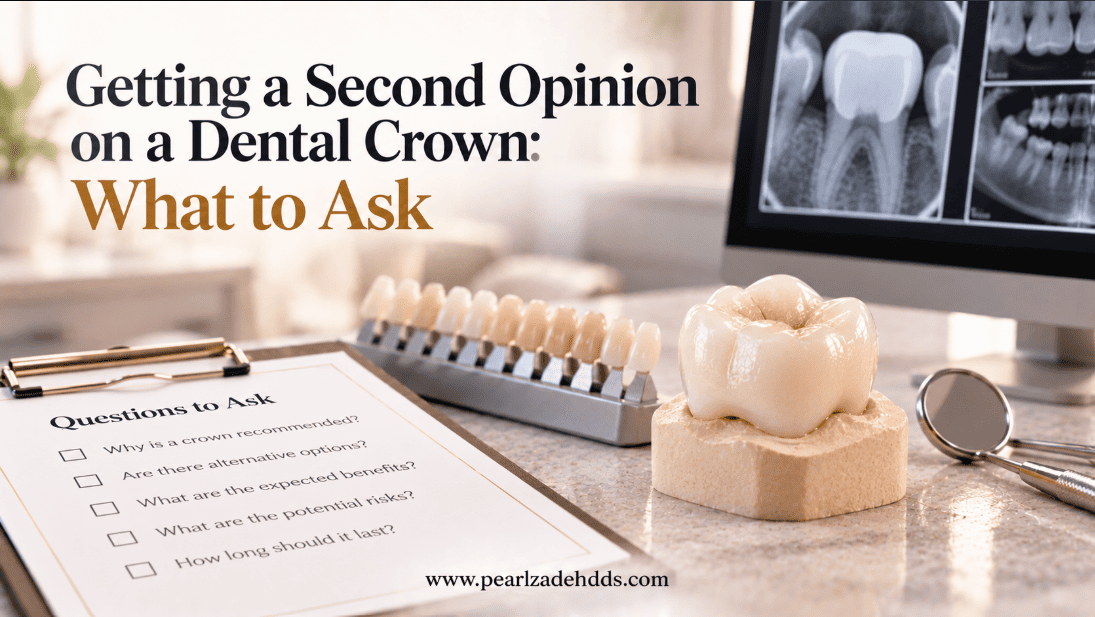
  • How Dentists Match Dental Crowns to Natural Teeth

    How Dentists Match Dental Crowns to Natural Teeth

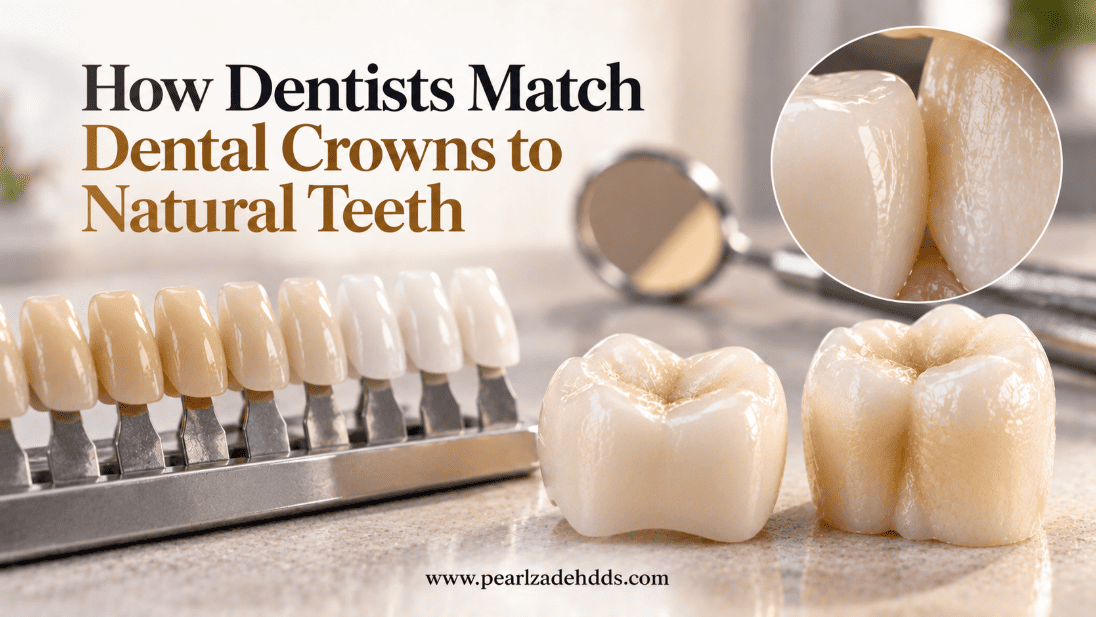
    Dentists consider several factors when matching a crown to nearby teeth, including color, brightness, translucency, and surface texture. They use these details to select a shade and provide instructions to the dental laboratory that makes the crown.

    The match depends on more than choosing a color from a shade guide. Lighting, crown material, and the way light passes through the crown can all affect how closely it resembles natural teeth.

    A crown that looks like a good match in the dental office may appear slightly different in natural daylight or other lighting. Understanding how shade selection works can help you discuss your preferences with your dentist before the crown is made.

    How Do Dentists Choose a Crown Shade?

    Dentists start by looking at the teeth around the crown. The goal is a shade that suits the intended result, which usually means blending with the neighboring teeth.

    A standardized shade guide is a common starting point. It is a set of tooth-shaped tabs in graded shades. The dentist holds tabs beside the tooth and compares them. Some guides group tabs with letters and numbers that stand for hue and chroma.

    Visual assessment remains common. Photographs and digital tools can add information. A 2021 review in the Journal of Pharmacy & Bioallied Sciences covers this topic. It says the latest shade-matching devices use digital camera technology. The same review notes that instrumental readings are objective.

    The dentist compares the planned crown with the surrounding teeth, not with a tab in isolation. A tab that looks right alone may look different beside neighboring teeth.

    How to Prepare for a Shade-Selection Appointment

    A few steps can make the visit more useful:

    • Mention any plan to whiten your natural teeth.
    • Say whether you want a close match to neighboring teeth or have another goal in mind.
    • Bring older photos of your smile, if you have them.
    • Ask how the dentist will record the shade and share it with the laboratory.

    Why Is Matching More Than Choosing a Tooth Color?

    A shade name describes only part of what the eye sees. Several qualities work together.

    The review defines hue as the feature that separates one color family from another. Value is the relative lightness or darkness of a color. Chroma is the intensity of the hue.

    Translucency adds another layer. It describes how much light passes through the tooth or crown. The review lists inadequate translucency mapping in some digital systems as a limitation.

    Surface qualities matter too. The review lists luster, glaze, and surface texture among the details a dentist records. A smoother, glossier surface can reflect light differently than a textured one.

    For these reasons, two teeth with a similar basic shade can still look different. A natural-looking crown depends on the whole combination, not one number on a guide.

    How Lighting Affects Crown Shade Matching

    Light changes how color looks. The review explains that under one kind of light, two objects can appear identical. Under another light, they may not.

    The review calls natural light the ideal light source. It says to select the shade first in natural daylight. Then the shade is confirmed under fluorescent and incandescent lighting.

    That approach reflects daily life. A crown will be seen in offices, homes, and outdoors. Checking more than one light is therefore practical.

    A dentist may therefore repeat comparisons instead of relying on one quick glance. The review describes limiting each comparison to about five seconds, with pauses between them.

    Photographs and digital tools can add information when they are useful. The dentist still has to judge how the shade will look in the mouth.

    How Crown Material Affects the Final Appearance

    Porcelain and zirconia are both ceramics. Cleveland Clinic describes pressed ceramic and all-porcelain crowns as mimicking the translucency of natural tooth enamel. It lists zirconia as a ceramic that can withstand heavier forces than other ceramic crowns.

    Porcelain and zirconia can differ in optical properties, such as how translucent or opaque they look. Products within each material also vary. Neither material always looks more natural.

    The better choice depends on the tooth’s location, the chewing forces it faces, and the space available. Aesthetic goals matter as well. A front tooth may call for more attention to appearance, while a back tooth may face heavier bite forces.

    Our article on zirconia versus porcelain crowns compares the two materials in more detail. You can also read about how long porcelain crowns last with proper care.

    What Role Does the Dental Laboratory Play?

    A dental laboratory fabricates the crown. Cleveland Clinic says a technician uses the dentist’s impressions to create the custom crown.

    The dentist also communicates the selected shade and other aesthetic details. These may include translucency, surface texture, and how the crown should look beside neighboring teeth. Photographs can help show these traits.

    The review names communication with the technician as a factor in successful shade selection. It adds that digital analysis calls for a laboratory system as well.

    The final appearance therefore depends on two things. One is accurate clinical information from the dentist. The other is the technician’s work with the chosen material.

    Why a Temporary Crown May Look Different

    The dentist places a temporary crown while the laboratory makes the final one. Cleveland Clinic says dentists often use resin for temporary crowns.

    A temporary crown may not match the final restoration in shade or surface. Judging the final result by the temporary is therefore unreliable. Ask your dentist what to expect.

    Should You Whiten Your Teeth Before Getting a Crown?

    It depends on your situation. Discuss any whitening plans with your dentist before the final shade is selected.

    The reason is simple. MouthHealthy says whitening will not work on caps, veneers, crowns or fillings. Natural teeth can respond to whitening, but a finished crown does not change the same way.

    Timing therefore affects which shade the crown should match. Your dentist can advise whether to whiten first and when to choose the final shade.

    Results also vary. MouthHealthy says whiteners may not correct all types of discoloration. Yellow teeth will probably bleach well, it adds. Brown teeth may respond less, and gray-toned teeth may not bleach at all.

    Whitening is not the right choice for everyone. Ask whether it suits your teeth.

    What If Your New Crown Looks Different From Your Other Teeth?

    Contact your dentist and describe what you notice. Differences can arise from shade, translucency, lighting, surface characteristics, or other factors. Avoid assuming the cause.

    The dentist can assess the fit, shade, contours, and other relevant factors. Next steps depend on the findings. Some concerns may be addressed with adjustments, while others may need a new crown.

    Our article on why a dental crown can look different from other teeth covers possible causes. You can also read about caring for a new crown after placement for advice on the weeks that follow.

    Before the final crown is made, discuss your shade preferences and treatment goals with Dr. Pearl Zadeh. Mention any whitening plans and ask how the crown shade will be checked. Learn more about dental crown treatment at Pearl Zadeh DDS.

    Call (818) 716-6722 or click the button below to schedule your consultation online.

    Frequently Asked Questions

    How do dentists choose the shade of a dental crown?

    Dentists compare the nearby teeth with a standardized shade guide, usually by eye. Photographs or digital tools may add information. The dentist then sends the chosen shade and other details to the laboratory.

    Can a dental crown look exactly like natural teeth?

    A close match may be achievable. An exact match in every lighting condition cannot be guaranteed. Natural teeth vary, and a crown is a manufactured restoration.

    Does crown material affect how natural the crown looks?

    It can. Porcelain and zirconia differ in optical properties, and neither always looks more natural. The best choice depends on the tooth’s location, chewing forces, available space, and appearance goals.

    Should I whiten my teeth before getting a crown?

    It depends. Whitening works on natural teeth, but a finished crown does not whiten the same way. Talk with your dentist before the final shade is chosen.

    Can a dentist change the shade of a crown after it is made?

    Not in a simple way. Whitening will not change a finished crown. Some cases may allow limited surface adjustments, while others may need a new crown. The dentist must assess the crown first.

    The information above is for informational purposes only and is not a substitute for professional dental advice. Please schedule a consultation with Pearl Zadeh DDS to discuss your specific situation.
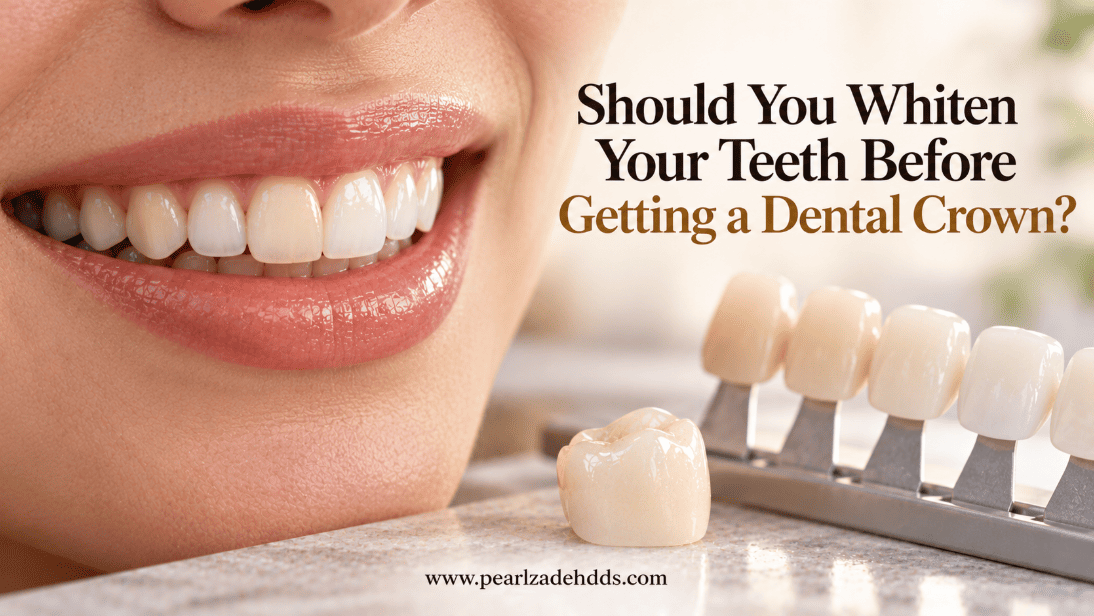
  • Getting a Second Opinion on a Dental Crown: What to Ask

    Getting a Second Opinion on a Dental Crown: What to Ask

    A second opinion can be helpful when a dentist recommends a crown. It gives you another chance to understand why the crown may be needed and whether other treatments are suitable for your tooth.

    Getting another opinion does not mean the first dentist was wrong. A crown may be the right choice for a damaged or weakened tooth, but another dentist may identify a different treatment option based on your dental condition.

    A second opinion can help you compare recommendations, prepare questions, and decide how to proceed. Bringing your dental X-rays and treatment records can also help the next dentist assess your case.

    Why Might a Dentist Recommend a Crown?

    A crown covers a tooth to restore its shape and function and to protect it. Cleveland Clinic says dentists use crowns to restore a decayed, broken, weak, or worn-down tooth.

    MouthHealthy is the American Dental Association’s (ADA) consumer site. It says a crown can strengthen a tooth with a large filling when not enough tooth remains. A crown can also protect a weak tooth from breaking.

    Common reasons include a broken or weak tooth. Another is a large filling with too little tooth left to support it. The recommendation depends on an examination and the specific condition of the tooth.

    Cracked teeth are one example. Our article on when a cracked tooth needs a dental crown explains why the extent of the crack matters.

    When Should You Consider a Second Opinion?

    Patients ask for another assessment for several reasons. Common ones include:

    • Uncertainty about what the diagnosis means.
    • A wish to compare reasonable treatment options.
    • Questions about the expected benefits or costs.
    • A need for more information before agreeing to treatment.

    The ADA’s Code of Ethics says dentists should inform patients of the proposed treatment and any reasonable alternatives. Dentists should do this in a way that lets patients become involved in treatment decisions. Asking about alternatives fits that standard.

    A recommendation to replace an existing crown can raise its own questions. Our article on signs a dental crown needs to be replaced explains common warning signs. We also cover whether a crown can be repaired instead of replaced.

    What a Second Opinion Can and Cannot Do

    Another dentist may agree with the original recommendation. Or the second dentist may suggest a different approach. A different recommendation does not automatically mean either dentist is wrong.

    Dentists can weigh the same findings differently, and an examination may reveal different details. A second opinion adds information. It does not settle the decision for you.

    Questions to Ask Before Agreeing to a Crown

    These questions can guide the conversation. They are prompts, not a checklist that points to one particular outcome.

    • What problem does the crown address?
    • What findings support this recommendation?
    • How much of the tooth is damaged or weakened?
    • Could a filling, bonding, or onlay be appropriate in this case?
    • What are the benefits and limitations of each reasonable option?
    • What are the risks of each option?
    • How long might the restoration be expected to last?
    • What could happen if treatment waits?
    • What material is being recommended, and why?
    • How many appointments will treatment require?
    • What costs should be expected, including any additional treatment the tooth may need?

    Ask the dentist to explain each answer in plain language. Questions about X-rays and examination findings also belong in the conversation, when they are relevant to the tooth.

    Comparing Fillings, Bonding, Onlays, and Crowns

    These options are not interchangeable. The right one depends on the amount and location of the damage. Cleveland Clinic says onlays can restore teeth too damaged for a filling but too healthy for a crown. A less extensive treatment is not always preferable, though. Teeth with little remaining structure may need more coverage.

    Our article on cracked tooth treatment with bonding, an onlay, or a crown explains how these options differ.

    Crown materials also vary. Our article on zirconia versus porcelain crowns compares two common choices.

    Appointments and cost deserve direct answers. Cleveland Clinic says crown placement usually requires two appointments and that crowns may be expensive. Individual plans vary, so ask for a written estimate.

    What Records Should You Bring?

    Existing records help another dentist review the case. Ask the first office for copies of:

    • Relevant X-rays.
    • Examination findings and notes.
    • The treatment plan.
    • Cost estimates.

    The ADA says HIPAA lets patients ask covered practices to send copies of their records to a designated person. Requests must be written and signed by the patient. Access can vary by state, the ADA adds.

    X-rays can often be forwarded. MouthHealthy says a new dentist may ask for copies instead of ordering new ones. It advises asking both dentists for help forwarding the X-rays.

    Records support the review, but they do not replace it. The second dentist may need to perform an independent examination. Additional imaging may also be needed, depending on the circumstances.

    How Do You Compare Two Different Recommendations?

    Recommendations can differ for several reasons. The tooth’s condition may be changing. Each dentist may observe different findings. Clinical approaches also vary, and some situations allow more than one reasonable path.

    Ask each dentist to explain the reasoning. Useful points to compare include:

    • The expected benefits of the recommended treatment.
    • The risks and limitations.
    • The alternatives considered.
    • The likely consequences of delaying treatment.

    Compare the reasoning, not only the price or how extensive the treatment sounds. If questions remain, return to the first dentist with what you learned. A clear explanation from either office helps you decide.

    What If the Tooth Needs Treatment Soon?

    The risks of waiting depend on the tooth’s condition. Some problems may worsen without treatment. Others may allow time for further assessment.

    Cracks show this range. Cleveland Clinic says that even with treatment, tooth cracks sometimes continue to get bigger or split. It also says a cracked tooth that causes no pain or infection may not need treatment.

    Taking time for another opinion may be reasonable when the tooth is stable and symptoms are mild. Ask your dentist how long waiting is reasonable for your tooth.

    Severe or worsening pain, swelling, fever, or difficulty swallowing warrants prompt dental or medical assessment. Do not delay urgent care while seeking another opinion. Mayo Clinic’s guidance on tooth abscess says to go to the emergency room for trouble breathing or swallowing. It also advises the emergency room for fever with facial swelling when you cannot reach your dentist. Cleveland Clinic notes that a badly cracked tooth may be a dental emergency.

    A second opinion works best as a way to understand your options. It is not a test of the first dentist. Dr. Pearl Zadeh can examine the tooth, explain the findings, and discuss the options that fit. You can also read about dental crown treatment at Pearl Zadeh DDS.

    Call (818) 716-6722 or click the button below to schedule your consultation online.

    Frequently Asked Questions

    Is it reasonable to get a second opinion before getting a dental crown?

    Yes. Patients may want clearer answers about the diagnosis, the alternatives, or the cost. A second opinion does not mean the first recommendation was wrong, and another dentist may agree with it.

    Can another dentist recommend a filling instead of a crown?

    Possibly, depending on the examination findings and the amount and location of the damage. Fillings, onlays, and crowns are not interchangeable, and the less extensive option is not always better.

    Should I bring my dental X-rays to a second opinion?

    Yes, if they are available. Ask the first office to send copies or forward them. The second dentist may still examine the tooth and may take new images.

    Is a second opinion necessary if my tooth does not hurt?

    Not necessarily. Whether a tooth hurts is only one part of the picture, and examination findings also matter. A second opinion can help if more information would make the decision clearer.

    Can I wait before getting a recommended dental crown?

    It depends on the tooth’s condition. Ask the dentist how long waiting is reasonable and what to watch for. Severe pain, swelling, fever, or trouble swallowing should not wait.

    The information above is for informational purposes only and is not a substitute for professional dental advice. Please schedule a consultation with Pearl Zadeh DDS to discuss your specific situation.
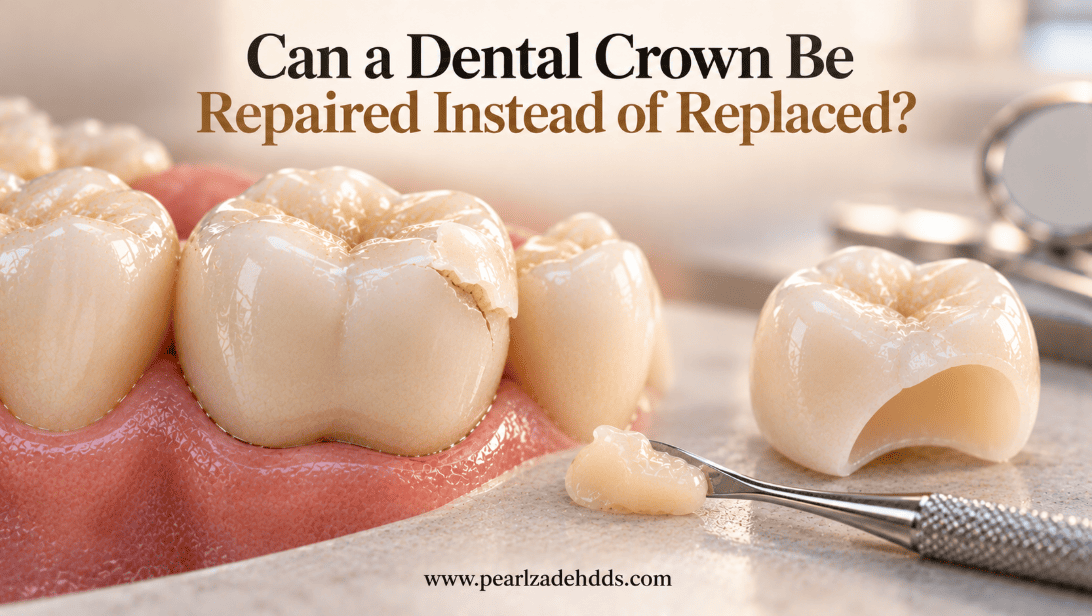
  • Should You Whiten Your Teeth Before Getting a Dental Crown?

    Should You Whiten Your Teeth Before Getting a Dental Crown?

    Whitening your teeth before getting a dental crown can be a good option if you want a lighter smile. Whitening first allows the dentist to select a crown shade that matches your teeth after treatment.

    Porcelain and zirconia crowns do not respond to whitening products like natural teeth. If you whiten your surrounding teeth after the crown is made, the crown may look darker than the teeth next to it.

    Whitening is not suitable for everyone, so a dental evaluation can help determine whether it is right for you and when to schedule it before crown treatment.

    Why Whitening Before a New Crown Can Matter

    A dentist typically chooses a crown shade by looking at the natural teeth around it. If those teeth later become lighter, the crown stays exactly as it was made.

    The American Dental Association (ADA) notes that restorations generally do not change color during whitening. That could result in differences between natural teeth and restorations.

    Treatment order solves much of this problem. Whitening first lets the dentist select the crown shade from the teeth as they will look afterward. Doing it second means the crown was matched to teeth that have since changed.

    Not every patient wants whitening. Some prefer to keep their natural shade, and the crown can be matched to it. The goal is the color you want, not the lightest color possible.

    Even with good planning, no dentist can promise an exact match. The result depends on your natural tooth color, the crown material, and your clinical needs.

    How Dentists Select a Crown Shade

    A crown has to blend with the natural teeth beside it, so the dentist studies those teeth. Cleveland Clinic says dentists can match porcelain-fused-to-metal crowns to the shade of your own teeth. Many dentists compare the teeth with a shade guide and pass that information to the lab.

    Lighting, the tooth’s natural translucency, and the crown material can all affect how a shade looks. That is why the dentist selects the shade from the teeth as they currently appear.

    Do Dental Crowns Whiten Like Natural Teeth?

    No. The ADA says only natural teeth can be whitened, not tooth-colored restorations. It lists crowns among the restorations the bleaching agent does not affect. MouthHealthy, the ADA’s consumer site, says whitening will not work on caps, veneers, crowns, or fillings.

    Natural teeth contain stains that bleaching agents can lighten. Crown materials are different. Porcelain and zirconia are ceramics made in a lab. They carry their shade from the day they are fabricated.

    Cleveland Clinic says all-ceramic and porcelain crowns mimic the appearance of tooth enamel more than any other crown type. It describes zirconia as a popular, durable ceramic. Dr. Pearl’s article on zirconia versus porcelain crowns compares the two materials.

    Because a crown’s shade is set when it is made, whitening cannot adjust it later. Planning the shade correctly the first time matters more.

    How Long Should You Wait to Get a Crown After Whitening?

    No single waiting period fits every patient. The right timing depends on the patient, the whitening method, the condition of the tooth, and the treatment plan.

    A dentist may recommend allowing the shade to stabilize before choosing the final crown color. That way, the shade reflects how your teeth look once they settle, not how they look right after whitening.

    Follow your dentist’s recommendation instead of choosing a date on your own. Starting whitening without telling your dentist about an upcoming crown can complicate the plan.

    Temporary Crowns Versus Final Crowns

    A temporary crown and a final crown serve different purposes. Cleveland Clinic says that while you wait on your final crown, your dentist places a temporary one. The page adds that crown placement usually requires two appointments.

    The final crown’s shade is selected as part of the restorative process. Not every temporary crown must be color-matched after whitening. Your dentist decides based on the tooth and the plan.

    Cleveland Clinic says the dentist checks the shape, color, and fit of the new crown at the second visit.

    What If You Already Have a Crown?

    Whitening your natural teeth around an existing crown can change how the two compare. Natural teeth may become lighter, while the crown keeps its original shade.

    The ADA notes that patient expectations may not be met without addressing cosmetic issues with existing restorations. Whitening does not lighten the crown, and ordinary whitening treatment cannot change it.

    Cleveland Clinic adds that lab studies suggest whiteners may react chemically with ceramic crowns. Those studies did not involve living teeth. Still, ask your dentist before using whitening products around a crown.

    If your crown already looks different from your other teeth, Dr. Pearl’s article on why a dental crown can look different from other teeth explains common reasons.

    Should Everyone Whiten Before Getting a Crown?

    No. Whitening is not suitable for everyone, and a dentist should assess your oral health first. The ADA supports educating the public to consult a licensed dentist about whether whitening is appropriate. Several factors can affect that decision:

    • Tooth sensitivity, which can be a side effect of whitening.
    • Untreated cavities.
    • Gum problems.
    • Existing restorations, which will not change color.
    • The cause of the discoloration.

    Cleveland Clinic advises getting teeth healthy before starting whitening. It adds that tackling concerns like gum disease or cavities beforehand is also important. Temporary sensitivity and gum irritation are common with whitening, per the same page.

    Color matters too. MouthHealthy says yellow teeth will probably bleach well, while teeth with gray tones may not bleach at all. It adds that whitening will not be effective if medications or a tooth injury caused the discoloration. A dentist can help identify the cause before you invest in whitening.

    A dental evaluation also helps decide whether whitening makes sense alongside a crown. You can read about teeth whitening at Pearl Zadeh DDS before your visit.

    How Dr. Pearl Zadeh Plans Crown Shade and Treatment

    Crown planning starts with a conversation. Tell Dr. Pearl what shade you want before the final crown is made, and mention any whitening you are considering.

    Dr. Pearl considers your natural tooth color, the crown material, and your clinical needs. Your preferred shade matters, along with what is realistic for your teeth.

    The crown process typically involves two appointments. The permanent crown is placed after it has been fabricated.

    You can read more about dental crown treatment at Pearl Zadeh DDS. For advice on daily care after placement, see the article on caring for your new dental crown.

    Choosing the crown shade before treatment helps the dentist plan for a result that complements your smile, whether you whiten your teeth first or keep their natural color.

    Call (818) 716-6722 or click the button below to schedule your consultation online.

    Frequently Asked Questions

    Should I whiten my teeth before getting a crown?

    If whitening is appropriate, finishing it before the final crown shade is selected may help the crown match. A dentist should evaluate your teeth and plan first, since whitening does not suit everyone.

    Will teeth whitening change the color of my crown?

    No. Whitening products affect natural teeth, not crowns. Lightening the teeth beside a crown can make the crown look darker by comparison.

    How long should I wait after whitening before getting a crown?

    No single period applies to everyone. Timing depends on the patient, the whitening method, the tooth’s condition, and the treatment plan. Follow your dentist’s recommendation.

    Can I whiten my teeth if I already have a crown?

    Sometimes, if a dentist finds whitening suitable. The crown will keep its shade, so the contrast with your natural teeth may increase. Ask your dentist before starting.

    Can a new crown be made to match whitened teeth?

    A dentist can select the crown shade after whitening, which may help the crown blend in. An exact match cannot be guaranteed, because results depend on natural tooth color, crown material, and clinical needs.

    The information above is for informational purposes only and is not a substitute for professional dental advice. Please schedule a consultation with Pearl Zadeh DDS to discuss your specific situation.
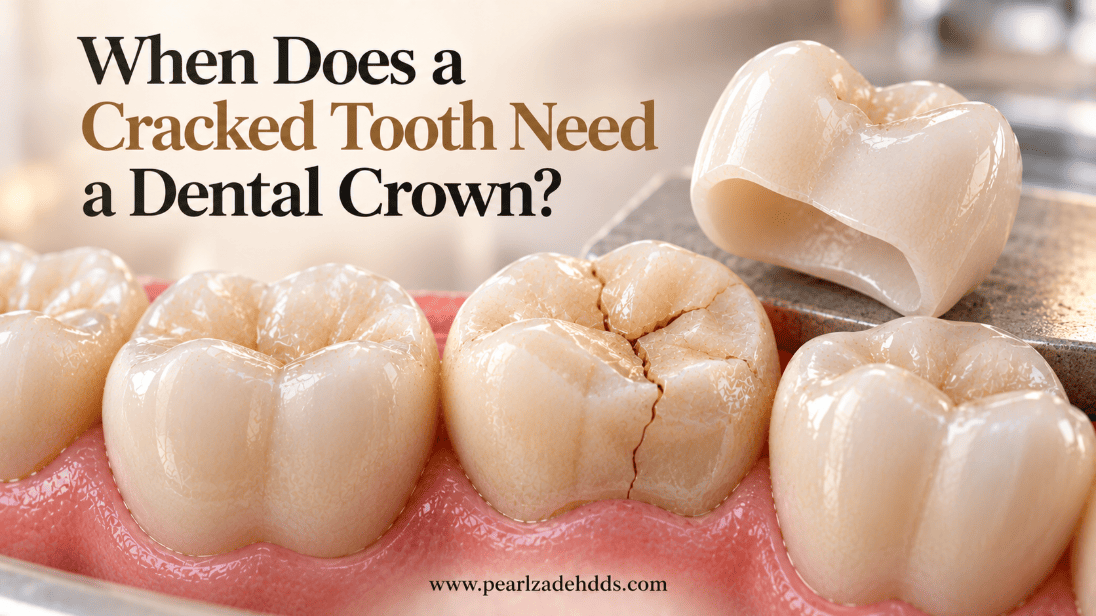
  • Can a Dental Crown Be Repaired Instead of Replaced?

    Can a Dental Crown Be Repaired Instead of Replaced?

    You notice a small chip in your dental crown, or it feels different when you bite down. You may wonder whether your dentist can repair it or if you need a replacement.

    A crown can sometimes be repaired, depending on the type of damage and its location. A small chip may be manageable, while a loose crown, a poor fit, or damage to the tooth underneath may call for replacement or further treatment. Not every damaged crown needs to be replaced, but some problems cannot be fixed with a simple repair.

    Your dentist can examine the crown and the tooth beneath it to determine what needs attention.

    Can a Dental Crown Be Repaired?

    Sometimes. Repair may be possible when damage is limited and the crown stays stable, functional, and suitable for continued use. A 2016 Operative Dentistry article on intraoral repair says repair is mainly indicated for localized shortcomings of restorations. It says replacement is indicated when problems are multiple or severe and repair is not feasible.

    Your dentist considers several factors:

    • The type and location of the damage.
    • Whether the crown is still securely attached.
    • The crown material.
    • The condition of the underlying tooth.
    • Whether the crown’s margins and fit remain acceptable.

    A dentist must evaluate these factors before recommending repair. Sometimes a small chip is the only problem. It may also accompany a fit or tooth problem that needs attention. Fit deserves special attention. A gap at the margin may allow bacteria to reach the tooth. Polishing or patching the visible surface does not close that gap. Your dentist checks the margins before deciding whether repair makes sense.

    What Types of Dental Crown Damage Can Sometimes Be Repaired?

    Small chips or rough edges. Minor damage may sometimes be smoothed, polished, or repaired with a restorative material. The options depend on the crown material and the location of the chip. Mention any rough spot that irritates your tongue or cheek.

    WebMD says a small chip on a porcelain or porcelain-fused-to-metal crown can be repaired with composite resin. The crown stays in your mouth during the repair. WebMD calls this usually a temporary fix and says extensive chipping may mean replacement. A dentist-focused Dental Update article calls repair of metal-ceramic and all-ceramic restorations a reliable, low-cost, low-risk technique. It says the technique may be of value for loss or fracture of porcelain from a crown or bridge. Sources differ, so outcomes vary.

    Surface wear or minor cosmetic defects. Polishing or another limited correction may improve a surface in some cases. Not every discoloration or defect can be corrected this way. The Operative Dentistry article adds that some minor margin defects, such as minor discoloration, may need only monitoring. Your dentist can explain whether a defect is cosmetic or affects function.

    A loose crown. Sometimes a loose crown may be recemented if the crown and tooth remain suitable. Colgate’s oral health site says a dentist first makes certain the crown is intact and still fits properly. It also notes that a badly broken or decayed tooth may not be strong enough to hold the crown.

    The crown may be reusable, or a new one may be needed. A dentist-reviewed Healthline article says the dentist decides whether to reinstall the crown or make a new one. Recementation does not suit every loose crown.

    Damage to the underlying tooth. Repairing the crown alone may not address decay, a fracture, or other problems in the tooth beneath it. WebMD notes that when cement washes out, bacteria can leak in and cause decay in the remaining tooth. In that case, the tooth needs attention too.

    Major cracks, extensive fractures, and significant structural damage are not routine repairs. Your dentist can tell you whether your crown is a candidate.

    When Does a Dental Crown Need to Be Replaced?

    Repair may not be reliable or appropriate in these situations:

    • A large chip or fracture that affects the crown’s strength.
    • Extensive cracking or structural damage.
    • A crown that no longer fits properly.
    • Damage or decay affecting the tooth underneath.
    • Repeated loosening or failure.
    • Problems with the bite or surrounding gum tissue that cannot be addressed adequately while keeping the crown.

    A large fracture can leave too little crown to withstand chewing. Repair may not restore that strength. In that case, replacement may be the more dependable option.

    Repeated loosening deserves a closer look. One retrospective study of 1,037 tooth-supported single crowns found loss of retention and recurrent caries the most common complications. That study reflects one dental school clinic, so it cannot predict your crown.

    Bite forces matter as well. Mayo Clinic says severe grinding may damage fillings, crowns, and other dental repairs. If bite forces keep damaging a crown, your dentist may need to address the cause, not only the damage.

    Replacement is not automatic whenever a crown has a problem. Depending on the findings, your dentist may recommend repair, recementation, replacement, or treatment of the underlying tooth.

    Our article on signs your dental crown needs to be replaced covers the warning signs in detail. Age alone does not decide the question either. Our article on how long porcelain crowns last with proper care explains what affects crown lifespan.

    Does Crown Material Affect the Repair Options?

    Yes, but not in a simple way. Repair techniques and their predictability vary by material, the type of damage, and where the crown sits. Some surface defects may be polished or repaired. A repair may not restore the original strength or appearance in every case. Location matters too. Back teeth take heavier chewing forces than front teeth. The same chip may call for different decisions in different places. Ask your dentist how your crown’s material affects the plan.

    The Operative Dentistry article says the composition of the repaired surface is the most important factor in success. Its repair protocols cover metal-ceramic and zirconia fixed restorations, not crowns alone. On metal, air abrasion followed by a metal primer increases adhesion significantly. For zirconia, air abrasion followed by a silane containing MDP monomer was the most effective conditioning method. The article still says achieving a sustainable chemical bond to zirconia remains problematic.

    The ADA’s page on indirect restorative materials describes complications by material. All-ceramic crowns commonly show fracture and chipping. Zirconia-based restorations commonly show chipping and fracture. A 2021 ADA survey cited on the same page found debonding the most common zirconia problem. Porcelain-fused-to-metal crowns commonly show veneer chipping. For gold restorations, secondary caries and retention failure are among the most common reasons for failure.

    Those lists describe what tends to go wrong. They do not rank repairability. No material is universally easier to repair, and none is immune to damage. Our article on how zirconia and porcelain crowns compare explains material differences in more depth.

    What Happens During a Dental Crown Repair Appointment?

    The process depends on the problem. Expect questions about when you noticed it and what you feel when you chew. Your dentist may also ask about habits such as grinding or chewing hard objects. They can affect the plan. A typical evaluation includes these steps:

    1. Your dentist examines the crown, its margins, and the underlying tooth.
    2. The damage is assessed, and the crown’s stability and bite are checked.
    3. Imaging, such as X-rays, may be used when indicated.
    4. You and your dentist discuss whether repair, recementation, replacement, or other treatment is suitable.
    5. If repair is appropriate, your dentist explains the procedure and its limitations.

    Imaging helps because X-rays can reveal damage or disease not visible during an exam, according to MouthHealthy. A crown can look fine while the tooth beneath it has a problem.

    Not every repair is finished in one appointment. Timing depends on the problem and the treatment needed. The Operative Dentistry article also notes that repair is not always risk-free, because the preparation sometimes needs extending. After any crown work, daily cleaning still matters. Our article on caring for a new dental crown covers habits that protect a crown.

    Can You Repair a Dental Crown at Home?

    No. Do not use household glue, superglue, or other non-dental adhesives on a crown. Also do not force a damaged or loose crown back into place. It may not seat correctly, and the tooth underneath may need treatment. Do not file or trim a rough edge yourself either.

    If a crown comes off, keep it in a safe, clean container. Avoid chewing on the affected tooth and contact your dentist for instructions. Healthline says the most important step is to retrieve the crown and take it to a dentist. Our article on what happens if your dental crown falls off covers that situation in detail.

    Temporary dental products exist, and some websites suggest them. They do not replace a professional evaluation, and they do not suit every situation. Ask your dentist before using one.

    Is Repair Cheaper Than Replacing a Dental Crown?

    Cost depends on the type of repair and the crown material. It also depends on the tooth underneath and whether additional treatment is needed. A simple polish differs from a repair that needs added material. Recementation differs from replacement.

    Repair is not always cheaper over time. A repair that does not hold may lead to other treatment later. Your dentist can give a more useful estimate after assessing the crown and the tooth. Ask what each option involves and what it may not solve. Also ask whether the estimate covers the tooth underneath.

    A damaged crown does not always need replacing, but not every crown can be repaired. Dr. Pearl Zadeh can examine your crown and the tooth beneath it and explain which options apply. You can learn more about dental crown treatment at Pearl Zadeh DDS.

    Call (818) 716-6722 or click the button below to schedule your consultation online.

    Frequently Asked Questions

    Can a chipped dental crown be repaired?

    Sometimes. A small chip may be smoothed, polished, or repaired, depending on the material and location. Large chips that weaken the crown may need replacement. Your dentist decides after an exam.

    Can a loose dental crown be recemented?

    Sometimes. A dentist checks that the crown is intact, fits properly, and sits on a sound tooth. If decay or damage is present, recementation may not be suitable. Do not use household glue.

    Can a cracked porcelain crown be repaired?

    Extensive cracking is not a routine repair. A small, localized defect may be a candidate. Cracks that affect the crown’s strength or involve the tooth may need replacement. Only an exam can tell which applies.

    Is it better to repair or replace a dental crown?

    Neither is better for every crown. Repair may suit limited damage on a stable, well-fitting crown. Replacement may suit extensive damage, poor fit, or tooth problems. Your dentist weighs these findings.

    Can I eat with a damaged dental crown?

    Avoid chewing on the affected tooth until your dentist gives guidance. This matters most if the crown is loose, fractured, or painful. Healthline advises soft foods and avoiding the affected side. Call your dentist for instructions.

    The information above is for informational purposes only and is not a substitute for professional dental advice. Please schedule a consultation with Pearl Zadeh DDS to discuss your specific situation.
  • When Does a Cracked Tooth Need a Dental Crown?

    When Does a Cracked Tooth Need a Dental Crown?

    A dentist finds a crack in a back tooth and recommends a crown. You may have expected a simple filling, so the recommendation might come as a surprise.

    A crown is not necessary for every cracked tooth. The best option depends on the crack’s location and depth, along with how much healthy tooth structure remains. Some cracks can be managed with monitoring or a smaller restoration. Others may need more extensive treatment, and a crown may not be enough.

    A dentist can examine the tooth and explain whether a filling, onlay, or crown is appropriate. If the crack extends too far into the tooth or root, a different treatment may be necessary.

    When Does a Cracked Tooth Need a Crown?

    A cracked tooth may need a crown when it is weakened and can still be restored predictably. Your dentist makes that call after an exam. It is not a rule for every crack.

    A crown covers the visible part of the tooth above the gum. That coverage can support a weakened tooth and shield it from chewing forces. Cleveland Clinic lists protecting and supporting a cracked tooth among the reasons dentists place crowns.

    Several different problems all get called cracks, and the type points toward different treatment. The AAE describes these types:

    • Craze lines: tiny cracks in the outer enamel that cause no concern beyond appearance.
    • Fractured cusp: a break in a chewing point of the tooth, which rarely damages the pulp.
    • Cracked tooth: a crack that runs vertically toward the root, in a tooth not yet separated into pieces.
    • Split tooth: a crack with distinct segments that can be separated.
    • Vertical root fracture: a crack that begins in the root and extends toward the chewing surface.

    For a fractured cusp, the AAE says a dentist can place a filling or crown to protect the tooth. So cusp damage points toward a crown in some cases, not all.

    Crowns become more likely when a crack involves a cusp or runs into the chewing surface. Even then, full coverage is not automatic. Cleveland Clinic says you may not need treatment for a cracked tooth that causes no infection or pain. That applies only if the crack does not extend very deep or far into the tooth. It also advises talking to a dentist whenever you notice a crack.

    Monitoring can be a reasonable plan for some teeth. In a National Dental PBRN study, 2,858 patients each had a visible crack in a back tooth. About 80% of teeth recommended for monitoring at the start stayed on monitoring for three years. The authors concluded that dentists can effectively evaluate patient, tooth, and crack features to choose between treatment and monitoring.

    What Determines Whether a Crown Can Save the Tooth?

    No single symptom or X-ray finding decides treatment. Dentists weigh several findings together. The AAE says treatment and outcome depend on the type, location, and extent of the crack. These factors matter most:

    • The crack’s location and depth.
    • Whether the crack extends below the gumline or into the root.
    • How much healthy tooth structure remains.
    • Whether the tooth is split or has separated segments.
    • Symptoms and findings from the clinical examination.
    • Whether the tooth can be predictably restored.

    Location and depth come first. A crack confined to the visible part of the tooth differs from one that runs toward the root. The AAE describes a cracked tooth whose crack extends below the gum line as no longer treatable.

    Remaining tooth structure matters because a crown needs sound tooth to hold onto. Earlier decay, a large filling, or the crack itself can reduce what remains. Your dentist may also check whether the pulp appears healthy.

    Symptoms and exam findings guide the decision, but each has limits. Pain on biting, temperature sensitivity, and a visible line can occur with several conditions. Our article on how a cracked tooth is diagnosed when an X-ray looks normal covers that evaluation.

    The final question is practical. Can the tooth be restored in a way that is likely to function? Dentists answer that by combining every factor above, not by relying on one.

    When Is a Filling or Onlay Enough?

    A filling, an onlay, and a crown differ mainly in how much of the tooth they cover. Cleveland Clinic describes inlays and onlays as custom restorations. They suit a cavity too big for a filling but too small for a crown. An onlay covers at least one cusp. A crown fits over the entire tooth.

    That range explains why treatment varies. A smaller defect may need a more conservative restoration. In contrast, a weakened tooth may need more coverage. An article on onlays and crowns, medically reviewed by a dentist, calls an onlay the more conservative option. It says the extent of damage and the condition of your teeth determine which one you receive.

    Research points toward coverage for some cracked teeth, though not all. In the same PBRN study, treatment failures were associated with intracoronal restorations rather than full or partial coverage. Intracoronal restorations sit within the tooth, like fillings. Among 478 teeth that received one recommended restoration, about 14% were determined to have failed. Dentists enrolled a convenience sample, so the results may not predict your outcome.

    No one option is best for every crack. Your dentist weighs the crack, the remaining tooth, your bite, and the pulp before recommending a restoration.

    If a crown or onlay is planned, material is a separate decision. Our article on how zirconia and porcelain crowns compare outlines the choices.

    When Might a Crown Not Be Enough?

    A crown cannot reliably repair every crack. The AAE notes that, unlike a broken bone, the fracture in a cracked tooth will not heal. A crown protects the tooth. It does not heal the crack. These situations may call for a different plan:

    • A crack that extends into the root.
    • A split tooth with separated segments.
    • Too little healthy tooth structure to support a crown.

    The AAE says a split tooth cannot be saved intact. Endodontic treatment may sometimes save a portion of it. For a vertical root fracture, it says treatment may involve extraction.

    Too little remaining structure creates a similar problem. A crown needs enough sound tooth to hold onto and seal against. When that is missing, your dentist may discuss other options.

    Root canal treatment and crown placement solve different problems. A root canal removes inflamed or infected pulp from inside the tooth. The crown covers and protects the outside. If a crack reaches the pulp and the pulp is irreversibly damaged, a tooth may need both. Your dentist decides that after testing and will explain who would provide each part of the care.

    The two treatments often work together. A 2024 systematic review in the Journal of Dentistry looked at cracked teeth with root canal treatment. It reported a higher extraction risk when the tooth had no full crown.

    Extraction may be recommended when a tooth cannot be restored predictably. Cleveland Clinic says a dentist may recommend removing the tooth when a crack severely damages the root and nerves. That decision should follow an exam and a discussion of your options.

    What Happens When a Dentist Treats a Cracked Tooth With a Crown?

    The exact process and timing depend on your tooth and your treatment plan. A typical sequence includes these steps:

    • Assessment of the crack, the remaining tooth structure, and your symptoms, with imaging when appropriate.
    • Treatment of any problem inside the tooth first, if the pulp is involved.
    • Preparation of the tooth, which involves removing some enamel and sometimes building up the tooth with filling material.
    • An impression or digital scan to guide the making of the crown.
    • A temporary restoration to protect the tooth while the permanent crown is made, when needed.
    • Placement of the permanent crown after a check of its fit, bonded with dental cement.

    Cleveland Clinic says crown placement usually requires two appointments. A dental lab usually takes two to three weeks or longer to make the crown. Your schedule may differ, especially if the tooth needs other treatment first. Ask your dentist to explain the plan and what to expect between visits.

    Can a Crown Prevent a Cracked Tooth From Getting Worse?

    Appropriate coverage may help protect certain cracked teeth from chewing forces. It does not make a tooth immune to further damage.

    The 2024 review included 27 studies. In cracked teeth with vital pulp, direct restorations without cuspal coverage were associated with higher risks than full crowns. Those risks included pulp complications and extraction. The authors also concluded that monitoring without restorative treatment might be an option for a cracked tooth without symptoms. They strongly recommended full crowns for cracked teeth with symptoms and for those with root canal treatment. Those pooled findings guide your dentist’s judgment. They cannot predict what will happen to your tooth.

    No crown guarantees a result. The AAE says a crown provides maximum protection but does not guarantee success in all cases. Cleveland Clinic adds that, even with treatment, cracks sometimes continue to get bigger or split. That can result in tooth loss.

    Long-term results also depend on the tooth and the crown. Our article on how long porcelain crowns last with proper care discusses crown longevity in general.

    When Should You Have a Cracked Tooth Evaluated?

    Schedule an evaluation if you have pain when you bite, sensitivity to temperature, or a visible crack. These signs have several possible causes, and only an exam can tell them apart. Early evaluation may give your dentist more options to discuss.

    Severe pain, swelling, or other worsening symptoms warrant prompt professional advice. Our article on what to do if you have a cracked tooth covers immediate steps.

    A crown may be the right treatment for some cracked teeth. It is not the answer for all of them. Dr. Pearl Zadeh can examine your tooth, explain what the findings mean, and discuss the options that fit it. You can learn more about dental crown treatment at Pearl Zadeh DDS.

    Call (818) 716-6722 or click the button below to schedule your consultation online.

    Frequently Asked Questions

    Does every cracked tooth need a crown?

    No. Craze lines and some small cracks may need no crown, and some teeth are monitored. Treatment depends on the type, location, and extent of the crack and the tooth structure that remains.

    Can a crown fix a cracked tooth?

    A crown can protect and support a cracked tooth that can be restored. It does not heal the crack, and it cannot fix every crack. A split tooth or a crack into the root may need a different plan.

    Is a crown better than a filling for a cracked tooth?

    Not always. A filling may be enough for a smaller defect, and an onlay may suit damage in between. For a weakened tooth, a crown gives more coverage. Your dentist compares the options for your tooth.

    Can a cracked tooth still need a root canal?

    Yes. If a crack reaches the pulp, root canal treatment may be needed. A root canal treats the inside of the tooth, and a crown protects the outside. Some teeth need both.

    Can a cracked tooth split even after getting a crown?

    It can happen. The AAE says a crown on a cracked tooth does not guarantee success in all cases. Some cracks keep progressing despite treatment. Regular exams help your dentist watch the tooth over time.

    The information above is for informational purposes only and is not a substitute for professional dental advice. Please schedule a consultation with Pearl Zadeh DDS to discuss your specific situation.
  • Signs Your Dental Crown Needs to Be Replaced

    Signs Your Dental Crown Needs to Be Replaced

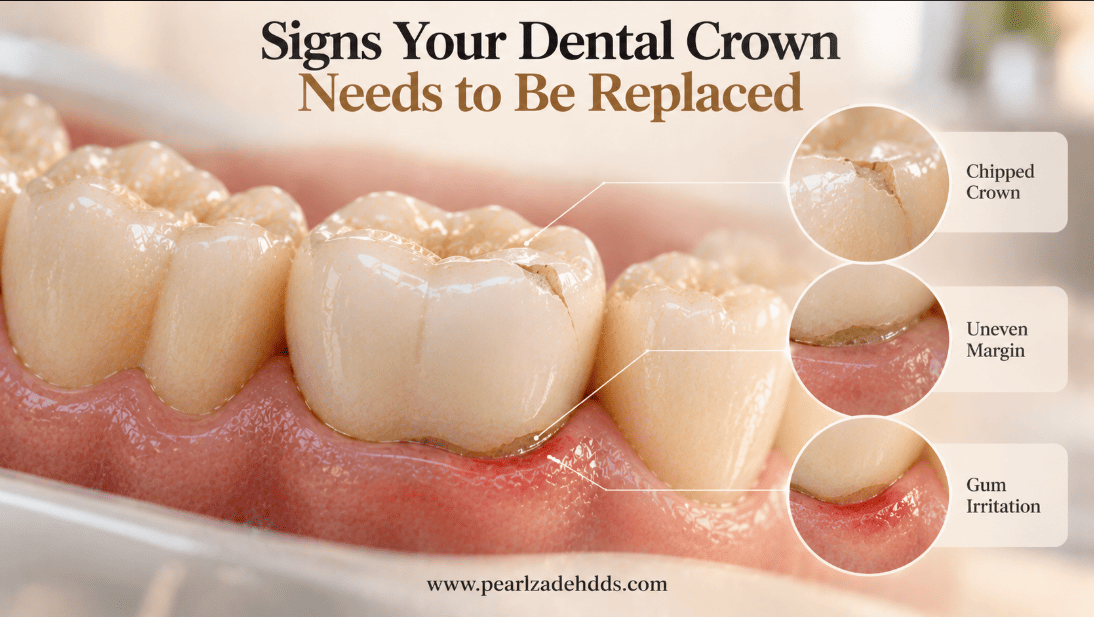
    Your crown may look fine, but chewing might feel different. The gum around it may be irritated, or you may notice a chip, crack, or gap along the edge.

    An old crown does not always need replacing, and one unusual sensation does not automatically mean something is wrong. Your dentist needs to examine the crown and the tooth underneath it to determine whether it needs repair or replacement.

    What Are the Signs Your Dental Crown May Need to Be Replaced?

    Some signs come from the crown, such as a chip or a loose fit. Others point to the tooth or the gums, such as pain or a changed margin. Telling them apart is part of the exam. These signs warrant evaluation:

    • A crown that feels loose or moves.
    • A visible chip, crack, or broken section.
    • Persistent or worsening pain or sensitivity.
    • Changes around the crown margin, where the crown meets the tooth.
    • Repeated food trapping or difficulty cleaning around the crown.
    • A noticeable change in how the crown fits or meets the opposing teeth.

    None of these automatically means replacement. Some come from the crown, some from the tooth beneath it, and some from the gums. Cleveland Clinic lists a loose crown, cracks or chips, and sharp edges among reasons to call your dentist. A crown that moves slightly deserves a call even if it has not come off.

    Can a Loose Dental Crown Be Saved?

    Sometimes. A crown may loosen for several reasons. The cement may lose its hold, the underlying tooth may change, or the crown itself may be damaged. Your dentist may also check how much natural tooth remains to hold the crown.

    Loss of retention is a recognized problem. One retrospective study of 1,037 tooth-supported single crowns found loss of retention and recurrent caries the most common complications. The authors counted a crown as failed if it was removed or replaced. Loss of retention accounted for 26.5% of the 230 failures. That study reflects one dental school clinic, so it cannot predict your crown.

    Your dentist will examine the crown and the supporting tooth. Depending on the findings, the crown may sometimes be recemented. In other cases, another treatment may be needed.

    Do not wiggle the crown, use household glue, or try to recement it yourself. If it comes off, save it and call your dentist. Our article on what to do if your dental crown falls off explains the steps.

    Does a Cracked or Chipped Crown Need Replacement?

    Not always. The extent and location of the damage matter. A minor surface defect may be managed differently from a deeper crack. Damage that affects the crown’s integrity or exposes the tooth underneath is a different situation.

    Material plays a role. The ADA’s page on indirect restorative materials describes fracture and chipping as common complications of all-ceramic crowns. It also calls veneer chipping a common complication of porcelain-fused-to-metal crowns. Our article on how zirconia and porcelain crowns compare covers material differences.

    Repair is sometimes an option. A 2016 Operative Dentistry article says repair of restorations is mainly indicated for localized shortcomings. It says replacement is indicated when problems are multiple or severe and repair is not feasible. A Dental Update article on defective restorations says repair may be of value for porcelain loss or fracture.

    Your dentist weighs the crown material, the size of the damaged area, and the condition of the supporting tooth. A chipped crown cannot always be repaired. Not every visible defect needs a new crown. Mention any rough spot your tongue notices. A small rough area can still matter if it catches food or irritates your cheek.

    Can Pain or Sensitivity Mean a Crown Needs Replacing?

    Pain and sensitivity have several possible causes:

    • Bite contact that needs assessment.
    • Irritation of the tooth following treatment.
    • Decay or damage affecting the underlying tooth.
    • A crack in the tooth.
    • Gum or surrounding tissue problems.
    • A loose or damaged restoration.

    The AAE says sharp pain on biting may reflect decay, a loose filling, or a crack. It also notes that cracked-tooth pain may come and go, which can make the tooth hard to find. A dentist-focused Dental Economics article says complaints soon after placement are frequently caused by a high spot.

    MouthHealthy lists decay, fractured teeth, worn fillings, and gum disease among causes of sensitivity. Several of those involve the tooth or gums, not the crown.

    Describe when it hurts: with cold, with heat, when you bite, or with no trigger. Those details help narrow the cause. Pain alone does not prove a crown needs replacing. Your dentist must identify the cause before recommending treatment. Severe, worsening, spontaneous, or persistent pain warrants prompt evaluation.

    What If There Is Decay Under the Crown?

    A crown does not make the underlying tooth immune to decay. Decay can develop around the crown margin or in exposed natural tooth structure. In the Hawthan study, recurrent caries affected 8.6% of crowns. Cleveland Clinic notes that a poorly fitting crown can trap bacteria and lead to decay. Warning signs worth a check include a rough edge, food catching at the margin, or a bad taste. They do not prove decay.

    Your dentist may examine the margins, the surrounding tissues, and the tooth. X-rays can reveal damage or disease not visible during an exam, according to MouthHealthy. That means appearance alone cannot always show decay.

    Decay does not always mean the crown must be replaced. Treatment depends on the extent of the decay, the remaining tooth structure, and the condition of the crown. Daily cleaning matters here, as our article on caring for a new dental crown explains.

    What Do Changes Around the Crown Margin Mean?

    A dark line, a visible margin, or gum recession can have different explanations. Some changes relate to the crown material or how the crown meets the tooth. Others involve the gums or the underlying tooth. WebMD lists gum disease, aggressive brushing, and grinding or clenching among causes of gum recession.

    A dark margin does not automatically prove decay. Gum recession does not always require crown replacement. A dental evaluation can separate an esthetic concern from a structural or biological problem. Note what you see and when you first noticed it. Photos taken in the same light over time can help.

    What If Your Crown No Longer Fits Comfortably?

    You may notice a change in your bite. Chewing may be uncomfortable, food may keep trapping, or the crown may feel shifted.

    These symptoms have several possible causes. The restoration, the tooth, or the surrounding tissues may have changed. Your dentist can check the bite and the fit before deciding what suits you.

    Depending on the findings, the answer may be an adjustment, a repair, recementation, or replacement. Not every bite concern requires a new crown. If you recently had other dental work, mention it, since changes nearby may affect how your bite feels.

    Does an Old Dental Crown Always Need to Be Replaced?

    No. Age alone does not decide whether a crown needs replacement. The crown’s condition, fit, and margins matter more than a fixed age. So do the supporting tooth, your gums, and your symptoms.

    Regular exams let your dentist watch the margins and the surrounding tissue over time. Some crowns stay serviceable for many years. Others develop problems sooner. No universal replacement schedule applies, and a crown does not follow a predictable timetable. Our article on how long porcelain crowns last discusses lifespan in more depth.

    What Happens If Your Dentist Recommends Replacing a Crown?

    Your dentist will assess the situation first. The process usually includes these steps:

    • Reviewing your symptoms and dental history.
    • Examining the crown, margins, gums, and underlying tooth.
    • Checking your bite when indicated.
    • Taking X-rays when clinically appropriate.
    • Deciding whether repair, adjustment, recementation, or replacement is suitable.

    Replacement means removing the existing crown and placing a new one. The details depend on your tooth and your treatment plan. If the underlying tooth needs treatment, that may need to be addressed before a new crown is placed. Ask what the exam found, which options apply, and what each involves. Your dentist may also discuss the material and design for a new crown. Those choices depend on your tooth and your bite.

    When Should You Contact Your Dentist About a Crown?

    Arrange an evaluation if a crown is loose, damaged, painful, or noticeably changed. You do not need to wait until it falls off or breaks completely. If you are unsure whether a problem is urgent, call and describe it. The office can advise your next step.

    Seek prompt assessment for worsening pain, swelling, or signs of infection. Facial swelling with difficulty breathing or swallowing needs emergency medical attention. Mayo Clinic advises going to the emergency room for trouble breathing or swallowing, in its guidance on tooth abscess.

    Have the Crown and the Tooth Examined Together

    A loose crown, visible damage, persistent discomfort, or changes around the crown can warrant an exam. None of them automatically proves that replacement is necessary. Your dentist must assess both the crown and the tooth underneath to choose the right treatment. Even mild or unclear changes deserve a look, since an exam can reassure you or catch a problem early. Dr. Pearl Zadeh can evaluate your crown and explain your options. You can learn more about dental crown treatment at Pearl Zadeh DDS.

    Call (818) 716-6722 or click the button below to schedule your consultation online.

    Frequently Asked Questions

    How do I know if my dental crown needs replacing?

    You cannot tell from symptoms alone. Looseness, damage, pain, or margin changes warrant an exam. Your dentist decides whether repair or replacement fits.

    How long should a dental crown last before replacement?

    No fixed schedule applies. Replacement depends on the crown’s condition, the tooth, the gums, and your symptoms, not on age alone.

    Can a dentist repair a damaged crown instead of replacing it?

    Sometimes. It depends on the material, the size of the damage, and the condition of the tooth. Some damage cannot be repaired.

    Can a tooth develop decay under a dental crown?

    Yes. A crown does not make the tooth immune to decay. Regular cleaning and exams help your dentist catch problems.

    Should a loose dental crown be replaced immediately?

    It should be evaluated promptly. Replacement is not always needed. Your dentist may recement the crown or recommend another treatment.

    The information above is for informational purposes only and is not a substitute for professional dental advice. Please schedule a consultation with Pearl Zadeh DDS to discuss your specific situation.

  • What Is a Temporary Crown and How to Care for It?

    What Is a Temporary Crown and How to Care for It?

    Your tooth has been prepared for a crown, and the numbness is fading. A temporary restoration now covers the tooth while your final crown is made. You may wonder how careful you need to be.

    A temporary crown serves a different purpose from a permanent one. It protects the tooth for a limited time, and it often needs extra care. Your dentist’s own instructions come first.

    Temporary crowns come in different materials and designs, so your care may differ from another patient’s. Ask your dentist what applies to your tooth.

    What Is a Temporary Dental Crown?

    Dentists use a temporary crown to cover and protect a prepared tooth until the permanent restoration is ready. A 2023 British Dental Journal article says provisionals should protect the pulp and secure positional stability, function, and esthetics. Common purposes include:

    • Protecting the prepared tooth.
    • Reducing sensitivity and discomfort.
    • Helping maintain the tooth’s shape and position.
    • Supporting chewing and appearance during the waiting period.

    Materials vary. A dentist-reviewed Healthline article quotes a dentist describing relatively weak plastics such as ethyl methacrylates and bisacrylics. One review in the Journal of the Irish Dental Association says the literature tends to favor acrylic resin. It adds that no ideal material exists. That review dates from 2004.

    The material and design depend on the clinical situation and your dentist’s workflow. Not every temporary crown offers the same protection or strength. A temporary may also look different from your final crown, since its shape and shade can differ.

    Why Do You Need a Temporary Crown?

    A permanent crown may need laboratory fabrication or additional preparation before placement. One dentist-reviewed WebMD article says a lab may need two to three weeks to make a permanent crown. Your timeline may differ.

    The temporary crown protects the prepared tooth during that interval. It also lets your dentist assess the tooth and proceed with the planned restoration at a later appointment.

    Healthline says a temporary crown protects the tooth and gums, helps you chew, and keeps spacing between teeth. Those jobs matter while the tooth waits.

    The number of appointments and the time between them vary. They depend on your treatment plan, the material, and your individual case.

    How Long Does a Temporary Crown Last?

    A temporary crown is built for short-term use, not long-term service. How long it stays in place depends on several factors:

    • The material and the fit of the crown.
    • The cement used to hold it.
    • The tooth’s location and the chewing forces on it.
    • Your individual habits.

    Heavier chewing forces on back teeth may affect how securely a temporary stays in place. Habits such as grinding can matter too.

    No universal number of days or weeks applies. The Healthline article quotes a dentist describing a weakened temporary cement purposely designed not to last long. Follow your dentist’s instructions and the appointment schedule they planned.

    Contact the office if the crown becomes loose or damaged before your permanent appointment. Permanent crowns follow a different timeline. Our article on how long porcelain crowns last covers that contrast.

    What Can You Eat With a Temporary Crown?

    You do not need a restrictive diet. A few sensible habits go a long way. If chewing feels awkward at first, soft foods such as eggs, yogurt, or cooked vegetables are an easy choice. Keep these habits in mind:

    • Choose foods that are comfortable to chew.
    • Cut firmer foods into smaller pieces.
    • Chew on the opposite side when possible.
    • Be cautious with sticky, chewy, hard, or crunchy foods.

    Those foods may dislodge or damage a temporary restoration. Examples include chewing gum, caramel, hard sweets, ice, and very crunchy foods. One student-written handout from the University of the Pacific dental school offers an example. It advises avoiding sticky, hard, and crunchy foods on that side to keep the temporary in place.

    Cleveland Clinic warns that ice cubes, extremely hard nuts, popcorn kernels, and sticky taffy can damage or dislodge crowns. The right precautions depend on the tooth, the restoration, and your dentist’s instructions.

    How Should You Brush and Floss Around a Temporary Crown?

    Keep cleaning your teeth, but do it carefully. MouthHealthy advises brushing twice a day with a soft-bristled brush. Brush gently around the crown and along the gumline. Aggressive scrubbing can irritate the gums and may loosen the temporary.

    Clean between your teeth daily. Do not stop flossing. Technique matters, though, because pulling floss upward against a temporary crown may dislodge it in some situations. Sources describe slightly different methods. The Pacific handout says to pull the floss out from the side instead of lifting it up. Healthline says to slide floss gently in and out rather than pulling it down.

    Ask your dentist which technique suits your crown and how to remove floss around it. MouthHealthy also says never to snap floss into the gums.

    Is Sensitivity Normal With a Temporary Crown?

    Some sensitivity to temperature, pressure, or chewing can occur after tooth preparation. The Pacific handout says sensitivity to cold or pressure may occur when the anesthetic wears off. Symptoms vary, and they should not automatically be dismissed as normal. Do not assume pain is normal simply because the crown is temporary.

    The American Association of Endodontists says recent dental work may inflame the tooth’s pulp and cause a temporary symptom. It advises a dentist or endodontist to check the tooth if pain persists or worsens. A 2019 literature review notes that this inflammatory response can be transient or persist.

    Mild sensitivity that is improving differs from pain that is severe, persistent, worsening, or spontaneous. Sensitivity may relate to the prepared tooth, the surrounding tissues, your bite, or another dental problem. Tell your dentist which triggers you notice: cold, heat, pressure, or chewing. Those details help narrow the cause. Contact your dentist if your symptoms concern you.

    What Should You Avoid While Wearing a Temporary Crown?

    These precautions protect the restoration and the tooth beneath it:

    • Avoid chewing ice or very hard objects.
    • Avoid sticky foods that may pull on the crown.
    • Do not use the crowned tooth to open packaging.
    • Avoid biting directly into very firm foods with the temporary.
    • Do not file, grind, glue, or adjust the crown yourself.

    MouthHealthy warns that chewing ice and using teeth as tools can crack teeth. Temporary crowns can be less durable and less securely retained than permanent ones. The Irish review notes that low strength and crack propagation are common causes of failure in acrylic restorations.

    What Should You Do If Your Temporary Crown Feels Loose or Falls Off?

    Stay calm. A loose temporary is a common problem, and a clear response helps:

    • Contact the dental office for instructions.
    • Save the crown, and any pieces, in a clean container if it comes off.
    • Avoid chewing on the affected tooth.
    • Keep the area clean without aggressive brushing.
    • Do not use household glue or force the crown back into place.

    If the crown comes off after hours, check your dentist’s voicemail or website for instructions.

    Your dentist may be able to recement or replace the temporary, depending on its condition and the tooth. Healthline notes that your dentist is likely to replace it with another temporary crown. Our article on what to do if a dental crown falls off gives more detailed instructions.

    Significant pain, swelling, or signs of infection warrant prompt assessment. Mayo Clinic advises going to the emergency room for trouble breathing or swallowing. Seek emergency medical attention for those symptoms.

    When Should You Contact Your Dentist About a Temporary Crown?

    Contact your dentist if the temporary crown does any of the following:

    • Comes loose or falls off.
    • Cracks or breaks.
    • Feels noticeably high or uneven when you bite.
    • Causes significant or worsening pain.
    • Is associated with swelling or persistent gum irritation.

    WebMD notes that a temporary crown may be taller than the other teeth and inflame a nearby tooth. Symptoms alone cannot identify the cause. Your dentist can evaluate the crown, the prepared tooth, your bite, and the surrounding tissues. Call even if the problem seems small, and the office can tell you whether you need a visit.

    Why Is It Important to Attend Your Permanent Crown Appointment?

    A temporary crown is not meant to replace the final crown indefinitely. Your final crown is made for your tooth, and the temporary is only a stand-in. The dentist needs to assess the tooth and place the planned permanent restoration when appropriate.

    Delaying the appointment can leave the prepared tooth dependent on a temporary restoration for longer than intended. Not every delay causes damage. The risk depends on the tooth, the restoration, and the clinical circumstances. At placement, your dentist can also check the permanent crown’s fit and bite.

    Some treatment plans use provisional restorations for longer periods for specific reasons. Follow the schedule your dentist gave you. If you need to reschedule, contact the office. Bring questions to the visit, and mention any sensitivity or bite changes you noticed while wearing the temporary.

    A Temporary Crown Needs Careful Handling Until the Permanent Crown Arrives

    A temporary crown protects a prepared tooth while the permanent restoration is made. It needs careful handling during that period. Follow your dentist’s instructions, call if the crown loosens or symptoms worsen, and attend your planned appointment. Dr. Pearl Zadeh can evaluate your tooth and explain next steps. For broader aftercare, see our article on caring for a new dental crown. You can also learn more about dental crown treatment at Pearl Zadeh DDS.

    Call (818) 716-6722 or click the button below to schedule your consultation online.

    Frequently Asked Questions

    How long can you keep a temporary crown?

    No universal timeline applies. A temporary crown is meant for short-term use. Follow your dentist’s schedule and call if it loosens or breaks

    Can you brush and floss with a temporary crown?

    Yes. Brush gently and clean between your teeth daily. Ask your dentist how to remove floss without lifting the crown.

    What foods should you avoid with a temporary crown?

    Be cautious with sticky, chewy, hard, and crunchy foods, such as caramel, gum, hard sweets, and ice. Chew on the other side when you can.

    What should you do if your temporary crown falls off?

    Call your dental office. Save the crown in a clean container and avoid chewing on that tooth. Do not use household glue or force it back.

    Is pain normal after getting a temporary crown?

    Some sensitivity can occur. Severe, persistent, worsening, or spontaneous pain deserves a call to your dentist.

    The information above is for informational purposes only and is not a substitute for professional dental advice. Please schedule a consultation with Pearl Zadeh DDS to discuss your specific situation.