Pearl Zadeh DDS

Author: tech@seosavvylawyer.com

  • TMJ Pain vs. Sinus Pain: How to Tell the Difference

    TMJ Pain vs. Sinus Pain: How to Tell the Difference

    You feel pressure around your cheeks and upper jaw, but you can’t quite tell where it’s coming from. Maybe your teeth feel sore when you bite down. Maybe your nose is congested. Or maybe your jaw has been tense lately.

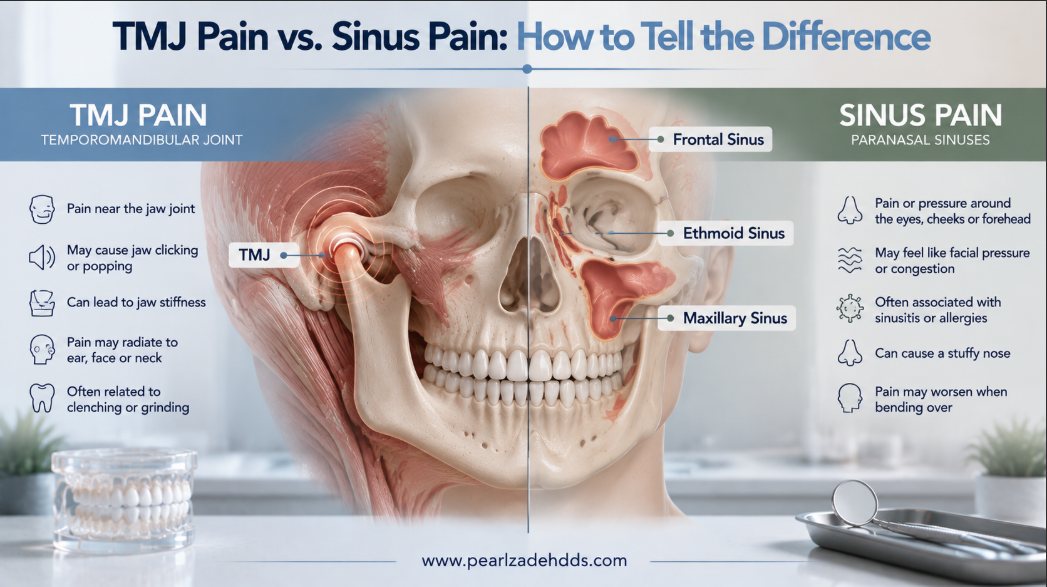
    Sinus problems and TMJ pain can feel surprisingly similar, especially around the cheeks, face, and upper jaw. The difference often comes down to the symptoms that appear alongside the pain, not simply where you feel it.

    Why TMJ Pain and Sinus Pain Can Feel Similar

    Both can involve discomfort around your cheeks, temples, upper jaw, general facial area, and the region near your ears. Nearby nerves and structures sit close enough together that pinpointing the actual source based on location alone is genuinely difficult, even for the person experiencing it.

    What Does TMJ Pain Usually Feel Like?

    Common patterns include jaw soreness, pain while chewing, pain when opening your mouth, jaw stiffness, tender jaw muscles, clicking or popping, difficulty opening your mouth fully, facial discomfort near the jaw joint itself, and symptoms that seem to worsen with clenching or grinding. None of these confirm anything definitively on their own. TMJ disorders can involve the jaw joints, the surrounding chewing muscles, or both together.

    What Does Sinus Pain Usually Feel Like?

    Common sinus-related symptoms include facial pressure, nasal congestion, a runny nose, a reduced sense of smell, pressure around the cheeks or forehead, symptoms that get worse with congestion, and in some cases discomfort in the upper teeth. A peer-reviewed review of maxillary sinus conditions lists facial pain or pressure, nasal congestion, nasal discharge, a persistent bad or foul smell, and postnasal drip among the more common symptoms associated with sinus-related conditions. Sinus conditions can genuinely create pressure that feels like it involves your upper teeth, which is exactly where this gets confusing.

    TMJ Pain vs. Sinus Pain: Common Differences

    Pain With Chewing

    Jaw-related pain tends to become more noticeable when you’re chewing or actively moving your jaw.

    Nasal Symptoms

    Congestion, nasal discharge, or a reduced sense of smell point more toward something sinus-related.

    Jaw Movement

    Stiffness, clicking, popping, or difficulty opening your mouth fully tend to accompany TMJ-related problems specifically.

    Facial Pressure

    Sinus-related discomfort often feels more like genuine pressure, particularly around the cheeks or forehead.

    Tooth Pain

    Both dental problems and sinus issues can create upper tooth discomfort. Tooth pain doesn’t automatically point to a dental cause.

    Morning Jaw Soreness

    Waking up with a sore jaw can happen with nighttime clenching or grinding, though morning soreness alone doesn’t prove bruxism is actually happening.

    Can Sinus Problems Cause Upper Tooth Pain?

    Yes, sometimes. Inflammation or pressure in the maxillary sinus area, located just above your upper back teeth, can sometimes be felt as discomfort in those same teeth. Mayo Clinic notes that if a dentist rules out a dental cause for a toothache, a medical evaluation for a possible sinus condition is a reasonable next step. Tooth pain can just as easily come from an actual dental cause, though. If tooth pain persists or shows up alongside other dental symptoms, a dental evaluation is worth pursuing.

    Can TMJ Problems Feel Like Sinus Pressure?

    Jaw or jaw-muscle discomfort can sometimes be felt in nearby areas of your face, which can create a sensation that resembles pressure. It wouldn’t be accurate to say TMJ problems commonly cause true sinus pressure, though. There’s a real difference between a general feeling of facial pressure and actual sinus inflammation or congestion, even when the two can feel surprisingly similar in the moment.

    Can Teeth Grinding Make the Difference Harder to Recognize?

    It genuinely can. Clenching and grinding cause jaw muscle soreness and facial discomfort, and some patients interpret that discomfort as a sinus problem or an unrelated headache instead. Our discussion of stress and teeth grinding goes further into that connection. Over time, grinding can also affect your teeth directly, which our discussion of how teeth grinding damages teeth over the years covers in more depth.

    What About Tooth Pain?

    Tooth pain deserves particular attention here, since it can come from several genuinely different places: tooth decay, a crack, a dental infection, gum problems, or discomfort referred from a sinus issue. A dentist can evaluate your actual teeth to determine whether a dental source is involved. This isn’t something to work out on your own from home.

    When Should You See a Dentist?

    A dental evaluation makes sense when:

    • Jaw pain keeps returning
    • Chewing causes discomfort
    • Your jaw feels stiff
    • Your mouth doesn’t open normally
    • Tooth pain persists
    • A tooth becomes sensitive without an obvious reason
    • Jaw symptoms show up alongside clenching or grinding
    • Facial pain continues even after sinus symptoms have improved
    • You’re genuinely unsure whether the discomfort is dental or jaw-related

    Not every facial pain problem requires a dentist, but these particular patterns are reasonable prompts.

    When Should You See a Doctor?

    Medical evaluation tends to make more sense when your symptoms lean heavily toward a sinus or respiratory issue: significant nasal congestion, persistent nasal discharge, fever, facial pressure alongside respiratory symptoms, symptoms that persist or get worse, or sinus problems that keep recurring. Severe or genuinely concerning symptoms may call for prompt medical care rather than waiting to see how things develop.

    What If You’re Not Sure Which One It Is?

    You don’t need to work out the diagnosis yourself. A dentist can evaluate your teeth, gums, jaw muscles, bite, and jaw movement directly. If what they find points toward a non-dental cause, you may simply be advised to pursue medical evaluation next. The goal is identifying what’s actually likely going on, not forcing every symptom into a dental explanation just because you started with a dentist. When jaw-related findings do turn out to be part of the picture, conservative management is often where things start, though that’s a separate conversation from the differential question itself.

    What Happens During a Dental Evaluation?

    Expect questions about:

    • When the pain started
    • Where it occurs
    • Whether chewing makes it worse
    • Whether your jaw clicks or feels stiff
    • Whether there’s tooth sensitivity
    • Whether you clench or grind
    • Whether you’ve had any recent dental procedures
    • Whether sinus symptoms are also present

    Your dentist may then examine your:

    • Teeth
    • Gums
    • Bite
    • Jaw movement
    • Jaw muscles
    • The TMJ area itself

    Imaging sometimes gets recommended when appropriate, though not every patient needs X-rays or advanced imaging as a matter of routine.

    What If Your Sinus Symptoms Improve but the Jaw Pain Remains?

    That’s worth another look. If your congestion and sinus pressure clear up but jaw or tooth discomfort sticks around, a dental evaluation may genuinely help. This doesn’t automatically prove a TMJ or dental cause on its own. It just means the remaining symptom deserves its own separate look rather than being assumed to fade along with the sinus issue.

    What If the Pain Gets Worse When You Chew?

    Jaw movement and chewing place real stress on your jaw muscles and joints, which can make jaw-related pain more noticeable. Tooth problems can become more noticeable with biting too, for entirely different reasons. Chewing pain alone can’t tell you which one you’re actually dealing with. If it persists, that’s a reasonable prompt for an evaluation rather than something to keep monitoring indefinitely on your own.

    What If the Pain Is Mostly in the Upper Teeth?

    Upper tooth discomfort specifically can have several possible sources: sinus pressure, tooth decay, a crack, an infection, or another dental problem entirely, and several of these can feel remarkably similar. A dental examination helps determine whether your teeth themselves actually look and test healthy, which narrows the possibilities considerably.

    Can You Have Both a Sinus Problem and TMJ Symptoms?

    Yes. Having one condition doesn’t prevent you from also experiencing the other. It’s entirely possible to have sinus congestion and jaw muscle tension happening at the same time, as two separate things rather than one causing the other. Without more specific evidence in your particular case, it isn’t accurate to assume one condition is responsible for the other.

    What Can You Do While You Figure Out the Cause?

    A few conservative steps can help in the meantime. Avoid excessive gum chewing. Skip opening your mouth unnecessarily wide. Pay attention to whether you’re clenching during the day. Choose softer foods temporarily if chewing hurts. Follow whatever medical advice applies to your sinus symptoms specifically. Keep a rough note of when the pain shows up. Aggressive jaw exercises or treatments aren’t something to start without an actual evaluation, and any medication decisions are worth discussing with whichever professional is treating the relevant symptom.

    When Facial Pain Needs Prompt Attention

    A few situations call for prompt medical or dental care rather than waiting things out:

    • Significant facial swelling
    • Difficulty breathing or swallowing
    • High fever with severe facial or dental pain
    • Rapidly worsening swelling
    • Severe pain following facial trauma
    • Other symptoms that feel genuinely urgent or unusual

    Most facial discomfort doesn’t fall into this category, but these particular situations are worth knowing.

    Look at the Whole Pattern, Not Just Where It Hurts

    TMJ pain and sinus pain can genuinely overlap, particularly around the cheeks and upper jaw. Jaw movement, chewing discomfort, stiffness, clicking, and muscle soreness tend to point toward TMJ-related problems. Congestion, nasal symptoms, facial pressure, and respiratory symptoms tend to point more toward a sinus issue. Symptoms can still overlap in individual cases, though, and persistent pain shouldn’t be self-diagnosed either way. When the source isn’t clear, a professional evaluation can help narrow down what’s actually causing the discomfort.

    Speak With Dr. Pearl Zadeh About Your Facial or Jaw Pain

    Facial, jaw, and upper tooth discomfort can have several possible causes. If you’re unsure whether your symptoms involve your teeth, your jaw, or something else entirely, a dental evaluation can help assess the dental and jaw-related possibilities. Dr. Pearl Zadeh, a member of the American Dental Association and California Dental Association, can evaluate your teeth, bite, jaw movement, and related symptoms, and can recommend appropriate next steps when further medical evaluation may be needed.

    Call (818) 716-6722 or click the button below to schedule a consultation online.

    Frequently Asked Questions

    How can I tell if my jaw pain is TMJ or a sinus problem?

    Jaw stiffness, clicking, and pain that worsens with chewing tend to point toward TMJ, while nasal congestion, discharge, and facial pressure tend to point toward sinus issues. Symptoms can overlap, so persistent discomfort is worth having evaluated.

    Can a sinus infection cause tooth pain?

    Yes, particularly in the upper back teeth near the maxillary sinuses. If a dentist rules out a dental cause, a sinus-related origin is worth discussing with a doctor.

    Can TMJ cause sinus-like pressure?

    TMJ or jaw muscle discomfort can feel like pressure in nearby facial areas, but it doesn’t typically cause true sinus inflammation or congestion.

    Should I see a dentist or a doctor for facial pain?

    It depends on your symptoms. Jaw stiffness, chewing pain, or tooth-specific discomfort are reasons to see a dentist, while significant congestion, discharge, or fever point more toward a medical evaluation.

    Can I have both TMJ symptoms and a sinus problem at the same time?

    Yes. Having one doesn’t rule out the other, and they can occur together without one necessarily causing the other.

    This article is for informational purposes only and is not a substitute for professional dental or medical advice. Please schedule a consultation with Pearl Zadeh DDS to discuss your specific situation, and seek prompt medical care for any urgent or severe symptoms.
  • How to Tell If Your Invisalign Treatment Is on Track

    How to Tell If Your Invisalign Treatment Is on Track

    You put in your new aligner and check the mirror out of habit. Nothing looks dramatically different. A few trays later, you’re still checking, and you’re still not entirely sure anything is actually happening under there.

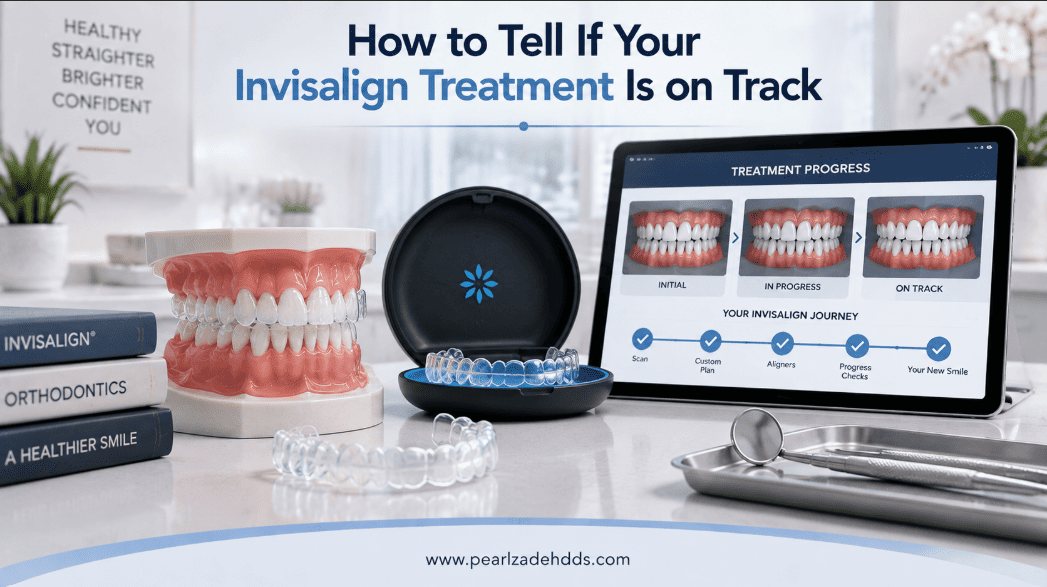
    Is your Invisalign treatment really working? That’s the wrong question to obsess over, honestly. Invisalign movement can be subtle from one tray to the next, and not seeing an obvious change doesn’t mean treatment has stalled. The better question isn’t whether your teeth look dramatically different every week. It’s whether your teeth and aligners are progressing according to the plan.

    What Does “On Track” Mean With Invisalign?

    Being on track means your teeth are generally following the sequence of movements your plan actually called for. Invisalign works through a series of aligners, each one nudging your teeth a little closer to their planned position. How fast that seems to happen varies between patients, and even between individual teeth within the same mouth. Nobody should expect their treatment to move at the same pace as someone else’s.

    Should You Notice Changes With Every Aligner?

    Not necessarily. You might notice a slight shift in tooth position, a small gap starting to close, a rotated tooth looking a bit straighter, a change in how certain teeth contact each other, or different pressure in a specific spot. Plenty of changes are simply too subtle to catch day to day, though. Checking obsessively after every single tray isn’t going to give you reliable information either way.

    How Should a Properly Fitting Aligner Feel, and What If It Doesn’t?

    A properly fitting tray should sit securely over your teeth and generally feel snug, without obvious large gaps between the plastic and your teeth. It may feel tight right when you put it in, and some pressure is normal as your teeth start responding to the new shape. Discomfort or tightness on its own doesn’t automatically mean the aligner is working correctly, though. It’s just a common part of the adjustment.

    Pay attention if a tray won’t fully seat, if there’s a visible gap between the aligner and a tooth, if it feels unusually loose, if it suddenly feels very different from previous trays, or if it’s difficult to engage an attachment properly. Don’t force a tray into position if something feels off. Contact your dentist if the issue persists or seems genuinely unusual rather than just a normal first-day adjustment.

    What Are Some Signs Invisalign Is Progressing?

    A few things tend to suggest treatment is moving forward:

    • Teeth gradually shifting position
    • Crowding starting to ease
    • Spaces getting smaller
    • Rotations becoming less pronounced
    • Your bite relationship changing the way the plan intended
    • Each tray generally fitting as expected
    • Attachments staying properly engaged
    • Your dentist confirming progress at your checkups

    These are possible signs worth noticing, not a way to independently confirm everything is going perfectly on your own.

    Can You Compare Your Teeth With Photos?

    Photos can genuinely help you notice gradual changes that are hard to see day to day. If your dentist is comfortable with the approach, taking occasional photos from a similar angle and similar lighting can be a useful way to track things over a longer stretch. Daily comparisons tend to create more anxiety than insight, though. Professional scans and actual dental examinations give far better information about what’s really happening with your teeth than any photo comparison can.

    Why Can’t You Always See Invisalign Progress?

    Tooth movement happens gradually, and some of it is genuinely hard to notice. Certain movements are small, difficult to see from the front of your mouth, happening toward your back teeth, related to bite changes rather than visible alignment, or occurring across several small stages rather than one dramatic shift. A peer-reviewed study measuring the accuracy of Invisalign tooth movement found that actual achieved movement often falls meaningfully short of what the digital treatment plan initially predicted, with accuracy varying a good deal depending on the specific movement involved. That gap between prediction and reality is exactly why a mirror alone can’t tell you the full story. You may feel pressure or notice a different fit well before you see anything obvious.

    What Does Your Dentist Check During Invisalign Appointments?

    Your dentist may evaluate aligner fit, actual tooth movement, your attachments, any bite changes, your general oral health, whether your teeth are tracking with the planned movements, and whether anything needs adjusting. Professional monitoring is really the most reliable way to know whether treatment is progressing as expected. Not every appointment involves the exact same checks. What gets reviewed depends on where you are in your specific treatment.

    What Does “Tracking” Mean in Invisalign?

    Tracking refers to how closely your teeth are actually following the movements your aligners were designed around. When teeth don’t move quite as expected, the next aligner in the sequence may not fit the way it’s supposed to. This connects directly to the accuracy gap mentioned earlier: even well-planned treatment can involve some teeth tracking more closely than others. One small gap on one tooth doesn’t automatically mean something has gone wrong with your entire treatment. It’s one data point your dentist weighs alongside everything else.

    What If One Tooth Isn’t Moving as Planned?

    Individual teeth sometimes respond differently than the rest. The specific movement might just be more difficult for that tooth, it might need more time, the aligner might not be fully seating, an attachment might be missing, or the treatment plan itself might need adjusting. Your dentist may recommend additional steps or refinements when that’s the case. Needing a refinement doesn’t automatically mean treatment failed. It can simply be part of finishing planned movements that needed a bit more time.

    What If Your Aligner Has a Gap, or Your Teeth Look the Same After Several Trays?

    A small space between an aligner and a tooth can have more than one explanation, and it isn’t automatically a tracking problem. A gap that’s persistent or obvious, especially if the tray isn’t seating properly, is worth mentioning to your dentist rather than trying to diagnose it yourself. Similarly, if you feel like nothing has visibly changed for an extended stretch, bring that up at your next appointment. Your dentist can compare your current tooth position against the actual treatment plan and tell you whether things are progressing as expected, which is something you genuinely can’t determine on your own from a mirror.

    What If the Next Tray Doesn’t Fit?

    Don’t force it into place. Contact your dentist if a tray won’t seat properly or feels significantly different from what you’re used to. Depending on your specific situation, your dentist might recommend going back to your previous tray for a while, staying in your current one a little longer, or a different approach entirely. There’s no single instruction that applies to every patient here, which is exactly why this is a conversation to have rather than a decision to make alone.

    Can Missing Wear Time Put Treatment Off Track?

    Invisalign depends on consistent wear according to your dentist’s specific instructions. Missing a significant amount of wear time can affect how well your next aligners fit and can genuinely interfere with the planned movements. Our discussion of what happens if you stop wearing Invisalign early goes further into what a longer interruption can mean for treatment. There’s no universal wear-time number worth repeating here beyond whatever your dentist has actually prescribed for you.

    Attachments and Elastics: Two More Pieces of the Picture

    If you have attachments, they help your aligner apply the force certain movements actually need. If one falls off, tell your dentist, since it can affect how well the aligner engages that tooth. If elastics are part of your plan for bite correction, wearing them exactly as prescribed matters for those specific movements to happen on schedule.

    What If Your Bite Feels Different?

    Bite changes can happen during Invisalign simply because your teeth are moving, and a changing bite doesn’t automatically mean something is wrong. Mention it if you notice significant discomfort, a bite that suddenly feels very different, difficulty chewing, a tooth contacting much earlier than the rest, or bite concerns that just won’t let up. If bite correction is a central part of your plan, movements like these are worth understanding as they unfold, and our discussion of Invisalign and open bite correction covers one specific example of that kind of more complex movement. Your dentist can tell you whether what you’re noticing is actually expected at this stage of treatment.

    How Often Should Your Dentist Check Your Progress?

    There’s no single universal schedule here. How often you’re seen depends on your specific treatment plan, your dentist’s approach, and how your case is actually progressing. What matters is that regular checkups let your dentist compare your actual tooth movement against what the plan called for, something that simply isn’t possible from home.

    What Are Signs You Should Contact Your Dentist?

    A few situations are worth reaching out about rather than waiting for your next routine visit:

    • An aligner won’t seat properly
    • A noticeable gap persists between the tray and a tooth
    • An attachment has fallen off
    • A tray suddenly feels unusually loose
    • A tray feels unusually difficult to seat
    • A tooth doesn’t appear to be following the planned movement
    • You’re experiencing persistent or significant discomfort
    • Your bite changes in a way that concerns you
    • You’ve missed substantial wear time and the next tray no longer fits
    • You’re unsure whether you should move to the next aligner

    You don’t need to wait until your next scheduled appointment if something genuinely seems unusual.

    Does Needing Refinements Mean Treatment Is Off Track?

    No. Refinements are common in Invisalign treatment and don’t automatically mean anything went wrong. Some planned movements simply need a bit more time or a small adjustment to finish exactly as intended.

    How Can You Help Keep Your Invisalign Treatment on Track?

    A few habits genuinely help:

    • Wear your aligners according to your dentist’s instructions
    • Keep them clean
    • Store them properly when they’re out
    • Avoid removing them more than necessary
    • Follow whatever instructions you’ve been given for attachments and elastics
    • Attend your scheduled checkups
    • Report a damaged or lost aligner right away
    • Ask questions whenever something feels unusual

    Our guide to cleaning Invisalign aligners the right way covers that specific part of the routine in more detail.

    Can You Tell From the Mirror if Invisalign Is Working?

    Partly, but not entirely. You can genuinely notice real changes over time, and that’s worth paying attention to. A mirror simply can’t tell you the whole story, though. Tooth movement, bite changes, and how closely your teeth are tracking with the plan are things a professional exam and a direct comparison with your treatment plan can assess far better than your own reflection ever could.

    Progress Is More Than What You See in the Mirror

    Invisalign progress can be gradual and genuinely difficult to judge from home. A snug-fitting aligner, gradual tooth changes, and consistent wear are all encouraging signs, but none of them replace professional monitoring. If an aligner doesn’t fit properly, an attachment falls off, a tooth seems to have stopped moving, or something just feels unusual, that’s worth contacting your dentist about. The goal was never to watch every tooth move day by day. It’s to follow the plan and speak up when something seems different.

    Speak With Dr. Pearl Zadeh About Your Invisalign Progress

    Invisalign treatment involves gradual tooth movement, and you may not always be able to tell from the mirror whether every planned movement is actually happening. As an Invisalign Premier Provider, Dr. Pearl Zadeh can evaluate your aligner fit, tooth movement, attachments, bite changes, and overall progress during your visits. If an aligner doesn’t fit properly or something about your treatment seems unusual, reach out rather than waiting.

    Call (818) 716-6722 or click the button below to schedule a consultation online.

    Frequently Asked Questions

    How can I tell if my Invisalign is actually working?

    Gradual changes, a generally good aligner fit, and confirmation from your dentist at checkups are all encouraging signs, though a mirror alone can’t tell the full story.

    Is it normal not to see changes after every tray?

    Yes. Many movements are too subtle to notice day to day. This doesn’t necessarily mean treatment has stalled.

    What does it mean if my Invisalign aligner isn’t tracking?

    It means your teeth haven’t moved quite as closely to the planned position as expected for that stage, which can affect how the next aligner fits.

    Should I be worried if one tooth seems to be moving slower than the others?

    Not necessarily. Individual teeth can respond differently, and your dentist may recommend an adjustment or refinement if needed.

    Does needing Invisalign refinements mean something went wrong?

    No. Refinements are a common part of many Invisalign treatments and simply help finish planned movements that needed more time.

    This article is for informational purposes only and is not a substitute for professional dental advice. Please schedule a consultation with Pearl Zadeh DDS to discuss your specific situation.

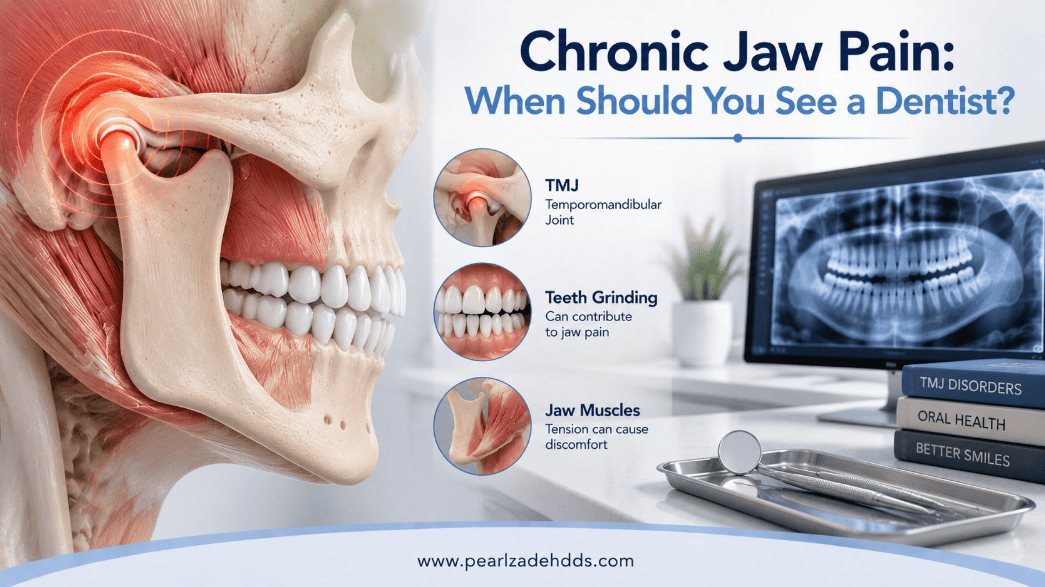
  • Chronic Jaw Pain: When Should You See a Dentist?

    Chronic Jaw Pain: When Should You See a Dentist?

    Jaw pain is easy to ignore when it comes and goes. You might notice it while chewing, wake up with a tight jaw, or feel soreness around your temples after a stressful day. Then it settles down, so you move on.

    But when the pain keeps returning, becomes more noticeable, or starts affecting how you eat or sleep, waiting it out becomes harder to justify.

    So when should you actually see a dentist for jaw pain? The answer depends on how long it has lasted, what triggers it, and what other symptoms you are experiencing.

    What Counts as Chronic Jaw Pain?

    “Chronic” generally means pain that persists or keeps returning over an extended stretch of time. The National Institutes of Health describes chronic pain broadly as pain lasting longer than three months, or longer than the time your body would normally need to heal. That’s a general medical benchmark, not a strict rule specific to your jaw. The pattern of your pain matters just as much as how long it’s lasted. Temporary soreness after a long day of chewing is different from discomfort that keeps returning every few weeks, which is different again from pain that’s simply been there, on some level, for a while now. Worth paying attention to whether your pain shows up in the morning, during chewing, when you open your mouth wide, after stressful stretches, alongside headaches, with clicking or popping, or together with tooth pain. Those details tell your dentist more than the raw duration alone.

    Where Does Jaw Pain Come From?

    Jaw pain can come from more places than people expect. The jaw joints themselves, the muscles around them, the teeth, the gums, strain related to your bite, clenching or grinding habits, previous dental work, or an old injury can all be involved. This isn’t a list to diagnose yourself from. It’s exactly why figuring out the actual source is one of the more useful things a dental evaluation can do.

    Could Teeth Grinding Be Causing Your Jaw Pain?

    It’s a genuine possibility for some patients. Nighttime grinding and daytime clenching place repeated stress on your jaw muscles and teeth, which can show up as morning jaw soreness, general muscle fatigue, tooth wear, or tooth sensitivity. Our discussion of how teeth grinding damages teeth over the years goes further into that connection. Not everyone with jaw pain grinds their teeth, though, so this is one possible piece of the picture rather than an automatic explanation.

    Could TMJ Disorder Cause Jaw Pain?

    Problems involving the temporomandibular joints or the muscles around them can genuinely cause jaw pain. That can include pain near the joint itself, pain while chewing, clicking or popping, jaw stiffness, limited opening, headaches, or facial muscle soreness. Our broader overview of TMJ disorder covers this territory in more depth. Clicking alone doesn’t automatically mean you’re dealing with a serious TMJ disorder. It’s one detail among several a dentist actually weighs.

    Can Jaw Pain Come From a Tooth?

    Not all pain you feel around your jaw actually originates in the joint. Tooth decay, a cracked tooth, a dental infection, gum problems, or an issue with an existing restoration can all cause pain that feels broader than one specific tooth. Dental pain has a way of radiating outward, which is part of why patients often can’t pinpoint the true source on their own. None of these possibilities can be confirmed from symptoms alone.

    Can Your Bite Contribute to Jaw Pain?

    How your upper and lower teeth meet can be relevant for some patients, though it isn’t accurate to say an imperfect bite automatically causes chronic jaw pain. A dentist evaluating this might look at bite contact, tooth wear, existing restorations, signs of clenching, and jaw movement together. Our discussion of signs your bite may be causing dental problems goes further into that evaluation. Bite assessment is one part of a broader picture, not the whole story on its own.

    When Should You See a Dentist for Jaw Pain?

    A dental evaluation makes sense when jaw pain:

    • Keeps returning
    • Doesn’t improve
    • Makes chewing uncomfortable
    • Affects your sleep
    • Comes with tooth sensitivity
    • Occurs alongside noticeable tooth wear
    • Comes with painful clicking or popping
    • Makes opening your mouth difficult
    • Occurs with headaches or facial muscle soreness
    • Follows dental treatment and doesn’t feel normal afterward

    Persistent or recurring symptoms deserve attention even when the pain itself isn’t severe. Our guide to when jaw symptoms warrant a dental evaluation goes further into that specific question.

    When Is Jaw Pain an Urgent Problem?

    A few situations call for prompt attention rather than a routine appointment:

    • Significant facial swelling
    • Fever along with dental or jaw pain
    • Difficulty breathing or swallowing
    • Signs of a severe infection
    • Major trauma to the jaw
    • Jaw locking that prevents normal movement
    • Sudden severe pain accompanied by other concerning symptoms

    If you’re experiencing difficulty breathing or swallowing, that calls for urgent medical care, not a wait-and-see approach. Most jaw pain doesn’t fall into this category, but these specific situations are worth knowing.

    What Happens During a Jaw Pain Evaluation?

    Expect questions about:

    • When the pain started
    • Where it hurts
    • What makes it better or worse
    • Whether it happens during chewing
    • Whether you grind or clench
    • Whether you get headaches
    • Your previous dental treatment
    • Any past jaw injuries

    Your dentist may then examine your:

    • Teeth
    • Gums
    • Bite
    • Jaw movement
    • Jaw muscles
    • The TMJ area itself

    Imaging sometimes gets recommended depending on what the exam finds, though not every patient needs X-rays or advanced imaging as a matter of routine.

    Does Every Jaw Pain Patient Need a Night Guard?

    No. A night guard can genuinely help patients who grind or clench, particularly when protecting the teeth is part of the goal. It isn’t automatically the answer for every case of jaw pain, though. What’s actually causing the pain needs to be understood before an appliance gets recommended, not the other way around.

    What About TMJ Treatment Without Surgery?

    Some TMJ-related symptoms can be managed with conservative approaches, depending on the underlying cause and how severe things are. Our discussion of non-surgical TMJ treatment options covers this in more depth. Not every TMJ condition can be resolved without surgery, but for plenty of patients, conservative care is where things reasonably start.

    Can Stress Make Jaw Pain Worse?

    For some people, yes. Stress may contribute to jaw clenching and general muscle tension, and patients sometimes notice more discomfort during particularly stressful stretches. This doesn’t mean stress explains every case of chronic jaw pain. It’s one contributing factor among several possible ones.

    What Can You Do While Waiting for an Appointment?

    A few low-risk, temporary steps can help in the meantime. Choose softer foods if chewing is uncomfortable. Skip chewing gum for now. Avoid opening your mouth unnecessarily wide. Pay attention to whether you’re clenching during the day. Follow any instructions your dentist has already given you. Keep a rough note of when your symptoms show up. None of this is a diagnosis or a cure, and it isn’t a reason to try aggressive jaw exercises or make permanent changes to how you eat. These are just reasonable comfort measures until you’re actually seen.

    What If the Pain Comes and Goes?

    Intermittent symptoms still deserve attention, even if you feel completely fine for days at a time between episodes. Pay attention to whether certain patterns line up with your flare-ups, stressful periods, mornings specifically, certain foods, chewing, recent dental treatment, clenching, or headaches. Mentioning those patterns during your visit gives your dentist genuinely useful information, more than just describing the pain itself.

    What If Your Jaw Pain Started After Dental Work?

    Some temporary soreness after certain dental procedures is normal. Persistent, worsening, or unusual symptoms are a different matter and worth a conversation with your dentist. Mention when the pain actually began, what procedure you had done, whether your bite feels different than before, whether chewing feels uncomfortable, and whether things seem to be improving or getting worse. This doesn’t mean the treatment caused a lasting problem. It just means it’s worth having someone take a look.

    How Can You Tell If Jaw Pain Is Coming From Your Teeth or Jaw?

    Honestly, you often can’t tell on your own. Tooth pain, jaw muscle discomfort, TMJ symptoms, and pain that radiates from somewhere else nearby can all feel remarkably similar. A dental examination is really what helps narrow down where the problem is actually coming from. There isn’t a reliable way to self-diagnose this based on symptoms alone.

    Can Chronic Jaw Pain Go Away on Its Own?

    Sometimes, yes. Some temporary jaw discomfort settles without any treatment at all. Pain that persists, keeps coming back, gets worse, or starts affecting your eating and daily activities is a different situation and genuinely deserves evaluation. Waiting indefinitely on the assumption it will eventually resolve isn’t a great strategy once a pattern like that shows up.

    What Happens If You Ignore Chronic Jaw Pain?

    Ignoring persistent symptoms mainly delays figuring out what’s actually causing them. If the underlying issue involves tooth damage, ongoing grinding, an infection, or a jaw function problem, putting off an evaluation just gives that issue more time to continue. This doesn’t mean every case of untreated jaw pain is destined to become severe. It just means there’s little upside to waiting once symptoms are clearly sticking around.

    Persistent Jaw Pain Is Worth Checking

    Jaw pain can come from the jaw joints, the surrounding muscles, your teeth, your gums, clenching or grinding, previous dental work, or other causes entirely. Occasional mild soreness may well settle on its own. Recurring or persistent pain deserves real attention. A dentist can evaluate your teeth, bite, jaw movement, muscles, and other relevant areas to help figure out what’s actually contributing to what you’re feeling. The goal was never simply to treat the pain. It’s to understand why it’s happening in the first place.

    Speak With Dr. Pearl Zadeh About Your Jaw Pain

    Persistent jaw pain can have several possible causes, and patients don’t always know where the discomfort is actually coming from. Dr. Pearl Zadeh, a member of the American Dental Association and California Dental Association, can evaluate your teeth, bite, jaw, and related symptoms to help identify what may be contributing to what you’re experiencing.

    Call (818) 716-6722 or click the button below to schedule a consultation online.

    Frequently Asked Questions

    How long does jaw pain need to last before I should see a dentist?

    There’s no strict cutoff, but pain that keeps returning, doesn’t improve, or interferes with chewing or sleep is worth having evaluated rather than waiting further.

    Does jaw pain always mean I have TMJ disorder?

    No. Jaw pain can come from the joint, the surrounding muscles, a tooth, the gums, or your bite. A dental evaluation helps identify the actual source.

    Can a tooth problem cause pain that feels like it’s in my jaw?

    Yes. Dental pain from decay, a crack, or an infection can radiate outward and feel broader than one specific tooth.

    When is jaw pain an emergency?

    Significant facial swelling, fever with jaw pain, difficulty breathing or swallowing, major trauma, or jaw locking all call for prompt attention rather than a routine appointment.

    Will jaw pain go away on its own?

    Sometimes mild, temporary soreness does. Pain that persists, keeps returning, or affects eating and daily activities is worth having evaluated.

    This article is for informational purposes only and is not a substitute for professional dental or medical advice. Please schedule a consultation with Pearl Zadeh DDS to discuss your specific situation, and seek prompt medical care for any urgent or severe symptoms.
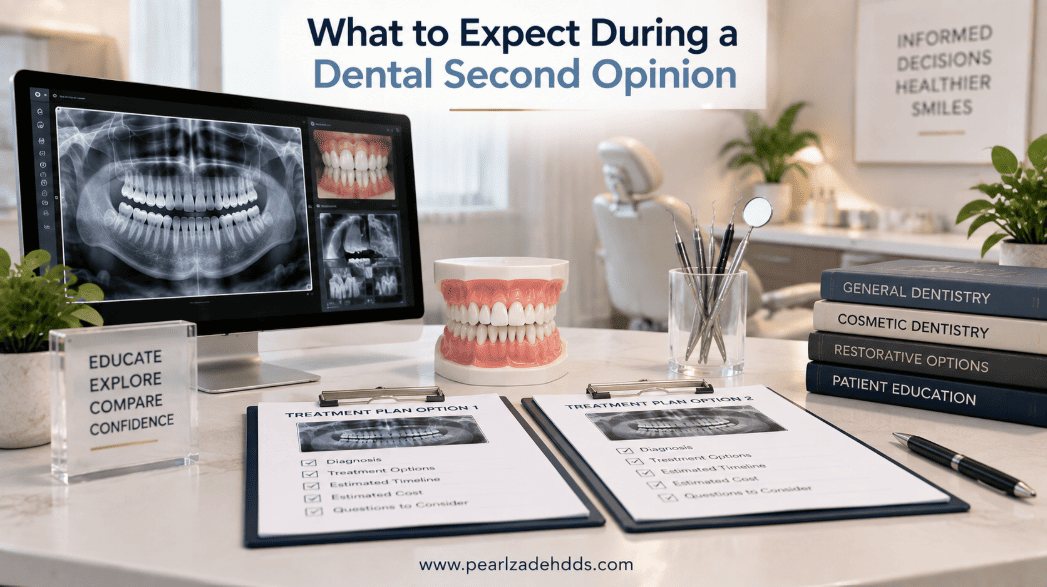
  • What to Expect During a Dental Second Opinion

    What to Expect During a Dental Second Opinion

    You’ve decided to get a second opinion. That part felt manageable. Now you’re sitting in your car in the parking lot, and a different kind of question shows up: what actually happens once you walk in there? Do you need to bring anything? Will they take new X-rays? Are you supposed to decide something on the spot?

    A second opinion is usually a conversation and an evaluation, not an appointment where you’re pressured to pick a new dentist or commit to treatment right then. Here’s what the actual visit tends to look like.

    What Is a Dental Second Opinion?

    Another dentist reviews your dental situation and the treatment you’ve already been recommended, then offers an additional professional perspective on it. That dentist might agree with the original recommendation, suggest a different approach, recommend gathering more information first, walk through alternatives you hadn’t considered, or in some situations suggest monitoring rather than immediate treatment. Our broader look at when to seek a second opinion covers the reasoning behind that decision in more depth. A second opinion isn’t set up to hunt for something wrong with your first dentist’s plan. It’s simply another set of eyes on your specific situation.

    What Should You Bring to the Appointment?

    Having the right information on hand makes the visit more useful. That generally includes recent dental X-rays, any treatment plan you’ve already received, your dental records, a list of current medications if that’s relevant to your situation, information about previous dental work, details about your symptoms or concerns, and the specific questions you want answered. The dentist won’t necessarily need every single record you have. Bringing what’s genuinely relevant is enough. You don’t need to track down your entire dental history before you’re allowed to schedule.

    Will You Need New X-Rays?

    It depends on what you already have. If recent, high-quality X-rays exist, the dentist reviewing your case may be able to work directly from those, especially if your original office can transfer them ahead of time. New imaging sometimes makes sense if your existing images aren’t available, are outdated, are incomplete, or simply don’t show the specific area that needs evaluation. Nobody should be ordering imaging you don’t actually need just as a formality.

    What Happens When You First Arrive?

    The appointment usually starts with a conversation rather than jumping straight into an exam. Expect questions about why you’re seeking another opinion, what treatment was actually recommended, any symptoms you’re currently experiencing, your previous dental treatment, and what specifically concerns you about the proposed plan. This part is meant to feel like a real conversation, not an interrogation.

    Will the Dentist Examine Your Teeth?

    Usually, yes, when a direct look at your actual condition matters for the evaluation. Depending on what’s being reviewed, that might include your teeth, your gums, any existing restorations, your bite, visible tooth wear, whatever area is causing discomfort, and your jaw movement if that’s relevant to the situation. How much of an exam happens depends heavily on the type of treatment being reviewed. A second opinion on a single filling looks different from one covering several teeth.

    Will the Dentist Review Your Existing Treatment Plan?

    Yes, and this is usually a central part of the visit. The dentist can walk through the recommended treatment and discuss what problem it’s actually meant to address. That might involve looking at the diagnosis itself, the recommended procedures, the treatment sequence, any existing dental work in the area, possible alternatives, and what outcome you can realistically expect. This is common territory for significant restorative work, including proposed crowns or bridges. Reviewing a treatment plan doesn’t automatically mean rejecting it. Plenty of reviews end with the plan making just as much sense as it did originally.

    Can a Second Dentist Give You a Different Treatment Plan?

    Yes, sometimes. Dentists can approach the exact same problem differently while still working from an identical diagnosis. Differences often show up in the materials used, the treatment sequence, timing, how many procedures are involved, a more conservative versus a more extensive approach, or whether treatment gets staged over time. A different recommendation doesn’t automatically mean the first dentist was wrong. It often just reflects a genuinely different, reasonable way of approaching the same situation.

    What Questions Should You Ask?

    A few genuinely useful questions to bring with you: What problem are we actually treating? Is treatment necessary right now? What happens if I wait? Are there alternatives worth considering? What are the benefits and downsides of each option? How will this treatment affect my teeth and bite? How long should it realistically last? What maintenance will I need afterward? What are the possible risks? And is there anything else I should be asking before I decide?

    Can You Ask About Less Invasive Options?

    Yes, when that’s genuinely appropriate for your situation. Reasonable questions include whether a tooth could simply be monitored instead of treated right away, whether a smaller restoration might work, whether treatment could be staged rather than done all at once, whether different restorative materials are available, or whether a different sequence makes sense. This doesn’t mean conservative treatment is automatically the better choice. The right option depends entirely on your actual dental condition, not a general preference for doing less.

    What If the Second Opinion Agrees With the First?

    That can genuinely be reassuring, and it doesn’t mean the visit was pointless. A second opinion doesn’t need to produce a different diagnosis to be useful. Agreement can help you feel more confident about the diagnosis itself, the proposed treatment, the timing, the alternatives you were given, and what outcome to expect. Confirmation is a legitimate, valuable result, not a consolation prize.

    What If the Two Opinions Are Very Different?

    Ask both dentists directly why they recommend their specific approach, what problem each plan is actually addressing, why one option might be preferable to the other, what happens if treatment gets delayed, and what the risks and long-term expectations genuinely are. If your situation is particularly complex, a specialist consultation can sometimes add another useful layer of perspective. Don’t default to whichever plan sounds easier or happens to cost less without actually understanding why the two recommendations differ.

    Will You Be Pressured to Start Treatment?

    You should feel comfortable asking questions and taking reasonable time to consider significant dental treatment. A second-opinion consultation is meant to give you room to ask questions and actually understand your options, not to rush you into a decision. Every practice runs its consultations a little differently, so this isn’t a claim about how every office operates. The American Dental Association’s own guidance on informed consent frames it as an ongoing conversation rather than simply a signature on a form, which is the standard a good consultation should actually meet.

    How Long Does a Dental Second Opinion Take?

    There’s no single length that applies to every appointment. It depends on how complex your dental situation is, whether an examination is actually needed, what records and imaging are already available, how many procedures are being reviewed, and how many questions you have. A straightforward review can move quickly. A second opinion on extensive treatment naturally takes longer.

    Do You Have to Choose the Second Dentist?

    No. Getting a second opinion doesn’t obligate you to transfer your care anywhere. You can use the consultation purely to gather information, then decide what actually feels right for you afterward, whether that means staying with your original dentist, moving forward with the second one, or taking more time before deciding anything.

    What Happens After the Consultation?

    You might leave with a clearer understanding of your diagnosis, confirmation of the original recommendation, additional treatment options you hadn’t considered, questions worth bringing back to your current dentist, or in some cases a recommendation for specialist evaluation. Whatever you walk away with, it’s worth taking real time to compare what you were told before making any major decision.

    How Should You Compare What You Were Told?

    A simple framework helps when you’re weighing two recommendations against each other:

    • Diagnosis: are both dentists actually treating the same problem?
    • Treatment goal: what is each plan trying to accomplish?
    • Alternatives: were different options actually discussed?
    • Timing: does treatment need to happen immediately?
    • Longevity: how long is the proposed treatment expected to last?
    • Maintenance: what will you need to do afterward?
    • Risks: what are the possible complications or limitations?
    • Cost: what does the quoted price actually include?

    Price is worth considering alongside the treatment itself, not as a separate, standalone factor.

    When Is a Second Opinion Especially Useful?

    A few situations tend to make a second opinion particularly worthwhile: extensive treatment plans, multiple procedures, major restorative work, full-mouth reconstruction, cosmetic treatment involving irreversible changes such as veneers, significant bite changes, an unclear diagnosis, conflicting recommendations, or treatment you simply don’t fully understand yet. None of this means routine dental care needs a second opinion attached to it.

    What to Expect From a Good Second Opinion

    A genuinely useful consultation should leave you with a clearer picture of what’s actually happening, why treatment was recommended in the first place, what real options exist, what happens if you wait, and what outcomes you can reasonably expect. The goal is clarity, not necessarily a different treatment plan. Sometimes those turn out to be the same thing. Often they aren’t, and that’s fine too.

    Speak With Dr. Pearl Zadeh About Your Dental Treatment Options

    You deserve to actually understand your dental treatment before making a significant decision about it. Dr. Pearl Zadeh, a member of the American Dental Association and California Dental Association, can review your dental concerns, examine your teeth and bite when appropriate, discuss your treatment options, and answer your questions about recommended care.

    Call (818) 716-6722 or use the website’s consultation booking option.

    Frequently Asked Questions

    Do I need to bring anything to a dental second opinion?

    Recent X-rays, your existing treatment plan, and relevant dental records make the visit more useful, though the dentist may not need everything you have.

    Will I need new X-rays for a second opinion?

    It depends on whether your existing images are recent, complete, and available. New imaging is only necessary when the existing images don’t cover what needs evaluation.

    Am I obligated to switch dentists after a second opinion?

    No. A second opinion is simply a chance to gather more information. You decide what to do with it afterward.

    What if the second dentist agrees with my original treatment plan?

    That’s a genuinely useful outcome. Confirmation can give you more confidence in the diagnosis and plan you were originally given.

    How long does a second opinion appointment usually take?

    It varies based on the complexity of your case, whether an exam is needed, and how many questions you bring. There’s no fixed length that applies to everyone.

    This article is for informational purposes only and is not a substitute for professional dental advice. Please schedule a consultation with Pearl Zadeh DDS to discuss your specific situation.

  • When Should You Get a Second Opinion on Dental Work?

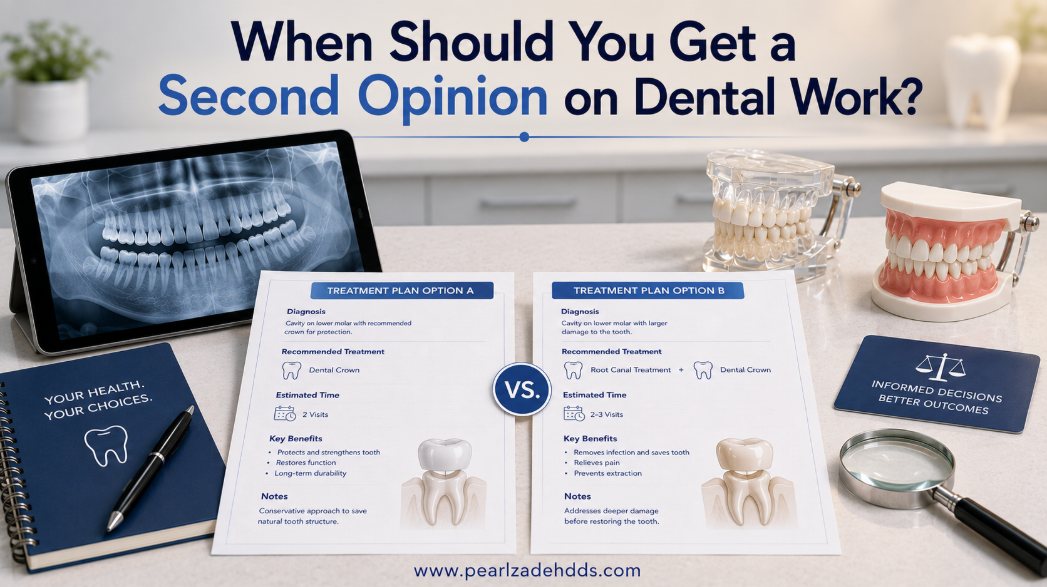
    When Should You Get a Second Opinion on Dental Work?

    You went in expecting a small filling. You left with a treatment plan covering four teeth, a conversation about crowns, and a number that made you sit down in your car for a minute before driving home. Now you’re wondering whether to just schedule everything, or pause and get another set of eyes on it first.

    Getting a second opinion isn’t necessarily about finding a dentist who tells you something different. Sometimes it’s simply about understanding your options before committing to something significant for your teeth.

    What Does a Dental Second Opinion Mean?

    Another dentist reviewing your case may look at your existing dental records, examine your teeth and gums directly, review your X-rays or other imaging, evaluate your bite, go through the proposed treatment, discuss alternatives, and explain what outcome you can realistically expect. Seeking a second opinion is a normal, professionally recognized part of dental care. The American Dental Association’s own Code of Ethics specifically addresses second opinions, expecting the dentist providing one to do so without a vested interest in which recommendation the patient ultimately follows. A second opinion can genuinely confirm what you were originally told. It can just as easily surface a difference in approach, timing, or an alternative you hadn’t considered.

    When Should You Consider a Second Opinion?

    A handful of situations are reasonable moments to pause and ask for another perspective:

    • You’ve been recommended extensive dental work
    • You’re unsure why several procedures are necessary
    • You’ve been given multiple treatment options and don’t know how they differ
    • The proposed treatment involves several teeth
    • You’re considering major restorative work
    • You’re considering veneers or other cosmetic treatment
    • You’ve been recommended a crown, bridge, or replacement of existing dental work
    • Your treatment could significantly change your bite
    • You’re considering full-mouth reconstruction
    • You’re uncomfortable proceeding without more information
    • You received different recommendations from different dentists
    • You want to understand whether treatment needs to happen immediately or can reasonably wait

    Not every patient needs a second opinion for every recommendation. These are simply situations where one tends to add genuine value.

    Do You Need a Second Opinion Before a Crown or Bridge?

    This comes up often enough to deserve its own mention. A second opinion can be reasonable when a proposed crown or bridge involves an important treatment decision, multiple teeth, unclear alternatives, or a meaningful change to your bite. Our full discussion of second opinions before a crown or bridge goes into this specific situation in more depth.

    What About Veneers or Cosmetic Dental Work?

    Cosmetic treatment is elective, which is exactly why patients often want more clarity before moving forward. Reasonable questions include whether veneers are genuinely the best option for your goals, whether a more conservative alternative exists, how much natural tooth structure the plan would actually alter, how the treatment might affect your bite, what happens if you change your mind later, and what ongoing maintenance to expect. Our practical guide to porcelain veneers covers what the treatment actually involves if you’re still gathering information. None of this is a knock against veneers or cosmetic dentistry generally. It’s simply that elective treatment deserves the same clarity as anything else.

    What About Full-Mouth Reconstruction?

    Extensive restorative treatment covering most or all of your teeth is a significant undertaking, and wanting another professional perspective before committing is entirely reasonable. Before moving forward, it helps to understand what specific problems the treatment is meant to address, which teeth actually need treatment, what happens if the work is staged over time rather than done all at once, how the plan affects your bite, what alternatives exist, and what maintenance the finished result will require. Our overview of full-mouth reconstruction in Woodland Hills covers what that treatment actually involves in more detail. A second opinion for treatment at this scale isn’t about doubting your dentist. It’s about making sure you understand a plan that will shape your dental health for years.

    Is a Second Opinion a Sign You Don’t Trust Your Dentist?

    Not necessarily. Patients seek another opinion for plenty of reasons that have nothing to do with distrust: wanting more information, wanting confirmation, wanting another perspective, wanting a clearer explanation, or simply wanting more confidence before committing to something significant. Good communication between a patient and dentist should leave room for questions, not discourage them. Seeking clarity isn’t an adversarial act.

    Does a Second Opinion Mean the First Dentist Was Wrong?

    Not necessarily. Dentists can recommend genuinely different approaches while working from the exact same underlying diagnosis. Differences often show up in treatment timing, materials, the specific restorative approach, how many procedures are involved, whether treatment gets staged over time, or a more conservative versus a more comprehensive strategy. Two different treatment plans for the same tooth doesn’t automatically mean one dentist made a mistake. It often just reflects a genuinely different, reasonable read on the same situation.

    What Questions Should You Ask During a Second Opinion?

    A few genuinely useful questions to bring with you: What problem are we actually treating? What happens if I wait? Does this need to happen now? Are there alternatives worth considering? What are the benefits and downsides of each option? How much healthy tooth structure would be affected? How could this affect my bite? How long should the treatment realistically last? What maintenance will I need afterward? What happens if the restoration eventually fails? Does anything about my existing dental work change the recommendation? And which part of this plan is essential, versus which part is optional?

    What Should You Bring to a Second Opinion?

    Bringing the right information makes the visit considerably more useful. That generally means recent X-rays, your dental records, any existing treatment plan you’ve already been given, your previous dental history, a list of your current concerns, information about previous restorations, and the specific questions you actually want answered. If records can be transferred directly between dental offices, you can simply ask both offices about that process rather than managing it yourself.

    Should You Tell Your Dentist You’re Getting a Second Opinion?

    You don’t need to feel uncomfortable about this. You can simply explain that you want to make an informed decision before moving forward with something significant. That’s a completely reasonable thing to say to any dentist, and it shouldn’t change how you’re treated.

    Should Cost Be the Reason You Get a Second Opinion?

    Cost differences between two treatment plans can genuinely exist, but price shouldn’t be the only thing you compare. Look at:

    • What’s actually being recommended
    • Why it’s being recommended
    • The materials involved
    • Expected longevity
    • How many appointments are required
    • Follow-up care
    • Risks
    • Available alternatives

    The most expensive option isn’t automatically the best one, and the cheapest option isn’t automatically the better value. Comparing the full picture matters more than comparing two numbers.

    What If Two Dentists Recommend Different Treatments?

    Don’t simply choose whichever plan sounds easier or costs less. Ask both dentists directly why they recommend their specific approach, what problem their treatment is meant to address, what alternatives they considered, what happens if treatment is delayed, and what the long-term expectations actually are. If the two recommendations differ substantially, you may need additional records, imaging, or input from a specialist to get a clearer picture before deciding.

    When You May Not Need a Second Opinion

    A second opinion tends to matter less when the treatment is straightforward, the diagnosis is clear, you actually understand the recommendation, the plan feels reasonable to you, and you feel genuinely comfortable with your dentist’s explanation. This isn’t meant to suggest getting multiple opinions before every routine filling or cleaning. Save it for decisions that actually warrant the extra step.

    When a Specialist Opinion May Make More Sense

    Some situations call for evaluation by a dentist or specialist with training specific to that problem. Examples include complex oral surgery, complicated orthodontic cases, significant jaw disorders, certain gum conditions, complex endodontic problems, and difficult restorative cases. A second opinion from another general dentist and a consultation with a specialist aren’t always the same thing, and depending on your situation, either one, or both, might be the right next step.

    How to Compare Two Treatment Plans

    A simple framework helps when you’re weighing two different recommendations side by side:

    • Diagnosis: are both dentists actually treating the same problem?
    • Goal: what is each treatment trying to accomplish?
    • Alternatives: are there less invasive or genuinely different options?
    • Timing: does treatment need to happen immediately?
    • Longevity: how long is the proposed treatment expected to last?
    • Maintenance: what will you need to do afterward?
    • Risks: what are the possible complications or limitations?
    • Cost: what’s actually included, and what future treatment might still be needed?

    This framework is meant to help you compare clearly, not to tell you which dentist to choose.

    What Should You Do After Getting a Second Opinion?

    The goal was never simply collecting two opinions and picking one at random. Take time to actually compare what each dentist told you, and ask follow-up questions if anything remains unclear. If the two recommendations differ significantly, another conversation, or a specialist evaluation, may genuinely help. Ultimately, choose a treatment plan you actually understand and feel comfortable moving forward with.

    What Matters Most When Choosing Between Treatment Plans?

    The real question was never simply which dentist is right. What matters is whether you understand your diagnosis, the purpose of the treatment being proposed, your actual alternatives, the risks involved, the expected outcome, and what long-term maintenance will look like. A second opinion is useful when it gives you more clarity, not simply when it happens to produce a different answer than the first one did.

    Speak With Dr. Pearl Zadeh Before You Move Forward

    You should feel comfortable asking questions before committing to significant dental treatment. Dr. Pearl Zadeh, a member of the American Dental Association and California Dental Association, can review your dental concerns, examine your teeth and bite, discuss your treatment options, and help you understand the reasoning behind a proposed plan.

    Call (818) 716-6722 or click the button below to schedule a consultation online..

    Frequently Asked Questions

    Does getting a second opinion mean I don’t trust my dentist?

    Not necessarily. Patients often seek another opinion for more information, confirmation, or confidence before a significant decision, not because of distrust.

    Will a second dentist automatically disagree with the first?

    Not necessarily. A second opinion can confirm the original recommendation just as easily as it can offer a different approach.

    Should I choose the cheaper treatment plan if two dentists disagree?

    Not automatically. Compare what’s included, materials, longevity, and risks alongside cost rather than price alone.

    What should I bring to a second opinion appointment?

    Recent X-rays, your dental records, your existing treatment plan, and a list of specific questions all make the visit more useful.

    Do I need a second opinion for a simple filling?

    Usually not. A second opinion tends to matter most for extensive, unfamiliar, or irreversible treatment, not routine or straightforward care.

    This article is for informational purposes only and is not a substitute for professional dental advice. Please schedule a consultation with Pearl Zadeh DDS to discuss your specific situation.

    Speak With Dr. Pearl Zadeh Before You Move Forward

    You should feel comfortable asking questions before committing to significant dental treatment. Dr. Pearl Zadeh, a member of the American Dental Association and California Dental Association, can review your dental concerns, examine your teeth and bite, discuss your treatment options, and help you understand the reasoning behind a proposed plan.

    Call (818) 716-6722 or use the website’s consultation booking option.

  • Stress and Teeth Grinding: Breaking the Nightly Cycle

    Stress and Teeth Grinding: Breaking the Nightly Cycle

    You wake up with a sore, tight jaw after a stressful day. Your teeth feel more sensitive than usual, and your partner says they heard you grinding during the night. Now you’re wondering whether all that tension followed you into sleep.

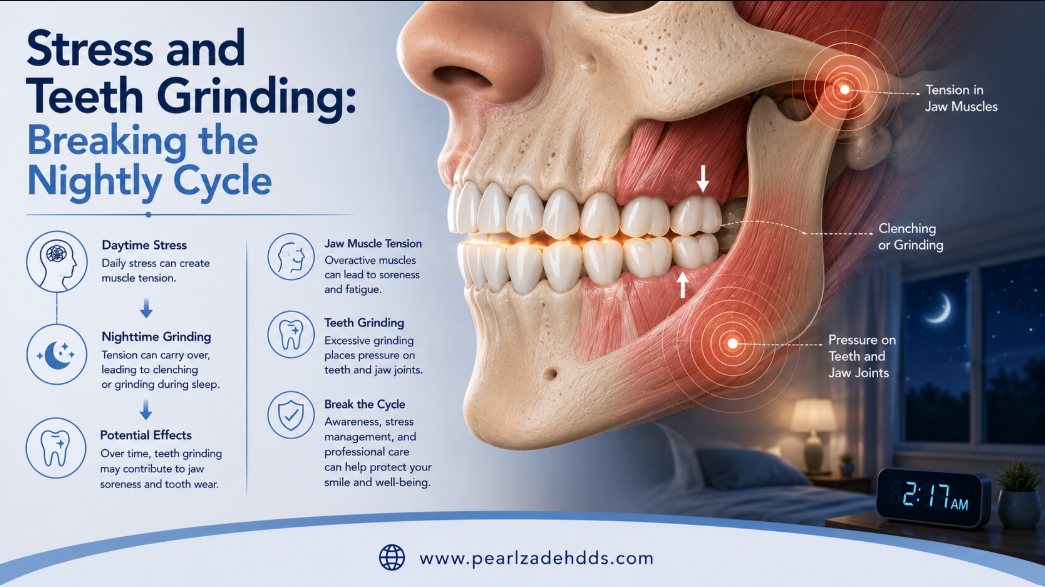
    It might have. Stress can contribute to teeth clenching and grinding in some people, especially during periods of ongoing tension. But stress isn’t the only possible reason you grind your teeth, and figuring out what’s behind it matters if your teeth or jaw are starting to suffer.

    What Is Teeth Grinding?

    Dentists call this bruxism, and it covers two related things. Grinding is when your teeth actually slide or rub against each other. Clenching is when your jaw muscles tighten forcefully, sometimes without much visible tooth movement. Both can happen while you’re asleep or while you’re awake. Plenty of people have no idea they grind or clench at night, simply because it happens while they’re unconscious. The signs usually show up elsewhere, a sore jaw, sensitive teeth, a comment from a partner, long before anyone notices the actual grinding.

    Can Stress Cause Teeth Grinding?

    Stress can be one factor that contributes to teeth grinding or clenching in some people. Periods of increased stress sometimes coincide with more noticeable jaw tension or grinding, though stress isn’t the only possible contributor here. A systematic review published in the Journal of Oral & Facial Pain and Headache looked specifically at psychosocial factors, including stress, anxiety, and depression, in relation to bruxism, and found evidence connecting these factors to grinding across a substantial body of research. That’s meaningfully different from saying stress causes teeth grinding outright. Sleep-related factors, certain medications, other habits, and various health conditions may also play a role. This isn’t meant to be an exhaustive rundown of every possible cause. It’s simply a reminder that stress is part of a bigger picture, not the whole picture.

    Why Does Stress Show Up in Your Jaw?

    Some people respond to stress by tightening their jaw muscles without ever noticing they’re doing it, the same way others might hunch their shoulders or clench their fists. In people who already grind or clench, that muscle activity can continue right through sleep. This may contribute to morning jaw soreness, facial muscle fatigue, temple discomfort, tooth sensitivity, headaches, or a general sense of jaw tightness. Every one of these symptoms can also come from something else entirely, so none of them confirms grinding on its own.

    How Do You Know If You Grind Your Teeth at Night?

    You may never actually notice the grinding itself, since it happens while you’re asleep. A few signs tend to point in that direction:

    • Waking with a sore or tired jaw
    • Tooth sensitivity
    • Flattened or worn tooth surfaces
    • Chipped teeth
    • Jaw stiffness
    • Temple discomfort
    • Indentations on your tongue or the inside of your cheek
    • A partner mentioning grinding sounds
    • Noticeably more jaw tension during stressful stretches

    None of these prove bruxism definitively on their own. A dentist can actually look for signs of tooth wear and other evidence that points toward grinding.

    What Happens to Your Teeth When You Grind?

    Repeated grinding can lead to tooth wear over time, flattened chewing surfaces, small cracks, chipping, increased sensitivity, and in some cases damage to existing dental work. This isn’t meant to sound alarming. Most grinding doesn’t cause dramatic damage overnight. It’s a gradual process, and how much wear actually shows up depends heavily on how often and how forcefully you grind.

    Can Teeth Grinding Affect Your Jaw?

    Repeated clenching and grinding places extra workload on your jaw muscles, which can show up as jaw soreness, muscle fatigue, clicking or popping, pain while chewing, or difficulty opening your mouth comfortably. Grinding doesn’t automatically mean you have a TMJ disorder, though the two can genuinely overlap for some patients. If jaw symptoms are part of what you’re noticing alongside grinding, that broader connection is worth understanding.

    Why Does Grinding Sometimes Get Worse During Stressful Periods?

    People sometimes clench more during periods of tension, worry, or intense concentration, even without realizing it in the moment. Daytime habits like this can sometimes carry over into nighttime grinding too. A demanding stretch at work, a major life change, anxiety before something important, long hours of focused concentration, or a run of poor sleep can all coincide with more noticeable grinding. This doesn’t mean reducing stress alone will fix the underlying habit. It’s more that stress can act as one thing tipping the scale.

    Can Stress Reduction Help With Teeth Grinding?

    For some people, yes, reducing stress may help ease clenching or general muscle tension, though it’s not a guaranteed fix. A few practical habits worth trying: keeping a consistent bedtime routine, actually getting enough sleep, taking short breaks during stressful stretches at work, paying attention to when you’re clenching during the day, practicing some form of relaxation before bed, and addressing ongoing sources of stress where that’s realistically possible. None of this replaces a conversation with your dentist if grinding is already affecting your teeth or jaw.

    What Is the Best Position for Your Jaw During the Day?

    When you’re not eating or speaking, your teeth generally don’t need to stay pressed together. A relaxed jaw means your lips are gently closed, your teeth are slightly apart, and your jaw muscles aren’t actively working. Simply noticing when you catch yourself clenching during the day, at your desk, in traffic, scrolling your phone, can make you more aware of a habit that often runs on autopilot.

    Can a Night Guard Help With Stress-Related Grinding?

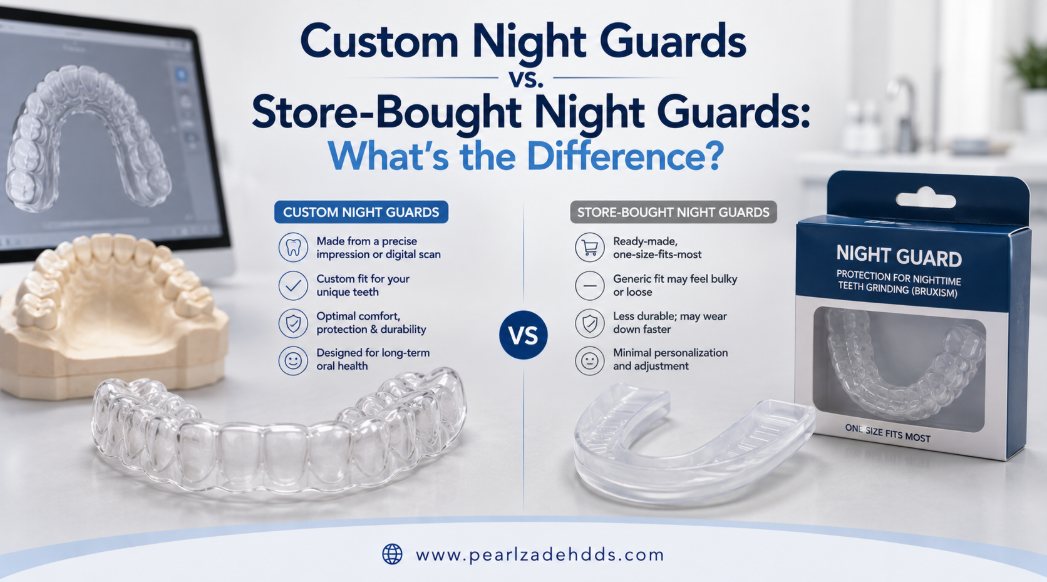
    A night guard may help protect your teeth from the physical effects of grinding and can be appropriate for some patients. What it generally doesn’t do is eliminate the underlying tendency to clench or grind in the first place. The right appliance should be selected based on your specific teeth, your bite, your grinding pattern, and your overall dental health, not chosen off a shelf without any of that in mind.

    Are Store-Bought Night Guards Good Enough?

    Sometimes, depending on the situation. Fit genuinely matters here, since a poorly fitting appliance can be uncomfortable or simply not suited to your bite. Our comparison of custom and store-bought night guards goes further into the practical differences between the two if you’re weighing your options.

    Can Teeth Grinding Cause Headaches?

    Grinding and jaw muscle tension may contribute to headaches for some people, and morning headaches sometimes show up alongside nighttime clenching. Headaches have plenty of possible causes beyond your jaw, though, so it wouldn’t be accurate to say grinding explains every morning headache you have. Our deeper look at TMJ and chronic headaches covers that connection in more detail.

    What About Jaw Clicking?

    Grinding and jaw tension can occur alongside clicking or popping, but clicking on its own doesn’t automatically mean you have a serious TMJ disorder. Our discussion of TMJ and jaw clicking goes further into what that sound can and can’t tell you. If you’re dealing with painful clicking, locking, or real difficulty moving your jaw, that’s worth discussing with a dentist rather than watching and waiting.

    When Should You Talk to Your Dentist?

    A few situations are worth bringing up rather than assuming they’ll resolve on their own:

    • Persistent morning jaw soreness
    • Tooth sensitivity without an obvious cause
    • Noticeable tooth wear
    • Chipped or cracked teeth
    • Frequent headaches alongside jaw symptoms
    • Pain when chewing
    • Painful clicking or popping
    • Jaw locking
    • Difficulty opening your mouth
    • A partner regularly noticing nighttime grinding

    A dentist can look for signs of bruxism and assess your teeth, jaw, bite, and any existing dental work together. Our guide to when jaw symptoms warrant a dental evaluation goes further into that distinction.

    What Can a Dentist Check?

    An evaluation typically covers:

    • Tooth wear
    • Cracks or chips
    • Tooth sensitivity
    • Jaw movement
    • Jaw muscle tenderness
    • Your bite
    • Any existing restorations
    • Other signs of clenching or grinding

    Your dentist looks at these findings alongside what you’re actually experiencing and your history, not any single finding in isolation. One worn tooth doesn’t prove nighttime grinding by itself. The overall pattern is what actually tells the story.

    Can You Break the Nightly Grinding Cycle?

    Managing bruxism often involves more than one single step. Depending on your situation, that might mean addressing:

    1. Possible contributing factors

    2. Daytime clenching habits

    3. Sleep and stress patterns

    4. Tooth protection

    5. Any jaw symptoms

    6. Underlying dental issues

    The right combination varies from person to person. Stress management alone isn’t a guaranteed cure, but it can genuinely be one useful piece of a larger approach.

    Stress May Be Part of the Picture

    Stress can contribute to clenching and grinding for some people, but it isn’t the only possible factor at play. Repeated grinding can affect your teeth and place real strain on your jaw muscles over time. Paying attention to stress, daytime clenching, sleep habits, and any dental symptoms can help you start noticing your own patterns. If grinding is frequent or already causing problems with your teeth or jaw, a dental evaluation can help figure out what’s actually happening and whether protection or treatment makes sense for you.

    Speak With Dr. Pearl Zadeh About Teeth Grinding

    Stress may contribute to teeth grinding, but persistent grinding can have several contributing factors working together. Dr. Pearl Zadeh, a member of the American Dental Association and California Dental Association, can evaluate your teeth, bite, jaw, and signs of grinding, then discuss appropriate ways to protect your teeth and manage related symptoms.

    Call (818) 716-6722 or click the button below to schedule a consultation online.

    Frequently Asked Questions

    Can stress really cause teeth grinding?

    Stress can be one factor that contributes to grinding or clenching in some people, though it isn’t the only possible cause. Sleep patterns, habits, and other health factors can play a role too.

    How do I know if I’m grinding my teeth at night?

    Common signs include waking with a sore jaw, tooth sensitivity, visible tooth wear, or a partner mentioning grinding sounds. A dentist can look for physical evidence during an exam.

    Will reducing stress stop my teeth grinding?

    It may help some people reduce clenching or jaw tension, but it isn’t a guaranteed fix. Grinding often has more than one contributing factor.

    Can a night guard stop the underlying urge to grind?

    Not necessarily. A night guard can help protect your teeth from the physical effects of grinding, but it doesn’t usually eliminate the underlying tendency to clench or grind.

    When should I see a dentist about teeth grinding?

    Persistent jaw soreness, noticeable tooth wear, chipped teeth, painful clicking, or a partner regularly noticing grinding are all reasonable reasons to schedule an evaluation.

    This article is for informational purposes only and is not a substitute for professional dental advice. Please schedule a consultation with Pearl Zadeh DDS to discuss your specific situation.

  • Can TMJ Cause Chronic Headaches? What Patients Should Know

    Can TMJ Cause Chronic Headaches? What Patients Should Know

    You wake up with a headache and a jaw that feels tired or sore. By afternoon, your temples feel tight again. Your partner has also mentioned hearing you grind your teeth at night. At first, none of these things seem connected.

    But when headaches keep showing up alongside jaw pain, clenching, or grinding, the connection is worth looking into. TMJ problems can involve the jaw joints and the muscles around them, and those muscles extend into areas that can hurt when they become tense or overworked.

    What Is TMJ?

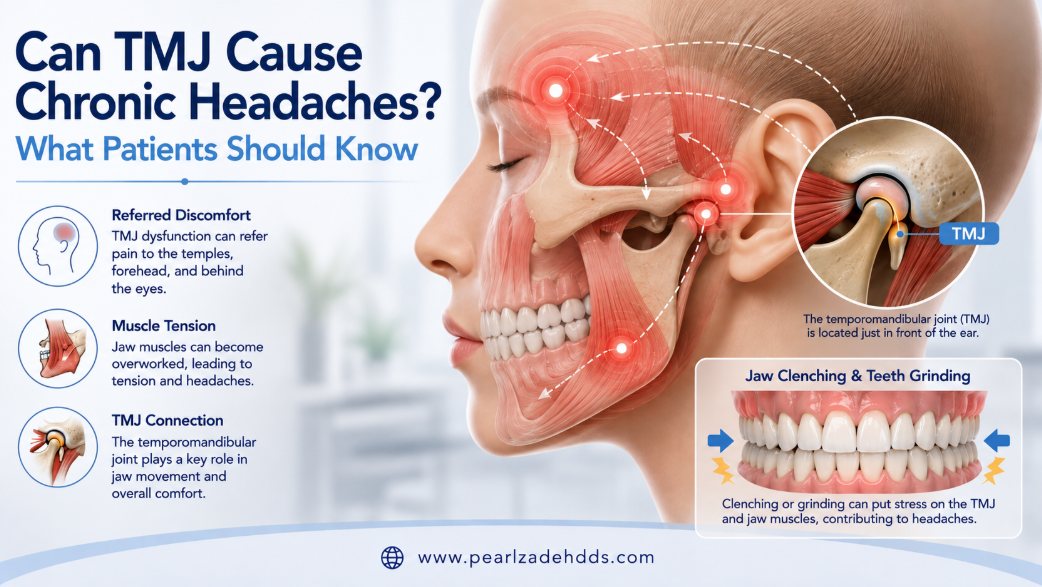
    You have a temporomandibular joint on each side of your face, connecting your lower jaw to your skull. These joints, along with the muscles around them, let you chew, speak, yawn, and swallow. TMJ disorders can involve the joint itself, the surrounding muscles, or both together.

    Can TMJ Problems Cause Headaches?

    TMJ disorders and jaw muscle tension may be associated with pain around your temples, face, jaw, the area near your ears, and your head and neck generally. Pain originating in overworked jaw muscles can genuinely be experienced as head pain, since these muscles sit close to areas patients associate with headaches. A systematic review published in the Journal of the American Dental Association found a real association between painful TMD and both tension-type headaches and migraines, though the certainty of that evidence was rated low to very low across the studies reviewed. Headaches have plenty of possible causes beyond your jaw, so having one doesn’t prove TMJ is responsible. TMJ problems may contribute to headaches in some patients. That’s a different statement than TMJ causing chronic headaches outright.

    What Does a TMJ-Related Headache Feel Like?

    There’s no single pattern that confirms a TMJ connection on its own. Some patients notice temple pressure or aching, jaw soreness, tenderness in the facial muscles, pain near the ears, jaw fatigue, headaches that show up after a long stretch of chewing, or symptoms that feel worse right after waking. Every one of these can have other causes too, which is exactly why none of them confirms anything by itself.

    Why Can Jaw Tension Lead to Head Pain?

    Your jaw muscles connect to and interact with muscles and tissue in nearby areas, including your temples. Repeated clenching, grinding, or holding tension in your jaw over long stretches can leave those muscles genuinely overworked. Discomfort starting in an overworked jaw muscle can spread into nearby areas rather than staying neatly contained. This doesn’t play out as a direct, guaranteed cause-and-effect chain in every patient. It’s a plausible mechanism, not a rule that applies identically to everyone.

    Can Teeth Grinding Be Connected to Headaches?

    Bruxism, the term for grinding or clenching your teeth, may be part of this picture for some patients. Nighttime grinding places repeated stress on both your jaw muscles and your teeth. Alongside grinding, you might notice morning jaw soreness, tooth sensitivity, worn or flattened teeth, chips, facial soreness, and headaches. Our discussion of how teeth grinding damages teeth over the years goes further into what that wear can actually look like over time.

    Why Are Headaches Sometimes Worse in the Morning?

    Unconscious nighttime clenching or grinding is one possible explanation for jaw-related discomfort you notice after sleeping. It isn’t the only one, though. Morning headaches can also come from sleep quality issues, other health conditions, and factors that have nothing to do with your jaw at all. Waking up with a headache doesn’t automatically point to bruxism. It’s simply one possibility worth mentioning if it’s a pattern you keep noticing.

    Can Stress Make TMJ Symptoms Worse?

    Stress may contribute to clenching or increased jaw muscle tension for some people, though it isn’t accurate to call stress the underlying cause of TMJ disorders generally. Some patients notice a real pattern where jaw tension, clenching, and headaches all become more noticeable during particularly stressful stretches. That’s worth paying attention to as a pattern, not as proof that stress alone explains everything going on.

    What Other TMJ Symptoms Should You Look For?

    Headaches become more worth discussing with a dentist when they show up alongside other jaw symptoms:

    • Clicking or popping
    • Jaw pain
    • Pain while chewing
    • Facial tenderness
    • Limited mouth opening
    • Jaw stiffness
    • Jaw locking
    • Discomfort near the ears
    • A noticeable change in how your teeth come together

    Our guide to when jaw symptoms warrant a dental evaluation goes further into that distinction.

    Is Jaw Clicking Related to Headaches?

    Clicking or popping by itself doesn’t necessarily mean you have a serious TMJ problem, and it isn’t accurate to say jaw clicking causes headaches. The same JADA-published systematic review specifically looked at painless TMJ issues, the kind without any accompanying pain, and found no positive association with either tension-type headache or migraine. Clicking that comes with pain, locking, or limited movement is a different situation and deserves more attention. The combination of symptoms matters more than the sound alone. Our discussion of TMJ and jaw clicking goes further into what jaw sounds can and can’t tell you on their own.

    Could a Night Guard Help?

    A night guard may be worth considering when teeth grinding or clenching is genuinely part of what’s going on. It isn’t a universal treatment for headaches or TMJ disorders in general. What actually helps depends on the underlying cause and your specific symptoms. Our overview of occlusal splints goes further into how these appliances work and who they’re actually appropriate for. No dentist can honestly promise that a night guard will stop your headaches.

    What Can a Dentist Check?

    An evaluation typically covers your jaw movement, any jaw tenderness, your bite, your teeth, tooth wear, signs of grinding, existing dental restorations, and what you report experiencing. Your dentist may ask when your headaches tend to occur, whether they’re worse in the morning, and whether jaw symptoms show up around the same time. A dental evaluation is genuinely useful, but it doesn’t rule out non-dental causes for your headaches. That’s an important limitation to keep in mind.

    Does TMJ Always Need Treatment?

    No. Mild or occasional jaw symptoms may not need active treatment at all. Whether treatment makes sense depends on severity, how long symptoms have lasted, how much pain is involved, how your jaw is functioning, how much it’s affecting your daily life, and what’s actually causing it. Our discussion of non-surgical TMJ treatment options covers conservative approaches in more depth. Surgery isn’t a commonly needed step for most patients dealing with jaw symptoms.

    What Can You Do at Home?

    A few simple, low-risk habits can reduce unnecessary strain on your jaw. Avoid chewing gum for long stretches. Skip very hard or chewy foods if chewing already causes discomfort. Pay attention to whether you’re clenching during the day, not just at night. Try keeping your jaw relaxed when you aren’t actively eating or speaking. Avoid repeatedly opening your mouth very wide just to test how it feels. Follow whatever specific instructions your dentist has actually given you. None of this is a substitute for an evaluation if your symptoms are persistent, and aggressive jaw exercises aren’t something to start on your own without a treatment plan behind them.

    When Should You See a Dentist?

    A handful of situations are worth bringing to a dentist rather than waiting them out:

    • Recurring headaches occurring alongside jaw symptoms
    • Persistent jaw pain
    • Pain while chewing
    • Frequent morning jaw soreness
    • Painful clicking or popping
    • Jaw locking
    • Difficulty opening your mouth
    • Frequent clenching or grinding
    • Significant tooth wear
    • A sudden change in your bite

    When Should a Headache Be Evaluated Medically?

    Chronic or recurring headaches can have plenty of causes that have nothing to do with your jaw. This section isn’t about diagnosing anything. It’s about making sure a dental explanation isn’t assumed when it shouldn’t be. Seek medical evaluation for headaches that are:

    • Sudden and extremely severe
    • Accompanied by neurological symptoms
    • Accompanied by confusion or fainting
    • Accompanied by weakness or trouble speaking
    • Accompanied by significant vision changes
    • Accompanied by fever or a stiff neck
    • Following a significant head injury

    Any of these deserve prompt medical attention rather than being treated as a dental issue.

    How Do You Know If Your Jaw Might Be Part of the Problem?

    Pay attention to whether your headaches repeatedly show up alongside jaw soreness, temple tenderness, teeth grinding, clenching, clicking, jaw stiffness, pain when chewing, or morning jaw fatigue. A pattern that keeps repeating is worth discussing with a professional. This isn’t meant as a diagnostic checklist you can score yourself against. It’s simply a way to notice whether your jaw and your headaches seem to be showing up together often enough to be worth a real conversation.

    Could Your Jaw Be Part of the Headache?

    TMJ problems and jaw muscle tension may contribute to head or facial pain in some patients. Teeth grinding and clenching can add extra strain on top of that. Headaches still have plenty of possible causes beyond your jaw, so TMJ shouldn’t automatically be assumed to be responsible just because both are present. When headaches keep showing up alongside jaw symptoms, a professional evaluation can help figure out what’s actually contributing, rather than guessing on your own.

    Speak With Dr. Pearl Zadeh About TMJ Symptoms

    Recurring headaches can have many causes, but jaw symptoms may be part of the picture for some patients. Dr. Pearl Zadeh, a member of the American Dental Association and California Dental Association, can evaluate your jaw, teeth, bite, and reported symptoms to help determine whether TMJ problems or grinding may be contributing. If your headaches are persistent or concerning, appropriate medical evaluation is worth pursuing alongside a dental visit, not instead of it.

    Call (818) 716-6722 or click the button below to schedule a consultation online.

    Frequently Asked Questions

    Can TMJ really cause headaches?

    Research shows an association between painful TMJ disorders and certain headache types, though it isn’t proof that TMJ causes every headache. It may contribute for some patients.

    What does a TMJ headache feel like?

    There’s no single confirming pattern. Temple pressure, jaw soreness, and facial tenderness alongside a headache are worth noting, though these symptoms can have other causes too.

    Does jaw clicking cause headaches?

    Clicking alone hasn’t shown a clear association with headaches in research. Clicking combined with pain, locking, or limited movement is a different, more relevant situation.

    Will a night guard stop my headaches?

    Not necessarily. A night guard may help if grinding is part of the picture, but it isn’t a universal fix for headaches or TMJ disorders.

    When should I worry my headache isn’t dental?

    Sudden severe headaches, neurological symptoms, confusion, vision changes, fever with a stiff neck, or headaches following a head injury need prompt medical evaluation, not a dental appointment.

    This article is for informational purposes only and is not a substitute for professional dental or medical advice. Please schedule a consultation with Pearl Zadeh DDS to discuss your specific situation, and seek prompt medical care for any concerning or severe headache symptoms.

  • Custom Night Guards vs. Store-Bought Night Guards: What’s the Difference?

    Custom Night Guards vs. Store-Bought Night Guards: What’s the Difference?

    You wake up with your jaw feeling tired again. Your partner says you were grinding your teeth again last night. So you start looking for a night guard and quickly find plenty of options online and at the pharmacy, some for surprisingly little money. Then you check the price of a custom night guard from a dentist and wonder why the difference is so large.

    Both are designed to sit between your teeth while you sleep. But they aren’t made the same way, and the difference goes beyond price. Fit, bite, comfort, material, and how your dentist monitors the appliance can all matter when you’re wearing it night after night.

    What Is a Custom Night Guard?

    A custom night guard is made specifically for your teeth, not selected from a shelf. Your dentist evaluates your bite before recommending one, then has it fabricated to fit your mouth precisely. If something feels off once you’re wearing it, your dentist can actually adjust it, which isn’t something you can do with a generic product. The design itself can take your specific dental situation into account, whether that’s existing dental work, how you grind, or your bite relationship. Not every custom appliance looks or works identically. What you actually get depends on what your teeth and grinding pattern call for.

    What Is a Store-Bought Night Guard?

    Two main types show up at pharmacies and online. Stock guards come ready-made in predetermined shapes and sizes, no molding required. Boil-and-bite guards use a material you soften in hot water and then bite into shape yourself at home. Both are considerably more accessible than a custom appliance, and both usually cost less. What neither one offers is a dentist’s detailed assessment of your individual bite before you start wearing it. That’s not a criticism so much as a description of how they’re made.

    Custom vs. Store-Bought: What’s Actually Different?

    A handful of practical things tend to separate these two categories:

    • How well the appliance actually fits
    • How it interacts with your bite
    • Comfort
    • Thickness
    • How well it stays in place
    • Whether it can be adjusted
    • How long it holds up
    • The material used
    • How easy it is to sleep with
    • Whether a professional is keeping an eye on how it’s working for you

    It wouldn’t be accurate to say custom guards always last longer across the board. Durability really depends on the material, the design, your own habits, and how heavily you grind. The next few sections go through the specifics that actually matter.

    Does Fit Really Matter, and Are Store-Bought Guards Bad for Your Teeth?

    A night guard sits in your mouth for hours while you sleep, so fit matters more than it might for something you only wear briefly. An appliance that feels loose, bulky, uncomfortable, or poorly positioned can be genuinely hard to tolerate night after night. A randomized controlled trial comparing over-the-counter and custom bite splints found that patients using the self-fitted, over-the-counter version had more difficulty getting the fit to a clinically acceptable standard than those using a custom appliance. That doesn’t mean every store-bought guard is bad for your teeth. Plenty of patients use one without major problems. What it does mean is that a store-bought appliance doesn’t come with the individualized assessment and adjustment a professionally made one does. Fitting over your teeth isn’t the same thing as fitting your bite correctly. Persistent discomfort, poor retention, or your bite feeling different are reasons to have the appliance actually looked at, not proof that it’s damaging you.

    Can a Night Guard Change Your Bite?

    A night guard sits directly between your upper and lower teeth, so it naturally affects how they contact each other while you’re wearing it. A properly selected appliance should be appropriate for your specific dental situation to begin with. If you notice your bite feeling different after you take the appliance out, new jaw discomfort, persistent tooth soreness, or trouble getting your teeth to come together the way they normally do, stop guessing and talk to your dentist. This doesn’t mean store-bought guards routinely cause permanent bite changes. It means any of these specific signs are worth a real evaluation rather than assuming they’ll sort themselves out.

    What About Comfort?

    A custom appliance is built around your specific teeth rather than a generic shape close enough to fit most people. That distinction tends to matter most for patients who struggle with bulkiness, looseness, gagging, pressure concentrated on certain teeth, trouble actually falling asleep with something in their mouth, or an appliance that just won’t stay put. None of this means a custom guard feels perfectly comfortable the moment you put it in. Most patients still need some adjustment period getting used to wearing one, custom or not.

    What About People With Heavy Teeth Grinding?

    How severe your grinding actually is changes what you need. Someone who occasionally clenches during a stressful week has different needs than someone grinding heavily enough to visibly damage their teeth. Signs pointing toward more significant grinding include flattened or worn tooth surfaces, chipped teeth, morning jaw soreness, headaches, tooth sensitivity, jaw fatigue, and cracked dental work. Our discussion of how teeth grinding damages teeth over the years goes further into what that wear can actually look like. Nighttime grinding can sometimes relate to sleep-disordered breathing too, though grinding on its own doesn’t mean you have a sleep-related breathing issue. That’s a separate question worth its own conversation if it applies to you.

    What If You Have Crowns, Veneers, or Other Dental Work?

    Existing dental work makes appliance selection a more individual decision. Crowns, veneers, bridges, fillings, and other restorations all factor into how an appliance should actually be designed. Your dentist may need to weigh your restorations, your bite, and your overall dental condition together when figuring out what makes sense. This doesn’t mean everyone with a crown or veneer automatically needs a custom guard. It means it’s one more factor worth considering rather than assuming a generic option will work fine regardless.

    What If You Have Jaw Clicking or TMJ Symptoms?

    A night guard isn’t automatically the answer to every jaw problem. If you’re already dealing with jaw clicking, jaw pain, limited opening, locking, jaw fatigue, or a bite that feels different than usual, those symptoms are worth discussing with a dentist before you pick out any appliance. Our discussion of TMJ and jaw clicking goes further into what those symptoms can and can’t tell you on their own. A night guard isn’t a cure for TMJ disorders, and assuming one will fix an underlying jaw problem isn’t a safe assumption to make on your own.

    Custom Night Guards and Occlusal Splints

    You’ll hear terms like night guard, occlusal splint, bite guard, and bruxism appliance used somewhat interchangeably in everyday conversation, and that’s not entirely wrong. Our overview of occlusal splints goes further into how appliances can actually differ in design and purpose even when the terminology overlaps. Not every night guard on the market, or even every custom one, is clinically identical to another.

    What About Boil-and-Bite Guards Specifically?

    Patients reach for these for understandable reasons: lower upfront cost, easy access without scheduling anything, no dental appointment required, and they can genuinely work as a temporary option in the right situation. The limitations are worth knowing too. The fit depends heavily on how well you actually mold the material yourself. They aren’t individually fabricated from a dental impression or digital scan. They can’t be professionally adjusted the way a custom appliance can. And some patients find them too bulky or simply hard to tolerate through a full night’s sleep. None of this adds up to a blanket recommendation either way. It depends on what you actually need it for.

    Cost and Lifespan: What Actually Varies

    There’s no single price that applies to every custom night guard, since cost depends on the type of appliance, the material used, the laboratory involved, the specific dental office, whether adjustments end up being needed, and whether an exam is required beforehand. The point isn’t simply that custom guards cost more. It’s understanding what that cost is actually paying for.

    Lifespan varies just as much, shaped by how severely you grind, how often you clench, the appliance material, your cleaning habits, how consistently you wear it, and whether it gets damaged along the way. A few signs suggest it’s time for an evaluation or replacement: cracks, significant wear, holes or thin spots, a fit that’s changed, persistent discomfort, or an appliance that no longer stays in place. There’s no single fixed replacement schedule that applies to every patient here either.

    Can You Sleep With a Store-Bought Guard Every Night?

    Plenty of people do exactly this without incident. The more useful question isn’t really whether nightly use is allowed. It’s whether the appliance actually fits well, stays comfortable, and remains appropriate for your specific dental situation over time. If you’re planning to wear a store-bought guard every night to manage significant grinding, that ongoing use is a reasonable moment to have a dentist take a look, mainly because significant grinding tends to benefit from an individualized assessment either way. None of this means you need to stop using an over-the-counter guard immediately. It just means regular, long-term use is worth checking in about rather than assuming indefinitely.

    When Should You See a Dentist Before Buying a Night Guard?

    A few situations are worth a professional evaluation before you pick anything out:

    • Significant or frequent teeth grinding
    • Chipped or worn teeth
    • A cracked tooth
    • Existing crowns, veneers, or extensive dental work
    • Jaw pain
    • Persistent jaw clicking along with other symptoms
    • Morning headaches or jaw soreness
    • A bite that feels different
    • Previous problems with a night guard
    • An appliance that causes discomfort or won’t stay in place

    None of this is meant to sound alarming. It’s about getting an actual look at your situation rather than guessing your way through it.

    Custom vs. Store-Bought: Which One Is Right for You?

    A store-bought guard may genuinely appeal to someone who:

    • Wants a lower-cost option
    • Needs something right away
    • Has mild or occasional symptoms
    • Has no known bite or jaw concerns

    A custom appliance tends to make more sense when:

    • Grinding is frequent or significant
    • Tooth wear is already noticeable
    • Existing restorations need to be factored in
    • Generic guards haven’t worked out well
    • Comfort and fit are major sticking points
    • A dentist has identified a specific bite or jaw-related concern

    These are general considerations to think through, not a diagnosis of what you specifically need.

    Questions to Ask Before Choosing a Night Guard

    If you’re unsure which type to choose, these questions can help you have a more useful conversation with your dentist:

    • How severe is my teeth grinding?
    • Is my grinding already causing tooth damage?
    • Does my bite need to be evaluated before I choose a guard?
    • Would a store-bought guard be appropriate for me?
    • Would a custom night guard be a better fit for my teeth?
    • Do my crowns, veneers, or other restorations affect which guard I should use?
    • How should I clean and store the appliance?
    • How often should I have the night guard checked or replaced?
    • What should I do if my bite feels different after wearing it?

    So, Which Night Guard Is Right for You?

    Store-bought night guards can be convenient and affordable, but they aren’t designed around your individual teeth and bite the way a custom appliance is. A custom guard offers a professionally planned fit that can actually be evaluated and adjusted as part of your ongoing dental care. Which one makes sense for you depends on how severe your grinding is, your dental health, any existing restorations, comfort, and what you specifically need, not simply which option costs less upfront.

    Speak With Dr. Pearl Zadeh About a Night Guard

    Choosing a night guard isn’t only about price. Fit, how severely you grind, existing dental work, your bite, jaw symptoms, and comfort can all matter. Dr. Pearl Zadeh, a member of the American Dental Association and California Dental Association, can evaluate your teeth and bite and discuss whether a custom appliance or another option makes sense for your situation.

    Call (818) 716-6722 or click the button below to schedule a consultation online.

    Frequently Asked Questions

    Do I really need a custom night guard, or is a store-bought one fine?

    It depends on your situation. Mild, occasional grinding with no bite or jaw concerns may be fine with a store-bought option, while significant grinding, existing dental work, or jaw symptoms are reasons to have a dentist evaluate what actually fits your needs.

    Are custom night guards worth the extra cost?

    For patients with significant grinding, existing restorations, or comfort issues with generic guards, the individualized fit and ability to adjust the appliance often justify the cost. It isn’t a universal requirement for every patient.

    Can a boil-and-bite guard damage my teeth?

    Not automatically. Many patients use them without major problems, though the fit depends on how well the material is molded, and it doesn’t come with a dentist’s individualized bite assessment.

    How do I know if my store-bought night guard isn’t working well?

    Persistent discomfort, poor retention, a bite that feels different, or the appliance not staying in place are all reasons to have it evaluated rather than continuing to use it as is.

    Should I see a dentist before buying any night guard?

    It’s worth it if you have significant grinding, tooth damage, existing crowns or veneers, jaw pain, or previous problems with a night guard. For mild, occasional symptoms, it’s a reasonable option to discuss but not always essential first.

    This article is for informational purposes only and is not a substitute for professional dental advice. Please schedule a consultation with Pearl Zadeh DDS to discuss your specific situation.

  • Teeth Whitening and Veneers: Which Should Come First?

    Teeth Whitening and Veneers: Which Should Come First?

    You want a brighter smile, and you’re planning veneers on a couple of front teeth too. It seems simple enough. Get the veneers now, whiten everything later, done. One smile, two upgrades, whatever order works for your schedule.

    Not quite. Natural teeth can change shade with whitening. Porcelain veneers generally don’t respond to whitening the same way. That difference means treatment order can actually affect how consistently your teeth match once everything’s finished.

    The Short Answer: Whitening Often Comes First

    When whitening is part of your goal, it often makes sense before your final veneer shade gets selected, especially when only some of your visible teeth are getting veneers, you want the surrounding natural teeth to look noticeably lighter, or matching the veneers to your natural teeth matters to you. That said, whitening doesn’t automatically come first for every patient. Your dentist needs to look at your full treatment plan before deciding what sequence actually makes sense for you.

    Why Does the Order Matter?

    Whitening treatments work by lightening the natural structure of your tooth. Porcelain veneers are fabricated in a shade that’s selected and locked in during the lab process. Whitening treatment doesn’t lighten porcelain the way it lightens natural enamel. If you whiten your natural teeth after your veneers are already placed, you can end up with a visible color difference between the two.

    Worth being upfront about here: the specific research on bleaching timing and veneer color is mostly laboratory work on extracted or animal teeth, not real patient outcomes measured over time. One study looking at porcelain veneers found that whether bleaching happened right before or right after preparing the same tooth didn’t significantly change how well the veneer masked underlying discoloration, though that study was testing a narrower question than the everyday scenario of whitening teeth that sit next to veneers placed earlier. Separate laboratory research on composite veneer material found that bleaching can interact with a veneer’s thickness and shade to change its final appearance in more complex ways than a simple before-or-after rule would suggest. None of this settles the practical question with certainty. It’s part of why sequencing gets decided case by case rather than from a fixed formula.

    What Happens If You Whiten Before Getting Veneers?

    Whitening first lets your dentist see your natural teeth at their lighter color before finalizing anything. Veneers can then be matched to the shade you’re actually aiming for, rather than a shade based on darker, unwhitened teeth. This tends to help with color consistency specifically when only selected teeth are getting veneers and the rest of your smile stays natural.

    Your dentist likely won’t finalize your veneer shade the same day whitening ends. Tooth color can shift slightly as it settles, so allowing some time before making final restorative decisions is common. There’s no single universal waiting period that applies to every patient, and any specific number would be more confident than the evidence actually supports. Your dentist can give you a realistic timeframe based on your case.

    What Happens If You Whiten After Getting Veneers?

    Picture this: you get veneers on two front teeth, then decide to whiten the rest of your smile a year later. Your natural teeth lighten. Your veneers stay exactly where they started. The color difference between the two can become considerably more noticeable than it was before whitening.

    A professional cleaning may help with external surface staining sitting on top of a veneer, but that’s different from actually changing the veneer’s underlying shade. Whitening treatment doesn’t work on porcelain the way it works on natural enamel. Don’t attempt to whiten veneers yourself with an over-the-counter product hoping for a similar effect. It isn’t designed for that material and isn’t going to change the veneer’s actual color.

    Do You Always Need to Whiten Before Veneers?

    No. Some patients already like their natural tooth color and have no interest in changing it. Others are getting veneers on a larger number of visible teeth, which shifts how much surrounding natural tooth color even matters for the final look. Existing restorations elsewhere in the smile can also influence the overall shade plan in ways that make a different sequence more sensible. Your dentist may simply recommend a different order based on what your case actually needs. Our rundown of common veneer myths touches on a few other assumptions patients make about veneer treatment that don’t always hold up. The treatment plan should be what guides the sequence, not a general rule applied automatically.

    What If You’re Only Getting One or Two Veneers?

    Shade matching becomes especially important when just a couple of teeth are getting veneers, since those restorations need to blend in with everything around them rather than standing on their own. If whitening is part of your goal, bringing it up before your veneers are fabricated gives your dentist a real chance to plan the shade accurately around your intended result. That said, no dentist can promise a perfect, invisible match in every lighting condition. The goal is a genuinely good blend, not an unrealistic guarantee.

    What If You Already Have Veneers and Want Whiter Teeth?

    Your natural teeth may still be reasonable candidates for whitening, depending on your oral health and overall treatment plan. Your existing veneers, though, will generally stay at their original shade regardless of what whitening does to the teeth around them. That can create a mismatch between the veneers and your newly whitened natural teeth.

    Your dentist can evaluate what’s actually going on before recommending anything. The underlying concern might be surface staining, natural teeth that have genuinely darkened over time, existing veneers that simply look darker by comparison now, or an older restoration that no longer fits the rest of your smile the way it used to. None of these automatically means you need new veneers. It depends on what’s actually happening in your specific mouth.

    Can Whitening Remove Stains From Veneers?

    It helps to separate three different things: surface stains or buildup sitting on a veneer, changes happening in your surrounding natural teeth, and any change involving the veneer material itself. A professional cleaning can often address certain external stains sitting on the surface of a veneer. Whitening treatment itself doesn’t work on porcelain the way it works on natural enamel, since it’s designed to lighten tooth structure, not ceramic. A dentist should actually look at the veneer in question before recommending any specific approach.

    How Does a Dentist Choose the Final Veneer Shade?

    Choosing veneer color involves more than picking the brightest option on a shade guide. Your dentist may weigh:

    • Your natural tooth color
    • Your neighboring teeth
    • Your cosmetic goals
    • The thickness of the veneer itself
    • Its translucency
    • The color of the tooth underneath it
    • Any existing restorations nearby
    • How everything looks together as a full smile

    Our guide to preparing for your veneers appointment goes further into how that planning process actually works.

    Why Planning the Whole Smile Matters

    Whitening and veneers tend to work best together when your dentist knows your complete cosmetic goal from the start, not just the next single procedure. A patient who initially wants two veneers might later decide they want a noticeably brighter overall smile. Planning both goals together from the outset helps avoid an unexpected color mismatch showing up later. Our breakdown of the steps involved in a cosmetic veneer case covers that broader planning process in more depth.

    What About Existing Crowns, Fillings, or Bonding?

    Whitening can raise similar color-matching questions with other restorations, not just veneers. Crowns, composite bonding, bridges, and existing veneers all generally don’t respond to whitening the way natural teeth do. That doesn’t mean every restoration needs replacing the moment you whiten your natural teeth. Your dentist can evaluate whether your existing restorations still genuinely blend with the rest of your smile before recommending anything.

    Could Invisalign Come Before Whitening or Veneers?

    These treatments address genuinely different things. Invisalign moves teeth into new positions. Whitening changes the color of your natural teeth. Veneers change the visible shape and color of selected teeth without moving them. For some patients, tooth movement makes sense to address before finalizing cosmetic restorations, particularly when tooth position affects the overall smile design. Our comparison of Invisalign and veneers goes further into which fits different smile goals. This doesn’t mean Invisalign is a required first step before anyone can get veneers. It depends entirely on what your specific smile actually needs.

    What If You Want Whitening and Veneers as Part of the Same Smile Plan?

    Both treatments can genuinely be coordinated as one cosmetic plan rather than two separate decisions made at different times. Your dentist may consider:

    • Which teeth will receive veneers
    • How many are planned
    • Your current natural tooth shade
    • Your desired smile color
    • Any existing restorations
    • Tooth position
    • Your oral health
    • Your bite

    Our overview of cosmetic dentistry in Woodland Hills covers this broader planning approach if you’re weighing multiple cosmetic goals at once. Sequencing works best when it’s actually planned, rather than decided one procedure at a time as ideas come up.

    What Should You Ask Before Starting?

    A few genuinely useful questions for a consultation: Should I whiten before getting veneers in my specific case? Which teeth will actually receive veneers? Will my natural teeth match afterward? When should the final veneer shade get selected? What happens if I want whiter teeth later on? Will my existing crowns or bonding still match once I whiten? Can my treatment be planned around my final smile goal from the start? And do I need orthodontic treatment before cosmetic work makes sense?

    When Whitening May Not Be the First Step

    Cosmetic whitening usually isn’t the first priority if you’re dealing with untreated decay, gum disease, significant tooth damage, a cracked tooth, a restoration that needs attention, or bite concerns that haven’t been evaluated yet. Oral health generally comes before cosmetic treatment, not after it. None of this is something to self-diagnose. A consultation is what actually determines whether cosmetic treatment makes sense right now or whether something else needs attention first.

    The Main Takeaway

    If whitening is part of your smile goal, discussing it before your final veneer shade gets selected often makes sense. Natural teeth can respond to whitening. Porcelain veneers keep whatever shade they were fabricated in. Planning both treatments together generally leads to a more consistent result than tackling them separately without a shared plan. None of this makes whitening-before-veneers a universal requirement, though. The right sequence depends on your own teeth, your goals, and the treatment plan your dentist builds around them.

    Speak With Dr. Pearl Zadeh About Whitening and Veneers

    Whitening and veneers can absolutely work together, but treatment order can matter when color matching is part of your goal. Dr. Pearl Zadeh, an accredited member of the American Academy of Cosmetic Dentistry, can evaluate your natural teeth, any existing restorations, your oral health, and your cosmetic goals before recommending the sequence that actually fits your situation.

    Call (818) 716-6722 or click the button below to schedule a cosmetic dentistry consultation.

    Frequently Asked Questions

    Should I whiten my teeth before getting veneers?

    Often, yes, especially if only some teeth are getting veneers and you want them to match your natural teeth. It isn’t a universal rule, though, and depends on your specific plan.

    Can porcelain veneers be whitened after they’re placed?

    No. Whitening treatment doesn’t change the shade of porcelain the way it changes natural enamel. A professional cleaning can address some surface staining, but not the veneer’s underlying color.

    What happens if I whiten my teeth after already having veneers?

    Your natural teeth may lighten while your existing veneers stay at their original shade, which can create a noticeable color difference between the two.

    Do I need to whiten before every veneer treatment?

    No. Some patients already like their natural tooth color, or are getting veneers on enough visible teeth that surrounding tooth shade matters less. Your dentist’s recommendation depends on your specific case.

    How long should I wait after whitening before getting veneers?

    There’s no universal waiting period. Many dentists allow some time for tooth color to stabilize before finalizing a shade, though the specific timeframe depends on your case.

    This article is for informational purposes only and is not a substitute for professional dental advice. Please schedule a consultation with Pearl Zadeh DDS to discuss your specific situation.

  • Custom Porcelain Veneers vs. Mass-Produced Options: What’s the Difference?

    Custom Porcelain Veneers vs. Mass-Produced Options: What’s the Difference?

    You’re comparing veneer options online and the prices swing wildly. One listing says custom porcelain veneers. Another advertises pre-made or prefabricated veneers at a fraction of the cost. Both cover your teeth. Both are described as porcelain. So why would one be so different from the other?

    Veneers aren’t simply pieces placed over teeth. How they’re planned, shaped, fitted, colored, and bonded can make a real difference in the result. That doesn’t automatically make one option the right answer for everyone reading this.

    What Are Custom Porcelain Veneers?

    A custom porcelain veneer is a thin shell of ceramic material designed and fabricated around one specific tooth, not selected from an existing catalog of shapes. The American College of Prosthodontists describes veneers generally as a thin, custom layer of material used to improve the appearance of teeth, often addressing staining, chips, or crooked teeth. Custom doesn’t simply mean more expensive. It describes how the restoration is planned and made, specifically for you rather than for a general category of patient. Customization can factor in:

    • Tooth shape
    • Tooth size
    • Facial proportions
    • Smile line
    • Shade
    • Translucency
    • How the veneer relates to neighboring teeth
    • Your bite
    • The specific cosmetic outcome you’re after

    What Are Mass-Produced or Prefabricated Veneers?

    Prefabricated or pre-made veneers are manufactured in standard shapes or sizes rather than individually fabricated from scratch for one particular tooth. This isn’t one single product. Options in this category can differ significantly in material, design, manufacturing process, and intended use. A prefabricated veneer meant as a temporary solution is a different thing than one intended for longer-term wear, and lumping every pre-made option together wouldn’t be an accurate way to think about this category.

    Custom vs. Mass-Produced: What’s Actually Different?

    A few specific areas tend to matter most to patients comparing these approaches.

    Shape and Fit

    A custom restoration is designed around your specific tooth rather than chosen from a standard shape closest to what you need. Fit affects more than comfort. It influences how the veneer looks against your gumline, how easy it is to keep clean, and how naturally it relates to the teeth next to it.

    Shade and Appearance

    Custom porcelain allows detailed planning of color, translucency, surface texture, and how the restoration reflects light, along with how closely it matches your neighboring teeth. This doesn’t mean every custom veneer looks completely indistinguishable from a natural tooth in every lighting condition. It means there’s considerably more room to fine-tune these details than a standard shape typically allows.

    Tooth Preparation

    How much of your natural tooth structure needs to be adjusted depends on your specific tooth and treatment plan, not on whether the veneer happens to be labeled custom. Custom veneers aren’t automatically “no-prep,” and prefabricated veneers don’t automatically require more reduction either. The real factors are your tooth position, the material being used, your desired result, and the specific restoration involved.

    Laboratory Fabrication

    Custom porcelain veneers typically involve real communication between your dentist and a dental laboratory technician. The lab fabricates the restoration based on your dentist’s clinical notes, photographs, digital scans or impressions, shade information, and treatment plan. That back-and-forth is part of what allows the level of detail custom work is known for.

    Why Does Customization Matter for Smile Design?

    Veneers don’t exist in isolation. A dentist planning a smile considers how your teeth relate to each other, your lips, your gums, your smile line, your bite, and your overall facial proportions. A single veneer that looks attractive sitting on its own might not look right once it’s placed next to your other teeth. That’s exactly why smile design involves more than picking a shade off a chart. It’s about how everything works together.

    Are Mass-Produced Veneers Always a Bad Choice?

    No. Pre-made or prefabricated options can have appropriate uses depending on the specific product and your situation. Where they tend to offer less flexibility is when you need highly specific changes to shape, shade, proportions, or fit that a standard option simply wasn’t designed to accommodate. The real question isn’t whether an option is prefabricated. It’s whether that particular option is actually appropriate for your clinical and cosmetic goals.

    Are Custom Porcelain Veneers Always Better?

    Not automatically. “Custom” describes how a restoration is designed and fabricated, but the quality of your overall treatment also depends on:

    • An accurate diagnosis
    • Thoughtful treatment planning
    • Your dentist’s experience
    • The material selected
    • The laboratory’s work
    • The bonding technique used
    • Your own oral health
    • Your bite
    • How well you maintain the result afterward

    The word custom by itself doesn’t guarantee a better outcome if any of those other pieces fall short.

    What Happens Before Custom Veneers Are Made?

    The process generally starts with a consultation and examination, followed by a conversation about your cosmetic goals. Your dentist evaluates your tooth and gum health and assesses your bite, then takes photographs or digital scans to guide smile planning. From there, tooth preparation gets discussed, a shade gets selected, and the restoration goes to fabrication. Depending on the case, you may have a try-in or evaluation step before final bonding. The exact sequence shifts somewhat depending on your specific case and the restoration being used.

    Can You Get Veneers Without Preparing Your Teeth?

    This comes up often, since patients frequently search for “no-prep veneers.” Some patients genuinely qualify for a minimal or no-preparation approach, but it isn’t appropriate for everyone. A nine-year comparative study of conventional and no-prep porcelain veneers notes that no-prep veneers rely on very thin feldspathic porcelain, often 0.2 to 0.3 millimeters, while veneers requiring more reduction typically use thicker ceramic. Whether a no-prep approach works for you depends on your tooth position, tooth size, existing enamel, the changes you’re hoping for, your bite, and any existing restorations. A separate clinical evaluation of a no-prep veneer protocol found genuinely good outcomes for appropriately selected patients, while also noting real controversy in the broader research about predictability. Avoiding tooth preparation isn’t always possible, and it isn’t automatically the preferable choice even when it is possible.

    How Does the Material Matter?

    Porcelain isn’t one single material with identical properties across every product. Different ceramic materials vary in strength, translucency, thickness, appearance, and how they’re fabricated, and thinner, more delicate materials generally call for a different approach to fit and bonding than thicker, stronger ones. The point isn’t to turn this into a materials science lecture. It’s that the specific material your dentist recommends should connect directly to what your teeth and goals actually need.

    What About Durability and Cost?

    Veneer longevity depends on several things working together:

    • The material
    • The quality of bonding
    • How much tooth preparation was involved
    • Your bite forces
    • Your oral hygiene
    • Whether you grind or clench your teeth
    • Habits like biting hard objects
    • How consistently you keep up with dental care

    Porcelain itself doesn’t make a restoration immune to chipping, fracture, or coming loose over time. It would be misleading to promise a specific lifespan without qualifying it heavily, since so much depends on your individual situation and habits.

    Cost follows a similar logic. Custom treatment often costs more because of individualized planning, the clinical appointments involved, laboratory fabrication, material selection, custom shade and shape work, and the expertise of both your dentist and the lab. A higher price doesn’t automatically mean higher quality, though. It’s worth comparing what’s actually included in a treatment plan rather than looking at the final number alone.

    What Should You Ask Before Choosing Veneers?

    A few genuinely useful questions to bring to a consultation: What type of veneer are you recommending, and why is it appropriate for my teeth? How much tooth preparation will I actually need? Can the shade and shape be customized to my face and smile? What material will be used, and will a dental laboratory fabricate them? How will these veneers be designed to match my other teeth? What happens if I don’t like the proposed shape or shade before it’s final? How does my bite factor into this? What are the risks, and how should I care for the result? What happens if one chips or comes loose down the line? And what’s actually included in the quoted fee?

    Is This the Right Time for Veneers?

    Custom porcelain veneers tend to be worth discussing when you want detailed changes to tooth shape, proportions, shade, symmetry, minor spacing, or certain other cosmetic imperfections. That said, veneers aren’t right for every patient at every point in time. A stable, healthy foundation matters. Some patients need other treatment first, whether that’s addressing decay, gum disease, significant tooth damage, an underlying bite problem, active grinding or clenching, or orthodontic movement, before cosmetic work makes sense. None of this is something to self-diagnose. A consultation is what actually determines whether veneers are the right next step or whether something else should come first.

    What If You’re Choosing Between Veneers and Invisalign?

    Veneers and Invisalign solve genuinely different problems. Invisalign primarily moves teeth into better positions. Veneers change the visible shape, color, and surface appearance of a tooth without moving it. Our comparison of Invisalign and veneers goes further into which fits different smile goals. Neither is universally the better choice. Some patients need orthodontic movement before cosmetic restoration makes sense, while others are reasonable candidates for veneers without any orthodontic treatment at all.

    Customization Is More Than Just Choosing a Shade

    Custom veneer treatment involves far more than picking a color from a chart. A well-planned restoration accounts for shape, size, proportion, tooth position, bite, smile line, neighboring teeth, material, and optical characteristics like translucency and light reflection together. The question worth asking isn’t simply “are these veneers custom?” It’s “how will these veneers actually be planned and made for my teeth and my goals?” That’s the question that tells you more about what to expect.

    Speak With Dr. Pearl Zadeh About Porcelain Veneers

    Choosing veneers involves more than picking a material or comparing prices. Dr. Pearl Zadeh, an accredited member of the American Academy of Cosmetic Dentistry, can evaluate your teeth, bite, gums, and smile goals before discussing whether porcelain veneers are appropriate for you. If veneers make sense, that conversation can also cover the type of restoration, the degree of customization involved, expected preparation, the overall process, and how to maintain the result afterward.

    Call (818) 716-6722 or click the button below to schedule a consultation online.

    Frequently Asked Questions

    Are custom porcelain veneers always better than prefabricated ones?

    Not automatically. Custom describes how a veneer is designed and made, but outcome quality also depends on diagnosis, planning, material, and bonding technique.

    Do custom veneers require less tooth preparation than mass-produced ones?

    Not necessarily. Preparation depends on your specific tooth, material, and treatment goals, not simply on whether the veneer is custom or prefabricated.

    Can I get veneers without any tooth preparation?

    Some patients qualify for a minimal or no-preparation approach, but it depends on tooth position, size, existing enamel, and your specific goals. It isn’t right for everyone.

    Why do custom porcelain veneers typically cost more?

    Individualized planning, laboratory fabrication, material selection, and the clinical time involved all factor into cost, though a higher price doesn’t automatically mean better quality.

    How long do porcelain veneers last?

    Longevity varies by patient and depends on the material, bonding, bite forces, oral hygiene, and habits like grinding. No veneer, regardless of material, is immune to chipping or wear over time.

    This article is for informational purposes only and is not a substitute for professional dental advice. Please schedule a consultation with Pearl Zadeh DDS to discuss your specific situation.